Disclosure: airfryerkitchensupply.com is reader-supported. When you buy through links on our site, we may earn an affiliate commission at no extra cost to you.
Where to buy
Every grill in this guide to the best barbecue grills for women to use was confirmed against a live Amazon listing before being shortlisted, so the links below open the exact models reviewed — right size, right fuel, right configuration. Prices move with the season, so check the current price on Amazon for each pick and confirm the included accessories before you order.
- Weber Spirit E-325 Gas Grill — Check the current price on Amazon
- Weber Q 1200N Portable Propane Gas Grill — Check the current price on Amazon
- Charbroil Classic 2-Burner Propane Gas Grill — Check the current price on Amazon
- Weber Original Kettle Charcoal Grill, 18-Inch — Check the current price on Amazon
- Coleman RoadTrip 225 Portable Tabletop Grill — Check the current price on Amazon
- Char-Griller AKORN Jr. Portable Kamado Charcoal Grill and Smoker — Check the current price on Amazon
Introduction: What “Easy to Use” Really Means in a Grill
Searches for the best barbecue grills for women to use are really searches for grills that respect the person cooking on them. Strip away the marketing and the criteria women consistently name are the criteria any sensible buyer should want: a grill that lights the first time without a wrestling match, that does not require dragging a hundred pounds of steel across the patio to clean behind it, whose lid and grates can be lifted and handled comfortably, whose controls make sense at a glance, and whose cleanup takes minutes rather than a Saturday. Heavy, fiddly, grease-caked equipment is not more “serious” — it is just worse designed.
This guide takes those criteria seriously and applies them across the whole market. The picks below favor reliable push-button and per-burner ignition, manageable weights and footprints, porcelain-enameled surfaces that wipe clean, ash systems that do not require scooping by hand, and sizes matched to cooking for two to six people — the way most households actually grill. Nothing here is a toy or a “lite” version of a real grill: the top pick is a full three-burner Weber with a sear zone, and the charcoal picks are genuine live-fire tools. They are simply the models whose design choices make grilling easier to start, easier to control, and easier to clean up afterward.
A word about how this guide treats size. Small is not automatically easy, and big is not automatically hard. A tiny grill with a feeble igniter and a grate that must be scrubbed in a campground parking lot is harder to live with than a full-size grill that lights at a knob’s turn and wipes clean. That is why the Spirit E-325 — the largest grill here — takes the top spot: its design removes more daily friction than any portable, for the cook whose grill lives in one place. The portables win their categories on a different axis, for cooks whose grills must move, travel, or store away. Read the badges as answers to “easy for which life?” and the right choice usually becomes obvious.
One more honest framing note: strength and hand size vary from person to person, and plenty of women happily run the biggest smokers on the market. This list is not about ability — it is about ergonomics and convenience. If your priority is a grill that is light to move, simple to light, and quick to clean while still cooking properly, these six are the strongest matches we verified.
In this guide
Quick Picks
- Best Overall — Weber Spirit E-325 Gas Grill: three burners with a sear zone, Snap-Jet ignition that lights each burner individually, and porcelain-enameled cast-iron grates — full-size performance with the easiest ignition in the class. Check the current price on Amazon
- Best Lightweight Portable — Weber Q 1200N Portable Propane Gas Grill: a single-burner tabletop grill with electronic ignition and cast-iron grates that one person can carry, set up, and store without help. Check the current price on Amazon
- Best Compact for Small Patios — Charbroil Classic 2-Burner Propane Gas Grill: 280 square inches and 20,000 BTU in a small-footprint cart grill with side shelves — a real grill that does not take over a balcony. Check the current price on Amazon
- Best Lightweight Charcoal — Weber Original Kettle Charcoal Grill, 18-Inch: the classic kettle in its most manageable size, with the One-Touch cleaning system that sweeps ash into a catcher instead of your hands. Check the current price on Amazon
- Best Tabletop for Tailgates and Camping — Coleman RoadTrip 225 Portable Tabletop Grill: two burners, Instastart push-button ignition, and a removable water pan that catches drippings and simplifies cleanup anywhere. Check the current price on Amazon
- Best Small Kamado — Char-Griller AKORN Jr. Portable Kamado: insulated kamado cooking — smoke, roast, and sear — in a portable size one person can reposition, with cast-iron grates. Check the current price on Amazon
How These Picks Were Chosen
We verified the full field of candidate grills so every model, size, and specification here matches a real current Amazon listing, then scored each grill against the ease-of-use criteria this search actually asks about. Ignition came first: push-button electronic systems and Weber’s per-burner Snap-Jet rank above match-light and single-spark designs that fail in damp weather. Handling came second: total weight, whether the grill is tabletop, cart, or folding-stand, lid weight, and whether one person can move, set up, and store it unaided.
Cleanup was scored just as heavily, because cleanup is where grill ownership is won or lost. Porcelain-enameled grates that release food and wipe clean, grease trays that slide out, ash catchers that empty without scooping, and removable water pans all scored points; exposed grease paths and hand-scoop ash systems lost them. Control clarity mattered too — clearly marked knobs, a lid thermometer you can actually read, and burners that respond predictably beat raw power in this ranking. Finally, we required genuine cooking competence: every pick had to sear properly and hold a steady temperature, because an easy grill that cooks badly is not easy to live with for long.
We also considered the ownership arc, not just the first cook. A grill that is easy in June but miserable in October — hard to cover, awkward to store, with a tank swap that requires a helper — fails this search’s real test. That is why the sections after the reviews cover tank swaps, storage, and seasonal care in practical detail: the best grill for a person is the one whose entire relationship with them is easy, from the first ignition to the hundredth cleanup. Assembly was weighed as well; portables that cook within minutes of unboxing scored accordingly, and the cart grills here are the ones whose builds are documented, logical, and achievable solo or with one helper.
The result is a list weighted toward gas for its light-and-cook simplicity, with two charcoal options for cooks who want live-fire flavor in its most manageable forms, and portables for anyone whose grilling happens on balconies, at campsites, or wherever the weekend goes.
The 6 Best Barbecue Grills for Women to Use

Weber Spirit E-325 Gas Grill — Best Overall
The Spirit E-325 is the easiest full-size grill here to live with, and the reason starts at the knob. Weber’s Snap-Jet ignition lights each burner individually with its own control — no pressing a separate igniter button and hoping, no single spark serving the whole firebox. Turn, click, lit, per burner. Add three burners with a dedicated Sear Zone with Boost, porcelain-enameled cast-iron grates, and a cabinet that hides the tank, and you have a grill that behaves like a good kitchen range moved outdoors: predictable, responsive, and quick to clean.
Strengths
- Snap-Jet per-burner ignition is the most reliable, least fiddly lighting system in this class — it just works, burner by burner.
- The Sear Zone with Boost gives steakhouse heat on demand while the other burners handle gentle finishing.
- Porcelain-enameled cast-iron grates sear properly and clean up with a burn-off and a brush, and Weber parts support stretches for years.
Trade-offs
- It is a full-size cart grill — movable on its wheels, but not something you carry up stairs or load into a car.
- Cast-iron grates are heavier to lift out for deep cleaning than wire grates; the trade is far better cooking.
- Costs more than the compact picks; you are paying for ignition, grates, and longevity.
Mini spec box: 3 burners · Sear Zone with Boost · Snap-Jet ignition · porcelain-enameled cast-iron grates · liquid propane.
Day to day, the E-325 removes friction at every step. Preheat takes about ten minutes, the three burners give you a true two-zone layout for chicken and vegetables, and the grease system channels drippings into a tray that slides out for emptying rather than pooling in the firebox. The lid is balanced and easy to lift one-handed with tongs in the other — a small thing that matters at every single cook. If you want one grill that a household will use several times a week because nothing about it is a chore, this is it.
Best for: anyone who wants full-size gas performance with the easiest ignition and cleanup in the class. / Not suited for: buyers who need a portable, or who are furnishing a very small balcony. Check the current price on Amazon

Weber Q 1200N Portable Propane Gas Grill — Best Lightweight Portable
The Q 1200N is the grill that proves “easy to use” and “cooks properly” can be the same product. It is a single-burner tabletop propane grill rated at 10,000 BTU with porcelain-enameled cast-iron grates and electronic ignition, in a compact body one person can carry by its handles, set on a table or tailgate, and store on a shelf. For solo cooks, couples, balcony grillers, and anyone who has ever looked at a full-size grill and thought “I just want dinner,” the Q is the answer.
Strengths
- Genuinely portable: light enough to carry solo, compact enough for a balcony corner, a car trunk, or an RV compartment.
- Cast-iron grates — almost unheard of in this size class — deliver real sear marks and heat retention.
- Electronic push-button ignition and a single simple control knob keep operation to seconds.
Trade-offs
- One burner means one heat zone; indirect cooking is done with placement and lid management rather than a second burner.
- Cooking space suits two to four people; a crowd means cooking in batches.
- Runs on 1-pound cylinders by default — heavy users will want the adapter hose for a full-size tank.
Mini spec box: 1 burner · 10,000 BTU · porcelain-enameled cast-iron grates · electronic ignition · tabletop portable.
What surprises first-time Q owners is how uncompromised the cooking is. The cast-iron grate gets properly hot, burgers and steaks sear instead of steam, and the domed lid gives enough headroom for chicken pieces and a small roast. Cleanup is the easiest on this list: a small grease tray, a compact grate that fits in a sink, and a body that wipes down in a minute. For apartments with grill restrictions that allow small propane units — always check your building’s rules — and for anyone whose grilling life is picnics and small patios, the Q 1200N is the easiest recommendation in this guide.
Best for: solo cooks, couples, balcony and RV grilling, and anyone who values carry-it-yourself portability. / Not suited for: cooking for groups larger than four, or multi-zone cooking. Check the current price on Amazon

Charbroil Classic 2-Burner Propane Gas Grill — Best Compact for Small Patios
The Classic 2-Burner is the full-cart grill shrunk to a civilized size: 280 square inches of cooking area, 20,000 BTU across two burners, porcelain-coated grates, and side shelves, in a footprint that leaves a small patio still feeling like a patio. It suits the cook who wants a “real” grill that stands on its own legs — not a tabletop — without the bulk, weight, and assembly project of a four-burner cabinet model.
Strengths
- Compact footprint with proper standing height and side shelves for a plate, tongs, and seasoning.
- Two burners still allow a basic two-zone setup: sear on one side, finish on the other with the burner low or off.
- Simple, light construction that one person can assemble, position, and roll aside for cleaning or storage.
Trade-offs
- Porcelain-coated steel grates are lighter than cast iron — they cook well but hold less heat and need gentler cleaning.
- 280 square inches feeds two to four comfortably; bigger groups cook in batches.
- Budget-tier lid and firebox lose more heat in wind than the Weber picks; pick a sheltered spot.
Mini spec box: 2 burners · 20,000 BTU · 280 sq. in. cooking area · porcelain-coated grates · side shelves.
In use, the Classic 2-Burner covers the weeknight repertoire without drama: burgers, chicken breasts and thighs, sausages, skewers, and vegetables all cook cleanly, and the two-burner layout is enough for a simple indirect finish. It is also the easiest full grill here to keep tidy — fewer burners, a smaller grease tray, and a frame you can wheel into a corner and cover in seconds. As a first grill or a small-space grill, it asks very little of its owner, which is precisely its charm.
Best for: small patios and balconies (where gas grills are permitted), first-time owners, and households of two to four. / Not suited for: large gatherings or cooks who want cast-iron searing mass. Check the current price on Amazon
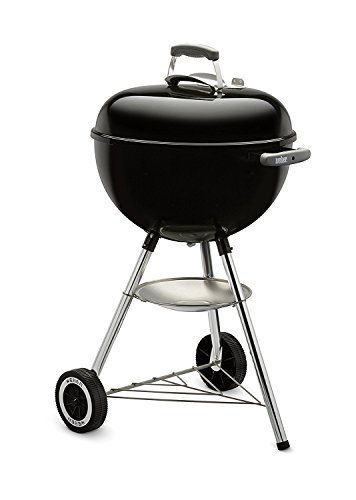
Weber Original Kettle Charcoal Grill, 18-Inch — Best Lightweight Charcoal
Charcoal flavor does not require a heavy grill. The 18-inch Original Kettle is the classic Weber bowl in its most manageable size — light enough to carry around the yard or load for a picnic, with the One-Touch cleaning system that sweeps ash into a removable catcher with a lever instead of a scoop. For cooks who want genuine live-fire taste in a grill that never feels like a burden, this is the charcoal pick.
Strengths
- Light and genuinely portable for a charcoal grill — move it solo, store it in a corner, take it to the park.
- One-Touch ash sweeping makes charcoal cleanup a lever pull and a catcher dump, not a dirty job.
- Real charcoal flavor and searing heat, with two-zone cooking done by banking coals to one side.
Trade-offs
- Charcoal routine applies: roughly twenty minutes to light and ash over, plus vent management instead of knobs.
- 18-inch grate suits two to four people; family-plus-guest loads need the 22-inch sibling.
- No built-in thermometer on this base model — an instant-read thermometer for food is essential kit.
Mini spec box: 18-inch kettle · One-Touch cleaning system · plated steel cooking grate · charcoal fuel.
The 18-inch kettle cooks exactly like its famous bigger sibling, just in a friendlier size: bank the coals, sear over them, slide food to the cool side, lid on, and dinner behaves. It is also the easiest grill in this guide to store — the whole unit tucks into a garage corner or under a cover on a small patio. If your grilling is for two, or two plus a couple of friends, and you want fire flavor without fire-management fuss, this little kettle has been the right answer for decades.
Best for: charcoal lovers cooking for two to four, and anyone who wants the lightest full-featured kettle. / Not suited for: big groups, or cooks who want gas-style push-button convenience. Check the current price on Amazon
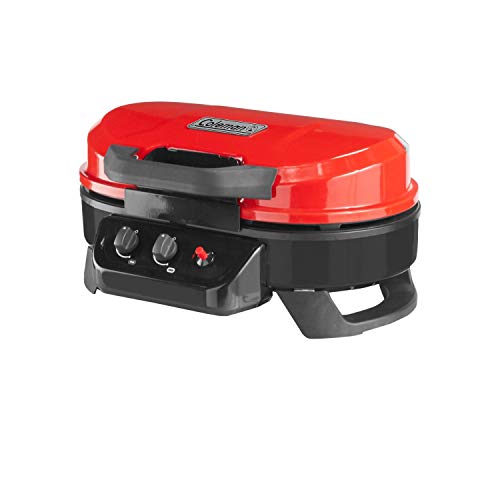
Coleman RoadTrip 225 Portable Tabletop Grill — Best Tabletop for Tailgates and Camping
The RoadTrip 225 is the tabletop sibling of Coleman’s bigger portable line: two burners, 11,000 BTU, Instastart push-button ignition, and a removable water pan under the grate that catches drippings — a small design choice that makes a big difference to cleanup, especially away from home where nobody wants to scrub a greasy grill at a campsite sink.
Strengths
- Instastart ignition lights without matches or lighters — press and cook, even at a windy picnic site.
- Removable water pan catches drippings, reduces flare-ups, and lifts out for easy emptying and washing.
- Two burners give real temperature control and a simple two-zone option, rare in tabletops this compact.
Trade-offs
- Tabletop format needs a stable table, tailgate, or the optional stand — plan your surface before you go.
- 11,000 BTU is adequate rather than fierce; thick steaks sear best with a full preheat and the lid used smartly.
- Compact grate cooks for two to four; it is not a party grill.
Mini spec box: 2 burners · 11,000 BTU · Instastart ignition · removable water pan · tabletop portable.
Where the 225 wins is the total experience away from home: it packs flat, sets up in a couple of minutes, lights instantly, cooks for a small group with genuine control, and cleans up with a pan dump and a wipe instead of a scrubbing session. Back home it stores on a shelf and comes out for balcony dinners just as happily. For campers, tailgaters, and small households that want one grill for both, it is the most considerate design in the portable class.
Best for: camping, tailgating, picnics, and small-space home use. / Not suited for: large groups or cooks chasing maximum searing power. Check the current price on Amazon

Char-Griller AKORN Jr. Portable Kamado Charcoal Grill and Smoker — Best Small Kamado
The AKORN Jr. shrinks the kamado idea — an insulated charcoal cooker that can smoke low, roast evenly, and sear fiercely — into a portable body with cast-iron grates that one person can reposition around a patio or load for a trip. It is the pick for the cook who wants one small charcoal grill that genuinely does everything, including slow smoking, without the weight and fragility of a ceramic kamado.
Strengths
- Insulated steel body holds temperatures with very little charcoal — long, steady cooks from a small fuel load.
- Cast-iron grates deliver proper sear marks and heat retention that portable grills rarely match.
- Portable size and steel construction travel far better than ceramic; no cracked-firebox worries in the car.
Trade-offs
- Kamado discipline applies: bring temperatures up slowly, because an insulated cooker overshoots easily and cools slowly.
- Cooking space is sized for two to four; a full packer brisket is beyond its brief.
- Charcoal startup time and ash cleanup come with the format, kamado or not.
Mini spec box: portable kamado · triple-wall insulated steel · cast-iron grates · charcoal fuel.
Cooking on the Jr. is a pleasure of control: set the vents, watch it settle, and it will hold a smoking temperature for hours on a modest pile of lump charcoal, then open up to sear steaks with real authority when dinner calls for it. Pizzas, whole chickens, ribs for two — the range is remarkable for its size. Keep it covered, treat the exterior kindly, and it will be the small grill you reach for when you want the food to taste like an occasion.
Best for: small households that want kamado versatility — smoke, roast, sear — in a portable, affordable body. / Not suited for: crowd cooking or absolute beginners who want knob-simple gas. Check the current price on Amazon
Comparison Table
| Pick | Badge | Key spec | Best for |
|---|---|---|---|
| Weber Spirit E-325 | Best Overall | 3 burners, Sear Zone, Snap-Jet ignition | Full-size ease, family cooking |
| Weber Q 1200N | Best Lightweight Portable | 1 burner, 10,000 BTU, cast-iron grates | Solo carry, balconies, RVs |
| Charbroil Classic 2-Burner | Best Compact Patio | 2 burners, 20,000 BTU, 280 sq. in. | Small patios, first grills |
| Weber Original Kettle 18″ | Best Lightweight Charcoal | 18-inch kettle, One-Touch cleaning | Fire flavor, light handling |
| Coleman RoadTrip 225 | Best Tabletop Portable | 2 burners, Instastart, water pan | Camping and tailgating |
| Char-Griller AKORN Jr. | Best Small Kamado | Insulated steel, cast-iron grates | Smoke-to-sear versatility |
How to Choose a Grill That Is Easy to Live With
Start with the three moments that decide whether a grill gets used or gathers dust: lighting it, moving it, and cleaning it. Then check cooking performance. In that order.
Ignition. The best systems light a specific burner when you turn its knob — Weber’s Snap-Jet on the Spirit E-325 is the benchmark — or fire from a dedicated push button, like Coleman’s Instastart and the Q 1200N’s electronic ignition. Avoid match-light designs entirely; they are the first thing owners hate and the first thing that stops working in damp weather. If a grill’s ignition frustrates you twice, you will stop grilling, and no spec sheet compensates for that.
Weight and handling. Honestly assess your space and your routine. Will the grill live in one spot (a cart grill on wheels is fine), travel to a storage shelf (choose a tabletop like the Q or RoadTrip 225), or move between sun and shade (the 18-inch kettle and AKORN Jr. reposition easily)? Check lid weight too — you will lift it one-handed, holding tongs, dozens of times a season. Balanced lids and good handles matter more than catalog dimensions.
Cleanup design. Look for porcelain-enameled grates, slide-out grease trays, ash catchers, and removable drip or water pans. Every one of those features converts a fifteen-minute scrub into a two-minute wipe. Also consider where the grill will be cleaned: a grate that fits in your sink (the Q’s does) is a quiet quality-of-life win.
Size for your real headcount. Two to four people is the honest number for most households most of the time, and every pick here except the Spirit is built around it. Cooking for six occasionally? Batch in two rounds or step up to the E-325. Do not buy a six-burner monument for a twice-a-year party and then wrestle it weekly.
Controls you can read at a glance. Clear knob markings, a responsive burner for each zone, and a readable lid thermometer (or a good instant-read food thermometer, which matters more) keep cooking calm. Complexity is not capability; the grills in this guide were chosen because their controls disappear into the background while you cook.
How to Set Up and Use Your Grill Comfortably and Safely
- Place it once, place it well. Level, non-combustible surface; clear of siding, rails, and overhangs; close enough to the kitchen door that trips with trays are short. A grill mat under the unit protects decking from drips and makes the whole station feel finished.
- Gas grills: leak-test on day one and at every tank change. Soapy water on the connections, tank valve open, burners off — bubbles mean reseat and retest. It takes two minutes and becomes automatic.
- Arrange a landing zone. A small side table or the grill’s own shelves should hold a tray, tongs, and seasoning within arm’s reach, so you are never juggling a hot platter. The Classic 2-Burner’s shelves and the RoadTrip’s tabletop format both shine here.
- Preheat with the lid down, then organize the grate. Hot side and gentle side, even on two burners. Put long-cooking items on first and quick items last so everything finishes together without frantic shuffling.
- Use the right tools for your hands. Medium-length tongs give control without putting your hands over the fire; a wide, thin spatula slides under delicate fish and burgers. Heat-resistant gloves make lid and grate adjustments calm instead of hasty.
- Clean while it is warm, cover when it is cool. A two-minute burn-off and brush after cooking, grease tray emptied regularly, ash catcher dumped when full — then the cover. The routine is the reason these particular grills stay pleasant to use for years.
The Details That Decide Daily Comfort
Spec sheets list burners and BTUs; daily comfort is decided by smaller things. These are the details experienced owners check — and the ones that separate the picks in this guide from grills that merely look similar.
Lid design. You will open the lid hundreds of times a year, often one-handed, often holding tongs or a tray. A balanced lid with a heat-resistant handle that opens smoothly and stays where you put it — as on the Spirit line — turns that motion into nothing. A heavy, front-heavy lid on a big budget grill turns it into a two-handed negotiation. When comparing grills, mentally rehearse opening the lid with a plate in your other hand; the right grill makes that image easy.
Knob size and markings. Controls should be grippable with a light glove, spaced so you do not brush the neighboring burner, and marked clearly enough to read at dusk. The Spirit E-325’s integrated Snap-Jet knobs are the high-water mark: the knob is the igniter, so there is one gesture per burner and no separate button to find. Tabletops like the Q reduce the whole question to a single knob, which is its own kind of clarity.
Grate handling. Grates come out for deep cleaning and go back in with your hands. Porcelain-enameled cast iron, as on the E-325 and Q, is heavier per piece but usually split into sections sized for real hands — and it fits a sink more often than one giant grate does. Wire grates are lighter but flex and chip. Either way, check for finger holds or a grate-lifting tool in the box; your future self, mid-clean, will be grateful.
Grease path. Follow the drippings with your eyes. On a well-designed grill they travel from grate to a sloped pan to a removable tray or cup you can reach without kneeling or disassembling anything. The RoadTrip 225’s water pan and the Spirit’s slide-out tray are the patterns to look for. If the grease path is a mystery in the photos, it will be a mess in your yard.
Wheels and feet. Two large wheels beat four small casters on real patios — they roll over deck boards and pavers instead of rattling to a stop. Locking casters matter on slopes. And tabletop grills need feet that grip: the Q and the RoadTrip sit planted on a picnic table instead of skating when you press a spatula down.
Tank Swaps, Storage, and Seasonal Care Made Simple
Three ownership tasks intimidate new grillers out of proportion to their difficulty. Here is each one demystified.
Swapping a propane tank. A full 20-pound tank weighs about 37 pounds total — the part people actually find awkward is not the weight but the shape. The routine: burners off, tank valve closed, unscrew the regulator coupling by hand (it is designed for hand-tightening; no wrench), lift the old tank out by its collar handle, set the new one in, reconnect hand-tight, then leak-test with soapy water before the first light. If lifting a full tank into a cabinet is genuinely difficult, two workarounds exist: have the tank filled in place by a delivery service where available, or run a portable like the Q or RoadTrip on 1-pound cylinders, which swap in seconds and weigh almost nothing. The Classic 2-Burner and Spirit both use standard quick-connect fittings, so the swap is a two-minute job once you have done it twice.
Storage. The kindest storage is a fitted cover on the patio where the grill lives — no hauling at all. Tabletops earn their keep here: the Q and RoadTrip 225 store on a garage shelf or in a closet, freeing the balcony entirely. Whatever the format, store with the tank valve closed, and store spare 1-pound cylinders in a ventilated spot away from heat sources. Never store a grill with a dirty grease tray; that, not weather, is what attracts pests and causes next season’s flare-ups.
Seasonal care in fifteen minutes, twice a year. Spring: brush and inspect the grates, check burner flames for even blue cones (a lazy yellow section means a blocked port to clear), empty and wash the grease system, and leak-test. Autumn: deep-clean before the cover goes on for winter, oil cast-iron grates lightly, and disconnect the tank if the grill will sit unused for months. Charcoal grills add one rule — never store them with ash inside, because damp ash corrodes the bowl. Fifteen minutes twice a year is the entire maintenance contract for every grill in this guide, which is exactly how it should be.
Common Buying Mistakes
- Buying the biggest grill in the store. Oversized grills are heavier to move, slower to preheat, and hungrier for fuel. Match the grill to your household, not your biggest imaginable party.
- Choosing looks over ignition. A beautiful grill with a flaky igniter becomes a match-light grill within a year. Test the ignition logic before the finish.
- Ignoring cleanup until after the first cook. Grease systems and ash handling are visible in the store and in the listing photos. Check them before you buy, not after the first greasy Saturday.
- Forgetting building rules. Many apartments restrict charcoal or limit propane cylinder size on balconies. Confirm what is allowed; the Q 1200N and RoadTrip 225 exist precisely for restricted spaces where they are permitted.
- Skipping the cover and the basics. A fitted cover, an instant-read thermometer, and decent tongs cost little and change ownership completely. Budget for them with the grill.
- Overlooking where the grill will be cleaned. A full-size grate that only fits an outdoor utility sink is a hidden burden. If your cleaning spot is a kitchen sink, favor split grates or a portable whose grate fits it.
- Assuming “easy” means low performance. The picks here sear, smoke, and roast properly. Ease of use is a design quality, not a compromise — refuse grills that offer you one by sacrificing the other.
A Weeknight Routine That Makes Any of These Grills Feel Effortless
The grills in this guide were chosen to disappear into a routine, and the routine itself is worth writing down, because it is the difference between grilling twice a month and grilling three times a week. It works on every pick here, gas or charcoal, full-size or tabletop.
Before: decide the menu around one hot item and one gentle item — chicken thighs and corn, burgers and onions, salmon and asparagus. Preheat while you prep, not after: gas and the Q need about ten minutes, charcoal needs the chimney lit as the first act of cooking. Set the landing zone — tray, tongs, seasoning, thermometer — before any food moves, so the cook itself has no errands in it.
During: load the long-cooking items first, use the two-zone layout so finished food has a warm holding spot, and keep the lid down for anything thick. Resist the urge to fuss: food that is left alone forms crust, releases cleanly, and cooks evenly. Check doneness by temperature near the end, not by cutting into pieces and losing their juices.
After: while the grill is still hot, run it a few minutes more and brush or scrape the grate — thirty seconds now replaces fifteen minutes of scrubbing later. Food rests, you eat, and the only remaining jobs are the grease tray check and, once the grill is cool, the cover. Charcoal cooks add the ash check once the coals are fully cold. The whole active burden beyond the cooking itself is under five minutes, which is why owners of well-chosen grills describe them as easier than the oven — no preheating a whole kitchen, no pile of pans, and dinner tastes like summer.
Final Recommendation
If the grill will live on your patio and cook for the household most weeks, choose the Weber Spirit E-325 — its ignition, sear zone, and cleanup design make full-size grilling feel effortless. If space is tight or the grill must travel, the Weber Q 1200N is the lightest complete package, and the Coleman RoadTrip 225 is the friendliest tabletop for camping and tailgates. Small patios with room for a standing grill point to the Charbroil Classic 2-Burner. And if your heart wants fire flavor, the 18-inch Weber kettle keeps charcoal light and simple, while the AKORN Jr. adds genuine kamado range in a portable body. Every pick here was chosen so that the person cooking spends their attention on the food and the company — not on fighting the equipment. That is the whole standard: light it easily, cook on it confidently, clean it quickly, and look forward to doing it again tomorrow.
Compare the wider cluster before you decide: Best Bar Bq Grills rounds up every fuel type, Best Barbecue Grills To Buy is the general shortlist, Best Barbecue Grills Propane goes deep on gas only, Best Barbecue Grills Under $200 covers the strict-budget tier, and Best Barbecue Grills Under $500 shows what a mid-range budget adds.
Frequently Asked Questions
What makes a grill easier for a woman to use?
The same things that make a grill easier for anyone: reliable push-button or per-burner ignition, a weight and footprint one person can manage, a balanced lid, grates and grease systems designed for quick cleanup, and clear controls. This guide ranked the verified field on exactly those criteria rather than on raw size or power.
Is a two-burner grill big enough for a family?
For two to four people, yes — the Classic 2-Burner’s 280 square inches handles a full family meal, especially with sides done in batches or in the kitchen. Households of five or more, or frequent hosts, will be happier with the three-burner Spirit E-325.
Which is easier to clean, gas or charcoal?
Gas, generally: burn off, brush, empty the grease tray. Charcoal adds ash handling to every cook, though systems like Weber’s One-Touch sweeping and the AKORN’s ash management keep it to a minute or two. The easiest cleanup of all here belongs to the small portables — the Q’s sink-sized grate and the RoadTrip’s removable water pan.
Can I manage a charcoal grill if I have never used one?
Yes, and the 18-inch kettle is the friendliest place to learn: light a chimney of coals, wait for them to ash over, bank them to one side, and manage temperature with the vents. Twenty minutes of patience replaces the learning curve people fear, and the flavor repays it immediately.
Are portable grills powerful enough for steaks?
The good ones are. The Q 1200N’s cast-iron grate and 10,000 BTU burner produce proper sear marks with a full preheat, and the AKORN Jr. sears at kamado temperatures. The RoadTrip 225 cooks steaks well with the lid used strategically. What portables give up is area and multi-zone flexibility, not the ability to cook a steak.
How hard are these grills to assemble?
The portables — the Q 1200N, RoadTrip 225, and AKORN Jr. — need little to no assembly and are cooking within minutes of unboxing. The 18-inch kettle is a short, simple build. The cart grills are the real projects: the Classic 2-Burner is a modest one-person job, and the Spirit E-325 is a larger build that goes fastest with a second pair of hands and an unhurried hour. Many retailers offer assembly services, and using one is a perfectly sensible choice — the goal is years of easy cooking, not a test of patience on day one.
Is it safe to grill alone, and what should a solo cook keep nearby?
Grilling solo is the normal case for most households and is perfectly safe with basic habits: keep the grill on a level surface away from structures, never leave a lit grill completely unattended, keep a phone within reach, and know your fuel shutoff — the tank valve for gas, the vents for charcoal. Heat-resistant gloves and long tools keep hands at a comfortable distance, and an instant-read thermometer means you are never guessing with raw chicken. The picks in this guide were chosen partly because their ignition and controls make solo operation calm rather than fiddly.
What accessories make grilling physically easier?
Start with medium-length tongs for control, heat-resistant gloves for confident lid and grate handling, a grill mat to define and protect the cooking station, a fitted cover so storage is a ten-second job, and an instant-read thermometer so doneness is a fact rather than a guess. Together they cost little and remove most of the friction from the whole activity.


