Disclosure: airfryerkitchensupply.com is reader-supported. When you buy through links on our site, we may earn an affiliate commission at no extra cost to you.
Where to buy
Every grill in this guide is a current-production model sold on Amazon, and every ASIN was verified against the live Amazon catalog before this guide was written. Apartment purchases carry one non-negotiable first step: read your lease and building rules before ordering. Charcoal is banned on apartment balconies almost everywhere, propane is banned in most buildings, and electric grills are the usual permitted option — five of these six picks are electric for exactly that reason. Check price on Amazon at the listing, since we never print static prices.
- Weber Lumin Compact Portable Electric Grill (Best for Strict Apartment Rules) — Check the current price on Amazon
- Cuisinart CEG-115 2-in-1 Portable Outdoor Electric Grill (Best for First Apartments and Tight Budgets) — Check the current price on Amazon
- Char-Broil Patio Bistro TRU-Infrared Electric Grill (Best for Even, Juicy Results) — Check the current price on Amazon
- George Foreman Indoor/Outdoor Electric Grill with Stand (Best for Roommates and Apartment Gatherings) — Check the current price on Amazon
- Techwood 15-Serving Indoor/Outdoor Electric Grill (Best Big-Plate Value for Renters) — Check the current price on Amazon
- Weber Q 1200N Portable Propane Gas Grill (Only If Your Lease Allows Propane) — Check the current price on Amazon
The best balcony grills for apartments are not simply small grills; they are grills that survive a lease. Apartment cooking adds three filters a house never applies: the building’s rules about fuel and flame, the storage reality of a home where every closet is spoken for, and the neighbor geometry of a balcony stacked above and below other people’s homes. This guide applies all three filters first and talks about searing second — because the finest grill in the world is worthless to a renter if it costs a lease violation, and because the modern electric picks below are good enough that the rules no longer feel like a punishment.
So the shape of the guide: electric-first, with the Weber Lumin leading for strict buildings, honest budget and capacity options behind it, and a single gas pick fenced with warnings for the minority of leases that allow propane. Every pick stores small, cleans without a hose, and cooks for the one-to-four people apartment dinners usually involve. If you are a renter who assumed grilling was a homeowner’s privilege, this guide is your correction — read your documents, pick your grill, and eat outside tonight.
In this guide
Quick Picks
Best for Strict Apartment Rules — Weber Lumin Compact Portable Electric Grill. If your lease bans everything with a flame, the Lumin Compact is the grill that makes you stop caring: a small-space electric from Weber that heats like a real grill and stores like a suitcase. Check price on Amazon.
Best for First Apartments and Tight Budgets — Cuisinart CEG-115 2-in-1 Portable Outdoor Electric Grill. The starter apartment’s best friend: 550°F from a wall outlet, a stand-or-tabletop 2-in-1 design, and the lowest tier in this guide. Check price on Amazon.
Best for Even, Juicy Results — Char-Broil Patio Bistro TRU-Infrared Electric Grill. The infrared specialist: TRU-Infrared heat means no hot spots and no flare-ups — the politest grill in the building, and one of the tastiest. Check price on Amazon.
Best for Roommates and Apartment Gatherings — George Foreman Indoor/Outdoor Electric Grill with Stand. The shared-apartment workhorse: 15 servings on one sloped, nonstick plate, on a removable stand — feeds the whole flat without a single flame. Check price on Amazon.
Best Big-Plate Value for Renters — Techwood 15-Serving Indoor/Outdoor Electric Grill. Techwood brings the 15-serving format to renters on a budget: a big double-layer electric plate that costs the least per serving in this guide. Check price on Amazon.
Only If Your Lease Allows Propane — Weber Q 1200N Portable Propane Gas Grill. The finest small gas grill in the world — included with a warning label, because most apartment leases ban it. If yours is the rare exception, nothing else here touches it. Check price on Amazon.
How These Picks Were Chosen
Every candidate was verified against the live Amazon catalog on the airfry site, with ASINs and titles taken from Amazon’s own responses; unverifiable models were excluded. Specs in the mini spec lines — temperatures, BTU, servings, heat settings — come only from those verified listing titles.
Selection for this apartment-specific guide weighted rule compliance and storage first, then verified cooking heat, then capacity matched to apartment households, cleanup burden without outdoor water, and brand support. Scores from our general balcony guide were deliberately re-weighted: a grill that is merely good on a house balcony can be wrong for an apartment if it stores fuel, smokes heavily or cannot come indoors. The badges below reflect the apartment lens throughout.
The 6 Best Balcony Grills for Apartments

Weber Lumin Compact Portable Electric Grill — Best for Strict Apartment Rules
Apartment grilling starts with a legal question, and the Weber Lumin Compact is the strongest answer that plugs into a wall. Weber built it for small spaces — the verified listing says so plainly — and engineered it to reach the high, dry heat that separates grilling from steaming. For a renter, its virtues compound: no fuel to store (a lease issue in itself), no flame for a property manager to object to, a footprint that fits a modest balcony, and a body light enough to store indoors between cooks if your building prefers balconies kept clear.
- Strengths: Genuine high-heat searing from a standard outlet — no flame, no fuel, no lease drama.
- Strengths: Compact and lightweight; stores in a closet, which strict buildings quietly appreciate.
- Strengths: Weber build quality and parts support in a category full of disposable appliances.
- Trade-offs: Premium tier for an apartment-sized grill.
- Trade-offs: Capacity is for one to four; apartment parties cook in rounds.
- Trade-offs: Needs an outdoor outlet within reach — check your balcony before ordering.
Mini spec: Electric grill; compact portable design for small spaces (verified from Amazon listing title). Check the current price on Amazon
The Lumin is the pick we give renters who ask one question — what is the best grill I am actually allowed to own? Its heat ends the electric apology, its size respects the reality of apartment balconies, and its brand means a replacement part is a website visit rather than a shrug. If your building’s rules are the strictest in this guide’s audience, this is the grill those rules were unknowingly written to permit, and it cooks well enough that the permission stops feeling like a compromise by the second week.
Best for: renters under strict no-flame rules who still want real grilling / Not suited for: hosts feeding crowds and anyone without a balcony outlet
Check the current price on Amazon

Cuisinart CEG-115 2-in-1 Portable Outdoor Electric Grill — Best for First Apartments and Tight Budgets
First apartments run on a budget and a learning curve, and the Cuisinart CEG-115 respects both. Its verified headline — 550°F grilling from a wall outlet — means it cooks with genuine heat rather than budget-appliance warmth, and the 2-in-1 design works on its stand on the balcony or as a tabletop unit, which suits the renter whose outdoor space is more aspiration than square footage. It is simple in the way a first grill should be: plug, preheat, cook, wipe, store.
- Strengths: Real 550°F heat at the friendliest tier in this guide.
- Strengths: Stand or tabletop flexibility fits balconies of every size and shape.
- Strengths: Lightweight and easy to store — a genuine renter’s appliance.
- Trade-offs: Budget materials; expect good seasons rather than a decade.
- Trade-offs: Small surface — perfect for one or two, tight for four.
- Trade-offs: Basic controls and no frills; it is a tool, not a toy.
Mini spec: Electric; 550°F max from wall outlet; stand or tabletop use (verified from Amazon listing title). Check the current price on Amazon
The CEG-115 earns its badge by being the grill a first apartment can say yes to immediately: yes to the price tier, yes to the storage, yes to the rules. It will teach its owner the fundamentals — preheating, drying food for a better sear, cooking in rounds — on equipment that forgives beginner mistakes and cleans in minutes. Many owners will eventually upgrade to the Lumin and keep the Cuisinart as the tabletop backup, which is the natural life cycle of a well-chosen first grill.
Best for: first apartments, students and budget-minded renters / Not suited for: cooks feeding families or chasing premium longevity
Check the current price on Amazon
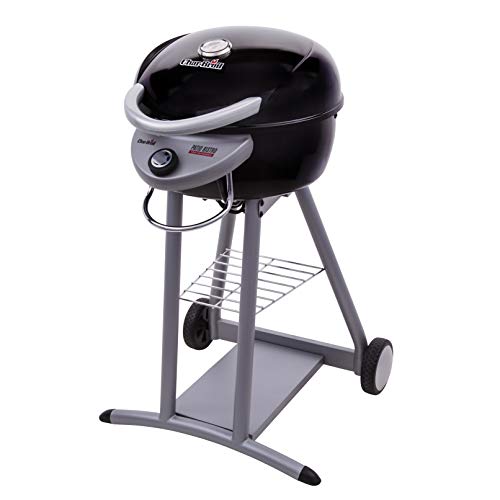
Char-Broil Patio Bistro TRU-Infrared Electric Grill — Best for Even, Juicy Results
The Patio Bistro has been the thinking apartment cook’s electric grill for years, and its TRU-Infrared system is the reason. An infrared emitter plate sits between the element and the food, evening out the heat and intercepting drips before they can flare. In an apartment, that second talent is as valuable as the first: no flare-ups means no sudden flames for a downstairs neighbor to photograph, and no smoke bursts through the railing. Add a proper lid for roasting and a long production history with easy parts, and you have the most civilized cooker in this guide.
- Strengths: TRU-Infrared evenness — edge-to-edge consistency small electrics rarely achieve.
- Strengths: No flare-ups: the most neighbor- and landlord-friendly cooking profile here.
- Strengths: Lid-down roasting makes it a complete little grill, not a hot plate.
- Trade-offs: The infrared plate needs regular cleaning to stay even.
- Trade-offs: Sear is refined rather than ferocious; dry surfaces and full preheats help.
- Trade-offs: Couple-scale capacity, like most apartment picks.
Mini spec: Electric grill; TRU-Infrared cooking system; model 20602107 (verified from Amazon listing title). Check the current price on Amazon
Choose the Bistro if your cooking style runs to chicken, fish and vegetables — foods that punish hot spots and reward even, juicy heat — or if your building politics demand the lowest possible profile. It is the grill least likely to generate a complaint and most likely to generate a compliment, a combination apartment cooks learn to value above raw searing violence. Its longevity in the market is itself a review: balconies are a hard niche, and the Bistro has owned its corner of it for a long time.
Best for: apartment cooks who value evenness, juiciness and a low profile / Not suited for: maximum-sear hunters
Check the current price on Amazon
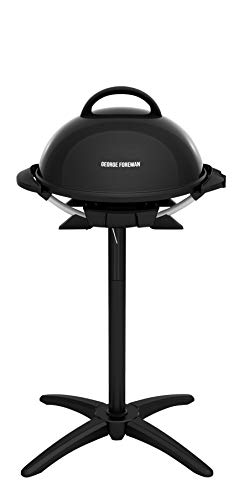
George Foreman Indoor/Outdoor Electric Grill with Stand — Best for Roommates and Apartment Gatherings
Shared apartments have a specific grilling problem: many mouths, one small balcony, zero tolerance from the lease for flames. The George Foreman Indoor/Outdoor is the format answer — a verified 15-serving plate on a removable stand, with 5 heat settings and the sloped, fat-draining, nonstick surface the brand is famous for. It moves from balcony to countertop as the weather and the gathering dictate, and its wipe-clean plate is the difference between a grill roommates use and a grill roommates avoid because nobody wants the scrubbing shift.
- Strengths: 15-serving capacity feeds a whole shared household at once.
- Strengths: Removable stand: balcony grill in summer, countertop grill in winter.
- Strengths: Nonstick sloped plate is the fastest cleanup in this guide.
- Trade-offs: No lid, so no roasting — it grills and griddles only.
- Trade-offs: Gentle sear compared with the Lumin; capacity is its talent, not crust.
- Trade-offs: The plate is wide — confirm your balcony fits it with room to stand.
Mini spec: 15-serving capacity; removable stand; 5 heat settings; fat-removing slope (verified from Amazon listing title). Check the current price on Amazon
The Foreman’s apartment logic is social: it is the grill that turns a shared balcony into the flat’s dining room. Burger nights, breakfast-for-dinner, a plate of grilled vegetables for the vegetarian roommate alongside the sausages — it absorbs the whole menu in one or two rounds and cleans up before the argument about dishes starts. In a solo apartment it is oversized; in a shared one, it is the pick that ends the queue at the grill, and that is a genuine quality-of-life upgrade.
Best for: shared apartments and roommate gatherings / Not suited for: solo cooks and sear purists
Check the current price on Amazon
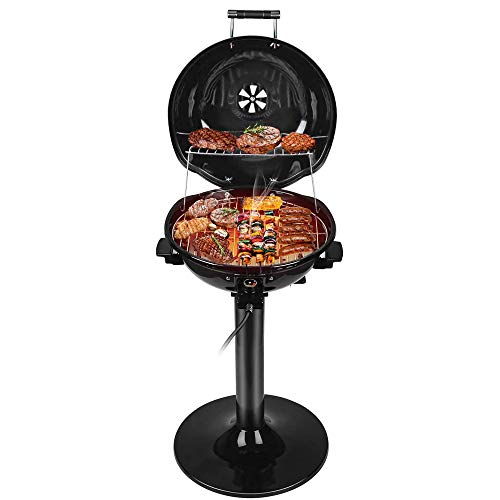
Techwood 15-Serving Indoor/Outdoor Electric Grill — Best Big-Plate Value for Renters
Not every apartment budget stretches to the famous names, and the Techwood 15-serving grill exists for exactly that renter: the big-plate indoor/outdoor electric format — capacity for a group, no flame for the lease to ban — at a value tier. Its double-layer design suits the indoor-outdoor double life apartment grills lead, and its proposition is purely mathematical: the most electric cooking surface per dollar in this guide, in a format the rules allow.
- Strengths: 15-serving plate at a value tier — unmatched capacity per dollar.
- Strengths: Indoor/outdoor flexibility suits small apartments with seasonal balconies.
- Strengths: Electric operation keeps it compliant where gas and charcoal are banned.
- Trade-offs: Brand support and parts trail the established names in this guide.
- Trade-offs: Value-grade fit and finish; ordinary care keeps it honest.
- Trade-offs: Lidless plate: grills and griddles, does not roast.
Mini spec: 15-serving capacity; indoor/outdoor electric; double-layer design (verified from Amazon listing title). Check the current price on Amazon
The Techwood is the right call when the horizon is a lease term rather than a decade: a year or three in a rental, a shared purchase among roommates, a first test of whether balcony grilling fits your life before real money follows. Bought for those purposes, its trade-offs are sensible rather than sad. Apartment living is full of interim solutions; the skill is choosing the ones that perform while they last, and on capacity per dollar under apartment rules, this is the strongest interim grill in the guide.
Best for: renters on a budget with groups to feed / Not suited for: buyers optimizing for decade-long support
Check the current price on Amazon

Weber Q 1200N Portable Propane Gas Grill — Only If Your Lease Allows Propane
This pick carries the most important sentence in the guide: most apartment buildings prohibit propane grills on balconies, and if yours does, stop reading this review and buy the Lumin. But a minority of leases — some townhome-style rentals, some buildings that ban only charcoal — permit small propane appliances, and for those balconies the Weber Q 1200N is untouchable: a 10,000 BTU burner under porcelain-enameled cast-iron grates with electronic ignition, in a cast-aluminum body that also happens to be a camping legend. It runs on 1 lb cylinders, so no large tank needs storing — itself a lease-sensitive point.
- Strengths: Real gas heat and cast-iron searing no electric fully matches.
- Strengths: 1 lb cylinder operation avoids bulk tank storage issues.
- Strengths: Superb build; doubles as a portable for trips beyond the balcony.
- Trade-offs: Banned by most apartment leases and many local codes — written permission first, always.
- Trade-offs: Single burner, single zone; indirect cooking needs technique.
- Trade-offs: Cylinder supply is an ongoing errand and a storage item.
Mini spec: 1 burner; 10,000 BTU; porcelain-enameled cast-iron grates; electronic ignition (verified from Amazon listing title). Check the current price on Amazon
We include the Q because pretending the exception does not exist would underserve the renters who live in it — and because its quality makes the rule-checking worthwhile. If your documents allow it, you own the best small grill of any fuel in this guide. If they do not, the honest consolation is that the electric picks have closed most of the gap: the Lumin sears, the Bistro roasts evenly, and neither will ever cost you a security deposit. Rules first, then grills — in that order, every time.
Best for: the minority of apartments whose rules permit small propane grills / Not suited for: everyone else — buy electric and keep the deposit
Check the current price on Amazon
Comparison Table
| Pick | Badge | Key spec | Best for |
|---|---|---|---|
| Weber Lumin Compact Portable Electric Grill | Best for Strict Rules | Electric, compact, high-heat | Renters under no-flame leases |
| Cuisinart CEG-115 2-in-1 Portable Outdoor Electric Grill | Best for First Apartments | 550°F, stand or tabletop | Budgets, small spaces |
| Char-Broil Patio Bistro TRU-Infrared Electric Grill | Best Even Cooking | TRU-Infrared, no flare-ups | Neighbor-conscious cooks |
| George Foreman Indoor/Outdoor Electric Grill with Stand | Best for Roommates | 15-serving, removable stand | Shared households |
| Techwood 15-Serving Indoor/Outdoor Electric Grill | Best Big-Plate Value | 15-serving, double-layer | Groups on a budget |
| Weber Q 1200N Portable Propane Gas Grill | Only If Lease Allows | 10,000 BTU, cast-iron grates | Propane-permitted leases |
Reading Your Lease Like a Grill Buyer: Fuel Rules Decoded
Apartment fuel rules are usually written in three sentences that matter enormously. The first bans ‘open flame’ or ‘solid fuel’ — that is charcoal, wood and pellet grills, gone. The second addresses ‘gas grills’ or ‘LP gas’ — propane — often with a tank-size limit when it is allowed at all; small 1 lb cylinders sometimes fall under a different clause than 20 lb tanks, which is why the Q in this guide runs on them. The third sentence, where it exists, names electric grills as permitted, because they present no flame, no fuel storage and no embers. Read for those three sentences, in your lease, your HOA rules and any building handbook — and if the documents are silent, ask management in writing and keep the reply.
Local fire codes sit above leases and occasionally ban what a lease allows, particularly for balconies above a certain height or on buildings of certain construction. A two-minute search of your city or county fire code for balcony grilling rules settles it. This sounds like homework, and it is — fifteen minutes of it, once, in exchange for years of untroubled cooking. The renters who lose deposits over grills are never the ones who checked; they are the ones who assumed. This guide assumes nothing, and neither should you.
Storage, Size and the Apartment Grill Footprint
In an apartment, a grill is stored in living space, so storage is a headline spec. The compact electrics in this guide — Lumin, CEG-115, Patio Bistro — fit a closet corner or the balcony’s own footprint under a cover, and the tabletop mode of the Cuisinart removes the stand from the equation entirely. The big plates earn their space only in shared households where their capacity is used weekly. Measure two footprints before ordering: the grill’s, taped on the balcony floor with room to stand and open the lid, and its storage footprint, taped in the closet or corner where it will actually live in February.
Weight is the hidden half of storage. A grill one person can carry through the apartment without a wrestling match gets stored properly; a heavy one migrates to permanent balcony residence, where it weathers and crowds. Every pick here is one-person portable, deliberately. Renters move more often than owners, too — a grill that rides to the next apartment in a car trunk is worth more than a marginally better one that needs a van and a favor. Apartment purchases should be judged on a three-year, two-address horizon, and these six were.
Apartment Cooking for One, Two and Four: Scaling Honestly
Most apartment grilling is weeknight cooking for one or two, with the occasional four-person evening — and small grills are not a compromise at that scale, they are the correct tool. A compact electric heats in minutes, cooks two chicken breasts or four burgers with room for vegetables, and cleans before the episode you are streaming reaches its credits. The discipline that makes it sing is sequencing: dense vegetables first, protein second, quick items like halloumi, shrimp or flatbread last, each round served hot rather than one crowded, steamed pile.
For the four-person night, the same grill works in courses — which apartment cooks should embrace rather than apologize for, because courses are how restaurants with small kitchens have always fed people well. The big-plate picks collapse the courses into one or two rounds for roommates and gatherings. Either way, the honest scaling rule is this: buy for your Tuesday, borrow capacity with courses on Saturday, and let the rare twelve-person event rent a park grill. Apartment grilling succeeds by fitting your real life, and your real life is mostly Tuesdays.
How to Grill in an Apartment Without Annoying Anyone
Technique is diplomacy on an apartment balcony. Start with the cleanest possible cook: trim excess fat before it goes on, because fat is smoke; keep sugary sauces for the final minutes, because sugar burns and smokes; and preheat with the lid down so the first-contact smoke burst is contained and brief. Electric grills already run nearly smokeless compared with any flame fuel — one more reason they dominate this guide — and a tidy drip tray keeps it that way across the whole cook. Cook earlier in the evening rather than at midnight, keep the balcony door mostly closed while cooking, and your grill’s entire neighborhood footprint shrinks to a pleasant smell.
Then apply the social layer. A wave and a sentence — ‘grilling tonight, shout if the smoke bothers you’ — converts potential complainants into stakeholders, and the occasional shared plate completes the conversion. Buildings rarely object to grills; they object to surprises, smells without context, and messes in shared sightlines. A renter who cooks clean, stores tidy and shares occasionally is not a problem tenant with a grill. They are the neighbor everyone hopes the empty unit goes to, and their grill is part of the charm.
Apartment Grill Care: No Hose, No Garage, No Problem
Apartment maintenance is sink-based, and the picks here were chosen to thrive on it. Electric grills are wiped, never washed: unplug, cool to warm, wipe the grate or plate with a damp cloth, empty the drip tray into the trash and wash it in the sink. The Q’s grates and pan lift out for a proper soak, one of its quiet renter-friendly virtues. Keep a small kit at the balcony door — brush, cloth, a spray bottle of water for the wipe-down — so the five-minute routine has no friction. A grill that is cleaned in five minutes gets cleaned every time, and a grill cleaned every time never becomes the smoky, greasy object that draws a building’s attention.
Seasonally, do the renter’s version of winterizing: deep-clean before storage, coil the cord loosely, and store the grill dry indoors if it will sit for months — apartment storage is kinder than any backyard, one of renting’s few maintenance advantages. Check cords for damage each spring, confirm the outlet still trips its GFCI test properly, and your grill starts every season as trustworthy as it ended the last. Small machines, small rituals, long service: that is the whole doctrine.
When the Answer Is No Grill at All: Reading a Total Ban Honestly
A minority of buildings ban every grill type, electric included, and this guide will not help you sneak around that — a lease is a lease, and a security deposit is real money. What it can do is point at the honest alternatives that survive a total ban: the building’s shared courtyard grill where one exists, the park grills a short walk away, and a good countertop contact grill or grill pan for the indoor version of the menu, accepting its limits with clear eyes. Some renters in total-ban buildings also become the friend with the standing invitation to a grilling household — an arrangement with its own honorable history.
If grilling matters enough to you, let it inform the next lease rather than violate the current one: ask about balcony rules before signing, the way you would ask about parking. Landlords answer the question cheerfully at the showing and grimly after the violation, and the difference between those conversations is the entire moral of this section. The apartment grilling life is widely available and genuinely good — it just begins, always, with reading the documents you already signed.
Moving Day: The Apartment Grill as Portable Property
One of renting’s quiet truths is that everything you own must eventually be carried down stairs, and apartment grills pass this test better than any other cooker in our guides. The compact electrics ride in a car; the big plates ride in a friend’s hatchback; even the Q travels like the camping grill it also is. When you choose among the picks here, you are also choosing your future moving-day burden, and all six were selected to keep it trivial. Clean the grill before the move — movers and landlords both appreciate it — keep its box if storage allows, and let it be one of the first things unpacked at the new place.
There is a small ritual worth adopting: the first-night grill at a new apartment, something simple on the balcony while the boxes are still stacked, does more to make a rental feel like home than any amount of unpacking. Apartment life is often treated as a waiting room for a house; a grill on the balcony is a refusal of that idea, in the most practical and delicious form. Buy the grill that fits your lease and your life now — both are real, both are yours, and dinner is tonight.
How to Set Up an Apartment Balcony Grill Station
Begin with permissions and placement together: the grill goes on a stable, non-combustible surface or its stand, clear of the wall, railing and anything that dries laundry, with the manufacturer’s clearances respected. Add a grill mat underneath — it catches the drips that would otherwise become a deposit deduction — and position a small side table or tray stand on your working side for plates and tools. Route the cord along the wall to the outlet, out of the walking path, and confirm the circuit can carry the grill without sharing with a heavy appliance during the cook.
Stock the station like a renter: everything within arm’s reach, because your kitchen is through a sliding door and every trip is a production. Prepped ingredients on a tray, tongs and cloth at the grill, a landing plate ready, trash bag clipped nearby. Cook in your planned rounds, wipe the grill while it is warm after the last round, empty the drip tray once cool, and the station vanishes back into a tidy balcony in minutes. That vanishing act — dinner cooked, no trace left — is the apartment grill station’s whole design goal, and a well-run one achieves it every single night.
Electric Grill Myths Apartment Cooks Should Retire
Myth one: electric grills cannot sear. That was true of the underpowered plates of twenty years ago; it is false of a Lumin run at full preheat with dry food on it, and the 550-degree ceiling of the budget Cuisinart in this guide would surprise most skeptics. What electric grills genuinely cannot do is impart smoke or flame flavor — a real limitation, honestly stated, and one apartment cooks answer with rubs, marinades, smoked spices and finishing butters rather than with denial. Myth two: electric grilling is just a contact press. The lid-down, grate-based grills in this guide cook with radiant and convective heat like any grill; the contact press is one format among several, chosen here only where its capacity serves a purpose.
Myth three: a balcony grill is a toy compared with a backyard grill. Cooked side by side on weeknight foods — burgers, thighs, salmon, vegetables — the apartment picks in this guide produce dinners that backyard owners would happily eat, because weeknight food rewards heat control and freshness more than it rewards scale. The backyard grill wins on brisket day and loses on nothing else that matters to a Tuesday. Renters who internalize that stop apologizing for their setup remarkably fast, usually around the third dinner, when the food has made the argument more eloquently than any guide can.
Measuring Your Balcony: A Five-Minute Fitting Session
Before any order, run the tape. Measure the usable rectangle of the balcony — not the brochure dimensions, but the floor that remains after the door swing, the railing planters and the chair you actually sit in. Tape the footprint of your finalist grill inside that rectangle, then stand in the remaining space and mime the cook: opening the lid, turning food, setting down a plate. If the mime feels like a dance in a phone booth, the grill is too big or the station needs rearranging — a side table moved, a chair sacrificed, the grill rotated to the short wall. Five minutes of mime has saved more apartment grill returns than any review ever written.
Measure the vertical story too: the open height of the lid against railings and overhangs, the position of the outlet against the honest reach of the cord, and the storage corner the grill will occupy in winter, measured with the same tape rather than optimism. Photograph the balcony with the tape in place and keep the photo with the listing when you order — future you, comparing a delivered box against a remembered balcony, will be grateful. Apartment grilling rewards the measured and punishes the assumed, in dimensions exactly as in lease clauses, which is the closest thing this guide has to a single unified lesson.
Costs of Apartment Grilling: Electricity, Cylinders and Consumables
Renters budget monthly, so here is the honest running-cost picture without a single product price in it. Electric grills draw roughly what a small space heater draws while running, and a typical weeknight cook runs for well under an hour of full-power time including preheat — the electricity cost of a balcony dinner is small change, and it arrives invisibly inside a bill you already pay, with no fuel errands attached. The Q’s small cylinders are the opposite profile: each one is a discrete purchase and a discrete errand, convenient in size, pricier per cook than bulk propane, and a storage item your lease may have opinions about even when the grill itself is permitted.
Consumables beyond fuel are minimal across this guide: a brush, a cloth, foil for drip trays where the design allows, and the occasional replacement part years in. Compare that with charcoal’s ongoing fuel-and-ash economy — irrelevant here, since charcoal is banned — and the apartment electric emerges as the cheapest grill in this entire series to run, as well as the easiest to house. For a renter counting both dollars and square feet, that double economy is not a footnote. It is one of the strongest arguments in this guide, and it belongs in the decision alongside heat and flavor, where this guide has tried to keep it.
Common Buying Mistakes
Assuming the rules instead of reading them. Fifteen minutes with your lease is the cheapest step in this entire guide. Storing fuel you should not have. If propane is banned, the cylinders are a violation even in the closet — go electric. Buying house-sized capacity. A giant grill on a small balcony crowds out the living the balcony was for. Skipping the grill mat. Drip stains on a rental balcony are a deposit conversation waiting to happen. Letting cleanup slide. A greasy, smoky grill is what turns a tolerant building strict. Grilling at hours that test everyone’s patience. Consideration is a feature; cook like a neighbor, because you are one.
One final apartment-specific thought. A balcony grill changes what an apartment is. It turns the smallest outdoor space in the building into a dining room, a reason to be outside on an ordinary evening, and a small daily pleasure that does not depend on a landlord project or a future house. Renters are often told to wait for real life to begin at some later address; the cooks in the audience for this guide have mostly stopped waiting, and their balconies smell wonderful. Join them carefully — rules read, tape run, mat down — and join them completely.
Final Recommendation
For most apartment balconies, the Weber Lumin Compact is the answer: fully legal under no-flame rules, genuinely hot, small enough to store in a closet. The Cuisinart CEG-115 is the budget and first-apartment champion, the Char-Broil Patio Bistro the even-cooking diplomat, and the George Foreman and Techwood plates feed shared households under electric-only rules. The Weber Q 1200N waits for the minority whose leases allow propane — with written confirmation in hand. Read your documents, measure your space, and the apartment grilling life is yours, deposit intact. Related reading in this series: Best Balcony Grills, Best Backyard Grills, Best Bang For Buck Grills, Best Backyard Gas Grills, Best Backyard Pellet Grills.
Frequently Asked Questions
What grills are allowed in most apartments?
Electric grills are the most widely permitted type, because they have no open flame, no fuel storage and no embers. Charcoal is banned almost universally on apartment balconies, and propane is banned in most buildings. Your own lease, HOA rules and local fire code are the final word — always check them first.
Can my landlord ban grills even if the city allows them?
Yes. A lease can be stricter than local law, and the lease is the document you signed. If your lease bans all grills, the honest options are shared building facilities, park grills, or indoor alternatives — not a violation that risks your deposit and tenancy.
Do I need renter’s permission in writing for a balcony grill?
If your documents are ambiguous, written permission is cheap insurance. An email from management confirming an electric grill is permitted settles every future question, and it takes five minutes to request before the grill arrives.
How do I grill on a balcony without setting off smoke alarms?
Keep the balcony door mostly closed while cooking, trim excess fat, add sugary sauces only at the end, and keep the drip tray clean. Electric grills produce minimal smoke, which is another reason they dominate apartment recommendations.
What is the best grill for a studio apartment balcony?
A compact electric like the Weber Lumin or the Cuisinart CEG-115 in tabletop mode. They store in a closet, cook perfectly for one or two, and their footprint suits the smallest balconies. Measure your space and tape the footprint before ordering.
Can I store a grill on my apartment balcony?
Many buildings allow it if the balcony stays tidy; some require balconies to be kept clear. A fitted cover keeps a stored grill presentable, and compact models that store indoors sidestep the question entirely. Check your building’s balcony rules alongside its grill rules.
Is an electric grill worth it if I love charcoal flavor?
It is a different flavor — clean and ingredient-forward rather than smoky — and most apartment cooks adapt happily, using marinades, spice rubs and smoked salts to layer flavor. Given that charcoal is banned on nearly all apartment balconies, the electric grill is not the consolation prize; it is the category.
What should I do if my building bans all grills?
Use the building’s shared grill if one exists, explore park grills nearby, and keep a good contact grill or grill pan for indoor cooking. And add balcony rules to your checklist when you next apartment-hunt — asking at the showing is painless.
What if my balcony has no outdoor outlet?
Then an electric grill needs a solution before it needs a model: some balconies can use a nearby indoor outlet with the cord routed safely through a door that does not pinch it, using a heavy-duty outdoor-rated cord — but if no safe power path exists, the honest options are a permitted gas grill where rules allow, or the building and park alternatives discussed in this guide. Do not improvise unsafe power runs.
Are balcony grills worth it for one person?
Emphatically yes — solo cooks may benefit most of all. A small electric grill heats in minutes, cooks a single portion beautifully, cleans in moments and turns a studio balcony into a private dining room. The compact picks in this guide were chosen with one-person households firmly in mind.


