Disclosure: airfryerkitchensupply.com is reader-supported. When you buy through links on our site, we may earn an affiliate commission at no extra cost to you.
Where to buy
Every grill in this guide is a current-production model sold on Amazon, and every ASIN was verified against the live Amazon catalog before this guide was written. This is a mixed-fuel guide — gas, charcoal, pellet and griddle — so confirm the fuel type on the listing before you check out, and check price on Amazon at the listing itself, since we never print static prices and this category rotates seasonally.
- Weber Spirit E-310 Gas Grill (Best Overall) — Check the current price on Amazon
- Weber Master-Touch Charcoal Grill 22-Inch (Best Charcoal Grill) — Check the current price on Amazon
- Traeger Pro 22 Wood Pellet Grill & Smoker (Best Pellet Grill) — Check the current price on Amazon
- Weber Original Kettle Charcoal Grill 22-Inch (Best Budget) — Check the current price on Amazon
- Blackstone 1883 Original 28-Inch Omnivore Griddle (Best Griddle) — Check the current price on Amazon
- Nexgrill Deluxe 5-Burner Gas Grill with Ceramic Side Burner (Best for Big Families) — Check the current price on Amazon
The best backyard grills are not a single product type, and any guide that pretends otherwise is selling you something. Backyard cooking runs on four different instruments — the gas grill, the charcoal kettle, the pellet grill and the flat-top griddle — and each one is genuinely the best tool for some dinners and the wrong tool for others. This guide picks a winner in each discipline, plus the best overall and the best budget, so you can start from how you actually eat rather than from a brand’s marketing department.
The short version: gas wins on frequency, charcoal wins on flavor, pellets win on effortless smoke, and the griddle wins on crowds and diner food. Most households need one of them; many end up happily owning two, because a kettle beside a gas grill covers more cooking than any single flagship. Read the picks with your real week in mind — the Tuesday chicken matters more than the hypothetical brisket — and the right answer usually announces itself.
A last framing thought before the picks themselves. Backyard grilling has a culture problem: it celebrates the biggest cook of the year and ignores the hundred ordinary ones that actually feed a family. The grills below were ranked the other way around — ordinary excellence first, spectacle second — because that is the ranking your household will feel. A grill that lights fast, cleans fast and cooks evenly on a tired Wednesday is worth more than a showpiece that dazzles twice a summer, and every badge in this guide was assigned with Wednesday firmly in mind. Keep that lens on as you read, and notice how often the deciding factor in each review is not a feature at all, but the friction a design removes from an ordinary evening. That friction — lighting, cleaning, storing, repairing — is where backyard grills are truly won and lost, and it is why the same few names keep appearing at the top of honest guides like this one.
In this guide
Quick Picks
Best Overall — Weber Spirit E-310 Gas Grill. The three-burner Spirit is the backyard grill most households should own: instant gas heat, porcelain-enameled cast-iron grates, per-burner Snap-Jet ignition and the deepest parts support in the business. Check price on Amazon.
Best Charcoal Grill — Weber Master-Touch Charcoal Grill 22-Inch. The 22-inch Master-Touch is the kettle perfected: Tuck-Away lid holder, One-Touch ash cleaning and the hinged grate that makes charcoal management easy — the flavor pick of this guide. Check price on Amazon.
Best Pellet Grill — Traeger Pro 22 Wood Pellet Grill & Smoker. The Pro 22 brings set-and-forget wood-fired cooking to a sane footprint: 572 square inches, an 18 lb hopper, a meat probe and 450°F max — brisket on Saturday, burgers on Tuesday. Check price on Amazon.
Best Budget — Weber Original Kettle Charcoal Grill 22-Inch. The original 22-inch kettle with the One-Touch cleaning system is the cheapest ticket in this guide to genuinely excellent grilled food — a budget pick with zero apology required. Check price on Amazon.
Best Griddle — Blackstone 1883 Original 28-Inch Omnivore Griddle. The 28-inch Omnivore griddle with hood and counter-height side shelves turns your backyard into a diner line: smash burgers, breakfast for a crowd, fried rice and cheesesteaks on one steel plate. Check price on Amazon.
Best for Big Families — Nexgrill Deluxe 5-Burner Gas Grill with Ceramic Side Burner. Five burners, a ceramic side burner and 65,000 BTU in a deluxe format — the capacity pick for households where backyard dinner regularly means ten plates. Check price on Amazon.
How These Picks Were Chosen
Every candidate was verified against the live Amazon catalog on the airfry site, with ASINs and titles taken from Amazon’s own responses. Products that could not be confirmed in the catalog were excluded. Specs quoted in the mini spec lines — burner counts, BTU totals, cooking areas, hopper sizes — come only from those verified listing titles.
Within each fuel discipline we judged heat quality, build and materials, ease of use, cleanup burden, and the manufacturer’s parts ecosystem, then cross-compared the discipline winners for the overall and budget badges. A deliberate bias runs through the selections: we favor grills a household will still be using in five years over grills that win a spec-sheet comparison in month one, because backyard cooking is a habit, and the best grill is the one that sustains it.
The 6 Best Backyard Grills

Weber Spirit E-310 Gas Grill — Best Overall
Ask what the best backyard grill is and the honest answer starts with how often you will use it — and for most households that answer favors gas. The current Spirit E-310 lights in seconds, runs a true two-zone fire across three burners, and sears on porcelain-enameled cast-iron grates that hold heat the way a cast-iron pan does. It is the grill that gets used on a wet Tuesday, not just on showcase Saturdays, and that frequency is what makes it the overall pick in a guide that also contains charcoal and pellet excellence.
- Strengths: Instant, repeatable heat with per-burner Snap-Jet ignition — no single point of lighting failure.
- Strengths: Cast-iron grates deliver genuine searing and the firebox manages grease instead of flaring it.
- Strengths: Weber’s parts ecosystem keeps burners, grates and igniters available for years.
- Trade-offs: Gas flavor is clean but neutral — no smoke character without adding a smoker box.
- Trade-offs: No side burner on this trim; sides share the main grate.
- Trade-offs: Mid-range tier buys build quality rather than maximum cooking area.
Mini spec: 3 burners; porcelain-enameled cast-iron grates; Snap-Jet ignition; Weber Works rails (verified from Amazon listing title). Check the current price on Amazon
The E-310 wins this guide on total ownership experience: the fastest path from hungry to eating, the least cleanup, and the longest support tail. Charcoal partisans will call gas soulless, and pellet owners will call it hands-on; both are describing the same virtue from different directions. If your backyard cooking is mostly weeknight dinners with weekend ambitions, this is the one grill that will still be your daily driver in year five.
Best for: most households wanting one grill that does everything well, often / Not suited for: smoke devotees who want low-and-slow to be the main event
Check the current price on Amazon

Weber Master-Touch Charcoal Grill 22-Inch — Best Charcoal Grill
The Weber kettle is the most imitated grill shape on earth, and the Master-Touch is its most complete expression. The 22-inch bowl, porcelain-enameled inside and out, runs everything from a screaming two-zone steak fire to a patient indirect chicken, while the Tuck-Away lid holder ends the ancient where-do-I-put-the-hot-lid dance and the One-Touch cleaning system sweeps ash into a removable catcher instead of onto your patio. The hinged cooking grate lets you add coals mid-cook without lifting dinner off the fire.
- Strengths: Unmatched charcoal flavor and searing ceiling — nothing in this guide gets hotter.
- Strengths: One-Touch ash system and lid holder solve the kettle’s two classic annoyances.
- Strengths: Hinged grate makes long cooks and coal top-ups simple.
- Trade-offs: Charcoal means lighting time, ash management and a learning curve gas owners never face.
- Trade-offs: Temperature control is manual — vents and coal placement, not a dial you set and forget.
- Trade-offs: No side tables of consequence; plan a landing surface beside it.
Mini spec: 22-inch charcoal kettle; Tuck-Away lid holder; One-Touch cleaning system (verified from Amazon listing title). Check the current price on Amazon
Choose the Master-Touch if flavor is your headline criterion. A kettle over real coals produces the crust and smoke kiss that define grilled food for most people, and it doubles as a respectable smoker for ribs and pork shoulder with a banked coal setup. The cost is involvement: you are the thermostat. For cooks who enjoy the ritual — and the results justify the ritual — this remains the best-value path to genuinely great backyard food in the entire guide.
Best for: flavor-first cooks who enjoy managing a live fire / Not suited for: anyone who wants dinner started in under five minutes
Check the current price on Amazon

Traeger Pro 22 Wood Pellet Grill & Smoker — Best Pellet Grill
Pellet grills exist to answer one question: how do I get real wood smoke with oven-like convenience? The Traeger Pro 22 is the category’s founding answer in a backyard-friendly size. An auger feeds hardwood pellets to a fire pot under electronic control, holding your set temperature while you do something else; the verified spec gives you 572 square inches of cooking space, an 18 lb hopper for long cooks, a meat probe, and a 450°F ceiling that covers grilling duty as well as smoking.
- Strengths: True set-and-forget temperature control with real wood-fire flavor.
- Strengths: 6-in-1 versatility — smoke, grill, bake, roast, braise and barbecue on one machine.
- Strengths: 18 lb hopper supports long low-and-slow cooks without babysitting.
- Trade-offs: Needs electricity and dry pellet storage; it is an appliance as much as a grill.
- Trade-offs: Searing is adequate rather than fierce — plan a cast-iron finish for steakhouse crusts.
- Trade-offs: Moving parts (auger, fan, controller) mean more to maintain than a kettle.
Mini spec: 572 sq. in. cooking area; 18 lb hopper; meat probe; 450°F max; 6-in-1 versatility (verified from Amazon listing title). Check the current price on Amazon
The Pro 22 is the pick for the cook who wants barbecue outcomes without barbecue labor. Brisket and pork shoulder become planning exercises instead of all-night vigils, and the same machine turns out weeknight chicken with a whisper of smoke that gas cannot imitate. It will not out-sear the kettle and it will not out-convenience the Spirit, but as a second grill — or a first grill for a smoke-leaning household — it occupies ground nothing else in this guide can hold.
Best for: smoke lovers who want low-and-slow without tending a fire / Not suited for: off-grid cooks and sear maximalists
Check the current price on Amazon

Weber Original Kettle Charcoal Grill 22-Inch — Best Budget
Before the Master-Touch refinements, there is the Original Kettle, and it remains a small miracle of value: the same 22-inch porcelain-enameled bowl, the same One-Touch cleaning system, at the friendliest tier in this guide. Generations of grillers learned fire management on this exact shape, and everything that makes kettle cooking great — fierce direct heat, gentle indirect zones, real charcoal flavor — is fully present. What you give up versus the Master-Touch is convenience trim, not cooking ability.
- Strengths: The full kettle cooking experience at the lowest tier in this guide.
- Strengths: One-Touch ash cleaning is included, not upsold.
- Strengths: Enormous accessory and knowledge ecosystem — every technique ever published assumes this grill.
- Trade-offs: No lid holder or hinged grate; you manage the lid and coals the classic way.
- Trade-offs: Charcoal’s usual costs apply: lighting time, ash, manual temperature control.
- Trade-offs: Legs and wheels are basic — it is a grill to park, not to parade.
Mini spec: 22-inch charcoal kettle; One-Touch cleaning system (verified from Amazon listing title). Check the current price on Amazon
The Original Kettle is the answer to a specific question: what is the least I can spend and still grill brilliantly? Its ceiling is the same as its fancier sibling’s — the difference is how much the grill helps you on the way there. For a first grill, a second grill for big gatherings, or a household that would rather spend the savings on better meat, it is not a compromise pick. It is the pick, full stop, that value hunters have correctly chosen for decades.
Best for: budget buyers who refuse to compromise on cooking quality / Not suited for: convenience seekers who want push-button grilling
Check the current price on Amazon

Blackstone 1883 Original 28-Inch Omnivore Griddle — Best Griddle
A griddle is not a grill with the grates missing; it is a different cooking instrument, and the Blackstone 28-inch Omnivore is its backyard benchmark. The flat steel plate runs two heat zones across 28 inches, the hood traps heat for melting and steaming, and counter-height side shelves give you the staging room a real griddle session demands. What it cooks — smash burgers with lacy edges, a full breakfast, teppanyaki-style vegetables, chopped cheesesteaks — it cooks better than any grate in this guide.
- Strengths: Unbeatable for smash burgers, breakfasts, fried rice and anything chopped, sauced or delicate.
- Strengths: Two-zone flat top with a hood for melting cheese and finishing with steam.
- Strengths: Feeds a crowd fast — the whole plate is a cooking surface with no flare-ups.
- Trade-offs: No grate means no grill marks and no direct-flame char; it complements rather than replaces a grill.
- Trade-offs: The steel plate needs seasoning and a light oil film after cooks to stay rust-free.
- Trade-offs: Open plate cooking in wind loses heat; a sheltered spot helps.
Mini spec: 28-inch flat top griddle; Omnivore plate; hood; counter-height side shelves (verified from Amazon listing title). Check the current price on Amazon
Households that add a Blackstone tend to use it more than they predicted, because the foods it excels at are weeknight foods. It is also the most social cooker here — the cook faces the guests across a flat top instead of turning away to a grate. If your backyard menu leans toward burgers, breakfasts and big-batch cooking, the griddle may not be your second cooker at all; it may be the main event, with a kettle or gas grill in support.
Best for: crowd feeders and burger/breakfast devotees / Not suited for: purists who want open-flame char as the house style
Check the current price on Amazon
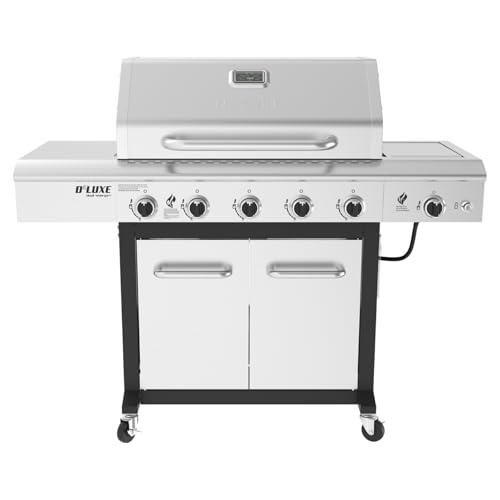
Nexgrill Deluxe 5-Burner Gas Grill with Ceramic Side Burner — Best for Big Families
When the guest list is the point, capacity stops being a spec and becomes the whole decision. The Nexgrill Deluxe 5-Burner spreads cooking across five main burners with a ceramic side burner for pots and pans, totaling 65,000 BTU on the verified listing. Ceramic side burners run hotter and more evenly than basic ring burners, which makes this one genuinely useful for searing in a pan or boiling a serious pot of corn rather than merely warming beans.
- Strengths: Five burners give the widest zone map in this guide — sear, roast and hold simultaneously.
- Strengths: Ceramic side burner is a real cooking tool, not a token.
- Strengths: 65,000 BTU total output keeps recovery fast when the grate is fully loaded.
- Trade-offs: Big footprint and a big assembly job; this is a patio commitment.
- Trade-offs: Value-brand longevity — plan on parts replacement sooner than the Weber picks.
- Trade-offs: Oversized for couples; heating five burners for two burgers is wasteful theater.
Mini spec: 5 burners; ceramic side burner with side table; 65,000 BTU (verified from Amazon listing title). Check the current price on Amazon
The Deluxe 5-Burner earns its badge on the days that define backyard cooking for big households: the birthday, the team dinner, the holiday where the grill never cools. Zones let you run burgers, chicken and vegetables in parallel shifts without a traffic jam, and the side burner keeps sauces and sides out of the kitchen. Bought with clear eyes about its tier — strong format, honest materials, parts in its future — it is the most capacity per dollar in this guide.
Best for: large families and habitual hosts cooking for eight to twelve / Not suited for: small households and small patios
Check the current price on Amazon
Comparison Table
| Pick | Badge | Key spec | Best for |
|---|---|---|---|
| Weber Spirit E-310 Gas Grill | Best Overall | 3 burners, cast-iron grates | Most households |
| Weber Master-Touch Charcoal Grill 22-Inch | Best Charcoal | 22-inch kettle, One-Touch ash | Flavor-first cooks |
| Traeger Pro 22 Wood Pellet Grill & Smoker | Best Pellet | 572 sq. in., 18 lb hopper | Effortless smoking |
| Weber Original Kettle Charcoal Grill 22-Inch | Best Budget | 22-inch kettle | Value hunters |
| Blackstone 1883 Original 28-Inch Omnivore Griddle | Best Griddle | 28-inch flat top, hood | Crowds, diner food |
| Nexgrill Deluxe 5-Burner Gas Grill with Ceramic Side Burner | Best for Big Families | 5 burners, 65,000 BTU | Cooking for 8–12 |
How to Choose a Backyard Grill: Start With Fuel, Not Features
Fuel decides everything downstream — flavor, effort, cleanup, running cost and how often you will cook. Gas is the frequency fuel: instant on, instant off, nothing to clean but a grease tray, and a clean neutral flavor that lets the food speak. Charcoal is the flavor fuel: the highest heat in the backyard and real fire character, paid for with lighting time, ash and attention. Pellets are the automation fuel: wood smoke with a thermostat, at the cost of electricity, moving parts and a gentler sear. A griddle is not a fuel choice but a surface choice, usually propane-fired, trading grill marks for a flat steel plate that cooks an entirely different menu brilliantly.
Be honest about your ratio. If eighty percent of your outdoor cooking is weeknight protein and vegetables, gas or a griddle will serve you best and a smoker will gather dust. If weekends are your cooking life and smoke is the point, start with the kettle or the pellet grill and let convenience be secondary. The most common backyard mistake is buying for the cook you fantasize about — the fourteen-hour brisket — instead of the cook you are forty weeks a year. Buy for the real ratio and the fantasy cooks can borrow capacity; buy for the fantasy and Tuesday dinner suffers.
Sizing a Backyard Grill for Your Household
Size for your regular crowd, then check the surge case. A 22-inch kettle or a three-burner gas grill covers dinners for four to six comfortably; five burners and 28-inch griddles exist for households whose normal is eight to twelve. Undersizing is the painful error — a too-small grill turns a gathering into shift work — while oversizing mostly costs patio space and preheat time. As a rough guide, allow about a hundred square inches of primary cooking surface per person for a mixed grill load, remembering that foods cook in waves and side dishes can hold on a warming rack or the cool zone.
Also size the grill to the patio, not just the people. Measure the footprint with the lid open and shelves out, keep safe clearance from siding and railings, and think about the path from kitchen to grill — you will walk it carrying raw meat in one direction and hot platters in the other, in the dark, in November. A slightly smaller grill in the right spot outperforms a giant exiled to the far corner of the yard, because proximity is what turns grilling from an event into a habit.
Build Quality: Reading a Grill Like an Owner, Not a Shopper
Shoppers read features; owners live with materials. The firebox and lid tell the truth first — lift the lid and note its weight, because mass there means heat stability and years of hinge life. Grates come next: thick cast iron or heavy steel rod store heat and sear; thin porcelain-coated steel is a consumable wearing a permanent costume. Burners, heat tents and grease paths decide the middle years of a gas grill’s life, and on charcoal and pellet grills the equivalents are the ash system and the auger-and-controller assembly. In every case the question is the same: when this part wears, can I buy another one cheaply and fit it with a screwdriver?
That parts question is why brand ecosystems dominate this guide’s picks. Weber, Traeger and Blackstone maintain deep catalogs of wear parts and an internet full of repair knowledge for exactly the models in this guide. A grill from a brand with no parts tail is not necessarily a bad grill, but it is a grill with an expiration date, and it should be priced — and chosen — with that understood. Longevity is the quiet spec that separates the best backyard grills from the merely impressive ones.
The Two-Cooker Backyard: Why Pairs Beat Flagships
Spend enough time in backyards that cook well and a pattern emerges: the happiest setups pair two modest instruments instead of one giant one. A gas grill plus a kettle covers instant weeknight cooking and full-flavor weekend fire. A gas grill plus a griddle covers weeknights and every crowd format from breakfast to burger night. A kettle plus a pellet grill covers flavor and effortless smoke for less than many flagships. Each pair costs patio space, but each also means the right tool is always lit, rather than one machine compromising at both ends.
If you are starting from zero, buy the cooker that matches your dominant cooking first — for most households that is the gas grill — and add the second when its absence actually annoys you, not before. The picks in this guide were chosen partly as good pair citizens: standard footprints, deep accessory ecosystems, and no proprietary lock-ins that complicate a mixed patio. Backyard cooking improves fastest when the tool matches the dinner, and pairs are how ordinary households get there without a caterer’s budget.
Care and Feeding: Keeping Any Backyard Grill at Its Best
Every fuel has a five-minute ritual, and the ritual is the difference between a grill that ages in dog years and one that shrugs off a decade. Gas: brush the grates warm, empty the grease tray regularly, and keep the burners’ ports clear. Charcoal: sweep ash after every cook — ash plus moisture becomes a corrosive paste that eats fire bowls — and store charcoal dry, because damp charcoal is the cause of half the ‘charcoal is hard to light’ complaints ever filed. Pellets: vacuum the fire pot on a rhythm, keep pellets in a sealed container, and never let the hopper sit damp over winter. Griddle: scrape while warm, wipe a whisper of oil over the plate, and the seasoning becomes armor.
Across all four, the cover is the universal longevity tool, and the annual once-over is the universal failure-preventer: hoses and connections on gas, vents and dampers on charcoal, auger and fan on pellets, plate surface on griddles. Fifteen minutes each spring, with replacement parts ordered before they are urgent, keeps any pick in this guide cooking at its best. Neglect is the only truly expensive accessory in backyard cooking.
Safety Basics for Every Fuel in the Backyard
The rules rhyme across fuels. Cook outdoors only, on a stable non-combustible surface, clear of siding, eaves and overhanging branches. Keep children and pets out of a marked cook’s zone, and never leave a lit grill — gas, charcoal or pellet — unattended. Gas adds the leak test and the lid-open lighting rule. Charcoal adds ash discipline: coals can hide heat for a full day, so ash goes into a metal container, never the trash, and never indoors for warmth. Pellets add electrical common sense: a dry outlet, a cord that is not a trip line, and no cooking in a closed garage.
Grease is the common enemy. Most backyard grill fires are grease fires, fed by trays and fireboxes that went too long between cleanings, and nearly all are preventable with the maintenance rhythms described above. If a fire does flare beyond the food, close the lid and cut the fuel or air rather than reaching for water, which spreads burning grease. Calm, prepared and clean is the whole doctrine — backyard cooking should be the most relaxed part of your week, and with these habits it reliably is.
What to Cook First on Each Grill in This Guide
New grills teach fastest with forgiving first cooks. On the Spirit or the Nexgrill, start with chicken thighs and sausages — hard to ruin, easy to read for hot spots, and the meal that maps your zones. On either kettle, begin with a two-zone fire and thick burgers, then graduate to a whole indirect chicken before attempting ribs. On the Traeger, a pork shoulder is the perfect first long cook: tolerant of every mistake, and it seasons the machine while feeding a crowd. On the Blackstone, smash burgers and a fried-rice night will teach you the plate’s heat map and your scraping technique in one delicious weekend.
In every case, take notes — burner settings, vent positions, times, what you would change. Three cooks with notes teach more than thirty cooks from memory, because each grill has a personality and the notes are how you learn yours. Within a month the new grill stops being equipment and becomes your grill, which is the real finish line of any purchase in this guide.
How to Set Up a Two-Zone Fire on Gas, Charcoal and Pellet Grills
The two-zone fire — one hot side, one gentle side — is the master technique of backyard cooking, and every grill in this guide does it differently. On gas, it is burner asymmetry: high on the left, low or off on the right, preheated until the grates reflect the arrangement. On a kettle, bank the lit coals to one half of the bowl and leave the other half bare; food over the bare side cooks by convection with the lid on, safe from flare-ups. On a pellet grill, zones are subtler — use the edges of the grate, which run cooler, and a cast-iron pan as your searing station while the main grate roasts gently.
Cook with the map, not against it. Sear over the fierce side, finish over the gentle side, and rest food in the coolest corner while the next batch takes the heat. Thick cuts, bone-in chicken and anything sugary — barbecue sauce burns fast — all belong on the gentle side for most of their cook. Once the two-zone habit forms, burnt-outside-raw-inside failures nearly vanish, because you always have somewhere safe to move food. It is the single highest-return skill in this entire guide, and it costs nothing but thirty seconds of setup.
Running Costs by Fuel: What Each Grill Costs to Feed
Purchase price is only the first invoice; fuel is the subscription. Gas is the predictable middle: a refillable propane tank carries many hours of cooking and exchanges are available everywhere, so cost per cook is modest and stable. Charcoal is the cheapest fuel to buy and the easiest to waste — a full chimney for two burgers is poor economics, while a well-managed kettle sipping a banked fire is frugal. Pellets sit between: hardwood pellets cost more per cook than charcoal, but the grill only burns what the thermostat demands, and long cooks are surprisingly efficient. The griddle runs on propane with gas-grill economics, though its big plate rewards batch cooking — cooking for eight on one heating cycle is cheaper per plate than four small sessions.
The hidden running cost is parts, and it dwarfs fuel over a decade. A grill that needs a burner set, a grate or an igniter every several years — all cheap, all available for the major brands in this guide — costs little to keep young. A grill whose parts do not exist costs a whole new grill. When you compare a budget pick against a premium one, compare ten-year cost: purchase, fuel, two rounds of wear parts and one cover. The ranking often flips, which is why this guide keeps returning to the parts ecosystem as the spec that matters most after heat quality.
Weather, Storage and Making a Grill Last
Backyard grills live outdoors, and weather is the opponent none of them can out-cook. Rain is the obvious enemy — it rusts grates, swells pellets and turns ash to corrosive paste — but sun, pollen and freeze-thaw cycles all take their tax. The defenses are boring and total: a fitted cover used every time, a spot with a little shelter from the prevailing rain if the patio offers one, and fuel stored dry indoors. Charcoal belongs in a sealed bin, pellets in a sealed container off the floor, and propane tanks upright and outdoors, never in a closed garage or shed.
Winter deserves its own sentence in cold climates. Clean the grill before storage, not after — grease and ash left sitting are what corrode over the dark months. Run pellet grills empty or keep the hopper dry, disconnect and store gas hoses where rodents cannot reach them, and expect the first spring cook to include a burn-off and an inspection. Owners who do this unglamorous work find their grill lights in April like it was September. Owners who skip it meet the troubleshooting section of the internet instead. Every pick in this guide can last — the variable is never the grill alone, it is the ritual around it.
The Short Accessory List Every Backyard Cook Actually Needs
Whatever fuel you choose, the same short kit separates smooth cooks from chaotic ones. Long tongs and a stiff spatula are your hands at the fire; buy them sturdy and buy them once. An instant-read thermometer is the difference between hoping chicken is done and knowing it, and it pays for itself in saved dinners within a month. A chimney starter transforms charcoal from a lighter-fluid ritual into a fifteen-minute certainty, and a pair of heat-resistant gloves makes grate lifting, pan moving and coal adjusting calm instead of daring. Finally, a dedicated landing surface beside the grill — even a small folding table — ends the plate-balancing act that causes most backyard spills.
Beyond the kit, buy accessories by menu, not by catalog. A griddle plate that drops onto a gas or charcoal grate borrows the Blackstone trick for occasional breakfast duty. A rotisserie is glorious if whole birds are a monthly habit and clutter if they are not. Pizza stones and steels thrill pizza households and gather dust in others. The discipline is to let your actual cooking nominate each purchase: cook first, notice the recurring friction, then buy the tool that removes exactly that friction. Backyard cooking rewards that restraint — the best-equipped patios are rarely the ones with the most gadgets; they are the ones where every tool within reach earns its hook.
Common Buying Mistakes
Buying for the fantasy cook. The brisket you will make twice a year should not dictate the grill you use twice a week. Judging by headline numbers. BTU totals and square inches say little about heat quality, materials or parts support. Skipping the second zone. One-zone cooking is the root cause of most burnt dinners on every fuel. Neglecting ash and grease. The two cheapest maintenance habits in grilling prevent the two most common failures — corrosion and grease fires. Forgetting the parts test. A grill whose burners, grates and igniters cannot be replaced is a rental, whatever the receipt says. Exiling the grill. A cooker placed far from the kitchen door gets used half as often; proximity is a feature.
Final Recommendation
If you buy one grill from this guide, make it the Weber Spirit E-310 — it is the best balance of convenience, cooking quality and longevity for most backyards. Choose the Master-Touch when flavor leads, the Traeger Pro 22 when smoke without labor is the dream, the Original Kettle when the budget leads, the Blackstone when your menu runs to burgers and breakfasts, and the Nexgrill Deluxe when the crowd is the constant. Whichever lands on your patio, learn its two-zone fire and keep its five-minute ritual, and it will feed you well for years. Related reading in this series: Best Backyard Gas Grills, Best Backyard Pellet Grills, Best Backyard Smoker Grills, Best Backyard Brick Grills, Best Bang For Buck Grills, Best Balcony Grills.
One practical note on ordering: grills are freight, not parcels. Check the listing for delivery arrangements and assembly expectations before you commit, keep the packaging until the grill has survived its first cook, and photograph any shipping damage before you assemble anything. A ten-minute inspection on delivery day is the cheapest warranty you will ever own, and it turns a potential dispute into a formality. Do the same for the first burn-off: run the grill empty, watch for anything that smells wrong, rattles loose or heats unevenly, and you will start your ownership with a machine you already understand and trust from the very first dinner onward, all season long.
Frequently Asked Questions
What type of grill is best for a backyard?
For most households, a mid-size gas grill is the best all-round choice because it gets used most often. Charcoal wins on flavor, pellet grills win on effortless smoking, and griddles win on crowd-pleasing diner food — the best type is the one that matches your typical week.
Is it worth owning two grills?
Often, yes. A gas grill paired with either a charcoal kettle or a griddle covers nearly all backyard cooking better than a single expensive flagship, because each tool does what it is best at. Start with one, and add the second when a real gap appears.
How long should a good backyard grill last?
With basic care and available replacement parts, the picks in this guide should serve for many seasons — gas burners, grates and igniters are wear items designed to be replaced. Grills without parts support typically age out far sooner.
Which grill is easiest to clean?
Gas grills are the easiest — a warm grate brush and a grease tray. Griddles are close behind with a scrape and wipe. Charcoal requires ash management after every cook, and pellet grills need periodic vacuuming of the fire pot.
Can a pellet grill replace a gas grill?
For smoking, roasting and baking, yes. For fast weeknight searing it is slower to heat and gentler at the top end, so many owners keep both. If you must choose one and smoke is your priority, the pellet grill is a satisfying only grill.
What size grill do I need for a family of five?
A three-burner gas grill, a 22-inch kettle or a comparable cooking area around 450–570 square inches handles family-of-five dinners comfortably, including sides in zones. Size up mainly if you host large gatherings often.
Should I buy a grill with a side burner?
Only if you will genuinely cook sides outdoors — sauces, beans, corn, a pan sear while the grate is full. A side burner used weekly is a second stovetop and a real asset; one used never is just another component to clean and eventually repair. Judge by your menu, not by the showroom.
What is the best grill for a beginner?
A three-burner gas grill like the Spirit E-310 in this guide is the friendliest start: instant lighting, forgiving zone control and easy cleanup while you learn. Beginners who love the idea of fire itself can start on the Original Kettle instead — the techniques learned there transfer to every other grill for life.


