Disclosure: airfryerkitchensupply.com is reader-supported. When you buy through links on our site, we may earn an affiliate commission at no extra cost to you.
Where to buy
Shopping for best argentine grills? The fastest way to buy any grill in this guide is through Amazon, where the verified picks below are listed with current configuration details. Use these links to check price on Amazon and confirm the exact model, fuel type and included accessories before ordering:
- Backyard Discovery Argentine Santa Maria Heritage Grill (Best Overall): Check on Amazon
- BIG HORN Santa Maria Grill (Large) (Best Value Full-Size): Check on Amazon
- Brand-Man Santa Maria Grill with Brasero (Best with Brasero): Check on Amazon
- Hickory Summit Argentine Santa Maria Grill with Tools (Best Complete Kit): Check on Amazon
- BIG HORN Portable Santa Maria Grill (Best Portable): Check on Amazon
- Flintex Argentine Santa Maria Grill Kit (Best Accessory System): Check on Amazon
Argentine grills are a specialist category: most are sold by smaller makers in limited runs, and configurations — grate style, brasero included or not, firebrick lining — change between production batches. Use the links below to check price on Amazon and confirm exactly what the current listing includes before you commit.
The best argentine grills are not really grills in the North American sense — they are parrillas: open-fire cooking stations built around a brasero where wood burns down to embers, and an adjustable-height grate that rises and lowers over those embers on a chain or crank. Heat control does not come from a dial. It comes from distance, ember management and patience, and the result — asado cooked slowly over real wood embers — is a flavour no gas burner reproduces.
That honesty matters for buyers. A parrilla asks more of its cook than any other grill in this series: you build a fire, wait for embers, rake them under the grate, and manage them for the length of the cook. If that ritual sounds like the point, read on. If it sounds like a chore, a kettle or kamado from the backyard guide will make you happier, and this guide will not pretend otherwise.
The six picks below are all currently listed, verified Argentine or Santa Maria style grills — Santa Maria being the Californian descendant of the same tradition, with the same crank-raised grate over live fire. They range from a portable entry point to a full heritage station with firebrick and a wood table, and each review is blunt about build, assembly and who should walk away.
In this guide
Quick Picks — The Best Argentine Grills at a Glance
Six live-fire parrillas, ordered from the full asado station down to the portable starter. Every one cooks over wood or charcoal embers — there is no gas shortcut in this category, by design.
Backyard Discovery Argentine Santa Maria Heritage Grill — Best Overall: The Heritage’s firebrick lining is not decoration. Brick absorbs ember heat and re-radiates it evenly, smoothing the hot and cool patches that make open-fire cooking tricky, and it protects the steel firebox from the the… Check on Amazon
BIG HORN Santa Maria Grill (Large) — Best Value Full-Size: What you are buying here is the geometry of asado: a generous firebox, a grate that travels through a useful height range smoothly, and room underneath for the wood pile and tools. In cooking terms it performs the full r… Check on Amazon
Brand-Man Santa Maria Grill with Brasero — Best with Brasero: The brasero is the soul of the method. Wood burns in the basket at the side; embers fall through and are raked under the grate as they mature, so the cook always works over clean, glowing embers rather than active flame…. Check on Amazon
Hickory Summit Argentine Santa Maria Grill with Tools — Best Complete Kit: The plancha is the differentiator. A steel flat plate over embers transforms what a parrilla session can include — provoleta without a pan hunt, vegetables that would fall through grates, chorizo finished in its own fat,… Check on Amazon
BIG HORN Portable Santa Maria Grill — Best Portable: Everything essential survives the shrinking: real embers, a height-adjustable grate, and the slow control that defines the cooking. The rotating grate system is a thoughtful addition at this size, letting you turn food t… Check on Amazon
Flintex Argentine Santa Maria Grill Kit — Best Accessory System: Grate quality is where cheap parrillas fail first — thin bars warp, coatings fail, and fat management is an afterthought. A stainless V-grate plus flat grates and a griddle pan replaces that whole layer with components s… Check on Amazon
How These Picks Were Chosen
Candidates were verified against the live catalogue, and only Argentine or Santa Maria grills with a confirmed current listing were kept. That filter is severe in this niche: several well-known parrilla brands sell only direct or through regional dealers and have no verifiable Amazon listing, so they are discussed honestly as prose context in the buying guide rather than given links this guide cannot stand behind.
Selection weighted the features that define the style: a genuinely adjustable grate (the heart of the method), V-channel grates that drain fat away from embers where fitted, a brasero or a sensible ember-making arrangement, firebrick or heavy steel in the firebox, and construction that will survive repeated high-heat cycles. Assembly burden and footprint were scored too, because these are large, heavy objects that arrive in crates.
Prices in this category move with steel costs and small-batch production, so this guide positions each grill by tier — entry, mid-range, premium — and leaves the number itself to the listing, where it belongs.
The 6 Best Argentine Grills — Full Reviews
Each review covers the fire system, the grate mechanism, and the ownership reality — assembly, weight and upkeep included. Live-fire cooking rewards skill; these reviews assume you want the truth about the learning curve too.

Backyard Discovery Argentine Santa Maria Heritage Grill — Best Overall
Best Overall. This is the fullest expression of the style in the guide: firebrick, adjustable grates, hooks and a work table, sold as one coherent station.
The Heritage’s firebrick lining is not decoration. Brick absorbs ember heat and re-radiates it evenly, smoothing the hot and cool patches that make open-fire cooking tricky, and it protects the steel firebox from the thermal cycling that warps thin fireboxes within a few seasons. Combined with crank-adjustable grates, it gives the cook the two real controls of asado: ember placement and grate height.
Ownership reality: this is furniture-scale equipment. It arrives heavy, assembles slowly, and wants a permanent home on a patio or in a yard. Buyers with the space get a station that handles a whole asado — provoleta, chorizo, morcilla, then the big cuts — in the traditional sequence without improvisation. Buyers without the space should look at the portable BIG HORN below and be honest about it.
Strengths
- Firebrick-lined firebox holds and evens ember heat
- Adjustable grates give true distance-based heat control
- Integrated acacia table and S-hooks complete the workflow
Trade-offs
- Large, heavy and a serious assembly job
- Premium tier — the most committed purchase in this guide
- Needs a dedicated permanent spot outdoors
Key specs: Wood/charcoal, adjustable grates, fire bricks, acacia wood table
Check on Amazon — check price on Amazon before you order, since configurations and included accessories change.
Best for: hosts who cook full asado for groups and have a permanent outdoor spot / Not suited for: apartment or small-patio cooks — see the portable pick instead

BIG HORN Santa Maria Grill (Large) — Best Value Full-Size
Best Value Full-Size. The large BIG HORN delivers the defining mechanism of the style — the raising grate over live embers — without the premium tier of the Heritage.
What you are buying here is the geometry of asado: a generous firebox, a grate that travels through a useful height range smoothly, and room underneath for the wood pile and tools. In cooking terms it performs the full repertoire, from high searing over fresh embers to the long, low, distant cook that large cuts demand. The differences from the premium pick are in refinement and longevity, not capability.
The care contract is real. Unlined steel in a firebox lives a hard life; keep it oiled, keep ash from sitting damp in it between cooks, and cover it. Owners who do that report years of service; owners who treat it like a gas grill will meet rust early. At its tier, that is a fair and knowable trade.
Strengths
- Adjustable-height grate — the essential mechanism, done properly
- Large cooking area for group asado
- Storage underneath keeps wood and tools at hand
Trade-offs
- No firebrick lining at this tier
- Assembly is a two-person job
- Steel needs oiling discipline to stay ahead of rust
Key specs: Wood/charcoal, adjustable-height grate, storage shelf
Check on Amazon — check price on Amazon before you order, since configurations and included accessories change.
Best for: asado learners ready for a full-size grill at a mid-range tier / Not suited for: buyers who want fit-and-forget, maintenance-free equipment

Brand-Man Santa Maria Grill with Brasero — Best with Brasero
Best with Brasero. The Brand-Man is the traditionalist’s pick: a built-in brasero, a V-grate and firebrick — the complete Argentine arrangement.
The brasero is the soul of the method. Wood burns in the basket at the side; embers fall through and are raked under the grate as they mature, so the cook always works over clean, glowing embers rather than active flame. It is slower to start and demands attention, and it produces the cleanest, most controllable asado heat of any arrangement in this guide. If you have watched asado cooked in Argentina and want that exact workflow, this is the one.
The V-grate deserves its own note: the channels catch rendered fat and carry it to a drip point instead of letting it fall onto embers, which means less acrid smoke on the meat and fewer flare-ups during long cooks of fatty cuts. Included skewers and S-hooks round out a package that needs nothing added on day one — just wood, time and practice.
Strengths
- Dedicated brasero makes embers the traditional way
- V-grate drains fat and reduces flare-ups over embers
- Fire brick plus included skewers and hooks
Trade-offs
- Premium tier pricing
- Brasero workflow has the steepest learning curve here
- Large footprint once assembled
Key specs: Wood parrilla, adjustable V-grate, brasero, fire brick, skewers and hooks
Check on Amazon — check price on Amazon before you order, since configurations and included accessories change.
Best for: experienced live-fire cooks who want the authentic brasero workflow / Not suited for: beginners — start with the portable pick and learn ember basics first

Hickory Summit Argentine Santa Maria Grill with Tools — Best Complete Kit
Best Complete Kit. The Hickory Summit competes on completeness: grill, brasero, plancha and the ember tools, in one crate.
The plancha is the differentiator. A steel flat plate over embers transforms what a parrilla session can include — provoleta without a pan hunt, vegetables that would fall through grates, chorizo finished in its own fat, eggs for a late asado breakfast. Many parrilla owners add a plancha within a year; this kit simply starts there, and the included shovel and tongs are the correct shapes for ember work even if keen cooks later upgrade to heavier favourites.
Temper expectations on finish: this is a working grill from a small maker, with welds and paint specified for heat rather than showroom shine. Judged as a tool it is excellent value; judged as patio furniture it is honest rather than pretty. For most asado cooks, that priority order is exactly right.
Strengths
- Brasero and plancha included — flat-top cooking joins the grate
- Shovel and tongs in the box for ember management
- Mid-range tier for the completeness on offer
Trade-offs
- Tool quality is starter grade — plan to upgrade favourites later
- No firebrick lining
- Brand support is smaller-maker scale
Key specs: Open-fire charcoal/wood, brasero, plancha, tools included
Check on Amazon — check price on Amazon before you order, since configurations and included accessories change.
Best for: first-time parrilla owners who want everything in one purchase / Not suited for: buyers who prioritise finish and brand-name support over kit completeness
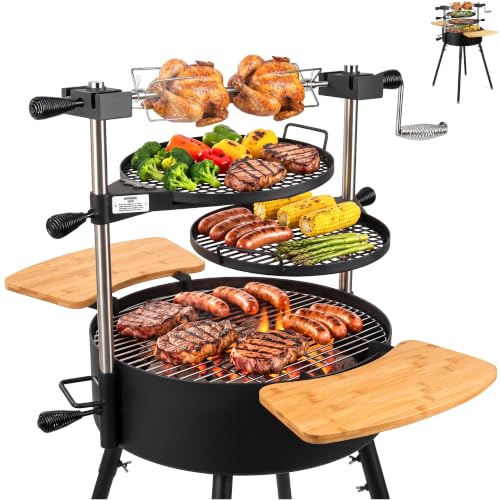
BIG HORN Portable Santa Maria Grill — Best Portable
Best Portable. The portable BIG HORN answers the obvious question: can the style travel? Yes — with capacity limits stated plainly.
Everything essential survives the shrinking: real embers, a height-adjustable grate, and the slow control that defines the cooking. The rotating grate system is a thoughtful addition at this size, letting you turn food through hot spots instead of shuffling pieces with tongs, and the rotisserie handles a chicken or a small roast in a way fixed grates cannot.
Be clear-eyed about scale. This cooks a wonderful asado for two to four people and cannot be stretched beyond that without cooking in relays. As a first parrilla it is arguably the smartest buy in the guide: the investment is entry-tier, the technique learned is the real technique, and if the style captures you, the full-size upgrade path is obvious.
Strengths
- Portable format takes Santa Maria cooking to camp and tailgate
- Rotating grates and rotisserie widen the repertoire
- Adjustable height keeps the essential technique intact
Trade-offs
- Small capacity — this is asado for a few, not a crowd
- Thinner build than the full-size models
- Rotisserie adds setup time to every cook
Key specs: Portable, adjustable height, 360° rotating grates, rotisserie
Check on Amazon — check price on Amazon before you order, since configurations and included accessories change.
Best for: campers, tailgaters and beginners learning the style / Not suited for: hosts cooking for large groups

Flintex Argentine Santa Maria Grill Kit — Best Accessory System
Best Accessory System. The Flintex kit serves the other kind of parrilla buyer: the one building a station or upgrading a firebox with proper stainless working parts.
Grate quality is where cheap parrillas fail first — thin bars warp, coatings fail, and fat management is an afterthought. A stainless V-grate plus flat grates and a griddle pan replaces that whole layer with components specified for the work, and stainless brings a cleaning and corrosion story that plain steel cannot match across years of ember heat.
Read the listing with a tape measure in hand. Kit components assume a firebox of compatible dimensions, and the value here collapses if the fit is wrong. For a built-in project or a measured upgrade, it is the most durable path in the guide; for a buyer wanting a complete grill in one box, the five picks above are the correct shortlist.
Strengths
- Full stainless grate system including V-grate and griddle
- Hooks and skewers cover the traditional serving methods
- Components upgrade an existing firebox or a built-in project
Trade-offs
- This is a kit of components — confirm what firebox it must pair with
- Premium tier for accessories
- Fit depends on your grill’s dimensions — measure first
Key specs: Stainless kit: V-grate, 2 grates, griddle pan, hooks, skewers
Check on Amazon — check price on Amazon before you order, since configurations and included accessories change.
Best for: DIY parrilla builders and owners upgrading worn grates / Not suited for: buyers who need a complete standalone grill
Comparison Table — Best Argentine Grills
| Pick | Badge | Key spec | Best for |
|---|---|---|---|
| Backyard Discovery Argentine Santa Maria Heritage Grill | Best Overall | Wood/charcoal, adjustable grates, fire bricks, acacia wood table | committed asado cooks who want the complete station in one purchase |
| BIG HORN Santa Maria Grill (Large) | Best Value Full-Size | Wood/charcoal, adjustable-height grate, storage shelf | buyers who want a full-size parrilla at a mid-range tier |
| Brand-Man Santa Maria Grill with Brasero | Best with Brasero | Wood parrilla, adjustable V-grate, brasero, fire brick, skewers and hooks | traditionalists who want the ember-making brasero built in |
| Hickory Summit Argentine Santa Maria Grill with Tools | Best Complete Kit | Open-fire charcoal/wood, brasero, plancha, tools included | buyers who want grill, brasero, plancha and tools in a single order |
| BIG HORN Portable Santa Maria Grill | Best Portable | Portable, adjustable height, 360° rotating grates, rotisserie | campers and small-space cooks who want the style without the station |
| Flintex Argentine Santa Maria Grill Kit | Best Accessory System | Stainless kit: V-grate, 2 grates, griddle pan, hooks, skewers | owners building or upgrading a parrilla with stainless components |
Read the table as a map, not a ranking: every pick here earned its place for a stated household, and the badge column tells you which household that is. Specifications are limited to details verified in the product listings; confirm the current configuration before ordering.
How to Choose the Best Argentine Grills: Parrilla Anatomy
Judge any parrilla by four parts. First, the firebox: firebrick-lined or heavy steel, sized for the groups you feed. Second, the grate mechanism: it must raise and lower smoothly through a wide range, under load, with one hand on the crank — this mechanism is the thermostat of the entire method. Third, the grate itself: V-channel grates manage fat best for long fatty cooks; flat bar grates mark food more classically. Fourth, the ember supply: a built-in brasero is the traditional answer; without one, you will make embers in a corner of the firebox or a separate fire, which works but demands more grate space.
Size honestly. A parrilla’s grate must hold the fire’s output and the food at once, and asado is cooked in courses — achuras and provoleta first, then the main cuts — so a mid-size grate used in sequence beats a giant grate used badly. Most home cooks are best served by the full-size-but-not-commercial models in the middle of this guide.
Finally, respect the fuel. These grills are designed for wood embers — quebracho traditionally, oak or other dense hardwoods in practice — with charcoal as the convenient stand-in. Lump charcoal is the sensible starting fuel while you learn; briquettes work but ash more. Gas conversions and lighter-fluid shortcuts defeat the entire purpose of the purchase.
The Asado Method: Embers, Height and Patience
Asado heat control has two variables: how many embers sit under the grate, and how far the grate sits above them. Start the fire in the brasero or firebox corner a full hour before food appears. When logs have collapsed into glowing embers, rake a layer under the grate — sparse for gentle cooking, dense for searing — and set the grate height accordingly. Food goes on when the embers glow orange-grey, never over open flame.
Cook in the traditional order. Provoleta and vegetables first at moderate distance; chorizo and morcilla next; then the large cuts, placed bone-side or fat-side toward the heat for most of their long cook and turned rarely. Salt coarsely, later than you think, and let the fire’s rhythm set the meal’s rhythm. Asado is a social cook measured in hours, and rushing it produces exactly the mediocre result the method exists to avoid.
Manage the fire continuously. Keep the brasero or reserve fire producing fresh embers throughout, because a long cook outlasts a single batch. This is the skill the first three cooks will teach you, and it is why the portable pick is such a sensible school: small fires forgive faster.
Parrilla Tiers: From Portable Fire to Heritage Station
The entry tier in this category is defined by the portable models: real ember technique, light construction, small capacity. It is the correct place to spend a first season, because asado skill is worth more than asado square footage, and the technique learned on a small fire transfers completely to a large one. Expect thinner steel and more fire attention per hour of cooking.
The mid-range tier — the large BIG HORN and the Hickory Summit kit — buys the full-size geometry and the useful inclusions: brasero or plancha, tools, storage. Materials remain working steel rather than heirloom specification, and the ownership contract is care: oiling, ash discipline, covers. Households that keep that contract get a decade-class tool at half the premium outlay.
The premium tier buys mass and lining: firebrick, heavy plate, integrated tables, stainless working parts. What that money actually purchases is forgiveness — a firebox that evens a beginner’s ember bed, a grate mechanism that stays smooth under load in year five, a station that hosts without improvisation. Buy it when the practice is proven in your household, not as a wager that it will be.
Wood, Charcoal and Ember Economics
Fuel will out-cost the grill within a few seasons of regular asado, so choose it like a staple, not an afterthought. Dense hardwood gives the longest ember life and the mildest smoke; a cord of oak bought dry and stored covered is the traditional economy. Lump charcoal trades a little romance for total convenience — consistent sizing, fast lighting, clean flavour — and for most home asadores it is the rational default.
Briquettes deserve a nuanced verdict: quality briquettes burn long and even, and for the firebox’s reserve corner they are genuinely useful, but their ash volume chokes airflow in a working bed faster than lump. Many experienced cooks run a hybrid — briquettes for the base bed, lump or wood embers for the cooking layer — and this guide endorses the pragmatism.
Whatever you burn, dryness is destiny. Damp fuel makes smoke, not embers, and no grate mechanism compensates. Store fuel off the ground, under cover with airflow, and bring the day’s supply to the grill in a metal hod that doubles as your ash-safe staging. The asado begins at the woodpile.
The Cuts and Courses: Building an Asado Menu
A well-built asado menu is a heat schedule wearing a menu’s clothes. Open with provoleta — provolone grilled in a cast-iron pan until its edges crisp — and grilled vegetables that tolerate the young fire. Follow with chorizo and morcilla, whose fat seasons both the grill and the guests’ expectations. Achuras for the devoted table come next, while the ember bed is at its most manageable.
The main cut should be one cut, done properly, rather than three done anxiously: vacío for its forgiving fat, entraña for speed and beefiness, or asado de tira — short ribs cut across the bone — for the full traditional statement. Salt coarsely with sal parrillera, cook bone or fat side toward the heat for most of the time, and rest without apology.
Sides serve the meat, not the spotlight: a sharp chimichurri made the same day, a simple salad for acid, grilled bread to close. Dessert, if the fire still glows, is fruit on the grate. The menu’s restraint is what lets the fire — and the cook — perform.
Maintaining Steel in a Firebox Environment
A parrilla firebox lives the hardest life of any grill in this series: direct ember contact, thermal cycling, fat, weather. Its maintenance is correspondingly simple and non-negotiable. Ash out, cold, after every cook — ash plus moisture is a corrosive paste that eats steel from the inside while the outside still looks sound. A dry firebox is a living firebox.
Grates get the cast-iron treatment: brush while warm, oil lightly while still warm, and never let them sit wet. V-grates add one task — clear the channels, because a blocked channel returns the fat to the embers the design exists to avoid. Moving mechanisms get a wire brush and a drop of high-temperature-safe lubrication when the crank begins to argue.
Paint on fireboxes is a consumable, not a finish: touch up exterior rust spots with high-heat paint as they appear, and accept the working patina as the honest look of a used tool. The grills in this guide are equipment for a practice; their beauty is in the food and the fire, and a maintained workhorse outlasts a pampered ornament every season.
Key Takeaways for Parrilla Buyers
Buy the mechanism first: a grate that raises and lowers smoothly, under load, through a wide range, is the parrilla. Firebox second — brick or heavy steel — and grate style third, V-channel for fatty course cooking, flat bar for marking. Accessories, tables and finishes decorate those three decisions; they cannot rescue them.
Match the station to the practice you will actually keep. A portable pick used monthly teaches more and feeds better than a heritage station used twice and rusting between whiles. Asado is a rhythm before it is a menu, and the right grill is the one whose size and care contract fit the rhythm of your household’s weekends.
Budget the whole system: grill, shovel and tongs, a provoleta pan, fuel storage, and a cover. The parrilla itself is roughly two-thirds of the true first-year cost, and the buyer who plans the whole system starts cooking on the first weekend instead of assembling a kit across a season.
Asado for Guests: Hosting Without Panic
The asado’s structure is a hosting system: the fire gives the afternoon its timetable, the courses give guests something arriving every twenty minutes, and the asador’s station keeps the host present instead of exiled to a kitchen. Prepare everything that can be prepared before the first match — salads, chimichurri, bread, drinks — because once the fire is lit, your job is the fire.
Quantities follow the courses: modest amounts of the opening items, generosity at the main cut, and always one more chorizo than arithmetic suggests. Guests pace themselves when food keeps arriving; they descend when it does not. The reserve fire is your insurance policy, and it should be burning before the first guest rings the bell, not after the bed begins to fade.
End the event at the fire too: the last embers grill fruit or warm bread for a closing course while the main grate is brushed clean. Hosting an asado well is mostly sequence and calm — the two things this guide’s method sections exist to teach.
From Fire to Table: A Complete Asado Timeline
Hour zero: the fire is lit in the brasero or reserve corner, the meat is out of the refrigerator salting at room temperature, and the chimichurri — made that morning — waits covered. The asador’s first hour belongs to the fire alone; guests who arrive early are handed a drink and a view of the process, which Argentinians understand to be part of the entertainment rather than a delay of it.
Hour one: the first embers are raked under the grate and the opening course goes on — provoleta in its pan, vegetables at the edges. The fire tender keeps the brasero producing; the cook’s whole attention is the ember bed’s depth and the grate’s height, adjusted in small movements that guests barely notice and the food entirely depends on.
Hour two: sausages and achuras take the grate, finished items migrate to the holding edge, and the main cut is positioned for its long cook — fat or bone side to the heat, grate raised, the bed thinned to a steady glow. This is the asado’s meditative centre: little to do, everything to watch, and a table that is eating in waves exactly as designed.
Hour three: the main cut is turned once, judged by touch and time, and rested under a loose cover for a period guests will call too long and the meat will call perfect. Final items — bread, fruit — kiss the grate. The fire is allowed to die in its own time, and the slicing happens at the grill, in slices cut to order, which is the asado’s closing ceremony.
The timeline’s lesson for buyers is hidden in its patience: every stage rewards the equipment this guide prioritised — a brasero that never stops producing, a mechanism that adjusts without drama, staging for finished courses. A parrilla that does those three things makes this afternoon feel inevitable; one that does not makes it feel like work.
Sourcing Meat and Produce for Asado Abroad
Outside Argentina, the asado menu is an exercise in translation. Vacío appears as flap steak or bavette depending on the butcher’s tradition; entraña is skirt steak, inside or outside; asado de tira is short rib cut flanken-style across the bone, a cut Korean butchers know intimately. The practical skill is describing the cut by anatomy when the name fails — a good butcher anywhere can cut what you can describe, and building that relationship is worth more than any imported product.
Chorizo and morcilla translate unevenly: fresh Argentinian chorizo is a coarse, mild pork sausage quite unlike Spanish cured chorizo or Mexican fresh chorizo, and the closest substitutes are mild Italian fresh sausage for the former and a quality local blood sausage for the latter. Provoleta needs a firm provolone that holds its shape under heat — aged, low-moisture versions succeed where young, soft ones collapse through the grate and into legend.
Produce asks less translation: peppers, onions, sweet potatoes and corn grill identically on every continent, and chimichurri’s ingredients are supermarket citizens everywhere. The asado abroad is therefore not an import exercise but a cooking practice with local materials — which is, historically, exactly how the tradition travelled in the first place.
Order the main cut ahead for gatherings. Butchers cut flanken ribs and whole flap steaks to request far more happily with two days’ notice than at a Saturday counter, and the asado’s timetable — fire first, courses in order — depends on the meat existing when the embers do. Planning the supply is part of the craft, and the notebook from your first season should record which local sources delivered, as faithfully as it records grate heights.
Troubleshooting the Parrilla: Common Fire Problems
Problem: the ember bed dies mid-cook. Cause, almost always: the reserve fire was allowed to die with it. The fix in the moment is to build a fast side fire with your smallest, driest fuel and cook thinner items while it matures; the fix for next time is structural — the reserve is lit at the start and fed on a rhythm, never improvised at the crisis. Asado’s calm is scheduled, not spontaneous.
Problem: flare-ups scorch fatty cuts. The bed is too close, too thick, or the fat has nowhere to go. Raise the grate first — distance is the fastest control — then rake embers thinner under the fattiest zone, and on V-grate models check the drainage channel for blockage before blaming the fire. Moving food to the holding edge while the bed settles is not defeat; it is the technique.
Problem: everything tastes of smoke in the wrong way. The fire was cooked over too young — flames and grey-black smoke instead of clean embers — or the fuel was damp, resinous or treated. There is no mid-cook cure for tainted fuel; the prevention is the whole discipline of this guide: dry hardwood or lump, embers before food, patience before both.
Problem: the grate mechanism stiffens or jams. Ash and fat carbonise in tracks and threads under heat. Brush the mechanism cold, clear the tracks, and work the crank through its range before the fire is lit — a mechanism exercised and cleaned monthly stays smooth for years, and one discovered jammed with guests arriving teaches the lesson at maximum tuition.
How to Set Up and Run a Parrilla for Your First Asado
Step one: site and assemble with the fire in mind. Place the grill on a non-flammable surface with generous clearance — open fire plus rendered fat demands respect — and assemble per the manual with a second pair of hands for the heavy parts. Season new steel grates with a hot fire and a light oiling before food ever touches them.
Step two: build the ember supply. Light hardwood or lump charcoal in the brasero or a designated corner of the firebox. Do not use lighter fluid; a chimney starter or natural firelighters keep flavours clean. Plan on forty-five minutes to an hour before the first embers are ready to rake under the grate.
Step three: set the working bed. Rake embers into an even layer under the cooking zone, leaving a cooler corner ember-free as a holding area. Lower the grate close for searing or raise it for the long cook, and test heat with your hand at grate level: a count of several seconds before you must pull away is gentle heat; two seconds is searing heat.
Step four: cook in courses and adjust by distance. If food is cooking too fast, raise the grate before you move food — height is your first control, ember quantity your second. Add fresh embers from the reserve fire as the bed fades, a shovelful at a time, rather than rebuilding the fire mid-cook.
Step five: shut down safely. Let the fire burn down under supervision, spread remaining embers thin to cool, and only dispose of ash once it is completely cold — ideally a full day later, in a metal container. Brush grates clean while warm, oil steel lightly, and cover the grill once cold. Ash left damp in a steel firebox is the fastest route to rust, so empty it as part of every shutdown.
Common Buying Mistakes
Buying the station before learning the fire. A premium parrilla does not cook asado; a practised cook does. Beginners learn faster and cheaper on the portable or value picks, and the technique transfers upward unchanged.
Cooking over flames instead of embers. Food over active flame soots, flares and cooks harshly. If flames are touching the food, you started too early — wait for the ember bed.
Skipping the brasero logic. Without a continuous ember supply — brasero, reserve corner or side fire — a long asado runs out of heat halfway. Plan the ember pipeline before the first guest arrives.
Letting ash live in the firebox. Damp ash is corrosive and will eat an unlined steel firebox. Empty it cold after every cook and oil the steel; ten minutes of care doubles the grill’s life.
Using softwood or treated wood. Pine and treated timber produce acrid smoke and worse. Dense hardwood or lump charcoal only — the fuel is an ingredient.
Final Recommendation
Buy the Backyard Discovery Heritage if you want the complete station — firebrick, table, hooks — and have the permanent space it deserves. It is the guide’s Best Overall because it removes every equipment excuse between you and a proper asado. Best Argentinian Grills
Choose the Brand-Man if the brasero workflow is the point, the large BIG HORN if value at full size leads, and the Hickory Summit if you want the plancha and tools included from day one. Start on the portable BIG HORN if you are learning — it teaches the real technique at an entry tier — and consider the Flintex kit when you are building or upgrading rather than buying complete. Best Backyard Bbq Grills
Above all, buy into the method honestly: wood, embers, height and time. A parrilla rewards the cook who enjoys the fire itself. If that is you, there is no more satisfying grill to own. Best Apartment Patio Grills Best Australian Grills
Quick recap with links:
- Backyard Discovery Argentine Santa Maria Heritage Grill (Best Overall): Check on Amazon
- BIG HORN Santa Maria Grill (Large) (Best Value Full-Size): Check on Amazon
- Brand-Man Santa Maria Grill with Brasero (Best with Brasero): Check on Amazon
Frequently Asked Questions
What is the difference between an Argentine grill and a Santa Maria grill?
They are cousins from the same tradition. Both cook over wood embers with a height-adjustable grate. Argentine parrillas typically add a brasero for making embers and often V-channel grates; Santa Maria grills, from California’s ranch tradition, centre on the crank-raised grate over an open firebox. The cooking technique transfers completely between them.
What wood should I use in a parrilla?
Dense hardwoods — quebracho in Argentina; oak, hickory or mesquite elsewhere — burned down to embers. Lump charcoal is the practical alternative and the best learning fuel. Never use softwood, treated wood or lighter fluid.
How long does an asado take?
Plan on the fire needing an hour before food, and large cuts cooking for one to three hours depending on thickness and grate height. Asado is deliberately slow; the courses structure the meal so guests eat throughout.
Do I need a brasero?
Not strictly — embers can be made in a corner of a large firebox — but a brasero makes the workflow far easier on long cooks by producing a continuous ember supply without disturbing the food. Traditional setups include one for a reason.
Are V-grates better than flat grates?
For fatty cuts cooked long, yes: the channels drain fat away from the embers, reducing flare-ups and acrid smoke. For quick searing and classic grill marks, flat bar grates are equally at home. Several cooks own both and swap by menu.
Can a beginner start on a full-size parrilla?
Yes, with honest expectations: the first cooks are lessons in ember management. Start with forgiving foods — chorizo, chicken, thick vegetables — before committing an expensive large cut, and keep the fire smaller than your ambition.


