Disclosure: airfryerkitchensupply.com is reader-supported. When you buy through links on our site, we may earn an affiliate commission at no extra cost to you.
Where to buy
Every pick in this guide is a hardwired or plug-in time switch sold through Amazon, where you can check the current price on Amazon and confirm the exact contact configuration before ordering. That confirmation step matters more with timers than with almost any other electrical device: the same product family often spans single-pole and double-pole versions, indoor and outdoor enclosures, and mechanical and digital variants that look nearly identical in a thumbnail. The listing is the specification of record, so match the model number in the review to the model number in your cart.
- TORK 1109A Mechanical Timer — Check on Amazon
- TORK TU40 Mechanical Timer — Check on Amazon
- TORK EWZ201C Digital Time Switch — Check on Amazon
- NSI TORK WFTU40 Smart Time Switch — Check on Amazon
- Intermatic ET91615CR Astronomic Timer — Check on Amazon
- TORK 1109A-O Outdoor Timer — Check on Amazon
The best 115 volt electrical timers solve a deceptively simple problem — turning a load on and off at the right times, every day, without anyone remembering to flip a switch — and they solve it in very different ways depending on what the load is. A timer running landscape lighting needs a weatherproof enclosure and a dusk-to-dawn option. A timer running a pool pump or a water heater needs contacts rated for serious current and a mechanism that will not weld itself shut after a season of hard switching. A timer running signage or a commercial lighting circuit needs a programmable calendar, because the schedule on a holiday weekend is not the schedule on a Tuesday. Voltage is the easy part of the decision: 115 volt is the conventional label for the standard North American household supply, the same supply other listings describe as 110V or 120V, and every pick in this guide is a multi-voltage or household-voltage device that runs correctly on that supply.
What actually separates the six picks below is mechanism and contact rating. Mechanical timers use a clock motor and physical trippers; they are cheap, repairable, immune to power-line surges in the ways that matter, and limited to schedules that repeat every 24 hours. Digital time switches add 7-day and 365-day calendars, astronomic dusk-and-dawn calculation, battery-backed memory, and multiple independent channels — at the cost of a programming interface you have to learn once and a dependence on an internal battery years down the road. Smart Wi-Fi switches add app control and remote override, which is genuinely useful for property managers and genuinely unnecessary for a pump that runs the same four hours every day. This guide includes all three families, because the honest answer to which timer is best depends entirely on which of those jobs you are hiring it to do.
One clarification before the picks: a timer is a control device, not a protective device. It does not replace a breaker, a GFCI where the code requires one, or correct wire sizing, and the contact rating printed on the device — not the rating of the circuit it sits on — is the ceiling for the load you may switch. Every review below states the verified contact rating from the manufacturer’s own listing so you can match it against your load before anything is ordered. If your load is a motor, also check the horsepower or inductive rating, which is always lower than the headline resistive rating, and treat that lower number as the real limit.
In this guide
Quick Picks
TORK 1109A Mechanical Timer — Best Overall. The benchmark hardwired mechanical timer: a 40-amp multi-voltage unit with a 24-hour dial and multiple on/off settings that runs the same dependable schedule every day. It is the default recommendation for lighting and appliance loads that do not need a calendar. Check on Amazon.
TORK TU40 Mechanical Timer — Best for Heavy-Duty Appliance Loads. A 40-amp mechanical appliance timer rated for indoor/outdoor use across 120-277V. Built for the unglamorous, high-value jobs — water heaters, pumps, and similar loads — where a rugged daily schedule beats a feature list. Check on Amazon.
TORK EWZ201C Digital Time Switch — Best Digital Programmable. A two-channel, 7-day digital time switch configurable as SPST or DPST. It runs two independent weekly schedules from one enclosure — the right step up when one dial can no longer describe your week. Check on Amazon.
NSI TORK WFTU40 Smart Time Switch — Best Smart Timer. A 40-amp smart time switch with Wi-Fi app integration, 7-day scheduling and an indoor/outdoor rating. It brings phone control to loads that plug-in smart timers cannot touch. Check on Amazon.
Intermatic ET91615CR Astronomic Timer — Best for Dusk-to-Dawn Lighting. A 365-day astronomic energy control in a Type 3R steel enclosure. It calculates dusk and dawn for your location and date, so exterior lighting follows the sun instead of a fixed clock time. Check on Amazon.
TORK 1109A-O Outdoor Timer — Best Outdoor Mechanical. The outdoor-rated sibling of our Best Overall pick: the same 40-amp multi-voltage mechanical platform and 24-hour programming, in an indoor/outdoor enclosure for exposed mounting. Check on Amazon.
How These Picks Were Chosen
Each candidate timer was verified against the Amazon Creators API on this site’s own installation: the brand and model were searched, the returned listing title was matched to the device described in the review, and only then was the ASIN recorded and linked. That process matters in this category because timer model numbers are dense and similar — a single letter often separates an indoor enclosure from an outdoor one or a single-pole switch from a double-pole one — and a mismatched link would send a reader to the wrong hardware. Contact ratings, voltage ranges, and programming types stated in the spec boxes come only from the verified listing titles and the manufacturers’ published descriptions of those exact models; nothing was inferred from a sibling model.
Beyond verification, picks were chosen to cover the real decision space rather than to repeat one design six times. The set includes a benchmark mechanical timer, an outdoor-rated mechanical variant, a heavy-duty mechanical appliance timer, a two-channel digital switch, a 365-day astronomic control, and a Wi-Fi smart switch. Each was assessed on contact rating and load type, schedule flexibility, behavior after a power outage, enclosure suitability for its intended location, and how forgiving the programming or setting process is for someone who will touch it twice a year. Timers that could not be matched confidently to a current listing were excluded rather than described from memory.
The 6 Best 115 Volt Electrical Timers
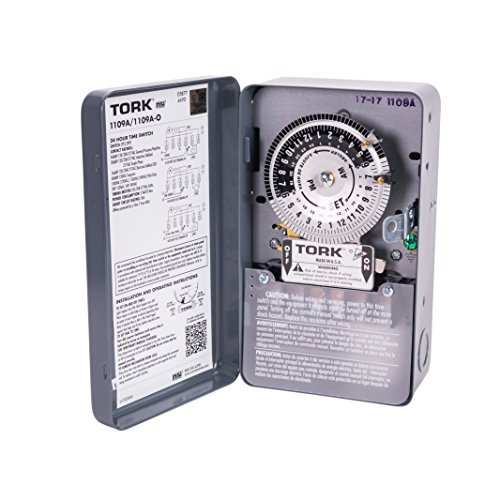
TORK 1109A Mechanical Timer — Best Overall
The TORK 1109A is the timer electricians reach for when the job is straightforward: switch a real load, on a real schedule, for years, with nothing to configure beyond pushing trippers around a dial. Its 40-amp contact rating is generous for a mechanical unit, and the multi-voltage design means the same device serves a 115/120V household circuit or a higher-voltage commercial one without a variant hunt. It suits homeowners automating exterior lighting, small commercial users running signage, and anyone replacing a failed timer who wants the new one to be a known quantity.
Strengths
- 40-amp contacts handle substantial lighting and appliance loads without an external contactor in most residential cases
- Multi-voltage operation covers household 115/120V service and higher voltages with one model
- Mechanical dial is set in seconds and can be inspected at a glance — the schedule is physically visible
Trade-offs
- The schedule repeats every 24 hours; there is no weekday/weekend split
- No astronomic function, so lighting schedules drift out of step with sunset across the seasons unless you reset the trippers
- Indoor enclosure on this variant — outdoor locations need the outdoor-rated sibling below
| Specification | Detail |
|---|---|
| Contact rating | 40 amp (per listing) |
| Voltage | 120/208-277 volt multi-volt |
| Programming | 24-hour mechanical dial, multiple on/off settings |
The case for a mechanical timer in a digital age is failure behavior. The 1109A’s clock motor and tripper mechanism have exactly one job, and when power fails the schedule simply pauses and resumes offset by the outage length — annoying for a day, but the device never loses a programmed calendar, never needs a battery, and never bricks itself. For loads like landscape lighting, a pool light, or a workshop circuit, that simplicity is the feature. Setting it is equally blunt: pull the dial to the current time, push the on and off trippers to the hours you want, and walk away. Anyone who encounters the timer later — a new homeowner, a maintenance tech — can read the schedule off the dial without a manual.
Where the 1109A earns its Best Overall badge over cheaper plug-in timers is the contact block. Forty amps of switching capacity, in a hardwired enclosure, is a different class of device from a 15-amp plug-in gadget: it can sit on a dedicated circuit and switch the whole load directly. That said, respect the inductive derating rule — motors and magnetic ballasts stress contacts far more than resistive loads of the same amperage, so a large motor load still belongs on a contactor with the timer driving the coil. Used within its ratings, this is the timer most readers should buy, and the one least likely to need replacing.
Best for: general lighting and appliance schedules on a repeating daily cycle / Not suited for: schedules that change by weekday or follow sunset
Check on Amazon — check the current price on Amazon and confirm the exact variant before ordering.

TORK TU40 Mechanical Timer — Best for Heavy-Duty Appliance Loads
The TU40 is TORK’s appliance-focused mechanical timer, and its pitch is durability in imperfect locations: the listing rates it for indoor and outdoor use, which makes it a natural fit for a timer mounted near a water heater, a well pump, or an exterior disconnect. It suits homeowners chasing the classic energy-saving play of running a water heater only during the hours hot water is actually used, and anyone whose timer lives in a garage, basement, or weather-exposed enclosure rather than a finished wall.
Strengths
- Indoor/outdoor rating removes the enclosure guesswork for garages, basements and exterior mounts
- 40-amp contacts suit genuine appliance loads, not just lighting
- Mechanical operation means no battery, no firmware and no app account standing between you and a working schedule
Trade-offs
- Daily-repeat schedule only, like all mechanical dial timers
- Fewer programming refinements than digital switches — this is an on/off workhorse
- Hardwired installation; not a plug-in convenience device
| Specification | Detail |
|---|---|
| Contact rating | 40 amp (per listing) |
| Voltage | 120-277 volt |
| Enclosure | Indoor/outdoor mechanical appliance timer |
The water-heater use case deserves a moment, because it is where a timer like the TU40 pays for itself most clearly. A storage water heater reheats and holds temperature around the clock, including the eight hours nobody is home and the six hours everybody is asleep. Restricting it to morning and evening windows with a 40-amp timer trims that standby loss without touching comfort, provided the tank is sized so a single heating window covers the household’s peak draw. The TU40’s job in that setup is simply to be boring for a decade: switch a heavy resistive load twice a day, in a warm utility space, without complaint. Its indoor/outdoor rating is what separates it from the indoor-only 1109A for this role.
The same logic covers pool and spa circulation pumps, attic fans, and similar fixed loads, with the standing caveat about motor ratings: check the horsepower rating for your specific motor rather than assuming the 40-amp headline covers it. Installation is a licensed-electrician job for most homeowners — the timer interrupts a hardwired circuit — and that one-time cost is worth paying rather than improvising. Once installed, the TU40 asks for nothing except a tripper adjustment when the seasons or the household routine change.
Best for: water heaters, pumps and other heavy appliance loads on a daily schedule / Not suited for: fine-grained multi-event programming or smart control
Check on Amazon — check the current price on Amazon and confirm the exact variant before ordering.

TORK EWZ201C Digital Time Switch — Best Digital Programmable
The EWZ201C is where this guide moves from clockwork to calendar. Two independent channels mean one device can run, for example, exterior lighting on a seven-day pattern and a second load — a fan, a sign, a pump — on a completely different one, and the 7-day programming means Saturday no longer has to pretend to be Tuesday. It suits small commercial spaces, schools and churches with genuinely weekly routines, and homeowners whose lighting schedule differs between workdays and weekends.
Strengths
- Two channels in one enclosure replace two separate timers and keep both schedules in one place
- 7-day programming supports distinct weekday and weekend patterns
- SPST/DPST configurability covers single-circuit and two-pole switching needs
Trade-offs
- Programming takes longer to learn than pushing mechanical trippers
- Digital controls depend on internal backup power to hold the schedule through outages — check the manual for its behavior
- More capability than a simple daily load will ever use
| Specification | Detail |
|---|---|
| Channels | 2-channel (per listing) |
| Programming | 7-day digital |
| Configuration | SPST/DPST |
Two-channel control is the feature readers most often undervalue until they price the alternative. Two mechanical timers mean two enclosures, two dials drifting independently, and two devices to reset after every outage and every daylight-saving change. The EWZ201C consolidates that into one programmed unit with a shared clock, which is why it shows up in small commercial work: a storefront’s sign and its parking lighting, a school’s bells-adjacent loads, a workshop’s compressor and its exterior lights. The 7-day calendar also handles the most common residential upgrade request — lights that run later on Friday and Saturday — without any astronomic complexity.
The honest cost is the interface. Digital time switches are programmed in a deliberate session with the manual open, pressing through menus that reward patience and punish guessing. Budget twenty minutes for the first setup and keep the manual with the panel paperwork afterward. In exchange you get precision a dial cannot offer: events to the minute, different events on different days, and a schedule that survives your forgetting about it. For a single daily load, stay mechanical; for anything with a weekly rhythm, this is the pick.
Best for: two separate schedules or two circuits on different weekly patterns / Not suited for: users who want set-and-forget mechanical simplicity
Check on Amazon — check the current price on Amazon and confirm the exact variant before ordering.

NSI TORK WFTU40 Smart Time Switch — Best Smart Timer
The WFTU40 takes the TU40-class hardware idea — a heavy-duty 40-amp switch in an indoor/outdoor enclosure — and adds the two things mechanical and basic digital timers cannot do: remote control from a phone, and a schedule you can change without opening the enclosure. It suits vacation-property owners, landlords, and small-business operators who need to override a schedule from across town, and homeowners who already run the rest of the house from an app and want the water heater or pool equipment to live there too.
Strengths
- Wi-Fi app control allows schedule changes and manual override from anywhere
- 40-amp rating keeps it in the heavy-load class rather than the plug-in gadget class
- 7-day scheduling plus app management suits properties you do not visit daily
Trade-offs
- Depends on Wi-Fi coverage at the enclosure — a metal outbuilding can be a dead zone
- App ecosystems change over a device lifetime that may exceed the app support window
- Setup is the most involved in this guide
| Specification | Detail |
|---|---|
| Contact rating | 40 amp (per listing) |
| Connectivity | Wi-Fi with app integration |
| Programming | Smart 7-day time switch, multi-voltage |
The genuine use case for a smart hardwired timer is distance. A vacation home’s water heater and exterior lighting, a rental’s pool pump, a small warehouse’s signage — these are loads whose schedules change with occupancy, and occupancy is exactly what you learn about when you are not standing in front of the timer. The WFTU40 lets the schedule follow the booking calendar instead of the seasons. Its 40-amp contacts matter here too: the smart plug category tops out at light resistive loads, while this device switches the same class of load as the mechanical workhorses elsewhere in this guide.
Balance that against infrastructure. The switch needs a stable Wi-Fi signal at its mounting point, which is a real constraint for detached garages, pump houses, and metal enclosures; test the signal with a phone at the exact spot before ordering. It also ties a ten-year hardware decision to a software service, so keep the manual override behavior in mind — the device should still run its last schedule if the network drops, and you should confirm that behavior during setup. For a property you visit daily, this is overkill; for one you visit monthly, it is the most useful timer here.
Best for: owners who want remote override and app scheduling on a heavy load / Not suited for: locations without reliable Wi-Fi or users avoiding app-dependent devices
Check on Amazon — check the current price on Amazon and confirm the exact variant before ordering.

Intermatic ET91615CR Astronomic Timer — Best for Dusk-to-Dawn Lighting
The ET91615CR solves the oldest annoyance in lighting control: a fixed schedule is wrong for half the year. Set lights for a December sunset and they burn an hour of daylight in June; set them for June and the property is dark before people get home in winter. An astronomic timer computes sunrise and sunset from the date and your location, then switches accordingly. This Intermatic unit adds a full 365-day calendar for holidays and exceptions, SPDT contacts, and a steel Type 3R enclosure built for outdoor mounting. It suits commercial exteriors, parking and signage lighting, and serious residential landscape installations.
Strengths
- Astronomic switching tracks the sun automatically — no seasonal tripper adjustments
- 365-day calendar handles holidays and one-off exceptions alongside the daily pattern
- Type 3R steel enclosure is built for outdoor, exposed mounting
Trade-offs
- 30-amp rating is a step below the 40-amp TORK units — check motor and ballast loads carefully
- Programming depth is the highest in this guide; expect a real setup session
- Premium-tier device priced for commercial duty, over-specified for a porch light
| Specification | Detail |
|---|---|
| Contact rating | 30 amp SPDT (per listing) |
| Voltage | 120-277 volt |
| Programming | 365-day astronomic |
| Enclosure | Type 3R steel |
Astronomic control changes the maintenance story of exterior lighting completely. Instead of four seasonal visits to nudge a dial, the timer is programmed once with its location, and dusk simply arrives at the right time every day of the year. The 365-day calendar layers exceptions on top: the office that stays dark on holidays, the retail sign that runs late during a December promotion, the school whose schedule pauses for summer. SPDT contacts add flexibility for control schemes that need a normally-closed path as well as a normally-open one, which is why this class of control shows up in energy-management work rather than only in simple on/off duty.
Choose it with clear eyes about scale. The enclosure, the programming model, and the price tier all assume a lighting system worth managing — multiple fixtures, a property where light at the wrong time is either a cost or a safety issue. A single porch light is better served by a photocell or one of the mechanical picks. But for the reader whose actual problem is ‘my lights are wrong half the year and I am tired of fixing it,’ this is the definitive answer in the guide, and its steel outdoor enclosure means it can live where the work is.
Best for: exterior lighting that must track sunset and sunrise all year / Not suited for: simple indoor appliance schedules
Check on Amazon — check the current price on Amazon and confirm the exact variant before ordering.

TORK 1109A-O Outdoor Timer — Best Outdoor Mechanical
The 1109A-O exists for a simple reason: timers for exterior lighting, pool equipment, and outbuilding circuits often have to live outside, and an indoor enclosure in that job is a slow failure. This variant keeps everything that makes the 1109A the default mechanical choice — 40-amp contacts, multi-voltage operation across 120/208-277V, a 24-hour dial with multiple on/off settings — and puts it in an enclosure rated for indoor/outdoor use. It suits homeowners and property managers whose control point is a exterior wall, a pool pad, or a detached structure.
Strengths
- Outdoor-rated enclosure suits pool pads, exterior walls and outbuildings
- Same proven 40-amp mechanical platform as the Best Overall pick
- Multi-voltage design covers household and light commercial circuits alike
Trade-offs
- Still a 24-hour repeat schedule — no weekly or astronomic programming
- Mechanical dial needs manual correction after extended power outages
- Costs more than the indoor variant for the same switching capability
| Specification | Detail |
|---|---|
| Contact rating | 40 amp (per listing) |
| Voltage | 120/208-277 volt multi-volt |
| Programming | 24-hour mechanical, multiple on/off settings |
| Enclosure | Indoor/outdoor |
Think of the choice between the 1109A and the 1109A-O as purely a question of where the device will live. Electrically and mechanically they are the same platform; the premium buys weather resistance, and weather resistance buys service life. An indoor timer mounted outdoors does not usually fail dramatically — it corrodes, its dial stiffens, condensation works into the mechanism, and one season the schedule quietly stops being kept. For a pool light, a driveway lighting circuit, or a barn’s exterior lights, the outdoor variant is not an upgrade so much as the correct specification.
In use it behaves exactly like its sibling: set the time, place the trippers, and the load follows the same pattern daily. Landscape lighting owners should pair that daily pattern with seasonal tripper checks — a mechanical dial cannot follow sunset — or step up to the astronomic Intermatic if the drift matters. For fixed-time loads like pool circulation windows, irrigation controls, or security lighting on a set curfew, the daily repeat is not a limitation at all. Buy the enclosure your mounting location demands and the mechanism will do the rest for years.
Best for: outdoor lighting and appliance loads on a daily schedule / Not suited for: weekly programming or sunset tracking
Check on Amazon — check the current price on Amazon and confirm the exact variant before ordering.
Comparison Table
| Pick | Badge | Key spec | Best for |
|---|---|---|---|
| TORK 1109A Mechanical Timer (Check on Amazon) | Best Overall | 40A multi-volt mechanical, 24-hour dial | general lighting and appliance schedules on a repeating daily cycle |
| TORK TU40 Mechanical Timer (Check on Amazon) | Best for Heavy-Duty Appliance Loads | 40A, 120-277V, indoor/outdoor mechanical | water heaters, pumps and other heavy appliance loads on a daily schedule |
| TORK EWZ201C Digital Time Switch (Check on Amazon) | Best Digital Programmable | 2-channel, 7-day digital, SPST/DPST | two separate schedules or two circuits on different weekly patterns |
| NSI TORK WFTU40 Smart Time Switch (Check on Amazon) | Best Smart Timer | 40A smart, Wi-Fi app, 7-day, indoor/outdoor | owners who want remote override and app scheduling on a heavy load |
| Intermatic ET91615CR Astronomic Timer (Check on Amazon) | Best for Dusk-to-Dawn Lighting | 30A SPDT, 365-day astronomic, Type 3R steel enclosure | exterior lighting that must track sunset and sunrise all year |
| TORK 1109A-O Outdoor Timer (Check on Amazon) | Best Outdoor Mechanical | 40A multi-volt mechanical, indoor/outdoor, 24-hour | outdoor lighting and appliance loads on a daily schedule |
Read the table by load first and features second. The contact rating and the load type it can safely switch decide whether a timer belongs on your circuit at all; only after that filter do programming style and connectivity matter. Note that headline amperage is a resistive rating — motors, pumps, and magnetic ballasts all require checking the device’s lower inductive or horsepower rating for your specific load.
How to Choose a 115 Volt Electrical Timer
Start with the load, because it eliminates most of the catalog. Write down what the timer will switch: the device’s amperage, and whether it is resistive (heaters, incandescent lighting), inductive (motors, pumps, fans), or electronic (LED drivers, ballasts). Match that against the timer’s rating for that load type, not its headline number. A 40-amp resistive rating might correspond to a far smaller motor rating, and exceeding the inductive rating is how timer contacts weld shut. If your load exceeds every timer’s direct rating, the correct design is a contactor rated for the load with any timer in this guide driving the contactor’s coil — a standard, inexpensive arrangement an electrician will recognize immediately.
Next, describe your schedule honestly. If the load runs the same hours every day of the year — a water heater’s morning and evening windows, a pump’s daily circulation — a mechanical 24-hour timer is not a compromise; it is the most reliable tool for the job. If weekdays and weekends differ, you need 7-day digital programming. If the load is lighting and the correct switch time is ‘dark,’ you need astronomic control or a photocell, because no fixed schedule survives the seasons. And if the schedule changes with occupancy you learn about remotely, a Wi-Fi switch earns its complexity. Buying more schedule than you need adds setup burden and failure modes; buying less guarantees a daily annoyance.
Finally, place the device. Indoor finished space can take any enclosure in this guide. Garages, basements, and utility areas favor at least an indoor/outdoor-rated unit for humidity alone. Exposed outdoor mounting demands a properly rated enclosure — the outdoor TORK variant or the Intermatic’s Type 3R steel box — and, for the smart switch, a Wi-Fi signal check at the exact mounting point. Consider who will interact with the timer in three years: a mechanical dial explains itself to any future owner, while a programmed digital or app-based switch should leave its manual and credentials with the property paperwork.
Mechanical vs Digital vs Smart Timers: Which Mechanism Fits Your Life?
Mechanical timers trade flexibility for transparency. The schedule is physical — trippers on a dial — so it can be verified with a glance and changed with cold fingers in an unheated garage. They shrug off the small surges and brownouts that age electronics, hold no data that can be lost, and fail in obvious ways. Their limits are equally physical: one pattern per day, minute-level imprecision, and a clock that stops when the power does. For the large class of loads whose schedule genuinely never changes, those limits never bind, which is why two of the six picks in this guide — three counting the outdoor variant — are mechanical.
Digital time switches trade that transparency for a calendar. Seven-day and 365-day programming, astronomic calculation, and multiple channels let one device describe a real institution’s week: the shop, the school, the house of worship, the office. The costs are a learning curve at setup, a dependence on backup power to ride through outages, and an interface a future maintainer will need documentation to change. Smart switches add a network layer on top of the digital model: remote override and app scheduling, purchased with Wi-Fi dependence and a software ecosystem whose lifespan is shorter than the hardware’s. Neither trade is right or wrong in general — the correct question is which failure you would rather manage: resetting a dial after an outage, or re-teaching a calendar to a new owner.
What a Timer Can and Cannot Save You
Timers save money in exactly one way: they stop a load from running during hours when its output is wasted. The canonical cases are storage water heating, where standby loss accrues around the clock; circulation and filtration, where more hours than necessary are commonly scheduled out of caution; and lighting, where fixtures burn into empty rooms, empty lots, and eventually into daylight itself as the seasons shift. In each case the saving is real but bounded — a timer cannot make a device more efficient while it runs, only absent while it is not needed. Readers estimating a payback should multiply the load’s draw by the hours genuinely eliminated, not by the hours in the new schedule.
The corollary is that a timer is the wrong purchase when the load’s runtime is already honest. A refrigerator, a sump pump standing guard, a network rack, medical or security equipment — these run when they run for reasons a schedule cannot improve, and putting them on a timer adds a failure point without removing a single wasted hour. The discipline this guide recommends is an audit before an order: list the loads you suspect, estimate each one’s truly wasted hours from a week of observation, and buy control only for the loads where the waste is provable. That audit is also what tells you which mechanism to buy, because the pattern of the waste — daily, weekly, seasonal, or occupancy-driven — is the pattern of the timer that fixes it.
How to Install and Set a Hardwired Timer Safely
Hardwired timer installation interrupts a live circuit, so the first step is always the breaker: switch it off, verify the conductors are dead with a tester you trust, and only then open the enclosure. If any part of that sentence is outside your experience, hire an electrician — the labor is a small fraction of the cost of a mistake, and several picks in this guide switch loads large enough to make mistakes unforgiving. Mount the enclosure where it will stay dry within its rating, where the dial or display can be reached without a ladder, and where a Wi-Fi model — if you chose one — demonstrably receives signal.
Wire the line and load exactly as the device’s diagram specifies; timers are not interchangeable in their terminal layouts, and a swapped pair can leave the load permanently live or the clock unpowered. Set the clock to the correct current time before placing any schedule — on mechanical dials this is the step everyone rushes and the cause of most ‘the timer is broken’ reports, which are usually ‘the timer is keeping a schedule six hours off.’ Program one on/off cycle, then test with the manual override: confirm the load actually switches, confirm it switches back, and only then set the full schedule. Finish by labeling the enclosure with the circuit it controls and the date, and file the manual with the panel. A timer nobody can identify is a timer the next person will bypass.
Common Buying Mistakes
- **Sizing by the headline amperage.** The big number on the box is a resistive rating; motors and ballasts must be checked against the lower inductive or horsepower rating.
- **Putting an indoor timer outdoors.** Condensation and corrosion kill it slowly; match the enclosure to the mounting location.
- **Buying a calendar for a daily job.** A 365-day astronomic control running a water heater is money spent on programming you will never use.
- **Forgetting the clock after an outage.** Mechanical timers resume offset by the outage length; check the dial after any extended power loss.
- **Skipping the override test.** Program, then manually switch the load on and off at the timer before trusting the schedule.
- **No plan for the next owner.** An undocumented programmed timer gets bypassed; leave the manual and a label.
Every one of these mistakes shares a root: treating the timer as a gadget instead of as part of the circuit. A timer is a switch that happens to have a clock, and it deserves the same respect in selection and installation as any other switching device — correct ratings, correct enclosure, correct wiring. Get those three right and the choice among the six picks above is genuinely a matter of taste in schedules. Get any of them wrong and no feature list will save the installation.
Final Recommendation
For most readers, the recommendation is the TORK 1109A: a 40-amp mechanical timer that will keep a daily schedule for years with nothing asked of you but a tripper adjustment when your routine changes. If the mounting point is outdoors, buy its sibling, the 1109A-O, and consider the enclosure question closed. If the load is a heavy appliance in a garage or utility space, the TU40 covers the same ground with an appliance focus. Those three mechanical picks are the guide’s center of gravity, and choosing among them is a matter of location, not capability.
Step up only when your schedule demands it. A genuinely weekly rhythm — different hours on weekends, two circuits on different patterns — is the EWZ201C’s home turf. Exterior lighting that must follow the sun belongs to the Intermatic ET91615CR and its astronomic calendar. A property you manage from a distance justifies the WFTU40’s app control, provided its Wi-Fi signal checks out. Readers comparing control strategies across the house may also find our related guides useful: Best 115 Volt Air Conditioner for the loads themselves, Best 1 Phase 230 Volt Tork Timer Spdt for the timer family in another voltage class, and Best 115 Volt Marine 16000 Air Conditioner for the marine branch of household-voltage equipment.
- TORK 1109A Mechanical Timer — Check on Amazon
- TORK TU40 Mechanical Timer — Check on Amazon
- TORK EWZ201C Digital Time Switch — Check on Amazon
- NSI TORK WFTU40 Smart Time Switch — Check on Amazon
- Intermatic ET91615CR Astronomic Timer — Check on Amazon
- TORK 1109A-O Outdoor Timer — Check on Amazon
Frequently Asked Questions
Is 115 volt the same as 110 or 120 volt for timer selection?
Yes, for practical purposes. These are all labels for the same nominal North American household supply, which varies within a tolerance band in real service. A timer listed for 120V, or a multi-voltage timer spanning 120-277V, is correct for a circuit described as 115 volt. What matters is that the device’s rated range includes your supply, which every pick in this guide satisfies.
Can one timer control both lighting and a motor load?
Only if both loads are within the timer’s ratings for their respective types and on a compatible circuit — and it is usually poor practice. Lighting and motor loads have different schedules and very different switching stress. The standard solution is separate timers, or one timer driving separate contactors. Check the inductive rating, not the headline amperage, before combining anything with a motor.
What happens to my schedule when the power goes out?
It depends on the mechanism. A mechanical timer’s clock stops during the outage and resumes afterward, so the schedule shifts by the outage length until you reset the dial. Digital switches typically hold their program in memory and ride through on backup power, resuming on time. Smart switches reconnect to the network and resync their clock automatically once power and Wi-Fi return.
Do I need an electrician to install a hardwired timer?
In most jurisdictions you are permitted to work on your own home’s wiring, but permission and wisdom are different questions. A hardwired timer interrupts a circuit carrying real current, and several picks here switch up to 40 amps. If you are not confident identifying line and load conductors and verifying a dead circuit, hire an electrician; the visit is brief and the work is then known to be correct.
What is an astronomic timer and do I need one?
An astronomic timer calculates sunrise and sunset from the date and your location, then switches at those times rather than at fixed clock times. You need one if your load is exterior lighting and you are tired of a schedule that is wrong for half the year. If your lighting runs on a fixed curfew or your loads are appliances and pumps, a standard daily or weekly timer does the job for less.
Can a timer reduce my water heater’s energy use?
It can reduce standby loss by limiting the hours the heater maintains temperature, which is meaningful for households with predictable routines and a tank large enough to cover peak use from one heating window. It will not change the energy needed to heat the water you actually use. A 40-amp mechanical timer such as the TU40 or 1109A is the usual hardware choice; confirm the heater’s draw against the timer’s rating first.


