Disclosure: airfryerkitchensupply.com is reader-supported. When you buy through links on our site, we may earn an affiliate commission at no extra cost to you.
The best baby toilets for infants are not training toilets at all, and this guide begins by refusing to pretend otherwise. An infant — in the first year of life — cannot sit independently for long, cannot signal deliberately, and cannot learn continence in any developmental sense. What infant-appropriate potties actually provide is a safe, right-sized place for elimination communication practice and early potty familiarity: a tiny bowl a caregiver can hold a baby over, or a low, supported potty for the older infant who is beginning to sit. Everything in this guide is judged against that honest purpose.
The shortlist leads with the products genuinely designed or sized for infants — an EC mini potty and BabyBjörn’s two infant-suitable potties — then covers the multi-stage and later-stage products that complete a family’s arc, each clearly badged with the stage it truly serves. All were verified against Amazon’s catalog, and manufacturer age guidance found in the listings is respected rather than argued with. The standing safety rules of this category apply on every line: an infant on a potty is held or watched at arm’s reach, the potty sits on the floor, and the session ends the moment the baby objects.
One reassurance to close the introduction: nothing in the infant stage is irreversible or urgent. A family that buys the compact potty at four months, tries offers at six, pauses at eight and resumes at ten has done everything ‘right’ — because the entire method is responsiveness, and responsiveness includes responding to weeks when nobody has the energy. The products below will fit that rhythm whenever you pick it up.
Where to buy
The confirmed picks in this guide are sold through Amazon, where you can check the current price on Amazon for each item, confirm the maker’s age guidance and dimensions on the listing, and order a lightweight product that arrives in days. Start with these confirmed options:
- BabyBjörn Smart Potty, Deep Green/White — Best First Infant Potty: Check the current price on Amazon
- The Baby Potty Mini V2.0 — Best for Elimination Communication: Check the current price on Amazon
- BabyBjörn Potty Chair, Deep Green/White — Best Supported Infant Seat: Check the current price on Amazon
- Munchkin Arm & Hammer Multi-Stage 3-in-1 Potty — Best Multi-Stage Value: Check the current price on Amazon
- BabyBjörn Toilet Trainer, White/Gray — Best Toilet Trainer for Later: Check the current price on Amazon
- Frida Drop Down Potty Training Seat — Best Family Seat for Later: Check the current price on Amazon
Read the listing’s own age and stage guidance before ordering — in this category the manufacturers are generally honest, and where a title says toddler, this guide believes it and badges the product accordingly.
In this guide
Quick Picks
- Best First Infant Potty: BabyBjörn Smart Potty, Deep Green/White — The benchmark compact potty — low and simple enough for held-over infant use, durable enough for toddlerhood — Check price on Amazon
- Best for Elimination Communication: The Baby Potty Mini V2.0 — Sized for the youngest babies and designed explicitly around EC practice — Check price on Amazon
- Best Supported Infant Seat: BabyBjörn Potty Chair, Deep Green/White — Backrest and armrests for the older infant learning to sit on a potty with confidence — Check price on Amazon
- Best Multi-Stage Value: Munchkin Arm & Hammer Multi-Stage 3-in-1 Potty — One purchase that converts from floor potty to toilet seat to step stool across the stages — Check price on Amazon
- Best Toilet Trainer for Later: BabyBjörn Toilet Trainer, White/Gray — The final-stage seat from the same trusted line — adjustable to fit the adult toilet securely — Check price on Amazon
- Best Family Seat for Later: Frida Drop Down Potty Training Seat — A permanently attached child seat that flips down — no loose rings to store at the training stage — Check price on Amazon
How These Picks Were Chosen
Verification followed the program’s standing method: brand-and-model searches through the airfry site’s Amazon listing data, with the returned Amazon title matched to the product reviewed before any link was granted. Infant products attract sentimental marketing, so the filter here was unusually concrete: physical size, support structure, cleanability and the maker’s stated stage. A product failing the infant test could still appear — this category’s buyers plan whole arcs — but only under a badge naming its real stage.
Three design facts dominated the infant rankings. First, the bowl must be small: an infant’s bottom is supported by a mini potty and swallowed by a toddler one, and support is safety at this age. Second, the whole object must rinse clean in seconds, because it is washed after every use and any crevice becomes a hygiene project. Third, stability: a non-slip base on a hard floor, at floor level, with no elevation, no ladder and no mechanism between the baby and the ground. Products embodying those facts — whatever their brand fame — outrank larger, cleverer designs for the infant stage specifically.
No developmental claims are made anywhere in this guide. Elimination communication is presented as an optional caregiving practice with practical conveniences, not a milestone, a competition or a predictor of later training speed.
A note on what was excluded entirely: ladder-style toilet seats and step-up trainers were not merely badged down but left off this infant list, because their entire mechanism — climbing — is outside infant capability, and their presence in infant search results is a keyword accident rather than a product category. Families will meet them at the correct stage in the toddler guides.
The 6 Best Baby Toilets for Infants

BabyBjörn Smart Potty, Deep Green/White — Best First Infant Potty
The BabyBjörn Smart Potty earns the top badge for infants on the strength of proportion: it is low, compact and stable, with a removable inner potty and a non-slip base, from the maker whose name defines this category. For a young infant it serves as a held-over potty during elimination communication; for an older infant beginning to sit, it is a floor-level first seat with an adult’s hands providing the backrest. It suits parents who want one trusted, simple object for the whole first phase. Parents who want built-in back support should take the Potty Chair as the companion or alternative.
Strengths
- Low, compact proportions suit infants better than any tall or feature-loaded design
- Removable inner potty rinses clean in seconds — the decisive trait at infant usage frequency
- Non-slip base and one-piece simplicity: nothing to assemble, break or hide grime
Trade-offs
- No backrest — young infants are held or hand-supported throughout
- Compact bowl is outgrown before the toddler training peak; a chair follows it
- Plain design offers none of the play features toddlers (not infants) enjoy later
| Specification | Detail |
|---|---|
| Type | Compact floor potty |
| Insert | Removable inner potty |
| Base | Non-slip |
Infant products succeed by subtraction. Every feature omitted here — sounds, lids, steps, characters — is a surface that does not need disinfecting and a mechanism that cannot pinch, stick or startle. What remains is geometry: a bowl small enough to support a small baby, a stance low enough to keep the experience at ground level, and materials smooth enough to wash thoughtlessly. That is the correct specification for the first year, and the Smart Potty is its reference implementation.
The deep green colorway is more than a style choice for some families: darker, design-led baby gear survives visual fatigue in a small home better than primary-colored plastic, and an object you will see twenty times a day for two years is worth choosing with your eyes open. Function identical, tolerance longer — a real if unglamorous buying factor at this stage of parenting.
Plan the handoff in advance: this potty’s second career is as the travel and car potty once a supported chair takes over the bathroom. Bought with that arc in mind, its cost per use across three years is among the lowest in the nursery.
Best for: Parents wanting the reference compact potty for the infant phase / Not suited for: Anyone wanting built-in back support from day one
Check the current price on Amazon

The Baby Potty Mini V2.0 — Best for Elimination Communication
If the Smart Potty is the mainstream answer, the Baby Potty Mini V2.0 is the specialist’s: a mini potty designed from a blank page for early training and elimination communication, sized for babies still in arms. It suits committed or curious EC families who will offer the potty many times a day and need it to come to the baby — during changes, after feeds, on waking — rather than the reverse. It will be outgrown earliest of all the picks here, and for a family starting at toddler age it is simply the wrong tool.
Strengths
- The smallest, most infant-appropriate bowl geometry in this guide
- Explicitly designed for elimination communication — the main infant use case
- Portable and lightweight enough to live wherever diaper changes happen
Trade-offs
- Shortest service life — a toddler chair replaces it as the baby grows
- Minimal structure: all support comes from the caregiver
- EC is a routine the parents maintain; the potty enables but cannot create it
| Specification | Detail |
|---|---|
| Type | Mini floor potty |
| Design purpose | Early training / elimination communication (per Amazon title) |
| Portability | Portable, lightweight |
EC lives or dies on friction. The offer must happen in the seconds when the moment is available, which means the potty must be in the room, in reach, and instantly cleanable afterward. The Mini V2.0’s entire design is an argument about friction: small enough to hold one-handed alongside a baby, light enough to travel between rooms and houses, simple enough to rinse without a second thought. Families who practice even part-time EC will feel that argument vindicated daily.
Positioning a young infant over a mini potty is a held technique — baby supported against the caregiver’s body, thighs supported, over the bowl — and the potty’s size is what makes that hold ergonomic rather than awkward. As sitting emerges, the same potty transitions to a floor seat with hands-on support. One object, two techniques, no stage where it is the wrong size during the first year: that continuity is its real specification.
Buy it without ceremony and without a program. Families who treat EC as a standing invitation rather than a regimen keep the practice longest, and a cheap, perfectly sized potty is what makes the invitation effortless to extend.
Best for: EC-practicing families from the earliest months / Not suited for: Families starting at toddler age, or wanting one potty for all stages
Check the current price on Amazon
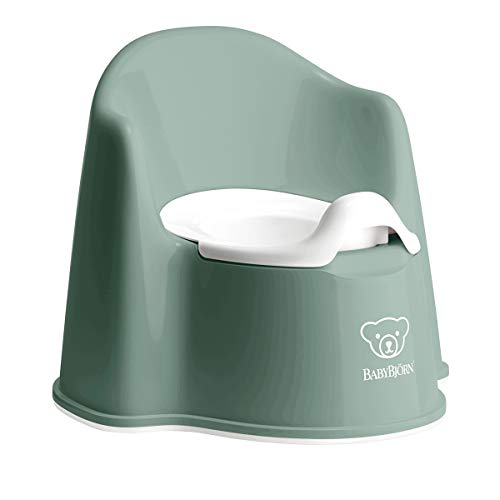
BabyBjörn Potty Chair, Deep Green/White — Best Supported Infant Seat
The Potty Chair is the supported end of the infant spectrum: a high backrest and armrests that let an older infant — sitting steadily, roughly the second half of the first year — sit on a potty with structure around them instead of only a caregiver’s hands. It suits families who tried a mini potty and want the next step, and it continues seamlessly into the toddler training stage, giving it the longest useful life of the infant-suitable picks. It is too much chair for a young infant not yet sitting, and too bulky to serve as the portable EC potty.
Strengths
- Backrest and armrests provide the support that turns held sits into seated sits
- Removable inner potty keeps cleaning identical to the Smart Potty
- Serves from supported infant sits through independent toddler training
Trade-offs
- Requires a baby who can sit with minimal help — not a young-infant product
- Largest footprint of the infant picks; a fixed bathroom resident
- Higher seat than the minis — the youngest sitters start lower
| Specification | Detail |
|---|---|
| Type | Potty chair with backrest |
| Insert | Removable inner potty |
| Base | Non-slip |
Support is a developmental bridge. The infant who has been held over a mini potty knows the routine but not the posture; the chair’s backrest and arms teach the posture — seated, balanced, relaxed, feet down — that independent toileting will eventually require. That is why this chair, alone among the infant picks, is also a genuine training product: the same object serves the held baby’s successor, the seated infant, and then the standing, climbing toddler who uses the armrests as push-off points.
The deep green finish pairs with the Smart Potty pick above as a deliberate two-potty system in one color family — mini for portability and early months, chair for the bathroom and the long arc. Families who value a calm-looking nursery will find the pair easier to live around than a rainbow of stage purchases, and both pieces share the same rinse-and-done cleaning logic.
Judge its size honestly against your bathroom before ordering: in a very small room, the Smart Potty alone may be the workable system, with the chair arriving only when training truly begins. The chair rewards space; it does not create it.
Best for: Older infants ready for supported sits, and one-purchase planners / Not suited for: Young infants, travel use, or very small bathrooms
Check the current price on Amazon
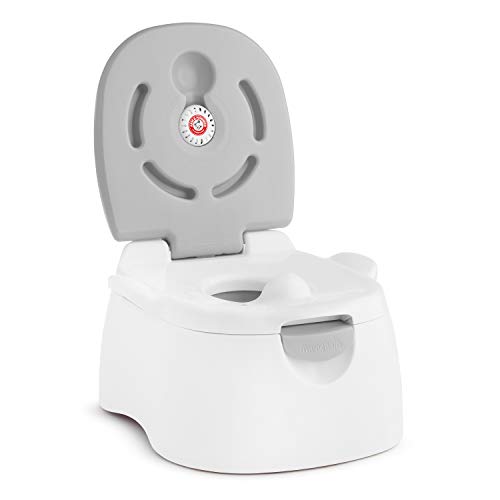
Munchkin Arm & Hammer Multi-Stage 3-in-1 Potty — Best Multi-Stage Value
The Munchkin 3-in-1 approaches the arc from the value end: a floor potty for the middle stage whose seat later mounts the family toilet and whose base becomes a step stool. For infants specifically it is a later purchase — the floor potty stage suits a sitting, growing baby rather than a young infant — but as a single buy covering three stages it is the economical planner’s pick. It suits budget-led families furnishing for the year ahead. Families practicing EC from early months still need a true mini potty first; this is the successor, not the starter.
Strengths
- Three stages in one purchase: floor potty, on-toilet seat, step stool
- The step-stool stage solves the climb-up problem the on-toilet seat creates
- Established brand and a design sold for years — a known quantity
Trade-offs
- Floor potty is toddler-scaled — not the right size for a young infant
- Multi-stage compromises: each stage is good rather than best-in-class
- More parts and seams to clean than the one-piece infant potties
| Specification | Detail |
|---|---|
| Type | Multi-stage 3-in-1 potty system |
| Stages | Floor potty / toilet seat / step stool (per product name) |
Multi-stage products are an argument about budgets, and it is a fair one: the potty journey otherwise involves three separate purchases, each used for a season. The 3-in-1 collapses them into one object that never leaves the bathroom, morphing as the child grows. The compromises are real — the floor potty is bigger than an infant needs, the seat is less elegant than a dedicated one — but for a family optimizing total spend and storage over per-stage perfection, this is the rational center of the category.
The step-stool afterlife deserves emphasis, because it outlasts toileting entirely: the same base that lifted a toddler to the toilet lifts a child to the sink for teeth and handwashing for years. Few nursery purchases amortize that long. Buy it when the baby is sitting well and the floor-potty stage is in view, and it will still be earning its shelf space at kindergarten.
Cleaning discipline matters more here than with the one-piece picks: the joints between stages collect what smooth molded potties never see. A weekly full disassembly wash keeps the system as hygienic as its simpler rivals — a small, schedulable price for the three-stage economy.
Best for: Budget-led families buying the middle and later stages in one object / Not suited for: Young infants, or EC practice in the first months
Check the current price on Amazon
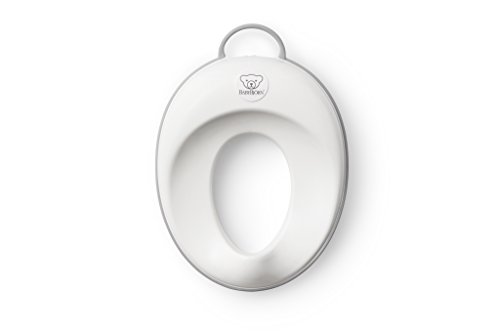
BabyBjörn Toilet Trainer, White/Gray — Best Toilet Trainer for Later
The BabyBjörn Toilet Trainer is the end of the arc: a child seat that adjusts to fit the family toilet firmly, shrinking the opening for a toddler ready to graduate from floor potties. For an infant it has no use whatsoever, and it appears in this guide — clearly badged — because infant-product shoppers are planning a sequence and deserve to see its final step from a maker they already trust. When the time comes, its dial-adjust fit solves the wobble that undermines toddler confidence on adult seats. Buy it in the training season, not the infant season.
Strengths
- Adjustable fit grips the adult toilet securely — no sliding, the toddler’s main fear removed
- Ends potty emptying: everything flushes, the adult’s favorite feature
- Same design language and quality as the infant picks — a coherent set across stages
Trade-offs
- A toddler product with zero infant application
- Requires a step stool and constant supervision at toilet height
- Must be removed and replaced for adult use unless the household has a second toilet
| Specification | Detail |
|---|---|
| Type | On-toilet trainer seat |
| Fit | Adjustable to toilet (per product line) |
Confidence is the whole curriculum at the on-toilet stage, and wobble is its enemy. A trainer that locks to the specific toilet — rather than resting hopefully on it — converts a scary perch into furniture. The BabyBjörn’s adjustment dial is the feature that matters, and it is why this seat, when its season arrives, outperforms the generic rings stacked beside it in every baby store. Sequence it after the floor potty, pair it with a sturdy stool, and the arc this guide describes is complete.
Storage is the trainer’s quiet virtue: it hangs on a hook by its handle and the bathroom returns to adult configuration in seconds. In one-bathroom homes that reversibility is not a detail — it is what makes the on-toilet stage livable for the adults sharing the room.
Buy it when the toddler starts asking for the big toilet, which is the readiness signal that outranks every age chart. Interest plus a secure seat plus a stool equals the easiest graduation in the whole potty story.
Best for: The final training stage, for toddlers graduating to the family toilet / Not suited for: Infants in any capacity — a planning pick only
Check the current price on Amazon

Frida Drop Down Potty Training Seat — Best Family Seat for Later
The Frida Drop Down takes a different route to the final stage: instead of a loose ring, it is a child seat that attaches to the adult toilet and flips down when a child needs it and up when they do not. Like the trainer above it is strictly a later-stage product — its own title addresses toddlers and kids — included so infant-stage planners can see the alternative endgame: no storage, no carrying, the child’s seat simply part of the toilet. For a household with one bathroom and a toddler approaching training, it is arguably the most livable final stage of all.
Strengths
- Permanently attached and flip-down — nothing to store, fetch or lose
- Secure attachment means no wobble, the confidence feature that matters
- One bathroom serves adults and child with a flip, not a swap
Trade-offs
- Toddlers and kids only — no infant use, by design and by title
- Installation attaches to the toilet seat hardware — a small project, not a drop-on
- Adults share a seat assembly with the child ring permanently present
| Specification | Detail |
|---|---|
| Type | Attach-and-flip child toilet seat |
| Stage | Toddlers & kids (per Amazon title) |
Every loose trainer ring creates the same household friction: where does it live, who fetched it, why is it in the bathtub. The Frida design deletes that friction by making the child seat a permanent, hinged citizen of the toilet itself. For one-bathroom families that deletion is worth more than any feature on the ring itself. It is the endgame for planners who know storage is their scarcest resource — which, in a house with an infant, it shortly will be.
Installation honesty: ‘attaches securely’ means tools and ten minutes, and a check that your toilet’s seat bolts and shape accept the mount. Do that check during the training season when you buy it — the infant season’s only task regarding this product is remembering that it exists.
Paired with a step stool, the flip-down seat gives a toddler the most independent setup in this guide: stool up, seat down, no adult equipment-handling at all. Independence was the point of the entire arc; this is where it lands.
Best for: One-bathroom families planning the training stage / Not suited for: Infants, renters who cannot modify the seat, or two-bathroom homes happy with a ring
Check the current price on Amazon
Comparison Table
| Pick | Badge | Key spec | Best for |
|---|---|---|---|
| BabyBjörn Smart Potty, Deep Green/White (check price on Amazon) | Best First Infant Potty | Compact low potty, removable inner potty, non-slip base | Parents wanting the reference compact potty for the infant phase |
| The Baby Potty Mini V2.0 (check price on Amazon) | Best for Elimination Communication | Purpose-built mini potty for early training and EC, portable | EC-practicing families from the earliest months |
| BabyBjörn Potty Chair, Deep Green/White (check price on Amazon) | Best Supported Infant Seat | High backrest and armrests, removable inner potty, non-slip | Older infants ready for supported sits, and one-purchase planners |
| Munchkin Arm & Hammer Multi-Stage 3-in-1 Potty (check price on Amazon) | Best Multi-Stage Value | 3-in-1: floor potty, toilet seat insert, step stool | Budget-led families buying the middle and later stages in one object |
| BabyBjörn Toilet Trainer, White/Gray (check price on Amazon) | Best Toilet Trainer for Later | Adjustable child seat that fits the family toilet | The final training stage, for toddlers graduating to the family toilet |
| Frida Drop Down Potty Training Seat (check price on Amazon) | Best Family Seat for Later | Seat that attaches to the adult toilet and flips down for kids | One-bathroom families planning the training stage |
How to Choose a Baby Toilet for an Infant
Choose for the infant in front of you, in this order. First, size: the bowl must support a small bottom — mini and compact potties pass, toddler chairs fail for young infants regardless of their other virtues. Second, support: either the potty provides a backrest (for the sitting older infant) or your hands provide it (for the held younger one); there is no third option and no age at which an infant sits on a potty unsupported and unattended. Third, cleaning: a removable insert, smooth surfaces, nothing electronic — the object will be washed after every use for months.
Then place the purchase in the arc honestly. The infant stage needs one small potty. The sitting stage may add a supported chair. The training stage — a year or more away — adds the realistic potties, seats and step stools reviewed in the companion guide to baby toilets for 6 month old babies and badged as later-stage picks here. Buying all stages at once is not thrift; it is storage. The exception is a deliberate gift or registry plan, where later-stage items are labeled and shelved with intent.
- Young infant, EC practice → mini potty, portable, smallest bowl
- Young infant, mainstream brand → compact low potty, held-over use
- Older infant sitting well → supported potty chair with backrest
- Budget arc purchase → multi-stage system for the stages after infancy
- Training stage (later) → adjustable trainer or flip-down family seat
Elimination Communication With an Infant: The Practical Routine
Elimination communication with an infant is a rhythm, not a regimen. The natural offer moments are waking, after feeds, and diaper changes — times when elimination is likely anyway. The caregiver holds the baby over the mini potty (young infant) or sits the baby on it with full support (older infant), makes a consistent cue sound, waits a few relaxed seconds, and finishes regardless of outcome. Caught output is a bonus; a calm baby who regards the potty as ordinary is the actual goal, because that familiarity is what transfers to later stages.
Keep the ethics of the practice in view, because they are also its mechanics: never restrain a baby on a potty, never prolong a session through fussing, never treat a miss as anything but a diaper doing its job. Families sustain EC for months precisely because it stays optional and brief. The moment it becomes a source of stress — parental or infant — the correct move is to pause for a week or a month. The potty keeps; the relationship with it is the fragile part, and it is protected by exactly this lightness.
Infant Potty Safety: The Short, Non-Negotiable List
Safety in this category is brief because it is absolute. A potty is used on the floor, never on a raised surface of any kind. An infant on or over a potty is held or within arm’s reach with eyes on them — not ‘nearby’, not ‘for a second’. Sessions are short, because infant sitting posture fatigues quickly and a tired baby slumps. Water is never involved — an infant potty is not a bath seat, a pool toy or a step to anywhere. And any potty that cracks, rocks or loses its non-slip grip is retired immediately; molded plastic is cheap and infants are not.
One more rule belongs to the later stages but is worth planting now: when the child graduates to anything at toilet height — trainer seats, flip-down seats, step stools — supervision graduates with them. Falls in this category happen at height transitions, and the household habit of ‘always in the room’ should be established in the infant stage, when it costs nothing, rather than negotiated at the toddler stage, when the child has opinions.
Reading Age Labels, Weight Limits and Marketing Claims
Infant product packaging speaks two languages at once. The regulatory language — age grades, weight limits, ‘toddler’ in a title — is written by people managing liability, and it is consistently the most honest text on the box. The marketing language — ‘start early!’, ‘for babies of all ages!’, a photograph of a young infant beside a toddler product — is written by people managing sales. This guide’s method, applied to every pick above, is to believe the regulatory language and discount the photography. Where a listing title itself says ‘Toddlers & Kids’, as the Frida seat’s does, the product is badged for toddlers and kids even though the keyword that brought you here says infants.
Weight limits deserve the same respect in the other direction: a potty a baby has outgrown by weight becomes unstable before it becomes small, and stability is the infant category’s core safety property. Check the limit when a product states one, retire products that rock or flex, and never extend a product’s life with cushions or boosters it was not designed for. The staged system this guide recommends — mini, compact, chair, seat — exists precisely so that no single product is ever asked to serve outside the envelope its maker specified.
Twins, Siblings and Second-Hand Potties: Household Logistics
Multiples change the arithmetic pleasantly: two infants in EC practice genuinely benefit from two mini potties, because offer moments arrive simultaneously and a queue is a miss. The mini and compact picks here are priced and sized for exactly that duplication, and color differences — the two BabyBjörn colorways in this guide, for instance — let each baby have an identifiable potty, a small dignity that toddlers later care about intensely. Siblings close in age create the opposite pattern: the toddler’s chair and the infant’s mini potty run in parallel in the same bathroom, and the infant’s early familiarity is often accelerated by watching the sibling — the one training aid no product can sell you.
Second-hand potties deserve a clear rule. Smooth molded plastic potties — the one-piece and removable-insert designs leading this guide — are among the few baby products that hand down safely: inspect for cracks, stress whitening or a rocking base, wash thoroughly, and the object is as serviceable as new. Multi-part systems with fabric, electronics or hidden seams do not hand down as confidently, because their hygiene history is uninspectable. When in doubt, the low cost of the infant picks here makes new the rational default — this is the cheapest category in the nursery to refuse compromise on.
How to Hold and Offer a Potty to an Infant
Technique matters more than equipment in the infant stage. Two holds cover the first year, and both keep the caregiver’s body as the baby’s support structure.
- For a young infant — the held position: sit with the potty between your feet on the floor, hold the baby facing outward with their back against your torso, one hand under each thigh, and let the baby’s bottom settle over the bowl; your body is the backrest and the security
- Make the family cue sound softly as you settle — the same sound every time — and wait a few seconds without bouncing, jiggling or urging
- Finish on the first sign of discontent: arching, fussing or crying ends the offer immediately, every time; a clean miss beats a distressed catch
- For an older infant — the supported sit: place the potty on the floor, sit the baby on it facing you, and kneel in front with hands at their torso until sitting is rock-steady; stay kneeling, stay present
- Empty the insert into the toilet and rinse it at once; the reset takes under a minute and keeps the next offer frictionless
- Dress the baby for the routine: easy-open diapers and minimal layers at offer times keep the window usable
- Offer at the rhythm points — waking, post-feed, changes — and let all other moments go; rhythm, not vigilance, is the sustainable version of this practice
Within a few weeks most families find the offers take less than a minute and the baby treats them as unremarkable as a diaper change — which is the precise definition of success at this age.
Reassess the setup at each developmental turn — rolling, sitting, pulling up. A potty corner arranged for a held newborn needs re-placing when the baby can suddenly grab, lunge or cruise along it. Thirty seconds of rearrangement at each milestone keeps the environment matched to the baby using it.
Common Buying Mistakes
Buying a toddler potty for a young infant because the marketing says “all ages.” Bowl size is physics, not marketing. An infant in a toddler bowl is unsupported and unsafe. Match the bowl to the baby; the toddler products will still exist next year.
Treating EC as a race or a milestone. There is no deadline, no chart and no prize. Families who chase catches quit within weeks; families who treat offers as routine continue for as long as it suits them.
Leaving an infant on a potty while doing “one quick thing.” The non-negotiable rule of this category. Nothing is quick enough. If you must step away, the baby comes with you or the session ends.
Using a potty on a bed, table or changing unit. Height adds injury to every other risk and convenience to none. Floor only — the rule survives every stage of this category.
Buying the whole arc at once to “be done.” Stages change sizes, and stored plastic helps no one. Buy the infant potty now; buy each later stage when its season is visible on the calendar.
Final Recommendation
For infants, the answer is small and specific: the BabyBjörn Smart Potty as the mainstream first potty, the Baby Potty Mini V2.0 for families practicing elimination communication in earnest, and the BabyBjörn Potty Chair when the baby sits well enough for supported sessions and you want one object to continue into training. The Munchkin 3-in-1 is the budget arc purchase for the stages after infancy, and the BabyBjörn Trainer and Frida Drop Down are the two credible endgames — adjustable ring or permanent flip-down seat — for a training season that is still over the horizon. Buy the stage you are in, hold the baby, keep it brief, and this category will be the calmest purchase of the first year.
If you take one sentence from this guide, take this one: the right infant potty is the smallest, simplest, easiest-to-wash one that fits your baby today — everything else in the category is for a later, wonderful, different season.
To compare the leading options side by side, start with BabyBjörn Smart Potty, Deep Green/White, The Baby Potty Mini V2.0, BabyBjörn Potty Chair, Deep Green/White — each listing confirms the current configuration and lets you check price on Amazon before you commit.
Keep researching within this category cluster: Best Baby Toilets For 6 Month Old Best Automatic Toilets Best Autoflush Toilets Best Ada Compliant Toilets
Frequently Asked Questions
At what age can a baby start using a potty at all?
A baby can be held over a mini potty from the earliest weeks as part of elimination communication, and can sit on a low potty with support once sitting emerges, typically in the second half of the first year. Independent use is a toddler development, usually well into the second year or later.
Is elimination communication the same as potty training?
No. EC is a caregiver-led practice of offering timely potty opportunities to an infant. Potty training is a child-led skill of recognizing and acting on body signals, which develops much later. EC families often find training smoother, but EC itself is not training and promises nothing about it.
Which is better for an infant: a mini potty or a compact potty?
For held-over EC practice in the early months, the mini potty’s size is purpose-built. The compact potty (BabyBjörn Smart) is the better all-round first purchase if you want one object to serve from held-over use into the first independent sits. Many EC families own both, using the mini at home and the compact for travel.
How do I know if a potty is too big for my infant?
If the baby’s bottom sinks into the opening without support from the seat edges, if their feet dangle far from the floor, or if they cannot be positioned without being held inside the bowl rather than on it — the potty is a later-stage product, whatever its packaging says.
Do infants need a splash guard or a lid?
Neither. Splash guards serve standing and aiming toddlers; lids serve households storing a used potty, which you should not do — empty and rinse after every use and the lid question disappears.
Can a potty replace diapers for an infant?
No. Even dedicated EC families use diapers as backup full-time in the early months; catches reduce diaper use, they do not eliminate it. Any product or program implying diaper-free infants is describing the caregiver’s effort, not a realistic outcome to purchase toward.
How should an infant potty be cleaned?
Empty into the toilet, rinse the insert, wash with warm soapy water, and air dry. Avoid harsh chemical residues on skin-contact surfaces, and inspect weekly for cracks or rough edges that would retire the potty.
Should an infant potty have a lid or a splash guard?
Neither serves an infant. A lid’s only infant-stage role would be covering a used potty, which the wash-after-every-use rule makes unnecessary. Splash guards are toddler equipment for boys learning aim. Infant money belongs in size, support and cleanability.
Can grandparents use the same potty routine when babysitting?
Yes, and consistency helps: the same potty (or its twin), the same offer moments and the same cue sound. Brief the grandparents on the two safety absolutes — floor only, never unattended — and the routine transfers intact.
Do infant potties come in different sizes?
Yes, and size is the category’s main real variable: mini potties for the youngest infants, compact potties as the all-round first buy, and chairs for supported sitters. The differences are a few inches of bowl diameter and seat height — small numbers that are the whole product at this scale.
What flooring is best under an infant potty?
Any hard, washable floor, or a washable mat on carpet. Spills in the infant stage are small but certain, and a surface that wipes clean keeps the routine — and the room — pleasant enough to sustain.


