Disclosure: airfryerkitchensupply.com is reader-supported. When you buy through links on our site, we may earn an affiliate commission at no extra cost to you.
Where to buy
All six entries in this guide to the best and easiest portable toilets are verified Amazon listings, so you can check the current price on Amazon for each one: the Thetford Porta Potti 365 for the benchmark all-rounder, the Thetford Porta Potti 565E Curve for battery-powered flushing and the most home-like seat, the Thetford Porta Potti 135 for the smallest, lightest carry, the SereneLife 5.2-gallon portable toilet for indoor and elderly-friendly use, the VEVOR 5.3-gallon portable toilet for its pressurised push-button flush, and the Kohree 5.8-gallon portable toilet for maximum time between emptying trips. Also budget for holding-tank treatment fluid or drop-in packets — every cassette-style portable in this guide needs them, and the first bottle belongs in the same order as the toilet.
The best and easiest portable toilets are the cassette-style flush toilets that split into two halves: a seat and freshwater flush tank on top, a sealed waste cassette below that slides out and carries to any ordinary toilet or dump point for emptying. “Easiest” in this category is a concrete list of things — a flush that actually rinses the bowl, a cassette that seals properly and pours without drama, a level indicator so you are never guessing, handles where your hands naturally go, and a seat height your knees can live with. The six models below cover the full spread from the premium electric-flush flagship to the budget ultralight, all built on that same two-piece cassette principle, and this guide is honest about the shared chore none of them escapes: sooner or later, somebody carries the cassette to a drain. Choose the model whose size, height and emptying rhythm fit your trips, and that chore becomes a two-minute routine instead of the story you tell about the holiday.
In this guide
Quick Picks
- Best Overall — Thetford Porta Potti 365: the category’s reference design — piston flush, generous capacities, level indicator, and decades of refinement. Check the current price on Amazon.
- Best Premium — Thetford Porta Potti 565E Curve: battery-powered electric flush and the tallest, most home-like seating in the cassette class. Check the current price on Amazon.
- Best Compact — Thetford Porta Potti 135: the smallest and lightest of the line for cars, small boats and tight storage. Check the current price on Amazon.
- Best for Indoor Use — SereneLife 5.2 Gallon: large capacity, waste level indicator and a design aimed at bedside, cabin and worksite duty. Check the current price on Amazon.
- Best Pressurised Flush — VEVOR Portable Toilet 5.3 Gal: a push-button pressurised flush that rinses more decisively than basic bellows pumps. Check the current price on Amazon.
- Best Large Capacity — Kohree Portable Toilet 5.8 Gallon: the biggest cassette here, for groups and longer intervals between dump points. Check the current price on Amazon.
How These Picks Were Chosen
Every model was verified against live Amazon listings, with capacities and flush types taken from the verified listings. The category is dominated by one architecture — the two-piece cassette — so selection focused on the differences that survive the brochure: flush mechanism (piston, bellows, pressurised or electric), fresh and waste capacities in gallons, seat height, level indication, and the sealing and pouring design of the cassette. Ease was scored on the emptying trip itself, because that is the moment owners judge these toilets by: how full the cassette can go before it must be moved, how heavy it is at that point, whether it pours cleanly, and whether it seals well enough to ride in a car without becoming a story.
We kept the list to cassette flush toilets rather than mixing in bag-and-bucket camp toilets, which are a different product with a different promise; the composting and dry alternatives live in our composting-toilets guide. Within the cassette class, the list deliberately spans the premium electric flagship, the mid-range benchmarks and the value brands whose verified listings justify them, because the right spend depends entirely on whether this toilet serves two weekends a year or two hundred nights.
The 6 Best and Easiest Portable Toilets

Thetford Porta Potti 365 — Best Overall
Thetford invented this category, and the Porta Potti 365 is its mature centre: a piston-pump flush, a 4-gallon fresh tank feeding a 5.5-gallon waste cassette in the common configuration, a waste level indicator, and a rotating pour-out spout that makes emptying a controlled pour instead of a hopeful tip. The seat height sits in the comfortable middle of the cassette class, the two halves latch together for carrying as one unit, and the design has been refined across so many production years that its quirks are all known and its spares — seals, caps, latches — are stocked wherever RVs are serviced. For RVs, boats, vans, cabins and home backup, this is the default recommendation because it is the known quantity: buy it, treat the cassette correctly, and it will simply work for years.
Strengths
- The benchmark cassette design: positive piston flush, level indicator and a pour spout that genuinely prevents splashing drama.
- Capacities sized for real trips — days of couple use between emptying stops.
- The deepest spares and knowledge ecosystem in the category, worldwide.
Trade-offs
- Mid-tier pricing — value brands undercut it with similar headline capacities.
- A full 5.5-gallon cassette is a serious carry; smaller users should empty at two-thirds.
- Seat height, while comfortable, is lower than a home toilet — a consideration for stiff knees.
The 365’s real advantage is accumulated detail: the cassette valve seals positively, the vent button releases vacuum so the pour runs smooth, the freshwater filler is sized for a hose or a jug without spilling, and the plastic resists the staining and odour absorption that cheapen rivals after one season. Owners measure these toilets in decades, and the 365 is why. If your use is serious — full-time van life, a boat that cruises, a cabin without plumbing — the premium over budget brands is the cheapest insurance in the whole purchase.
Best for: RVs, boats, campervans and cabins wanting the proven all-rounder. Not suited for: the tightest budgets or the smallest storage lockers. Check the current price on Amazon.
Thetford Porta Potti 565E Curve — Best Premium
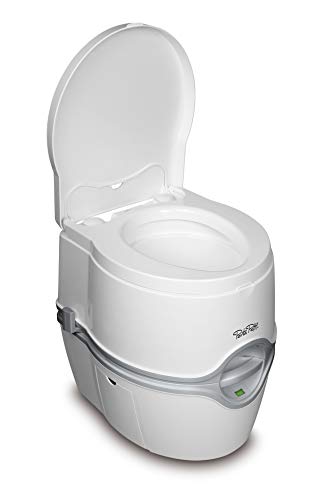
The Curve is Thetford’s answer to the cassette toilet’s traditional compromises: a battery-powered electric flush that rinses at the push of a button, a taller seat that approaches home-toilet height, and styling that does not look like camping equipment. The electric flush matters more than the luxury framing suggests — it delivers a consistent, complete bowl rinse every time, including for children and elderly users who under-pump a manual bellows or piston, and consistency is what keeps a cassette toilet fresh across a trip. Capacities are in the same generous class as the 365 (the listing describes the 4/5.5-gallon arrangement), and the cassette shares the family’s pour-spout and sealing discipline.
Strengths
- Electric flush gives a complete, repeatable rinse for every user, including kids and grandparents.
- The tallest, most home-like seat in the cassette class — the kindest option for knees and hips.
- Thetford build, seals and spares support behind the premium features.
Trade-offs
- Premium-tier pricing, the highest in this guide.
- Batteries join the pre-trip checklist; a flat set means a weaker flush until replaced.
- Larger and heavier than the compact models — it earns its space rather than saving it.
Choose the Curve when the users decide the purchase: a grandparent joining the camping trip, a partner with a bad knee, a family tired of supervising children’s flushing. In those households the electric flush and real seat height are not indulgences — they are the difference between a portable toilet that gets used willingly and one that gets avoided until desperation. That willingness, sustained over a whole trip, is worth more than any capacity figure on this page.
Best for: families, older users and anyone wanting home comfort in a portable. Not suited for: ultralight or budget-led packing. Check the current price on Amazon.

Thetford Porta Potti 135 — Best Compact
The 135 is the smallest Porta Potti: a compact cassette toilet for car camping, small boats, truck cabs and emergency kits, with reduced capacities traded for a footprint and weight that fit where the 365 cannot. The flush is a simple bellows or piston arrangement per the listing’s configuration, the cassette seals with the same positive discipline as its bigger siblings, and the whole unit stores in the kind of locker or boot corner that actually exists in a small vehicle. It asks more frequent emptying — that is the entire trade — and in return it makes a real flushing toilet possible in vehicles and spaces where the alternative is a bag system or nothing.
Strengths
- The smallest, lightest route into a genuine flushing cassette toilet.
- Thetford sealing and build quality at the compact end of the range.
- Stores almost anywhere — the emergency-kit and small-boat champion.
Trade-offs
- Small capacities mean frequent emptying with more than solo use.
- The lowest seat in the guide; tall or stiff-kneed users will feel it.
- Best as a secondary or occasional toilet, not a full-time solution.
Judge the 135 as an enabler. On a small sailboat, in a micro-camper or in the cupboard of a home that loses water service during works, it converts an undignified problem into a solved one for very little space or money. The owners who love it bought it for exactly those niches; the owners who curse it asked it to serve a family full-time, which is the 365’s job. Buy it for the niche and it is the easiest purchase in this guide to feel good about.
Best for: car camping, small boats, truck drivers and home emergency kits. Not suited for: full-time or family-volume use. Check the current price on Amazon.

SereneLife 5.2 Gallon Portable Camping Toilet — Best for Indoor Use
The SereneLife aims at the use case the camping brands treat as secondary: indoor duty. Its 5.2-gallon detachable waste tank, waste level indicator and listing-claimed 100-plus flushes per fill suit bedside and in-home roles — recovery from surgery, an elderly parent whose bathroom is a staircase away, a basement or workshop without plumbing, a cabin’s winter season — as much as they suit a campsite. The design language follows: it reads as an appliance rather than expedition gear, the seat is a sensible height for indoor users, and the cassette detaches for the carry to the household toilet, which is where indoor cassettes are always emptied.
Strengths
- Capacity and level indicator sized for indoor intervals — fewer carries, no guessing.
- Indoor-appropriate design and seat height for bedside, recovery and elderly use.
- Equally serviceable outdoors, so one unit covers cabin and campsite too.
Trade-offs
- A full 5.2-gallon cassette is heavy for the very users the indoor role serves — plan half-full empties or a helper.
- Value-brand spares support is thinner than Thetford’s if a seal or latch fails years on.
- The flush is a conventional pump arrangement, not the Curve’s electric rinse.
The honest planning point for indoor use is the emptying logistics, and it is better faced here than at 2 a.m.: the cassette must travel to a flushing toilet, the carrier must be able to lift it at the weight you let it reach, and treatment fluid must be dosed so the unit stays fresh in a warm room. Manage those three and the SereneLife does a quietly dignified job that families consistently describe as a lifesaver during recovery periods. It is the pick in this guide most often bought for someone else — buy it with the helper conversation already had.
Best for: bedside and indoor backup, recovery, elderly care, cabins and workshops. Not suited for: solo users who cannot carry a cassette at half capacity. Check the current price on Amazon.

VEVOR Portable RV Toilet 5.3 Gallon — Best Pressurised Flush
VEVOR’s entry attacks the cassette class’s weakest point — the rinse. Its push-button pressurised flush stores pressure and releases a decisive bowl wash, closer in spirit to the Curve’s electric consistency than to a hand bellows, while the tank split (5.3 gallons of waste capacity with a 3.2-gallon flush tank, per the verified listing) targets RV and camping trips measured in days. The cassette is leak-proof sealed with a level indication, and the whole unit is positioned at a value tier that makes it the easiest recommendation for buyers who want the strong flush without the premium badge.
Strengths
- Pressurised flush rinses more completely than bellows designs, which keeps the bowl fresher between deep cleans.
- Generous waste capacity with a sensibly sized separate flush tank.
- Value-tier pricing for a feature set that challenges the mid-range.
Trade-offs
- VEVOR’s spares and support ecosystem is generalist rather than RV-specialist; keep the manual and model details.
- Pressurised mechanisms reward correct use — over-pumping against a closed valve helps nothing.
- Full-cassette weight is, as ever, the real limit; empty at two-thirds on long carries.
The flush is the feature you use twenty times a day and the cassette is the feature you use twice a week, which is why a value toilet that invests in the flush is making the right trade. For RV and tent campers who rinse discipline has defeated before — the half-pumped bellows, the bowl that never quite clears — the VEVOR’s pressurised rinse is the fix, at a price that leaves room in the budget for the treatment fluid and a decent toilet tent to go with it.
Best for: RV and camping use where rinse quality has been the complaint. Not suited for: buyers who prioritise a specialist spares network above features. Check the current price on Amazon.
Kohree Portable RV Toilet 5.8 Gallon — Best Large Capacity
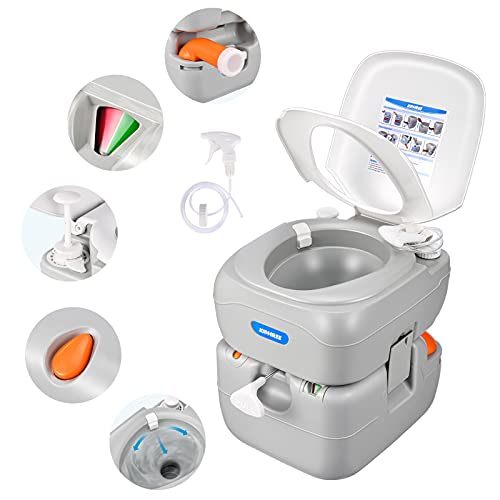
The Kohree’s headline is capacity: 5.8 gallons of waste storage, the largest in this guide, in a detachable, leak-proof cassette with a level indicator. Capacity is a genuine ease feature — it is emptying trips not taken, dump-point queues not joined on the last morning of the holiday — and for groups, families and basecamp-style camping it is the specification that decides satisfaction. The toilet around the cassette is conventional in the right ways: a pump flush, a seat height in the class’s comfortable band, and a two-piece split for carrying. Kohree also offers an elongated-seat variant in its range for buyers who find standard portable seats pinched.
Strengths
- Largest waste capacity here — the fewest emptying trips for groups and families.
- Level indicator and leak-proof detachable cassette keep the big capacity manageable.
- Value-tier pricing for top-of-class volume.
Trade-offs
- Physics collects its fee: a full 5.8-gallon cassette is the heaviest carry in the guide. Empty at half on any distance.
- Bulkier stored size than the compact picks — measure the locker.
- Newer brand support profile, as with the other value picks.
The discipline with a big cassette is to treat capacity as range, not as a target. Use the indicator, empty at the convenient dump point rather than the desperate one, and the Kohree’s size becomes pure advantage: a family of four on a long weekend can plausibly never queue at all. Let it brim because it can, and you will learn the category’s oldest lesson at maximum weight. Bought for groups and used with that rhythm, it is the easiest group toilet here.
Best for: families, groups, basecamps and long weekends away from dump points. Not suited for: solo users with long carries or small storage. Check the current price on Amazon.
Comparison Table
| Pick | Badge | Key spec | Best for |
|---|---|---|---|
| Thetford Porta Potti 365 | Best Overall | Piston flush, 5.5 gal waste class, level indicator | RV, boat and cabin all-round use |
| Thetford Porta Potti 565E Curve | Best Premium | Electric flush, tallest seat in class | Families and older users |
| Thetford Porta Potti 135 | Best Compact | Smallest footprint and weight in the line | Cars, small boats, emergencies |
| SereneLife 5.2 Gallon | Best for Indoor Use | 5.2 gal cassette, level indicator | Bedside, recovery, workshops |
| VEVOR 5.3 Gallon | Best Pressurised Flush | Push-button pressurised flush, 3.2 gal fresh tank | Rinse quality on a budget |
| Kohree 5.8 Gallon | Best Large Capacity | 5.8 gal waste cassette, level indicator | Groups and long intervals |
How to Use and Empty a Portable Toilet Without the Drama
Setup first: charge the waste cassette with water and holding-tank treatment at the dose on the treatment’s label before first use — the treatment is what breaks down waste and controls odour, and skipping it is the root of most portable-toilet misery. Fill the fresh tank, add a freshwater rinse aid if you use one, and test the flush and the cassette seal with clean water before the trip. In use, the rules are minimal: flush with the blade valve operated as the manual directs, keep the seat lid closed between uses, and watch the level indicator like a fuel gauge — plan the empty, do not discover it. Emptying, done right, is a two-minute procedure: separate the cassette, carry it by its handle keeping it level, set the pour spout over a flushing toilet or dump point, rotate the spout out, press the vent button so the pour runs smooth rather than glugging, pour steadily, rinse the cassette with clean water, recharge it with treatment and a litre of water, and reseat it. Rinse water goes into the same drain, never onto the ground. Hands washed, the job is genuinely over — every horror story in this category comes from skipping the vent button, overfilling past the indicator, or carrying a cassette by anything but its handle.
How to Choose the Easiest Portable Toilet for Your Trips
Start with the users. Children and elderly users push you toward the Curve’s electric flush and taller seat; able-bodied adults on a budget are well served by any manual model here. Then size the cassette to the crew and the dump-point map: solo and couple use empties a mid-size cassette every few days, groups should start at the Kohree’s capacity or accept daily empties, and everyone should convert capacity into carry weight honestly — waste weighs what water weighs, so a full large cassette is a 20-kilo-class lift. Check seat height against the tallest and stiffest user, check the stored dimensions against the locker or boot it must live in, and confirm the flush type suits the trip’s rhythm: pressurised and electric rinses for freshness-critical indoor or family use, simple pumps for occasional outdoor duty. Finally, decide your treatment system — liquid or drop-in packets — and standardise on it; mixing treatments and improvising doses is how cassettes acquire smells that no toilet design can be blamed for.
Common Buying Mistakes
- Buying capacity you cannot carry. The cassette’s full weight, not its gallon figure, is the real specification. Match it to the person who will empty it, at the distance they will carry it.
- Skipping or under-dosing the treatment. Untreated cassettes smell and stain; the treatment is the system, not an accessory.
- Ignoring the level indicator until it matters. An overfilled cassette is the category’s defining accident. Empty at the planned point, not the desperate one.
- Choosing the lowest seat for elderly users. Seat height decides whether a grandparent uses the toilet independently. The Curve exists for this reason.
- Emptying anywhere but a proper drain. Cassette contents go into a flushing toilet, sewer or designated dump point — never onto ground or into storm drains.
- Storing the toilet with waste or treatment sitting in it. End every trip with an emptied, rinsed, dried cassette and the seals lightly lubricated; storage is where these toilets age.
Final Recommendation
Buy the Thetford Porta Potti 365 if you want the category’s proven answer and your use is serious. Buy the Curve when the users are children, grandparents or anyone whose knees vote. The 135 covers small spaces and emergency kits, the SereneLife covers indoor duty, the VEVOR fixes rinse quality on a budget, and the Kohree stretches group intervals the furthest. Whichever you choose, order the treatment in the same basket and empty by the indicator, not by optimism. For the waterless alternatives, see Best And Easiest Composting Toilets; for the home fixtures these replace on the road, see Best And Easiest To Clean Toilets and Best And Most Reliable Toilets.
Treatment Fluids and Drop-Ins: The Chemistry That Makes It Easy
Every cassette toilet in this guide depends on its treatment, so the choice deserves more than grabbing the blue bottle. Modern treatments fall into three families: traditional formaldehyde-based fluids (effective, increasingly restricted at dump points and inappropriate for septic discharge), formaldehyde-free liquids (the mainstream default, effective and widely accepted), and drop-in packets or sachets (pre-dosed, tidy to store, popular with RV users who value the absence of measuring). Enzymatic and probiotic treatments are the gentlest option and the natural choice where cassette contents will meet a septic system. Whichever family you choose, three rules govern all of them: dose for the cassette’s capacity and the expected temperature — hot weather genuinely needs the full dose — recharge after every empty without exception, and never mix families in the same cassette, because the chemistries can neutralise each other and leave you with an untreated tank that believes it is treated. Freshwater rinse aids are the optional second bottle: they keep the bowl slicker and the flush water fresher, and on long trips they earn their shelf space; on weekend trips they are a luxury you can skip without consequence.
Portable Toilets for Specific Situations
Boats. A cassette portable replaces a marine head where no holding tank exists or where simplicity wins; secure it against movement — a pitching boat tests lashings, not intentions — and remember that discharge rules for the cassette are the same sewage rules as for any holding tank. Van life full-time. The toilet is furniture and infrastructure at once: mid-to-large capacity, a level indicator you trust, and a permanent home in the build rather than a locker it is dragged from. The 365 and Kohree divide this role between proven support and maximum interval. Truck drivers and worksites. Compactness and a fast, sealed empty at ordinary toilets dominate; the 135 and SereneLife bracket the size choices. Festivals and group camps. Capacity and queue management: one large toilet per realistic group size, treatment dosed for heat, and an emptying rota agreed before the last morning rather than discovered during it. Home emergencies. The toilet you own before the water is shut off is worth three bought during it; a compact model in a cupboard, plus treatment, converts plumbing works and outages from crisis to inconvenience — the cheapest dignity insurance in this entire guide.
Seat Height, Stability and Using a Portable Toilet Comfortably
Comfort details decide whether a portable toilet is used willingly for a whole trip. Seat height is the big one: cassette toilets sit lower than home toilets because the cassette lives under the bowl, and the spread across this guide — from the compact 135 to the tall Curve — is the difference between a squat and a seat for a stiff-kneed user. Where height matters and the budget will not stretch to the Curve, a stable portable toilet stand or a site on a firm raised platform is the honest workaround, provided the unit cannot slide. Stability is the second detail: on grass, gravel or a boat sole, level the unit before first use and re-check after the first day, because a rocking portable trains users to hover, and hovering defeats the seat design and the diverter geometry of every model. The third detail is privacy infrastructure — a toilet tent, a van curtain, a cabin corner with a door — which sounds soft and is actually decisive: a toilet people are embarrassed to use is a toilet whose cassette fills with everything except what the treatment plan assumed. Buy the tent with the toilet and the whole system works better.
Long-Term Care: Seals, Valves and Winter
A cassette toilet’s working life is its seals’ life. The blade-valve seal that closes the cassette is the critical component: keep it clean, lubricate it lightly with silicone grease each season, and replace it when the cassette starts to weep or smell at the joint — a cheap part that restores the toilet to new. Rinse the cassette thoroughly after trips rather than letting residue dry in it, because dried residue is where odour takes up permanent residence in the plastic. Freshwater pumps and pressurised mechanisms want a flush of clean water before storage for the same reason. Winter storage adds one rule: drain everything — a cassette or pump holding water in a freezing garage will crack along lines no warranty will honour — and store the unit dry with the valve open. Attended to this way, the benchmark models in this guide serve for many years; neglected, any of them can be ruined in a single winter, which is why this section, unglamorous as it is, is the highest-value reading in the article after the pick that matches your trips.
Cassette Portables vs the Alternatives: Bag, Bucket and Composting
It helps to place these toilets among their rivals honestly. Bag-based camp toilets — a frame, a seat and a disposable bag — are the cheapest and lightest option and the least pleasant: no flush, no rinse, and a waste stream that must be binned where rules allow. They suit ultralight backpacking-adjacent camping and little else in this guide’s world. Bucket-and-diverter systems are the budget doorway into urine separation, trading finish and comfort for price. Composting toilets — the subject of our companion guide — remove the dump point and the chemicals entirely, at higher upfront cost and with a routine of medium and venting instead of cassettes. The cassette flush toilet’s claim sits between them: a real flush, a sealed and civilised empty, a modest purchase price, in exchange for treatment consumables and dependence on toilets or dump points to empty into. For the largest group of campers, RVers and households — people near infrastructure who want dignity without construction — that remains the sweet spot, and it is why the category Thetford created has outlived every attempt to replace it.
What a Full Cassette Actually Weighs, and Other Physics
Run the numbers before the first trip so nothing surprises you at the dump point. Waste and flush water weigh a kilogram per litre, so a 5.5-gallon cassette filled to the indicator carries roughly 20 kilograms of contents plus the cassette’s own weight — a proper two-handed lift, comparable to a full suitcase. The 5.8-gallon Kohree at capacity exceeds that; the compact 135 stays in one-hand territory. These figures argue for three practical habits: emptying at two-thirds when the carrier is smaller or the walk is long, siting the toilet as close to the emptying route as the trip allows, and never letting a child be the person who discovers the cassette is full. They also explain the category’s design centre of gravity: capacities cluster around five gallons not because manufacturers lack imagination, but because human arms set the specification. When you compare listings, translate gallons into the lift your household can actually make, and the “easiest” toilet often turns out to be the one size smaller than the one you first reached for.
Buying for Children: What Changes
Children alter the portable-toilet equation in three ways. First, volume: small users fill cassettes with flush water faster than with waste, because enthusiastic pumping is irresistible — another point for the Curve’s metered electric rinse and for pressurised systems that deliver a set rinse per press. Second, height: a seat that is low for an adult is right for a child, and families spanning both should either accept the compromise of the mid-height models or add a stable step that serves the child at the toilet and the adult at the sink. Third, the emptying rota becomes a teaching moment the whole family remembers; involve older children in the clean-water side of the routine — filling the fresh tank, dosing treatment under supervision — and the chore normalises instead of becoming one parent’s secret burden. None of this requires a special “family” model; it requires choosing the flush discipline and capacity with the smallest users in mind, which is why the Curve and the Kohree anchor the family end of this guide.
Troubleshooting: Odour, Weak Flushes and Stiff Valves
Work the short list before blaming the toilet. Odour in use almost always means the cassette was under-dosed, the treatment family was mixed, or the blade seal is fouled or perished — clean the seal, re-dose correctly, and the problem ends at the next empty. Odour only when the flush opens is normal in hot weather at high fill levels and is the indicator telling you the empty is due. A weak flush on a manual model is usually an incomplete pumping technique or a low fresh tank; on the pressurised VEVOR it is a valve left partially open bleeding pressure; on the Curve it is batteries at the end of their life. A stiff blade valve is dried residue or a dry seal — rinse, lubricate with silicone, and work it gently rather than forcing the handle. A cassette that will not reseat is nearly always misaligned rather than broken: lift, align the rails or guides squarely, and slide home without force. The pattern across all five is that these are maintenance states, not failures — cassette toilets are simple machines, and their problems are correspondingly simple, provided the treatment discipline in the earlier sections has been kept.
Budget Tiers: What the Premium Actually Buys
The spread across this guide is wide, so it is worth naming what each step purchases. The budget tier — the compact 135 and the value brands’ smaller models — buys the core cassette system with manual flushing and honest capacities; nothing about it is a compromise for occasional use. The mid tier — the 365, the SereneLife, the VEVOR and the Kohree — buys capacity, level indication, better flush mechanisms and, in Thetford’s case, the spares network; this is where most serious users should land. The premium tier is the Curve alone, and what it buys is not capacity but constituency: the electric flush and tall seat that keep children, grandparents and injured users independent and willing. Allocated across a household, that framing suggests the sensible pattern — premium where the users demand it, mid-tier for the workhorse roles, budget for the emergency cupboard — rather than three identical toilets at one tier. Add the running costs honestly to each tier: treatment is a per-trip consumable at every level, batteries join it at the premium tier, and a replacement blade seal every few years is the only predictable parts spend in the whole category. Check the current price on Amazon for the tier you land on; the gaps move, and a mid-tier model on promotion routinely undercuts a budget model at full price.
Related guides
Frequently Asked Questions
Where can you empty a portable toilet?
Into any ordinary flushing toilet, a sewer-connected drain, or a designated RV dump point or cassette disposal station. Never onto open ground, into a storm drain, or into a septic system in bulk without checking — the contents are sewage and are treated as such everywhere.
Do portable toilets smell?
A treated, sealed cassette does not smell in normal use — the treatment breaks down waste and the cassette seals positively when closed. Smell arrives with skipped treatment, an overfilled cassette venting under pressure, or a perished seal. All three are maintenance, and the fixes are in the how-to section above.
How long does a cassette last before emptying?
It depends on crew size and capacity: a mid-size cassette serves a couple for roughly three to four days of full-time use, and the large-capacity Kohree stretches a family weekend. The level indicator is the authority — plan empties by it rather than by the calendar.
Can a portable toilet be used indoors in a home?
Yes — that is one of the category’s main modern uses, for recovery, elderly care, renovations and water outages. Choose a model with a level indicator and a seat height the user can manage, site it on a washable floor, and plan the cassette’s route to the household toilet before the first night.
What is the difference between piston, bellows, pressurised and electric flushes?
Piston and bellows pumps are hand-powered and differ in feel and stroke; both work well when pumped fully. Pressurised systems store pressure for a sharper rinse at a button press. Electric flushes motorise the rinse entirely, giving the most consistent result for children and elderly users at the cost of batteries and price.
Is a portable toilet a good solution during home renovation or a water shut-off?
It is one of the best — this is the use case that converts sceptics. A cassette toilet needs no water connection and no drain, works the hour the mains are shut off, and empties into any toilet that is still connected (or a neighbour’s, by arrangement). Households that buy one for a renovation routinely keep it afterwards for outages, guests in a camper on the drive, and the next project. The compact and indoor picks in this guide — the 135 and the SereneLife — are sized exactly for this double life.
Do I need a separate toilet tent or shelter?
Not legally anywhere and practically almost everywhere. A simple toilet tent gives privacy, weather protection and a defined place for the unit, treatment and paper — and it keeps the toilet out of the sleeping and cooking space, which is the arrangement everyone’s nose prefers by day two. In a van or cabin the equivalent is a dedicated corner or cupboard. The shelter is the cheapest satisfaction upgrade in the whole setup, and it belongs in the first order alongside the treatment, the spare batteries if your flush needs them, and a small bottle of silicone seal lubricant for the season ahead.
What size portable toilet do I need for a family of four?
Start from interval, not headcount: a family of four fills roughly a gallon to a gallon and a half of cassette capacity a day in full-time use, so a long weekend without a dump point argues for the largest cassette — the Kohree class — or for a mid-size model emptied once mid-trip. If a dump point is on site, capacity matters far less and the mid-tier models serve a family comfortably with a relaxed emptying rhythm.
Can I use normal toilet paper in a portable toilet?
Yes, in normal amounts — cassette treatments are formulated to break paper down. Rapid-dissolve or RV-specific paper breaks down faster and is the safer choice for small cassettes and long intervals, but ordinary household paper in sensible quantities will not harm any model in this guide. What must never go in is wipes of any kind, including those labelled flushable; they do not break down on cassette timescales and they foul valves and dump-point equipment.
How long do the batteries last in the electric-flush Curve?
Battery life is measured in flushes and seasons rather than hours — a set typically covers a long stretch of trips because each flush draws briefly. The practical discipline is to carry a spare set in the toilet’s storage kit and to remove batteries for winter storage so a leak cannot damage the compartment. When the flush audibly weakens, the batteries, not the toilet, are the first suspect.
How should a portable toilet be stored between trips?
Emptied, rinsed and dried, with the cassette valve left open so seals rest uncompressed, a light silicone lubricant on the blade seal, and the unit stored out of freezing standing water. A toilet stored clean needs ten minutes of setup next trip; a toilet stored dirty needs an afternoon and an apology to everyone nearby.


