Disclosure: airfryerkitchensupply.com is reader-supported. When you buy through links on our site, we may earn an affiliate commission at no extra cost to you.
The best american made toilets come with a complication this guide will handle honestly from the first paragraph: “American made” is not a single fact but a spectrum. Some toilets are designed, cast and assembled in the United States by American companies. Some come from American brands whose production for a given model happens across a border. And one of the finest toilets sold in America comes from a Japanese company that manufactures a large share of its US-market products at its plant in Georgia. Shoppers who care about origin usually care about three things — supporting American manufacturing jobs, the quality discipline of domestic plants, and a parts-and-service network close to home — and this guide ranks its picks against those real motivations rather than a flag on a box. Every pick below is verified in Amazon’s catalog data, and where a model’s production is mixed or model-dependent, we say so and tell you how to check the individual unit: the country of origin is printed on the carton and in the listing’s specification details, and that label, not the brand’s birthplace, is the final word.
Where to buy
All six picks are sold through Amazon, where you can check the current price on Amazon and inspect each listing’s origin and specification details before ordering. We do not print fixed prices here. Start with the confirmed options:
- Kohler Highline Comfort Height 1.28 GPF — Best Overall: Check the current price on Amazon
- Mansfield Summit ADA 1.28 — Best Ohio Heritage Pick: Check the current price on Amazon
- Gerber Avalanche Select 1.28 GPF — Best Pro-Brand Pick: Check the current price on Amazon
- American Standard Cadet PRO 1.28 GPF — Best Iconic Brand Value: Check the current price on Amazon
- TOTO Drake 1.28 GPF — Best US-Plant Production: Check the current price on Amazon
- Mansfield Alto 1.6 GPF — Best Budget American Brand: Check the current price on Amazon
In this guide
Quick Picks
- Best Overall — Kohler Highline 1.28 GPF: Wisconsin’s Kohler, Class Five flushing and Comfort Height in a compact round-front two-piece. Check price on Amazon
- Best Ohio Heritage — Mansfield Summit ADA 1.28: from a maker producing plumbing in Ohio since 1929, in an ADA-compliant configuration. Check price on Amazon
- Best Pro-Brand — Gerber Avalanche Select: the Chicago trade brand’s WaterSense chair-height elongated model with seat and kit included. Check price on Amazon
- Best Iconic Value — American Standard Cadet PRO: America’s most storied plumbing name, in its plumber-grade, fit-and-forget configuration. Check price on Amazon
- Best US-Plant Production — TOTO Drake 1.28 GPF: the benchmark modern toilet, with substantial US manufacturing for the American market — check your model’s label. Check price on Amazon
- Best Budget — Mansfield Alto 1.6 GPF: an Ohio brand’s elongated workhorse at the bottom of the credible price range. Check price on Amazon
How These Picks Were Chosen
Origin was assessed at three levels, in descending order of importance to most shoppers: the company’s identity and accountability, the manufacturing footprint behind the specific model family, and the service network that will support the toilet for twenty years. Kohler, American Standard, Gerber and Mansfield are American companies with deep domestic operations; TOTO is included — transparently — because its American manufacturing presence is large and its US-market toilets are substantially produced in the United States, and because a guide that excluded the Drake on a passport technicality would be performing purity rather than serving readers. Beyond origin, the ordinary disciplines of this programme applied in full: verified product data, glazed trapways, credible flush platforms, standard rough-ins and parts availability. We excluded brands whose American identity is a marketing veneer over anonymous importing, and models whose origin could not be established at all. Where production varies by production run — a reality across the whole industry — the reviews tell you to verify the individual model’s origin statement rather than trusting ours.
The 6 Best American Made Toilets

Kohler Highline Comfort Height Round-Front 1.28 GPF — Best Overall
Kohler has made plumbing products in Wisconsin since the nineteenth century and remains the name most synonymous with American bathroom manufacturing, and the Highline is its accessible workhorse: a Comfort Height two-piece with Class Five flushing, Kohler’s canister flush valve and a round-front bowl that fits smaller bathrooms. Class Five is engineered for bulk clearing at 1.28 gallons — a large flush valve and an engineered trapway moving waste decisively — while the canister valve delivers water faster than a flapper and ages without the flapper’s curling leaks. The verified configuration carries a right-hand trip lever; confirm lever side and seat inclusion on the listing, as Kohler sells this line in several trims. It suits buyers who want the strongest combination of American manufacturing identity, flush engineering and dealer support at an accessible tier. It is less suited to elongated-bowl loyalists, who should look at Kohler’s elongated Highline variants or the Gerber below.
Strengths
- Iconic Wisconsin manufacturer with a deep domestic footprint and dealer network.
- Class Five flush platform with a canister valve that holds performance for years.
- Comfort Height comfort in a compact round-front footprint.
Trade-offs
- Round-front bowl is the compact rather than spacious choice.
- Seat commonly sold separately on this line.
- Canister seals are brand-pattern parts, though universally stocked.
The Highline’s case in an origin-focused guide is that it is the complete package behind the flag: an American company, a flagship flush technology developed for the American market, and a support network that means the toilet’s twentieth year is as serviceable as its first. Owners should still perform the guide’s universal check — read the individual model’s origin statement on the carton — because even Kohler’s global production footprint means the honest answer is per-model. What does not vary is the engineering: this is one of the most consistently recommended affordable toilets in the country, and its presence at the top of this list is earned on merit first and origin second, which is the right order. The compact round-front format also makes it the guide’s friendliest pick for the small bathrooms of older American homes, where elongated bowls crowd doors and vanities.
Best for: buyers wanting American manufacturing identity plus proven engineering / Not suited for: elongated-bowl loyalists
Check the current price on Amazon

Mansfield Summit ADA 1.28 Toilet — Best Ohio Heritage Pick
Mansfield Plumbing has manufactured in Ohio since 1929 — through the Depression, the postwar housing boom and every plumbing fashion since — and the Summit ADA is its modern water-saving configuration: a 1.28-gallon flush in an ADA-height package from one of the most genuinely domestic production stories in this guide. Mansfield is the pick for buyers whose definition of American made is the strict one: an American company with Ohio manufacturing at its core and a product line built for the American trade. The Summit’s elongated, height-compliant format suits accessible bathrooms and taller users, and its conventional internals keep service simple for decades. It suits heritage-minded buyers, accessible renovations and anyone who wants their purchase to support a regional American manufacturer rather than a global giant. It is less suited to shoppers who want the most refined flush engineering in this guide — the Kohler and TOTO platforms are a step ahead — and its styling is honest rather than inspired.
Strengths
- Ohio manufacturing heritage stretching back to 1929.
- ADA-compliant height and elongated format.
- Conventional, universally serviceable internals.
Trade-offs
- Flush engineering is dependable rather than class-leading.
- Traditional styling.
- Confirm seat inclusion and exact configuration on the listing.
There is a particular satisfaction in buying a fixture from a maker that has outlasted nearly a century of competitors, and it is not purely sentimental: longevity in manufacturing is evidence of a company that supports its installed base, because plumbers stop specifying brands that orphan them. The Summit brings that institutional reliability to a modern, code-friendly specification. For a buyer renovating a bathroom in the Midwest — or anywhere the words “made in Ohio” carry weight — this is the guide’s most direct answer, with the ADA format as a practical bonus for ageing-in-place planning. It is also the pick whose purchase most literally keeps an American production line busy, if that is the sentence you want your money to say.
Best for: heritage-minded buyers and accessible renovations / Not suited for: buyers chasing the most advanced flush platforms
Check the current price on Amazon
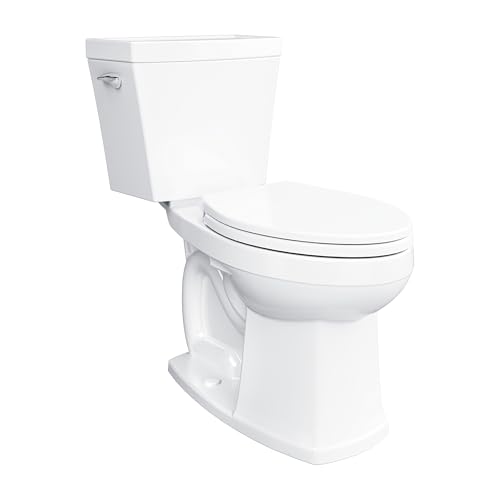
Gerber Avalanche Select Chair Height Elongated 1.28 GPF — Best Pro-Brand Pick
Gerber is the Chicago company the American plumbing trade has relied on for generations while retail shoppers walked past it, and the Avalanche Select shows the trade’s priorities in porcelain: WaterSense-certified 1.28-gallon performance, a quiet and powerful flush, a stain-resistant glaze, and — the tell — a soft-close seat and full install kit in the box, because professionals bill by the job, not by the errand. The chair-height elongated bowl is the format most American adults prefer, and Gerber’s quality control is calibrated to buyers who install hundreds of units and remember every failure. It suits homeowners who want the plumber’s own shortlist, landlords standardising on a supported model, and anyone who values a complete box. It is less suited to design-led renovations — Gerber’s styling is professional-neutral — and to buyers for whom a famous consumer brand is part of the purchase.
Strengths
- Chicago trade brand with generations of professional trust.
- WaterSense 1.28 performance with seat and install kit included.
- Chair-height elongated comfort in a complete package.
Trade-offs
- Neutral professional styling rather than a design statement.
- Lower consumer profile means fewer showroom encounters before buying.
- Confirm the current listing’s kit contents, which can vary by configuration.
The Avalanche Select earns its slot by being the toilet in this guide most likely to be chosen by the person who would install yours. That endorsement pattern — quiet, professional, repeat — is the strongest signal in the fixture business, and Gerber’s American identity is of the same character: a working manufacturer in Chicago, not a flag printed on an import. Pair that with the complete-box honesty this programme always rewards, and the Avalanche is the pick for buyers who want their American-made purchase to also be the low-drama one. Its stain-resistant glaze deserves its sentence too: bowls that resist build-up flush consistently for longer between deep cleans, which is a quality-of-life feature disguised as a specification.
Best for: buyers who trust the trade’s judgement and want a complete box / Not suited for: design-first renovations
Check the current price on Amazon

American Standard Cadet PRO Round 1.28 GPF — Best Iconic Brand Value
American Standard’s name is quite literally the category’s generic term in much of the country — generations of Americans have used “an American Standard” to mean a toilet — and the Cadet PRO is where that heritage meets professional value: the Cadet flush engine with its oversized valve and fully glazed trapway, the EverClean antimicrobial surface, and a plain round two-piece body priced for working bathrooms. The honest origin note for this pick, as for much of the modern industry, is that American Standard is an American brand within a global group, and production of specific models varies — check the individual model’s origin statement if strict domestic manufacture is your deciding criterion. What does not vary is the support reality: no toilet in this guide is easier to get parts for, anywhere in America, at any hour. It suits landlords, renovators and homeowners who rank serviceability first. It is less suited to strict-origin purists and to chair-height seekers, who should take the elongated Cadet configurations instead.
Strengths
- The most storied name in American plumbing, with unmatched parts availability.
- Cadet flush engine with a long anti-clog track record.
- EverClean surface helps the bowl stay cleaner between scrubbings.
Trade-offs
- Production of specific models varies — verify the individual origin statement.
- Standard height, round front: the compact, traditional configuration.
- Seat commonly a separate purchase on PRO configurations.
The Cadet PRO’s argument is about the next twenty years rather than the purchase day. Toilets are serviced, not replaced, and every service event on this model is a stocked part and a ten-minute job in every town in the country. That infrastructure is itself a form of American manufacturing value — an installed base so large that supporting it is an industry. Buyers who weight that reality heavily, and who read the origin label with open eyes, will find this the most practical pick in the guide. It is also, not incidentally, a genuinely strong flusher: the Cadet engine’s reputation was earned in exactly the high-use, low-patience settings where weak toilets are found out fastest.
Best for: serviceability-first buyers, landlords and renovators / Not suited for: strict per-model origin purists
Check the current price on Amazon

TOTO Drake Two-Piece Elongated 1.28 GPF — Best US-Plant Production
This pick requires the guide’s most careful sentence, so here it is: TOTO is a Japanese company, and it is also one of the largest toilet manufacturers on American soil, producing a substantial share of its US-market products at its Georgia plant — which means many Drakes sold in America are American-made in the literal, factory sense, while others in the range are produced elsewhere. Check your specific model’s origin label; we include the Drake because a guide about toilets made in America that hid the country’s best-selling premium toilet and its Georgia workforce would be misleading by omission. The toilet itself needs no advocacy: TORNADO FLUSH rim delivery, CEFIONTECT glaze, universal height, an included SoftClose seat and a two-decade reputation as the modern benchmark. It suits buyers who define American made by where the work happens and want the finest engineering in the guide. It does not suit buyers whose criterion is an American-owned company — for them, the Kohler, Gerber and Mansfield picks are the honest answers, and this guide has ranked them accordingly.
Strengths
- Benchmark flush engineering and glaze technology.
- Substantial US production for the American market, centred in Georgia.
- Universal height with SoftClose seat included.
Trade-offs
- Japanese-owned company — fails a strict American-ownership test.
- Origin varies by model and production run; the label check is essential.
- Premium end of this guide’s price band.
Handled transparently, the Drake clarifies what most origin shoppers actually want. If your goal is American factory jobs and American quality control, a Georgia-made Drake serves it directly. If your goal is American ownership and accountability, the guide’s other picks serve it better. Either way, the Drake’s engineering is the standard the rest of the industry chases, and its TORNADO FLUSH bowl wash — which keeps the bowl cleaner between scrubs than any rival here — is a daily, tangible advantage that no label can confer. Decide which definition of “American made” is yours, then let this pick be exactly what it honestly is. There is no wrong answer between those definitions; there is only the wrong process — buying first and discovering your own standard afterwards.
Best for: buyers who define American made by US factory production / Not suited for: buyers requiring American company ownership
Check the current price on Amazon

Mansfield Alto Elongated 1.6 GPF — Best Budget American Brand
The Alto is Mansfield’s workhorse and this guide’s budget door into American-brand manufacturing: an elongated two-piece with a full 1.6-gallon flush, conventional internals and a price position at the very bottom of the credible market. Its full-volume flush suits older American housing stock — long runs, shallow slopes, cast iron — better than any water-saving design, and its simplicity is a feature: every wear part is a universal item your hardware store stocks. The origin story is the same Ohio heritage as the Summit’s, at a workingman’s specification. It suits budget renovations of older homes and buyers who want an American brand’s support without a premium. It is not a water saver, and some jurisdictions cap new installations at 1.28 gallons — check local code, as with any 1.6 model. For the right house, though, the Alto is the most American answer in this guide per dollar spent.
Strengths
- Ohio brand heritage at the lowest credible price in this guide.
- Full 1.6-gallon flush for older American drain lines.
- Universal internals serviceable anywhere, forever.
Trade-offs
- Highest water use here; verify local installation codes.
- Basic finish and styling appropriate to its tier.
- Seat and kit typically separate purchases.
The Alto closes the guide by proving that origin and economy are not enemies. A buyer with a tight budget and an old house does not have to choose between an anonymous import and an American brand — Mansfield has been the working alternative for generations, and the Alto’s conventional design means the savings never come due as orphaned parts or an unserviceable valve. If your drains are old and your dollars are counted, this is the patriotic purchase that is also the practical one. Its elongated bowl deserves a final mention, because budget toilets so often ration comfort: at this price, a full-size elongated seat from an Ohio maker is a small monument to what the American industry still does well.
Best for: older American homes and tight budgets / Not suited for: water-conservation goals or 1.28-capped jurisdictions
Check the current price on Amazon
Comparison Table
| Pick | Badge | Key spec | Best for |
|---|---|---|---|
| Kohler Highline 1.28 | Best Overall | Class Five flush, Comfort Height, round front | All-round American quality |
| Mansfield Summit ADA | Best Ohio Heritage | 1.28 GPF, ADA format, Ohio maker since 1929 | Strict-origin buyers |
| Gerber Avalanche Select | Best Pro-Brand | WaterSense 1.28, chair height, kit included | Complete-box value |
| American Standard Cadet PRO | Best Iconic Value | Cadet flush, EverClean, parts everywhere | Serviceability first |
| TOTO Drake 1.28 | Best US-Plant Production | TORNADO FLUSH, CEFIONTECT, Georgia production | Finest engineering |
| Mansfield Alto 1.6 | Best Budget | 1.6 GPF elongated, universal parts | Older homes, tight budgets |
How to Choose an American Made Toilet
Begin by deciding which definition of American made is actually yours, because the picks diverge on it: American company ownership (Kohler, Gerber, Mansfield, American Standard), American factory production regardless of ownership (which adds the Georgia-built TOTO models), or American support infrastructure (where American Standard’s installed base is unmatched). Write the definition down before you shop if the purchase matters to you — it is remarkable how a one-sentence standard, fixed in advance, dissolves the marketing fog that otherwise surrounds this search, because every listing can then be passed or failed against your own words rather than the seller’s. Then verify at the model level — read the origin statement on the listing and the carton, because production varies across every global maker’s range and the label is the only statement that counts. After origin, apply the ordinary tests with the ordinary rigour: glazed trapway, proven flush platform, correct rough-in, the height and bowl shape your household needs, and a total-box price that includes the seat where applicable. Finally, think about the service horizon: an American-made purchase pays its dividend in year twelve, when the part you need is in production, stocked within driving distance, and documented in English by a company that answers its phone in your time zone. Choose the definition, verify the model, and the toilet will take care of the rest.
How to Verify a Toilet’s Origin Before You Buy
Because this search attracts vague claims, here is the verification routine in full. On the listing, find the specification or product-details section and look for the country-of-origin field; reputable sellers populate it, and its absence is itself information. On the maker’s own site, the model’s specification sheet carries the same statement in authoritative form. At delivery, the carton is printed with the origin and the model and serial details — photograph it before installation, while a return is still simple, and keep that photograph with your home records alongside the warranty card. Be alert to the vocabulary of evasion: “designed in the USA”, “American company” and “assembled in the USA from global parts” are three different claims, none of which is “made in the USA”, and a seller’s willingness to state the plain phrase is a quality signal in itself. Finally, remember that origin can change between production runs of the same model — which is why this guide teaches the check rather than issuing certificates. Five minutes of verification converts a marketing adjective into a fact you chose on purpose.
How to Install Your Toilet and Register Its Warranty
The installation itself follows the standard sequence covered across this programme — inspect the flange, set a fresh wax ring, seat the bowl level, tighten alternately and gently, connect a new supply line, and test through repeated flushes before caulking the front and sides of the base. Origin adds two steps worth taking, and neither costs more than a few minutes on the one day when they are effortless to do. First, record the model and serial numbers and the origin statement from the carton in your home file, together with the purchase receipt; warranty claims and parts orders both begin with those numbers, and American makers’ support lines will ask for them. Second, actually register the warranty where the maker offers registration — it takes minutes, it starts the documentation trail that makes a year-ten claim frictionless, and it is the step almost every buyer skips. A toilet bought partly for its maker’s accountability deserves the paperwork that makes the accountability usable.
A Short History of Toilets Made in America
The American toilet industry grew up with the American bathroom itself. In the late nineteenth century, indoor plumbing moved from luxury to expectation, and potteries and brassworks across the industrial states — Ohio, Wisconsin, New Jersey, Illinois — began casting the vitreous china fixtures the new bathrooms demanded. The companies in this guide carry that lineage directly: Mansfield dates to 1929 in Ohio, Kohler’s Wisconsin works grew from a nineteenth-century foundry, Gerber built its Chicago business supplying the trade, and American Standard’s roots reach into the same founding era of American sanitary ware. The twentieth century consolidated the industry and standardised the product — the two-piece, floor-mounted, tank-and-bowl toilet in your home is an American industrial archetype, refined over a hundred model years. Late-century globalisation then did to toilets what it did to everything: production spread across borders, brands became groups, and the origin question became the genuinely complicated one this guide keeps returning to. What survived globalisation intact is the service infrastructure — the distributors, parts counters and plumber familiarity that make an American-market toilet from these makers the lowest-risk fixture a homeowner can buy. That infrastructure, as much as any factory, is what “American made” buys you now.
What American Manufacturing Actually Buys You in a Fixture
Strip the sentiment away and four concrete advantages remain. First, accountability: a maker manufacturing for the American market under American consumer law, selling through American retailers, faces returns, reviews and regulators in your language and time zone — a discipline that shows up as honest specifications. Second, standards fit: domestic production is built natively around American rough-ins, American supply fittings and American code expectations, so the fixture meets your house where it stands. Third, parts longevity: the economics of a huge domestic installed base keep flappers, valves, seals and seats in production for decades, which is the difference between a repair and a replacement in year fifteen. Fourth, freight physics: porcelain is heavy and fragile, and shorter supply chains mean fewer chips, faster replacements and a smaller transport footprint for a product that will cross the country to reach you. None of these advantages requires the toilet to be flawless, and none belongs exclusively to domestic production — excellent imported toilets exist, as this programme’s other guides happily recommend. But for a buyer whose values or risk calculus point homeward, these are the real, bankable contents of the phrase “American made”, and the picks in this guide deliver them in different proportions.
The Disappearing Middle: Why So Few Toilets Are Fully Domestic
Shoppers sometimes ask why a guide like this cannot simply list six toilets cast in America by American companies from American clay, and the honest answer is industrial. Vitreous china production is capital-hungry and energy-intensive; over four decades it consolidated into fewer, larger plants, many of them sited near the growing markets and lower production costs of Mexico and beyond. American brands kept design, engineering, quality control and much high-value production at home while distributing casting across North America — which is why the per-model label, not the brand story, is the unit of truth. Simultaneously, foreign makers like TOTO invested in American plants to serve the American market, blurring the line from the other direction. The result is the spectrum this guide describes, and it is not a scandal — it is the actual structure of the industry, visible to anyone who reads cartons. The buyer’s power inside that structure is real: demand concentrates where shoppers direct it, and choosing the models with the deepest domestic content — verified, per model — is precisely how a preference for American manufacturing becomes an economic fact rather than a slogan.
Caring for an American Made Toilet So It Outlives Its Warranty
The domestic support advantage only pays out if the toilet survives to need it, and survival is mostly housekeeping. Keep the tank’s water level at its mark, replace the flapper or canister seal at the first whisper of a running toilet, and keep in-tank bleach products out — they eat the seals your maker’s warranty assumes you will not dissolve. Clean the bowl with non-abrasive products to protect the glaze your maker engineered, and in hard-water regions, stay ahead of rim-jet scale with periodic vinegar treatment. Keep the model’s documentation — the carton photograph, the serial number, the registered warranty — in one place, because the day a part is needed, those numbers convert a research project into a phone call. And when a part is needed, buy the maker’s genuine component or its exact specified equivalent: the domestic parts ecosystem rewards fidelity with another decade of service. A toilet from this guide, kept this way, is a thirty-year fixture; that lifespan, multiplied across a housing stock, is the deepest sense in which buying well-made is buying American — nothing manufactured anywhere benefits from being thrown away early.
American Made on a Budget: Where the Value Actually Sits
Origin-conscious shoppers often assume a domestic premium applies across the board, and this category pleasantly refutes them. The Mansfield Alto sits at the bottom of the credible market from any country; the Gerber and Cadet PRO picks compete directly with import value brands while including kits and support the imports rarely match. The premium, where it exists, concentrates at the design end — the Drake’s engineering, Kohler’s broader design lines — which is to say it prices the engineering, not the flag. The practical strategy for a budget buyer who cares about origin is therefore simple: shop the trade brands first. Gerber and Mansfield price for professionals who buy by the pallet and punish waste; their American identity comes without a consumer-brand marketing tax. Add the total-box discipline this programme repeats — seat, kit, consumables — and the American-made shortlist in this guide is cost-competitive with any equivalent import shortlist, before you count a single year of the parts advantage. Patriotism, in this category at least, does not require a surcharge; it requires knowing which names the plumbers buy.
Questions Origin Shoppers Ask at the Counter
Plumbing counters hear the same handful of origin questions, and their answers generalise. “Which of these can I still get parts for in fifteen years?” — the legacy four in this guide, with American Standard’s network the deepest of all. “Which is really made here?” — read the carton with the customer; the honest counter staff do exactly that, because they know the answer is per-model. “Is the imported one worse?” — not categorically; the Drake’s Georgia production and the general excellence of the best global makers make origin a values-and-support decision more than a quality verdict. “What would you put in a rental?” — the Cadet PRO or a Gerber, for the parts and the complete box. “And in your own house?” — the answer that built this guide’s top spot: the toilet whose engineering and support are both strongest for the money, which is why the Highline leads a list it also happens to satisfy on origin. Let those five answers steer you and the label question resolves into the practical one it always was.
Reading the Label Like a Regulator
Since the whole purchase can turn on a phrase, it is worth knowing how the phrases are governed. In the United States, an unqualified “Made in USA” claim carries a strict regulatory meaning — all or virtually all of the product, parts and processing included, must be of US origin — and marketers who use it loosely face enforcement. Qualified claims (“Made in USA with US and imported parts”) describe a middle state and must be truthful about it. “Assembled in the USA” is narrower still, and brand-level language (“an American company since 1929”) describes the firm, not the fixture. None of this makes any particular toilet good or bad; it makes the vocabulary legible. The shopper’s move is to match the phrase on the carton to the standard in their own head: if you want the strict claim, look for the strict words and accept the shorter shortlist they produce — in this guide, the domestic-core Mansfield and selected Kohler and Gerber configurations are where that search concentrates. If a qualified claim satisfies your purpose, your shortlist widens honestly. Either way, you are now buying a verified fact instead of an atmosphere, which is the entire discipline this guide exists to teach.
Why the Label Question Will Not Settle, and How to Shop Anyway
It is worth admitting plainly that the origin question has no permanent answer, because production footprints move. A model cast domestically this year may be cast across a border after a plant retooling; a line imported today may be reshored tomorrow. Brands rarely announce these shifts, and yesterday’s research expires quietly. This is precisely why this guide refuses to issue certificates and instead teaches a verification habit: the definition is yours, the label is the model’s, and the check takes five minutes at the moment of purchase, when the information is current and the return is still free. Shoppers who internalise that habit stop being vulnerable to both directions of error — the flag-waving listing that conceals an import, and the reflexive dismissal of a genuinely domestic product because its brand “sounds foreign” or its parent is global. The industry will keep rearranging itself; a buyer with a definition and a habit is equipped for every rearrangement. That, more than any single pick, is what this guide hopes to leave with you — the picks are simply the best current answers the habit produces today.
Common Buying Mistakes
The first mistake is trusting a brand’s birthplace instead of the model’s origin label — the two diverge across the modern industry, in both directions. Closely related is the mistake of treating a seller’s enthusiasm as evidence: if the origin matters enough to pay for, it matters enough to find in print, on the specification or the carton, rather than in a chat window’s assurances. The second is treating “American made” as a quality guarantee by itself: a poorly engineered domestic toilet is still a poor toilet, which is why this guide ranked flush platforms alongside flags. The third is the mirror error — dismissing a US-plant product like the Georgia-built Drake on ownership grounds when your actual goal was American jobs. The fourth is forgetting the total box: seat, kit and installation consumables change the real price ranking. The fifth is skipping warranty registration and losing the documentation that makes domestic support valuable. The last is neglecting the plumbing fundamentals — rough-in, bowl shape, drain condition — for a label; origin is a reason to choose among good toilets, never a substitute for choosing a good one.
Final Recommendation
For the complete package of American identity and engineering, buy the Kohler Highline. Whichever definition of American made you settled on, verify the individual model’s label when the carton arrives, register the warranty the same day, and keep the carton photograph with your home records — three small acts that convert a marketing phrase into a documented fact you own. Strict-origin and heritage buyers should take the Mansfield Summit or the trade-trusted Gerber Avalanche Select; serviceability-first buyers the Cadet PRO; buyers who define American made by factory soil the TOTO Drake with its label checked; and tight budgets in old houses the Mansfield Alto. Continue with Best Affordable Toilets, Best American Standard High Flow Toilets, Best 2 Piece Toilets and Best Alternative Toilets.
Frequently Asked Questions
Which toilet brands are actually American?
Kohler (Wisconsin), American Standard, Gerber (Chicago) and Mansfield (Ohio) are American companies with deep domestic operations. Production of individual models varies across the industry, which is why this guide insists on the per-model origin check rather than issuing blanket certificates for any brand, including these. The same caution applies in reverse: do not assume a model is imported merely because its brand is global — several of the most domestic products in the category wear very international names.
Is TOTO an American company?
No — TOTO is Japanese. It is included in this guide, transparently, because it manufactures a substantial share of its US-market toilets in the United States, principally in Georgia. If your criterion is American ownership, choose from the Kohler, Gerber, Mansfield or American Standard picks; if it is American factory production, a US-built Drake qualifies — verify your model’s label either way, and hold every brand in this guide, domestic names included, to the same evidentiary standard.
Does “assembled in the USA” mean the same as “made in the USA”?
No. Assembly describes final putting-together, which may use predominantly imported components; “made in the USA” is a stricter claim about origin of the product and its parts, regulated in how it may be used in marketing. Read the exact phrase on the carton and decide whether it matches the standard you intended to buy.
Are American made toilets better quality?
Origin and quality correlate imperfectly. The picks in this guide are chosen because they are good toilets from makers with American manufacturing depth and support — the engineering evidence (flush platforms, glazes, parts networks) is what guarantees your experience, and it happens to be strong in this group. Judge any toilet, from anywhere, on that evidence first. A useful tiebreaker when two toilets are otherwise equal: choose the one whose maker you could reach on the phone tomorrow, because over twenty years, you probably will.
Why does buying American made matter for a toilet specifically?
Because a toilet is serviced for decades. Domestic manufacturing depth usually means parts that stay in production, documentation and support in your market, and a maker accountable to your regulators and retailers. The benefit is less about the purchase day than about every repair day that follows. There is also a simpler, civic arithmetic: a toilet is one of the heaviest, longest-lived objects a household buys, and where it is made determines whose craftsmanship your money sustains for a generation.
How can I tell where a specific toilet was made?
Check the country-of-origin field in the listing’s product details, the maker’s specification sheet for the model, and — decisively — the printed statement on the carton when it arrives. Photograph the carton label before installation so the record survives the recycling run.
Do American plumbers prefer American made toilets?
Plumbers prefer toilets that do not generate callbacks and whose parts sit on their wholesaler’s shelf — which in practice means the trade brands in this guide, Gerber and the Cadet line prominent among them. Their preference is professional rather than patriotic, but it lands on many of the same products, which is a reassuring overlap for an origin-minded buyer.

