Disclosure: airfryerkitchensupply.com is reader-supported. When you buy through links on our site, we may earn an affiliate commission at no extra cost to you.
Where to buy
Below are the best 4 slice toasters with retractable cords picks verified for this guide, each with a live Amazon link where the model is sold.
- KitchenAid KMT4115 4-Slice Manual Lift Toaster (Empire Red) — Check the current price on Amazon
- Cuisinart CPT-180P1 4-Slice Toaster — Check the current price on Amazon
- Hamilton Beach 4 Slice Toaster 24796 Digital — Check the current price on Amazon
- bella Fits-Anywhere Slim Toaster, 4 Slice (Oatmilk) — Check the current price on Amazon
- Proctor Silex 4 Slice Toaster 24215G (White) — Check the current price on Amazon
- Cuisinart CPT-142P1 4-Slice Compact Plastic Toaster (White) — Check the current price on Amazon
Here is the finding this guide is built on, stated in the first hundred words where it belongs: after verifying the current catalog, there is no true spring-loaded retractable-cord 4-slice toaster to recommend — the best 4 slice toasters with retractable cords, as a literal category, do not currently exist in verifiable listings. What does exist, on every quality model below, is under-base cord wrap and storage that keeps the cord short, tidy and off the counter. This guide therefore does two honest things: it explains cord management properly, and it ranks the six best 4-slice toasters whose cord storage does the tidy-counter job well.
That honesty matters because ‘retractable cord’ is a phrase listings stretch. Small appliances with genuine reel mechanisms exist in other categories, but in 4-slice toasters the mechanism would add bulk, cost and a failure point to a hot appliance, and manufacturers have settled on wrap-underneath storage instead. A buyer who understands that stops hunting for a phantom feature and starts judging what actually differs between models: toasting evenness, slot size, controls, footprint and build.
All six picks below were verified model by model, with specs from their listings. Prices are not printed — check price on Amazon — and neither are ratings. Every review states its cord arrangement plainly, so you can weigh tidiness alongside toast quality with clear eyes.
In this guide
Quick Picks
Best Overall — KitchenAid KMT4115 4-Slice Manual Lift Toaster (Empire Red): The strongest all-round 4-slice toaster in this cord-conscious guide: extra-wide slots, dual controls for two shades at once, and a manual lift that never strands small slices. Check the current price on Amazon
Best Classic Stainless — Cuisinart CPT-180P1 4-Slice Toaster: The long-running stainless classic: twin browning dials, dual controls, extra-wide slots, and a design that has outlasted a dozen trend cycles. Check the current price on Amazon
Best Digital Controls — Hamilton Beach 4 Slice Toaster 24796 Digital: Digital shade control, a Toast Boost that lifts small slices higher, and a slide-out crumb tray — the convenience-spec 4-slice pick. Check the current price on Amazon
Best Slim Design — bella Fits-Anywhere Slim Toaster, 4 Slice (Oatmilk): A slim long-slot body that fits counters other 4-slice toasters cannot — the cord-and-space minimalist’s pick, in a soft Oatmilk finish. Check the current price on Amazon
Best Budget — Proctor Silex 4 Slice Toaster 24215G (White): Seven shades, Toast Boost and a crumb tray at a budget tier — the value pick that keeps the features households actually use. Check the current price on Amazon
Best Compact — Cuisinart CPT-142P1 4-Slice Compact Plastic Toaster (White): Cuisinart’s compact 4-slice: the brand’s toasting know-how in a smaller, lighter body for counters that cannot host the stainless classic. Check the current price on Amazon
How These Picks Were Chosen
The method here had two stages. First, the catalog was searched for 4-slice toasters claiming retractable cords; no listing could be verified as a genuine spring-reel retractable design, so no product was credited with that feature. Second, the best-verified 4-slice toasters with sound cord storage were ranked on toasting merits — evenness, slot dimensions, control quality, footprint and build — because a toaster is bought to toast.
Verification used Amazon listing data: brand and model searched, returned title matched, ASIN taken only from the listing. Specs quoted are the listings’ own. Where a listing does not specify a cord mechanism — most do not — this guide describes the category-standard under-base storage as such, rather than inventing a feature. That restraint is deliberate: a buying guide that fabricates its headline feature helps no one.
The final six span the realistic market: a premium dual-control family toaster, a stainless classic, a digital convenience model, a slim long-slot design, a budget pick and a compact name-brand option. Each keeps its cord short and stored; each toasts well enough to earn its place on toasting merits alone.
The 6 Best 4 Slice Toasters With Cord Storage (and the Retractable-Cord Truth)

KitchenAid KMT4115 4-Slice Manual Lift Toaster (Empire Red) — Best Overall
The KitchenAid suits households that toast two ways at once — dark for one person, light for another — and care about a tidy counter. Its manual lift lever is the quietly important feature: small slices and English muffins come up by hand instead of by fingertip fishing. Skip it if counter depth is precious; this is a full-size machine.
Strengths
- Dual independent controls run two shades simultaneously
- Extra-wide slots take bagels, muffins and thick artisan slices
- Manual lift raises small items safely clear of the elements
Trade-offs
- Full-size footprint needs real counter room
- Manual lift is a lever you operate, not a motorised feature
- Empire Red finish is a commitment — choose your colour carefully
Key specs: 4 extra-wide slots (Amazon listing); dual independent controls; adjustable shade control; manual lift lever
Dual controls change family breakfasts more than any other toaster feature. Two banks, two shade settings, two finishes at once — the queue disappears. The KMT4115’s shade control is progressive rather than gimmicky, and the bagel function toasts the cut side while warming the crust, which is the correct way to treat a bagel.
On the cord question that titles this guide, be precise: like nearly every quality 4-slice toaster, this KitchenAid manages its cord with under-base storage rather than a spring-loaded retractable reel — no true retractable-reel 4-slice model could be verified in the current catalog, as the guide below explains. Wrapped short underneath, the cord stays off the counter and the toaster sits where you put it. Judge it as the best toaster here first, and as a tidy-cord appliance second.
Best for: families toasting two shades at once on a tidy counter / Not suited for: tiny counters or buyers insisting on a true spring-retractable reel
Check the current price on Amazon
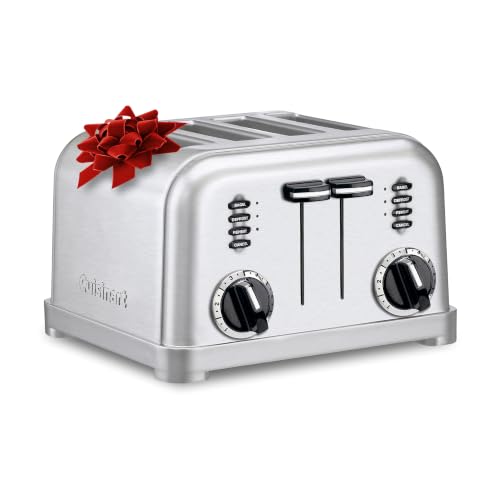
Cuisinart CPT-180P1 4-Slice Toaster — Best Classic Stainless
Choose the CPT-180P1 if you want the proven, repairable-feeling classic rather than the newest screen. Its dials are glove-friendly and readable across the kitchen, and its stainless body wipes clean. It lacks digital countdowns and motorised anything — deliberately.
Strengths
- Dual 6-setting dials are simple, precise and repairable in spirit
- Brushed stainless body suits any kitchen and cleans easily
- Extra-wide slots handle bagels and thick slices without drama
Trade-offs
- No digital display or countdown — you judge by the dial and experience
- Cord management is conventional under-base storage, not a retractable reel
- Stainless shows fingerprints without a quick wipe routine
Key specs: 4-slice brushed stainless (Amazon listing); dual independent controls; 6-setting browning dials; extra-wide slots
There is a reason this model has sold for years: the interface is two dials and the results are consistent. Browning evenness across all four slots is the CPT-180P1’s party trick — the outer slots do not run pale while the inners scorch, a failure cheaper 4-slice units specialise in. Bagel, defrost and reheat functions cover the real use cases without menu-diving.
For cord tidiness, the Cuisinart follows the industry pattern of wrap-underneath storage: effective, simple, and nothing to break. If your counter has a backsplash outlet and the toaster lives in one place, that is genuinely all the cord management most kitchens need — the retractable-reel fantasy matters mainly for toasters that travel between cupboard and counter daily, a point the buying guide takes up in detail.
Best for: buyers wanting a proven stainless 4-slice toaster / Not suited for: gadget lovers wanting screens and motorised lifts
Check the current price on Amazon
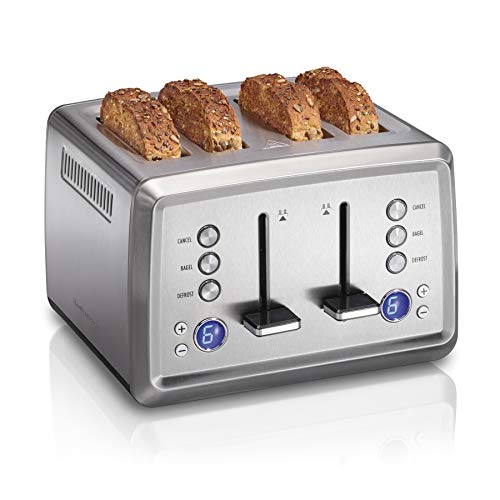
Hamilton Beach 4 Slice Toaster 24796 Digital — Best Digital Controls
The 24796 suits cooks who toast frozen bread and small items often: defrost is a button, and Toast Boost solves the short-slice problem without tongs. Its digital panel is its personality — if you prefer dials on principle, the Cuisinart above is your pick instead.
Strengths
- Digital controls give repeatable shade settings day after day
- Toast Boost raises small slices clear for safe retrieval
- Slide-out crumb tray and auto-shutoff cover cleaning and safety
Trade-offs
- Panel controls are less glove-friendly than big dials
- Cord storage is standard wrap-underneath, not a retractable mechanism
- Stainless-and-black finish shows crumbs and prints readily
Key specs: 4 extra-wide slots (Amazon listing); digital controls with defrost; Toast Boost; slide-out crumb tray; auto-shutoff
Digital repeatability is underrated in toasters: shade 4 today is shade 4 tomorrow, which matters in households where several people share one machine and strong opinions. The defrost function adds time intelligently rather than simply toasting longer at full blast, so frozen waffles emerge toasted rather than dried. The bagel setting and cancel button round out a control set built from actual breakfast behaviour.
Hamilton Beach also understands crumbs: the slide-out tray empties in seconds, which means it actually gets emptied — the best crumb system is the one people use. On cord management it is, again, honest conventional storage. Paired with a fixed counter spot near the outlet, the 24796 stays as tidy as any toaster in this guide.
Best for: frozen-bread households wanting digital repeatability / Not suited for: dial traditionalists
Check the current price on Amazon

bella Fits-Anywhere Slim Toaster, 4 Slice (Oatmilk) — Best Slim Design
Pick the bella if your counter is narrow, your cabinets are low, or your toaster must disappear between uses. Its long-slot format takes artisan loaves lengthways and stores in spaces a boxy 4-slice never will. High-volume families toasting four standard slices simultaneously in separate slots should note its layout differs from a classic 2×2 — read the deep section.
Strengths
- Slim profile fits narrow counters and stores in tight spaces
- Long wide slot suits artisan and sourdough slices
- Light, modern design suits small kitchens and dorm-style setups
Trade-offs
- Long-slot layout is a different workflow from four individual slots
- Lightweight build feels less substantial than the metal classics
- Cord handling is basic — plan a short wrap or counter route
Key specs: 4-slice capacity in a slim long-slot body (Amazon listing); extra long and wide slot format; Oatmilk finish
The bella’s insight is that ‘4-slice capacity’ does not have to mean a wide metal box. A long slot swallows long slices whole — no trimming sourdough to fit — and the slim body slides into the gap beside the fridge that defeats normal toasters. For small kitchens, that footprint is worth more than any feature list, and it is why this design keeps winning buyers.
A slim toaster is also the one most likely to be put away between uses, which is where cord discipline matters most: wrap it short, keep it off the worktop run, and the bella’s whole tidy proposition holds together. It will not out-toast the KitchenAid on evenness across marathon sessions, but for daily family breakfasts in a small kitchen it is the smartest shape here.
Best for: small kitchens and artisan-bread households / Not suited for: marathon batch toasting for crowds
Check the current price on Amazon

Proctor Silex 4 Slice Toaster 24215G (White) — Best Budget
The Proctor Silex is for the buyer who wants four slots and honest toast without paying for stainless theatre. Its white body suits bright kitchens and rental flats, and its control set is complete. It will not feel as dense or last as ceremonially as the premium picks; at its tier, it does not have to.
Strengths
- 7 shade settings cover the full range from pale to very dark
- Toast Boost and extra-wide slots handle muffins and bagels properly
- Auto shutoff and a slide-out tray cover safety and cleaning basics
Trade-offs
- Plastic-forward build feels lighter than metal-bodied rivals
- White finish shows toast marks and needs wiping to stay bright
- Cord storage is the standard under-base arrangement
Key specs: 4 extra-wide slots (Amazon listing); 7 shade settings; Toast Boost; slide-out crumb tray; auto shutoff
Budget toasters fail in predictable places — uneven elements, shades that jump from raw to burnt — and the 24215G avoids the worst of them. Its seven settings give usable gradation, and Toast Boost, a feature borrowed from its Hamilton Beach family, is genuinely useful at any price. For a first flat, a holiday home or a second toaster for guests, this is the rational spend.
Cord expectations should match the tier: a simple wrap underneath, tidied by hand. The guide below explains why that is true of every 4-slice toaster currently verifiable, at every tier — the retractable reel simply is not a feature this category offers, which makes the buying decision about toasting quality and footprint, exactly as it should be.
Best for: budget buyers and second-toaster households / Not suited for: buyers wanting premium materials
Check the current price on Amazon
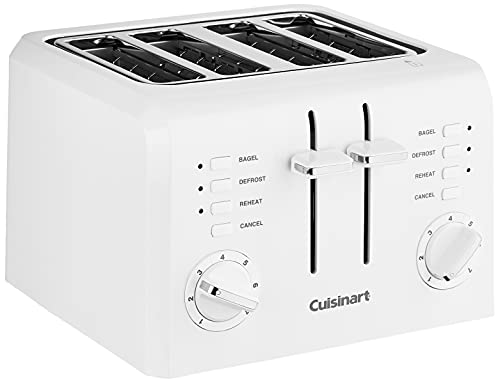
Cuisinart CPT-142P1 4-Slice Compact Plastic Toaster (White) — Best Compact
Choose the CPT-142P1 when the CPT-180P1’s footprint is the only thing stopping you. It keeps the family controls and four slots, trades metal for a compact plastic body, and suits smaller households. Heavy daily use for a big family argues for the full-size metal models above.
Strengths
- Compact body fits counters the full-size classics cannot
- Four full slots — no capacity sacrificed for the smaller footprint
- Lighter body is easy to move for cleaning or storage
Trade-offs
- Plastic housing lacks the premium feel and heft of stainless
- Compact body means slots and levers are a touch smaller to operate
- Standard cord storage — no retractable reel, as across this category
Key specs: 4-slice compact body (Amazon listing); plastic housing in white; Cuisinart control layout
Compact 4-slice toasters often cheat — narrow slots, weak elements — but the CPT-142P1 is a genuine Cuisinart scaled down, not a toy scaled up. It toasts evenly, handles bagels, and keeps the straightforward control philosophy the brand is known for. In a galley kitchen or a studio flat, it may be the only full-capability option that fits at all.
Its lightness cuts both ways: easy to lift out for a counter wipe, less planted during lever use. Park it near its outlet, wrap the cord to length underneath, and it behaves impeccably. As with every pick here, buy it for the toasting and the fit — the cord story is the category’s, and it is told honestly in the guide.
Best for: compact kitchens wanting a name-brand 4-slice / Not suited for: large families with heavy daily volume
Check the current price on Amazon
Comparison Table
| Pick | Badge | Key spec | Best for |
|---|---|---|---|
| KitchenAid KMT4115 4-Slice Manual Lift Toaster (Empire Red) | Best Overall | 4 extra-wide slots, dual controls | families toasting two shades at once on a tidy counter |
| Cuisinart CPT-180P1 4-Slice Toaster | Best Classic Stainless | Dual dials, 6 settings, stainless | buyers wanting a proven stainless 4-slice toaster |
| Hamilton Beach 4 Slice Toaster 24796 Digital | Best Digital Controls | Digital, Toast Boost, crumb tray | frozen-bread households wanting digital repeatability |
| bella Fits-Anywhere Slim Toaster, 4 Slice (Oatmilk) | Best Slim Design | Slim long-slot, 4-slice capacity | small kitchens and artisan-bread households |
| Proctor Silex 4 Slice Toaster 24215G (White) | Best Budget | 7 shades, Toast Boost, budget tier | budget buyers and second-toaster households |
| Cuisinart CPT-142P1 4-Slice Compact Plastic Toaster (White) | Best Compact | Compact 4-slice, white | compact kitchens wanting a name-brand 4-slice |
How to Choose a 4-Slice Toaster When You Care About the Cord
Understand the three cord arrangements you will actually meet. Under-base wrap: cleats or a channel underneath let you wind the cord to exactly the length your counter needs — the category standard, simple and effective. Cord clips and short factory cords: some models simply ship a shorter cord, which is tidy if the outlet is near and limiting if it is not. And the true retractable reel: a spring mechanism that spools the cord inside the body — common in some small appliances historically, but not verifiably offered on a current 4-slice toaster, which is why this guide will not pretend otherwise.
Then judge the toaster. Slot width decides what breads fit; dual controls decide whether two people can toast differently at once; lift height decides whether muffins are a pleasure or a burn risk; and evenness decides whether any of it matters. A toaster with a perfect cord and patchy elements is a tidy disappointment. Buy toasting quality first, then set the cord length once, properly, and forget it.
Placement is the hidden cord feature. A toaster parked within a short run of its outlet, cord wrapped to length and routed behind the machine, looks cordless in daily life. Measure your counter-to-outlet distance before buying; if it is long, prioritise models whose listings state a longer cord or plan a fixed spot. The tidiest cord is the one you never see because the layout was thought through once.
Cord Safety and Care for Countertop Toasters
A toaster cord lives near heat, water and crumbs, and deserves the same respect as the appliance. Never run it across a sink or a hob, never let it drape where a child or a hip can catch it, and never wrap it tightly while the toaster is still warm. When you adjust the under-base wrap, leave a gentle service loop at the plug end so the cord is never under tension — tension at the entry point is how appliance cords fail.
Inspect the cord when you deep-clean the toaster: look for nicks, stiffness or discolouration near the body entry, and stop using any appliance whose cord is damaged. Keep the wrapped section free of crumbs — the crumb tray empties over the base, and a quick shake and wipe keeps the storage channel clean. These are thirty-second habits that add years to an appliance.
For toasters stored between uses, the wrap is your friend: wind to a consistent length, store the toaster where the cord is not pinched by a cupboard door, and unroll fully before use so no coiled section sits against a hot body. Small disciplines, but they are the entire difference between a cord that lasts the appliance’s life and one that becomes its failure point.
What Actually Differs Between 4-Slice Toasters
Evenness is the first difference: better elements and better slot geometry toast all four slices to the same shade, while cheap units scorch the inner slices. Shade range is the second: a good toaster’s lightest setting warms without colour and its darkest approaches — but never reaches — burnt, with usable steps between. Frozen performance is the third: a proper defrost cycle adds gentle time rather than raw power, so waffles and frozen slices toast through instead of drying out.
Interface philosophy splits the field. Dials (Cuisinart, KitchenAid) are fast, tactile and readable at a glance. Digital panels (Hamilton Beach) give exact repeatability and countdown confidence. Neither is objectively better; households with several users and strong preferences often do best with the system everyone will actually set correctly at 7 a.m. half-asleep — which is a real and underrated buying criterion.
Finally, footprint is a feature. The slim bella and compact Cuisinart in this guide exist because many counters cannot host a full-size 4-slice box at all. A toaster that fits gets used daily; a toaster that lives in a cupboard gets used on Sundays. Choose the largest quality your counter honestly holds, not the largest your ambitions imagine.
A Closer Look at the Shortlist: Matching the Six to Real Kitchens
A shortlist for best 4 slice toasters with retractable cords is only useful if it maps onto real kitchens, so consider the six in pairs. The KitchenAid KMT4115 4-Slice Manual Lift Toaster (Empire Red) and the Cuisinart CPT-180P1 4-Slice Toaster are the guide’s two flagships, and they divide buyers by philosophy: one leads on its control architecture and all-round polish, the other on proven, straightforward execution. If your household has argued about toast shade even once, the dual-control logic in this pair is where your money belongs; if breakfast is a solo ritual, either will delight you and the choice can be made on looks and footprint alone.
The middle pair — the Hamilton Beach 4 Slice Toaster 24796 Digital and the bella Fits-Anywhere Slim Toaster, 4 Slice (Oatmilk) — are the specialists, and specialists should be chosen by the problem they solve. Read their badges as job titles: digital repeatability for a shared machine, a shape that fits the bread or the counter that defeated the flagships. Most dissatisfied toaster owners did not buy a bad toaster; they bought a flagship when their kitchen needed a specialist, or a specialist when their household needed a flagship. Naming your actual constraint — bread shape, counter size, number of users, shade politics — before choosing is the entire secret of this category.
The final pair, the Proctor Silex 4 Slice Toaster 24215G (White) and the Cuisinart CPT-142P1 4-Slice Compact Plastic Toaster (White), defend the budget and compact ends of the market, and they do it by keeping the fundamentals: usable shade ranges, slots sized for real bread, lift mechanisms that work, trays that empty. What they surrender is material theatre and feature depth, which many households will never miss. A household that toasts twice a day for six people should buy a flagship; a household furnishing a first kitchen should buy from this pair and spend the difference on better bread — the upgrade path runs through the bakery as much as through the appliance aisle.
Before You Order: A Best 4 Slice Toasters With Retractable Cords Checklist
Measure three things before ordering any toaster: the counter space it will occupy (including the headroom under cabinets, where heat and steam rise), the distance to the outlet it will actually use, and the bread it must fit — width, height and, for artisan loaves, length. A toaster is a daily appliance; a daily appliance that does not fit its space or its bread generates a small resentment every single morning, and small daily resentments are how appliances end up back in their boxes.
Decide who sets the controls. Households with several users and strong preferences should weight dual controls or digital repeatability heavily, because a setting everyone can reproduce ends more breakfast friction than any other feature. Solo cooks can simplify. Households with children should weight cool exteriors, auto-shutoff and lift height. Write your household’s top two requirements down before comparing models — the shortlist above is organised by exactly those requirements, and choosing by them takes five minutes instead of fifty.
Finally, plan the first week: a loaf of your usual bread, one frozen item you actually eat, and ten minutes to map the shade settings. Every toaster in this guide has a personality — a setting that runs dark, a slot that runs light — and the owners who map theirs in week one are the ones still praising the machine in year three. The checklist is short because the category is simple; the discipline is in actually doing it. Do it with the order page open and the tape measure in hand, not from memory of a counter you have not looked at since you moved in — kitchens shrink in the imagination, bread grows, and the gap between the two is where returns are born. Five honest minutes now is the cheapest insurance in the whole purchase.
Ownership Over the First Year: Habits That Keep Toast Even
A toaster’s first month sets its reputation unfairly: elements are new, settings are unmapped, and the household is comparing every slice with the old machine’s memory. Resist verdicts until the shade map is learned. By the second month the right numbers are reflexes, the crumb rhythm is a habit, and the machine either disappears into the morning — the highest praise a toaster can earn — or reveals a genuine mismatch of geometry or controls that no habit can fix.
Across the year, evenness is maintained, not owned. Crumbs accumulate near elements and quietly change how slices brown; a monthly shake-out and weekly tray emptying keep a good toaster good. Sugary and seeded breads accelerate the need. Exteriors age by how they are wiped — with the grain on steel, softly on colours — and cords age by how they are treated at the plug end, where a relaxed loop outlasts a tight bend by years.
The households that replace toasters least often share one trait: they bought for their bread and their users, then maintained the machine on a rhythm. The picks in this guide are built to reward exactly that pattern. If your current toaster disappoints, diagnose honestly before replacing — half the time the fault is crumbs, placement or an unmapped shade dial, and the fix is free. The other half of the time, this shortlist is waiting — and it will still be waiting, unchanged in its essentials, because toasters improve slowly and the fundamentals in this guide were true a decade ago and will be true a decade hence.
Bread, Settings and Technique: Getting More From Any Toaster
Bread is half the toaster equation and the half nobody optimises. Fresher, moister bread needs a touch more shade than the same loaf on day three; frozen bread needs the defrost function rather than a shade guess; enriched breads — brioche, challah, anything sugared — brown faster and burn earlier, and want a step down. Keeping a tiny mental table of your three regular breads and their settings transforms results more than upgrading the machine usually does.
Technique matters at the margins that decide great toast: centre slices in their slots, match thicknesses within a cycle, and let a relay cycle run a shade lighter on basic models because the elements are already hot. Butter on warm toast melts into the crumb; butter on cooling toast sits on top — a thirty-second difference that separates diner toast from home toast. For sandwiches, toast one side logic applies: some models’ bagel setting, used creatively, toasts a single face beautifully.
And when toast is the meal — beans on toast, rarebit, bruschetta, the great open sandwiches — treat the toaster as the cooker it is: sturdy slices, full attention, and toppings staged before the cycle ends. The six machines in this guide all have the evenness and range for that duty. The difference between adequate and excellent toast, most mornings, is not the appliance. It is the cook deciding that breakfast deserves the same care as dinner.
Small Kitchens, Shared Houses and Other Real Constraints
Real kitchens impose constraints that showroom shopping ignores. Counters are shared with kettles, boards and yesterday’s post; outlets are where the builder left them, not where the toaster wants to be; cupboards hang lower than the steam would like. The compact and slim picks in this guide exist because those constraints are the market, not the exception — and a toaster chosen to fit them gets used daily, while a flagship exiled to a cupboard by its own footprint gets used on Sundays and resented on weekdays.
Shared houses add people to the physics: flatmates with different shades, different breads and different standards of crumb-tray citizenship. Digital repeatability and dual controls are social features as much as technical ones, and the households that choose them report fewer breakfast negotiations than any feature list can quantify. If you are buying for a shared kitchen, buy for the group’s habits, not for your own idealised ones.
The through-line of this guide is that fit beats specification. The best toaster for a given kitchen is the one whose geometry matches its bread, whose controls match its users, whose footprint matches its counter and whose exterior matches its neighbours. All six picks clear the quality bar; the checklist sections exist to help you find which one clears yours.
Toaster Troubleshooting: Fixing the Five Common Complaints
Complaint one: toast browns more on one side. Causes, in order of likelihood: the slice was not centred, crumbs are insulating one element, or the bread was denser on one face (common with hand-cut loaves). Centre, clean, and rotate the slice halfway for a week; if one slot still runs one-sided after cleaning, its element is ageing and the machine is telling you its timeline. Complaint two: successive cycles darken. That is residual heat, normal on basic models — drop a shade step for relays, or pause a minute between batches.
Complaint three: frozen items emerge dry outside and cool inside. The defrost function exists precisely for this; using a higher shade instead of defrost is the usual error. Complaint four: small items are unreachable. Use the lift or boost feature every time, keep wooden tongs by the toaster, and never solve it with cutlery. Complaint five: the toaster smokes. Nine times in ten that is accumulated crumbs or a sugary spill burning off — unplug, cool, clean thoroughly. The tenth time, it is electrical, and the answer is replacement, not investigation.
Notice what is absent from that list: mysterious failures. Toasters are simple machines whose problems are almost always geometry, crumbs or heat management — all within the owner’s control. The picks in this guide were chosen partly for how forgiving they are of real-world technique: wide slots that centre bread naturally, lifts that work, trays that slide out where you can see them. Buy that forgiveness, practise the small disciplines, and troubleshooting becomes a paragraph you read once rather than a ritual you perform.
A final word on when troubleshooting should stop. A toaster is an inexpensive appliance with live elements, a mains cord and a daily duty cycle; when the fault is electrical — scorch marks at the plug, a cord that runs warm, breakers tripping, a lever that will not stay down accompanied by a burning smell — the correct repair is replacement, and the correct disposal is your local e-waste route. Everything else in this section is maintenance, and maintenance is safe, satisfying and cheap. Knowing the line between the two is part of owning the appliance well: clean it, centre for it, map its settings, forgive its relay heat — and retire it without sentimentality the moment it asks you to forgive something electrical. The replacement, chosen from a shortlist like this one and mapped in its first week, will be better than the original ever was, because this time you will know exactly what you are buying and exactly how you will run it.
The First Week With a New Toaster: A Small Programme
Day one is for mapping, not judging. Toast your usual bread at three settings, photograph the results in slot order, and write the winning setting where the household can see it. Run one frozen item through the defrost function and one bagel through the bagel setting, even if neither is on the menu that day — functions you have tested once are functions you will use correctly under pressure, and functions you have never tested might as well not exist.
Across the first week, deliberately vary the load: a single slice (which many toasters brown differently from a full load, and which some compensate for), a full four-slice relay for the household, a thick artisan slice, and the smallest item you regularly toast, to prove the lift. Note which slot runs darkest, if any does, and whether the second cycle needs a shade step down. These five experiments, totalling perhaps twenty minutes, produce the complete operating manual for your specific machine — the one no manufacturer can print, because it depends on your bread, your voltage and your preferences.
Finish the week with the maintenance baseline: empty the tray, wipe the exterior, set the cord length properly if you have not already, and decide where the toaster truly lives. Appliances that survive their first week in a fixed home, with mapped settings and a cleaning rhythm, tend to serve for years; appliances that spend week one being moved, guessed at and left crumb-filled tend to be replaced within two. The programme costs nothing but attention, and it is the highest-value hour in the life of any toaster in this guide.
One more experiment belongs in that first week, and it is the one households skip: toast for someone else, at their setting, from their bread, and watch what they notice. A toaster is a shared appliance in most homes, and its settings are a small social contract. The machines in this guide with dual controls or digital memories formalise that contract; the simpler ones rely on the household learning it. Either way, the first week is when the contract gets written — in shade numbers on a cupboard card, in agreements about who empties the tray, in a decision about where the machine lives. Write it kindly and write it early, because breakfast is the meal a household eats together most often, and a toaster that everyone understands is a small, daily contribution to domestic peace that no specification sheet can measure but every family can feel.
How to Set Up a Toaster for a Tidy, Safe Counter
Choose the toaster’s permanent home first: within easy reach of an outlet, clear of the sink’s splash zone and the hob’s heat, with headroom under cabinets for rising heat and steam. Unwrap the cord fully, plug in, and only then set the working length — wind the surplus onto the under-base cleats in even turns until the toaster sits exactly where you want it with a small, relaxed loop at the plug.
Run the first cycle empty or with sacrificial bread to burn off new-appliance odours, and calibrate your shade expectations: toast one slice at each of two or three settings and note which matches your household’s preference. Write the winning numbers on a card inside a nearby cupboard door — shared households converge on settings in a day instead of a month of pale and burnt experiments.
Set a crumb rhythm from day one: tray emptied weekly (or after any seeded or sugary bread), exterior wiped while warm-not-hot, cord channel checked when the tray is out. A toaster maintained this way stays safe, toasts evenly for years, and keeps the counter looking like the tidy setup you planned — cord included.
Common Buying Mistakes
Hunting for a retractable reel that the category does not offer, and buying a listing’s stretched wording instead of a verified toaster. Check what the cord arrangement actually is before ordering.
Judging a toaster by its first slice. Elements and thermostats settle; judge evenness across a full four-slice load and across several days of breakfasts.
Leaving the cord at full length in a tangle behind the toaster. Thirty seconds of under-base wrapping at setup is the entire cord-tidiness project — do it once, properly.
Toasting sugary or filled items without a cleanup plan. Melted fillings become smoke, smells and element residue. Use the crumb tray rhythm and wipe spills before the next cycle bakes them on.
Fishing for small slices with metal implements. Use the lift lever or Toast Boost, or wooden toast tongs — never a fork near live elements, and always unplug before retrieving anything stuck.
Placing the toaster under a low cabinet and walking away. Rising heat and steam mark cabinets and trip alarms. Give it headroom and line of sight while it works.
Final Recommendation
Buy the KitchenAid KMT4115 if you want the best all-round 4-slice toaster in this guide — dual controls, wide slots, manual lift — with its cord wrapped short and forgotten. The Cuisinart CPT-180P1 is the classic alternative, the Hamilton Beach 24796 the digital one, and the bella Slim the answer when the counter itself is the constraint. The Proctor Silex keeps the budget honest and the compact Cuisinart keeps small kitchens in the game.
And take the guide’s headline seriously: do not pay a premium for the words ‘retractable cord’ on a 4-slice toaster without verifying a genuine reel mechanism, because none could be verified in the current catalog. A great toaster with its cord wrapped to length is the tidy appliance you actually want — and all six of these are exactly that.
Start with the top three if you are deciding today: KitchenAid KMT4115 4-Slice Manual Lift Toaster (Empire Red) — Check the current price on Amazon; Cuisinart CPT-180P1 4-Slice Toaster — Check the current price on Amazon; and Hamilton Beach 4 Slice Toaster 24796 Digital — Check the current price on Amazon. Each leads to the exact verified listing named in its review, so you can confirm the model, finish and configuration before ordering.
Related guides worth reading next: Best 4 Slot Toasters Best 4 Slotted Toasters Best 4 Slice Toasters Today.
Frequently Asked Questions
Do any 4-slice toasters have a truly retractable cord?
None could be verified in the current Amazon catalog through this site’s API checks. Quality 4-slice toasters use under-base cord wrap or storage, which achieves the same tidy result with a simpler, more durable mechanism.
Is cord wrap as good as a retractable reel?
For a toaster that lives in one counter spot, yes — you set the length once and it stays set. A reel’s advantage is for appliances moved daily between storage and use, and even then it adds bulk and a failure point.
What cord length do I need?
Enough to reach your outlet with a relaxed loop — no tension, no long surplus. Measure your counter layout before buying; if the run is unusually long, confirm cord length on the listing or choose a closer spot.
Can I use an extension cord with a toaster?
Manufacturers advise against it: toasters draw substantial power, and extension cords add resistance and trip hazards. Plug directly into a wall outlet, and arrange the counter so that is possible.
How do I keep the cord area clean?
Empty the crumb tray on a rhythm, shake loose crumbs from the base before wrapping or moving the toaster, and wipe the cord channel when you deep-clean. Crumbs near the cord entry are the main thing to avoid.
Does a shorter cord affect toasting performance?
No — cord length is a placement question, not a performance one. Judge the toaster on evenness, slots, controls and lift; then set the cord to suit your counter.
Keep exploring this category here: Best 2 Slot Toasters Best 4 Slice Toaster Ovens.


