Disclosure: airfryerkitchensupply.com is reader-supported. When you buy through links on our site, we may earn an affiliate commission at no extra cost to you.
Charcoal is barbecue’s first fuel and, for many cooks, its final answer. The best backyard charcoal smokers share a beautiful premise: a bed of coals, a managed draft, and time — no augers, no elements, no apps required, though a fan controller can join the system whenever you like. What charcoal returns for that simplicity is the flavor benchmark itself: the deep smoke, firm bark, and rendered richness against which pellet and electric barbecue are politely measured. This guide picks the six charcoal formats that matter in a backyard — bullet, kamado, drum, vertical cabinet, and gravity-fed — and matches each to the cook it serves.
Charcoal smoking asks for a modest skill and repays it for life: laying a fire that burns progressively, reading vents the way sailors read wind, and knowing that the coal bed you build at 9 a.m. is the brisket you slice at 9 p.m. The learning curve is real and short — two or three cooks to competence, a season to confidence — and every pick here was chosen to teach it kindly. Two of them even automate it: the gravity smoker holds temperature with a fan while burning real charcoal, proof that tradition and convenience stopped being enemies a while ago.
Every pick was verified against its current Amazon listing before inclusion, model identity matched to the verified listing title. All are current-production charcoal smokers from established makers, with the parts and community support a decades-long fuel deserves.
Where to buy
All six charcoal smokers are sold on Amazon, most through their manufacturers’ stores. Charcoal cookers ship from compact to genuinely heavy (the kamado) — check the listing’s weight and assembly notes, and have your charcoal store ready before the first fire: a sealed bin of quality lump or briquettes is part of the purchase.
- Weber Smokey Mountain Cooker 22-inch — Check the current price on Amazon
- Weber Smokey Mountain Cooker 18-inch — Check the current price on Amazon
- Oklahoma Joe’s Bronco Pro 21.5-inch Charcoal Drum Smoker — Check the current price on Amazon
- Kamado Joe Classic Joe Series II 18-inch — Check the current price on Amazon
- Cuisinart 18-inch Vertical Charcoal Smoker COS-118 — Check the current price on Amazon
- Masterbuilt Gravity Series 600 Digital Charcoal Grill and Smoker — Check the current price on Amazon
In this guide
Quick Picks
In brief: the Smokey Mountain 22 for the classic bullet experience, its 18-inch sibling for most households, the Bronco Pro drum for punchy efficiency, the Kamado Joe for the ceramic summit, the Cuisinart for the budget door, and the Gravity 600 for charcoal with a thermostat.
- Weber Smokey Mountain Cooker 22-inch — Best Overall Charcoal: The charcoal smoker against which others are measured: dual grates, the water pan system, and stability that has made it a competition staple for decades. Check price on Amazon.
- Weber Smokey Mountain Cooker 18-inch — Best for Most Households: The same legendary bullet in the household size: a brisket, two butts, or a family rib load, with smaller charcoal appetite and patio footprint. Check price on Amazon.
- Oklahoma Joe’s Bronco Pro 21.5-inch Charcoal Drum Smoker — Best Drum Smoker: The drum perfected for backyards: sealed, efficient, punchy — hangs ribs, holds heat like a safe, and grills when the smoking is done. Check price on Amazon.
- Kamado Joe Classic Joe Series II 18-inch — Best Kamado Charcoal: Ceramic insulation makes charcoal behave like it has a thermostat: the longest, steadiest low cooks in this guide, plus searing range when wanted. Check price on Amazon.
- Cuisinart 18-inch Vertical Charcoal Smoker COS-118 — Best Budget Charcoal: The bullet format’s budget door: water bowl, dual vents, two grates, and an integrated thermometer — the complete charcoal smoking kit at the entry tier. Check price on Amazon.
- Masterbuilt Gravity Series 600 Digital Charcoal Grill and Smoker — Best Automatic Charcoal: Charcoal flavor, thermostat manners: the hopper feeds the fire, the fan holds the temperature, and the app reports. For charcoal lovers with pellet-grill schedules. Check price on Amazon.
How These Picks Were Chosen
Format coverage drove the selection: bullet, drum, kamado, budget vertical, and gravity-fed are the five living traditions of backyard charcoal, and each deserved its exemplar. The bullet earned two places — 22 and 18 inch — because it is the category’s center of gravity and the size question is the most common real decision charcoal buyers face. Every pick burns charcoal as its primary fuel and holds smoking temperatures for long cooks by its format’s own method.
Verification followed the standing rule without exception: each pick confirmed, model identity matched to the listing title, specifications quoted only from verified titles. Marketing capacities were cross-checked against format reality — a drum’s 366 square inches is described as the intimate, intense space it is, not inflated into a party claim.
Longevity and teachability completed the screen. Charcoal smoking is a skill a household keeps for decades, so the picks favor cookers whose parts, gaskets, and grates remain available and whose methods are documented by deep owner communities. The one budget pick is included honestly as a teacher and a second cooker, with its lighter build stated rather than smoothed over.
The 6 Best Backyard Charcoal Smokers

Weber Smokey Mountain Cooker 22-inch — Best Overall Charcoal
If the backyard charcoal category has a capital city, it is the Smokey Mountain 22. The design is a masterclass in doing few things perfectly: a charcoal ring at the base lit minion-style, a water pan above it acting as heat buffer and humidity source, two full grates of cooking space, and vents that — once the fire settles — hold smoking temperatures with a composure that seems impossible for so simple a machine. The 22-inch size takes two briskets or four pork butts without stacking compromises.
Strengths
- Benchmark charcoal flavor, bark, and smoke ring
- Famously stable once settled — the water pan is a thermal flywheel
- Weber longevity, parts, and community in full
Trade-offs
- Manual vents — the skill is yours to build, though the teacher is gentle
- Capacity this size eats charcoal proportionally on small cooks
- No lid hinge or shelf luxuries; it is a focused instrument
| Fuel | Charcoal, water pan system |
| Size | 22-inch, dual cooking grates (per Amazon listing title) |
| Format | Vertical bullet smoker |
| Brand line | Weber Smokey Mountain Cooker (per Amazon listing title) |
The bullet’s method rewards a specific discipline: fill the ring, bury a few wood chunks, light a small count of coals in the center, assemble, and then — the hard part — leave the vents nearly alone. The Smokey Mountain climbs to its range and parks there, and cooks who resist fiddling are rewarded with eight, ten, twelve hours of steadiness from one load. That is why the platform wins competitions and why it converts kettle owners permanently: it demonstrates that charcoal smoking is not firefighting, it is fire planning.
At 22 inches, think in events: the holiday brisket plus a butt, the rib cook for the whole street, the freezer-filling Saturday. The grate space invites a drip-pan discipline — catch the renderings, keep the water pan’s job distinct — and the bullet’s modest footprint means it lives happily beside a grill rather than demanding the patio. For the household whose cooks run large, this is the charcoal smoker to buy once and hand down.
Best for: most charcoal households, event cooks, and aspiring competition cooks / Not suited for: small households that never cook beyond two racks of ribs
Check the current price on Amazon
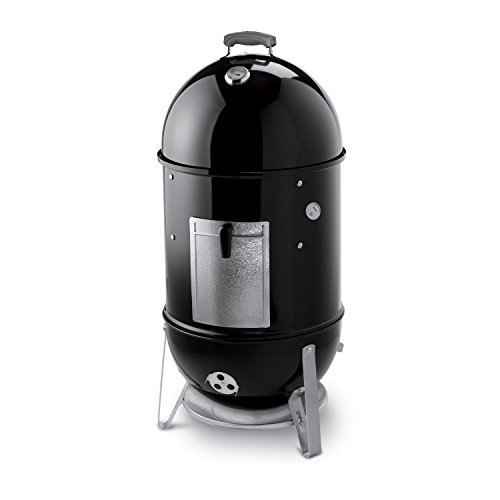
Weber Smokey Mountain Cooker 18-inch — Best for Most Households
The 18-inch Smokey Mountain is the 22’s doctrine in the size most households actually live at. Everything is here — water pan, dual grates, the settling fire, the benchmark flavor — scaled to a brisket, two pork butts, or the family’s rib night, on less charcoal per cook and less patio per year. For the majority of backyard cooks, this is not the smaller compromise; it is the correct instrument, and its sales history against its own sibling says the market agrees.
Strengths
- Identical method and flavor to the 22-inch, household-scaled
- Economical charcoal use and quick to bring to temperature
- The most documented smoker in barbecue — every question pre-answered
Trade-offs
- A full packer brisket may need a rib rack or a gentle shoehorn technique
- Crowd cooks require batching or a second cooker
- Same manual-vent discipline as its sibling
| Fuel | Charcoal, water pan system |
| Size | 18-inch, dual cooking grates (per Amazon listing title) |
| Format | Vertical bullet smoker |
| Brand line | Weber Smokey Mountain Cooker (per Amazon listing title) |
The 18-inch teaches the essential charcoal lesson fastest, because its smaller fire responds a touch quicker and its cooks finish a touch sooner — feedback loops tighten, and the cook learns the vents in three cooks instead of five. Its capacity ceiling is honest: when the household’s ambitions outgrow it, the 18 becomes the second cooker (poultry and ribs beside the big brisket machine) rather than a regret. Many two-Smokey-Mountain households exist, and nearly all of them started exactly here.
Pair it with a fan controller — the Smokey Mountain is the controller category’s favorite pupil — and this modest bullet becomes a genuinely automatic overnight smoker while remaining, at heart, charcoal and patience. Or run it manually for a decade on Weber parts and stubbornness. Both ownership stories are well documented and both end at the same table: benchmark charcoal barbecue from the most proven cooker in the guide.
Best for: typical households wanting the classic bullet in the right size / Not suited for: regular crowd cooks (choose the 22-inch)
Check the current price on Amazon
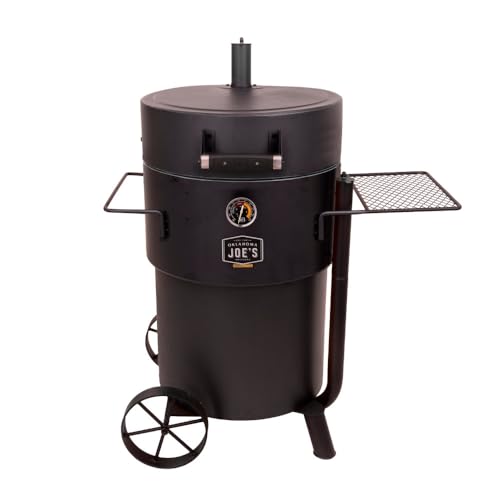
Oklahoma Joe’s Bronco Pro 21.5-inch Charcoal Drum Smoker — Best Drum Smoker
Drum smokers are the hot-rodders of charcoal: a sealed barrel, a charcoal basket at the bottom, and a draft so efficient that the cooker sips fuel while holding temperature like a bank vault. The Bronco Pro is the format’s polished backyard form — 21.5 inches, 366 square inches of grate, heavy-duty construction, and the drum party tricks included: ribs hung from hooks cook evenly in the rising heat, and the same drum converts to direct grilling when the occasion turns. Oklahoma Joe’s build gives the drum a finished, warrantied form its homemade ancestors lacked.
Strengths
- Drum efficiency — long, steady cooks on modest charcoal
- Hanging-rib capability produces famously even results
- Converts to a grill; heavy-duty build for the format
Trade-offs
- 366 sq in is brisket-shaped but not crowd-sized
- Drum cooking runs a touch hotter and faster — recalibrate your timing
- Fewer decades of community than the Weber bullets
| Fuel | Charcoal basket, drum draft system |
| Cooking area | 366 sq in (per Amazon listing title) |
| Size | 21.5-inch drum (per Amazon listing title) |
| Format | Drum smoker and grill (per Amazon listing title) |
The drum’s character is intensity with control: the sealed body and direct-rising heat give meat a slightly bolder, drippings-kissed flavor — fat vaporizing on the coals is the drum’s signature note, distinct from the bullet’s cleaner profile — while the intake system holds the line for hours. Ribs hung in a Bronco are a backyard spectacle with a practical core: gravity keeps them straight, the heat bathes them evenly, and the results rival any format’s. Cooks who find bullets too polite often find the drum is the personality they were looking for.
The Pro’s size suits the household-plus-guests scale: a brisket, or a butt and ribs, or a hanging gallery of ribs for the whole table. Its grill conversion is no gimmick — the same draft that smokes so steadily grills hot and fast with the basket raised in spirit. Keep the intake path ash-free and the drum’s steadiness becomes metronomic. For the cook who wants charcoal with an edge, this is the pick.
Best for: rib lovers and cooks wanting efficient, bold drum flavor / Not suited for: crowd-capacity buyers or the gentlest-smoke palates
Check the current price on Amazon

Kamado Joe Classic Joe Series II 18-inch — Best Kamado Charcoal
A kamado is a charcoal smoker wrapped in a thermos. The Classic Joe II’s ceramic body stores heat so completely that a modest load of lump charcoal holds smoking temperatures for durations that sound exaggerated until you have watched one do it — through the night, into the morning, with charcoal to spare. The Series II kit completes the backyard picture: cart, side shelves, the counterbalanced hinge, and flexible two-level cooking. As a smoker it is the efficiency champion of this guide; as a cooker it also roasts, bakes, and sears, because kamados refuse categories.
Strengths
- Unmatched charcoal efficiency and temperature stability
- Moist, even smoking from ceramic’s radiant environment
- Full temperature range — one cooker for the whole outdoor menu
Trade-offs
- Premium purchase, premium accessories
- 18-inch grate batches crowds rather than swallowing them
- Lump charcoal is the required fuel — briquettes need not apply
| Fuel | Lump charcoal, ceramic body |
| Size | 18-inch (per Amazon listing title) |
| Included | Cart and side shelves (per Amazon listing title) |
| Series | Classic Joe Series II (per Amazon listing title) |
Kamado smoke has a quality its owners struggle to describe and refuse to surrender: the tiny airflow the insulated fire needs means the meat bathes in gentle, continuous smoke without drying, and the ceramic’s even radiation cooks edges like centers. Briskets emerge with deep color and a tenderness that makes the format’s devotees patient with its price. Add a fan controller and the kamado becomes the most automatic charcoal system in existence — owners set it at night with the confidence other formats reserve for pellet grills.
The discipline is overshoot: ceramic stores heat so well that blowing past your target costs an hour, so kamado cooks approach temperature from below, vents narrowing as the line climbs. Learn that single patience and the Classic Joe becomes the easiest charcoal cooker in this guide to run long — a paradox the owners all recognize. It is the premium pick, and the one whose cost-per-cook over a decade quietly becomes the lowest here.
Best for: efficiency devotees and one-cooker households with premium budgets / Not suited for: briquette loyalists or crowd-first cooks
Check the current price on Amazon

Cuisinart 18-inch Vertical Charcoal Smoker COS-118 — Best Budget Charcoal
The COS-118 is how a household finds out whether charcoal smoking is its hobby, at a cost that makes the experiment painless. The format is the bullet’s, honestly rendered: an 18-inch vertical body, a water bowl buffering the fire, dual vents for draft control, chrome-plated grates on two levels, and an integrated thermometer in the lid. Cuisinart’s version adds the brand’s retail polish and support, and the listing’s own ambitions — brisket, camping, tailgates — describe its portable, versatile character accurately.
Strengths
- Complete charcoal smoking kit at the entry tier — nothing else required to start
- Water bowl and dual vents teach the real bullet method, not a toy version
- Light and portable enough for camping and tailgating duty
Trade-offs
- Light-gauge build — expect a shorter service life than the Weber bullets
- Lid thermometer is a guide, not gospel; verify with a real probe
- Sealing and wind resistance are modest; site it sheltered
| Fuel | Charcoal, water bowl system |
| Size | 18-inch vertical (per Amazon listing title) |
| Features | Integrated thermometer, dual vents, chrome-plated grates (per Amazon listing title) |
| Model | COS-118 (per Amazon listing title) |
Budget smokers earn their keep as teachers, and the Cuisinart teaches the genuine curriculum: minion fires, vent discipline, water-pan management, and the patience of the long cook. Its thinner steel makes it a more attentive teacher than the Weber — wind matters more, recovery is slower — and cooks who master it here find every subsequent cooker easy. The food, meanwhile, is no asterisk: a well-run COS-118 produces brisket and ribs that embarrass expensive equipment in careless hands, which is the oldest lesson in barbecue.
Treat it kindly and it lasts longer than its tier promises: shelter it, keep ash out, and let the water bowl do its buffering work. Many households run one for years as the second cooker — the poultry-and-ribs station beside a larger brisket machine — after graduating to heavier steel for the main role. As an entry ticket to charcoal smoking that also works at the campsite, it has no real competition in this guide.
Best for: beginners testing the charcoal hobby and campers wanting a portable smoker / Not suited for: buyers seeking a decade-long primary cooker
Check the current price on Amazon

Masterbuilt Gravity Series 600 Digital Charcoal Grill and Smoker — Best Automatic Charcoal
The Gravity 600 closes this guide by dissolving its oldest argument. Charcoal purists said automation meant surrendering real fire; Masterbuilt answered with a hopper: charcoal feeds downward by gravity as it burns, a digitally controlled fan meters the air, and WiFi keeps the cook informed — while the smoke rolling over the meat is unmistakably, traditionally charcoal. At 600 square inches it is sized for households, and it grills hot as readily as it smokes low, because a fan-fed charcoal fire answers the throttle in both directions.
Strengths
- Real charcoal flavor with set-and-forget temperature holding
- GravityFed hopper refuels continuously — no mid-cook charcoal additions
- WiFi monitoring and full grilling range in one charcoal cooker
Trade-offs
- Ash and hopper housekeeping exceed a bullet’s simplicity
- Fan, seals, and electronics are wear items a manual cooker does not have
- Charcoal consumption on long cooks is a real budget line
| Fuel | Charcoal, GravityFed hopper |
| Cooking area | 600 sq in (per Amazon listing title) |
| Control | Digital fan control with WiFi technology |
| Model | MB20041023 (per Amazon listing title) |
The Gravity’s brisket is the argument settled on a plate: bark and smoke ring in the offset’s family, produced by a cook who slept. The system’s one demand is that you treat the hopper as a fuel system — dry charcoal, ash path cleared, seals maintained — rather than as a hole to pour briquettes into. Owners who do, report the strangest and best charcoal experience available: the flavor of the oldest fuel with the schedule of the newest appliance. In a guide devoted to charcoal, that synthesis earns the closing position.
It also reframes the household debate: the cook who loves charcoal flavor and the household that needs weeknight feasibility no longer have to compromise on a pellet grill neither loves. The Gravity smokes the Saturday brisket with charcoal depth and grills Tuesday’s chicken with charcoal speed. If your backyard’s charcoal loyalty is sincere but your calendar is modern, this is the machine the category built for you.
Best for: charcoal loyalists wanting automation and overnight freedom / Not suited for: manual-fire traditionalists or minimal-maintenance buyers
Check the current price on Amazon
Comparison Table
| Pick | Badge | Key spec | Best for |
|---|---|---|---|
| Weber Smokey Mountain Cooker 22-inch | Best Overall Charcoal | 22-inch bullet, dual grates, water pan system | most charcoal households, event cooks, and aspiring competition cooks |
| Weber Smokey Mountain Cooker 18-inch | Best for Most Households | 18-inch bullet, dual grates, water pan system | typical households wanting the classic bullet in the right size |
| Oklahoma Joe’s Bronco Pro 21.5-inch Charcoal Drum Smoker | Best Drum Smoker | 366 sq in, drum format, smoker and grill | rib lovers and cooks wanting efficient, bold drum flavor |
| Kamado Joe Classic Joe Series II 18-inch | Best Kamado Charcoal | 18-inch ceramic, cart and shelves, divide-and-conquer grates | efficiency devotees and one-cooker households with premium budgets |
| Cuisinart 18-inch Vertical Charcoal Smoker COS-118 | Best Budget Charcoal | 18-inch vertical, water bowl, dual vents, integrated thermometer | beginners testing the charcoal hobby and campers wanting a portable smoker |
| Masterbuilt Gravity Series 600 Digital Charcoal Grill and Smoker | Best Automatic Charcoal | 600 sq in, GravityFed hopper, digital fan, WiFi | charcoal loyalists wanting automation and overnight freedom |
How to Choose a Backyard Charcoal Smoker
Begin with the fire you want to tend. The bullet asks for a setup and near-silence afterward — the planner’s cooker. The drum asks the same with a bolder flavor and a hanging rack’s theater. The kamado asks for patience on the climb and then ignores you for a day. The budget vertical asks for attention in wind and repays it in tuition. The gravity asks for housekeeping and gives you back your night. All five bargains are fair; the cook’s temperament is the only referee that matters.
Lump versus briquettes
Briquettes burn evenly, predictably, and long — the bullet and drum fuels of choice for overnight steadiness, with more ash as the tax. Lump burns hotter, cleaner, and with less ash, but in irregular sizes that make every load its own small experiment; kamados require it, and gravity hoppers accept either with different manners. Most households settle on one primary fuel per cooker and learn its personality deeply rather than alternating — consistency of fuel is consistency of results.
Size and the second-cooker truth
Buy the size of your largest monthly cook. Then accept the backyard’s open secret: serious charcoal households often end with two cookers — a large for events, a small for Tuesdays — because charcoal cookers are comparatively affordable and each size has cooks it does best. The 18-inch bullet plus the 22, or the Cuisinart beside the kamado, are not redundancies; they are a fleet, and fleets get used.
Charcoal Fire Craft: The Skills Every Format Shares
Every cooker in this guide runs on the same three skills. First, the progressive fire: unlit fuel arranged to catch gradually — the minion method in bullets and drums, the buried-pocket light in kamados, the loaded hopper in the gravity — so the fire grows into the cook instead of peaking at its start. Second, draft discipline: vents changed in small moves, then left alone long enough for the fire to answer, because charcoal responds on a delay and impatient hands chase a lagging indicator into oscillation. Third, ash awareness: ash is insulation and obstruction, and the cook who manages it — before the cook, and on the longest smokes, during — owns the steadiest fire on the street.
Wood is the seasoning hand: chunks buried in the charcoal load, never a bonfire of splits in a bullet or drum, chosen by the meat — oak and hickory for beef and pork, fruitwoods for poultry and fish, mesquite in a whisper if at all. Smoke should be a presence, not a weather event. The charcoal provides the heat and the base note; the wood provides the accent; the cook provides the restraint.
Adding a Controller: Charcoal’s Optional Autopilot
Every manual cooker in this guide can be automated after the fact with a fan controller — a pit probe, a small computer, and a fan at the intake that holds temperature the way the gravity smoker does natively. The Smokey Mountain and the kamado are the controller’s star pupils, sealing well and sipping air. The purchase logic is simple: learn your cooker manually for a season, so the controller’s behavior means something to you, then add it when overnight cooks or busy Saturdays make vigilance the binding constraint.
Controllers do not repeal fire craft — they assume it. The fire must still be laid progressively, the cooker sealed, the ash managed. What the fan removes is the hourly presence, and for many households that removal is the difference between charcoal smoking as a monthly ceremony and charcoal smoking as a weekly habit. The companion controller guides in this series sort the hardware; the charcoal guides, including this one, teach the fire it will manage.
Charcoal and Weather: Cooking Through the Seasons
Charcoal is the all-season fuel, but each season argues with it differently. Summer’s heat makes fires eager — smaller lit counts, vents a touch more closed, and shade for the cooker if the afternoon is fierce. Winter is charcoal’s finest hour and its hungriest: cold-soaked steel and wind steal heat, so budget more fuel, preheat longer, site the cooker out of the wind’s road, and expect the same steadiness once the system settles — kamados and bullets in particular cook January briskets with a shrug. Rain asks only for shelter over the cook and dry storage for the fuel; snow asks for a shoveled station and the confidence that the fire does not care.
The cooks who smoke year-round share one trait: their stations are set up for the worst month, not the best — fuel under cover, a windbreak position chosen, lighting that works at 5 a.m. in February. Build the station for winter and summer becomes effortless; build it for July and January becomes an excuse. Charcoal rewards the prepared in every season, which is most of what this guide has been saying in different words.
The Charcoal Pantry: Building a Fuel and Wood Library
Serious charcoal households keep a small library, and it is worth building deliberately. One primary charcoal — the bag your cooker knows — bought in quantity when it is available, because consistency across a season is worth more than novelty across bags. A second charcoal for contrast: lump beside briquettes, each with its cooks. And a wood shelf sorted like spices: oak for the base note, hickory for assertion, a fruitwood for sweetness, each in chunks sized to your cookers, stored dry and labeled by the date they arrived — wood, like charcoal, is an ingredient with a shelf life and a personality.
The library’s payoff is repeatability with range: the same fire you trust, seasoned six ways. Cooks who build it stop chasing recipes and start composing — this butt on oak and apple, that brisket on oak and hickory — and their notes, kept beside the library, become the household’s private barbecue literature. It begins, unglamorously and entirely, with a sealed bin and a dry shelf.
Charcoal Smoking for Gatherings: Scaling Without Panic
The charcoal formats scale by temperament as much as by size. The 22-inch bullet and the drum answer a crowd with capacity and efficiency; the kamado answers with batches and a holding strategy — brisket rested and held warm while ribs take the grate — that experienced hosts plan like a train schedule. The gravity smoker answers with the rarest gathering gift of all: a host who is present, because the fan is minding the fire while the guests are being fed. Whichever format you own, the gathering rules are constant: cook the long items to finish early and hold them properly, let the short items — wings, sausage, ribs in their final hour — provide the theater, and never let a crowd watch you learn a new fire.
Leftovers are part of the design, not an accident of it. Charcoal cooks freeze beautifully — pulled pork and brisket especially — and the household that smokes for gatherings discovers the second dividend on the following Tuesday, when the weekend’s fire is still feeding the week. Scale with confidence; the freezer is the charcoal cook’s silent partner.
How to Light a Charcoal Smoker for a Long, Steady Cook
The long cook is won in the lighting. This sequence — the minion method and its variants — serves the bullet, drum, and vertical picks directly, and its principles govern the kamado and gravity as well.
- Build the unlit bed first: fill the charcoal ring or basket most of the way with unlit fuel, and bury three or four wood chunks through it at different depths so smoke arrives across the cook, not all at once.
- Light a small count of coals separately — a chimney a third full is the classic measure — and let them ash over completely. Small is the discipline: you are starting a relay, not a bonfire.
- Pour the lit coals into a shallow well in the center of the unlit bed, assemble the cooker, fill the water pan where the design uses one, and set vents to the starting positions your cooker’s community recommends.
- Let the cooker climb and settle for 30 to 45 minutes. The temperature will overshoot its first impression and calm; load the meat when the line steadies and the smoke runs thin and pale, not when the clock says so.
- For the cook’s remainder, adjust vents in small moves separated by patience, and plan any ash or fuel intervention for a natural milestone — the wrap, the rotation — rather than as a series of interruptions.
Keep notes on the first three cooks: coals lit, vent positions, weather, and the line’s behavior. Charcoal cookers are individuals, but they are consistent individuals — your notes from October are still true in June, and they are the shortest path from following instructions to cooking by understanding.
Common Buying Mistakes
Charcoal smoking’s mistakes are as traditional as its methods. These five are the ones that still catch new cooks every season.
Lighting the whole load at once
A fully lit charcoal bed peaks early and fades — the exact opposite of a long cook’s needs — and its initial inferno overshoots every target. The progressive fire exists because barbecue is a marathon: light a few coals, let them recruit the rest slowly, and the same fuel that would have burned out in four hours carries twelve. This single correction transforms more first seasons than any other.
Fiddling with the vents
Charcoal answers vent changes on a delay of many minutes, so the cook who adjusts every five minutes is steering by a wake, not a compass — and oscillating wildly while believing they are correcting. Make a small move, wait twenty minutes, read the trend. The best charcoal cooks look lazy from the outside; the laziness is instrumentation discipline.
Burning wet, cheap, or mystery fuel
Damp charcoal lights dirty and burns sullen; bargain fuel brings fillers and off-flavors; the fire is the one ingredient that touches everything. Buy quality fuel, store it sealed and dry, and treat the charcoal budget as part of the meat budget — because the most expensive brisket in the store cannot survive the cheapest fire in the yard.
Judging doneness by time and temperature alone
Charcoal cooks vary with weather, load, and the individual animal. Time is a plan and temperature is a clue, but tenderness is the verdict — the probe sliding into brisket with little resistance, the rib bending and cracking its bark, the butt’s bone wiggling loose. Cooks who serve by the clock alone blame their smokers for what their schedules did.
Letting ash accumulate across cooks
Old ash holds moisture against steel, blocks airflow at the next cook’s start, and insulates the coal bed from the draft you are trying to manage. Ash out after every cook — into a metal container, treated as live for a full day — and the cooker lights cleaner, holds steadier, and lives longer. It is the least glamorous habit in this guide and the one most correlated with all the others working.
Final Recommendation
The Smokey Mountain 22 is the charcoal smoker to buy for a lifetime of big cooks; its 18-inch sibling is the same lifetime at household scale, and the right answer for most yards. The Bronco Pro serves the rib-loving, efficiency-minded cook; the Kamado Joe serves the household ready for the ceramic summit; the Cuisinart serves the beginner and the campsite; and the Gravity 600 serves the charcoal loyalist whose calendar demands automation. Every one of them, run with a progressive fire and a patient hand, makes barbecue worth writing home about.
Go deeper with the sibling guides: Best Backyard Bbq Smokers puts charcoal in the full multi-fuel picture, Best Back Yard Off Set Smokers covers charcoal’s offset tradition, and Best Automatic Temperature Controllers For Smokers details the fans that can automate the manual picks here. For the automated charcoal story from the factory, see Best Automatic Smokers.
And a final encouragement for the cook still standing in the aisle, bag of charcoal in hand, wondering whether the manual formats are worth it in an automated age: they are — not despite the attention they ask, but because of the understanding they teach, and the first brisket that comes off your own well-kept fire will explain the whole tradition better than any guide can.
- Weber Smokey Mountain Cooker 22-inch — Check price on Amazon
- Weber Smokey Mountain Cooker 18-inch — Check price on Amazon
- Oklahoma Joe’s Bronco Pro 21.5-inch Charcoal Drum Smoker — Check price on Amazon
- Kamado Joe Classic Joe Series II 18-inch — Check price on Amazon
Frequently Asked Questions
Is charcoal smoking hard to learn?
It is a weekend’s learning curve and a season’s mastery curve — genuinely approachable, honestly deep. The core skills fit in one list: lay a progressive fire, set the vents and wait, manage ash, judge tenderness. The picks here were chosen as kind teachers, and the bullet in particular has introduced more people to barbecue than every other format combined. Expect your third cook to be good and your thirtieth to be the one neighbors talk about.
Lump or briquettes — which should I stock?
Match the fuel to the cooker and the cook. Briquettes for bullets and drums on overnight cooks, where their even, long burn is worth the extra ash. Lump for kamados always, and for shorter, hotter charcoal work everywhere. Many households stock both and choose by the day’s plan. What matters more than the type is the discipline: quality fuel, stored dry, from a maker whose product is consistent bag to bag — your notes only stay true if the fuel does.
How long can a charcoal smoker really hold temperature?
Longer than most cooks need. A bullet on a full minion load holds its range through a brisket’s full cook; a kamado’s insulated efficiency stretches a load past a day in favorable conditions; drums are similarly frugal. The variables are wind, ambient cold, and how often the lid opens. With a fan controller added, all of these stretch further — but the honest headline is that fuel capacity stopped being charcoal’s limitation a design generation ago.
Can I grill on a charcoal smoker?
On several of these, genuinely yes: the kamado is one of the finest grills made, the drum converts to direct grilling, and the gravity sears with fan-fed enthusiasm. The bullets and the budget vertical are smokers by design — their grilling is improvised at best. If one cooker must do both jobs at full quality, the kamado and gravity picks are your answers; if smoking is the mission, the specialists reward the focus.
What does charcoal smoking cost to run?
Fuel is the main consumable and it is modest: a long cook uses a fraction of a bag of quality charcoal plus a few wood chunks — less, in most households’ accounting, than the meat’s seasoning budget over the same period. Kamados sip least, big bullets drink deepest, and the gravity sits between. Ash disposal and the occasional gasket are the only other recurring costs. Against any other format’s fuel bill, charcoal remains the economist’s fuel as well as the traditionalist’s.
How do I keep a charcoal smoker from rusting?
Ash out after every cook, because ash plus moisture is corrosive paste. Keep the cooker covered or sheltered between cooks. Maintain the interior’s seasoned layer by cooking — the best rust protection a smoker owns is regular use — and touch up exterior chips on steel models before they spread. Weber’s enamel and the kamado’s ceramic shrug off weather that tests painted steel, but no format survives neglect gracefully. Care is the warranty you write yourself.
Can I add a fan controller to any of these smokers?
To most of them, yes — bullets and kamados are the controller category’s best pupils, drums adapt readily, and the budget vertical accepts one with a little ingenuity. The gravity smoker, of course, arrives with its fan built in. The controller guides linked in this article sort the hardware by fitment. The standing advice is to learn your cooker manually for a season first: a controller automates a fire you understand far better than one you have never tended, and the manual season is what makes the automation legible when weather or ash misbehaves.


