Disclosure: airfryerkitchensupply.com is reader-supported. When you buy through links on our site, we may earn an affiliate commission at no extra cost to you.
An automatic temperature controller is a small box that does a pitmaster’s oldest job: watching the fire so you do not have to. The best automatic temperature controllers for smokers pair a pit probe with a fan mounted at your cooker’s intake; the controller reads the temperature, compares it to the set point you chose, and meters air to the coals in exactly the quantity that holds the line. On a kamado, a bullet smoker, or a kettle, the transformation is dramatic — a cooker that once wandered through the night settles into a flat, boring, beautiful temperature graph, and brisket stops requiring an alarm clock.
This guide approaches the category from the kamado and ceramic side of the yard, where controllers deliver their most spectacular results: insulated ceramic cookers sip charcoal and seal tightly, so a gentle fan can hold a fire at temperature for the length of the longest cooks on a single load. The picks divide accordingly — kamado-specific flagships, a proudly app-free local controller, budget kits with generous probe counts, and a fan add-on for an existing thermometer platform. If your cooker is a kettle, drum, or offset, the companion guide to this one sorts the same hardware with a universal-fit lens; the overlap is deliberate and the angles are different.
Every linked pick was verified against its current Amazon listing, with model identity matched to the verified listing title before an ASIN was used. Fitment claims — which cookers each kit serves — come from those verified titles, because the right adapter matters more than any other specification in this category: a controller that does not seal to your intake is a thermometer with ambitions.
Where to buy
All six products are sold on Amazon. Before ordering, confirm two things on the listing: that the kit’s adapter matches your cooker model, and what ships in the box — fan, controller, probes, and power supply are packaged differently across brands, and one pick here is a fan that pairs with a thermometer hub you may already own.
- Flame Boss 550 Kamado Wi-Fi/Bluetooth Smoker Temperature Controller — Check the current price on Amazon
- BBQ Guru DigiQ DX3 BBQ Temperature Controller — Check the current price on Amazon
- Inkbird WiFi & Bluetooth BBQ Temperature Controller Kit — Check the current price on Amazon
- Flame Boss 400 Kamado WiFi Smoker Temperature Controller — Check the current price on Amazon
- Inkbird 5G Wi-Fi & Bluetooth BBQ Temperature Controller (5 Probes) — Check the current price on Amazon
- ChefsTemp Breezo BBQ Temperature Control Fan — Check the current price on Amazon
In this guide
Quick Picks
In short: Flame Boss 550 for kamado owners wanting the flagship, DigiQ DX3 for cooks who want no app at all, Inkbird kits for probes-per-dollar, and the ChefsTemp Breezo as the fan that completes a ProTemp setup.
- Flame Boss 550 Kamado Wi-Fi/Bluetooth Smoker Temperature Controller — Best Overall for Kamado: The kamado flagship: Flame Boss’s variable-speed fan, dual Wi-Fi and Bluetooth, and a kit fitted to ceramic cookers. The steadiest line in this guide. Check price on Amazon.
- BBQ Guru DigiQ DX3 BBQ Temperature Controller — Best No-App Simplicity: No WiFi, no Bluetooth, no account — a controller and a fan that simply hold temperature, from the brand that founded the category. For cooks who want automation without software. Check price on Amazon.
- Inkbird WiFi & Bluetooth BBQ Temperature Controller Kit — Best Budget Kit: A complete kit — controller, built-in fan, three meat probes and an oven probe — with WiFi and Bluetooth for ceramic and kamado cookers at the budget tier. Check price on Amazon.
- Flame Boss 400 Kamado WiFi Smoker Temperature Controller — Best Mid-Tier Kamado WiFi: The 400-series kamado kit: variable-speed fan and WiFi across the widest kamado fitment list in the guide — Egg, Joe, Primo, Grill Dome, Akorn, Vision. Check price on Amazon.
- Inkbird 5G Wi-Fi & Bluetooth BBQ Temperature Controller (5 Probes) — Best Multi-Probe: Five probes, an on-unit LCD screen, and dual connectivity, fitting ceramic smokers, the Big Green Egg, and the Weber Smokey Mountain. The monitoring maximalist’s pick. Check price on Amazon.
- ChefsTemp Breezo BBQ Temperature Control Fan — Best Fan Add-On: An honest add-on pick: the Breezo is the fan half of ChefsTemp’s system, bringing app-controlled automation to owners of the ProTemp S1 or ProTemp 2 Plus thermometer. Check price on Amazon.
How These Picks Were Chosen
Fitment to ceramic and kamado cookers led the selection, because this guide’s lens is the insulated-cooker yard where fan control performs best. Kits had to name their cookers or demonstrate genuine adapter coverage in their verified listings; vague universal claims without named fitment were not enough. The one deliberate cross-format pick — the five-probe Inkbird — earned its place by explicitly covering the Weber Smokey Mountain alongside kamados.
Verification was by the standing rule: every linked product was confirmed, model identity matched to listing title, on 2026-11-20. The ChefsTemp Breezo’s nature as a hub-dependent fan is disclosed in its review rather than hidden, because a buyer misled about what a box contains has been failed by the guide regardless of the product’s quality.
Control philosophy was the third axis. The final six include a variable-speed flagship, a variable-speed mid-tier standard, a proudly unconnected local controller, two probe-rich connected kits at different counts, and a platform add-on fan. Radios, probes, and apps were treated as choices with real trade-offs — not as a ladder where more is automatically better — because the best controller is the one whose information style matches its cook.
The 6 Best Automatic Temperature Controllers for Smokers

Flame Boss 550 Kamado Wi-Fi/Bluetooth Smoker Temperature Controller — Best Overall for Kamado
The 550 Kamado is Flame Boss’s current flagship for ceramic cookers, and it pairs the two technologies that suit a kamado best. The patented variable-speed fan breathes proportionally instead of blasting — critical in an insulated cooker where a single hard puff can overshoot a fire that holds heat for hours — and dual Wi-Fi/Bluetooth connectivity means the app works from the grocery store and from the patio alike. Two probes cover pit and meat, and the kamado fitment seals to the intake the way ceramic cookers demand.
Strengths
- Variable-speed fan is the gentlest, steadiest air control here — ideal for kamado physics
- Wi-Fi and Bluetooth together: remote range plus a local fallback connection
- Kamado-specific kit with the seal quality ceramic cookers require
Trade-offs
- Two probes, where multi-probe rivals offer four or five at lower tiers
- Flagship positioning within the Flame Boss line
- Ceramic-specific — this kit is not the one for kettles and drums
| Control | Wi-Fi/Bluetooth with patented variable-speed fan (per Amazon listing title) |
| Probes | 2 probes (per Amazon listing title) |
| Fit | Ceramic and kamado cookers (per Amazon listing title) |
| Series | Flame Boss 550 (per Amazon listing title) |
Kamado owners learn one lesson early: their cooker forgives slowly. The ceramic mass that makes a kamado efficient also makes overshoot expensive — an extra fifty degrees can take an hour to shed. The 550’s fan logic respects that physics, approaching the set point the way a good manual cook does, with patience engineered in. The result, on a Big Green Egg or Kamado Joe with a sensibly laid fire, is the flattest temperature graph in this entire category of products: hours of line so steady it looks drawn. For ceramic owners, this is the controller the rest are measured against.
The dual-radio design proves its worth in ordinary life rather than in specifications. WiFi carries the overnight cook’s alerts to your bedroom; Bluetooth carries the Saturday afternoon check when the router is being unhelpful. Flame Boss’s app keeps the cook history that turns one brisket into tuition for the next. Keep the pit probe wiped clean, store the controller indoors, and the 550 becomes invisible infrastructure — the kamado simply behaves as though it had a thermostat all along, which, with this mounted, it does.
Best for: kamado and ceramic owners wanting the flagship controller experience / Not suited for: kettle, drum, and offset owners (choose the universal kits)
Check the current price on Amazon
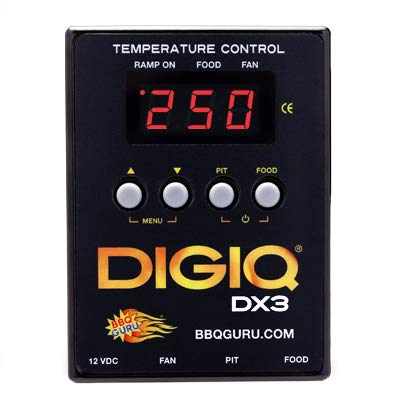
BBQ Guru DigiQ DX3 BBQ Temperature Controller — Best No-App Simplicity
The DigiQ DX3 is the controller for the cook who looked at app-connected everything and said: just hold the temperature. BBQ Guru’s long-running DigiQ line pairs its fan control with a local display and physical controls — set the pit temperature, set the meat target, and walk away from a device that has no firmware to update and no password to forget. Fitment spans Big Green Egg, Kamado Joe, Weber, and ceramic grills generally, and the unit doubles as a digital meat thermometer in the same housing.
Strengths
- Zero connectivity complexity — nothing to pair, log into, or update
- BBQ Guru’s proven fan-control logic and adapter ecosystem
- Pit control and meat monitoring in one self-contained unit
Trade-offs
- No remote monitoring — checking the cook means visiting the cooker or adding a separate wireless thermometer
- Display-era interface rather than an app dashboard
- Serious cooks who log cooks will miss the data layer
| Control | Local digital controller with fan (per Amazon listing title) |
| Monitoring | Digital meat thermometer function included (per Amazon listing title) |
| Fit | Big Green Egg, Kamado Joe, Weber, and ceramic grills (per Amazon listing title) |
| Model | DigiQ DX3 (per Amazon listing title) |
There is a deep practical wisdom in the DigiQ’s restraint. Every connected controller in this guide depends on a chain — router, app, account, phone — and every link is a small way for an overnight cook’s alerts to fail silently. The DigiQ removes the chain. Its control quality is not a compromise: BBQ Guru’s fan logic has held competition pits for years, and on a kamado the DigiQ’s behavior is the category’s reference for set-and-truly-forget. What you surrender is information at a distance; what you gain is a device that will work identically in ten years, indifferent to the fate of any app store.
The DigiQ also suits the second-cooker and cabin scenarios beautifully: a lake-house kamado with indifferent WiFi, a hunting-camp drum, a borrowed cooker at a family property — places where connectivity is a rumor but barbecue is serious. Owners consistently describe the same ownership experience: there is almost nothing to describe. It mounts, it holds, it comes off, it goes in a drawer. In a category racing toward dashboards, the DigiQ’s silence is its feature, and for a substantial tribe of excellent cooks, it remains the correct purchase.
Best for: connectivity skeptics, cabins and second properties, kamado owners wanting pure control / Not suited for: cooks who want phone alerts and logged cook history
Check the current price on Amazon
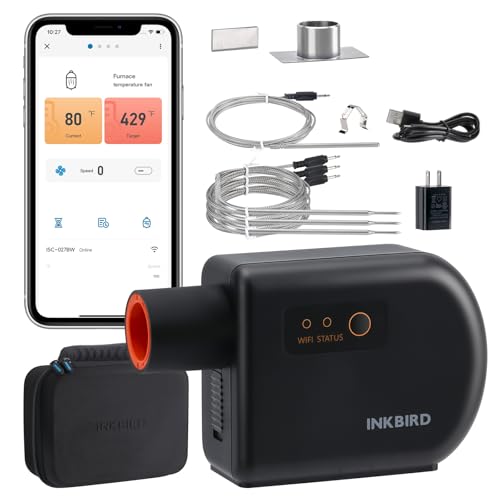
Inkbird WiFi & Bluetooth BBQ Temperature Controller Kit — Best Budget Kit
Inkbird’s controller kit is the value play executed properly: everything in one box. The controller carries WiFi and Bluetooth, the fan is built into the kit with a high-efficiency rating in the listing, and the probe count is the generous one — three meat probes plus a dedicated oven (pit) probe — aimed squarely at ceramic smokers, kamados, and Vision grills. For a first controller purchase, the appeal is completeness: no accessory list to assemble, no second order for the probe you forgot.
Strengths
- Four probes total included — three meat plus pit — the full monitoring set
- Built-in fan and complete-kit packaging; nothing else to buy to start
- WiFi and Bluetooth dual connectivity at the budget tier
Trade-offs
- Fan control refinement trails the variable-speed flagships on the tightest cookers
- App experience is functional rather than polished
- Hardware heft is a tier below BBQ Guru and Flame Boss flagships
| Control | WiFi & Bluetooth automatic smoker fan controller (per Amazon listing title) |
| Probes | 3 meat probes and 1 oven probe (per Amazon listing title) |
| Fan | Built-in high-efficiency fan (per Amazon listing title) |
| Fit | Ceramic smokers, kamado, Vision Grill (per Amazon listing title) |
Three meat probes change the sociology of a cook. The brisket’s flat and point get separate witnesses; the pork butt stops being a rumor; the chicken announces itself. Most controller owners discover that monitoring, not control, was the anxiety — and this kit answers monitoring lavishly at a tier where rivals include two probes and sell the rest. The fan’s control is honest mid-category work: on a sealed kamado it holds smoking temperatures with the steadiness the format promises, asking only that the cooker’s gaskets and vents cooperate, as every controller does.
Buy this kit as a system and use it as one: dedicate the oven probe to grate level beside the largest cut, assign meat probes by cook order (the cut that finishes first gets checked most), and set alarms per probe rather than one global alert. Inkbird’s instruments have earned trust in adjacent categories — brewing, sous vide, grilling thermometers — by being accurate at honest prices, and this kit carries the same DNA. For the kamado owner who has priced the flagships and hesitated, this is where to start; many who start here never feel the need to leave.
Best for: first-time controller buyers and kamado owners wanting a complete, probe-rich kit / Not suited for: buyers seeking flagship fan refinement and app polish
Check the current price on Amazon

Flame Boss 400 Kamado WiFi Smoker Temperature Controller — Best Mid-Tier Kamado WiFi
If the 550 is the flagship, the 400 Kamado is the fleet standard: the same patented variable-speed fan philosophy and WiFi control, in the kamado kit that has automated more ceramic cookers than any other single model. Its fitment list is the broadest in this guide — Big Green Egg, Kamado Joe, Primo, Grill Dome, Akorn Kamado, and Vision Classic — which matters in a category where the adapter is destiny. Two probes cover the standard cook, and the Flame Boss app covers the monitoring.
Strengths
- Variable-speed fan steadiness at the mid tier
- Broadest kamado fitment in this guide — six cooker families named in the listing
- Mature model with a deep owner community and known behavior
Trade-offs
- WiFi only — no Bluetooth fallback connection
- Two probes, like its flagship sibling
- The 550 exists above it with dual radios for those who want the maximum
| Control | WiFi with patented variable-speed fan (per Amazon listing title) |
| Probes | 2 probes (per Amazon listing title) |
| Fit | Big Green Egg, Kamado Joe, Primo, Grill Dome, Akorn Kamado, Vision Classic (per Amazon listing title) |
| Series | Flame Boss 400 Kamado (per Amazon listing title) |
The 400 Kamado’s case is the case of the proven middle. Its fan behavior on ceramic is the established reference — gentle, proportional, allergic to overshoot — and its production history means every kamado pairing question has an owner-community answer already written. Against its own flagship sibling, the honest differences are the Bluetooth radio and refinements at the margin; the temperature line on your brisket will not know which of the two you bought. That makes the 400 the rational kamado purchase for most owners, and its sales history suggests most owners have agreed.
A fitment note worth the space: Akorn and Vision owners should be especially pleased to see their cookers named, because metal kamados and less-common ceramics are where universal kits most often disappoint. A kit engineered for your intake geometry seals properly, and sealing — as this guide repeats because it is true — is nine-tenths of controller performance. Verify your exact model against the kit before ordering, mount it snugly, close the top vent to the manual’s specification, and let the fan take the night shift.
Best for: kamado owners wanting proven variable-speed WiFi control at the mid tier / Not suited for: buyers wanting Bluetooth fallback or four-plus probes included
Check the current price on Amazon
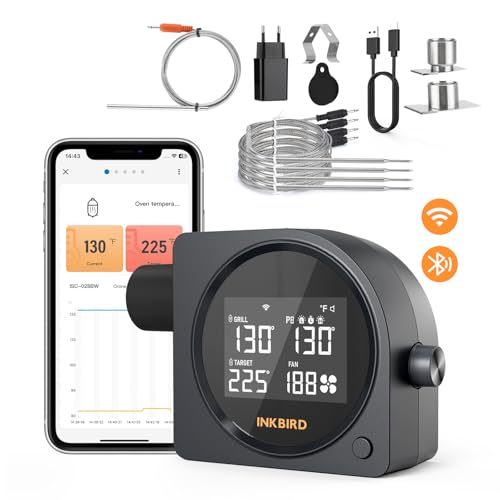
Inkbird 5G Wi-Fi & Bluetooth BBQ Temperature Controller (5 Probes) — Best Multi-Probe
Some cooks run one probe; this controller is for the cooks who run five. Inkbird’s 5G Wi-Fi and Bluetooth model pairs its automatic fan with five probes and an LCD screen on the unit itself — so the full state of a complex cook is visible at the cooker and on the phone. Fitment spans ceramic smokers, the Big Green Egg, and notably the Weber Smokey Mountain, bridging the kamado and bullet worlds that most kits treat separately.
Strengths
- Five probes — the most complete monitoring in this guide
- On-unit LCD shows the cook without reaching for a phone
- Fits both kamados and the Smokey Mountain bullet — rare cross-format coverage
Trade-offs
- Managing five probes is its own discipline; cable routing needs care
- Fan finesse is mid-category, like its Inkbird sibling
- The information abundance suits big cooks more than simple ones
| Control | 5G Wi-Fi & Bluetooth automatic smoker fan with LCD screen (per Amazon listing title) |
| Probes | 5 probes (per Amazon listing title) |
| Fit | Ceramic smokers, Big Green Egg, Weber Smokey Mountain (per Amazon listing title) |
| Brand | Inkbird (per Amazon listing title) |
Five probes earn their keep on the cooks that define a season: the holiday load with a brisket, a butt, and ribs finishing on three different clocks; the sausage batch where every link’s temperature is a safety question; the competition practice where flat and point are judged separately. The LCD deserves its own praise — app-first design forgets that the cook at the cooker, hands full and phone in the house, needs the numbers at a glance. This unit remembers. Paired with the app for alerts and history, it offers the most complete information picture in the guide.
Discipline makes the abundance useful: label your probes (a wrap of colored tape at the plug end pays for itself immediately), assign them in the same order every cook, and route the cable bundle through one gasket point so the lid seals once, cleanly. Bullet-smoker owners should note the WSM fitment particularly — the Smokey Mountain plus a fan controller is one of barbecue’s great value systems, a modest cooker made genuinely automatic, and this kit serves it without adaptation guesswork.
Best for: multi-cut cooks, holiday loads, and Smokey Mountain owners wanting full monitoring / Not suited for: single-probe minimalists
Check the current price on Amazon

ChefsTemp Breezo BBQ Temperature Control Fan — Best Fan Add-On
This pick requires the guide’s clearest framing: the Breezo is a fan, and its brain lives in ChefsTemp’s ProTemp thermometer line. If you own a ProTemp S1 or ProTemp 2 Plus, the Breezo completes the system — wireless app control automation with the fan your thermometer commands — at an add-on cost rather than a whole new platform. If you do not own the hub, this is not your pick; the standalone controllers above are. Included for the substantial number of cooks already in the ChefsTemp ecosystem, it is the cheapest route to full automation in this guide for those owners.
Strengths
- Completes an existing ProTemp setup at add-on cost
- Wireless app control automation through the hub you already use
- One thermometer platform for monitoring and control — no second app to learn
Trade-offs
- Requires a ProTemp S1 or ProTemp 2 Plus — not a standalone controller
- Total system cost exceeds standalone rivals if you own neither piece
- Ecosystem is younger and smaller than the category leaders’
| Device | BBQ temperature control fan for smokers and grills (per Amazon listing title) |
| Compatibility | ProTemp S1 and ProTemp 2 Plus (per Amazon listing title) |
| Control | Wireless app control automation via the paired hub (per Amazon listing title) |
| Brand | ChefsTemp (per Amazon listing title) |
Platform logic is familiar from every other tool category: the second half of a system you own is worth more than a stranger’s whole system. ProTemp owners already trust the thermometer’s readings and live in its app; the Breezo simply gives that trusted measurement a hand on the intake vent. Fan control through a measurement-first platform tends to be conservative and accurate — the system’s heritage is in reading temperature honestly, and the fan obeys those readings. For the ecosystem’s owners, this is not a compromise pick; it is the obvious one.
For everyone else, treat the Breezo as a signpost: if you are shopping for a thermometer and a controller together, price the combined ChefsTemp route against the standalone systems here before deciding — platform purchases reward foresight. And if you already own the hub and have been tending vents manually out of habit, the fan is the small purchase that retires the habit. Automation, in this corner of the category, arrives as an accessory rather than an appliance, and there is something elegant about that.
Best for: ProTemp S1 and ProTemp 2 Plus owners completing their system / Not suited for: anyone without the ChefsTemp hub — choose a standalone controller
Check the current price on Amazon
Comparison Table
| Pick | Badge | Key spec | Best for |
|---|---|---|---|
| Flame Boss 550 Kamado Wi-Fi/Bluetooth Smoker Temperature Controller | Best Overall for Kamado | Variable-speed fan, Wi-Fi/Bluetooth, 2 probes, kamado fit | kamado and ceramic owners wanting the flagship controller experience |
| BBQ Guru DigiQ DX3 BBQ Temperature Controller | Best No-App Simplicity | Local control, no app required, kamado and Weber fit | connectivity skeptics, cabins and second properties, kamado owners wanting pure control |
| Inkbird WiFi & Bluetooth BBQ Temperature Controller Kit | Best Budget Kit | WiFi & Bluetooth, 4 probes total, built-in high-efficiency fan | first-time controller buyers and kamado owners wanting a complete, probe-rich kit |
| Flame Boss 400 Kamado WiFi Smoker Temperature Controller | Best Mid-Tier Kamado WiFi | Variable-speed fan, WiFi, 2 probes, broad kamado fit | kamado owners wanting proven variable-speed WiFi control at the mid tier |
| Inkbird 5G Wi-Fi & Bluetooth BBQ Temperature Controller (5 Probes) | Best Multi-Probe | 5 probes, LCD screen, Wi-Fi & Bluetooth, BGE and WSM fit | multi-cut cooks, holiday loads, and Smokey Mountain owners wanting full monitoring |
| ChefsTemp Breezo BBQ Temperature Control Fan | Best Fan Add-On | Fan unit, app control automation via ProTemp S1 / ProTemp 2 Plus | ProTemp S1 and ProTemp 2 Plus owners completing their system |
How to Choose an Automatic Temperature Controller: Kamado First
Kamados reward controllers more than any other cooker, for a physical reason: they waste almost no heat. A sealed, insulated ceramic cooker holds temperature with tiny air inputs, so a fan’s gentle corrections map almost one-to-one onto fire behavior. That is why the flagship picks here are kamado kits. If your cooker is ceramic, buy the kit made for your brand’s intake, prioritize a variable-speed or otherwise gentle fan, and expect the most dramatic before-and-after in barbecue.
The vent discipline that makes controllers work
Every kamado controller manual says the same thing in different words: once the fan owns the intake, the top vent becomes a fixed setting, not a control. Open it to the specified crack and leave it there. Cooks who keep adjusting the top vent are running two control systems against each other, and the resulting oscillation gets blamed on the fan. One controller per fire — that is the whole rule, and it is the difference between the owners who rave and the owners who return.
Charcoal layout for controlled cooks
Lay the fire for the controller: a full basket of lump with a small lit pocket, or the minion arrangement your cooker favors, so unlit fuel catches gradually as the fan feeds air. A controller throttling a fully blazing load spends the cook braking; a controller feeding a growing fire spends it cruising. Lump charcoal’s irregular sizes burn less predictably than briquettes but with cleaner flavor; many kamado owners split the difference with a quality lump and a tight basket pack.
Probes, Alarms, and the Information Layer
Decide your probe count by your largest regular cook, not your average one. Two probes serve a single-cut cook completely. Four or five serve the holiday load, the sausage batch, and the brisket whose flat and point refuse to agree. Extra probes cost little at purchase and cannot be added later to most systems — the probe count is the one specification to buy with headroom.
Alarms deserve the same forethought. Set a low pit alarm (fire trouble — usually fuel or ash), a high pit alarm (a leak or an overshoot), and per-meat target alarms set below finishing temperature so the alert means ‘come and judge tenderness,’ not ‘the moment has passed.’ A controller with perfect hardware and no alarms set is a monitoring system that watched your cook fail in high resolution. The five minutes of setup is the cheapest insurance in the category.
The Controller-Cooker System: Seals, Ash, and Air
A controller commands air through one door; every other crack in the cooker is a side entrance it cannot close. Felt gaskets flatten with age, latches loosen, and ash pans warp — each leak raises the fire’s minimum idle and narrows the controller’s authority at low temperatures, exactly where smoking lives. The annual ritual that keeps the system honest: replace tired gasket material, snug the bands and latches, vacuum the intake path, and confirm the fan adapter’s seal. Owners who do this describe controllers that ‘still work like new’ in year five; the controller never changed — the cooker around it was maintained.
Ash is the second system input. A deep ash bed insulates the coal from the fan’s air and makes the fire’s response laggy and vague; the controller hunts, the line waves, and the hardware takes the blame. On long cooks, the one permitted intervention is an ash management visit — a gentle stir or a grate shake at the wrap, say — after which the system settles again. Think of the controller as the fire’s manager and yourself as its facilities department: air paths clear, fuel stocked, and the manager left alone to manage.
Controller Cooking Beyond Brisket: Where Precision Pays Twice
The cooks that convert controller skeptics are rarely briskets — they are the precision jobs. Fresh sausage, which turns grainy and loses its fat to a temperature spike, cooks serenely under a controller’s flat line. Jerky dries evenly instead of case-hardening through a swinging afternoon. Fish on a kamado at a gentle, exact heat is a different dish from fish on a wandering fire. And the holiday turkey — the highest-stakes cook of the year, on the cooker most likely to be opened by curious relatives — holds its schedule because the fan, not the crowd, manages the fire. A controller is usually bought for overnight brisket and kept for everything else.
There is also a teaching dividend. A new charcoal cook tending vents learns ten variables at once and cannot tell which one mattered. A new cook with a controller watches one variable — the fire the fan is managing — and learns charcoal behavior from the graph’s responses: what a fresh lump addition does, how wind leans on the line, when ash begins to mute the fire’s answers. Controllers are sometimes accused of deskilling barbecue; used attentively, they are its clearest classroom.
How to Set Up a Kamado Controller for an Overnight Cook
Kamado plus controller is barbecue’s most reliable overnight system when set up in the right order. The sequence below assumes any of the kamado-capable picks in this guide.
- Start clean: ash out of the firebox and intake path, last cook’s grease scraped, gasket inspected. Overnight authority begins with a cooker that seals.
- Load a full basket of lump charcoal with a few wood chunks buried through it. Full means full — the overnight cook’s fuel margin is not the place for optimism.
- Light one small pocket of the load. Not a chimney’s worth — a pocket. The controller will grow the fire; your job is to hand it a fire small enough to govern.
- Mount the fan, seat the adapter, set the top vent to the manual’s controller specification, and place the pit probe at grate level away from the fire’s direct radiation.
- Set the target and let the controller climb and settle for a full 30 minutes before the meat goes on. A settled fire, then food — never both negotiations at once.
- Load the meat, place probes, set low-pit, high-pit, and meat alarms, confirm the app (if any) shows the cook, and go to bed like you mean it.
In the morning, judge by probe tenderness and keep the graph as your record. If the line wandered, the graph plus one question — where is the air getting in? — will find the cause faster than any forum. Kamado-controller owners tend to become evangelists after exactly one successful overnight brisket; the setup above is how that first one succeeds.
Common Buying Mistakes
Controller disappointment is almost always system disappointment — the cooker, the fire, or the setup, rather than the box. These five mistakes produce most of it.
Running two control systems at once
Fan mounted, intake governed — and the owner still opening the top vent ‘to help.’ The fire now answers to two masters and oscillates between them. Set the exhaust once, per the manual, and let the controller be the controller. If temperatures misbehave afterward, you have a diagnosable system; before, you had an argument.
Lighting the whole basket
A kamado full of blazing lump is a stored-heat problem no fan can solve: the controller can starve air but cannot remove heat from ceramic. The first hour becomes an overshoot the cook spends waiting out. Light a pocket, always — the controller’s climb is fast, and control from below is the entire design.
Ignoring the gasket until the controller ‘fails’
The classic sequence: gasket flattens over two seasons, idle temperature creeps up, low cooks run hot, owner blames the new controller. The controller arrived at a leaking cooker. Replace the felt, snug the bands, and the ‘failing’ controller recovers instantly. Maintain the cooker and the electronics will seem immortal.
Setting alarms at finishing temperature
An alarm that fires at the target tells you the moment has arrived and begun leaving. Set meat alarms below target — enough margin to walk out, judge tenderness, and decide — and set pit alarms wide enough to ignore lid openings but narrow enough to catch a dying fire. Alarms are appointments; schedule them early.
Judging the controller on its first cook
The first cook includes an unlearned fire layout, an unmapped cooker, and a new device’s setup — three novices in one system. By the third cook, with seals confirmed and a pocket-lit fire, the same hardware draws the flat line from the advertisements. Give the pairing its three cooks before verdicts, in either direction.
Final Recommendation
For kamado owners who want the best of the category, the Flame Boss 550 Kamado is the answer — variable-speed gentleness, dual radios, ceramic fit. The Flame Boss 400 Kamado delivers most of that experience at the mid tier with the broadest fitment list. The BBQ Guru DigiQ DX3 serves the cook who wants automation with no software in the loop. Inkbird’s kit and five-probe model serve value and monitoring depth respectively. And ProTemp owners should simply complete their system with the Breezo fan.
Read this guide alongside its companions: Best Automatic Temp Controllers For Smokers sorts the universal-fit hardware for kettles, drums, and offsets, Best Automatic Smokers covers cookers with control built in, and Best Automated Smokers takes the wider automated view. The cookers these controllers serve are reviewed in Best Backyard Charcoal Smokers, and the full patio picture is in Best Backyard Bbq Smokers.
Whichever unit you mount, give the pairing its three learning cooks before judging it — seals checked, fires lit small, vents disciplined — because a controller and a cooker are a system, and systems have a handshake period. After it, the handshake disappears, and what remains is the thing you actually bought: a charcoal fire that keeps your hours instead of consuming them, season after season, cook after cook, without complaint.
- Flame Boss 550 Kamado Wi-Fi/Bluetooth Smoker Temperature Controller — Check price on Amazon
- BBQ Guru DigiQ DX3 BBQ Temperature Controller — Check price on Amazon
- Inkbird WiFi & Bluetooth BBQ Temperature Controller Kit — Check price on Amazon
- Flame Boss 400 Kamado WiFi Smoker Temperature Controller — Check price on Amazon
Frequently Asked Questions
What is the difference between an automatic temperature controller and a thermometer?
A thermometer reports; a controller acts. The controller reads its pit probe and drives a fan to add or withhold air, holding the temperature you set without your involvement. Several products here combine both roles — the DigiQ includes meat thermometer functions, the five-probe Inkbird monitors extensively — but the defining feature is always the fan under command. If a device cannot change the fire, it is not a controller, whatever its screen shows.
Why do kamados benefit so much from controllers?
Insulation and sealing. A kamado wastes little heat, so small air corrections have predictable, lasting effects, and a single charcoal load can outlast the longest cooks. The fan’s gentle management therefore achieves an unusually flat line. The same physics punishes overshoot — stored ceramic heat sheds slowly — which is why variable-speed fans and pocket-lit fires matter more on kamados than on any other cooker.
How many probes do I actually need?
Two — pit plus one meat — cover the classic single-cut cook completely, and most owners most of the time need no more. Buy more when your cooks multiply: a brisket’s flat and point, a second protein, a sausage batch. Probes cannot usually be added beyond a unit’s channel count later, so if your holiday cooks are ambitious, the four- and five-probe models in this guide are the prudent purchase even if Tuesday’s ribs use two.
Can a controller damage my kamado or void anything?
Used as directed, no — the fan mounts to the intake the cooker provides, and the temperatures involved are the cooker’s normal working range. The disciplines are ordinary: keep the controller unit itself sheltered from weather and radiant heat, route cables away from hot surfaces, and follow the cooker maker’s guidance on maximum temperatures. Controllers have been standard kamado accessories for many years across all the major ceramic brands, several of which sell their own — the EGG Genius in the companion guide is exactly that.
WiFi, Bluetooth, or no radio — which should I choose?
Choose by where you are during cooks. If you leave the house or want alerts in bed, WiFi earns its place. If you are home but want patio freedom, Bluetooth suffices. If you distrust the whole chain and cook within earshot of the yard, the DigiQ’s local control removes every dependency and will behave identically for a decade. None of these choices changes the fire’s behavior — they change how the cook’s information reaches you, so buy for your habits, not for the spec sheet.
My temperature swings for the first hour, then settles. Is the controller faulty?
Almost certainly not — that pattern is a system settling, not a device failing. Common causes are a fire lit too large, a top vent set wide, or a cold, full load of meat absorbing heat unevenly. Light a pocket, fix the vent per the manual, load once, and give the pairing its half hour. If the swing persists past the second hour on a sealed cooker with a modest fire, then inspect probe placement and gasket health before suspecting the electronics.
Should I buy the controller or a new automatic smoker instead?
Price the comparison honestly: a controller upgrades the cooker you own for a fraction of a new automatic smoker’s cost, and it preserves the charcoal flavor and the skills you have built. Buy the new smoker instead when your current cooker is failing structurally, when you want pellet or electric fuel rather than charcoal, or when capacity — not control — is your real limitation. If your cooker is sound and your only complaint is tending it, the controller is almost always the correct purchase, and it is the one this category exists to make.


