Disclosure: airfryerkitchensupply.com is reader-supported. When you buy through links on our site, we may earn an affiliate commission at no extra cost to you.
Where to buy
Shopping for the best 2.2 cu ft microwaves? Every model below was verified in Amazon’s catalog data at a genuine 2.2 cu ft before earning its place, and each listing is where to confirm the exact dimensions and configuration of the unit you order. Our Best Overall is the Panasonic NN-SN97JS. The inverter value pick is the Toshiba 2.2 Cu.Ft Inverter, the budget pick is the Frigidaire 2.2 Cu.Ft, and the class is rounded out by the Sharp SMC2266KS, the Farberware Professional FMO22ABTBKC and, for cabinet installations, the Frigidaire Gallery GMBS3068BF Built-In. Appliance prices change constantly, so check price on Amazon at the listing rather than trusting any figure quoted elsewhere.
The Biggest Mainstream Countertop Size, Explained Plainly
The best 2.2 cu ft microwaves sit at the top of the mainstream countertop range, and the size exists for a concrete reason: it is the smallest format that comfortably rotates a 9 x 13 casserole, defrosts a whole bird, and reheats family quantities in one pass instead of three. Everything smaller asks for compromises — dishes that cannot turn, loads split into batches, a turkey breast that has to be cut before it can be thawed. Everything larger leaves countertop territory entirely and becomes a built-in or commercial conversation.
Unlike our companion guide to the exact 2.2/1200 specification, this guide imposes no wattage requirement, which widens the field in useful ways. It admits Panasonic’s 1250-watt cyclonic flagship as a full linked pick rather than a footnote, and it admits a genuine built-in model for the households renovating a cabinet opening. What does not change is the discipline: every pick is verified at 2.2 cu ft in catalog data, and every pick wins a distinct use case, from budget capacity to flagship heating technology. If your kitchen life is family-scale, this is the size class built for it — with the standing warning that it needs family-scale counter space to live on, measured honestly before the box arrives.
In this guide
Quick Picks
- Best Overall: Panasonic NN-SN97JS — Cyclonic Inverter evenness, Genius Sensor and countertop-or-built-in flexibility at 1250W. Check the current price on Amazon
- Best Inverter Value: Toshiba 2.2 Cu.Ft Inverter — true inverter power and sensor cooking at 1200W, below flagship money. Check the current price on Amazon
- Best Budget: Frigidaire 2.2 Cu.Ft — the full family capacity and 1200W at the friendliest tier in the class. Check the current price on Amazon
- Best Classic: Sharp SMC2266KS — the proven Carousel formula at full size, with controls anyone can use. Check the current price on Amazon
- Best Sensor Cooking: Farberware Professional FMO22ABTBKC — automatic sensor timing in brushed stainless at a mid-tier position. Check the current price on Amazon
- Best Built-In: Frigidaire Gallery GMBS3068BF — a 2.2 cu ft built-in for cabinet installations, with a trim kit available separately. Check the current price on Amazon
How These Picks Were Chosen
Capacity was the gate: only models verifiable at 2.2 cu ft in catalog data were considered, whether countertop or built-in. Within that gate we ranked on heating quality first — power delivery type and sensor systems — because at this cavity size the gap between even and uneven results is the widest in the countertop market. Turntable diameter, control clarity, cleaning practicality and brand support decided the remaining order. We deliberately included one built-in model, clearly labeled, because a meaningful share of shoppers in this size class are filling a cabinet opening rather than a counter, and sending them away to start their research over would help nobody. Everything else here is a countertop machine that plugs in and works the day it arrives.
The 6 Best 2.2 Cu Ft Microwaves
Panasonic NN-SN97JS — Best Overall
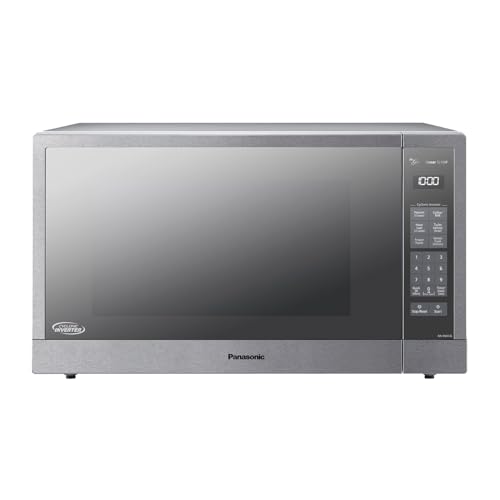
Panasonic’s flagship earns the top spot in the unrestricted class on the strength of its heating system. The Cyclonic Inverter distributes energy through the big cavity more evenly than conventional designs, the Genius Sensor times cooking by steam rather than by guess, and the cabinet works on the counter today and in a cabinet opening after a remodel. It suits serious home cooks and long-term buyers. It is the premium-priced pick here, and households that mostly reheat will not extract its full value.
Strengths
- Cyclonic Inverter evenness is the benchmark for large, dense dishes.
- Genius Sensor cooking and reheating across the family repertoire.
- Countertop or built-in convertible with a trim kit.
Trade-offs
- Premium tier positioning within the class.
- 1250W output means package times written for weaker ovens need a slight reduction and an early check.
- Built-in conversion costs extra for the trim kit and installation planning.
| Spec | Detail |
|---|---|
| Capacity | 2.2 cu ft |
| Power | 1250W Cyclonic Inverter |
| Sensor | Genius Sensor |
| Install | Countertop / built-in convertible |
Big cavities expose weak heating systems mercilessly, and this is the machine designed to be exposed. Family casseroles come out uniformly hot with fewer interventions, defrosting is genuinely gentle, and the sensor handles the daily reheat traffic without supervision. As a decade-scale appliance purchase, it justifies its tier. Check the current price on Amazon
Best for: buyers wanting the best heating technology at this size / Not suited for: budget-first or reheat-only households

Toshiba 2.2 Cu.Ft Inverter — Best Inverter Value
The Toshiba delivers the two technologies that matter most at this size — inverter power and sensor cooking — at 1200 watts and a tier below the flagship. For most families it is the sweet spot of the class: big loads defrost evenly, dense reheats come through, and the 16.5-inch turntable takes the largest dishes in the cupboard. Buyers who want built-in flexibility or cyclonic refinement step up to the Panasonic; everyone else can stop here happily.
Strengths
- True inverter delivery for defrosting and gentle cooking at family scale.
- Sensor cook with auto menus and a child lock.
- Large 16.5-inch turntable for the biggest rotating dishes.
Trade-offs
- Countertop only; no built-in path.
- Still a full-size footprint that demands measured counter space.
- Very large loads still reward a mid-cook stir.
| Spec | Detail |
|---|---|
| Capacity | 2.2 cu ft |
| Power | 1200W inverter |
| Turntable | 16.5 inch removable |
| Extras | Sensor cook, 6 auto menus, child lock |
Value at this size does not mean cheap; it means the money lands on the components that change results. The Toshiba spends on the power supply and the sensor, keeps the interface sensible, and skips the flagship garnish. For the median family shopping this class, it is the rational top of the list. Check the current price on Amazon
Best for: most families wanting inverter quality without flagship pricing / Not suited for: built-in installations

Frigidaire 2.2 Cu.Ft — Best Budget
The Frigidaire’s proposition is uncomplicated: the full 2.2 cu ft and a full 1200 watts from a mainstream brand, at the most accessible tier in the class. It is a programmable stainless family oven that does the standard repertoire without ceremony. It suits large households on a budget and anyone replacing a failed unit under time pressure. The compromises are a conventional power supply and a competence-first feature set.
Strengths
- Full capacity and full power at the class’s friendliest tier.
- Programmable multi-function cooking covers everyday family jobs.
- Mainstream brand with ordinary service channels.
Trade-offs
- Conventional pulsing power at low settings.
- No inverter or flagship sensor refinements.
- Stainless finish needs regular wiping in a busy kitchen.
| Spec | Detail |
|---|---|
| Capacity | 2.2 cu ft |
| Power | 1200W |
| Type | Countertop, programmable |
| Finish | Stainless steel |
Budget recommendations fail when they quietly shrink the product. This one keeps the size and the watts that define the class and trims the electronics instead, which is the right order of sacrifices for a capacity-driven buyer. Check the current price on Amazon
Best for: large households prioritizing capacity per dollar / Not suited for: defrost perfectionists

Sharp SMC2266KS — Best Classic
Sharp’s entry is the class in its classic form: a big Carousel turntable, 1200 watts, stainless cabinet and controls refined across decades of family kitchens. It suits buyers who trust specialization and want zero learning curve, including households replacing an older Sharp. Technology chasers will prefer the inverter models; nearly everyone else will feel immediately at home.
Strengths
- 16.5-inch Carousel turntable rotates the largest dishes in the class.
- Full 1200W with clear, classic controls.
- Specialist brand heritage in microwave cooking.
Trade-offs
- Conventional power supply.
- Feature set is traditional rather than automated.
- Full-size depth, as with the whole class.
| Spec | Detail |
|---|---|
| Capacity | 2.2 cu ft |
| Power | 1200W |
| Turntable | 16.5 inch Carousel, removable |
| Finish | Stainless steel |
The classic formula persists because it works: a big even turntable, honest power, and an interface that never needs explaining to a guest. In a category filling with menus and modes, the Sharp’s restraint is a feature. Check the current price on Amazon
Best for: traditionalists and multi-generational households / Not suited for: automation-first buyers

Farberware Professional FMO22ABTBKC — Best Sensor Cooking
The Farberware Professional brings genuine sensor cooking to the class at a mid-tier position, in brushed stainless with a distinctive green LED display. Sensor timing is the feature that most improves the reheat-heavy reality of family microwave use, and that is this model’s whole case. Heavy defrost users should note the conventional power supply underneath and weigh the inverter picks accordingly.
Strengths
- Sensor cooking judges doneness for reheats and vegetables automatically.
- Full-size capacity and 1200W at a mid-tier position.
- Brushed stainless hides fingerprints well.
Trade-offs
- Conventional power delivery.
- Green LED aesthetic is a matter of taste.
- Smaller brand support network than the class leaders.
| Spec | Detail |
|---|---|
| Capacity | 2.2 cu ft |
| Power | 1200W |
| Cooking | Sensor cooking |
| Finish | Brushed stainless steel |
Most microwave disappointment is a timing error repeated daily, and a sensor is the systematic fix. In this size class, at this tier, the Farberware Professional is the systematic fix with the least money attached. Check the current price on Amazon
Best for: reheat-heavy families wanting automatic timing / Not suited for: inverter-focused buyers

Frigidaire Gallery GMBS3068BF — Best Built-In
Not every 2.2 cu ft shopper has a counter in mind. The Gallery GMBS3068BF is Frigidaire’s built-in entry in this capacity, designed for a cabinet opening with a trim kit sold separately, bringing the Gallery line’s styling to a fitted installation. It suits remodelers and new kitchens where the microwave belongs in the cabinetry, not on the worktop. It is not a countertop appliance and should never be bought as one; installation planning and ventilation are part of the purchase.
Strengths
- Genuine 2.2 cu ft capacity in a purpose-built built-in format.
- Gallery-series styling for fitted kitchens.
- Frees the entire counter footprint a countertop model would occupy.
Trade-offs
- Trim kit is sold separately and installation is a project, not an unboxing.
- Not portable and not a countertop substitute.
- Specification details such as wattage should be confirmed on the listing for your exact configuration.
| Spec | Detail |
|---|---|
| Capacity | 2.2 cu ft |
| Type | Built-in microwave oven |
| Trim kit | Sold separately |
| Series | Frigidaire Gallery |
A built-in is a commitment to a kitchen layout, rewarded with a seamless look and a permanently clear counter. If that is the kitchen you are building, this is the 2.2 cu ft model designed for it, from a brand whose built-in channels and trim ecosystem are established. Check the current price on Amazon
Best for: remodels and fitted kitchens with a cabinet opening / Not suited for: anyone needing a countertop appliance
Comparison Table
| Pick | Badge | Key spec | Best for |
|---|---|---|---|
| Panasonic NN-SN97JS | Best Overall | 2.2 cu ft, 1250W Cyclonic Inverter | Flagship evenness, flexible install |
| Toshiba 2.2 Inverter | Best Inverter Value | 2.2 cu ft, 1200W inverter, sensor | Most families |
| Frigidaire 2.2 | Best Budget | 2.2 cu ft, 1200W | Capacity on a budget |
| Sharp SMC2266KS | Best Classic | 2.2 cu ft, 1200W, Carousel | Proven simplicity |
| Farberware Professional | Best Sensor Cooking | 2.2 cu ft, 1200W, sensor | Automatic reheating |
| Frigidaire Gallery Built-In | Best Built-In | 2.2 cu ft, built-in format | Fitted kitchens |
How to Choose a 2.2 Cu Ft Microwave
Confirm the size is your size. This class is justified by dishes and loads: 9 x 13 casseroles, whole birds, family packs, party quantities. If your weekly reality is plates and mugs, a 1.2 or 1.6 cu ft oven will serve you better and cost you less counter. If the big loads are real, nothing smaller will do, and the rest of this guide is about choosing well within the class.
Pick the power delivery before the brand. Inverter systems — Panasonic’s cyclonic at the top, Toshiba’s standard inverter below it — deliver continuous low power and transform defrosting and delicate cooking. Conventional systems in the Frigidaire, Sharp and Farberware picks are entirely competent at full-power work and reheating. Your dominant jobs, honestly listed, make this decision for you.
Decide the installation question early. Countertop models plug in and work today; the built-in Frigidaire Gallery and the convertible Panasonic ask for planning, trim and ventilation in exchange for a fitted look and a clear counter. Renters and the commitment-averse belong on the countertop side of that line.
Measure like it matters, because it does. Width, height, depth and door swing, against the exact figures on the listing of the model you choose. Then check the circuit: this class draws heavily, and a lightly shared kitchen circuit is the right home for it.
How to Use a Family-Size Microwave Well
The techniques that unlock this class are simple and consistent. Cook in shallower layers when you can, because microwave energy reaches about an inch deep and conduction does the rest. Stir or flip dense foods halfway, even on a turntable. Use reduced power — 70 to 80 percent — for thick reheats, and genuine low power for defrosting and melting, especially on the inverter models where low means low. Cover dishes to trap steam and keep the cavity clean. Respect standing time as part of the cooking, not a delay after it: it is when centers finish and temperatures equalize. And sequence big cooking days deliberately — densest items first, each resting covered while the next runs — so the oven works like the second pair of hands it can be at family scale.
Common Buying Mistakes
- Buying the biggest size for a small household’s ego rather than its dishes. Capacity you never use is counter you always miss.
- Judging by cubic feet alone. Turntable diameter and interior height decide what actually fits and rotates.
- Ignoring power delivery type. At this cavity size, inverter versus conventional is the difference between even and uneven on hard jobs.
- Putting a countertop model in a cabinet. Only the built-in and convertible picks belong in an opening, with their trim and ventilation plans.
- Skipping the depth and swing measurements. The class’s most common failure is geometric, not culinary.
- Overlooking the circuit. A full-power family oven on an overloaded shared circuit will introduce itself via the breaker panel.
Final Recommendation
For the best heating at this size, buy the Panasonic NN-SN97JS. For most families, the Toshiba 2.2 Inverter is the smarter spend — near-flagship capability at a friendlier tier. On a budget, the Frigidaire 2.2 keeps the size and watts honest. Traditionalists should take the Sharp SMC2266KS, reheat-led households the Farberware Professional, and remodelers the Frigidaire Gallery Built-In. Narrowing further? Our spec-specific guides cover Best 2.2 1200w Microwaves, Best 2.2 1200w Microwaves With Handle, Best 13 X 24 Countertop Microwaves, Best 1200w Microwaves and the step down at Best 1.6 Cu Ft Microwaves. Whichever direction you land, measure the space first and buy once — this class rewards a deliberate purchase more than any other in the microwave aisle.
The Case For — and Against — the Largest Countertop Size
The case for 2.2 cu ft is a list of specific moments: the casserole that rotates instead of jamming, the whole chicken defrosted in the oven instead of the sink, the holiday side dishes reheated in family portions while the range is fully committed, the batch-cooking Sunday where four containers go in across an afternoon without a single “too big” failure. Households that live those moments monthly or weekly are not indulging themselves with this size; they are removing a recurring friction from their cooking, and they will feel the purchase paying rent for years.
The case against is equally concrete. The footprint is the deepest and widest in the countertop world, and in a small kitchen it can consume the prep space that cooking actually requires. The cavity is inefficient for the single small portions that dominate some households’ use, heating them no faster than a compact oven while occupying three times the counter. The purchase price band sits above the mid-size classes, and the weight makes the oven a fixed feature rather than a movable one. The discipline this guide recommends is a two-minute audit before ordering: list the five largest things you microwaved in the last month and the five most frequent. If the first list is real and recurring, buy this class with confidence. If the second list is all mugs and single plates and the first list is theoretical, buy the class your life actually describes — the neighboring size guides below exist for exactly that honesty.
Defrosting at Scale: Where This Class Separates Itself
No job distinguishes big microwaves like defrosting, because no job combines size and delicacy so completely. A whole bird or a family pack needs the cavity room to lie flat and the power discipline to thaw without cooking, and weakness in either shows immediately. The inverter models in this guide — Panasonic’s cyclonic flagship and Toshiba’s 1200W inverter — hold a genuine low output that lets a large protein thaw evenly from surface to center with minimal intervention. Conventional models in the class manage the same job with technique: lower effective settings through pulsing, a pause halfway to separate and rearrange pieces, and an early finish that lets the refrigerator complete the equalizing gently. Both routes work; the inverter route works with less of your attention, which is the honest summary of what the premium buys.
Two habits improve results on any model here. Defrost in the dish you will cook or store in, so juices stay contained and the transfer step disappears. And build the thaw into the day’s plan rather than the meal’s deadline — a protein defrosted calmly in the morning and finished in the refrigerator is safer and better textured than one rescued at full attention at 6 p.m., whatever oven you own. At family scale, defrosting is not an emergency feature; it is a weekly system, and this class is where the system runs properly.
Sensor Cooking vs Preset Buttons: What Actually Helps
Manufacturers compete on the length of the preset list, but the feature that changes outcomes is the sensor. A preset is a timer wearing a costume: it applies a fixed program to a food whose starting temperature, quantity and container it cannot know. A humidity sensor watches the steam the food releases and ends the cycle when the food’s own behavior says it is ready, which is why sensor reheats land correctly for different portion sizes and starting temperatures without the user entering anything but a single press. In this class, Panasonic’s Genius Sensor and the sensor systems on the Toshiba and Farberware Professional are the implementations to weight; the Sharp and Frigidaire compete instead on honest power and simplicity, which is a legitimate alternative philosophy rather than a deficiency.
The practical advice is to count your own usage. If most of your microwave cycles begin with a guess at a number of minutes, a sensor model will quietly correct hundreds of small errors a year. If your cycles are dominated by boiling water, popcorn with its own bag instructions, and a +30 button you already use expertly, the sensor premium buys you little and the simpler machines in this guide are the honest value. Either way, ignore the preset census on the box; it is the least informative number in the category.
Cleaning and Care at Family Scale
A 2.2 cu ft cavity processes family quantities of everything, including splatter, so the ownership routine matters. Prevention first: a microwave-safe cover on anything saucy eliminates most of the mess at the source. Response second: fresh spills wipe in seconds, while set residue yields to the steam method — a bowl of water with lemon, run for several minutes, then a cloth. The removable turntables and roller rings across these countertop picks go to the sink, which makes the periodic deep clean genuinely easy. Keep the door seal and latch area clean and check that the door closes firmly and evenly; a door that ever fails to latch takes the oven out of service until repaired. Keep the vents unobstructed, never run the oven empty, and avoid abrasive cleaners inside the cavity. That is the whole liturgy, and households that keep it get the long service life this class is built to deliver.
Beyond the Main Kitchen: Second Spaces This Class Serves
The 2.2 cu ft format also earns its place outside the primary kitchen. In a basement or garage apartment setup it becomes the main cooking appliance for real meals rather than snacks, because its capacity handles actual dishes. In a large household’s pantry or butler’s-pantry arrangement it absorbs the reheat traffic that would otherwise queue at the main oven during gatherings. In office kitchens serving a floor of people, the class’s ability to take big shared dishes and run all day at full power is exactly the requirement, and the mainstream brands here are the ones facilities managers can service and replace without drama. Each of those settings values the same triad — capacity, power, durability — in a different order, and the six picks above cover the permutations: flagship technology for the serious second kitchen, inverter value for the family overflow role, budget capacity for the office that will inevitably replace it in a few years.
Energy and Circuit Planning for the Big Class
Full-size microwaves draw serious power while they run — this class sits at 1200 to 1250 output watts, with a higher input draw behind it — and a few minutes of planning prevents the only electrical drama these ovens ever cause. Give the oven a circuit that is not already carrying the kitchen’s other heavy appliances at the same moment; the classic trip is the microwave, kettle and toaster oven peaking together on one shared circuit during a busy breakfast. Plug directly into a wall outlet rather than a power strip or extension arrangement, which are poor partners for high-draw appliances. Beyond that, the energy story of this class is favorable: microwave cooking heats food directly and briefly, so for steaming, reheating and defrosting it is typically the most efficient tool in the kitchen per task, easily beating a full-size oven that must heat a large box and hold it at temperature. The inefficiency to avoid is behavioral, not electrical — running the biggest cavity in the house for a single spoonful-sized job all day. Used at the scale it was built for, a 2.2 cu ft oven is an economical appliance wearing an intimidating specification.
What the Premium Tier Really Buys at This Size
The price spread within this class can look puzzling until it is translated into components. At the budget tier, the Frigidaire buys capacity and wattage with a conventional power supply and a standard feature set — the size is premium, the electronics are honest basics. The mid tier, where the Toshiba and the Farberware Professional sit, buys a better brain: inverter delivery on the Toshiba, a genuine sensor system on the Farberware, finishes and controls a step up. The premium tier, occupied by the Panasonic flagship, buys the best energy-distribution system in the class, the benchmark sensor, and installation flexibility that protects the purchase across a remodel. What the tiers do not buy is basic speed: a cup of water boils at essentially the same pace in all of them, because full power is full power. The money buys finesse on hard jobs, automation on frequent jobs, and options on future kitchens. Shoppers who map their own usage onto those three currencies will find the right tier quickly — and will notice that for a large share of families, the mid tier is where the value curve bends, which is why the Toshiba carries this guide’s value badge.
Noise, Light and Household Peace
Two unlisted qualities decide how a big oven feels to live with. The first is sound: a full-size cooling fan is audible, and many models run it briefly after cooking to protect the electronics, which is normal and desirable. In open-plan homes and early-rising households, a mute or sound on/off control — present on several models in this wider family — is worth checking on the listing of the specific model you choose, because beeps at 5 a.m. are a household-relations issue disguised as a feature list. The second is light: a bright interior light is the difference between catching a boil-over in time and cleaning it up afterward, and it pairs with a clear door window to make the oven genuinely monitorable. Neither factor should outrank capacity, power delivery or fit, but between two otherwise equal picks they are the tiebreakers the household will notice daily, long after the specification debate is forgotten.
End-of-Life Signs and Replacement Timing
A quality oven in this class should serve for many years, and knowing its retirement signals helps you replace it on your schedule rather than its own. Heating that becomes uneven and stays uneven after a thorough cleaning of the cavity, turntable and roller ring is the classic first sign. A door that needs encouragement to latch, or that has visible damage to its seal area, is a stop-and-replace signal rather than a quirk, because the door system is part of the oven’s safety design. Grinding from the turntable motor, a control panel that drops inputs, or a fan that has grown suddenly loud all point the same way. When two or more of those appear together on an oven that has served a long life, replacement is maintenance, not indulgence — and the advantage of shopping this guide calmly, in advance, is that the six picks above can be compared and ordered before the old oven’s final failure chooses your timing for you, mid-recipe, on a holiday weekend, as dying appliances so reliably arrange.
Techniques That Belong to Big Cavities
Large ovens reward a few techniques that small ones cannot even attempt. Batch steaming is the first: a full-size cavity takes a wide, shallow layer of vegetables that steams in one even pass, where a compact oven forces two batches with two results. Double-duty reheating is the second: two compatible dishes can share a cycle in a 2.2 cu ft cavity if their densities are similar and both get a stir or swap halfway — a weekday time-saver that smaller ovens physically refuse. Proofing and gentle warming form the third: the big, draft-free box at the lowest power settings is a friendly environment for dough and for holding a finished dish briefly without cooking it further, especially on the inverter models whose low settings are genuinely low. And the fourth is the party trick that becomes a habit: defrosting and cooking in sequence, using a multi-stage program or a simple manual relay, so a frozen family dish travels from freezer to table through one appliance with one human instruction at the start. None of these techniques appears on a spec sheet, and together they are the lived difference between owning a big microwave and using one.
Accessories Worth Owning With a Full-Size Oven
A short list of inexpensive companions multiplies what this class does. A microwave-safe cover or splatter guard is the essential one: it traps steam for more even reheating, keeps the cavity clean, and pays for itself in avoided scrubbing within a month. A microwave-safe steamer basket or lidded steamer suits the vegetable-heavy use this size encourages. A simple instant-read food thermometer closes the safety loop on reheated meats and family leftovers, replacing the poke-and-guess method with a number you can trust. Trivets that live beside the oven — not across the kitchen — complete the system, because a 1200-watt-class oven makes big dishes genuinely, sometimes surprisingly, hot. What you do not need is the novelty tier of single-purpose gadgets; the oven’s own size and power are the capability, and the four basics above are the support kit that lets it work.
Three Kitchens, Three Right Answers
Abstract tiers become clear when they are attached to real kitchens. Consider the young family in a first house, cooking nightly, defrosting on Sundays, watching every dollar: the Frigidaire’s capacity at the budget tier, or the Toshiba if the budget stretches once, serves them for years, and the money not spent on flagship electronics buys the groceries the oven will cook. Consider the established household replacing a fifteen-year-old oven in a kitchen they love, cooking seriously and hosting monthly: the Panasonic flagship is the honest match for their standards, and its built-in convertibility quietly insures the purchase against the remodel they are already discussing. Consider the multi-generational home where grandparents, parents and teenagers all use the oven daily with different confidence levels: the Sharp’s classic interface and proven turntable minimize friction across all of them, and its mid-position pricing leaves room in the budget for the rest of a busy household. None of these households bought the “wrong” oven by choosing differently from the others; each bought the pick whose strengths matched their actual week. That is the exercise this guide exists to support, and it is worth doing with your own kitchen’s week written down before the order is placed.
Dividing the Labor: The Big Microwave Beside the Range
The households happiest with this class stop thinking of the microwave as the range’s understudy and start running the two as a team with defined roles. The range owns browning, searing, crisping and anything whose identity depends on a crust. The big microwave owns steaming, reheating, defrosting, melting, and the fast vegetable work where its speed and moisture retention beat every alternative. Weeknight dinners get faster when the division is planned rather than improvised: rice or grains in the microwave free a burner and a pot; vegetables steam in the microwave while the protein sears; the sauce that must not break warms gently at inverter low power instead of occupying watched stovetop space. On big cooking days the microwave becomes the staging system — components cooked in sequence, held warm, and finished on the range for their thirty seconds of browning glory. This division is also the honest answer to the perennial question of whether a powerful microwave is worth its counter: in a kitchen that cooks, the big oven is not competing with the range for relevance, it is removing the queue in front of it, and the cooks who discover that arrangement rarely go back to a small microwave again.
Frequently Asked Questions
What fits in a 2.2 cu ft microwave?
A 9 x 13 casserole rotating on a roughly 16.5-inch turntable, whole chickens and family packs for defrosting, large mixing bowls and family-size frozen meals. It is the largest mainstream countertop capacity.
Is 2.2 cu ft too big for a family of three?
Not if the family cooks in large dishes or batch-preps; yes if the oven’s work is three plates and a mug. Judge by your dishes and loads, not by headcount alone.
What wattage do 2.2 cu ft microwaves have?
Most cluster at 1200 watts, with flagship models at 1250 watts. That is the right power band for the cavity size; significantly lower wattage in this size usually means slower, less even results on big loads.
Countertop or built-in: which should I choose?
Countertop for flexibility, renters and immediate use; built-in for remodels where a fitted look and a permanently clear counter justify the installation project. One model here, the Panasonic, converts between the two with a trim kit.
Do I need an inverter at this size?
If you defrost large items or cook delicate foods regularly, it is the single most valuable upgrade in the class. If your use is reheating and full-power cooking, conventional models perform the same on those jobs.
How much space do I need around a 2.2 cu ft microwave?
The manufacturer’s stated clearances on the sides, back and top, plus room for the door to swing fully and for you to stand with a hot dish. Measure your counter’s depth honestly; this is the deepest countertop class.
Can two dishes cook at once in a 2.2 cu ft microwave?
Often, yes — that is one of the size’s real advantages. Two dishes of similar density and portion size can share a cycle, especially if you swap their positions and stir each halfway. Pairing a dense item with a delicate one is where it fails, so batch like with like and check each dish on its own terms before serving.
How heavy is a microwave this size, and can one person install it?
Full-size countertop models are substantial appliances; treat the move as a two-person lift even if you are strong, because the awkwardness of a wide, smooth cabinet causes more drops and counter damage than the weight itself. A built-in model is a different category of job entirely and should be planned as an installation, with the trim kit and ventilation arranged in advance.
Will a 2.2 cu ft microwave heat a single mug of coffee properly?
Yes — it will simply be a large room for a small job. Center the mug on the turntable, and expect times similar to any full-power oven, since wattage rather than cavity size drives a small load’s heating. If ninety percent of your usage is single mugs and bowls, though, let that fact argue honestly for a smaller class; the big cavity earns its footprint on the loads only it can take.
What is the difference between this guide and the 2.2 1200W guide?
Scope. The 2.2 1200W guide admits only models verified at exactly 1200 watts, which is why the Panasonic flagship appears there as an unlinked alternative. This guide is organized by capacity alone, so the flagship is a full pick here, the class includes a built-in model, and wattage is treated as a choosing factor rather than an entry requirement. Read the one that matches the question you are actually asking.
Is a bigger microwave less energy-efficient?
Per task, generally no: the oven runs only while cooking, and a full-power model finishes family-size jobs in fewer minutes than a weaker one, so the energy per meal is comparable or better. The cavity size does not consume power by existing. Efficiency is lost only in the behavioral pattern of using the largest oven for the smallest jobs all day, and even then the absolute numbers are small next to a range or a full-size oven doing the same work.
Should I keep my old smaller microwave as a second unit?
Sometimes, if you have the space and a genuine second station — a basement bar, a workshop, an office corner — a retired but healthy oven can serve there for drinks and snacks. In the main kitchen, two microwaves almost always mean one too many: the counter cost is real, the old unit’s remaining life is short, and the new 2.2 cu ft oven handles the small jobs adequately. Pass the old one on, recycle it responsibly, and let the new oven own its footprint.
What should I cook first to learn a new full-size oven?
Something you know cold in your old oven — a familiar frozen meal, your usual bowl of oatmeal, the leftovers you reheat weekly. A known dish gives you a baseline for how much faster and more even the new machine is, and calibrates your instincts in one meal instead of a month of small surprises.


