Disclosure: airfryerkitchensupply.com is reader-supported. When you buy through links on our site, we may earn an affiliate commission at no extra cost to you.
Where to buy
Every linked pick in this guide to the best 1000 watt microwaves was verified against Amazon’s own catalog on 2026-11-20, with the model number on each listing matched to the machine reviewed below. Start with the Toshiba EM131A5C if you want the best countertop all-rounder, the GE JVM3160RFSS if your 1000 watts need to live over the range, or the Café 1.5 Cu.Ft Convection if you want the premium end of the class. Check the current price on Amazon from any pick’s link, and for the over-the-range pick, confirm your cabinet dimensions against the listing before ordering — format mistakes are the expensive mistakes in this category.
The best 1000 watt microwaves share one number and almost nothing else. One thousand watts is the cooking power the food industry calibrates its instructions against, so any true 1000-watt machine makes package directions work as printed. But within that wattage, this class spans countertop boxes, over-the-range units that double as vent hoods, and convection combos that behave like small second ovens. The real question behind this search is not “which 1000 watts” — it is “which format of 1000 watts belongs in my kitchen.” This guide answers that question with six verified machines, one for each serious format and budget position in the class.
An honesty note on scope: every pick below is rated at exactly 1000 watts of cooking power per its verified listing. We excluded the near-misses — the 900-watt machines marketed alongside them and the 1100-watt models that borrow the searches — because a guide to a specific wattage owes you the specific wattage. Where a format’s 1000-watt tier is thin (true built-in drawer models, for instance), we say so rather than quietly substituting a different power class. That discipline costs this guide a few fashionable names, and it buys you the only thing a wattage-specific guide is actually selling: the certainty that the machine you order is the machine the headline promised, in the format your kitchen needs, verified on the date printed at the top of this page.
In this guide
Quick Picks
- Best Overall: Toshiba EM131A5C 1.2 Cu.Ft Countertop — humidity sensor, mute, ECO mode, and the class’s most balanced everyday performance.
- Best Over-the-Range: GE JVM3160RFSS 1.6 Cu.Ft — 1000 watts over the cooktop with a 300 CFM vent hood and LED lighting built in.
- Best Multi-Function: Toshiba 4-in-1 1.5 Cu.Ft with Air Fryer Combo — microwave, air fry, and convection sharing one cavity and one footprint.
- Best Budget Countertop: Sharp SMC1161KB 1.1 Cu.Ft — Sharp’s Carousel turntable and straightforward controls at a budget-friendly tier.
- Best Premium: Café 1.5 Cu.Ft Countertop Convection — bake, roast, and broil alongside the microwave, with scan-to-cook convenience.
- Best Mid-Size Value: Frigidaire 1.1 Cu.Ft Countertop — ten power levels and auto defrost from a major appliance brand at a mid tier.
How These Picks Were Chosen
Verification came first, as it does in every guide in this program. Each model was searched by brand and model access on 2026-11-20; the returned listing title had to match the intended machine, including its 1000-watt rating and its format, before its ASIN earned a link. That process matters here because 1000-watt searches surface a fog of variants — the same product family often spans 700, 900, 1000, and 1100 watts under lookalike names — and a guide that links the wrong variant has failed at its only job.
Ranking within the verified shortlist followed format logic. For countertop models we weighted sensor quality, cavity honesty (turntable diameter against stated capacity), and controls. For the over-the-range pick we weighted ventilation (CFM), cooktop lighting, and installation practicality, because an OTR microwave is a hood that also cooks. For the multi-function picks we asked whether the secondary modes were genuine — real convection heat and real air frying — rather than spec-sheet decoration. The result is a list organized by the decision you are actually making: where the machine lives and what else it must do.
We also held the line on two exclusions worth explaining. First, no pick was admitted on brand reputation alone: every machine here earned its place against the current verified listings, which is why a value brand with a genuinely strong model (the Sharp) outranks weaker efforts from bigger names that did not verify as cleanly at this wattage. Second, we excluded microwave drawers and built-in wall units from the ranked picks. They exist, they are lovely, and at exactly 1000 watts they are few, installation-bound, and priced in a different conversation; a household planning one is planning a kitchen, not buying an appliance, and the buying guide below treats that format honestly rather than forcing a token entry into the list.
The 6 Best 1000 Watt Microwaves

Toshiba EM131A5C — Best Overall
The EM131A5C is the best expression of the standard format: a 1.2 cubic foot countertop machine whose smart humidity sensor does the judging that most owners get wrong. It suits couples and small families who use a microwave as a daily cooking tool, not an occasional reheater. It is less suited to kitchens that need the counter space back — that is the GE below — and to households of five or more cooking in volume.
Strengths
- Smart humidity sensor delivers the most consistent reheating and defrosting in the countertop class.
- Mute function and ECO mode cover the two livability features rivals most often skip.
- Easy-clean interior, 12 auto menus, and a 12.4-inch turntable that fits a standard dinner plate.
Trade-offs
- Countertop format: it occupies a permanent footprint of counter.
- Conventional power delivery — low power levels pulse rather than holding steady.
- Stainless finish needs regular wiping to stay presentable.
| Spec | Value |
|---|---|
| Format | Countertop |
| Capacity | 1.2 cu ft |
| Power | 1000W |
| Key features | Humidity sensor, 12 auto menus, mute, ECO mode |
What separates the Toshiba from the other competent countertop machines in this class is judgment. The sensor watches steam and ends cycles when the food is done, which forgives wrong weights, wrong starting temperatures, and optimistic timers — the three causes of nearly every bad reheat. Add manners (a mute button, an eco mode) and an interior that wipes clean without a fight, and you have the machine we would install in a normal kitchen without a second thought. Check the current price on Amazon; it is one of the most actively promoted models in the class.
Best for: most households wanting the best countertop 1000-watt machine / Not suited for: kitchens that must reclaim the counter space.
Check the current price on Amazon

GE JVM3160RFSS — Best Over-the-Range
The JVM3160RFSS is the over-the-range institution: a 1.6 cubic foot, 1000-watt microwave mounted over the cooktop, pulling double duty as a 300 CFM vent hood with LED cooktop lighting. It suits kitchen remodels, small kitchens where counter space is precious, and anyone replacing an existing OTR unit — the mounting pattern is a known quantity. It is less suited to renters and to anyone unwilling to do or hire a cabinet installation, and its wide-but-shallower cavity fits plates and bowls better than tall stockpots.
Strengths
- Frees the entire countertop footprint while adding real ventilation over the range.
- 300 CFM hood performance with LED lighting that genuinely improves cooktop visibility.
- 1.6 cubic feet with a 12.8-inch turntable — family-size capacity in the OTR format.
Trade-offs
- Installation is a two-person, cabinet-and-template job; budget time or a professional.
- Controls sit higher than countertop models — shorter users should test the reach in a showroom if possible.
- Vent performance depends on your ducting; recirculating installs move less air than ducted ones.
| Spec | Value |
|---|---|
| Format | Over-the-range |
| Capacity | 1.6 cu ft |
| Power | 1000W |
| Ventilation | 300 CFM hood, LED lighting |
GE has refined this platform across many model years, and it shows in the details that matter at installation and at dinner: the mounting system is standardized, the filters are washable, and the control layout assumes a cook standing at a stove rather than a counter. As a microwave it is a solid citizen — 1000 watts, family capacity, sensible presets. As a hood it is honest mid-range ventilation, dramatically better than the recirculating afterthoughts under many cabinets. If your kitchen plan says the microwave lives over the range, this is the 1000-watt answer with the fewest surprises.
Best for: remodels and small kitchens reclaiming counter space / Not suited for: renters or no-installation households.
Check the current price on Amazon
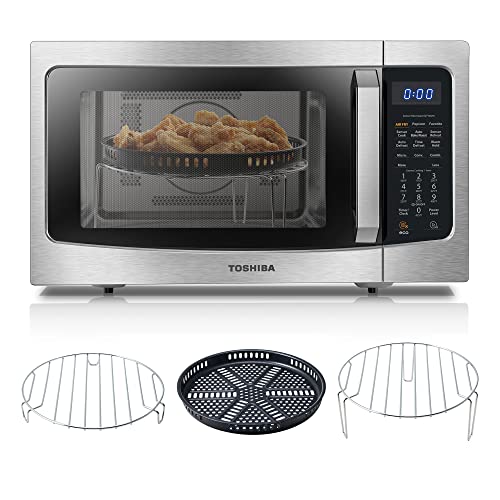
Toshiba 4-in-1 Air Fryer Combo — Best Multi-Function
Toshiba’s 4-in-1 puts a 1000-watt, 1.5 cubic foot microwave, an air fryer, and a convection oven in one countertop body. It suits small kitchens, dorm-adjacent apartments with real cooking ambitions, and anyone whose main oven is slow or oversized for small jobs. It is less suited to households that need to microwave and air fry at the same moment — one cavity, one task — and to purists who want a dedicated basket air fryer’s throughput.
Strengths
- Three appliances in one footprint, with convection and air fry modes that genuinely brown and crisp.
- Smart sensor cooking and a mute function keep its microwave manners equal to the class leaders.
- Position-memory turntable and a 1.5 cubic foot cavity handle family-size dishes.
Trade-offs
- Air fry batch size is limited by the cavity; big families will cook in rounds.
- Mode management and accessories add a learning curve and storage needs.
- Premium tier over a plain 1.5 cubic foot microwave.
Combo appliances live or die on whether the extra modes are real, and Toshiba’s are: the convection mode bakes, the air fry mode crisps, and the microwave mode is a full citizen rather than a token. The honest compromise is sequencing — the cavity cannot reheat sauce while it crisps chicken — so households that routinely run both at dinner should keep separate appliances. Everyone else gains two appliances’ worth of capability for one footprint, which in a small kitchen is the most valuable trade in this entire guide.
Best for: small kitchens consolidating appliances / Not suited for: simultaneous microwave-and-air-fry households.
Check the current price on Amazon

Sharp SMC1161KB — Best Budget Countertop
The black version of Sharp’s 1.1 cubic foot countertop is the budget pick with a pedigree: the Carousel turntable system from the company that invented it, a removable 12.4-inch plate, and controls that favor typing a time over browsing menus. It suits first homes, offices, and anyone whose microwave workload is beverages, reheats, and frozen staples. It is less suited to sensor seekers and to cooks who use presets heavily — the Sharp’s intelligence is in its even heating, not its software.
Strengths
- Genuine Carousel evenness in a budget-tier machine.
- Black finish hides smudges and suits dark or modern kitchens.
- Simple, legible controls that a guest can operate without instruction.
Trade-offs
- No humidity-sensor reheat; timing is manual.
- Preset list is the essentials, not an encyclopedia.
- No mute function for night-time use.
Budget microwaves usually reveal themselves in uneven heating — the cold center, the scorched rim. The Sharp’s defense is mechanical: a well-designed turntable system rotating food through the energy pattern exactly as intended. For households whose cooking is honest and simple, that mechanical competence beats a longer feature list, and the black finish keeps the machine looking tidy between cleanings. It is the pick we would buy for a rental property or a first kitchen without hesitation.
Best for: budget buyers who value even heating over features / Not suited for: preset and sensor enthusiasts.
Check the current price on Amazon

Café 1.5 Cu.Ft Countertop Convection — Best Premium
Café’s countertop convection microwave is the design-forward premium of the class: a 1.5 cubic foot, 1000-watt machine that bakes, roasts, and broils in addition to microwaving, with scan-to-cook technology that reads a packaged food’s barcode through an app and sets the cycle. It suits style-conscious kitchens, small households that cook seriously, and anyone who wants a second oven without a remodel. It is less suited to budget-led purchases and to households that will never open the convection mode — in which case the premium buys decoration.
Strengths
- True convection baking and roasting alongside full microwave function.
- Scan-to-cook removes the guesswork from packaged foods in its database.
- Café’s design language and finishes coordinate with the brand’s appliance suites.
Trade-offs
- The highest tier in this guide by a clear margin.
- App-dependent features add setup and a phone to the cooking loop.
- Convection batch size is small-oven scale, not holiday scale.
Judge the Café as a small premium oven that also microwaves superbly, and its tier makes sense: the convection element produces real browning, the cavity takes a small roast or a batch of vegetables, and the microwave side loses nothing in the combination. For a couple cooking dinner in a kitchen without room for a double oven, it quietly becomes the most-used appliance in the house. Check the current price on Amazon before deciding — premium appliances in this class move between tiers with promotions more often than budget ones.
Best for: design-led kitchens and small households wanting a second oven / Not suited for: budget-first buyers.
Check the current price on Amazon

Frigidaire 1.1 Cu.Ft — Best Mid-Size Value
Frigidaire’s 1.1 cubic foot stainless countertop is the appliance-brand value pick: ten power levels, auto defrost settings, and the backing of a major manufacturer’s parts network at a mid tier. It suits buyers who rank reliability and serviceability over headline features, and kitchens matching a Frigidaire suite. It is less suited to feature maximalists — there is no sensor suite or mute here — and to anyone who needs more than 1.1 cubic feet.
Strengths
- Ten power levels give fine manual control for melting and gentle reheating.
- Auto defrost by weight and time covers the freezer staples competently.
- Major-brand support and parts availability at a mid-range tier.
Trade-offs
- No humidity-sensor cooking to match the Toshiba.
- Stainless finish shows fingerprints like every stainless rival.
- Feature list is deliberately conservative.
There is a kind of buyer — a sensible one — who wants the microwave decision to be boring: a known brand, the standard wattage, the standard size, a control panel that makes sense, and a service network if anything ever fails. The Frigidaire is that buyer’s machine. It does not win any single category in this guide, and it does not need to; it is the mid-size, mid-tier, mid-everything answer that a great many kitchens are actually asking for.
Best for: reliability-first buyers and brand-matched kitchens / Not suited for: feature hunters.
Check the current price on Amazon
Comparison Table
| Pick | Badge | Key spec | Best for |
|---|---|---|---|
| Toshiba EM131A5C | Best Overall | Countertop, 1.2 cu ft, humidity sensor | Most households |
| GE JVM3160RFSS | Best Over-the-Range | OTR, 1.6 cu ft, 300 CFM vent | Reclaiming counter space |
| Toshiba 4-in-1 | Best Multi-Function | Countertop, 1.5 cu ft, air fry + convection | Small kitchens |
| Sharp SMC1161KB | Best Budget | Countertop, 1.1 cu ft, Carousel | Budget-first buyers |
| Café Convection | Best Premium | Countertop, 1.5 cu ft, convection + scan-to-cook | Design-led kitchens |
| Frigidaire 1.1 | Best Mid-Size Value | Countertop, 1.1 cu ft, 10 power levels | Reliability-first buyers |
How to Choose a 1000 Watt Microwave
Choose the format before the model. Countertop is the default: no installation, portable, replaceable in an afternoon. Over-the-range buys back your counter and adds ventilation, at the cost of a real installation and a fixed position. Convection and multi-function countertop models buy a second oven’s capability for a premium. Built-in and drawer formats exist but are remodel decisions with remodel budgets; at exactly 1000 watts the built-in selection is thin, which is itself information — the class’s center of gravity is the countertop, and that is where the best engineering per dollar lives.
Verify the wattage on the model, not the headline. Product families span multiple wattages under similar names. The check that protects you: find the exact model number, confirm its rated cooking output in the manufacturer’s specification, and make sure the listing you buy is that model. Every pick in this guide passed that check on 2026-11-20.
Size by dish, not by headline volume. Turntable diameter decides what fits: about 12.4 inches for a standard dinner plate, 12.8 in the GE OTR, and larger plates in the 1.5 cubic foot combos. OTR cavities are wide and shallow; countertop cavities are squarer. Measure your largest regular dish and your tallest mug, and shop against those numbers.
Match the intelligence to your habits. Sensor cooking (Toshiba) forgives guesswork. Multi-stage and convection (Café, Toshiba 4-in-1) reward planning. Manual simplicity (Sharp, Frigidaire) suits instinct cooks. The most expensive mistake in this class is buying intelligence you will never switch on; the second most expensive is needing it daily and not having it.
For OTR buyers: plan the installation honestly. You need a cabinet of the right width and depth, a mounting wall that takes the bracket, and a decision about venting — ducted to outside if your kitchen allows it, recirculating if it does not. The GE’s 300 CFM is meaningful with ducting and modest without. Measure twice, because an OTR return is a two-person problem.
How to Install an Over-the-Range Microwave (and Set Up a Countertop One)
The GE pick is the only machine in this guide that needs installing, and the job is a well-documented two-person project:
- Confirm the cabinet width (30 inches for this class), the mounting height above the cooktop per the manual, and whether you will vent through the wall, the roof, or recirculate.
- Turn off power to the outlet in the cabinet, remove the old unit or hood, and locate the wall studs — the mounting bracket must anchor to studs, not drywall.
- Fit the mounting plate using the supplied template, drill the cabinet floor holes for the top screws and the power cord, and set the blower orientation for your venting choice before lifting anything.
- With a helper, lift the unit onto the bracket hooks, feed the cord, and drive the top cabinet screws while supporting the weight.
- Connect the duct transition if ducting, fit the grease filters, restore power, and test the fan on all speeds and the microwave with a mug of water.
- Keep the charcoal filter replacement schedule if you recirculate; it is the maintenance item OTR owners most often forget.
Countertop setup is simpler but not thoughtless: unbox, remove all interior packing, wash the turntable, place with ventilation clearances on a level counter, plug directly into a wall outlet, set the clock, and run the same mug-of-water test. If any part of the OTR job involves gas lines, structural changes, or electrical work beyond an existing outlet, that part belongs to a professional.
Countertop vs Over-the-Range: The Honest Trade-Offs
The countertop case: zero installation, total flexibility, the best selection and the newest technology at every tier, and replacement that takes an afternoon and one person. The countertop cost: roughly two square feet of work surface, permanently, plus a visible appliance where some kitchens prefer a clean run. The over-the-range case: the counter comes back, the cooktop gains light and ventilation, and the kitchen gains the integrated look buyers expect in a remodel. The OTR costs: installation effort, a fixed position you will live with for a decade, controls at a height that suits average-to-tall users best, and a cavity shape that favors plates over pots.
Households that cook heavily at the range tend to value the OTR’s hood more than they miss counter space; households that bake, prep, and spread out tend to guard their counters and accept the countertop box. Renters and first-home buyers should default to countertop — your microwave should be able to move when you do. Remodelers should decide the format before the cabinets are ordered, because the cabinet run is designed around the answer. Neither format cooks better at 1000 watts; they cook identically and live differently, which is why this guide ranks by format fit rather than pretending one winner exists.
Common Buying Mistakes
- Buying a wattage variant by mistake. Lookalike model families span 700 to 1100 watts; verify the exact model’s rating.
- Choosing OTR without measuring the cabinet. Width, depth, and mounting height all have to agree, and the cooktop-to-cabinet distance is a safety specification.
- Ignoring venting reality. A 300 CFM hood recirculating through a tired charcoal filter is not 300 CFM of smoke removal.
- Paying for convection you will never use. The Café and Toshiba 4-in-1 premiums are justified only if the extra modes enter your weekly cooking.
- Forgetting the circuit. A 1000-watt microwave plus a kettle on one kitchen circuit is a breaker trip with a timer on it.
- Assuming capacity numbers compare across formats. A 1.6 OTR and a 1.6 countertop have different shapes and different usable dishes; compare turntables and interior dimensions.
Ventilation, Explained: CFM, Ducting, and the Over-the-Range Reality
If you choose the over-the-range format, you are also choosing a vent hood, and hood specifications deserve the same scrutiny as cooking specifications. CFM — cubic feet per minute — measures how much air the fan moves. The GE pick in this guide is rated at 300 CFM, which is honest mid-range ventilation: adequate for ordinary stovetop cooking, including pasta water and pan frying, and noticeably better than the token fans under many cabinets. Serious searing and wok cooking generate more smoke and grease than any microwave hood fully captures; that is a limitation of the format’s shallow canopy, not of this model.
What decides whether rated CFM becomes real CFM is the duct path. Ducted installations — venting through the wall or roof — deliver the rating, provided the duct run is short, smooth, and the correct diameter. Every elbow and every foot of run subtracts performance. Recirculating installations blow air through a charcoal filter and back into the kitchen: they reduce odors somewhat, capture little heat or moisture, and depend entirely on filters that most owners forget to replace. If your kitchen cannot duct, choose the OTR for its space and lighting benefits with clear eyes about the ventilation, or keep a countertop microwave and spend the difference on a real hood someday.
Two practical notes complete the picture. Grease filters on OTR microwaves are washable and should be washed monthly in a busy kitchen — a clogged filter strangles airflow and drips. And the cooktop lighting, LED on the GE, is a feature you will use every single day, arguably more than the ventilation; it is one of the quiet reasons OTR owners rarely go back to countertop models.
What 1000 Watts Cooks Well — and What It Should Not Be Asked to Do
A 1000-watt microwave is genuinely good at a defined set of jobs: reheating anything, steaming vegetables with a spoonful of water, cooking grains and oatmeal, melting and softening ingredients, defrosting with the techniques in our countertop guide, and cooking fish and eggs with a gentleness that rewards attention. Popcorn, bacon, and mug cakes are its party tricks. In the convection picks here — the Café and the Toshiba 4-in-1 — browning joins the list, because those modes use conventional heat rather than microwave energy.
The honest limits are equally defined. A plain microwave cannot brown, crisp, or caramelize; it heats water molecules, and wet surfaces do not exceed the boiling point of water by enough to sear. Large roasts cook unevenly because penetration is shallow. Pastry goes tough, pizza crust goes leathery, and anything whose virtue is a crust should be finished in an oven, a skillet, or the air fry mode of a combo. Knowing this boundary is what separates satisfied owners from disappointed ones: every pick in this guide is excellent inside its physics, and no microwave at any wattage escapes them. Buy the format whose extra modes cover the jobs you actually cook — that, more than the wattage, is the decision this search is really asking about.
Caring for Both Formats
Countertop care is a weekly five minutes: steam a bowl of water with lemon or vinegar, wipe the cavity and door seals, wash the turntable and roller ring, and keep the exterior vents dust-free. Over-the-range care adds the hood’s chores: wash the grease filters monthly, replace the charcoal filter on schedule if you recirculate, and wipe the underside — the surface that faces your cooktop collects a film of cooking grease that dulls both the finish and the lights. For both formats, the door rules are identical: clean seals, gentle closing, and immediate retirement of any unit with door damage, because the door assembly is the containment system.
The electrical habits are shared too. Plug countertop units directly into a wall outlet; OTR units use the cabinet outlet installed for them. Keep cords and outlets dry, and never operate any microwave empty — the energy needs food or liquid to absorb it, and an empty cavity stresses the magnetron. Do these unglamorous things and a 1000-watt machine from this list, in either format, will serve quietly for years; the category’s early failures are overwhelmingly failures of vents, seals, and filters, not of the cooking core.
Choosing Between the Two Toshibas in This Guide
Two picks here share a brand and a wattage, and the choice between them is the cleanest illustration of this guide’s format-first logic. The EM131A5C is a microwave that does microwaving superbly: the humidity sensor, the mute, the easy-clean interior, in a 1.2 cubic foot countertop body at a mid tier. The 4-in-1 is a small kitchen system: a bigger 1.5 cubic foot cavity that also air fries and convection-bakes, at a premium tier, with a modest learning curve. If your oven works well and your cooking is reheat-and-steam, the EM131A5C is the correct spend and the 4-in-1’s extra modes will gather dust. If your oven is slow, tiny, or shared with roommates, and your counter cannot hold separate appliances, the 4-in-1 replaces three purchases with one and earns its premium in footprint alone. Neither is the better microwave in the abstract; each is the better answer to a different kitchen. That is the pattern for the whole list — the GE against every countertop pick, the Café against the 4-in-1 — and it is why we urge you to name your format constraint out loud before comparing models.
Why the 1000-Watt Class Is Crowded — and Why That Helps You
One thousand watts is where the microwave industry fights its hardest, because it is where the volume is. Food manufacturers calibrate to it, retailers promote around it, and every major brand fields multiple models in it. The buyer’s advantage in a crowded class is that competition disciplines the tier structure: budget models must offer real wattage and real capacity to survive, as the Sharp in this guide does, and mid-tier models must offer genuine intelligence — sensors, staging, convection — rather than decoration, as the Toshibas and the Café do. The buyer’s risk in a crowded class is the opposite: lookalike variants, borrowed headline numbers, and listings that blur cooking power with input power. The defense is the one this guide applied on your behalf: verify the exact model, in the exact format, at the exact wattage, before money moves. Do that, and the crowd works for you — six machines in this guide prove the class can serve a studio, a family, a remodel, and a design-led kitchen without any of them pretending to be the others.
The Three Feature Axes: Sensor, Convection, and Vent
Beyond format and wattage, every machine in this class differentiates on one of three axes, and knowing which axis you value prevents the classic error of paying for all three and using one. The sensor axis is about judgment: humidity and weight sensors that decide doneness so you do not have to. Toshiba’s countertop picks own this axis in the guide. It pays off daily, in reheats and defrosts, for cooks who value consistency over involvement. The convection axis is about range: a heating element and fan that turn the cavity into a small oven, owned here by the Café and the Toshiba 4-in-1. It pays off weekly, for households whose cooking includes browning and baking in small batches, and it is wasted on households whose oven already does those jobs happily. The vent axis belongs to the GE alone: ventilation and lighting for the cooktop below, paying off every time the stove runs, in kitchens where the range is the busiest station.
Most households have one dominant axis. Name yours — daily reheating consistency, small-batch baking range, or cooktop ventilation — and the shortlist in this guide collapses to one or two machines, which is what a buying guide is for. The mistake is shopping by feature count: a machine with all three axes exists only as a compromise at a premium, while a machine that owns your axis at a fair tier will satisfy you every day you own it.
Budget Tiers Across Formats
Money behaves differently across formats in this class, and the tiers are worth stating plainly. Countertop machines span the widest range: a budget tier where the Sharp competes, a mid tier where the Toshiba EM131A5C and Frigidaire sit, and a premium tier where convection and design live — the Café and the Toshiba 4-in-1. Over-the-range machines start where countertop mid-tier ends, because you are buying a hood as well as a microwave, and installation adds either a weekend of your labor or a professional’s invoice. Built-in formats, thin at this wattage, start higher still and belong to remodel budgets.
The value logic follows. A renter’s best dollar is a mid-tier countertop with a sensor — capability that moves house with you. A remodeler’s best dollar is often the OTR, because the counter space and ventilation it returns are worth more in a finished kitchen than the installation costs. A small kitchen’s best dollar may be the 4-in-1’s consolidation, replacing purchases rather than adding one. There is no universal best value in this class; there is a best value per housing situation, and this guide’s picks were chosen to give each situation a verified answer at exactly 1000 watts.
Replacing an Old Microwave: Compatibility and Disposal Notes
Most 1000-watt purchases are replacements, and replacements have their own logic. For countertop swaps, compatibility is nearly total: the new machine needs the counter footprint, the clearances, and the outlet the old one used, and the main upgrade decision is whether to keep the size or take the occasion to fix a mismatch — the plate that never fit, the wattage that never matched the food. For over-the-range swaps, compatibility is dimensional: the cabinet width and the mounting height carry over, most brands’ brackets land in similar places, and the vent configuration (ducted or recirculating) usually persists — but confirm the new unit’s required mounting height above the cooktop, because a taller unit over a gas range can violate clearance specifications that the old unit satisfied.
Disposal deserves a sentence of planning. Microwaves are electronic waste: they contain a capacitor that can hold a charge, which is why you should never open the cabinet of a dead unit yourself, and they should go to an e-waste or appliance recycling channel rather than general trash. Many retailers haul away the old unit when delivering a replacement, and most municipalities run periodic e-waste collections. Build the disposal path into the purchase and the new machine’s arrival is a clean swap rather than the start of a garage-storage era for the old one.
One last replacement habit: photograph the old installation before removal — the bracket, the vent connection, the outlet — especially for OTR units. The photos answer questions at the exact moment the hardware store is closed, and they make the new installation a reversal of the old one instead of a fresh puzzle.
Household Safety Notes for the 1000-Watt Class
A few safety habits belong in any honest guide to this class, because 1000 watts is real power delivered by an appliance that sits at counter height in the busiest room of the house. Enable the child safety lock — fitted to several picks here — if small children can reach the controls; a microwave that a toddler can start is a microwave that will eventually be started with something metal or nothing at all inside it, and both are bad days. Teach the household the superheating rule: still water heated in a smooth cup can erupt when disturbed, so beverages get a stir stick, a textured cup, or a brief stand before handling. Keep the door and its seals clean and undamaged, and retire any unit whose door is bent or whose latch fails to engage — the door is the containment, and its integrity is not a cosmetic matter. Finally, give the machine its electrical due: a direct wall outlet, a circuit not shared with another heavy appliance at the same moment, and ventilation space that stays clear when the kitchen gets busy. None of this is specific to one pick; all of it is the difference between an appliance that serves a household safely for years and one that becomes a story.
Final Recommendation
For most kitchens, the Toshiba EM131A5C is the 1000-watt microwave to buy: the standard format, the smartest sensor, the quietest manners, and the best everyday performance in the class. Choose the GE JVM3160RFSS when the counter must be reclaimed and the range needs a hood, the Toshiba 4-in-1 when one footprint must do three jobs, the Sharp when the budget leads, the Café when a premium second oven is the goal, and the Frigidaire when you want the sensible brand-name middle. All six are true, verified 1000-watt machines — check price on Amazon from the links, and measure before you order, whichever format you choose.
Related guides in this cluster: Best 1000 Watt Countertop Microwaves, Best 10 Countertop Microwaves, Best 1100 Watt Microwaves Ovens, Best 1.2 Cf Otr Microwaves.
Frequently Asked Questions
Is 1000 watts the right power for a microwave?
For most households, yes. It is the wattage that frozen food instructions and microwave recipes are calibrated to, so directions work as printed. Smaller households reheating single servings can live happily at lower wattages; high-volume households may prefer 1100 to 1200 watts mainly for speed across many cycles.
What is the difference between countertop and over-the-range 1000 watt microwaves?
The cooking power is the same. The difference is everything around it: countertop models sit on the counter and move freely; over-the-range models mount under a cabinet, free the counter, and add a vent hood and cooktop light, at the cost of installation and a wide, shallow cavity.
Can a 1000 watt convection microwave replace a second oven?
For small batches — vegetables, a small roast, a tray of appetizers — yes, models like the Café and the Toshiba 4-in-1 genuinely substitute. For holiday-scale cooking they are a supplement, not a replacement, because one modest cavity can only hold so much.
How hard is it to install an over-the-range microwave?
It is a standard two-person DIY project for a prepared household: mounting plate to studs, top screws through the cabinet, venting configured, unit lifted onto the bracket. The preparation — measuring, stud-finding, vent planning — is most of the work. Anything involving new electrical or duct runs is professional territory.
Why do some listings show a higher wattage number for the same-looking microwave?
Two reasons: families of lookalike models genuinely span several wattages, and listings sometimes display input power (what the machine draws) instead of cooking power (what the food receives). Compare cooking power, and verify it against the exact model number — the method used for every pick in this guide.
How long will a 1000 watt microwave last?
The cooking core is long-lived; the wear points are door switches, control panels, and turntable motors. Brands with real parts networks — GE, Toshiba, Sharp, Frigidaire among these picks — make those repairs economical, which is why format and features aside, support is a legitimate buying criterion in this class.


