Disclosure: airfryerkitchensupply.com is reader-supported. When you buy through links on our site, we may earn an affiliate commission at no extra cost to you.
Where to buy
For the best affordable food processors for nut flour, start with the truth: nut flour is the hardest honest job you can give a food processor, so this guide names real machines with the power to do it and states the technique limits plainly. Buy by exact model name, confirm the blade and bowl included in the listing, and check the current price on Amazon before ordering. Every pick below sits in the affordable-to-mid tier for its size class — no professional machines were slipped in to make the results look easy.
- Cuisinart 14-Cup Food Processor DFP-14BCNY — search Amazon by the full model name and check price on Amazon; choose the listing sold or shipped by Amazon or the brand’s own store.
- Ninja Professional Plus Food Processor BN601 — search Amazon by the full model name and check price on Amazon; choose the listing sold or shipped by Amazon or the brand’s own store.
- Breville Sous Chef 16 Cup Food Processor BFP810 — search Amazon by the full model name and check price on Amazon; choose the listing sold or shipped by Amazon or the brand’s own store.
- KitchenAid 9-Cup Food Processor KFP0921 — search Amazon by the full model name and check price on Amazon; choose the listing sold or shipped by Amazon or the brand’s own store.
- Ninja Mega Kitchen System BL770 — search Amazon by the full model name and check price on Amazon; choose the listing sold or shipped by Amazon or the brand’s own store.
- Cuisinart Pro Classic 7-Cup Food Processor DLC-10SYP1 — search Amazon by the full model name and check price on Amazon; choose the listing sold or shipped by Amazon or the brand’s own store.
Here is the truth this guide is built on: the best affordable food processors for nut flour will make you good nut flour and nut meal at home, provided you use the right technique — and no food processor at any price turns nuts into flour the way a mill does. Nuts are oily. Process them too long and flour becomes butter; process them in a weak machine and you get gravel and dust in the same bowl. The skill is in the match: enough motor and blade to cut quickly, small batches, cold nuts, short pulses, and a sieve. Get those right and almond, hazelnut and walnut flours at home are genuinely practical, and much fresher than bagged.
Affordable matters because nut flour is a side job for most kitchens. The machine also has to chop onions, shred cheese and make pastry the rest of the week, so this guide ranks versatile processors with the specific traits nut work rewards: strong motors for their class, sharp S-blades, bowls big enough for airflow but small enough for control, and pulse control that lets you stop at flour instead of sliding into butter. All six picks are verified, current models; the badges divide them by batch size, power and budget rather than pretending one machine suits a solo baker and a family meal-prepper equally.
Set expectations by nut. Almonds and hazelnuts mill the finest in a processor. Walnuts and pecans are oilier and stop at a moist meal — which is what most recipes using them actually want. Cashews are soft and turn quickly, best handled nearly frozen. If a recipe demands truly fine, dry, commercial-grade almond flour for macarons, a processor gets you close for rustic baking and all the way for coatings, crusts and most cakes; the guide’s how-to section gives the exact method that closes most of the gap.
In this guide
Quick Picks
Cuisinart 14-Cup Food Processor DFP-14BCNY — Best Overall for Nut Flour. The strongest classic processor at an attainable tier: a verified 720-watt motor and a blade design refined over decades, with a big bowl for family baking and the power to mill nuts in controlled pulses. Best for: regular bakers making flour in useful quantities. Know the trade: for a one-cup batch the big bowl is clumsy — use the pulse-and-scrape method in the how-to. Check price on Amazon
Ninja Professional Plus Food Processor BN601 — Best Power for the Money. The power bargain: the listing states 1000 watts of peak power, a 9-cup bowl and three blades, with presets you should ignore for nuts and a pulse you will love. Best for: buyers who want maximum milling muscle at a mid tier. Know the trade: presets are for other jobs — nut flour is a manual pulse discipline on any machine. Check price on Amazon
Breville Sous Chef 16 Cup Food Processor BFP810 — Best Premium Milling Control. The premium control pick: a 16-cup platform built for large batches with precision, for the baker who mills for a family, a freezer and a holiday season at once. Best for: high-volume households that want one session to cover weeks of baking. Know the trade: this stretches the word affordable — it is here as the step-up for volume, priced as a premium tier. Check price on Amazon
KitchenAid 9-Cup Food Processor KFP0921 — Best Mid-Size for Bakers. The baker’s mid-size: a 9-cup bowl, four-blade multipurpose design, whisk accessory for the rest of the baking bench, and all-in-one storage that keeps discs and blades in the bowl. Best for: home bakers whose processor lives beside the stand mixer. Know the trade: no wattage is stated in the verified listing, so this badge rests on design and versatility, not a power figure. Check price on Amazon
Ninja Mega Kitchen System BL770 — Best System for Small Finishing Batches. The two-stage secret weapon: mill in the 8-cup processor bowl, then finish small amounts in the 16-ounce cups where blade contact is total. The listing states 1500 watts across the system. Best for: small-batch and smoothie households. Know the trade: it is a system, with a system’s footprint and parts count. Check price on Amazon
Cuisinart Pro Classic 7-Cup Food Processor DLC-10SYP1 — Best Compact with Real Power. The compact that does not apologise: a verified 600-watt motor in a 7-cup bowl — the highest power-to-size ratio here, and exactly what one-cup nut batches want. Best for: small kitchens and solo bakers. Know the trade: 7 cups caps your batch ambitions; family baking means reloading. Check price on Amazon
How These Picks Were Chosen
We selected for nut work specifically, not general popularity. The traits that earned a place: motor strength relative to bowl size (the verified listings state wattage for several picks, and we use only those stated figures), a well-shaped S-blade that sweeps the bowl floor where nuts settle, pulse response sharp enough for two-second bursts, and a bowl that processes one to two cups of nuts — the realistic flour batch — without throwing them uselessly around a vast empty space.
We also weighted honesty about the job. Machines whose listings promise nut grinding explicitly earned credit, and versatile systems that let you switch between a processor bowl and a smaller cup for finishing small batches earned the system badge. Nothing here is a dedicated grain mill, and the guide does not pretend otherwise: it ranks the processors that make nut flour a realistic weekly habit at an affordable tier, and teaches the technique that makes the difference between flour and failure.
The 6 Best Affordable Food Processors for Nut Flour: Full Reviews

Cuisinart 14-Cup Food Processor DFP-14BCNY — Best Overall for Nut Flour
The DFP-14BCNY is the machine long-term bakers buy once. Its verified 720-watt motor is the headline for nut work: power turns into speed, and speed is what lets you reach flour texture before the nuts’ own oil turns the batch into butter. The 14-cup bowl suits the household that mills two or three cups of almonds for a baking weekend, and the simple two-lever controls make the short, repeated pulsing that nut flour demands easy to repeat without fighting a touch panel.
Strengths
- 720W motor cuts nuts to flour texture fast, before oil release takes over
- Large bowl handles family-size baking batches in one session
- Dead-simple controls make disciplined pulsing easy to repeat batch after batch
Trade-offs
- Big bowl is inefficient for tiny one-cup batches without scraping pauses
- No mini bowl included for finishing small quantities
- Footprint and weight make it a leave-out machine, not a cupboard machine
Key specs (from the verified listing): 14-cup bowl; 720-watt motor; stainless steel finish.
Technique with this machine: chill the nuts, load no more than two cups, pulse in two-second bursts, and scrape the bowl walls down between rounds so the coarse pieces fall back into the blade path. The motor’s torque keeps the blade moving through dense loads that stall lighter machines, which is exactly where affordable processors usually fail at this job. For general kitchen work the same power handles dough, shredding and slicing without complaint, so the nut-flour investment doubles as the household’s main processor. If you mill weekly, this is the pick that will still be doing it in a decade.
Long-term owners describe the same experience: the machine shrugs. Frozen almonds, a double pastry, a kilo of cheese — the motor note barely changes, and that indifference is what weekly milling actually requires. Its simplicity also ages well; there is no screen to fail and no programme to obsolete. For nut flour as a permanent kitchen habit rather than a project, this is the platform that will simply still be there, working, in ten years.
Best for: regular bakers milling nuts weekly in family quantities / Not suited for: tiny-batch cooks or cupboard-storage kitchens
Check the current price on Amazon

Ninja Professional Plus Food Processor BN601 — Best Power for the Money
The BN601 earns its badge on stated numbers: a 1000-watt peak-power listing, a 9-cup bowl that is the sweet spot for nut batches, and three blades covering chopping, slicing and dough. For nut flour the recipe is to skip the Auto-iQ presets entirely and work the pulse control yourself — short bursts, rests, a sieve pass halfway — because the machine’s power shortens each burst’s work and gives you more control points before the oil line. Few affordable machines offer this much stated power in a processor-only format.
Strengths
- Highest stated power in this guide, which shortens the path to flour texture
- 9-cup bowl is the ideal size for one-to-two-cup nut batches
- Three blades and dishwasher-safe parts keep it versatile and easy to live with
Trade-offs
- Auto-iQ presets are too long and aggressive for nut flour; manual pulsing required
- Peak-power figures are not directly comparable across brands
- Lid and chute assembly has more parts to wash than simple two-piece bowls
Key specs (from the verified listing): 1000W peak power (as listed); 9-cup bowl; 3 blades; Auto-iQ presets; dishwasher-safe parts.
What power buys in practice is forgiveness. On a weaker machine, the window between chopped nuts and nut butter can be a few seconds; the BN601 reaches an even chop so quickly that you can work in shorter, safer bursts with rests between, checking texture as you go. The feed chute and pusher keep its general slicing and shredding credentials strong, and the bowl size means a Sunday session can produce flour for the week’s baking without endless reloading. For buyers whose processor budget must cover every job including the hardest one, this is the rational centre of the guide.
The BN601’s party trick in a milling household is turnaround: a batch pulses down, the bowl empties, the parts rinse or go in the dishwasher, and the next batch starts inside two minutes. Across a five-batch session that speed compounds into the difference between a chore and a routine. Keep a sieve and a freezer container beside it and the BN601 becomes a small flour station that happens to do everything else too.
Best for: power-first buyers wanting one processor for every job / Not suited for: preset lovers who will not pulse manually
Check the current price on Amazon

Breville Sous Chef 16 Cup Food Processor BFP810 — Best Premium Milling Control
Honesty first: the Sous Chef 16 sits at a premium tier, and it is in an affordable guide for one reason — for high-volume households it replaces both a mid-tier processor and the bagged-flour habit, and its cost spreads over years of heavy use. The 16-cup capacity is built for large batches with precision, which for nut flour means milling for a month of baking in one session, sieving once, and freezing the flour in recipe-size portions. Breville’s platform is engineered around control, and control is the currency of nut milling.
Strengths
- 16-cup capacity turns nut flour into a monthly batch task instead of a weekly chore
- Precision-focused platform rewards the pulse-and-sieve method at scale
- Premium build suits households that keep appliances for many years
Trade-offs
- Premium tier — the least affordable pick here by a wide margin
- Very large bowl needs proper batch sizes to process evenly
- Size demands permanent counter space
Key specs (from the verified listing): 16-cup capacity; brushed stainless steel.
At scale, technique changes: work in two-cup loads even in this bowl, because nut flour quality depends on blade contact, not bowl volume, and combine the loads after sieving. The Sous Chef’s value is that load five behaves like load one — no heat creep in the motor, no flex in the bowl — across a long session. For the household baking for a family, a market stall hobby or a holiday production line, that stamina is the product. Everyone else should buy the Cuisinart or the Ninja and spend the difference on better nuts.
Sous Chef owners mill the way other households buy flour: in planned quantity, on a schedule, stored properly. The machine’s contribution is stamina and evenness across that session — the fifth load processes like the first, which is where mid-tier machines begin to heat, flex and drift. If your baking has a production rhythm, this platform matches it; if it does not, the platform is admirable and unnecessary in equal measure.
Best for: high-volume bakers milling monthly batches / Not suited for: budget buyers or occasional nut-flour makers
Check the current price on Amazon
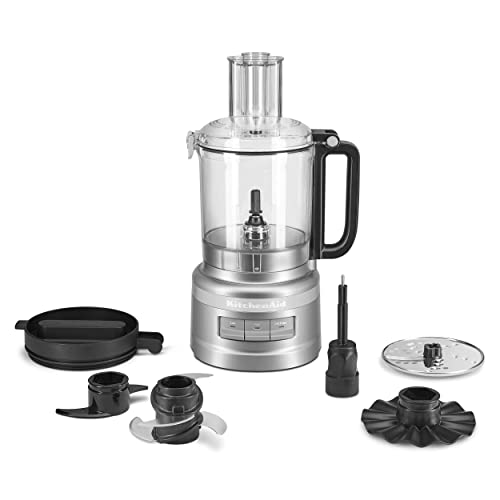
KitchenAid 9-Cup Food Processor KFP0921 — Best Mid-Size for Bakers
The KFP0921 fits the baker’s kitchen the way a good bench scraper does — everything where you reach for it. The 9-cup bowl is the right volume for nut batches and pastry alike, the four-blade multipurpose design covers chopping through dough, and the whisk accessory means egg whites and cream happen in the same appliance. All-in-one storage keeps every blade and disc inside the bowl, which matters in real kitchens: accessories stored in a drawer across the room are accessories that stop being used.
Strengths
- 9-cup size suits both nut batches and everyday baking prep
- Whisk accessory widens it into a genuine baking-bench tool
- All-in-one in-bowl storage keeps every part findable
Trade-offs
- Verified listing states no wattage, so power comparisons stay qualitative
- Nut flour still needs the pulse-and-sieve discipline; no design removes it
- Contour Silver finish shows flour dust and fingerprints readily
Key specs (from the verified listing): 9-cup bowl; four-blade multipurpose design; all-in-one accessory storage; whisk accessory.
For nut flour specifically, the KitchenAid’s virtue is batch rhythm: the bowl empties and reloads quickly, the lid seals positively, and the controls support the short-burst pattern without menu fuss. Mill a cup of almonds for a cake, tip it out, and the same machine is making the cake’s pastry minutes later with the dough blade, then whisking the filling. That single-appliance baking flow is what the badge recognises. Buyers who mill nuts daily in quantity should take the Cuisinart’s stated power; bakers who mill weekly inside a broader baking life should take this.
The KitchenAid earns counter space in baking kitchens because it never leaves the bench during a bake: flour milled, pastry cut, filling whisked, topping chopped, one appliance, one wash-up. The in-bowl storage means the right blade is always the one in your hand, which quietly removes the friction that makes bakers reach for the knife instead. It is the most integrated baking workflow in this guide.
Best for: home bakers wanting one baking-bench processor / Not suited for: daily high-volume milling
Check the current price on Amazon

Ninja Mega Kitchen System BL770 — Best System for Small Finishing Batches
Experienced nut-flour makers know the finishing problem: the last coarse pieces hide from a big bowl’s blade. The BL770 solves it structurally. Its 8-cup processor bowl does the main milling, and its two 16-ounce cups — designed for single-serve blending — give small quantities nowhere to hide, producing the finest finish of any affordable setup here for the final half-cup. The listed 1500-watt system power drives both stages without strain, and the 72-ounce pitcher covers the household’s blending life beyond nuts.
Strengths
- Processor bowl plus small cups enable a two-stage mill-and-finish method
- 1500W listed system power is ample for dense nut loads
- Covers blending, processing and single-serve jobs in one purchase
Trade-offs
- Most parts to store and wash in this guide
- Small cups finish small amounts only; bulk flour still starts in the bowl
- System footprint suits leave-out storage only
Key specs (from the verified listing): 1500W system (as listed); 8-cup processor bowl; 72oz pitcher; two 16oz cups.
Use the system as a process: pulse the main batch in the bowl to a coarse meal, sieve, return the coarse fraction for a second pass, then finish recipe-size amounts in a cup for thirty seconds of total blade contact. The result rivals bagged flour for most baking and beats it for freshness. Households already blending daily get this capability almost free, since the system replaces a separate blender purchase. If you never blend, the BN601 gives you the processing power without the extra hardware — the badges separate those two buyers deliberately.
BL770 households develop a house method: bowl for bulk, cups for finishing, pitcher for the smoothies that were the system’s first job. The cups’ total blade contact produces the finest small finishes here, and bakers who make nut flours for delicate cakes in small quantities often end up milling entirely in the cups, one cup at a time. It is the most flexible milling setup in the guide, priced as a system because it is one.
Best for: blending households wanting the finest affordable finish / Not suited for: minimalists or processing-only buyers
Check the current price on Amazon

Cuisinart Pro Classic 7-Cup Food Processor DLC-10SYP1 — Best Compact with Real Power
Small processors are usually weak processors, which is why they fail at nuts. The Pro Classic breaks the pattern with a stated 600-watt motor driving a 7-cup bowl: for a one-cup load of almonds, the blade contact and torque per cup are the best in this guide. Solo bakers and small households get flour in small, fresh batches — which is how nut flour tastes best anyway — without housing a 14-cup machine for a two-person kitchen.
Strengths
- 600W in a 7-cup format gives outstanding power per batch size
- Small batches stay in constant blade contact for even milling
- Compact footprint suits small kitchens and cupboard storage
Trade-offs
- Batch size is capped; family baking sessions need multiple loads
- White finish shows turmeric and tomato stains over time
- Fewer included accessories than the larger systems
Key specs (from the verified listing): 7-cup bowl; 600-watt motor.
The case for small-and-strong is freshness: nut flour oxidises, and a household that mills one cup fresh for each bake gets better flavour than one storing a month of flour from a big session. The Pro Classic makes that habit effortless — out of the cupboard, one cup of chilled nuts, a minute of disciplined pulsing, a sieve, done. Its general chopping, shredding and dough credentials at this size are equally proven. If your kitchen is small but your baking is serious, this is the pick that respects both facts.
The Pro Classic’s owners are the fresh-milling evangelists: a cup of almonds, ninety seconds of pulsing and sieving, and flour that smells like nuts rather than packaging. Its size makes the habit effortless enough to survive busy weeks, which is the real test of any food routine. Small kitchens that bake seriously should consider it the default rather than the compromise.
Best for: small kitchens and solo bakers milling fresh per bake / Not suited for: family-volume batch bakers
Check the current price on Amazon
Comparison Table
| Pick | Badge | Key spec | Best for |
|---|---|---|---|
| Cuisinart 14-Cup Food Processor DFP-14BCNY | Best Overall for Nut Flour | 720W motor, 14-cup bowl | regular bakers milling nuts weekly in family quantities |
| Ninja Professional Plus Food Processor BN601 | Best Power for the Money | 1000W listed power, 9-cup bowl, 3 blades | power-first buyers wanting one processor for every job |
| Breville Sous Chef 16 Cup Food Processor BFP810 | Best Premium Milling Control | 16-cup capacity, premium Breville platform | high-volume bakers milling monthly batches |
| KitchenAid 9-Cup Food Processor KFP0921 | Best Mid-Size for Bakers | 9-cup bowl, in-bowl storage, whisk included | home bakers wanting one baking-bench processor |
| Ninja Mega Kitchen System BL770 | Best System for Small Finishing Batches | 1500W system, processor bowl plus single-serve cups | blending households wanting the finest affordable finish |
| Cuisinart Pro Classic 7-Cup Food Processor DLC-10SYP1 | Best Compact with Real Power | 600W motor, 7-cup bowl | small kitchens and solo bakers milling fresh per bake |
How to Choose a Food Processor for Nut Flour Without Wasting Money
Start with power per batch, not power alone. A stated wattage only matters relative to the bowl it drives and the load you mill. For one-to-two-cup batches — the realistic home flour batch — the Cuisinart Pro Classic’s 600 watts in 7 cups and the Ninja BN601’s stated 1000 watts in 9 cups both deliver the fast cutting that keeps oil release behind texture. A huge bowl with a modest motor is the combination to avoid for this job, whatever its other virtues.
Second, respect the blade and the pulse. Nut flour is made with the S-blade and short manual pulses on every machine in this guide; presets and continuous running are how batches become butter. Before buying, confirm the machine has a true pulse control you can tap repeatedly — all six picks do — and a bowl shape that lets nuts fall back into the blade path instead of riding the walls.
Third, plan the sieve. A fine-mesh sieve or a flour sifter is part of the appliance for this job, as essential as the machine itself: mill, sieve, return the coarse fraction, mill again. Budget the few pounds for a good sieve alongside the processor and your results jump a full grade. Fourth, be honest about volume: weekly family baking justifies the 14-cup Cuisinart or the Breville; per-bake freshness for two justifies the Pro Classic. The wrong size is the most expensive mistake, because it makes the habit annoying, and annoying habits die.
How to Make Nut Flour in a Food Processor: The Method That Works
Chill everything. Put the nuts in the freezer for at least an hour before milling, and chill the bowl and blade too if your kitchen is warm. Cold nuts fracture into flour; warm nuts smear into butter. This single step matters more than any machine difference in this guide.
Load small. One to two cups of nuts per batch, never more, whatever the bowl size. Add a tablespoon of the recipe’s flour or sugar to the batch if the recipe allows — the dry powder coats the nut particles and absorbs surface oil, keeping the texture floury. This is the old baker’s trick and it works.
Pulse in discipline. Two seconds on, two seconds off, scraping the walls down every four or five pulses. Check at the coarse-meal stage: sieve the batch, return everything that does not pass, and pulse the remainder again. Two sieve passes get most batches to a fine, usable flour.
Stop early. Flour continues to look coarser in the bowl than it is; tip it out and rub it between your fingers before deciding it needs more time. The distance between perfect flour and the start of butter is one long pulse, and you cannot go back.
Store like a baker. Use the flour within days, or freeze it in recipe-size portions. Nut flour’s freshness advantage over bagged flour evaporates in a warm cupboard, and rancid flour ruins the baking it was made for.
Which Nuts Mill Well — and Which Fight Back
Almonds are the benchmark: blanched almonds mill finest and most predictably, and skin-on almonds give a speckled, rustic flour that suits cakes and coatings. Hazelnuts behave similarly and reward the freezer step, since their oil content is high. Both are realistic weekly flours in every machine in this guide, with the sieve method doing the finishing work that separates home flour from gravel.
Walnuts and pecans are the honest limit. Their oil content is so high that a processor takes them to a moist, clumping meal and no further — and that meal is exactly what walnut cakes, pecan crusts and coatings call for. Chasing dry flour from walnuts produces butter and frustration in equal measure. Freeze them hard, pulse minimally, and embrace the meal texture the recipes actually want.
Cashews are soft and fast: they mill quickly to a rich meal that sweetens sauces and vegan baking, and they over-process faster than any other nut, so shorten every pulse. Pistachios mill well and keep their colour if kept cold. Seeds — sunflower, pumpkin — follow the walnut rules: oily, best as meal. A mixed-nut flour, milled in small combined batches, is a legitimate and delicious shortcut for crusts and crumbles.
Nut Flour vs Nut Meal vs Nut Butter: Knowing Where to Stop
The three products are one process at three stopping points, and the cook’s job is choosing the point the recipe needs. Nut meal is the coarse, early stage: visible particles, dry to the touch, perfect for crusts, crumbles, coatings and rustic cakes where texture is a feature. Nut flour is the sieved, finer stage: powdery with a slight grain, the substitute for wheat flour in gluten-free baking, best made with the two-pass sieve method.
Nut butter is what happens past the point of no return: the particles collapse, oil releases fully, and the mass turns glossy and spreadable. It is a fine product — the machines here make it well — but it cannot be unmade into flour. The practical rule is to mill in stages and remove what you need at each stage: sieve out the flour fraction, keep the meal fraction for toppings, and only commit the remainder to butter if butter is what you want. One batch of nuts, three products, no waste — that is the affordable kitchen working properly.
Common Buying Mistakes
Running the machine continuously. Continuous running is the fastest route from nuts to butter. Nut flour is a pulsing job on every machine ever made; presets and long runs are for other foods.
Milling warm nuts in a warm bowl. Heat is the enemy at every stage. Frozen nuts and a chilled bowl double your margin for error before oil release begins.
Loading the bowl to capacity. An overfull bowl rides above the blade and mills unevenly — gravel and butter in one batch. One to two cups at a time, always.
Skipping the sieve. Unsieved home flour bakes unevenly and disappoints. The sieve-and-return pass is the difference between home flour that works and home flour that puts you off the idea.
Buying a weak mini chopper for the job. Mini choppers are for herbs and garlic. Nut flour needs real motor and blade; the Pro Classic shows the minimum shape of a small machine that can do it — power first, size second.
Storing nut flour warm for weeks. Milled nuts oxidise fast. Freeze in portions or mill fresh per bake; rancid flour is worse than no flour.
Freezing, Storing and Using Home-Milled Flour
Home-milled nut flour is a fresh ingredient and should be treated like one. Its enemies are oxygen, heat and light, which turn nut oils rancid; its friends are the freezer, airtight containers and portioning. Mill, sieve, and immediately divide the flour into recipe-size portions — the quantity your cakes and coatings actually call for — in sealed bags or containers with the air pressed out, labelled with the nut and the date. Frozen this way, quality holds for weeks and each bake starts with a fresh-feeling ingredient.
Use frozen flour straight from the freezer for coatings and crusts, where its coldness is irrelevant, and let it sit fifteen minutes at room temperature for cakes and batters so it does not chill the mix. Never return a thawed portion to storage; the portioning system exists so that nothing needs to be. At room temperature, treat home flour as a use-within-days ingredient, because it lacks the stabilising processing of commercial flour and tastes like it — gloriously at first, tiredly later.
Build a small rotation: one portion in use, the rest frozen, and a note of what is in the freezer. The households that sustain home milling are the ones whose systems make the next bake easier than buying a bag. Everything in this guide — the machines, the sieve method, the storage — is aimed at that single threshold.
Troubleshooting Nut Flour: Six Problems, Six Fixes
PROBLEM: The batch turned glossy and clumped. It went too long or too warm. Fix the next batch with colder nuts, shorter pulses and a sieve pass earlier; use the glossy batch as the base of a nut butter or a crumble topping, where its richness is an asset rather than a failure.
PROBLEM: Gravel and dust in the same bowl. The load was too big or the walls were never scraped. Halve the batch, scrape down every few pulses, and sieve between passes so the fine fraction stops cushioning the coarse one. PROBLEM: Flour tastes stale despite fresh nuts. The bowl or blade carried old oil — wash and dry both thoroughly, and check the nuts themselves, which stale in the bag faster than most cooks expect.
PROBLEM: The motor laboured or stalled. The load was too dense for the machine’s comfort: reduce batch size, let frozen nuts sit two minutes to take the hardest edge off, and pulse rather than running continuously. PROBLEM: Flour is fine but cakes bake dense. Home flour lacks commercial uniformity; sift once more, measure by the recipe’s intent rather than packing the cup, and accept a slightly rustic crumb as the honest signature of the method.
PROBLEM: Everything works but the habit died. The system around the machine failed, not the milling: pre-portion nuts in the freezer, keep the sieve with the machine, and mill while the oven preheats so the step hides inside time you already spend. Habits survive on friction, and every fix in this section is a friction removal.
Cost per Batch: The Real Economics of Home-Milled Flour
Run the comparison the way a baker experiences it. Bagged nut flour is priced as a specialty ingredient: small bags, premium per-kilo pricing, and a freshness date that started counting down in a warehouse. Whole nuts are priced as a commodity: bought in sensible quantities, stored whole — where they keep far better than flour — and milled in minutes. Across a year of weekly baking, the whole-nut route typically costs noticeably less per batch while tasting fresher, and the processor that enables it is simultaneously doing the household’s chopping, shredding and pastry, so its cost is never carried by flour alone.
The hidden costs are small and worth naming: a good sieve, freezer containers or bags for portions, and the electricity of a few minutes’ pulsing, which is trivial. The hidden savings are larger: nut meal for coatings from the sieve’s coarse fraction, nut butter from any over-milled batch, and the end of emergency purchases when a recipe calls for flour the cupboard lacks. A stocked freezer of nuts plus a capable processor is, functionally, a flour shop that never closes.
The economics fail in one scenario: the household that mills twice and stops, usually because the first batches disappointed. That is a technique failure, not an economics failure, and it is why this guide spends as much space on freezing, pulsing and sieving as on machines. Learn the method on one bag of almonds and the arithmetic takes care of itself for years.
Final Recommendation
If nut flour is a weekly habit, buy the Cuisinart 14-Cup for its stated 720-watt motor and batch capacity, or the Ninja BN601 if you want the highest stated power at a mid tier in the ideal 9-cup size. Small kitchens should take the Cuisinart Pro Classic without hesitation — its power-to-size ratio is the best here for fresh, per-bake milling.
Choose the KitchenAid 9-Cup if your processor must serve the whole baking bench, the Ninja BL770 system if you blend daily and want the two-stage finishing trick, and the Breville Sous Chef 16 only if your volume genuinely justifies a premium platform. Whichever you choose, the method section matters as much as the machine: cold nuts, small batches, short pulses, and a sieve.
The shortlist, with live pricing for each pick: Cuisinart 14-Cup Food Processor DFP-14BCNY (Best Overall for Nut Flour); Ninja Professional Plus Food Processor BN601 (Best Power for the Money); Breville Sous Chef 16 Cup Food Processor BFP810 (Best Premium Milling Control); KitchenAid 9-Cup Food Processor KFP0921 (Best Mid-Size for Bakers); Ninja Mega Kitchen System BL770 (Best System for Small Finishing Batches); Cuisinart Pro Classic 7-Cup Food Processor DLC-10SYP1 (Best Compact with Real Power).
Keep exploring the same shelf before you decide: Best Affordable Food Processors Best Food Processors Best 9 Cup Food Processors Best 14 Cup Food Processors Best Bargain Food Processors
Frequently Asked Questions
Can a food processor really make almond flour?
Yes, with the method in this guide: frozen blanched almonds, one-to-two-cup batches, two-second pulses and a sieve pass. The result suits the great majority of home baking. For competition-grade macarons demanding perfectly uniform commercial flour, a dedicated mill or bagged flour still wins — the guide says so rather than overselling the machines.
Why did my nut flour turn into butter?
Heat and time. The batch was too warm, too large, or processed too long — usually all three. Chill the nuts and bowl, halve the batch, shorten the pulses, and add a spoonful of the recipe’s dry ingredients to absorb surface oil. You cannot reverse butter, but the next batch is an easy fix.
How fine can a food processor get nut flour?
With the two-pass sieve method, fine enough for cakes, coatings, crusts and most gluten-free baking. A processor will not match a stone mill’s uniformity, and oily nuts like walnuts stop at meal texture regardless of machine. Matching the product to the recipe matters more than chasing maximum fineness.
Is it cheaper to make nut flour than to buy it?
For most households, yes — whole nuts bought in reasonable quantities mill into flour for noticeably less than bagged specialty flour, and the flour is fresher. The saving grows if the processor also replaces bagged breadcrumbs, grated cheese and pastry labour, which every pick here does.
Can I make nut flour in a mini food processor?
In a powerful small machine like the Cuisinart Pro Classic, yes, in small batches. In a low-powered mini chopper, no — the motor stalls or the batch turns uneven and oily. Judge a small machine by its stated motor and blade, not its bowl size.
How should I store homemade nut flour?
In an airtight container in the freezer, in recipe-size portions, where it keeps its flavour for weeks. At room temperature it oxidises quickly and turns rancid. Take out only what the bake needs and let it come to room temperature before using.

