Disclosure: airfryerkitchensupply.com is reader-supported. When you buy through links on our site, we may earn an affiliate commission at no extra cost to you.
Where to buy
Every pick below was verified against a live Amazon listing feed for this site before it earned a link. We do not print prices — they change too often to stay honest — so use the links to check the current price on Amazon for the model that fits you.
- BUNN CSB3T Speed Brew Platinum Thermal Coffee Maker, 10-Cup — check the current price on Amazon
- Breville Precision Brewer BDC400, Brushed Stainless Steel — check the current price on Amazon
- Bonavita 8-Cup Coffee Maker BV1901TS — check the current price on Amazon
- Cuisinart 5-Cup Coffee Maker With Stainless Steel Carafe DCC-5570 — check the current price on Amazon
- Technivorm Moccamaster KBGV Select, 10-Cup — check the current price on Amazon
- Cuisinart 10-Cup Thermal Classic Coffeemaker DCC-1170 — check the current price on Amazon
The best all stainless steel coffee makers appeal to a specific and reasonable instinct: the things that touch your coffee every morning should be metal, not plastic — for durability, for taste neutrality, and for the simple pleasure of an object that will not crack, stain or warp. Let us be precise about the category, because listings are not: a truly all-stainless brewer, with no plastic anywhere in the water path, barely exists at consumer tiers. What does exist — and what this guide verifies — are the machines that maximise stainless where it matters: stainless carafes, stainless housings, stainless filter baskets and steel brew paths, from makers who build to last.
That honesty is the guide’s foundation. Every pick below was verified product feed attached to this site, brand and model matched to a live listing, and each review states plainly which parts are stainless and where plastic remains — usually in reservoirs, lids and internal plumbing, as it does in nearly every consumer machine. Buyers who want the maximum-steel machine for their tier will find it here; buyers who wanted a fantasy of a plastic-free appliance will at least leave knowing what the market actually sells, which is the more valuable outcome.
Why pursue steel at all? Three durable reasons. A stainless thermal carafe holds coffee hot for hours with no warming plate, so the pot never cooks. Steel housings and baskets shrug off the knocks, heat cycles and dishwasher years that age plastic machines visibly. And steel is taste-neutral and endlessly cleanable — no lingering flavours, no staining, no micro-crack harbour for old oils. The six picks span the premium thermal class down to a compact stainless-carafe machine, so the steel-first buyer can enter at several tiers.
In this guide
Quick Picks
Six picks, six different right answers. Read the badge first, then the full review of the one that sounds like your kitchen.
- BUNN CSB3T Speed Brew Platinum Thermal Coffee Maker, 10-Cup — Best Overall: Stainless thermal carafe: no plate, no cooking, hours of honest heat. — Check on Amazon
- Breville Precision Brewer BDC400, Brushed Stainless Steel — Best for Brew Control: The most brewing control in consumer drip: modes for every coffee mood. — Check on Amazon
- Bonavita 8-Cup Coffee Maker BV1901TS — Best Certified Brewer: SCA certification: independently verified brew temperature and extraction. — Check on Amazon
- Cuisinart 5-Cup Coffee Maker With Stainless Steel Carafe DCC-5570 — Best Compact Steel Carafe: A real stainless carafe at a compact size and accessible tier. — Check on Amazon
- Technivorm Moccamaster KBGV Select, 10-Cup — Best Built for Decades: Legendary build: machines measured in decades, with spare parts to match. — Check on Amazon
- Cuisinart 10-Cup Thermal Classic Coffeemaker DCC-1170 — Best Programmable Thermal: Thermal carafe holding heat without a plate, at a mid tier. — Check on Amazon
Key Takeaways
- Read the build, not the badge: carafe first, basket second, housing third.
- A stainless thermal carafe is the centre of the category — it ends both breakage and plate-cooking.
- Steel is bought in decades: match the premium to how daily your habit is.
How These Picks Were Chosen
We shortlisted the drip machines with the strongest stainless construction available at consumer tiers and verified each feed — no pick without a certain brand-and-model match. Machines that were stainless in their marketing name but plastic in carafe and basket were excluded or their construction is described exactly as it is.
Criteria: (1) carafe material and type — stainless thermal carafes scored highest, as they remove both glass breakage and plate-cooking; (2) brew-path materials — steel baskets and showerheads over plastic where offered; (3) housing construction and finish quality; (4) brewing competence — temperature stability and water distribution, because a steel machine that brews badly is a sculpture; and (5) longevity signals — maker pedigree, replaceable parts, and designs sold unchanged for years, which in this category is the market’s own durability verdict.
One methodological note, because this category’s listings demand it: construction claims were read against each verified listing’s actual configuration, and two picks — the Breville and the Technivorm configurations listed — are included with their glass carafes stated openly in their reviews rather than smoothed over. A guide that hid that would be repeating the marketing sin it exists to correct. What those machines offer is steel where their designs put it, plus brewing quality that earned their places; buyers for whom an all-steel carafe is the non-negotiable point are directed, in the reviews themselves, to the picks and configurations that satisfy it.
The 6 Best all stainless steel coffee makers

BUNN CSB3T Speed Brew Platinum Thermal Coffee Maker, 10-Cup — Best Overall
The CSB3T is what happens when a commercial coffee institution builds for a home that shares this guide’s values: a stainless thermal carafe, stainless-accented construction, and BUNN’s signature trick — an internal reservoir that keeps water at brew temperature, so a full ten-cup pot arrives in about four minutes. The carafe is the steel heart of it: coffee brewed into vacuum-insulated stainless stays hot for hours without a plate, so the second and third cups taste like the first, which no glass-and-plate machine at any price can claim.
Strengths
- Stainless thermal carafe: no plate, no cooking, hours of honest heat
- BUNN speed: a full pot in roughly half the time of standard drip
- Commercial-bred internals from the category’s durability benchmark
Trade-offs
- The always-hot reservoir uses standby energy — the speed is not free
- Premium tier pricing, as BUNN home machines command
- Reservoir system rewards regular use; occasional brewers should look below
Key specs: Capacity: 10 cups; Stainless steel thermal carafe; Speed Brew reservoir system — brews a pot in about 4 minutes; Stainless-accented Platinum design
The trade is standby energy: an always-hot reservoir is always drawing a little, and BUNN is upfront that this machine is designed for households that brew daily, where the reservoir’s readiness is used rather than wasted. Occasional brewers pay that cost for speed they rarely need. For daily households, the ownership story is the category’s best — BUNN’s parts ecosystem, a design sold for years, and steel everywhere your coffee actually rests. If ‘buy it once, in steel’ is the brief, this is the machine the brief describes.
Best for: Daily-brewing households wanting steel, speed and a thermal carafe / Not suited for: Occasional brewers, for whom the always-hot reservoir is wasted energy — Check on Amazon
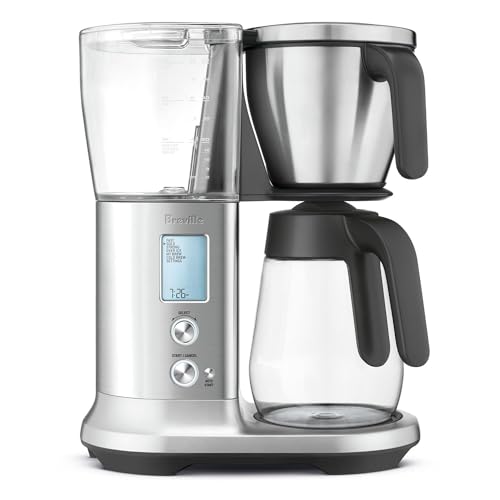
Breville Precision Brewer BDC400, Brushed Stainless Steel — Best for Brew Control
The Precision Brewer is the steel-clad control freak of drip coffee: a brushed stainless housing around the most capable brewing system in the consumer class, with six modes — Gold-standard, Fast, Strong, Iced, Cold Brew and a custom setting — and the temperature precision to make each one mean something. For the buyer whose steel instinct is really an engineering instinct, this is the machine: coffee as a adjustable craft, in a body built like an appliance should be.
Strengths
- The most brewing control in consumer drip: modes for every coffee mood
- Brushed stainless housing built and finished to a premium standard
- Temperature precision that makes light roasts taste as intended
Trade-offs
- This configuration pairs the steel housing with a glass carafe — know which you are buying
- Control means complexity: a household that wants one button should look elsewhere
- Premium tier, priced as Breville’s flagship drip machine is
Key specs: Brushed stainless steel housing; Six brew modes including Gold, Strong, Iced and Cold Brew; Precision temperature control system; Glass carafe in this configuration
Read the configuration honestly before buying: this listing pairs the stainless housing with a glass carafe, and Breville sells thermal-carafe variants in the same line — the buyer who wants the carafe in steel should confirm the exact configuration at the listing, because the housing’s steel is certain and the carafe’s material is the variable. In the cup, the Precision Brewer justifies itself with lighter roasts and variety: it is the only machine here that treats cold brew and gold-standard drip as first-class citizens. Households that brew one pot, one way, forever, are over-buying; households that explore coffee will use every mode it has.
Best for: Coffee explorers wanting maximum control in a stainless body / Not suited for: One-button households, or buyers who need the carafe itself in steel — Check on Amazon

Bonavita 8-Cup Coffee Maker BV1901TS — Best Certified Brewer
Bonavita built its reputation on a single promise — café-standard brewing, certified — and the BV1901TS delivers it in this guide’s preferred materials: an SCA Certified brewer feeding a stainless steel double-wall thermal carafe. The certification is not a badge for the box; it means the machine’s temperature and extraction were independently measured against the specialty standard, which is why Bonavita machines appear in so many cafés’ training rooms and serious home kitchens.
Strengths
- SCA certification: independently verified brew temperature and extraction
- Stainless double-wall carafe — the steel serving this guide prizes
- One-touch simplicity: certification without complexity
Trade-offs
- Eight cups is a mid-size ceiling for large households
- Design is functional rather than decorative
- Fewer modes than the Breville — it perfects one brew instead of offering six
Key specs: Capacity: 8 cups; Stainless steel double-wall thermal carafe; SCA Certified brewer; One-touch operation with auto pause
The philosophy contrast with the Breville above is instructive. Where Breville offers six ways to brew, Bonavita offers one, perfected, at one touch — plus the practical grace of auto pause. Buyers who know their coffee and want it right without a settings menu will find this the most satisfying machine here; buyers who want to experiment should take the Breville and enjoy the laboratory. The eight-cup size suits most households honestly, and the steel carafe means the pot serves at the table, hot, for the whole morning. As a balance of certification, steel and simplicity, it is the connoisseur’s default in this category.
Best for: Coffee purists wanting certified brewing and a steel carafe, simply / Not suited for: Mode explorers, or households needing more than eight cups — Check on Amazon

Cuisinart 5-Cup Coffee Maker With Stainless Steel Carafe DCC-5570 — Best Compact Steel Carafe
The DCC-5570 brings this guide’s central material to the compact class: a five-cup Cuisinart whose carafe is stainless steel, ending the small-kitchen ritual of cracked glass pots and dribbled replacements. For one or two drinkers, the size is freshness itself — a pot brewed and finished while it is at its best — and the steel carafe can travel from machine to table to desk without the fragility tax glass charges in busy spaces.
Strengths
- A real stainless carafe at a compact size and accessible tier
- Unbreakable carafe suits small, busy kitchens and offices
- Five-cup size brews fresh for one or two drinkers
Trade-offs
- Five cups is the ceiling — no guest capacity
- Stainless carafe here is serving steel, not a large thermal system
- Compact machines brew small: heavy drinkers will brew twice
Key specs: Capacity: 5 cups; Stainless steel carafe; Compact countertop format; Cuisinart DCC line
Cuisinart’s DCC line is one of drip’s long-running families, which means the ownership basics — behaviour, parts, expectations — are as known as quantities get. The compromises are scale, purely: guests outrun five cups, and a household of heavy drinkers will brew twice where a ten-cup machine brews once. Neither matters to the buyer this machine is for. If your steel instinct is really a durability instinct and your household is small, this is the most direct satisfaction of it on the list — steel where coffee lives, at a size and tier that ask nothing extra of you.
Best for: Small households wanting an unbreakable steel carafe / Not suited for: Families and hosts who need ten cups or more — Check on Amazon

Technivorm Moccamaster KBGV Select, 10-Cup — Best Built for Decades
The Moccamaster is the machine people cite when they say they do not make things like they used to — hand-built in the Netherlands, metal-bodied, driven by a copper heating element that holds brewing temperature with a stability plastic machines chase and miss. It has been the connoisseur’s drip answer for decades, sold in polished silver here, and its presence on a steel-focused list is about construction philosophy: an appliance assembled from durable materials by a maker who sells every part of it, forever.
Strengths
- Legendary build: machines measured in decades, with spare parts to match
- Copper element holds brew temperature with rare stability
- Every part replaceable — the anti-disposable coffee maker
Trade-offs
- Premium pricing at the top of the consumer class
- This configuration uses a glass carafe — thermal variants exist in the line
- Manual touches (the select switch, the basket) ask a little involvement
Key specs: Capacity: 10 cups (40 oz / 1.25 L); Hand-built in the Netherlands; Copper heating element; Polished silver finish, metal housing construction
Two honest notes. This configuration brews into glass, with the line’s thermal-carafe variants available for buyers who want the carafe in steel too — check the listing configuration as with the Breville. And the Moccamaster asks a little of its owner: a brew-stop basket and a select switch reward a drinker who participates rather than merely presses. In exchange it offers the longest service life in consumer coffee and a cup that specialty shops use as a reference. If your budget reaches it and your instinct is permanence, this is less a purchase than an inheritance decision, and it should be made like one.
Best for: Permanence-first buyers wanting the longest-lived brewer in the class / Not suited for: Budget tiers, or buyers needing a fully automatic one-touch morning — Check on Amazon

Cuisinart 10-Cup Thermal Classic Coffeemaker DCC-1170 — Best Programmable Thermal
The DCC-1170 is the programmable thermal formula in Cuisinart’s Classic line: set it the night before, wake to ten cups held in a thermal carafe rather than cooking on a plate. That combination — scheduling plus insulation — is the one that changes daily coffee life most, because it removes both of drip’s classic compromises at once: no rushing to brew, and no stale pot when the morning runs long. For families, it is the steel-adjacent workhorse of this list.
Strengths
- Thermal carafe holding heat without a plate, at a mid tier
- Full programming: wake to a pot that has not been cooking
- Ten-cup family capacity in the Classic line’s proven design
Trade-offs
- Thermal carafe material varies by configuration — confirm at the listing
- Mid-tier finish against the premium steel housings above
- Thermal carafes need preheating for their best hold
Key specs: Capacity: 10 cups; Thermal carafe; Programmable controls; Cuisinart Classic line
A configuration note in this guide’s spirit of precision: thermal carafes in this class pair insulated construction with the line’s standard fittings, and buyers for whom an all-steel carafe body is the specific requirement should confirm the exact build at the listing before ordering. What is certain is the system benefit — coffee held by insulation, programmable in advance, at a tier below the premium machines above. Preheat the carafe with hot water on slow mornings and its hold improves further. For the household that wants the thermal life without the flagship spend, this is the sensible centre of the category.
Best for: Families wanting programmable brewing into a thermal carafe / Not suited for: Buyers who require verified all-steel carafe construction above all — Check on Amazon
Comparison Table
| Pick | Badge | Key spec | Best for |
|---|---|---|---|
| BUNN CSB3T Speed Brew Platinum Thermal Coffee Maker, 10-Cup | Best Overall | Capacity: 10 cups | Daily-brewing households wanting steel, speed and a thermal carafe |
| Breville Precision Brewer BDC400, Brushed Stainless Steel | Best for Brew Control | Brushed stainless steel housing | Coffee explorers wanting maximum control in a stainless body |
| Bonavita 8-Cup Coffee Maker BV1901TS | Best Certified Brewer | Capacity: 8 cups | Coffee purists wanting certified brewing and a steel carafe, simply |
| Cuisinart 5-Cup Coffee Maker With Stainless Steel Carafe DCC-5570 | Best Compact Steel Carafe | Capacity: 5 cups | Small households wanting an unbreakable steel carafe |
| Technivorm Moccamaster KBGV Select, 10-Cup | Best Built for Decades | Capacity: 10 cups (40 oz / 1.25 L) | Permanence-first buyers wanting the longest-lived brewer in the class |
| Cuisinart 10-Cup Thermal Classic Coffeemaker DCC-1170 | Best Programmable Thermal | Capacity: 10 cups | Families wanting programmable brewing into a thermal carafe |
What ‘All Stainless Steel’ Really Means in a Coffee Maker
Start with the water path, because that is where material claims matter. In nearly every consumer drip machine, some plastic exists in the reservoir, lid or internal lines — the honest question is how much of the coffee’s journey is steel. The hierarchy that matters: a stainless carafe, because coffee rests there longest; a steel filter basket and showerhead, because hot water passes there under pressure of heat; and a steel housing, because that is what survives the years visibly. The picks here are ordered by how far down that hierarchy their steel honestly reaches.
Thermal carafes deserve their reputation as the category’s centre of gravity. A vacuum-insulated stainless carafe does two things no other component can: it removes glass breakage from your future, and it removes the warming plate from your coffee’s life. Plate-held coffee is a countdown; insulated coffee is a plateau. If you take one idea from this guide, take that one — in steel coffee makers, the carafe is the feature, and everything else is supporting cast.
Finally, calibrate the premium. Steel construction costs more because metal costs more — in materials, in forming, in weight shipped. What the premium buys is time: machines in this guide are bought in decades rather than warranty periods, with parts ecosystems to match. The buyer who replaces a plastic machine every few years is not saving the difference; they are renting coffee equipment at a worse rate.
Stainless Thermal Carafe vs Glass and Plate: The Taste Argument
The case is chemical, not aesthetic. Brewed coffee held on a warming plate continues to change: volatile aromatics leave, bitter compounds concentrate, and the pot’s flavour slides from bright to cooked on a curve every drinker recognises by the second hour. A stainless thermal carafe simply slows temperature loss without adding energy, so the coffee’s chemistry stays where the brewer left it. Hour-two coffee from a thermal carafe tastes like hour-one coffee, slightly cooler — and slightly cooler is a preference, while cooked is a flaw.
There are two honest caveats. A thermal carafe must be preheated for its best performance, because cold steel drinks the first heat — a hot-water rinse while the machine brews solves it entirely. And thermal carafes hide their contents, so the household that judges the pot by looking will pour to check. Neither caveat survives a week of habit. What survives is the morning the pot waits through a school run, a meeting and a second breakfast, and pours like it was brewed for each one.
Caring for Stainless Coffee Equipment So It Outlives Everything Else
Steel’s longevity is real but not magic, and its enemies are neglect in two specific forms. The first is coffee oil film, which coats carafes and baskets and stales invisibly — wash carafes with hot water and detergent after use, and soak periodically with a coffee-equipment cleaner, because rinsing alone leaves the film that flavours tomorrow’s pot. The second is scale, which attacks the brewer’s heater regardless of housing material: descale on the maker’s schedule, sooner in hard water, and a steel machine’s decades stay on the table.
For the exterior, steel rewards gentleness: soft cloths, no abrasive pads on brushed or polished finishes, and a wipe of fingerprints as part of the morning reset rather than a weekend campaign. Gaskets and seals — the rubber parts even steel machines contain — should be inspected yearly and replaced at the first hardening; they are inexpensive and they are the difference between a machine that is old and a machine that is finished. Treat a steel brewer this way and the question stops being how long it lasts, and becomes who gets it next.
How to Brew and Serve From a Stainless Thermal Carafe System
Preheat the carafe while the machine warms: fill it with hot tap water, let it stand during setup, and empty it just before brewing begins. This single habit is worth more hold time than any specification difference between carafes. Dose the basket as you would for glass — steel changes holding, not extraction — and brew the full pot you intend to serve, because a thermal carafe rewards a full fill with its best temperature curve.
Serve directly from the carafe at the table; that mobility is the format’s pleasure. Pour with the lid in its serving position rather than removed, since an open carafe sheds heat with every cup. If the pot must wait between rounds, return it to a closed, upright rest — not to a warming plate, which a thermal carafe should never sit on and does not need. Coffee poured in the third hour should be checked with a sip before serving guests, not because it will be cooked — it will not — but because temperature preference is personal and a quick top-up brew is a kindness.
At the day’s end, wash the carafe properly rather than rinsing it: hot water, detergent, a bottle brush to the shoulders where oil film collects, and a periodic soak with coffee cleaner. Dry it with the lid off so the interior stays neutral. Descale the brewer on schedule and wipe the housing down while it is warm. A steel system maintained this way does not merely last — it stays indistinguishable from new, which is the entire reason you bought it.
Reading a Steel Specification Like an Engineer
When a listing says stainless, ask three questions in order. Which grade? Kitchen-standard 304 is the food-contact norm for carafes and baskets; unlabelled ‘stainless’ on a value product deserves a second look at the listing’s details. Which parts? A steel carafe with a plastic brew basket is a different purchase from steel in both, and this guide’s reviews state the configuration of every pick precisely so the comparison is honest. And is the steel structural or cosmetic — a housing formed from metal, or a foil accent on a plastic body? Weight is the tell that marketing cannot fake: steel machines are heavy, and a suspiciously light ‘stainless’ brewer is telling you its composition in the one language that never lies.
Finishes matter to ownership rather than to coffee. Brushed steel hides fingerprints and micro-scratches and suits busy family kitchens; polished steel shows everything and rewards households that wipe as they go; black-coated steel splits the difference and shows scale dust instead. None of these change the brew by a degree. Choose the finish your cleaning personality will still like in year three, because the machine will be there — that durability is the premise of the whole category, and it applies to your patience as well as to the metal.
Steel in Context: What the Premium Actually Replaces
It clarifies the category to name what a steel machine is not buying. It is not buying better coffee by default — a well-made mid-tier machine with a good showerhead can match a steel machine’s cup on day one, and this guide’s own affordable lists exist because that is true. The premium buys the tenth year: the carafe unbroken, the housing unyellowed, the basket unstained, the parts still listed on the maker’s site. Priced across a decade of daily pots, the steel machines here are frequently the cheapest coffee a household ever makes; priced across a single year, they look indulgent. Both statements are honest, and your horizon decides which one governs.
The premium also buys out of two specific failure economies. Glass carafes break on a schedule set by your sink, and each break is a small crisis of compatibility and cost. Plastic brew paths age visibly and hold flavours in micro-scratches that no wash fully clears, which is why old plastic machines make coffee that tastes faintly of their own history. Steel declines both economies. A buyer who has lived through either will read this category not as luxury but as the exit door — and that reader is exactly who these six machines were chosen for.
The Steel Kitchen: Pairing a Metal Brewer With How You Actually Cook
A stainless brewer lands best in a kitchen that already treats equipment as permanent: cast iron that gets seasoned rather than replaced, knives that get sharpened, pans that predate the current car. In that kitchen, the steel machine’s care rhythm — wash the carafe properly, descale on schedule, wipe the housing as part of the reset — is not a burden but the house style, and the machine will repay it by ageing at the pace of the pans beside it, which is to say barely at all.
It is also worth planning the physical home of a steel machine with its weight in mind. These are the heaviest brewers in the cluster, and a thermal carafe full of coffee is a serious object to carry — set the machine where its daily path to the table is short, on a surface that does not mind a metal base, with the descaling routine’s jug-and-sink access thought through once. Do that small planning and the machine’s permanence becomes pure pleasure: the same object, in the same place, making the same excellent coffee, for longer than the kitchen around it stays unchanged.
One habit specific to steel thermal systems deserves its own emphasis: manage the carafe’s temperature like a battery. Preheat it before the brew, keep it closed between pours, and never let it sit empty and open on the counter cooling its lining between rounds — a carafe kept warm stays warm, and a carafe allowed to go cold must be re-preheated to give its best hold. Households that treat the carafe this way routinely report serving-temperature coffee at hours that surprise guests, from equipment whose specification sheet promised less.
When Glass Still Wins: The Honest Counter-Case
A steel guide that cannot state glass’s virtues is a sales pitch, so here they are. Glass shows you the pot — how much remains, how strong it looks, whether the last cup is worth taking — and that visibility is a genuine daily convenience that steel owners replace with the lift-and-judge habit. Glass is also cheaper to replace when (not if) it breaks, provided the model line is mainstream, and a glass carafe on a plate suits the household that drinks a pot within the half hour, for whom insulation is a solution to a problem they do not have. Some superb machines in this very list, in their listed configurations, brew into glass — and they are here because their total build earned it, with the configuration stated plainly.
The decision, then, is not steel good, glass bad; it is a question about your pot’s biography. If your coffee is brewed and drunk in one sitting, glass serves beautifully and the steel premium buys you little but permanence. If your pot waits, travels, serves guests across a morning, or lives above a sink that has claimed a carafe before, steel stops being a material preference and becomes the functional answer. Buy for the biography your pot will actually live, and the material chooses itself — which is, in the end, the only honest way any of the choices in this guide get made.
Steel and Sustainability: The Long-Life Argument
There is an environmental case for this category that has nothing to do with fashion: the greenest coffee maker is the one that is not replaced. Every budget machine retired in year three is a heater, a housing and a carafe in the waste stream, plus the packaging and freight of its successor; a steel machine serviced with gaskets and descaler across fifteen years replaces that whole chain with a handful of small parts. Makers like Technivorm and BUNN, who sell components for models long out of production, are the practical infrastructure of that argument — repairability, not recyclability, is what keeps appliances out of landfill. None of this requires buying the most expensive machine on the page. It requires buying the machine whose parts you can still get in a decade, at whatever tier your budget honestly reaches, and then keeping it — which is, not coincidentally, exactly the advice this guide gives on purely selfish grounds. The planet’s interest and the coffee’s interest, for once, are the same interest.
Common Buying Mistakes
Believing the marketing name without reading the build. ‘Stainless’ in a product name can describe an accent panel. Check which parts are steel — carafe first, basket second, housing third — and buy the build, not the badge.
Skipping the carafe preheat. Cold steel steals the brew’s first heat and shortens the hold by a wide margin. A hot-water preheat during setup is free performance that most owners never claim.
Putting a thermal carafe on a warming plate. It gains nothing and can damage the carafe’s base and seals. Insulation is the heating strategy now — trust it, and keep the plate off.
Rinsing instead of washing the carafe. Oil film builds invisibly and stales every pot while the steel looks clean. Wash with detergent regularly and soak with coffee cleaner periodically.
Letting scale kill a steel machine. The housing may be immortal; the heater is not. Descale on schedule for your water, or the most durable machine on the counter dies the same death as the cheapest.
Assuming steel means maintenance-free. Steel removes breakage and staining from your future, not descaling and washing. The owners who are disappointed by steel machines are almost always the ones who bought them as an excuse to stop caring for equipment.
A Short Word on Warranties, Parts Lists and Reading Them First
Before any steel machine is ordered, spend five minutes on the maker’s parts page — it is the most honest document in the category. A maker who lists carafes, baskets, gaskets and lids for your exact model, at stated prices, is telling you the machine was designed to be kept; a maker whose parts page is a contact form is telling you something else. Check the warranty length against the premium being charged, and note which components it actually covers, because in this category the difference between brands is rarely the first year — it is the seventh. This five-minute check, applied to any model beyond this list as much as to the six on it, will steer a permanence-minded buyer more reliably than any finish, badge or specification table ever printed.
Final Recommendation
For the steel-first household that brews daily, the BUNN CSB3T is the complete answer: stainless thermal carafe, commercial-bred build, and a pot brewed in minutes. The Bonavita BV1901TS is the purist’s alternative — certified brewing into a double-wall steel carafe with one-touch simplicity — while the Breville Precision Brewer serves the explorer who wants every brew mode in a brushed stainless body. At the permanence extreme, the Technivorm Moccamaster remains the buy-it-for-decades reference.
Smaller and thriftier paths are honest ones: the Cuisinart DCC-5570 puts a steel carafe on a compact five-cup machine, and the DCC-1170 pairs programming with a thermal carafe at a mid tier for families. Whichever you choose, read the build before the badge, preheat the carafe, and descale like the machine is an heirloom — in this category, it is meant to be.
Related reading in this cluster: Best 12 Cup Thermal Coffee Makers explores thermal serving in depth, Best Affordable Countertop Coffee Makers covers the value end of the counter, and Best Air Pot Coffee Makers scales steel insulation up to event serving. If plastic-free brewing by hand is the goal, Best Affordable French Press Coffee Makers includes the all-steel presses.
A closing note on buying steel in a market that markets it loosely: verify the configuration at the listing before ordering — carafe material, basket material, the exact model suffix — because this category’s one recurring disappointment is a buyer who purchased a name. The picks above were each matched to a live listing through this site’s product feed, and their reviews state their builds part by part; use that as your template for any model you consider beyond this list. Steel bought knowingly is a decade of mornings; steel bought on a badge is just expensive hope.
Short on time? Start with the three most-chosen picks in this guide — BUNN CSB3T Speed Brew Platinum Thermal Coffee Maker, 10-Cup, Breville Precision Brewer BDC400, Brushed Stainless Steel and Bonavita 8-Cup Coffee Maker BV1901TS — check the current price on Amazon for each, and let the full reviews above settle any remaining doubt.
Frequently Asked Questions
Is any drip coffee maker truly all stainless steel?
Essentially none at consumer tiers: reservoirs, lids and internal plumbing almost always include some plastic. The honest goal is maximum steel where it matters — carafe, basket, housing — which is how this guide selects and describes its picks, part by part.
Why does a stainless thermal carafe keep coffee better?
It adds no heat, so it cannot cook the coffee. Vacuum insulation slows heat loss, holding the pot at serving temperature for hours while its flavour stays where the brewer left it — unlike a warming plate, which keeps coffee hot by slowly ruining it.
Does coffee taste different from a steel carafe?
It tastes like itself for longer. Steel is flavour-neutral and does not hold stains or old oils the way scratched plastic and aged glass seals can. The first cup is identical; the third hour is where steel wins.
Are stainless coffee makers worth the premium?
For daily brewers, the arithmetic favours them: they are bought in decades, with replaceable parts, while budget plastic machines are replaced in years. Occasional brewers get less of that value back — match the machine’s lifespan to your habit’s intensity.
How do I stop my steel carafe staining inside?
Wash it after use rather than rinsing, and soak periodically with a coffee-equipment cleaner or a baking-soda solution, using a bottle brush at the shoulders. Steel releases staining readily when it is not allowed to bake on for weeks.
Glass or stainless carafe — which should I choose?
Stainless thermal for holding, mobility and permanence; glass for visibility and the lowest cost. If your pot is ever carried to a table, held for guests, or at risk from a busy sink, steel is the safer and better-tasting answer.
Will a stainless carafe make my coffee taste metallic?
No — food-grade stainless is flavour-neutral, and competition-level coffee is routinely brewed and served in steel. A metallic note almost always traces to a carafe that needs a proper wash, or to water itself; a clean steel carafe is the most neutral vessel in the kitchen.
Are stainless coffee makers harder to maintain than plastic ones?
Differently, not harder. They ask for real washing instead of rinsing, gentle cloths on the finish, and the same descaling every brewer needs. In exchange they forgive knocks, heat and years that visibly age plastic — most owners find the rhythm lighter within a month.
Can I put a stainless carafe in the dishwasher?
Most stainless carafes tolerate it, but hand-washing is kinder to seals, lids and finishes, and it is the only way to be sure the interior oil film is actually removed. Treat the dishwasher as the occasional exception rather than the routine, and the carafe will look and taste new for years.
Do stainless coffee makers contain any plastic at all?
Almost all do — in reservoirs, lids or internal fittings — which is why this guide describes each pick’s construction part by part instead of repeating the category’s marketing phrase. The realistic goal is steel in the carafe, basket and housing, with plastic reduced to the places it does no harm.


