Disclosure: airfryerkitchensupply.com is reader-supported. When you buy through links on our site, we may earn an affiliate commission at no extra cost to you.
Where to buy
Every pick below was verified against a live Amazon listing feed for this site before it earned a link. We do not print prices — they change too often to stay honest — so use the links to check the current price on Amazon for the model that fits you.
- MuellerLiving French Press Coffee Maker, 34 oz — check the current price on Amazon
- Bodum Brazil French Press, 12 oz — check the current price on Amazon
- Secura French Press Coffee Maker, 34 oz — check the current price on Amazon
- Veken French Press Coffee Maker, 34 oz — check the current price on Amazon
- Bodum Chambord French Press, 12 oz — check the current price on Amazon
- Bodum Bean French Press, 34 oz — check the current price on Amazon
The best affordable french press coffee makers share a beautiful property: the technology is a beaker, a plunger and a mesh screen, so almost all of your money can go into materials rather than electronics — and at the affordable tier, it does. A press is also the most forgiving brewer in coffee: no paper filters to stock, no heater to descale, no pump to fail, and a full-immersion brew that flatters a wide range of beans and grinds. For a household priced out of good electric brewing, a press is not a compromise; it is frequently the best-tasting option on the counter.
What separates a good affordable press from a bad one is not the brewing — immersion is immersion — but the hardware around it. Glass should be thick, heat-resistant borosilicate, seated securely in its frame. The filter screen should be fine stainless mesh, flat and well-edged, because a frayed or wavy screen is what lets sludge into the cup. The plunger rod should run true, the knob and handle should stay cool, and — the ownership question — replacement beakers and screens should exist for the model, because glass eventually meets a sink wrong.
All six picks were verified product feed attached to this site, brand and model matched to live listings. The set spans the honest spectrum of affordable press design: two Bodum classics at the smallest size, a big double-walled stainless Mueller, a Secura insulated steel press, a Veken glass press built to keep plastic away from the coffee, and Bodum’s sustainable Bean line. Every one costs less than the electric machines elsewhere in this cluster, and every one can make a genuinely excellent cup this morning, with no warm-up and no counter space surrendered.
In this guide
Quick Picks
Six picks, six different right answers. Read the badge first, then the full review of the one that sounds like your kitchen.
- MuellerLiving French Press Coffee Maker, 34 oz — Best Overall: Double-wall steel keeps the second cup hot and cannot shatter. — Check on Amazon
- Bodum Brazil French Press, 12 oz — Best Budget: The lowest-cost route into genuine Bodum press quality. — Check on Amazon
- Secura French Press Coffee Maker, 34 oz — Best Insulated Value: Insulated steel body holds serving temperature through a long breakfast. — Check on Amazon
- Veken French Press Coffee Maker, 34 oz — Best Glass Press: Thickened glass and steel frame — the sturdy end of glass presses. — Check on Amazon
- Bodum Chambord French Press, 12 oz — Best Classic Design: The iconic Chambord frame — the design that defined the category. — Check on Amazon
- Bodum Bean French Press, 34 oz — Best Sustainable Pick: Full 34-ounce family size from Bodum’s sustainable line. — Check on Amazon
Key Takeaways
- Size in mugs: 12 oz is one drinker, 34 oz is the family standard.
- Coarse grind, four minutes, slow press, decant everything — the whole technique in one line.
- Buy the press whose beaker and screens you can replace in minutes, not the prettiest unknown.
How These Picks Were Chosen
We shortlisted the French presses that lead the affordable tier on Amazon and verified each feed; unverifiable no-name presses, however pretty, were excluded. In a category this simple, the listing check matters because replacement-part availability matters — a press you cannot re-beaker is a disposable, whatever its price.
Five criteria decided the six. (1) Beaker quality: borosilicate glass thickness or stainless double-wall construction. (2) Filter quality: fine, flat stainless mesh and a plunger that seals evenly. (3) Frame and handle: stability, cool touch, and a spout that pours without dribbling down the glass. (4) Size honesty: presses are measured to the brim, so usable yield is always a little less — we weighed real serving counts. (5) Spares: screens and beakers available for the model line. Taste differences between presses are small; ownership differences are large, and the criteria reflect that.
The exclusion that defines this list is the beautiful unknown: dozens of presses with elegant photography and no verifiable listing, no beaker standard and no screen supply were passed over, because a press is a system of replaceable parts pretending to be a single object. The day its beaker chips, the no-name press becomes landfill while the Bodum gets a new beaker and a second decade. Every pick here was also checked for the unglamorous detail of screen availability, since the screen is the part that wears in normal use. A short list of serviceable presses is worth more than a long list of disposable ones.
The 6 Best affordable french press coffee makers
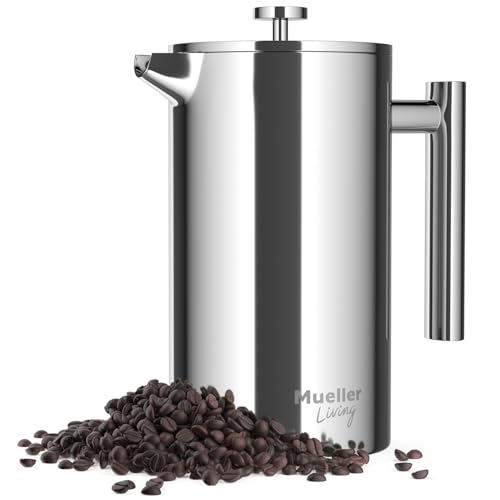
MuellerLiving French Press Coffee Maker, 34 oz — Best Overall
The MuellerLiving 34 oz is the affordable press for people who have already broken a glass one, or intend never to. Its double-wall stainless body does three jobs at once: it insulates, so the brew stays hot through a slow breakfast; it armours, ending the beaker-replacement cycle entirely; and it reads as a permanent kitchen object rather than a fragile one. The 4-filter screen system is the other headline — stacked filtration that presses cleaner than the single-screen standard, cutting the sludge that press sceptics complain about.
Strengths
- Double-wall steel keeps the second cup hot and cannot shatter
- Multi-layer filtration gives an unusually clean cup for a press
- No glass beaker to replace — the durable long-term buy
Trade-offs
- You cannot watch the brew through steel — immersion is by timer, not by eye
- Heavier than a glass press, especially full
- Steel costs more than basic glass models at the same capacity
Key specs: Capacity: 34 oz; Double-wall insulated stainless steel; 4-filter screen system; Rust-free, food-grade steel construction
In use, the discipline is the same as any press — coarse grind, four minutes, press slowly — but the results hold up better across a long morning because the steel holds temperature. The trade-offs are honest ones: you brew by timer rather than by watching the bloom through glass, and the pot is noticeably weighty when full, which smaller hands should test with water before committing. Against the glass classics below, you pay more once to stop paying for beakers forever. For clumsy households, busy households and anyone brewing for a table, that arithmetic usually wins.
Best for: Households wanting one durable press that keeps coffee hot and cannot break / Not suited for: Visual brewers who like watching the coffee bloom through glass — Check on Amazon

Bodum Brazil French Press, 12 oz — Best Budget
The Brazil is Bodum’s entry line and the affordable press in its purest form: a borosilicate beaker, a stainless plunger and screen, and a simple black frame, made in Portugal at a price that undercuts nearly every credible rival. The 12-ounce size is a deliberate virtue for its drinker — one full mug, brewed fresh, with nothing left to cool and stale. As a first press, a desk press, or a travel-home press, it is close to unbeatable value.
Strengths
- The lowest-cost route into genuine Bodum press quality
- Small size brews one mug perfectly — no stale second cup
- Replacement beakers and screens are stocked everywhere
Trade-offs
- Twelve ounces is one mug: no use for couples or guests
- Glass beaker is breakable, as all glass beakers are
- Basic frame offers less grip security than premium lines
Key specs: Capacity: 12 oz; Borosilicate glass beaker; Black frame and handle; Made in Portugal
What the entry price does not buy is armour. The glass is proper borosilicate and tolerates boiling water happily, but a knock against a granite sink ends it, and the replacement beaker — available, inexpensive, everywhere — becomes part of the ownership plan. The frame is functional rather than luxurious, with a simpler handle than the Chambord below. None of that touches the cup: same immersion, same screen design language, same coffee. If your press will live a careful life on a quiet counter, the Brazil gives you the category’s best coffee per unit of money, full stop.
Best for: Solo drinkers and first-time press buyers on the tightest budget / Not suited for: Clumsy kitchens, couples, or anyone brewing for a table — Check on Amazon
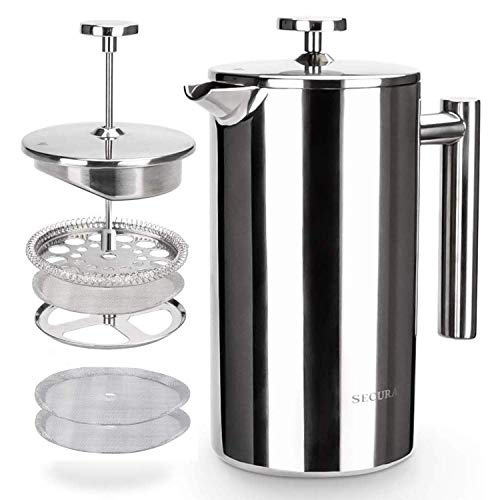
Secura French Press Coffee Maker, 34 oz — Best Insulated Value
Secura’s 34 oz press makes the stainless case at a keener tier than the Mueller, and sweetens it with the detail owners appreciate most in year two: two extra filter screens in the box. Screens are the wear item of press ownership — they fray at the edges over time and let sediment creep in — so a press that ships with its own spares is a press designed by someone who has owned one. The insulated 304-grade steel body keeps a litre of coffee at serving temperature long enough for a household to drink at its own pace.
Strengths
- Insulated steel body holds serving temperature through a long breakfast
- Two spare screens in the box — years of filtration included
- 304-grade steel is the food-safe standard for kitchenware
Trade-offs
- Steel body hides the brew — timer discipline required
- Spare screens must be stored somewhere you will remember
- Heavier than glass equivalents when full
Key specs: Capacity: 34 oz (1 litre); 304-grade stainless steel, insulated; Two extra screens included; Silver finish
Choosing between the Secura and the MuellerLiving is the stainless decision in miniature. The Mueller’s multi-layer filtration presses a cleaner cup out of the box; the Secura counters with included spares and typically keener pricing, and its single-screen clarity is one spare-screen swap away at all times. Both free you from glass anxiety; both ask you to brew by timer. Households that entertain will like the litre capacity either way. If your priority is the cleanest possible cup today, take the Mueller; if it is the lowest lifetime cost in steel, take the Secura and its spare screens.
Best for: Steel-press buyers optimising lifetime value over showroom features / Not suited for: Drinkers who judge the brew by eye through glass — Check on Amazon
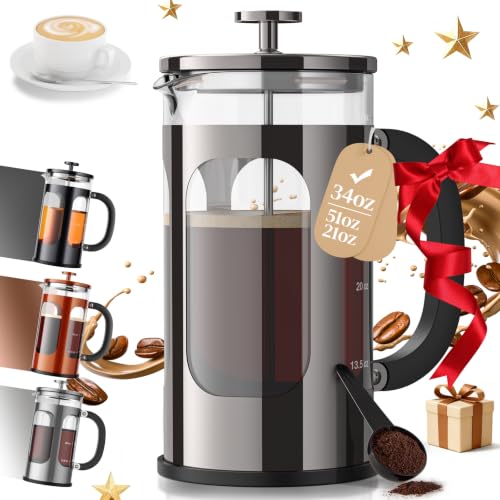
Veken French Press Coffee Maker, 34 oz — Best Glass Press
The Veken is the glass answer to the steel presses above: a full-litre borosilicate beaker, thickened beyond the category’s flimsy norm and cradled in a stainless frame, designed so that no plastic touches the coffee at any point in the brew. For buyers who want to watch the bloom and the press — half the pleasure of the method — without accepting the Brazil’s fragility or small size, this is the glass press to buy. It also moonlights as a cold brew pot and a loose-leaf tea press, which on a small counter is real versatility.
Strengths
- Thickened glass and steel frame — the sturdy end of glass presses
- No-plastic-contact brew path for buyers who care about materials
- Full litre size serves a table; doubles as a cold brew pot
Trade-offs
- Glass remains glass: one hard knock can end it
- Larger frame needs a little more storage room
- Multi-use design means a plunger sized for versatility, not specialisation
Key specs: Capacity: 34 oz (1 litre); Thickened borosilicate glass, stainless frame; Designed so no plastic touches the coffee; Also suitable for cold brew and tea
Glass ownership rules still apply, thickened or not: thermal shock and granite sinks are the enemies, and the beaker deserves a soft landing in the wash. In exchange, you get the visual ritual steel cannot offer and a brew path that material-purists will approve of. The litre capacity changes the social math too — this press serves three or four mugs, where the 12-ounce Bodums serve one. If your press is a table object as much as a brewer, the Veken is the glass pick; if it is a battleground appliance in a busy family kitchen, steel remains the wiser armour.
Best for: Glass lovers brewing for a table who want a plastic-free brew path / Not suited for: High-traffic family kitchens where breakage is a matter of time — Check on Amazon

Bodum Chambord French Press, 12 oz — Best Classic Design
The Chambord is the French press as design icon: the polished stainless frame, the domed lid, the proportions that have sat on café tables and in museum shops for decades. Under the styling it is the same honest Bodum brewworks as the Brazil — borosilicate beaker, stainless screen — elevated by a frame that holds the glass more securely and looks like it means it. In 12-ounce form it is a personal luxury: one mug’s worth of coffee from the most beautiful affordable press made.
Strengths
- The iconic Chambord frame — the design that defined the category
- Polished stainless frame grips the beaker more securely than entry lines
- Same deep Bodum spares ecosystem as the Brazil
Trade-offs
- You pay for the classic frame: functionally close to the cheaper Brazil
- Twelve ounces serves one drinker only
- Polished steel shows fingerprints — a cloth lives nearby
Key specs: Capacity: 12 oz; Borosilicate glass beaker; Polished stainless steel frame; Made in Portugal
The honest question is whether the frame premium is worth it over the Brazil, and the answer is genuinely personal. Functionally the cups are near-identical; the Chambord’s case is security of grip, permanence of looks, and the daily pleasure of a well-made object — which, for an appliance used every morning, is not a trivial thing. Its spares ecosystem is Bodum-deep, so the beaker question is an errand, not a crisis. Buy the Brazil to save money without losing coffee; buy the Chambord if the press will live on an open counter and be looked at as much as used. Both decisions are defensible, which is why both are on this list.
Best for: Design-led solo drinkers wanting the classic press in its finest affordable form / Not suited for: Pure value hunters — the Brazil brews the same cup for less — Check on Amazon
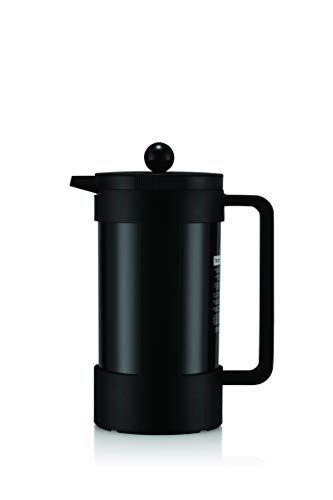
Bodum Bean French Press, 34 oz — Best Sustainable Pick
The Bean is Bodum’s sustainable-line press in the full 34-ounce family size: a big borosilicate beaker and the line’s lighter-footprint materials and styling, for households that brew a table’s worth of coffee and think about what their kitchen objects are made of. It rounds out this list deliberately — the affordable press buyer who wants capacity and a sustainability story does not have to leave the Bodum ecosystem or the budget tier to get both.
Strengths
- Full 34-ounce family size from Bodum’s sustainable line
- Materials and design chosen for a lighter footprint
- Bodum screen and beaker spares apply as usual
Trade-offs
- Glass beaker care rules apply in full
- Sustainable-line styling is plainer than the Chambord’s polish
- Large beaker is the most fragile format here — handle with both hands full
Key specs: Capacity: 34 oz; Bodum sustainable line design; Borosilicate glass beaker; Black finish
Size is its own handling discipline: a litre of near-boiling coffee in glass deserves two hands, a steady pour, and a sink routine that does not involve stacking it under pans. Do that and the Bean serves the same long, forgiving life as every Bodum here, with screens and beakers replaceable from the standard ecosystem. Against the Veken, it trades the no-plastic-contact framing for the sustainability line’s materials story; against the steel presses, it keeps the glass ritual and accepts the glass risk. It is the family glass press for buyers whose values include the object’s footprint as well as its coffee.
Best for: Families wanting a full-size glass press from a sustainability-led line / Not suited for: Households that know a big glass beaker will not survive their sink — Check on Amazon
Comparison Table
| Pick | Badge | Key spec | Best for |
|---|---|---|---|
| MuellerLiving French Press Coffee Maker, 34 oz | Best Overall | Capacity: 34 oz | Households wanting one durable press that keeps coffee hot and cannot break |
| Bodum Brazil French Press, 12 oz | Best Budget | Capacity: 12 oz | Solo drinkers and first-time press buyers on the tightest budget |
| Secura French Press Coffee Maker, 34 oz | Best Insulated Value | Capacity: 34 oz (1 litre) | Steel-press buyers optimising lifetime value over showroom features |
| Veken French Press Coffee Maker, 34 oz | Best Glass Press | Capacity: 34 oz (1 litre) | Glass lovers brewing for a table who want a plastic-free brew path |
| Bodum Chambord French Press, 12 oz | Best Classic Design | Capacity: 12 oz | Design-led solo drinkers wanting the classic press in its finest affordable form |
| Bodum Bean French Press, 34 oz | Best Sustainable Pick | Capacity: 34 oz | Families wanting a full-size glass press from a sustainability-led line |
How to Choose an Affordable French Press: Size, Glass and Screens
Size first, and size honestly: a press’s stated capacity is filled to the brim, so usable yield is roughly four ounces less once grounds and headroom are accounted for. Twelve ounces is one mug. Thirty-four ounces is three to four mugs and the family standard. The common mistake is buying the big press ‘for guests’ and brewing it half-full daily — immersion brewing tolerates that better than drip does, but the right-sized press still makes the more consistent cup and the easier pour.
Glass versus steel is the second decision, and it is about your kitchen, not your palate — the brew is identical. Glass gives you the visual ritual and lower prices, at the cost of breakage risk and faster cooling. Double-wall steel gives you insulation and near-immortality, at the cost of brewing by timer and paying more once. There is no wrong answer, only a dishonest self-assessment: if your sink has killed a beaker before, believe it.
Finally, inspect the screen and the spares. The screen should be fine stainless mesh, flat, with edges that will not fray into the cup, and the model should have replacement screens and beakers findable in seconds — true of every pick here, and the quiet reason no-name presses were excluded. A press is a decade-long object whose wear parts cost very little; buy the one whose wear parts you can actually get.
Getting a Clean Cup From a Press: Grind, Time and the Skim Trick
Press coffee’s muddy reputation comes from technique, not the method. Start with coarse, even grounds — fine grind slips through the screen and over-extracts into bitterness. Use water just off the boil, pour it over the grounds in a circle, and let the press steep a full four minutes before touching the plunger. Most thin or sour press cups are simply under-steeped or under-dosed; immersion needs its time and a generous ratio to show what it can do.
For a cleaner cup, borrow the cafés’ trick: after the steep, skim the floating crust and any foam off the top before pressing, then press slowly — a hard, fast plunge churns sediment back into the brew. Stop the plunger just above the grounds bed rather than compacting it, and pour all the coffee out into cups or a serving vessel at once. Coffee left sitting on its grounds keeps extracting and turns harsh, which is the second-most-common press complaint and the easiest to fix: decant, always.
And if your press still tastes muddy, check the screen before blaming the beans. A screen that has frayed, warped or lost its edge fit lets grounds bypass it entirely. Replacement screens cost very little — the Secura even includes spares — and a fresh screen restores a press to day-one clarity in about a minute.
French Press vs Drip at the Affordable Tier: An Honest Comparison
At equal money, a press usually makes the better-tasting cup, and it is worth understanding why. Immersion gives every ground equal time in hot water, with no showerhead to fail and no paper filter stripping the oils that carry body and aroma. Drip’s counter-arguments are convenience and scale: a programmable machine brews while you sleep and serves a family from a carafe, while a press is a manual ritual that serves its beaker and stops.
The running costs are not close. A press consumes coffee and nothing else — no filters, no pods, no descaler schedule, no heater to die. Its failure modes are a screen that frays in years and, for glass, a beaker that breaks by accident rather than age. Households that enjoy the four-minute ritual get café-competitive coffee for the price of the press and the beans; households that need coffee waiting for them should buy the drip machine and feel no guilt. The two methods answer different mornings, and this cluster covers both honestly.
How to Brew French Press Coffee Properly, Step by Step
Boil fresh water and let it sit for about thirty seconds off the boil — water at a rolling boil scorches grounds and sharpens bitterness. While it rests, add coarse-ground coffee to the empty beaker: a generous tablespoon per four ounces of water is the reliable starting ratio, adjusted over a few brews to your taste. Warm the beaker with a splash of the hot water first in cold kitchens or with glass presses, so the brew temperature does not crash on contact.
Pour the water over the grounds in a slow circle, making sure everything is wetted, and start a four-minute timer. At about a minute in, break the crust that forms on top with a spoon and give one gentle stir. When the timer ends, skim off the floating foam and stray grounds if you want the cleanest cup, then set the plunger and press slowly and steadily, stopping just above the bed of grounds — pressing into the bed squeezes bitterness out of it.
Pour every cup immediately. Coffee left in the press continues to extract and will punish a slow breakfast; if you brewed more than the moment needs, decant the rest into a warmed flask or jug. Rinse the beaker and screen while they are warm, taking the plunger apart properly once a week to wash the grounds that hide between screen and cross-plate — that hidden residue is the source of the stale taste people blame on presses. Dry, reassemble loosely, and the press is ready for tomorrow.
Ratios and Recipes: A Starting Grid for Press Coffee
Every press household should own a starting grid and then personalise it. The reliable baseline is one part coffee to twelve parts water by weight — in kitchen terms, roughly two level tablespoons of coarse grounds per six ounces of water — steeped four minutes in water just off the boil. From there, adjust one variable per brew: a stronger cup comes from more coffee first, not from a longer steep, which mostly adds bitterness; a smoother cup comes from a slightly coarser grind or water a touch cooler, not from less coffee, which mostly adds sourness.
Two variations reward learning early. The long-steep method — eight to ten minutes, with the crust broken and the foam skimmed, then a very gentle press that barely touches the bed — produces an exceptionally clean, sweet cup from the same equipment, and it is the technique cafés use when they serve press coffee proudly. The half-caf morning blend is the other: mixing regular and decaf beans in the basket lets a household tune its caffeine without owning two brewers. A press is a recipe instrument as much as a machine, and these are the first two recipes worth writing on the cupboard door.
Beyond Coffee: Cold Brew, Tea and the Press as a Kitchen Tool
A French press is quietly one of the most versatile vessels in the kitchen, and affordable ownership gets more valuable the more of its lives you use. Cold brew is the famous second life: coarse grounds, cold water, a long steep in the fridge, one press — and the result is a smooth concentrate that dilutes over ice for days of drinks from one batch. The big steel and glass presses on this list, the Mueller, Secura and Veken especially, are sized exactly for a batch worth making.
Loose-leaf tea is the third life, with one etiquette rule: dedicate the screen or wash it scrupulously between careers, because mesh holds flavours faithfully in both directions. The press also froths warm milk respectably with a few pumps of the plunger, strains small batches of infused oils and syrups, and rinses grains in a pinch. None of this should decide your purchase — the coffee comes first — but a tool that earns its shelf five ways is a tool that stays on the counter, and staying on the counter is how presses get used daily instead of occasionally.
Glass Beaker Care, Replacement and the Economics of Spares
Since glass breakage is the press category’s one predictable expense, it deserves plain economics. A replacement beaker for a major line like Bodum costs a fraction of a new press, swaps in under a minute, and is stocked by the maker and by general retailers alike — which converts the worst day in a glass press’s life into a minor errand. The buying implication is direct: the beaker’s availability is a feature, and it is a large part of why this list is built from established lines rather than beautiful no-name presses whose glass fits nothing else on earth.
Prevention is cheaper still. Thermal shock is the silent killer — never pour boiling water into a beaker cold from a winter windowsill without a warming rinse first, and never set a hot beaker on a cold stone counter. Wash the beaker on its own rather than in a crowded sink of pans, and store the press assembled loosely so the beaker is cradled by its frame. Households that know they will not live this carefully are not careless people; they are steel-press people, and this list serves them first and second for exactly that reason.
Calibrate your press once, properly, and every future brew improves: fill the beaker with water to your usual level, pour it into a measuring jug, and note the true ounces — manufacturers’ capacities are brim measurements, and your ratio math deserves the real number. Mark the level on a piece of tape inside a cupboard door with your dose beside it. That two-minute calibration ends the era of guessing, and it is the difference between a press that makes good coffee when you concentrate and one that makes it when you are half asleep.
Diagnosing Your Cup: A Troubleshooting Walk-Through
When a press cup disappoints, diagnose it in the order the variables matter. Sour and thin almost always means under-extraction: check the dose first — weigh or measure honestly, because most households under-dose by habit — then the steep time, then the grind, which may have drifted too coarse. Bitter and harsh means over-extraction or abuse after brewing: water poured at a violent boil onto fine grounds, a steep that ran long, or coffee left sitting on its bed after pressing. Each cause has a distinct fix, and changing one variable per brew is what turns a month of random pots into a week of learning.
Muddy and gritty is a mechanical diagnosis, not a recipe one: the grind is too fine for the screen, the plunge was violent, or the screen itself is worn at the edges. Hold a suspect screen up to the light — frayed or wavy edges announce themselves — and replace it before touching the recipe; screens are the cheapest part in the system and the most commonly blamed-by-omission. Weak flavour with correct dose and time usually indicts the coffee itself: stale beans defeat immersion as surely as they defeat espresso. The press is the most honest brewer in the kitchen, which means it reports the truth about your beans, your water and your habits without flattery — and that honesty, used well, is a free education in coffee.
The Press at Work: Desks, Offices and the Second Station
The French press has a second career as the office brewer, and it suits the role for reasons no machine matches: it needs only a kettle, which offices already have; it makes no noise, claims no counter power outlet, and locks in a drawer when the desk must be a desk. For the worker whose building coffee is a daily disappointment, a 12-ounce Brazil or Chambord at the desk converts the worst cup of the day into the best, for the price of a week’s café visits, forever. The etiquette is simple — rinse in the kitchen sink rather than the water cooler, keep grounds out of the office plumbing by knocking them into the bin first, and decant your brew fully so the afternoon does not steep in it. Remote workers should note the same logic applies to the home desk: a small press at the workstation ends the kitchen trips that fragment a work morning, and its four-minute steep is a natural, screen-free pause that a pod machine never gives you.
Common Buying Mistakes
Using fine-ground coffee. Fine grounds pass the screen, sludge the cup and over-extract into bitterness. Press coffee wants a coarse, even grind — it is the single biggest quality lever in the method.
Pressing hard and fast. A violent plunge churns sediment through the whole brew. Press slowly, stop above the grounds bed, and let the screen do its work gently.
Leaving coffee sitting in the press. Brewed coffee on top of its grounds keeps extracting and turns harsh within minutes. Decant everything the moment you press — into cups or a flask, never left in the beaker.
Skimping on the dose. Immersion is forgiving, not magical. Under-dosed press coffee is thin and sour no matter the steep time. Weigh or measure generously and adjust across brews, not within one.
Never deep-cleaning the plunger. Grounds hide between the screen and cross-plate and stale every subsequent brew. Take the plunger apart weekly, wash all three pieces, and check the screen edges while you are there.
Knocking the beaker against the tap to empty grounds. The classic beaker-killer. Loosen grounds with a spoon and a splash of water instead, and tip them into the bin or compost — the beaker survives, and so does the sink’s plumbing.
Final Recommendation
If this list has a default answer, it is the MuellerLiving 34 oz: steel armour, real insulation and filtration that produces the cleanest press cup at the tier — the press you buy once. The Secura 34 oz runs it close on lifetime value, with spare screens included and a keener tier, and steel-press buyers will be happy with either. Glass loyalists should choose the Veken for a table-size, plastic-free brew path, and solo drinkers should take one of the little Bodums — the Brazil for pure value, the Chambord for the classic object.
The Bodum Bean completes the set for families who want full capacity from the sustainable line. What unites all six is that none of them asks for filters, pods, descaler or electricity — in a category this simple, the honest buying decision is materials and size, and every pick here gets both right for somebody.
Keep reading in the cluster: Best Affordable Drip Coffee Makers covers the electric alternative at the same spend, Best Affordable Cuban Coffee Makers offers the stovetop route to strong small coffee, and Best Affordable Countertop Coffee Makers weighs all of it against counter space. If your press technique is the question rather than the press, Best 1 Cup Coffee Makers covers the solo-cup problem from the machine side.
Consider, finally, what the press asks of you as an owner: a kettle, a timer, four patient minutes, and a weekly minute with the plunger taken apart. Households that enjoy that small ceremony will find the affordable press the best-tasting purchase in this entire cluster. Households that do not should buy the programmable drip machine without a backward glance — the best brewer is the one whose ritual fits the morning it must survive, and this guide’s only loyalty is to that fit.
Short on time? Start with the three most-chosen picks in this guide — MuellerLiving French Press Coffee Maker, 34 oz, Bodum Brazil French Press, 12 oz and Secura French Press Coffee Maker, 34 oz — check the current price on Amazon for each, and let the full reviews above settle any remaining doubt.
Related guides
Frequently Asked Questions
What size French press should I buy?
Twelve ounces brews one mug; thirty-four ounces brews three to four. Remember that stated capacity is to the brim, so real yield is a little less. Buy for your daily count, not for guests — a right-sized press used daily beats a party press used badly.
Is French press coffee stronger than drip?
It tastes fuller rather than simply stronger: immersion extracts evenly and the metal screen lets through the oils that paper filters remove, giving more body. Caffeine depends on dose and time in both methods — a generously dosed, fully steeped press will certainly feel robust.
Glass or stainless steel press — which is better?
The coffee is the same; the ownership is not. Glass is cheaper and lets you watch the brew, but breaks and cools faster. Double-wall steel costs more, insulates, and is effectively unbreakable. Choose by your sink’s history and whether you drink the pot slowly.
Why is my press coffee muddy?
Usually fine grind, a violent plunge, or a worn screen. Use coarse grounds, press slowly and stop above the grounds bed, skim the crust before pressing, and replace a frayed screen — clarity returns immediately.
How long should French press coffee steep?
Four minutes is the reliable standard for a full-size press with coarse grounds. Shorter steeps taste thin and sour; much longer steeps without decanting turn bitter. Decant the moment you press, whatever your steep time.
Can I make cold brew or tea in a French press?
Yes to both. For cold brew, use coarse grounds and cold water, steep many hours, and press as usual. For loose-leaf tea, the screen strains leaves neatly — just dedicate the screen or wash it thoroughly, since tea and coffee flavours linger in mesh.
Can I use regular pre-ground coffee in a French press?
You can, and most households start there — expect a little more sediment and a slightly heavier cup, since drip grind is finer than ideal. Compensate by steeping the full four minutes, skimming before you press, and letting the poured cup settle for thirty seconds before the first sip.
How do I keep the second cup hot in a glass press?
Decant it the moment you press — into a pre-warmed mug or a small insulated flask — rather than leaving it in the glass, where it both cools and over-extracts. The steel double-wall presses on this list exist precisely for households whose second cup is a ritual rather than a rush.
Should I bloom the coffee in a French press?
A short bloom — wetting the grounds and waiting thirty seconds before filling — releases gas from fresh beans and makes the pour and the steep more even. It is optional with ordinary beans and genuinely helpful with very fresh ones; the four-minute clock traditionally starts at the full pour either way.
Can I keep coffee warm in the press with a cozy or towel?
You can slow the cooling slightly, but the coffee is still sitting on its grounds and over-extracting while it waits. Decanting into a pre-warmed flask is strictly better: the temperature holds longer and the flavour stops changing. The steel insulated presses exist for households who want that hold built in.


