Disclosure: airfryerkitchensupply.com is reader-supported. When you buy through links on our site, we may earn an affiliate commission at no extra cost to you.
Where to buy
Every pick in this guide to the best bargain for countertop blenders was confirmed through Amazon’s own product data before it earned a link, so the model names and capacities below match what you will actually receive. Use the shortlist here to jump straight to a product page, or read the full reviews further down for the trade-offs behind each badge.
- Ninja Professional Blender BL610 — Best Value Power: Check the current price on Amazon
- Hamilton Beach Power Elite 58148AG — Best Glass-Jar Bargain: Check the current price on Amazon
- Oster Pro 1200 — Best Versatility Bargain: Check the current price on Amazon
- Hamilton Beach Blender and Food Processor Combo 58163 — Best Combo Bargain: Check the current price on Amazon
- BLACK+DECKER BL2010BG — Best Simple Countertop Bargain: Check the current price on Amazon
- Aeitto Blender 1500W — Best High-Power Bargain: Check the current price on Amazon
Shopping for the best bargain for countertop blenders means you have already made the right first decision: a countertop machine, not a personal cup, is the format that cooks — soups, sauces, family smoothies, party pitchers. The bargain question is therefore narrower and more interesting: how much countertop capability can the budget tier honestly deliver? The answer, from the six listing-confirmed machines below, is: almost all of the ordinary repertoire, provided you choose circulation and construction over program counts and peak-wattage theatre.
Countertop ownership has its own economics. The machine will live in view, so footprint and height matter; it will be washed hundreds of times, so jar material and blade access matter; and it will be asked for the occasional heroic job — a double batch, a frozen dessert attempt — so honest ceilings matter most of all. This guide states each pick’s ceiling in its review rather than letting you discover it mid-recipe. No static prices are printed; the picks are positioned by tier, and at this end of the market you should always check the current price on Amazon before choosing, because promotions routinely promote one good machine over another.
Key Takeaways
- Choose a countertop bargain from the counter backwards: storage height, jar capacity for your largest regular job, then circulation design.
- The Ninja BL610 is the family-scale value pick; the Hamilton Beach Power Elite is the glass-jar pick for smaller households.
- Circulation is the budget tier’s real performance divide — stacked blades, wave jars, and reversing blades all beat raw wattage claims.
- Price the whole ownership: replacement jar cost and availability matter as much as the machine’s tier.
In this guide
Quick Picks
Ninja Professional Blender BL610 — Best Value Power
A 72 oz pitcher, 1000 watts, and stacked blades that circulate for you — family-scale countertop power at a tier well below the premium brands. Check the current price on Amazon
Hamilton Beach Power Elite 58148AG — Best Glass-Jar Bargain
The circulation-first countertop bargain: a 40 oz glass jar whose Wave Action shape makes 700 watts perform above its class. Check the current price on Amazon
Oster Pro 1200 — Best Versatility Bargain
A glass-jar countertop blender with a dual-direction blade and a 24 oz smoothie cup in the box — full-size and personal formats in one bargain purchase. Check the current price on Amazon
Hamilton Beach Blender and Food Processor Combo 58163 — Best Combo Bargain
A 40 oz glass blender jar plus a 3-cup food chopper on one 700-watt base. For small kitchens, it is two appliances’ jobs at one bargain tier. Check the current price on Amazon
BLACK+DECKER BL2010BG — Best Simple Countertop Bargain
A full six-cup glass jar and ten speeds with no novelty features — the straightforward countertop bargain for occasional, standard jobs. Check the current price on Amazon
Aeitto Blender 1500W — Best High-Power Bargain
1500 watts and a 68 oz pitcher at a bargain-adjacent tier. The wattage-per-money pick for buyers whose priority is frozen drinks and big smoothies. Check the current price on Amazon
How These Picks Were Chosen
Candidates were full-size countertop blenders at budget tiers, confirmed through Amazon data. We scored jar design first — capacity, material, and circulation behaviour — because a countertop jar is both the workspace and the washing-up. Motor credibility came second: sustained, honestly rated power for the format rather than headline peak numbers. Third came construction signals for longevity: drive materials, jar availability, and design maturity. Program counts were treated as neutral at best.
The final six span the countertop bargain spectrum deliberately: a value-power Ninja for households whose loads are genuinely heavy, two Hamilton Beach glass-jar designs for the circulation-first school, an Oster with a smoothie cup for versatility, a blender-processor combo for small kitchens consolidating appliances, and a high-power budget entrant for buyers chasing wattage per tier. Each review names who should skip the machine as clearly as who should buy it, because a bargain that mismatches its kitchen is not a bargain at any tier.
The 6 Best Bargain Countertop Blenders
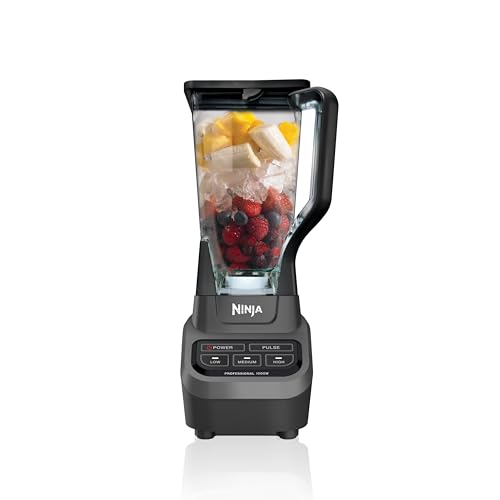
Ninja Professional Blender BL610 — Best Value Power
The BL610 is the countertop bargain for households whose blending is heavy and frequent. Its stacked blade column and XL pitcher handle family smoothie batches and frozen drinks in single cycles, and every removable part goes in the dishwasher. It suits busy family counters where the blender works daily.
Strengths
- Stacked blades deliver genuine circulation — fewer stalls, less stirring
- 72 oz pitcher covers family batches in one cycle
- Dishwasher-safe parts keep daily use sustainable
Trade-offs
- Pitcher is plastic, not glass
- No programs beyond three speeds and pulse
- Loud under full frozen loads
| Specification | Detail |
|---|---|
| Motor | 1000 watts |
| Pitcher | 72 oz |
| Controls | 3 speeds + pulse |
| Blades | Stacked Total Crushing assembly |
Within the bargain band, the BL610 is the performance ceiling: it does the frozen, family-size jobs that expose lesser machines, and it does them without technique. The stacked-blade design is the reason — ingredients are drawn through multiple cutting levels instead of depending on a single blade plane and gravity. The compromises are material and refinement: a plastic pitcher where rivals offer glass, and a plain control set. For a working family counter, those are the right compromises, because the machine’s job is throughput. It earns the value-power badge by delivering mid-tier results at a budget-adjacent tier.
For countertop duty specifically, the BL610’s footprint-to-output ratio is its quiet triumph: it occupies an ordinary blender’s space while producing batches that usually require a step up in class. The pitcher handle and spout handle a full 72 oz pour without drama, and the base’s simple wipe-clean panel suits a machine that will live permanently in splash range of a working counter. Families should note the pitcher is the wear item to protect — it is dishwasher-safe, but keeping it out from under heavy pans in the sink extends its clarity for years. As the working centre of a family counter at a bargain-adjacent tier, it has very few peers.
Best for: families blending daily at volume who want power without premium pricing / Not suited for: glass-jar loyalists or buyers wanting programs and quiet operation
Check the current price on Amazon

Hamilton Beach Power Elite 58148AG — Best Glass-Jar Bargain
For smaller households, the Power Elite is the countertop bargain to beat: a proper glass jar, labelled functions, and jar geometry that keeps mixtures moving into the blades. It suits one to three people whose blending is daily but moderate in volume.
Strengths
- Wave Action jar compensates for modest wattage
- Glass jar resists stains and odours
- Labelled buttons suit every user in the house
Trade-offs
- 40 oz limits family batches
- Thick frozen loads need liquid-first loading
- No smoothie-cup or processor extras
| Specification | Detail |
|---|---|
| Motor | 700 watts peak |
| Jar | 40 oz glass |
| Functions | 12 functions |
| System | Wave Action |
Countertop bargains are won in the jar, and this jar is the best-designed at the tier: the wave-shaped interior turns the mixture over continuously, which is why its smoothies finish in one cycle while stronger flat-jar rivals need intervention. The glass construction adds the daily pleasures of clean pouring and odour-free storage. Its ceiling — batch size and very thick loads — is the honest price of the tier. For the household it fits, it is not a compromise purchase at all, which is the highest praise a bargain can earn.
Countertop permanence changes what matters, and the Power Elite’s glass jar is its permanence credential: it does not cloud across hundreds of dishwasher cycles, does not hold last week’s salsa when this week’s smoothie goes in, and looks presentable in the open-plan kitchens where counters are display space. Its modest height also suits the under-cabinet slide that taller rivals fail. The 40 oz ceiling is the deliberate trade — this is a small household’s permanent machine, not a family’s. Bought for the counter it fits, it delivers a daily experience indistinguishable in satisfaction from machines a tier up, which is the precise definition of a successful bargain.
Best for: small households wanting a glass countertop jar with guided operation / Not suited for: large families or heavy frozen-blend routines
Check the current price on Amazon
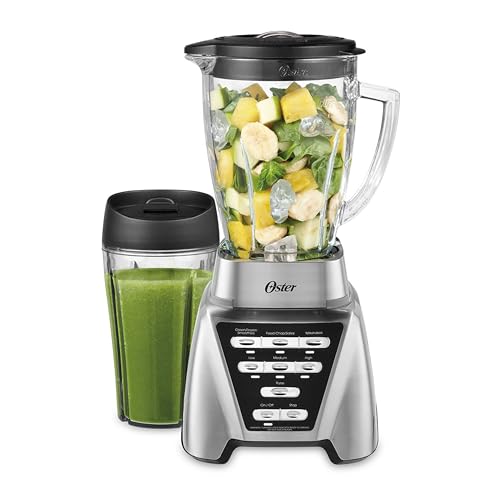
Oster Pro 1200 — Best Versatility Bargain
The Oster Pro 1200 hedges the format question elegantly: a full glass jar for family jobs and a 24 oz smoothie cup for solo mornings, driven by a dual-direction blade that reverses to pull food into the cutting zone. It suits mixed households whose blending alternates between batches and singles.
Strengths
- Glass jar plus included 24 oz smoothie cup covers both formats
- Dual-direction blade improves circulation on thick loads
- Seven speeds give real control range
Trade-offs
- More parts to store and wash than single-format rivals
- Glass jar care applies — no thermal shock
- Sits at the top of the bargain band
| Specification | Detail |
|---|---|
| Jar | Glass jar + 24 oz smoothie cup |
| Speeds | 7 speeds |
| Blade | Dual-direction blade technology |
| Brand | Oster metal-drive heritage |
Versatility is a legitimate bargain strategy — one purchase retiring two appliances — and the Pro 1200 executes it well. The reversing blade is not a gimmick: alternating direction genuinely reduces the dead zone where thick mixtures sit unblended, narrowing the gap to stacked-blade rivals while keeping a glass jar. The smoothie cup gets used more than buyers expect, because weekday singles outnumber weekend batches in most homes. The costs are cupboard space for the extra vessels and a tier at the bargain band’s ceiling. Households that will use both formats get mid-tier utility here for budget money.
The Pro 1200’s dual-format design has a second-order benefit owners discover slowly: the smoothie cup changes weekday behaviour. A full jar for one morning smoothie is a washing commitment that quietly reduces how often the blender is used; the cup removes that friction, so the big machine gets used more, not less, for having a small partner. The reversing blade, meanwhile, earns its keep on the thick mixtures — hummus-style blends and dense smoothies — where single-direction budget jars stall into a cavitation pocket. Storage of the extra cup and lids is the only ongoing cost. For the mixed-format household, this is the most thoughtfully complete bargain in the guide.
Best for: mixed households alternating family batches and solo smoothies / Not suited for: minimalists who want one jar and the lowest possible tier
Check the current price on Amazon
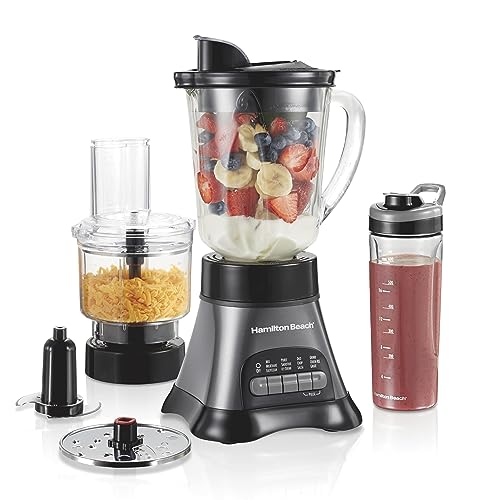
Hamilton Beach Blender and Food Processor Combo 58163 — Best Combo Bargain
Counter space is a currency, and the 58163 spends it once for two jobs: blending in a glass jar and chopping in a 3-cup processor bowl. It suits small kitchens, salsa and sauce makers, and cooks whose chopping is frequent but small-scale.
Strengths
- Blender and chopper share one base and one footprint
- Glass blending jar at a budget tier
- Chopper handles onions, nuts, and salsa quantities a blender mangles
Trade-offs
- 700 watts peak is modest for both roles
- 3-cup chopper is small for serious food processing
- Two vessels mean two wash-ups after combo meals
| Specification | Detail |
|---|---|
| Motor | 700 watts peak |
| Jar | 40 oz glass blender jar |
| Chopper | 3-cup food chopper attachment |
| Functions | Blend and chop on one base |
Combo appliances usually compromise both jobs; this one compromises mainly on scale. The blender side is the familiar, competent Hamilton Beach glass-jar experience, and the chopper covers the small-prep territory — onions without tears, nuts without nut butter ambitions, salsa with texture a blender would puree away. For a small kitchen, retiring a separate mini-processor is a real saving of space and money. The ceilings are clear: neither vessel is large, and the shared motor is a budget unit that wants sensible loads and rests. Within those lines, it is one of the most practical bargains in this guide.
The combo’s countertop logic deserves a precise statement: it is not that the chopper equals a food processor — at three cups, it plainly does not — but that the most frequent chopping jobs in a small kitchen are small. An onion, a cup of nuts, a salsa for two: these are the tasks that otherwise dirty a full-size processor or get done badly by knife. Housing them on the blender’s base means the small kitchen’s two most-used prep machines occupy one footprint and one purchase. The blender side remains a competent glass-jar Hamilton Beach. Small kitchens should weigh that consolidation heavily; it is a form of value that spec sheets cannot express.
Best for: small kitchens wanting blending and small-scale chopping on one base / Not suited for: large households or anyone needing a full-size food processor
Check the current price on Amazon

BLACK+DECKER BL2010BG — Best Simple Countertop Bargain
The BL2010BG is the countertop bargain for buyers who want capacity and glass without paying for anyone’s cleverness. Its six-cup jar is the largest glass vessel in this guide, and its ten speeds cover the standard repertoire. It suits occasional blenders and recipe-followers who think in jar cups, not programs.
Strengths
- Largest glass jar here at six cups
- Ten speeds plus pulse cover standard recipes
- Replacement jars are stocked everywhere
Trade-offs
- Plain circulation — thick loads need help
- No extras or attachments
- Basic finish reflects the tier
| Specification | Detail |
|---|---|
| Jar | 6-cup glass |
| Speeds | 10 + pulse |
| Format | Full-size countertop |
| Positioning | Budget tier |
Some kitchens need a blender the way they need a kettle: present, capacious, and unremarkable. The BL2010BG fills that role at a bargain tier with the guide’s biggest glass jar, which matters for soups and party batches more than any feature list. It asks for ordinary technique — liquid first, a pulse for thick loads — and repays it with years of unglamorous service and universally available parts. Buyers who blend daily and hard should step up to the Ninja; buyers who blend weekly and normally have found their machine.
Permanence is also this machine’s theme, expressed through ubiquity. A countertop blender’s worst day is the day its jar breaks; the BLACK+DECKER’s jar is among the most widely stocked replacement parts in the category, which converts that worst day into a minor errand and keeps the machine on the counter for years. Its six-cup capacity handles the soup batches and party pitchers that define countertop ownership, and its ten speeds map onto recipe language without translation. It asks for ordinary technique and gives ordinary, dependable service — a fair trade that generations of basic blenders have been bought on, and still the right trade for occasional-use counters.
Best for: occasional users wanting maximum glass capacity at a budget tier / Not suited for: daily heavy users needing circulation assistance
Check the current price on Amazon

Aeitto Blender 1500W — Best High-Power Bargain
The Aeitto is the spec-sheet bargain: a 1500-watt motor and a 68 oz pitcher positioned far below the premium high-power brands. It suits frozen-drink enthusiasts and large-smoothie households willing to trade brand heritage for raw numbers.
Strengths
- 1500 watts is the strongest motor in this guide
- 68 oz pitcher handles large batches
- Positioned well below premium high-power brands
Trade-offs
- Younger brand — parts and longevity track record are thinner
- Power exceeds the jar’s refinement on delicate tasks
- Loud, as high-power budget machines are
| Specification | Detail |
|---|---|
| Motor | 1500 watts |
| Pitcher | 68 oz |
| Role | High-power countertop |
| Positioning | Bargain-adjacent tier |
High wattage at a low tier always invites the same question: where was the money saved? Here, the honest answers are brand infrastructure and refinement — the Aeitto’s controls and finish are workmanlike, and its long-term parts story is unproven next to Oster or Hamilton Beach. What is not in doubt is the blending: frozen drinks and big smoothie batches are dispatched with an ease the 700-watt picks cannot match, because at some point circulation tricks stop substituting for power. Buy it with eyes open — as a power bargain for heavy frozen work, with the established brands as the safer long-term bet — and it earns its place as this guide’s sixth pick.
The Aeitto should be bought the way you would buy a powerful tool from a young brand: for the work it does now, at a price that does not require a decade of service to justify itself. Its 1500 watts and 68 oz pitcher handle the frozen, large-format jobs that define its badge, and its controls are simple enough that nothing about its operation needs a manual. What it cannot yet offer is the Oster-style ownership story — stocked parts everywhere, a design unchanged for years — because that story is written by time, not specifications. Buyers who blend hard and often, and who accept a shorter evidence base in exchange for power per tier, will find it the most exciting bargain here; cautious buyers have four safer names above it.
Best for: frozen-drink and big-batch buyers prioritising power per tier / Not suited for: buyers who value proven longevity and stocked spare parts above wattage
Check the current price on Amazon
Comparison Table
| Pick | Badge | Key spec | Best for | Where to check |
|---|---|---|---|---|
| Ninja Professional Blender BL610 | Best Value Power | 1000W, 72 oz, stacked blades | families blending daily at volume who want power without premium pricing | Check price on Amazon |
| Hamilton Beach Power Elite 58148AG | Best Glass-Jar Bargain | 700W, 40 oz glass, Wave Action | small households wanting a glass countertop jar with guided operation | Check price on Amazon |
| Oster Pro 1200 | Best Versatility Bargain | Glass jar + smoothie cup, dual-direction blade | mixed households alternating family batches and solo smoothies | Check price on Amazon |
| Hamilton Beach Blender and Food Processor Combo 58163 | Best Combo Bargain | 700W, 40 oz glass + 3-cup chopper | small kitchens wanting blending and small-scale chopping on one base | Check price on Amazon |
| BLACK+DECKER BL2010BG | Best Simple Countertop Bargain | 6-cup glass, 10 speeds | occasional users wanting maximum glass capacity at a budget tier | Check price on Amazon |
| Aeitto Blender 1500W | Best High-Power Bargain | 1500W, 68 oz pitcher | frozen-drink and big-batch buyers prioritising power per tier | Check price on Amazon |
How to Choose a Bargain Countertop Blender
Countertop bargains should be chosen from the counter backwards. Measure the space under your wall cabinets first — a machine that must be pulled out and plugged in for every use will be used half as often, and a bargain unused is the worst bargain of all. Then choose jar capacity by your largest regular job, not your largest imaginable one: 40 oz serves small households daily, 68 to 72 oz serves families and parties, and the six-cup glass jar serves recipe-followers. Material follows lifestyle: glass for stain-free, odour-free permanence; plastic for lightness and drop resistance.
Next, decide your circulation strategy, because it is the budget tier’s real performance divide. Stacked blades (Ninja) and wave-shaped jars (Hamilton Beach) circulate mechanically; reversing blades (Oster) circulate actively; plain jars ask you to circulate with loading order and pulses. All four work — they simply bill different accounts: money, or technique. Finally, price the whole ownership: replacement jar cost and availability, and whether the brand will exist in five years. The countertop is a long-term post; staff it accordingly.
Countertop vs. Personal Blenders: The Bargain Maths
Personal blenders look cheaper until a household outgrows them, at which point the countertop machine is bought anyway and the personal unit becomes a supplement. Countertop bargains invert the risk: bought first, they cover every job at some level, and a personal cup can be added later only if the solo-smoothie routine proves real. The Oster Pro 1200 in this guide collapses the debate by including both formats. As a rule, households of two or more should start countertop; confirmed solo users should start personal and pocket the difference.
There is also a capability floor that only countertop machines cross: hot soup batches, party-quantity frozen drinks, and sauce-making for a family all require pitcher volume and vented lids. If any of those jobs appears in your month, the countertop bargain is not the expensive option — it is the only option, and the personal machine is the false economy.
Reading Countertop Specs Without Being Fooled
Three spec habits protect bargain buyers. First, separate peak from rated power where listings allow, and weight jar design as heavily as either number — circulation converts watts into results. Second, treat capacity claims as working capacity minus a margin: a jar filled to its printed maximum with a frozen load will under-blend and may leak, so effective capacity is roughly the printed figure less a fifth. Third, discount program counts to zero in your comparison and price the machine on motor, jar, drive, and parts — the four things still working in year three.
Applied consistently, those habits explain this guide’s shape: a stacked-blade Ninja and two circulation-jar Hamilton Beach models at the top, a metal-heritage Oster in the middle, and a raw-power entrant included with its trade-offs stated rather than hidden. Spec literacy, at the bargain tier, is worth more than any single feature.
How to Set Up and Use a Countertop Blender for Best Results
Step 1 — Seat the jar correctly. Place the jar on the base and confirm it sits level and locked as the design intends; a jar slightly askew is the hidden cause of many leaks and rattles. Step 2 — Load in order. Liquid, soft ingredients, powders, frozen last — and never above the max line, because blends expand as they aerate. Step 3 — Start low, then commit. A few seconds at low speed settles the load into the blades; then run the working speed until the surface moves in a steady vortex and the sound evens out. Step 4 — Use the lid plug. Add liquids or small ingredients through the opening mid-blend instead of stopping; for hot soups, leave the plug loosened as directed so steam can vent. Step 5 — Pour and clean promptly. Pour slowly to let the spout work, then run the warm-water-and-soap self-clean rinse before residue dries — the habit that keeps a bargain countertop machine feeling new.
Countertop Placement, Storage, and Noise: The Ownership Details
A countertop blender’s specifications end at the plug; its ownership begins with placement. Start with the slide test: the machine should move from its storage position to its working position without lifting, because lifting a glass-jar blender daily is how jars meet tile floors. If the only storage is a deep cupboard, weight becomes a first-order specification and the lighter plastic-pitcher models gain ground. Next, ventilation and splash: blenders want a hand’s width of clearance, and a permanent spot away from the stove’s grease plume keeps the base’s finish and buttons honest across years.
Noise deserves a placement decision too. Every full-power machine in this guide is loud at full speed; the variables are duration and distance. Short cycles — most smoothies finish within a minute — make noise a minor tax in a house, and a major one in a studio flat at 6 a.m. If your routine is early and your walls are thin, that is a genuine argument for a personal blender for weekdays and the countertop machine for weekends, a two-format solution the Oster Pro 1200 in this guide conveniently packages. None of these considerations appear on a spec sheet, and all of them decide whether a bargain countertop blender is still on the counter, earning its place, in year three.
When a Bargain Countertop Blender Is the Wrong Buy
Honesty about a category includes its boundaries. A bargain countertop blender is the wrong buy when the household’s signature jobs are premium jobs: daily nut butters, grain milling, dough work, or thick hummus in quantity. Those loads need sustained torque, superior containers, and cooling headroom that this tier does not sell at any brand — attempting them here produces a frustrated owner and an overworked motor, and the correct purchase is a mid-tier or premium machine, or a food processor for the dough and hummus work. It is also the wrong buy when silence is a hard requirement; no unenclosed countertop blender is quiet, and the sound-enclosed machines in this site’s bartender guide are the honest address for that need.
Finally, it is the wrong buy as a speculative upgrade. If your current blender handles your actual menu, a bargain countertop machine will feel like the same appliance in a new box, because at the level of ordinary jobs, it is. The buyers who love this category are those whose old machine died, whose household outgrew a personal format, or whose first kitchen needs staffing. For them, the six picks above represent the tier’s genuine best. For everyone else, the most economical countertop blender is the one already on the counter — a sentence this guide is happy to end on, because a bargain recommendation should be willing to talk itself out of a sale.
Countertop Bargains for Specific Jobs: Soup, Smoothies, and Sauces
Job-first shopping sharpens the shortlist further. For soup households, the countertop requirements are a jar that pours without drama, capacity for a family batch, and a lid that vents steam safely: the six-cup BLACK+DECKER and the glass Hamilton Beach models serve this kitchen best, with the working rule that very hot liquids are blended in batches, started on low, with the lid plug loosened as the manual directs. Plastic pitchers should be allowed to cool slightly before the hottest blends, a small patience that extends their life considerably. For smoothie households, circulation is the whole specification: the Ninja’s stacked blades for family volume, the Power Elite’s wave jar for smaller households, and loading discipline — liquid first, frozen last — as the free upgrade that makes either machine feel a tier stronger.
For sauce and prep households, the calculus shifts again: a blender that also chops (the Hamilton Beach combo) or one whose pitcher handles both a Sunday gravy batch and a weekday vinaigrette without staining (glass, again) outranks raw power. Frozen desserts and thick dips are the one job where this tier asks for honesty — they are achievable with added liquid, pulsing, and patience, but they are the premium tier’s home ground, and a household making them weekly should budget accordingly rather than asking a bargain to pretend. Matching the machine to the menu, job by job, is the last refinement of bargain shopping: the picks above each name their job, and the right one is the one whose job is yours.
Countertop Bargain Scenarios: Matching the Machine to the Kitchen
Three kitchens recur in this category, and each has a correct answer hiding in the shortlist. The first is the family kitchen with a breakfast rush: smoothies for three or four people inside twenty minutes, five days a week. Throughput and washing speed rule here — the Ninja BL610’s batch size finishes the rush in one cycle, and its dishwasher-safe pitcher means the machine is clean before the school run rather than waiting in the sink as a daily reproach. Any smaller jar converts breakfast into shifts, and any hand-wash-only part converts it into a chore; this kitchen should buy capacity and dishwasher compatibility before anything else.
The second kitchen is the couple’s flat where the counter is also the dining table’s overflow and the blender must earn a permanent, visible place. Appearance and footprint become functional specifications: the Power Elite’s glass jar and modest height, or the Oster Pro’s tidy dual-format story, keep the machine welcome rather than tolerated. The third kitchen is the enthusiastic cook’s: soups on Sundays, sauces and salsas through the week, occasional baking support. This kitchen values the glass jar’s stain resistance, the combo model’s chopper for prep work, and honest mid-range power over headline numbers — and it is the kitchen most likely to keep a bargain machine for a decade, because its jobs sit squarely inside the tier’s competence. Identify your kitchen among the three, and the shortlist collapses to one or two names; that collapse, not any single specification, is what good bargain buying feels like.
Common Buying Mistakes
Mistake 1: Buying a pitcher too tall for your cabinets. Measure the storage spot, not the counter — the machine lives where it is stored. Mistake 2: Comparing peak watts only. Jar circulation and drive construction decide real results at this tier. Mistake 3: Filling to the printed maximum. Working capacity is less than the headline number, especially with frozen loads. Mistake 4: Skipping the parts check. A bargain whose replacement jar is unavailable is one accident from replacement. Mistake 5: Blending hot liquid in a sealed jar. Steam pressure is real — vent as the manual directs and respect hot-fill limits. Mistake 6: Storing the jar with the lid sealed tight. Trapped moisture breeds odours; store dry and loosely covered.
Final Recommendation
Most bargain countertop buyers should choose between the Ninja BL610 for family-scale power and the Hamilton Beach Power Elite for glass-jar, small-household value — those two cover the majority of kitchens. The Oster Pro 1200 is the pick when solo cups and family batches alternate, the Hamilton Beach combo when chopping shares the counter, the BLACK+DECKER when simple glass capacity is the whole brief, and the Aeitto when frozen-drink power per tier outranks brand heritage.
See the neighbouring guides before you commit: the all-format ranking in Best Bargain Blenders, the wider value field in Best Affordable Blenders, the ease-first view in Best And Easy To Use Blenders, and the wattage-focused roundup in Best 1000 Watt Blenders. Then check the current price on Amazon for your shortlist — countertop bargains are promotion-driven, and the best machine on paper is regularly the second-best deal on the day.
Shortlist for a final price check: Ninja Professional Blender BL610 — Check the current price on Amazon · Hamilton Beach Power Elite 58148AG — Check the current price on Amazon · Oster Pro 1200 — Check the current price on Amazon
Countertop Bargain Longevity: What Owners Report After Year One
The first year of a countertop bargain follows a recognisable arc, and knowing it helps buyers separate the machines that settle from the machines that grate. In the first month, everything is judged on blending results, and every pick in this guide passes — the tier’s floor is genuinely competent. By month six, the judgements shift to the routine: whether the jar has clouded or held odours, whether the lid still seals without a wrestling match, whether the base’s buttons have stayed legible under daily wiping. This is where glass jars quietly win their owners’ loyalty and where circulation designs prove they were not a first-week novelty but a permanent reduction in effort. By the end of year one, the surviving complaints are almost never about power; they are about a gasket, a spout, a noise that developed in a bearing — the small wear points this guide’s maintenance advice exists to catch early.
Year two separates the brands. Machines from lines with stocked parts get their gaskets and jars replaced and continue; machines without parts support begin their slide toward replacement at the first accident. The countertop bargains that owners recommend to friends at this point share a profile the shortlist above was built to match: a jar that still looks clear, a drive that has never drawn attention to itself, and a routine so unremarkable that the machine is simply part of the kitchen’s furniture. That unremarkable quality is the true product at this tier. Buyers who understand it shop for year two, not week one — and they are the buyers this guide was written for.
Accessories and Add-Ons: What a Countertop Bargain Actually Needs
Countertop bargains attract accessory spending that mostly should not happen, so here is the short, honest list. Worth it: a second jar only if your routine genuinely alternates between smoothies and savoury sauces daily and flavour carry-over bothers you — for most households, the self-clean rinse makes the second jar a cupboard ornament. A spare gasket, bought in year two, is the cheapest insurance in the category. A long bottle brush that reaches the jar’s base corners pays for itself in the first month of ownership. Not worth it: blade ‘upgrades’ from third parties, whose fit and balance are unverified and whose failure mode is a leaking jar; novelty lids and pour spouts that duplicate what the machine shipped with; and extended warranties priced at a large fraction of a budget machine’s cost, where the maths almost never favours the buyer.
The deeper principle is that a bargain countertop blender is a finished system, not a platform. Its value lies in being complete at its tier — jar, lid, blade, and a routine that works — and money spent accessorizing it is usually better banked toward the eventual mid-tier replacement or spent on the ingredients the machine exists to blend. Buy the brush and, later, the gasket. Let the rest of the accessory wall keep its inventory.
One last scenario deserves a sentence of its own: the shared house, where a countertop blender serves several adults with different habits. Shared ownership punishes complexity and rewards the designs in this guide with sealed, labelled controls and dishwasher-safe everything, because the machine’s real specification in a shared kitchen is that the least careful user cannot hurt it or be hurt by it. If that is your kitchen, weight the Hamilton Beach models’ labelled functions and the Ninja’s four-control simplicity even more heavily than this guide already does — in a shared house, forgiveness is the premium feature, and it is available at a bargain tier.
Frequently Asked Questions
What is the best bargain countertop blender for families?
The Ninja BL610: its 72 oz pitcher and stacked blades handle family batches and frozen drinks in single cycles, and its parts are dishwasher-safe. Glass-jar families blending smaller volumes should look at the Hamilton Beach Power Elite instead.
Is a 700-watt countertop blender powerful enough?
For smoothies, sauces, soups, and standard frozen drinks, yes — especially in a jar designed to circulate, like the Hamilton Beach models. Very thick mixtures and constant heavy frozen loads are where higher wattage earns its keep.
How much countertop capacity do I actually need?
Match the jar to your largest regular job: around 40 oz for one to three people, six cups for recipe-scale batches, and 68 to 72 oz for families and entertaining. Remember effective capacity is about a fifth below the printed maximum.
Are blender and food processor combos worth it?
For small kitchens doing small-scale chopping — onions, nuts, salsa — yes: one base and footprint cover both jobs, as the Hamilton Beach 58163 shows. Serious processing volume still deserves a dedicated full-size processor.
Should a bargain countertop blender have a glass or plastic jar?
Glass resists stains and odours and suits permanent counter duty; plastic is lighter and more drop-tolerant. At this tier, choose glass for longevity of appearance and plastic for portability and family-proofing — both appear among this guide’s picks for those reasons.
Why do bargain countertop blenders leak?
Usually a jar not seated fully, a lid not sealed, or a fill above the max line with an expanding blend. Seat, seal, and respect the fill line, and check the gasket’s condition if leaking persists on an older machine.

