Disclosure: airfryerkitchensupply.com is reader-supported. When you buy through links on our site, we may earn an affiliate commission at no extra cost to you.
Where to buy
Every pick in this guide to the best baby blenders and steamer was confirmed through Amazon’s own product data before it earned a link, so the model names and capacities below match what you will actually receive. Use the shortlist here to jump straight to a product page, or read the full reviews further down for the trade-offs behind each badge.
- BEABA Babycook Neo — Best Overall: Check the current price on Amazon
- BEABA Babycook Duo — Best for Big Batches and Twins: Check the current price on Amazon
- BEABA Babycook Solo 4-in-1 — Best Classic All-in-One: Check the current price on Amazon
- nutribullet Baby Steam + Blend NBY50200 — Best Mid-Tier Combo: Check the current price on Amazon
- Grownsy Baby Food Maker — Best Budget Combo: Check the current price on Amazon
- Momcozy AutoMeal Baby Food Maker — Best Fully Automatic: Check the current price on Amazon
The best baby blenders and steamer combos exist to delete a whole relay race from your kitchen: no separate pot, no colander, no transferring hot food from one vessel to another while a hungry baby supervises at full volume. In a steam-and-blend machine, raw ingredients go into one bowl, steam cooks them in their own basket, and the same bowl blends them into a puree — with the cooking liquid right there to adjust the consistency. That single-vessel workflow is the entire case for the category, and this guide takes it seriously, ranking six listing-confirmed machines on how completely and how conveniently they deliver it.
The differences that matter are capacity, automation, and what happens after the first month. Capacities range from a compact 15-ounce automatic to a twin-bowl design producing a combined 9.1 cups — the spread between cooking every day and cooking once for the week. Automation ranges from fully manual timing to machines that steam, blend, and even clean themselves while you do something else. And the after-month-one question — can it defrost, reheat, pulse to chunkier textures, warm a bottle — separates appliances you will use for a year from appliances you will store by spring. Every pick below is verified through Amazon’s product data; tiers are described in words rather than static prices, and no health claims are made — this is purely a guide to preparation practicality.
Key Takeaways
- One vessel is the whole point: steaming and blending in the same bowl keeps the cooking liquid for consistency control and deletes a pot, a transfer, and a wash from every session.
- Capacity splits the field — the twin-bowl Duo (9.1 cups combined) for batch cooking and twins; the 15 oz Momcozy for unattended daily-fresh cooking.
- Defrost and reheat functions (the BEABA line) decide whether the machine stays central after the freezer stash exists.
- Descaling the water tank on schedule is the one maintenance task this category cannot skip.
In this guide
Quick Picks
BEABA Babycook Neo — Best Overall
The premium evolution of the Babycook idea: a 42 oz bowl, steam-and-blend in one vessel, one-handed use, and dishwasher-safe cleanup. It grows from first purees to soft solids without new parts. Check the current price on Amazon
BEABA Babycook Duo — Best for Big Batches and Twins
Two independent 27 oz bowls — 9.1 cups combined, up to 54 servings in about 20 minutes. Steam two different recipes at once, or run a double batch of one. This is the batch-cooking ceiling of the category. Check the current price on Amazon
BEABA Babycook Solo 4-in-1 — Best Classic All-in-One
The original: steam, blend, defrost, and reheat in a 37 oz bowl, up to 27 servings in 20 minutes or less. A proven design with the longest track record in the category. Check the current price on Amazon
nutribullet Baby Steam + Blend NBY50200 — Best Mid-Tier Combo
Steam basket, pulse-controlled blending, and the storage cups included in the box. The most complete mid-tier package — the only pick here that ships with its portioning system. Check the current price on Amazon
Grownsy Baby Food Maker — Best Budget Combo
The steam-and-blend workflow at a budget tier, with an elevated BPA-free basket. Smaller batches, simpler feature set, same fundamental convenience. Check the current price on Amazon
Momcozy AutoMeal Baby Food Maker — Best Fully Automatic
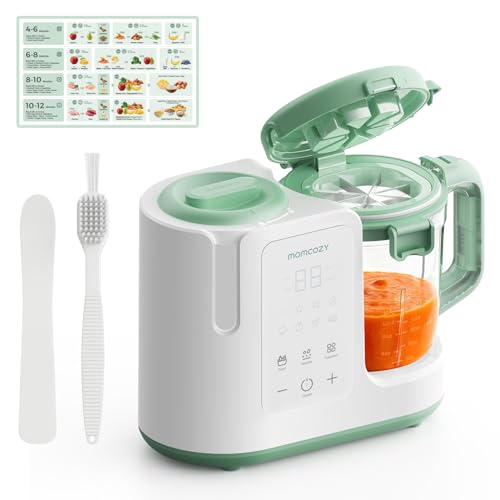
Load, select a texture stage, walk away: the AutoMeal steams then blends on its own and cleans itself afterwards. The 15 oz cup is small — attention is what it saves. Check the current price on Amazon
How These Picks Were Chosen
We restricted this guide to machines that genuinely combine both functions — a steamer and a blender in one unit — all confirmed through Amazon data. Blend-only systems, however good, belong in the companion baby blenders guide. Each candidate was assessed on steam performance (even cooking, basket design, cycle time), blending performance (smoothness of first purees, control over later textures), capacity per session, and the supporting functions that extend usefulness: defrosting, reheating, self-cleaning, and included storage.
We also weighed the unglamorous ownership details: whether the water tank is easy to fill and descale, whether the bowl and blade go in the dishwasher, and whether the footprint earns permanent counter space in a kitchen that is probably already full of bottles and sterilisers. One-handed operation was scored explicitly, because these machines are used by people whose other hand is reliably occupied. The result is a list ordered by workflow completeness rather than brand prestige, with the budget and compact options kept honest about the batch sizes they ask you to accept.
The 6 Best Baby Blenders With Steamers

BEABA Babycook Neo — Best Overall
The Babycook Neo is the most refined expression of the steam-and-blend concept. Its 42 oz capacity is the largest single bowl in this guide, the controls are designed for one-handed operation, and the texture journey from silky puree to soft solids is handled by blending time rather than accessory swaps. It suits parents who will use the machine daily for a year or more and want the flagship version of the idea.
Strengths
- Largest single-bowl capacity here at 42 oz
- One-handed operation designed into the bowl and controls
- Dishwasher-safe cleanup keeps the daily routine light
Trade-offs
- Premium tier — the most expensive positioning in this guide
- One bowl still means sequential cycles for multiple recipes
- No automatic steam-then-blend sequence; you start each stage
| Specification | Detail |
|---|---|
| Capacity | 42 oz bowl |
| Functions | Steam and blend |
| Operation | One-handed use |
| Cleaning | Dishwasher-safe parts |
The Neo’s advantage is the accumulation of small correct decisions. The bowl size means a single session genuinely stocks a freezer tray collection; the one-handed design means the session can happen while holding the baby it is for; and the steam basket keeps ingredients above the water so the liquid you blend back in is a choice, not an accident. Texture control by blending duration sounds basic, but with a powerful blade it spans the full weaning range — a long blend for week one, short pulses for month eight. Where rivals beat it is automation: the Momcozy below runs its whole sequence unattended, and the Duo out-produces it for twins. As a single-bowl flagship for one baby, though, the Neo is the most complete package in the category.
The Neo’s refinement shows most in repeated daily use. Its bowl handles a genuinely large single session without the motor labouring, the steam distribution is even enough that mixed-size loads — within reason — cook through together, and the blend control lets you stop at soft-solid textures with the same confidence as stage-one purees. Cleanup being dishwasher-safe is not a bullet point here but a rhythm: bowl and basket go in the evening wash and return for the morning session. Against its own sibling, the Solo, the Neo is the choice when the budget stretches; against the Duo, it is the choice when one baby and one bowl honestly suffice. Flagship pricing buys flagship execution of a simple idea, and the idea is executed completely.
Best for: parents wanting the flagship single-bowl steam-and-blend machine for daily use / Not suited for: twins or bulk cookers who need twin bowls, and strict budget buyers
Check the current price on Amazon

BEABA Babycook Duo — Best for Big Batches and Twins
The Babycook Duo answers the question every single-bowl owner eventually asks: what if I could run two recipes at once? Its twin bowls steam and blend independently, so sweet potato can cook on the left while pear cooks on the right, or both bowls can produce one giant batch. It suits twins, batch-cooking devotees, and anyone stocking a serious freezer supply.
Strengths
- Twin bowls give a combined 9.1-cup capacity — up to 54 servings per round
- Two different foods can steam simultaneously at their own settings
- Retains one-handed operation and BPA-free construction
Trade-offs
- Largest footprint in this guide; needs real counter space
- Premium tier, above the single-bowl Neo
- More parts to wash after a full double session
| Specification | Detail |
|---|---|
| Capacity | Two 27 oz bowls, 9.1 cups combined |
| Yield | Up to 54 servings in about 20 minutes |
| Functions | 4-in-1 steam, blend, defrost, reheat |
| Operation | One-handed, independent bowls |
The Duo changes the economics of homemade baby food. A single 20-minute round producing up to 54 servings turns a weekly cooking session into a genuine stock-up, and the independence of the bowls matters more than the raw capacity: different foods need different steam times, and staggered finishing is built into the design rather than improvised. Defrost and reheat functions on both sides keep the machine central when the freezer stash is in use. The costs are space and price — it is a substantial appliance at a premium tier — and washing two bowls after a marathon session is real work, even with dishwasher-safe parts. For twins it is close to essential; for a single baby with a weekly routine it is luxurious but rational; for occasional cooks it is more machine than the job requires.
A session with the Duo teaches its real lesson: parallelism beats capacity. Two medium bowls running different foods at different steam times produce a varied freezer library faster than one huge bowl running sequentially, because variety — not volume — is what a good stash is made of. The bowls’ independence also de-risks cooking: a failed experiment occupies one bowl, not the afternoon. Practical notes: the Duo wants a permanent home on the counter, since moving it daily would erase its convenience, and its wash load after a full session is the largest in this guide, though everything is dishwasher-safe. For twins, the calculation is not close at all — this is the only pick designed around two babies’ appetites from the first day.
Best for: twins, batch cookers, and families building a large freezer rotation / Not suited for: small kitchens or parents who cook fresh in small amounts daily
Check the current price on Amazon

BEABA Babycook Solo 4-in-1 — Best Classic All-in-One
The Solo is the machine that proved parents would pay for a dedicated steam-and-blend appliance, and its formula remains competitive: a generous 37 oz bowl, four functions including defrost and reheat, and one-handed operation. It suits parents who want the proven option with years of accumulated user knowledge behind it rather than the newest refinement.
Strengths
- Complete 4-in-1 function set including defrost and reheat
- 37 oz bowl yields up to 27 servings per session
- Long production history means abundant guidance and spare parts
Trade-offs
- Sits a tier below the Neo’s refinement at a still-premium position
- Single bowl limits simultaneous recipes
- Design is older, with fewer automation touches than newer rivals
| Specification | Detail |
|---|---|
| Capacity | 37 oz bowl |
| Functions | Steam, blend, defrost, reheat |
| Cycle | 20 minutes or less |
| Yield | Up to 27 servings |
There is a particular confidence in buying the category’s reference design. The Solo’s workflow is documented in a decade of parent forums, its quirks are known, and its accessories are everywhere. Functionally it gives up little to the Neo: the bowl is slightly smaller, the finish less premium, but the core experience — one bowl, one hand, twenty minutes, a tray of purees — is identical. The defrost and reheat functions deserve their recurring praise in this guide, because they convert the machine from a cooking appliance into the centre of the whole feeding routine. Choose the Solo when you want the proven tool at a step below the flagship’s tier, and spend the difference on the storage cups and trays you will use alongside it.
The Solo’s case strengthens the longer you own it, because its four functions map onto the whole arc of the first year rather than the first month. Early on it is a steam-and-blend factory; later it is the defrost-and-reheat station that makes the freezer system you built actually convenient at 6 a.m.; later still it reheats family portions for a toddler. That second career is why so many Solos are handed down or resold rather than discarded. The machine also benefits from the category’s most mature knowledge base — any question you will ever have about it has been asked and answered publicly. In a guide that values honesty, the Solo is the low-risk premium: not the newest, rarely the wrong answer.
Best for: parents who want the proven, well-documented all-in-one at a step below flagship tier / Not suited for: buyers wanting the newest design or twin-bowl capacity
Check the current price on Amazon

nutribullet Baby Steam + Blend NBY50200 — Best Mid-Tier Combo
NutriBullet’s Steam + Blend is the pragmatist’s all-in-one: it covers steaming and blending competently, adds a pulse cycle for texture progression, and includes the 2 oz and 4 oz storage cups that rivals sell as accessories. It suits parents who want one box to start with and a mid-tier total spend.
Strengths
- Storage cups included — no separate portioning purchase needed
- Pulse cycle gives deliberate texture control as babies progress
- BPA-free, dishwasher-safe parts throughout
Trade-offs
- Basket batches are smaller than the BEABA bowls
- No defrost/reheat specialisation comparable to the Babycook line
- Ecosystem is younger, with fewer add-ons available
| Specification | Detail |
|---|---|
| Functions | Steam and blend with pulse cycle |
| Storage | 2 oz and 4 oz cups included |
| Materials | BPA-free |
| Cleaning | Dishwasher-safe parts |
Total cost of ownership is this pick’s argument. A steam-and-blend machine without storage cups is an unfinished system, and the NutriBullet box closes the loop on day one: steam, blend, portion, freeze. The pulse cycle is the feature that ages best, because it converts the machine from a puree maker into a texture tool that stays relevant as your baby moves to mashed and minced family foods. Against the BEABA machines it concedes bowl size and the defrost/reheat polish, and its steam basket suits modest batches. For a household cooking two or three times a week in moderate quantities, that trade lands exactly right, which is why it holds the mid-tier badge in a guide full of premium French hardware.
Consider the Steam + Blend as the systems purchase of this guide. Rival machines are better at individual moments — bigger bowls, automatic cycles — but this is the box that contains a complete, working routine on day one, including the portion cups most rivals leave as a second purchase. Its pulse blending also future-proofs the texture year more cheaply than the automatic staging of the Momcozy, at the cost of your attention during the blend. For parents who comparison-shop total cost rather than headline price, the included storage regularly moves this model from mid-tier to best-value in the whole category. It is the pick for the spreadsheet-minded, and the spreadsheet is right.
Best for: parents wanting a complete steam, blend, and store system at a mid tier / Not suited for: bulk batch cookers or buyers who prioritise defrost and reheat functions
Check the current price on Amazon

Grownsy Baby Food Maker — Best Budget Combo
The Grownsy proves the all-in-one workflow does not require a premium badge. Its elevated steam basket cooks food above the water line, and blending follows in the same unit. It suits budget-conscious families, cautious first-time buyers testing whether homemade food fits their life, and second locations like a grandparent’s kitchen.
Strengths
- Budget-tier access to the full steam-and-blend workflow
- Elevated basket promotes even steaming and clean liquid control
- BPA-free construction sized for starting solids and weaning prep
Trade-offs
- Modest batch capacity means more frequent sessions
- No defrost, reheat, or self-clean extras
- Thinner accessory and spare-parts ecosystem than the leaders
| Specification | Detail |
|---|---|
| Functions | Steam and blend |
| Basket | Elevated, BPA-free |
| Positioning | Budget tier |
| Stage | Starting solids, 6+ months |
Budget picks in baby gear live or die on whether the savings cost you the core experience, and here they do not: food steams evenly in the raised basket, blends in place, and the consistency trick of adding back cooking liquid works exactly as it does on machines several tiers up. What the budget removes is scale and ceremony — smaller batches, no reheat programme, no included storage wardrobe. For the early months, when portions are measured in tablespoons, small batches are barely a limitation at all, and many families will find the Grownsy covers the whole puree era before the family blender takes over for chunkier food. As an entry point or a second machine, it is the sensible spend in this guide.
The Grownsy’s honest place in this guide is as the gateway to the category. Families unsure whether homemade food fits their life can test the full steam-and-blend routine at a budget tier, and the test is valid — the workflow, the liquid control, the one-vessel cleanup are all genuinely present, only the scale and extras are trimmed. If the routine sticks, the Grownsy retires gracefully to a grandparent’s house or a travel role when a larger machine arrives; if it does not, the experiment cost little. Its elevated basket also deserves a final mention: it is a design idea the premium brands charge for, delivered here without ceremony, and it makes the small machine’s steaming quality better than its tier suggests.
Best for: budget buyers, first-time homemade-food parents, and second kitchens / Not suited for: families wanting large batches, reheating functions, or a full accessory system
Check the current price on Amazon
Momcozy AutoMeal Baby Food Maker — Best Fully Automatic
Every other pick in this guide asks you to run two stages; the Momcozy runs them for you. Its automatic sequence steams, then blends to one of three texture stages, and a self-cleaning function handles the aftermath. It suits parents for whom the barrier to homemade food is not money or space but the sheer number of attended steps in a day.
Strengths
- Fully automatic steam-then-blend sequence needs no mid-cycle attention
- Three auto texture stages track the weaning journey
- Self-cleaning function removes the worst chore in the category
Trade-offs
- 15 oz cup is the smallest capacity in this guide
- Less manual override for parents who like precise texture control
- Small batches mean frequent sessions as appetites grow
| Specification | Detail |
|---|---|
| Cup | 15 oz |
| Blades | 6-blade design |
| Textures | 3 auto stages |
| Cleaning | Self-cleaning |
Automation is a genuinely different product, not a feature checkbox. With the AutoMeal, making a puree becomes a background process: it starts when you load the cup and announces itself when it is done, and the self-clean cycle means the machine is ready again without a scrubbing session. The three texture stages are well judged for the first year. The compromise is absolute, though — 15 ounces. Parents who batch-cook will find the cup a hard ceiling, and the machine’s natural home is the daily-fresh routine: small amounts, made often, with almost zero effort per session. In that routine it has no rival in this guide, and its badge reflects the routine rather than the spec sheet.
Judge the AutoMeal by the clock on the wall rather than the spec sheet. A manual steam-and-blend session is twenty minutes of cooking plus several minutes of attended steps spread across it; the Momcozy converts that into two minutes of loading and a finished cup. Multiplied across two or three sessions a day for months, the reclaimed attention dwarfs the capacity it concedes. The three texture stages also remove the most common beginner error — advancing textures by guesswork — by making progression a labelled choice. Its buyers should simply commit to its rhythm: small, fresh, frequent. Parents who want a Sunday factory should buy the Duo; parents who want a tireless daily assistant have found it here.
Best for: daily-fresh cooks who value unattended operation above batch size / Not suited for: weekly batch cookers and families with twins
Check the current price on Amazon
Comparison Table
| Pick | Badge | Key spec | Best for | Where to check |
|---|---|---|---|---|
| BEABA Babycook Neo | Best Overall | 42 oz, steam+blend, one-handed | parents wanting the flagship single-bowl steam-and-blend machine for daily use | Check price on Amazon |
| BEABA Babycook Duo | Best for Big Batches and Twins | 2 x 27 oz bowls, 54 servings | twins, batch cookers, and families building a large freezer rotation | Check price on Amazon |
| BEABA Babycook Solo 4-in-1 | Best Classic All-in-One | 37 oz, 4-in-1, 27 servings | parents who want the proven, well-documented all-in-one at a step below flagship tier | Check price on Amazon |
| nutribullet Baby Steam + Blend NBY50200 | Best Mid-Tier Combo | Steam+blend, pulse, storage included | parents wanting a complete steam, blend, and store system at a mid tier | Check price on Amazon |
| Grownsy Baby Food Maker | Best Budget Combo | Steam+blend, elevated basket, budget | budget buyers, first-time homemade-food parents, and second kitchens | Check price on Amazon |
| Momcozy AutoMeal Baby Food Maker | Best Fully Automatic | 15 oz, fully automatic, self-cleaning | daily-fresh cooks who value unattended operation above batch size | Check price on Amazon |
How to Choose a Baby Blender and Steamer Combo
Begin with your cooking rhythm, because it determines capacity more honestly than your baby’s age. If you picture one weekend session producing the week’s food, you need the big bowls: the Duo for maximum output, the Neo or Solo for a single generous bowl. If you picture making a small amount most days, automation beats capacity — the Momcozy’s unattended cycle will be used more faithfully than a large machine that asks for twenty attended minutes. Second, list the after-cooking jobs you will actually hand the machine: reheating frozen portions daily argues for the Babycook line’s defrost and reheat functions; portioning argues for the NutriBullet’s included cups.
Third, inspect the steam design. An elevated basket keeps food out of the water for more even cooking and cleaner flavour, and a visible, easy-fill water tank with a descale routine you will actually perform keeps steam performance consistent across months of use. Fourth, plan the texture year: pulse control or staged textures extend the machine’s life from first purees to family-food mashes. Finally, measure the footprint against your real counter, because a combo machine only saves effort if it lives where you cook — a Duo stored in a cupboard loses to a Grownsy living on the counter.
Steam-and-Blend vs. Separate Steamer and Blender
The separate-appliance route — a steamer basket in a pot plus any blender — costs less if you already own the parts and scales to family quantities effortlessly. Its costs are attention and washing: two vessels, a transfer of hot food, and timing you manage yourself. The combo route consolidates everything into one bowl with a timed steam cycle, which is why it dominates the baby category despite costing more than the sum of generic parts. The deciding factor is session frequency: the more often you make baby food, the more the combo’s saved minutes and saved washing compound.
There is also a consistency argument. Steaming in the blending bowl keeps the cooking liquid in the same vessel, so the thin-to-thick adjustment that defines good puree-making is a matter of adding liquid back by the spoonful rather than fetching water and guessing. Parents who struggled with grainy or watery results from the pot-and-blender relay often find the combo’s closed system easier to get right — not because the blender is stronger, but because the process has fewer uncontrolled steps.
Getting Textures Right: From First Purees to Soft Solids
Texture progression is the year’s real curriculum. First foods should be completely smooth and thin enough to fall off a spoon slowly; blend long, add steaming liquid generously, and check by rubbing a little between your fingers for grit. The middle stage thickens: less liquid, shorter blends, a puree that holds soft peaks. The late stage introduces lumps deliberately — pulse cycles and staged settings exist for this — so your baby practises chewing on soft pieces rather than only swallowing. Machines with pulse control or auto stages handle the whole arc; single-programme machines handle the first stage beautifully and the later stages with your hand on the button.
Two practical rules apply across every pick here. Steam until ingredients are completely soft before judging a blend — undercooked produce defeats any blade. And blend in the cooking liquid rather than fresh water where the recipe allows, since that liquid carries the flavour (and the soluble goodness) that drained away during steaming. Beyond those rules, follow your paediatric guidance on what to serve and when; this guide’s scope is the machinery, not the menu.
How to Use a Baby Blender and Steamer: A Complete Session
Step 1 — Fill the tank and load the basket. Add water to the level your machine specifies for the food’s steaming time, and load evenly cut pieces into the basket — uniform size means uniform cooking. Step 2 — Steam hands-free. Start the steam cycle and use the time elsewhere; the machine’s cycle is calibrated so food emerges fully soft. Step 3 — Check softness, then blend. A piece should crush between finger and thumb with no resistance. Blend in the same bowl, starting with short runs and adding steaming liquid by the spoonful until the texture matches your baby’s stage. Step 4 — Work the texture ladder. For later stages, stop early or pulse, leaving soft lumps; taste the consistency yourself to calibrate. Step 5 — Portion, label, store. Fill 2 oz cups for new foods and 4 oz cups for established favourites, label with food and date, refrigerate today’s and freeze the rest. Step 6 — Clean and descale on schedule. Wash bowl and blade the same day; descale the water tank as the manual directs — mineral build-up is the main cause of weakening steam over a machine’s life.
Steam-and-Blend Machines vs. Baby Food Makers With Separate Pots
Some baby food systems split the process across a standalone steamer pot and a separate blending unit, and the comparison is worth making explicit because the two designs suit different kitchens. The split design’s advantage is scale and flexibility: a big steamer pot handles family quantities, and each half can be replaced independently. Its cost is the transfer — hot food moving between vessels, with the cooking liquid usually left behind, plus two appliances to store and wash. The integrated design ranked in this guide reverses the trade: smaller scale, but zero transfers, liquid retained by default, and one footprint.
The deciding variable is session frequency multiplied by batch size. Daily small batches punish the split design’s washing and reward integration; weekly enormous batches punish integration’s bowl sizes and reward the pot. Most families in the first year live closer to the daily-small end, which is why integrated machines dominate the category’s premium end. Whichever design you choose, keep the workflow test from this guide’s main sections in mind: the best machine is the one whose routine you will still be following, without resentment, in month eight.
Maintaining a Steam-and-Blend Machine: Water, Scale, and Seals
These machines live or die by their water systems, so maintenance deserves more than the usual paragraph. Mineral scale builds on the heating element and in the tank in proportion to your water’s hardness, and its first symptom is subtle: steam cycles that take longer and cook slightly less evenly. Descale on the manufacturer’s schedule — typically with a vinegar or citric solution run through a steam cycle — rather than waiting for visible failure, because by the time steaming is obviously weak, the build-up is heavy. Using filtered water slows the cycle considerably in hard-water areas and is the cheapest upgrade available to any pick in this guide.
The second maintenance frontier is seals. Bowl lids, blade gaskets, and basket rims all trap puree films that rinsing misses; a weekly removal and proper wash keeps flavours clean and prevents the slow souring that owners misattribute to the food. Inspect the blade assembly for play or grinding as you wash — a bearing going loose announces itself there first. Finally, store the machine dry with the lid ajar. A steam appliance stored sealed and damp develops exactly the odours its owner then blames on the last batch of carrots. Five minutes of weekly attention is the full tariff for keeping a steam-and-blend machine performing like the one reviewed here.
One Machine or Two? Planning for Twins, Siblings, and Hand-Me-Downs
The capacity question returns in a second form for many families: not ‘how big a bowl’ but ‘how many babies, across how many years’. For twins in the present tense, the Duo’s parallel bowls are the only pick designed for the arithmetic, and pairing it with a generous stock of storage cups turns its sessions into a genuine weekly system. For siblings in sequence — a baby now, another planned — durability and parts support outrank capacity, because the machine must survive storage and return to daily service; the BEABA Solo and Neo, with their mature accessory ecosystems, are the natural holds. Buying with the second child in mind is the strongest argument in this category for the premium tiers, since a machine that serves two children costs half as much per child as its ticket suggests.
There is also the two-machine strategy, which suits some households better than one flagship: a large bowl machine for weekend batching plus a compact automatic for weekday freshness covers both rhythms and provides a backup when one unit is in the wash. The combined spend can undercut a single flagship while out-convenience-ing it — a genuinely rational pattern that this guide’s tier spread makes possible, pairing, say, the Grownsy or Solo for batches with the Momcozy for daily portions. Whichever structure you choose, decide it before the first purchase; the most expensive baby blender is the one bought twice because the household’s real shape was never admitted.
Steam-and-Blend Machines in Real Kitchens: Three Households
Abstract advice sharpens when it is attached to households. Consider the first-time parent cooking alone most evenings: the binding constraint is attention, and the machine that respects it is the one whose cycle needs no mid-point intervention — the Solo or Neo, loaded once and emptied once, with the defrost function quietly handling yesterday’s planning. The equipment disappears into the routine within a week, which is precisely the outcome this household is buying. Capacity beyond one generous bowl would be wasted; automation beyond a timed steam cycle would be decoration.
Now the household with twins and a grandparent helping three days a week. Here the binding constraint is throughput with consistency: different caregivers must produce identical results, so the Duo’s parallel bowls and the category’s simplest controls win, and the household’s real investment is the storage system around the machine — cups, trays, labels — because two babies convert disorganisation into waste at double speed. Finally, the small-flat household where the kitchen is also the nursery: footprint and multi-function value rule, the compact automatics and dual-purpose designs earn their place, and a machine that must be fetched from a cupboard will simply not be used daily. Three households, three different correct answers — all of them present in this guide’s six picks, which is why the guide ranks by fit rather than by a single ladder of quality.
Common Buying Mistakes
Mistake 1: Buying capacity for a baby you imagine instead of the routine you live. Daily cooks overbuy big bowls; batch cooks underbuy small automatics. Match the machine to the session pattern. Mistake 2: Steaming uneven pieces. Mixed sizes mean some pieces are mush and others are firm, and no blending fixes the blend of both. Mistake 3: Draining away the steaming liquid, then adding water. You discard flavour and control; blend the cooking liquid back in gradually instead. Mistake 4: Ignoring descaling. Steam output fades slowly with mineral build-up until cycles undercook — descale on the manufacturer’s schedule. Mistake 5: Blending a full bowl of a brand-new food. Test new ingredients in small amounts first; a freezer full of a rejected flavour is a classic waste. Mistake 6: Forgetting the machine after the puree stage. Defrost, reheat, pulse textures, and (on the Bear in the companion guide) bottle functions keep these appliances useful long past month six.
Final Recommendation
Choose the BEABA Babycook Neo for the best single-bowl experience, the Babycook Duo when twins or serious batch cooking demand twin bowls, and the Babycook Solo for the proven classic a step below the flagship. The nutribullet Steam + Blend is the mid-tier system that includes its storage cups, the Grownsy delivers the core workflow at a budget tier, and the Momcozy AutoMeal is the choice when unattended automation matters more than capacity.
Compare the blend-only alternatives in Best Baby Blenders, the food-stage advice in Best Baby Food Blenders, the general ease rankings in Best And Easy To Use Blenders, and the wider value field in Best Bargain Blenders. Then check the current price on Amazon for your shortlisted machine — in this category, bundles that include storage cups and extra bowls change the real value comparison, so compare complete packages, not bare units.
Shortlist for a final price check: BEABA Babycook Neo — Check the current price on Amazon · BEABA Babycook Duo — Check the current price on Amazon · BEABA Babycook Solo 4-in-1 — Check the current price on Amazon
A Note on Second-Hand Steam-and-Blend Machines
This category has an active second-hand market, because the machines are durable and their first careers are short. Buying used can be sensible — the BEABA line in particular holds up well — but steam appliances carry two specific checks. Inspect the water tank and heating plate for scale damage, since a neglected descale history is the main hidden defect, and run a full steam cycle before paying if the seller allows it: the machine should reach a vigorous steam without leaking at the bowl seal. Confirm the blade assembly turns freely and the basket is included, since a missing basket converts a bargain into a parts hunt. Sellers who kept the manual and accessories are, as usual, the tell of a machine that was maintained. With those checks passed, a used flagship can serve a second family at a budget tier — the most sustainable outcome this category offers.
Frequently Asked Questions
Is a baby blender with a steamer worth it versus separate appliances?
If you make baby food more than twice a week, yes: one vessel replaces a pot, a steamer basket, and a blender, and the timed steam cycle removes the most attention-heavy step. If you already own a good blender and steam family food routinely, the separate route remains perfectly workable.
How many servings does one steam-and-blend session make?
It depends on capacity: the twin-bowl Babycook Duo produces up to 54 small servings per round, the 37 oz Solo up to 27, while compact automatics like the 15 oz Momcozy make a few days’ worth of early portions. Match the yield to how often you want to cook.
Can these machines defrost and reheat frozen portions?
The BEABA Babycook models include defrost and reheat among their four functions, which makes them the centre of the freezer-stash routine. Most other combos focus on cooking and blending, so frozen portions are thawed in the fridge or warmed separately.
Do steam-and-blend machines handle chunkier textures for older babies?
Yes, with the right controls: pulse cycles and staged texture settings let you stop at mashed and soft-lump consistencies. The Momcozy automates three stages, while manual machines achieve the same range by shortening blend time as your baby progresses.
How do I stop purees coming out grainy?
Steam until the food is completely soft — graininess is undercooking, not under-blending — then blend with the steaming liquid added gradually. Evenly sized pieces before steaming make the biggest difference of all.
How often do these machines need descaling?
Follow the manufacturer’s schedule for your water hardness; mineral build-up in the tank is the main cause of weakening steam over time. Regular descaling keeps cycle times honest and is the single most important maintenance task for this category.


