Disclosure: airfryerkitchensupply.com is reader-supported. When you buy through links on our site, we may earn an affiliate commission at no extra cost to you.
Where to buy
Every pick in this guide to the best baby blenders was confirmed through Amazon’s own product data before it earned a link, so the model names and capacities below match what you will actually receive. Use the shortlist here to jump straight to a product page, or read the full reviews further down for the trade-offs behind each badge.
- NutriBullet Baby Complete Food-Making System NBY-50100 — Best Overall: Check the current price on Amazon
- BEABA Babycook Solo 4-in-1 — Best Steam-and-Blend: Check the current price on Amazon
- Grownsy Baby Food Maker — Best Budget Steam-and-Blend: Check the current price on Amazon
- Momcozy AutoMeal Baby Food Maker — Best Automatic: Check the current price on Amazon
- nutribullet Baby Steam + Blend NBY50200 — Best All-in-One Value: Check the current price on Amazon
- Bear Baby Food Maker Steamer & Blender — Best Compact Multi-Tasker: Check the current price on Amazon
Looking for the best baby blenders means you are probably standing in a kitchen at an odd hour, one-handed, holding a baby with the other arm, wondering why making a simple puree requires so many separate appliances. That real-world context is exactly how this guide judges the category. A baby blender is not a small smoothie maker; it is a tool for turning steamed vegetables, fruits, and later proteins into smooth, safe textures in batches you can portion and freeze — quickly, quietly enough not to undo a nap, and with cleanup that does not punish you for using it three times a day.
The market splits into two honest designs. Dedicated baby food systems, led by BEABA’s Babycook and the NutriBullet Baby, combine steaming and blending in one small footprint, which removes the pot-to-pan-to-blender relay entirely. Blend-focused systems skip the steamer and concentrate on portioning: batch bowls, storage cups, and freezer trays that turn one cooking session into a week of meals. Both approaches are legitimate; the right one depends on whether you already steam food as part of family cooking. Every pick below is confirmed through Amazon’s product data, and the reviews are frank about batch sizes, because the gap between a 15-ounce and a 37-ounce bowl is the difference between cooking twice a week and cooking every other day. No health claims are made here — this is a guide to food preparation practicality, nothing more.
Key Takeaways
- Choose by workflow, not by brand: steam-and-blend machines (BEABA, Grownsy, Momcozy) own the whole process; the NutriBullet Baby owns blending plus portioning for kitchens that already steam.
- Batch size is the decision that ages worst when guessed wrong — 37 oz bowls stock a freezer; 15 oz automatics cook fresh daily.
- Texture range matters more than peak smoothness: pulse or staged settings keep the machine useful from first purees to chunky mashes.
- Storage is part of the product — portion cups and a freezer tray turn a cooking session into a week of calm meals.
In this guide
Quick Picks
NutriBullet Baby Complete Food-Making System NBY-50100 — Best Overall
A 32-ounce batch bowl, a short cup for smaller blends, and a full storage system of portion cups and a freezer tray. It is a blending system rather than a steamer — and for parents who already steam in a pot, the most complete package here. Check the current price on Amazon
BEABA Babycook Solo 4-in-1 — Best Steam-and-Blend
Steam, blend, defrost, and reheat in one 37 oz bowl, in 20 minutes or less, with one-handed operation and up to 27 servings per session. The original all-in-one baby food maker remains the benchmark. Check the current price on Amazon
Grownsy Baby Food Maker — Best Budget Steam-and-Blend
Steam-and-blend functionality with an elevated BPA-free steam basket at a budget tier. It covers the essential workflow — steam, blend, serve — without the premium brands’ price positioning. Check the current price on Amazon
Momcozy AutoMeal Baby Food Maker — Best Automatic
One step: the machine steams, then blends automatically, with three auto texture stages and a self-cleaning function. The 15 oz cup is small — the automation, not the capacity, is the product. Check the current price on Amazon
nutribullet Baby Steam + Blend NBY50200 — Best All-in-One Value
NutriBullet’s answer to the Babycook: a steamer basket and blender in one unit, with a pulse cycle for texture control and 2 oz and 4 oz storage cups included, all dishwasher-safe and BPA-free. Check the current price on Amazon
Bear Baby Food Maker Steamer & Blender — Best Compact Multi-Tasker
An 18.5 oz one-step processor with dual-layer steam baskets — steam two foods at once — that also warms bottles and sterilises small items. The compact footprint suits small kitchens and multi-tasking nurseries. Check the current price on Amazon
How These Picks Were Chosen
We shortlisted baby blenders confirmed through Amazon data and judged them on the workflow of real weaning. First, batch economics: how many servings one cycle produces, since a system that makes up to 27 servings at once changes your week differently from one that makes four. Second, texture range: the machine must produce a truly smooth first puree and, months later, a chunkier mash, ideally without buying new parts. Third, one-handed and low-attention operation, because the other hand is occupied. Fourth, cleaning: dishwasher-safe bowls, blades that rinse clean, and no hidden gaskets trapping food.
We also screened for materials transparency — BPA-free food-contact parts are standard among the picks — and for storage ecosystems, because portioning into 2-ounce and 4-ounce cups with lids is where homemade baby food becomes practical rather than aspirational. Models that were simply miniaturised adult blenders with baby branding were cut; a baby blender earns its name through batch size, storage, or steam integration, not through pastel colours. As always on this site, no static prices or ratings are printed: each pick is positioned by tier, and you can check the current price on Amazon before deciding.
The 6 Best Baby Blenders

NutriBullet Baby Complete Food-Making System NBY-50100 — Best Overall
The NutriBullet Baby is the best overall baby blender because it treats portioning as part of blending. The 32 oz batch bowl handles a serious cooking session, the smaller cup covers quick single meals, and the included storage cups and freezer tray close the loop from cooking to serving. It suits parents who batch-cook weekly and already own a steamer basket or cook baby portions alongside family meals.
Strengths
- Complete system: batch bowl, short cup, storage cups, and freezer tray included
- Familiar push-down NutriBullet operation is genuinely one-hand friendly
- Portion sizes match how babies actually eat across the weaning stages
Trade-offs
- No built-in steamer — food must be cooked before blending
- Blending very small amounts in the big bowl is inefficient; use the short cup
- Plastic components need prompt rinsing to avoid staining from carrots and sweet potato
| Specification | Detail |
|---|---|
| Batch bowl | 32 oz |
| Includes | Short cup, storage cups, freezer tray |
| Operation | Push-down activation |
| Steam function | No — blend and store system |
The system’s intelligence is in its sequencing. Steam a pot of sweet potato and pear while the family dinner cooks, blend the batch in under a minute, portion into the dated storage cups, freeze the tray, and the week’s first foods are done. The extractor blade produces a genuinely smooth first-stage puree from well-steamed ingredients, and pulsing instead of running gives the lumpier textures older babies need. Because it shares the NutriBullet operating logic, there is no learning curve and no control panel to wipe down. Its honest limitation is the missing steamer: if your kitchen routine has no steaming step, a steam-blend machine below will save you a pot every session. Judged as a blender plus storage ecosystem, though, nothing else here is as complete.
Practical ownership notes round out the case. The batch bowl’s size hits a sweet spot: large enough for a real session, small enough that the blade still engages modest quantities without splashing them up the walls. The storage cups stack and their lids seal reliably for the freezer, and the tray releases portions with a twist rather than a excavation. Because the system shares NutriBullet’s push-down logic, a sleep-deprived parent can operate it without a single decision — fill, press, portion. The accessories are also the easiest in this guide to replace individually, which matters across a year of daily use and, often, a second child. It is a system designed by people who understood that the blender is the easy part.
Best for: batch-cooking parents who already steam food and want blending plus portioning in one system / Not suited for: parents who want cooking and blending in a single appliance
Check the current price on Amazon

BEABA Babycook Solo 4-in-1 — Best Steam-and-Blend
The Babycook Solo is the machine that defined this category: raw ingredients go in, and 20 minutes later a finished puree comes out of the same bowl, with defrost and reheat functions extending its life well past first foods. Its 37 oz capacity is generous for a single-bowl design. It suits parents who want the entire process in one appliance on the counter and value the large batch size.
Strengths
- True 4-in-1: steam, blend, defrost, and reheat in a single bowl
- Large 37 oz capacity makes up to 27 servings per session
- Designed for one-handed operation — a real, daily advantage
Trade-offs
- Premium tier within the baby category
- One bowl means sequential batches for varied menus
- Texture control is via blending time, which takes a little practice
| Specification | Detail |
|---|---|
| Capacity | 37 oz bowl |
| Functions | Steam, blend, defrost, reheat |
| Cycle time | 20 minutes or less |
| Yield | Up to 27 servings per session |
The Solo’s advantage compounds over months. Steaming in the same bowl you blend in preserves the cooking liquid, which you can add back to reach exactly the consistency you want — thin for first tastes, thicker as your baby progresses. Defrost and reheat sound like minor features until you are reheating a frozen portion at 6 a.m.; then they are the product. One-handed operation is not marketing here: the bowl locks and the controls work while you hold a baby, which our other picks mostly cannot claim as completely. The premium tier is the hesitation, and the single bowl does mean menu variety requires back-to-back cycles. For a first baby with years of use ahead — and possibly a second child — the Solo’s completeness justifies its badge.
The Solo’s longevity in the market shows in details rivals are still copying. The steam basket lifts out with the cooked food, the water tank’s fill level maps to steaming time in a way that becomes intuitive within a week, and the blend dial’s resistance is calibrated for one-handed turning while the other hand steadies nothing — because the bowl locks down on its own. Owners also benefit from the deepest accessory bench in the category: extra bowls, storage jars, and replacement blades are all standard purchases rather than special orders. When a machine will be used three times a day for a year, that infrastructure is not a footnote; it is a substantial part of what the premium tier is buying.
Best for: parents wanting one appliance for the whole process with a large batch size / Not suited for: budget buyers or parents who prefer separate, larger steaming capacity
Check the current price on Amazon

Grownsy Baby Food Maker — Best Budget Steam-and-Blend
The Grownsy brings the all-in-one concept to a budget tier, which matters because baby gear spending competes with a hundred other essentials. Its elevated steam basket keeps food above the water for even steaming, and blending happens in the same unit. It suits cost-conscious parents, second-machine buyers for grandparents’ houses, and anyone unsure how long they will make food at home.
Strengths
- Steam-and-blend workflow at a budget tier
- Elevated steam basket promotes even cooking
- BPA-free food-contact parts, sized for starting solids and baby-led weaning prep
Trade-offs
- Smaller batches than the BEABA Solo or Duo
- Fewer included storage accessories than the NutriBullet Baby system
- Brand ecosystem and spare parts are thinner than the category leaders’
| Specification | Detail |
|---|---|
| Functions | Steam and blend |
| Basket | Elevated steam basket, BPA-free |
| Positioning | Budget tier |
| Use stage | Starting solids, 6+ months |
Budget baby appliances earn trust by doing the core job without drama, and the Grownsy’s core job is sound: steam evenly, blend smoothly, clean up easily. The elevated basket is a thoughtful detail — food steamed in its own basket rather than sitting in water cooks more evenly and keeps the blending liquid separate until you choose to add it. Batch size is the compromise; plan on more frequent, smaller sessions than a Babycook allows. For many families that rhythm is fine, even preferable, because fresh small batches suit the early weeks when a baby eats spoonfuls, not bowls. As appetites grow you may blend family food in a regular blender and keep the Grownsy for reheating and small jobs. At its tier, that is a perfectly good career for the machine.
Set expectations precisely and the Grownsy satisfies them. Cycle times are unhurried rather than slow, the blend from a fully steamed basket is smooth enough for first foods, and the unit’s modest footprint means it can live beside the bottle station instead of competing for main counter space. It is also a genuinely useful travel or grandparents’-house machine, where a premium unit would be an anxious loan. Where it asks for your help is batch planning: run it twice for a freezer session rather than overloading the basket, because even steaming depends on space between pieces. Treated as the small-batch tool it is, it delivers the category’s core convenience at the guide’s most accessible tier.
Best for: budget-conscious parents and grandparents’ houses needing a capable steam-and-blend unit / Not suited for: heavy batch cookers who want the largest possible single session
Check the current price on Amazon
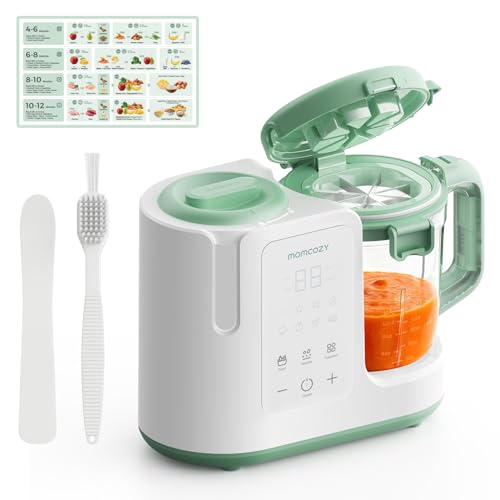
Momcozy AutoMeal Baby Food Maker — Best Automatic
The Momcozy AutoMeal is built for the parent whose scarcest resource is attention. Load the 15 oz cup, choose a texture stage, and the machine runs the steam-then-blend sequence itself, finishing with a self-clean cycle. It suits parents of young babies eating small portions, who value a completely hands-off process over batch size.
Strengths
- Fully automatic steam-then-blend sequence — no mid-cycle steps
- Three auto texture stages map to weaning progression
- Self-cleaning function reduces the daily washing burden
Trade-offs
- 15 oz cup is the smallest batch in this guide
- Automation means less manual control over exact texture
- Per-session yield suits early weaning better than hungry older babies
| Specification | Detail |
|---|---|
| Cup | 15 oz |
| Blades | 6-blade design |
| Textures | 3 auto texture stages |
| Cleaning | Self-cleaning function |
Every baby appliance promises to save time; the AutoMeal saves attention, which is rarer. The automatic sequence means you can start a puree and go deal with the reason you were in the kitchen in the first place, returning to a finished, correctly textured result. The three texture stages are sensibly spaced — smooth, medium, and chunkier — so the machine grows through the first year without new parts. The trade is written on the spec sheet: 15 ounces is a few days of early portions, not a week’s batch, and parents of twins or enthusiastic eaters will run it constantly. Position it correctly — as the effortless daily driver for the small-portion months, possibly alongside a bigger batch tool later — and it is the most modern-feeling product in this guide.
The AutoMeal’s automation deserves one more examination, because it changes who can make baby food and when. A parent alone with a contact-napping baby can start it with one hand and finish the cycle without returning to the kitchen; a partner who ‘doesn’t cook’ can run it without instruction, because the machine owns the sequence and the texture decision is a labelled stage rather than a judgement call. The self-clean cycle, often dismissed as a luxury, is what keeps an automatic machine automatic — a dirty manual step at the end would quietly return the burden the design removed. Its small cup remains the honest limit, but within the daily-fresh routine, no pick here removes more friction per session.
Best for: time-poor parents of young babies who want a fully hands-off steam-and-blend cycle / Not suited for: batch cookers, twins, or families wanting one weekly session to cover the week
Check the current price on Amazon

nutribullet Baby Steam + Blend NBY50200 — Best All-in-One Value
The Steam + Blend takes the NutriBullet Baby ecosystem and adds the missing cooking step. The steamer basket feeds a blender with a dedicated pulse cycle, so texture is something you dial in rather than hope for, and the included portion cups keep the storage discipline of the original system. It suits parents who liked the NutriBullet Baby concept but want cooking included.
Strengths
- Steaming and blending in one unit, with storage cups included
- Pulse cycle gives deliberate control from puree to chunkier textures
- Dishwasher-safe, BPA-free parts keep cleanup simple
Trade-offs
- Smaller ecosystem of accessories than the original NutriBullet Baby
- Steam basket batches are modest compared with the Babycook Duo
- Newer model with a shorter track record than the category veterans
| Specification | Detail |
|---|---|
| Functions | Steam and blend, pulse cycle |
| Storage | 2 oz and 4 oz cups included |
| Materials | BPA-free, dishwasher-safe |
| Basket | Integrated steamer basket |
This model resolves the original NutriBullet Baby’s one structural gap — the separate steaming step — while keeping what made that system practical: portion cups in the two sizes that map to real appetites, and parts that go in the dishwasher. The pulse cycle deserves emphasis, because texture progression is where baby blenders are won or lost over a year; a machine that can only produce one smoothness becomes obsolete as chewing skills develop, while pulse control stretches from first purees to family-food mashes. Batch size sits in the middle of this guide — adequate for most households, short of the BEABA Duo’s twin-bowl marathon sessions. As an all-in-one at a mid tier with storage included, it is the value pick of the steam-and-blend group.
Two details elevate this model beyond its spec sheet. The steamer basket’s size is well judged for the two-to-three-session-per-week rhythm most families actually keep — large enough to matter, small enough that food stays fresh in rotation. And the pulse control is genuinely progressive: short pulses chop, longer pulses puree, and holding the blend takes you to stage-one smoothness, so the same control covers the whole texture year without modes to learn. The included cups in both portion sizes mean the first session ends with a stocked freezer tray, not a shopping list. In a category where premium brands sell completeness at premium tiers, this box’s completeness at a mid tier is its defining virtue.
Best for: parents wanting steam, blend, and storage in one mid-tier system / Not suited for: maximum-batch cookers or buyers loyal to the BEABA ecosystem
Check the current price on Amazon

Bear Baby Food Maker Steamer & Blender — Best Compact Multi-Tasker
The Bear takes a different route to value: instead of a bigger bowl, it stacks functions. Dual-layer baskets steam two ingredients simultaneously in its 18.5 oz chamber, and the same base warms bottles and sterilises pacifiers and small parts. It suits small kitchens, combination feeding households, and parents who like one compact appliance earning its counter space several ways.
Strengths
- Dual-layer baskets steam two different foods in one cycle
- Adds bottle warming and sterilising to the food-making role
- Compact footprint for small kitchens and nursery counters
Trade-offs
- 18.5 oz capacity limits batch cooking
- Multi-function designs ask you to clean around more features
- Less specialised blending power than the category leaders
| Specification | Detail |
|---|---|
| Capacity | 18.5 oz |
| Baskets | Dual-layer steam baskets |
| Extra functions | Bottle warmer, sterilising |
| Materials | BPA-free food-contact parts |
The dual-layer basket is the genuinely clever idea here: carrots on one level, apple on the other, both steamed in a single cycle and blended separately or together, which halves the sessions needed for a varied freezer stash. The bottle-warming and sterilising functions will not matter to every household, but in a small flat where each appliance must justify itself, a food maker that also handles bottles earns its place. Capacity is the clear ceiling — 18.5 ounces is a modest batch — and blending performance, while fine for steamed produce, is not the headline. Buy the Bear as a compact kitchen-and-nursery multi-tasker and it satisfies; buy it as a batch-cooking station and it will feel small within a month.
The Bear rewards a specific kind of household and should be bought by exactly that household: one where counter space is contested, bottles are in daily rotation, and menu variety is a deliberate strategy rather than an accident. Its sterilising function, easy to overlook in a blender guide, replaces a separate appliance for many families, and the bottle warmer covers the night feed without a kitchen trip. The dual-layer baskets also make combination cooking natural — steam the components of a mixed puree together, blend them together — which is how family food actually gets made. Judge it as a compact nursery-kitchen hub rather than a pure blending instrument, and its badge makes complete sense.
Best for: small kitchens and parents who value dual-layer steaming plus bottle functions / Not suited for: high-volume batch cookers feeding twins or stocking a large freezer
Check the current price on Amazon
Comparison Table
| Pick | Badge | Key spec | Best for | Where to check |
|---|---|---|---|---|
| NutriBullet Baby Complete Food-Making System NBY-50100 | Best Overall | 32 oz batch bowl + storage system | batch-cooking parents who already steam food and want blending plus portioning in one system | Check price on Amazon |
| BEABA Babycook Solo 4-in-1 | Best Steam-and-Blend | 37 oz, 4-in-1 steam/blend/defrost/reheat | parents wanting one appliance for the whole process with a large batch size | Check price on Amazon |
| Grownsy Baby Food Maker | Best Budget Steam-and-Blend | Steam + blend, elevated basket, budget tier | budget-conscious parents and grandparents’ houses needing a capable steam-and-blend unit | Check price on Amazon |
| Momcozy AutoMeal Baby Food Maker | Best Automatic | 15 oz, auto steam+blend, 3 textures | time-poor parents of young babies who want a fully hands-off steam-and-blend cycle | Check price on Amazon |
| nutribullet Baby Steam + Blend NBY50200 | Best All-in-One Value | Steam+blend, pulse, 2 oz/4 oz cups | parents wanting steam, blend, and storage in one mid-tier system | Check price on Amazon |
| Bear Baby Food Maker Steamer & Blender | Best Compact Multi-Tasker | 18.5 oz, dual-layer baskets, warmer | small kitchens and parents who value dual-layer steaming plus bottle functions | Check price on Amazon |
How to Choose a Baby Blender
Decide first whether steaming must be built in. If your cooking already includes steaming — a basket over a pot while family food cooks — a blend-and-store system like the NutriBullet Baby is efficient and complete. If baby food is its own separate event in your kitchen, an all-in-one steam-and-blend machine removes a pot, a transfer, and a timing step from every session, which is why the BEABA and its rivals dominate the category. Second, size the batch to your real rhythm: weekly batch cookers should prioritise the largest bowls (the 37 oz Solo, or the Duo in the companion guide), while parents who cook fresh every day or two are better served by a compact automatic like the Momcozy.
Third, check the texture path. Your baby will need silky purees for a short window and progressively chunkier food for much longer, so a machine with pulse control or staged textures has a longer useful life than a single-speed puree maker. Fourth, audit the storage story: portion cups in 2 oz and 4 oz sizes, lids that seal for freezing, and a tray format that releases portions easily. Finally, be honest about cleanup tolerance. These machines are used daily at tired hours; dishwasher-safe parts and a self-clean option are not luxuries, they are the features that decide whether homemade food survives contact with real life.
Baby Blender vs. Regular Blender: What Is Actually Different?
A regular countertop blender can absolutely puree steamed vegetables — parents did it for decades — so the honest question is what a dedicated baby blender adds. Three things: batch geometry (small bowls that blend spoonful quantities properly, where a big jar’s blades would spin beneath a small load), steam integration (cooking and blending in one vessel, keeping the cooking liquid for consistency control), and the portioning ecosystem (cups and trays sized to infant servings). If you already own a good blender and a steamer and you batch-cook large quantities, the dedicated machine is a convenience, not a necessity.
Where the dedicated machine wins decisively is frequency and scale of effort. Daily small batches in a full-size blender mean washing a full-size jar daily; a baby unit rinses in seconds. The immersion-blender-in-the-pan method is the other legitimate alternative for soups and soft foods. Most families land on a hybrid: a baby system for the first months, graduating to the family blender as portions grow and textures chunk up — which is why resale-friendly, durable picks hold their value in this category.
Batch Sizes and Storage: Planning a Week of Purees
Translate bowl sizes into your week before buying. A 37 oz session yielding up to 27 small servings can cover most of a week for one baby in the early months; a 15 oz automatic covers a few days but asks for near-daily sessions. Neither is wrong — they suit different temperaments — but buying the small machine while intending to batch-cook is the category’s classic regret. Portion into 2 oz cups for first tastes and 4 oz cups as appetites grow, label with the food and the date, and freeze trays flat so portions stack.
Thaw overnight in the fridge or use the defrost function several picks here include, and reheat only the portion you will serve. Keep a simple rotation: oldest portions first, and a freezer inventory on the door if your stash grows. The machines in this guide all support that workflow; the difference is how many sessions per week the workflow costs you, and that is the number to optimise when you choose.
How to Use a Baby Blender: Your First Batch, Step by Step
Step 1 — Choose and prep. Start with a single ingredient — sweet potato, carrot, pear, or avocado (no cooking needed for ripe avocado). Wash, peel where appropriate, and cut into even, small pieces so steaming is uniform. Step 2 — Steam until truly soft. In an all-in-one, load the basket and run the steam cycle; in a blend-only system, steam in a pot until a fork slides through with no resistance — undercooked produce is the main cause of grainy purees. Step 3 — Blend with the cooking liquid. Transfer food to the bowl, add a little of the steaming liquid, and blend to completely smooth for first foods, checking for lumps by rubbing a spoonful between finger and thumb. Add liquid gradually; you can thin a puree but you cannot thicken one. Step 4 — Portion immediately. Spoon into 2 oz cups or a freezer tray while the food is fresh, label with ingredient and date, refrigerate today’s portions and freeze the rest. Step 5 — Clean at once. Rinse the bowl and blade straight away — dried puree under a blade is stubborn — and run dishwasher-safe parts through the machine or a self-clean cycle where fitted.
Baby Blenders and Food Safety Basics
Equipment guides are not medical advice, and nothing here replaces your paediatrician’s or local health authority’s guidance on feeding. With that boundary clear, the machinery side of food safety is mostly about temperature, time, and cleanliness — all three of which these machines are designed around. Cook ingredients until completely soft and steaming hot throughout; blend promptly rather than letting cooked food sit at room temperature while other tasks intervene; and portion into clean cups immediately, refrigerating the portions for the next day and freezing the rest rather than leaving a large bowl to be dipped into repeatedly across the week.
Thawing and reheating deserve the same discipline. Thaw frozen portions in the refrigerator, use the defrost and reheat functions where your machine provides them or another gentle method you trust, stir reheated food and let it stand so temperatures even out, and test the temperature yourself before serving. Discard a portion a baby has eaten from rather than returning it to storage. On the equipment side, wash bowls and blades the same day without exception, inspect gaskets and blade seals weekly for trapped residue, and descale steam tanks on schedule — a scaled tank steams weakly, and weakly steamed food is both a texture failure and a safety shortcut you did not intend to take. The machines make the safe routine the easy routine; the parent’s job is simply not to improvise around it.
What to Make First: A Practical Flavour Progression
New owners often ask what a baby blender is actually for in week one, and a simple progression helps the machine earn its keep. Begin with single, naturally soft or easily steamed staples: sweet potato, carrot, butternut squash, pear, and banana or avocado mashed without cooking. These blend to a reliable smoothness in every pick in this guide and establish your baseline for consistency — the ribbon-off-the-spoon texture you will compare everything against. Once single flavours are accepted, combinations become the machine’s playground: apple with carrot, pear with parsnip, pea with potato. Combination purees are where dual-basket and large-bowl machines show their worth, steaming components together and blending them as one.
As textures advance, the same ingredients return in rougher form — the pulse and staged settings in this guide exist for exactly that return trip. Later still, the machines pivot to family support work: blending a portion of the family’s soup smooth, mashing soft-cooked legumes and grains, or reheating the freezer portions that remain in rotation. Planning the flavour ladder this way also protects your budget: you will use the machine in every phase, which is the difference between a baby blender that was a purchase and one that was an investment. Introduce new foods one at a time and in small test batches, per standard guidance, and let the big bowls wait for proven favourites.
Accessories Worth Adding — and the Ones to Skip
Every baby blender ecosystem sells extras, and a short buy/skip list saves real money. Worth adding: a second bowl or cup set if your machine runs daily, because a clean dry bowl ready to go is worth more at 6 a.m. than any feature; extra storage cups beyond the included set once your freezer rotation grows past a dozen portions; and a spare blade or gasket for the machine you will hand down, bought while the model is current and parts are certain. A bottle brush sized to the bowl is the unglamorous essential — it reaches the blade base that sponges miss and extends the life of every seal it cleans gently.
Usually skippable: specialised recipe books for a process this guide and a hundred free resources cover completely; decorative storage that duplicates the cups you own; and single-purpose gadgets — mashers, mills, portioners — whose jobs your blender’s pulse and a fork already do. The exception that proves the rule is a second freezer tray in a different portion size when your baby graduates from 2 oz to 4 oz servings, because the tray is the one accessory whose size genuinely changes the workflow. Spend accessory money on capacity and spares, in that order, and the system you bought stays the system that works.
How Long Each Type of Baby Blender Stays Useful
A final planning lens: expected service life by design. Blend-and-store systems like the NutriBullet Baby typically peak during the puree and early mash months, then retire to smoothie duty for the parents — a respectable second career that keeps them out of storage. Steam-and-blend machines with defrost and reheat functions stay in the feeding routine longest, because reheating frozen portions is a daily job that outlives blending itself by months. Automatic small-cup machines serve intensely and briefly, matching the daily-fresh window, and are the most commonly resold while still current models. None of these arcs is a defect; each is the honest shape of the design’s usefulness.
The buying implication is to price the arc, not the appliance. A premium machine used daily for fourteen months across two children can cost less per week than a budget machine used for four months and shelved. Conversely, a family certain it will blend for one baby and stop should not pay for a second child’s durability. The picks in this guide were badged with their arcs in mind — match yours to theirs, and the machine you choose will feel correctly priced every single week you own it.
Common Buying Mistakes
Mistake 1: Buying a tiny blender for a batch-cooking plan. Match bowl size to your weekly rhythm, not to your baby’s current tiny portions — appetites grow fast. Mistake 2: Blending undercooked food. Grainy puree is almost always a steaming problem, not a blender problem; cook until completely soft. Mistake 3: Making the puree too thick, then too thin. Add steaming liquid a spoonful at a time; consistency control is the core skill of the first month. Mistake 4: Skipping the storage system. A blender without portion cups and a freezer tray turns cooking sessions into serving stress; buy the ecosystem, not just the motor. Mistake 5: Letting the machine sit dirty. Puree dries like cement under blades and gaskets — rinse immediately, every time. Mistake 6: Keeping a puree-only machine too long. As your baby needs chunkier textures, use pulse modes or graduate to mashing; a blender that cannot adapt becomes clutter by the first birthday.
Final Recommendation
Most parents should start with the NutriBullet Baby if they already steam food, or the BEABA Babycook Solo if they want the entire process in one bowl — those two cover the majority of kitchens between them. The nutribullet Steam + Blend is the mid-tier all-in-one with storage included, the Grownsy delivers the same basic workflow at a budget tier, the Momcozy is the pick when automation matters more than batch size, and the Bear suits compact kitchens that value its dual-layer baskets and bottle functions.
Round out your research with the food-focused companion guide at Best Baby Food Blenders, the steam-centred roundup at Best Baby Blenders And Steamer, and the general ease-of-use rankings in Best And Easy To Use Blenders for the family blender you will graduate to. Check the current price on Amazon for your shortlist, and remember that in this category the best machine is simply the one whose batch size and cleanup match the life you actually live.
Shortlist for a final price check: NutriBullet Baby Complete Food-Making System NBY-50100 — Check the current price on Amazon · BEABA Babycook Solo 4-in-1 — Check the current price on Amazon · Grownsy Baby Food Maker — Check the current price on Amazon
Frequently Asked Questions
Do I really need a dedicated baby blender?
Not strictly — a regular blender plus a steamer works. A dedicated unit earns its place through small-batch blending, steam integration, and portion storage, which together save meaningful time and washing across months of daily use. If you will make food daily in small amounts, it is worth it.
What size baby blender should I buy?
Weekly batch cookers should choose the largest bowls — around 37 oz — which can yield up to 27 small servings per session. Parents cooking fresh every day or two can choose compact 15 to 19 oz automatics. Twins or enthusiastic eaters push every recommendation one size up.
Can baby blenders handle meat and grains?
Once ingredients are cooked until tender, the picks here can puree soft meats, lentils, and grains, especially when blended with their cooking liquid or vegetables. Very fibrous or dry mixtures may need extra liquid and longer blending; start with produce and add proteins as your baby’s eating develops.
How long will I use a baby blender?
Most families use one intensively for six to twelve months, from first purees through chunkier mashes. Models with defrost and reheat functions, pulse texture control, or bottle-warming extend usefulness beyond the puree stage, and durable units commonly serve a second child.
Are the plastics in baby blenders BPA-free?
The picks in this guide specify BPA-free food-contact parts, and several are dishwasher-safe for thorough cleaning. Always confirm the current product listing details when you buy, and replace any part that becomes cracked, warped, or persistently stained.
Can I make baby food in a regular personal blender instead?
For soft, well-cooked ingredients in small quantities, yes — though you lose steam integration and the portion-cup ecosystem, and very small amounts can blend unevenly in larger cups. Many parents start with a dedicated system and graduate to the family blender as portions grow.


