Disclosure: airfryerkitchensupply.com is reader-supported. When you buy through links on our site, we may earn an affiliate commission at no extra cost to you.
Where to buy
Aluminum gas grills are a specialist category sold by the manufacturers, grill dealers, and Amazon. Every pick below with an Amazon link was verified against Amazon’s catalog before this guide was published; check price on Amazon from the links in each review. Several of these grills are sold as heads or post-mount units — read each review for what the configuration includes.
- Broilmaster P3XF Premium Gas Grill Head — available on Amazon. Check the current price on Amazon.
- Phoenix SDRIVDDP Grill Head on Pedestal Cart — available on Amazon. Check the current price on Amazon.
- MHP WNK4 Natural Gas Grill on Stainless Cart — available on Amazon. Check the current price on Amazon.
- MHP JNR4DD Natural Gas Grill on In-Ground Post — available on Amazon. Check the current price on Amazon.
- Napoleon TravelQ PRO285X Portable Propane Grill — available on Amazon. Check the current price on Amazon.
- Camp Chef Explorer 2-Burner Camp Stove — available on Amazon. Check the current price on Amazon.
The Best Aluminum Gas Grills, and why this category is a well-kept secret
Shoppers hunting for the best aluminum gas grills have usually learned something the mainstream market does not advertise: cast aluminum is arguably the ideal material for a grill housing. It cannot rust through the way steel does, because aluminum’s corrosion forms a protective oxide rather than flaking scale. It is thick, rigid, and holds heat evenly when cast. And it is the material behind some of the longest-lived gas grills ever sold — the cast-aluminum heads from makers like Broilmaster, MHP, and Phoenix that owners pass down like cast iron skillets.
Here is the honest complication this guide will not hide: true all-aluminum gas grills are a niche. The mainstream industry builds with stainless panels and porcelain steel because they photograph well and cost less to ship. Aluminum appears in most modern grills only in supporting roles — lids, end caps, burners — while the full cast-aluminum housing survives in a handful of specialist lines, mostly American, mostly sold as grill heads and post-mount units rather than big-box cart grills. If you want the real thing, those specialists are where it lives, and they dominate this roundup for that reason.
So the picks below split into two honest groups. The first is the cast-aluminum aristocracy: Broilmaster, Phoenix, and MHP heads whose housings are the genuine article, bought by people who intend to grill for decades. The second is aluminum where it counts in portable and camp cooking — a travel grill built around aluminum construction and a camp system whose cast-aluminum burners are its heart — for buyers whose aluminum need is mobility rather than permanence. Both groups beat pretending that a stainless cart grill with an aluminum badge belongs here.
In this guide
Quick Picks
Six aluminum-forward gas grills and cooking systems worth your money, from the cast-aluminum classics to the portable and camp specialists.
- Broilmaster P3XF — Best Overall: The definitive cast-aluminum grill head, with a lifetime-minded design and a cult following earned over decades. Check the current price on Amazon.
- Phoenix SDRIVDDP — Best on a Pedestal: A cast-aluminum Phoenix head on a pedestal cart, with stainless accents and a drip-managed design. Check the current price on Amazon.
- MHP WNK4 — Best Natural Gas: An aluminum-housing grill on a stainless cart, plumbed for natural gas and built in the MHP tradition. Check the current price on Amazon.
- MHP JNR4DD — Best Permanent Post-Mount: The compact in-ground post installation — the grill as a fixture of the yard. Check the current price on Amazon.
- Napoleon TravelQ PRO285X — Best Portable: Two-burner propane grilling on a folding scissor cart, built for tailgates and small spaces. Check the current price on Amazon.
- Camp Chef Explorer — Best for Camp Cooking: Twin 30,000 BTU cast-aluminum burners on detachable legs, ready for a grill box and every camp accessory. Check the current price on Amazon.
How These Picks Were Chosen
The first test was material honesty: is aluminum doing structural work in this product, or is it a garnish? Cast-aluminum housings and heads passed at the top of the list. Aluminum burners — the component where the metal’s heat conduction and corrosion resistance matter most in a camp system — qualified the portable and camp picks. Products whose aluminum content was a lid handle or a badge were excluded, however good they are as grills, because this search makes a material promise and this guide keeps it.
Every product with an Amazon link was verified through Amazon’s own catalog data before publication: brand, model, and configuration had to match the product described. Where the verified listing states a material or a burner specification, the spec box says so; where the aluminum construction is the manufacturer’s documented design for the line, the review says that and no more. We print no prices and no fixed ratings, because both change constantly.
We also weighted longevity infrastructure, because cast-aluminum grills are bought on a decades horizon. Broilmaster and MHP are famous for supporting grills long after their purchase dates, with burners, grates, and hardware orderable by model — the ecosystem that turns a durable housing into a genuinely permanent appliance. A rust-proof box around unavailable parts would be a monument, not a grill.
The 6 Best Aluminum Gas Grills

Broilmaster P3XF Premium Gas Grill Head — Best Overall
The Broilmaster P3 is the grill that built this category’s reputation: a premium propane grill head whose cast-aluminum housing is the reason owners talk about these grills in decades. Aluminum this thick does three things steel cannot match — it cannot rust through, it distributes heat across the head with cast metal’s evenness, and it shrugs off the thermal cycling that fatigues thinner fireboxes. The P3XF configuration adds the Flare Buster system for managing drippings, and it mounts to Broilmaster’s posts and carts as a permanent installation.
Strengths
- Cast-aluminum head: rust-proof by material, not by coating, with cast metal’s even heat
- Broilmaster’s legendary parts support — these grills are maintained, not replaced
- Flare Buster ceramics manage drippings and even out the cooking surface’s temperament
Trade-offs
- Sold as a grill head — a post or cart mount is part of the purchase and the plan
- Styling is honest and traditional, not showroom-sleek; this grill impresses at year ten, not at unboxing
- Premium tier for its size class — you are buying the housing and the decades
| Format | Premium propane gas grill head per Amazon listing |
| Key feature | Flare Buster system per Amazon listing |
| Verification | ASIN confirmed, 2026-11-20 |
Understanding the P3 means understanding what actually kills gas grills. It is rarely the burners or the grates — those are replaceable — it is the firebox and housing rusting through until the structure is unsafe or unsightly, at which point the whole appliance is scrap. A cast-aluminum head removes that failure mode from the timeline entirely. What remains is maintenance: a burner here, a grate there, each orderable because Broilmaster supports its installed base with a seriousness the industry cites as the standard.
Cooking character follows the material. The thick casting holds a reservoir of heat that steadies the cooking environment when the lid opens and cold food lands, and the head’s compact efficiency makes it frugal with fuel for its size. This is not the largest grill in any roundup, and it does not chase features; it cooks evenly, sears honestly, and will be doing so when trendier appliances have been replaced twice.
Buy the P3XF if you are installing a grill as a fixture — on a post by the patio, in a permanent outdoor spot — and you want the housing question settled for the rest of your grilling life. It is the connoisseur’s answer in this category, and the least fashionable, most durable pick in this guide.
Best for: Permanent installations and buyers who measure grill life in decades / Not suited for: Anyone wanting a self-contained cart grill out of the box, or the latest features
Check the current price on Amazon
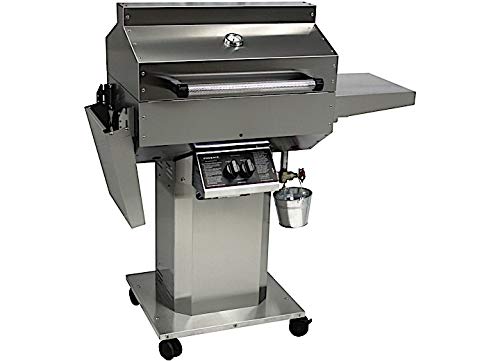
Phoenix SDRIVDDP Grill Head on Pedestal Cart — Best on a Pedestal
Phoenix grills — built by the same MHP tradition that pioneered cast-aluminum gas grilling — take a distinctive engineering path: a cast-aluminum head with a stainless, riveted construction on a pedestal cart, designed around a drip-pan system that manages grease by collecting and cooking it off rather than letting it pool and flare. The SDRIVDDP arrives as a complete pedestal installation in liquid propane, ready to anchor a patio corner permanently.
Strengths
- Cast-aluminum Phoenix head — the rust-proof housing that defines this category
- Pedestal cart included: a complete, permanent-feeling installation in one purchase
- Phoenix’s drip management design is engineered against flare-ups at the source
Trade-offs
- A pedestal is a commitment to a location — this grill lives where you install it
- Traditional control layout and feature set; no electronic garnishes
- Smaller dealer visibility than the big-box brands — know your parts source
| Format | Grill head on pedestal cart per Amazon listing |
| Fuel | LP (propane) per Amazon listing |
| Verification | ASIN confirmed, 2026-11-20 |
The Phoenix design philosophy deserves a paragraph, because it differs from the flare-guard approach of mainstream grills. Rather than shielding burners from drippings with tents, Phoenix’s system embraces a drip pan that vaporizes juices in a controlled way — which both flavors the food and reduces the uncontrolled flare-ups that scorch it. Owners describe the cooking character as steady and forgiving, particularly for chicken and fatty cuts that punish other grills.
The pedestal format suits a specific and common life: the grill that lives beside the back door or at the patio’s edge, always in the same place, always ready. There are no wobbly cart legs, no wheels to flat-spot, no repositioning — the pedestal is furniture, and the cast head on it is effectively immortal. For smaller patios, that footprint discipline is a feature in itself.
Choose the Phoenix if the Broilmaster head-only format does not fit your plan but the cast-aluminum promise does. It is the complete-installation route into this category’s material advantages.
Best for: Homeowners wanting a permanent pedestal grill with a cast-aluminum head, complete in one purchase / Not suited for: Anyone who needs to move or store their grill
Check the current price on Amazon

MHP WNK4 Natural Gas Grill on Stainless Cart — Best Natural Gas
Modern Home Products — MHP — effectively invented the residential gas grill, and its WNK series carries the founding design brief: a cast-aluminum housing, built to outlast its owner, on a stainless cart, burning natural gas so fuel management disappears. The WNK4 configuration pairs the aluminum head with stainless cooking grids and the mobility of a cart — permanence of construction without permanence of position.
Strengths
- Cast-aluminum housing from the company that created the category
- Natural gas fueling — no tanks, ever, with a cart’s placement flexibility within hose reach
- Stainless cooking grids and a stainless cart complete the corrosion-proof brief
Trade-offs
- Requires a natural gas supply point; renters and propane homes are out
- Heritage design language — function-first, without contemporary styling flourishes
- Premium specialist tier and dealer-channel pricing structure
| Format | Natural gas grill on stainless cart per Amazon listing |
| Grids | Stainless per Amazon listing |
| Verification | ASIN confirmed, 2026-11-20 |
MHP’s longevity culture is the story here. The company built its name on grills that stay in service for extraordinary spans, supported by a parts pipeline that treats a twenty-year-old grill as a current customer. The WNK’s aluminum housing is the foundation of that culture — a head that cannot rust away — and everything else on the grill is specified to be maintained rather than mourned.
The natural gas specification shapes the ownership experience completely: the grill lives where the gas stub-out is, cooks at a moment’s notice, and never introduces a tank into your week. Combined with the cart — which allows seasonal repositioning within the hose’s reach and easy movement for patio work — it is the most livable form of the permanent grill.
If your home offers natural gas at the patio and your instinct is to buy once, the WNK4 is the aluminum category’s most complete expression of that instinct. It is not the cheapest way to grill this year; it is among the cheapest ways to grill for the next twenty.
Best for: Natural-gas households wanting a cast-aluminum grill with lifetime support culture / Not suited for: Propane-only homes or style-first buyers
Check the current price on Amazon
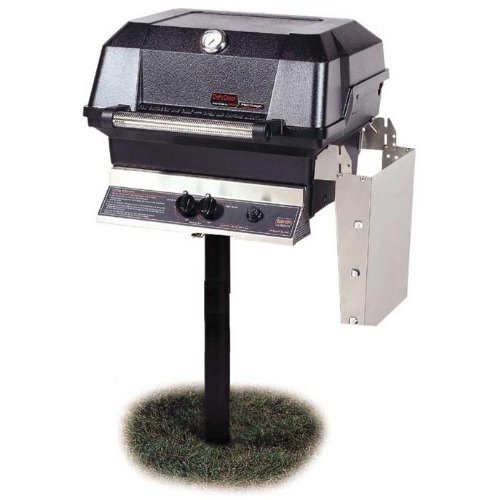
MHP JNR4DD Natural Gas Grill on In-Ground Post — Best Permanent Post-Mount
The JNR4DD is the compact expression of the same MHP philosophy: a cast-aluminum natural gas grill head — the JNR format — mounted on an in-ground post, with stainless grids. It is the grill as landscape fixture: installed once into the yard or patio, plumbed permanently, and thereafter simply part of the property, like a lamp post that cooks.
Strengths
- In-ground post installation — the most permanent, stable mounting in home grilling
- Cast-aluminum MHP head with stainless grids: corrosion-proof where it counts
- Compact footprint suits smaller yards and dedicated grill stations
Trade-offs
- Installation is a project: post setting and a gas line run, professionally done
- Compact cooking area — this is a household grill, not an entertaining platform
- Natural gas only, and the position is forever — choose the spot with a lifetime’s care
| Format | Natural gas grill on in-ground post per Amazon listing |
| Grids | Stainless per Amazon listing |
| Verification | ASIN confirmed, 2026-11-20 |
The post-mount format has a mid-century heritage — the backyard grill as a built feature of the home — and the JNR4DD is its modern, corrosion-proof heir. There is a particular pleasure in a grill that is simply there: no cover wrestling in the wind, no cart to wheel from the garage, no storage question in winter. You walk out with a plate of food and the grill is waiting, plumbed and permanent.
Size is the honest trade. The JNR format cooks for a household beautifully — its cast head is efficient and even — but it will not cater a reunion. Buyers should size their ambitions to it deliberately: this is the everyday grill for a couple or a small family, installed at the exact spot where that cooking happens, and its compactness is what makes the permanent installation sensible in an ordinary yard.
Choose the JNR4DD if you are landscaping or re-landscaping and want the grill designed into the property from the start. It is the most architectural pick in this guide.
Best for: Homeowners building a permanent, compact grill station into a yard or patio / Not suited for: Entertainers needing large capacity, or anyone not ready to commit to a spot
Check the current price on Amazon

Napoleon TravelQ PRO285X Portable Propane Grill — Best Portable
Not every aluminum gas grill buyer is building a monument. The TravelQ PRO285X is the category’s mobile answer: a two-burner portable propane grill on a folding scissor cart, from Napoleon’s TravelQ line, whose cast-aluminum construction ethos — the PRO285 family is built around a cast aluminum body design — makes it dramatically more durable than the stamped-steel portables that rust out in a few seasons of tailgates.
Strengths
- Folding scissor cart: rolls like luggage, stores upright in a corner
- Two burners give real zone control — rare in the portable class
- Napoleon build quality and parts support in a take-anywhere format
Trade-offs
- Portable capacity: family-sized, not crowd-sized
- Runs on small propane cylinders or a hose-adapted tank — plan your fuel format
- Premium tier among portables; stamped-steel rivals cost less and last less
| Burners | 2 burners per Amazon listing |
| Format | Portable propane grill with foldable scissor cart per Amazon listing |
| Verification | ASIN confirmed, 2026-11-20 |
The scissor cart is the design’s genius: it folds flat for transport and storage, deploys in seconds, and holds the grill at proper working height — no picnic-table improvisation, no ground-level crouching. For apartment balconies, campsites, tailgates, and small patios that must return to being patios after dinner, that transformability is the product.
Cooking performance respects the format’s limits and exceeds its class’s habits: two burners allow a hot side and a gentle side, the lid and body hold heat like a real grill rather than a camp stove, and the whole unit shrugs off the transport abuse that kills lesser portables. Aluminum construction is the durability story here — the body that will not rust in a truck bed or a coastal campsite.
Buy the PRO285X if your grilling life moves — between balcony and campsite, tailgate and beach house — and you want one portable built to survive the moving. It is the premium portable, priced and built accordingly.
Best for: Tailgaters, campers, and small-space grillers who need durability in a folding format / Not suited for: Stationary family cooking in volume
Check the current price on Amazon

Camp Chef Explorer 2-Burner Camp Stove — Best for Camp Cooking
The Explorer is the aluminum story told from the burner outward: a two-burner outdoor cooking system whose burners are cast aluminum — stated plainly in its listing — each rated at 30,000 BTU, on detachable steel legs, with a 448-square-inch cooking platform designed to accept Camp Chef’s accessory ecosystem, including the grill boxes that turn it into a true camp grill. It is the base camp of outdoor cooking, and its aluminum heart is why it survives decades of campsite duty.
Strengths
- Two 30,000 BTU cast-aluminum burners — serious, corrosion-resistant power
- Accessory system accepts grill boxes, griddles, and ovens — one burner platform, many kitchens
- Detachable legs and rugged simplicity make it the camp and emergency-prep standard
Trade-offs
- As listed it is a stove platform — grilling requires the grill box accessory
- No lid, no enclosure: wind is your cooking variable at camp
- Utilitarian by design; it will not win a patio beauty contest
| Burners | Two 30,000 BTU cast-aluminum burners per Amazon listing |
| Total output | 60,000 BTU per Amazon listing |
| Cooking area | 448 sq in platform per Amazon listing |
| Verification | ASIN confirmed, 2026-11-20 |
Why cast aluminum burners matter becomes clear the first time a steel burner clogs or rusts at a campsite: aluminum does not rust, conducts heat evenly, and shrugs off the moisture of outdoor storage. The Explorer’s burners are the component most likely to outlive its owner, which is precisely the material argument of this entire guide expressed at camp scale.
The system’s versatility is the second argument. With a grill box, it grills with a lidded, cast-iron-grated competence that surprises people; with a griddle, it is a breakfast station for a scout troop; with two stock pots, it is a canning and crawfish operation. No other pick in this guide shape-shifts like this, and for rural properties, hunting camps, and serious tailgates, that flexibility is the purchase.
Choose the Explorer if your aluminum gas cooking happens under open sky, in quantity, and far from a patio. It is the workhorse pick — the one that cooks for the camp while the monuments cook for the home.
Best for: Campers, tailgaters, and outdoor cooks who need a versatile, powerful burner platform / Not suited for: Patio cooks wanting a finished, lidded grill out of the box
Check the current price on Amazon
Comparison Table
Two families in one table: permanent cast-aluminum heads for the home, and aluminum-hearted portables for everywhere else. Cross-family shopping is the common error here — decide which family your life belongs to before comparing within it.
| Pick | Badge | Key spec | Best for |
|---|---|---|---|
| Broilmaster P3XF | Best Overall | Cast-aluminum propane head, Flare Buster | Permanent installations measured in decades |
| Phoenix SDRIVDDP | Best on a Pedestal | Cast-aluminum head on pedestal cart, LP | Complete permanent patio installation |
| MHP WNK4 | Best Natural Gas | Cast-aluminum head, stainless cart and grids | Natural-gas lifetime grilling |
| MHP JNR4DD | Best Permanent Post-Mount | Compact head on in-ground post, NG | A grill built into the landscape |
| Napoleon TravelQ PRO285X | Best Portable | 2 burners, folding scissor cart | Durable grilling that travels |
| Camp Chef Explorer | Best for Camp Cooking | Two 30,000 BTU cast-aluminum burners | Camp and high-volume outdoor cooking |
How to Choose an Aluminum Gas Grill
Start by deciding which aluminum promise you are buying: permanence or portability. The cast-aluminum heads — Broilmaster, Phoenix, MHP — are permanence purchases, installed on posts, pedestals, or carts in a chosen spot and maintained for decades. The portable picks trade that permanence for freedom of location. Buyers who confuse the two end up with a grill head and no mounting plan, or a travel grill asked to feed a patio of twelve. The families in this guide do not compete with each other; they serve different lives.
Second, plan the installation as part of the purchase. Heads need mounts; post mounts need setting; natural gas needs a line and a professional; pedestals need a level, permanent home. The total project — grill, mount, fuel work, cover — is the real price, and it is still, amortized over the decades these housings last, among the cheapest grilling math available. But it must be budgeted whole, or the project stalls at a head in a box.
Third, verify the parts pipeline for your exact model before ordering. The cast-aluminum proposition only fulfills itself if burners, grates, igniters, and hardware remain orderable — and with Broilmaster and MHP, that support is the brand’s founding promise. Check the model’s parts diagram, note the wear items, and confirm availability. A permanent grill with a living parts catalog is an heirloom; without one, it is a countdown.
Finally, size honestly. These are not the largest grills on the market, and their compact efficiency is part of their design philosophy — heat a cast head, not a cavern. A household that grills for four to six will find them perfectly scaled; a household that regularly grills for fifteen should either accept batch cooking or look at the large-format categories elsewhere on this site, trading the aluminum housing for capacity with open eyes.
And consider the used market as part of your research, even if you buy new. Cast-aluminum heads appear in estate sales and classified listings decades after manufacture, still cooking, still supported — a living demonstration of the category’s premise that no showroom visit can replicate. Reading those listings teaches you the models’ real longevity, the parts that eventually get replaced, and the prices that permanence holds. Few product categories offer their buyers that kind of evidence before purchase; take advantage of it.
How to Install and Set Up a Cast-Aluminum Grill Head
Installation begins with the mount. For post installations, the post is set in concrete below the frost line where your climate demands it, plumb and at the height the manufacturer specifies, with the gas line roughed to the post’s base before the concrete cures. Pedestal and cart installations need level, stable ground — a head this permanent deserves a pad or a properly prepared patio surface, not a wobble on pavers. In all cases, observe the manufacturer’s clearances to structures and overhangs, and have gas connections made or inspected by a licensed professional where your jurisdiction requires it — which is most of them.
Commissioning follows the ritual every gas grill deserves and permanent ones most of all: leak-test every fitting with soapy water, verify each burner’s ignition and flame character — a healthy flame is blue with defined cones — and run a full burn-off cycle to clear manufacturing residues before food is involved. Check the head’s level and the grates’ seating, fit the drip management components as designed, and photograph the model and serial plate for your records before the first cook makes it greasy.
The first cooks should be simple and observant. Cast aluminum’s evenness rewards you quickly, but every grill has its zones: map them with a bread test, learn where the head runs hot, and note your vent and valve habits in the first month. Fit the cover — sized to the head and mount — from the first week. Aluminum does not rust, but covers keep water out of ignition systems, pollen out of burners, and the whole installation looking like the fixture it is. Installed and commissioned with this care, a cast-aluminum head asks for almost nothing afterward except food.
Why Cast Aluminum Outlasts: The Material Science in Plain Terms
Steel’s enemy is its own corrosion chemistry: iron oxide flakes, exposing fresh metal, which oxidizes again — a self-feeding process that eventually perforates a firebox. Paint and porcelain slow it; they do not change its nature, and every chip restarts the clock. Aluminum plays by different rules: its oxide forms instantly, adheres tightly, and seals the surface beneath it. A cast-aluminum housing can discolor and dull across decades, but it does not rust through, because the corrosion product is the protection.
Casting adds the second advantage: thickness with shape. A cast head’s walls are substantial, which makes them stiff — lids seal and stay sealed — and gives the metal thermal mass that evens the cooking environment. The same thickness makes the housing tolerant of the small abuses of outdoor life: the bumped corner, the dropped tool, the hailstorm. Where thin steel dents and then rusts at the dent, cast aluminum shrugs and oxidizes politely.
The material has honest limits, and this guide will name them. Aluminum softens at temperatures steel tolerates, which is why burner design and clearances in these grills are engineered conservatively — and why you should never run a cast head with a grease fire raging inside it. It can also suffer galvanic corrosion where it meets dissimilar metals in constant moisture, which good design isolates against. Neither limit troubles a maintained grill. What the material offers — a housing removed from the mortality table — is why a small group of makers never stopped casting, and why their owners never stop recommending them.
Cast Aluminum vs Stainless vs Porcelain Steel: The Housing Head-to-Head
Since this category is defined by a material, the comparison deserves direct treatment. Porcelain-enameled steel is the mainstream default: inexpensive, attractive when new, and entirely dependent on its coating — every chip at a grate support or a fastener hole is a rust site with a head start. In dry climates and covered storage it serves respectably; in coastal air and uncovered life, its timeline is the shortest of the three. Stainless steel, the premium mainstream answer, resists through its chromium layer and serves for many years, with its lifespan set by grade and by the thickness of the firebox — and with surface staining, rather than perforation, as its usual aging mode in harsh environments.
Cast aluminum’s claim is different in kind: the housing exits the corrosion race altogether, and its thickness adds stiffness and thermal steadiness that neither sheet material matches. Its costs are weight, a traditional aesthetic, and a market structure — specialist brands, dealer channels, head-and-mount purchasing — that asks more of the buyer at the start. Judged purely as a housing for a twenty-year grill, cast aluminum wins on the merits. Judged as a shopping experience, it is the road less traveled, and this guide exists partly because that road is easy to miss.
The pragmatic synthesis most long-term owners reach: choose the housing by your horizon and your climate, and the internals by your cooking. A five-year grill in a dry climate can be any material honestly maintained. A twenty-year grill anywhere, or a ten-year grill at the coast, argues for cast aluminum or high-grade stainless — and between those two, the tiebreaker is whether you prefer the built-in and flagship world of stainless or the permanent-fixture world of the cast head.
Living With a Permanent Grill: The Ownership Rhythm
Owners of cast-aluminum fixtures describe a distinctive rhythm, and prospective buyers should recognize whether it suits them. The grill is always there — which means it gets used for the small cooks that cart owners skip: two sausages, a single eggplant, a piece of fish on a Tuesday. Permanent grills quietly raise a household’s grilling frequency, because the activation energy of a cook falls to the time it takes to carry a plate outside. There is no setup, no storage, no seasonal commissioning — just a cover lifted and a burner lit.
The maintenance rhythm matches the material: an annual hour, not a weekly chore. Once a season, brush the burners’ ports clear, check the igniter, scrape the interior, inspect the gas connections, and confirm the parts that will eventually need ordering while they are still a plan rather than a problem. Every several years, a wear part gets replaced in minutes. That is the whole liturgy — the least demanding ownership in gas grilling, purchased with the most deliberate installation.
The rhythm’s one shadow is permanence itself: the grill does not follow you to the next house, and it does not rearrange when the patio does. Owners accept this the way they accept a planted tree — as a feature of a settled home. If your life is settled, the rhythm is a gift. If it is not, the portable picks in this guide were chosen with your chapter of life in mind.
Accessories and Upgrades Worth Adding to a Cast Head
A permanent grill deserves a short, deliberate accessory list. First, the fitted cover, sized to head and mount together — the single highest-value accessory for any fixture that lives outdoors. Second, a spare burner and igniter kept in the garage once the grill passes its fifth birthday: not because failure is likely in any given season, but because a permanent grill’s rare downtime should be measured in minutes with a part on hand, not in shipping days with guests coming. Owners of decades-old Broilmasters treat this as simple adulthood.
Third, a quality instant-read thermometer and, for the post-mount cooks who roast, a leave-in probe — the cast head’s evenness makes its results unusually predictable once measured, and measurement is what turns a good fixture into a precision instrument. Fourth, for the Camp Chef and portable owners, the accessories invert: the grill box for the Explorer and a hose adapter for the TravelQ are the two purchases that unlock each system’s full range. In every case the pattern is the same — buy the few accessories that complete the system’s purpose, and resist the catalog’s long tail of novelties that a permanent grill will outlive anyway.
Common Buying Mistakes
This niche category has niche mistakes:
- Ordering a grill head without a mounting plan — post, pedestal, or cart is part of the purchase, not an accessory.
- Assuming “aluminum” in a mainstream listing means a cast housing; most often it means a lid or a burner. Read for the housing material specifically.
- Skipping the parts-availability check on a decades-horizon purchase.
- Installing a natural gas post grill in a spot chosen in haste — permanent means permanent.
- Expecting big-box capacity from compact cast heads; their efficiency is the point, and batch cooking is the trade for crowds.
- Neglecting burner and grate maintenance because the housing is immortal — the wear parts still wear.
Buy the material for the life you actually live — installed forever, or folded into a trunk — and aluminum will keep its side of the bargain for a very long time. If you take one research step beyond this guide, make it this: find the parts diagram for the exact model you are considering and confirm the wear items are listed and priced. That five-minute check is the whole category in miniature — permanence is a system, not a substance, and the diagram shows you the system working.
Final Recommendation
For a permanent home installation, the Broilmaster P3XF is the category’s defining purchase — the cast head, the parts culture, the decades of service that follow from both. The Phoenix SDRIVDDP is its complete-on-a-pedestal alternative, and MHP serves natural-gas households with the WNK4 on its stainless cart or the JNR4DD as a fixture of the landscape.
For grilling that travels, the Napoleon TravelQ PRO285X brings durability to the folding format, and the Camp Chef Explorer puts cast-aluminum burners under whatever camp kitchen you assemble. Whichever family fits your life, you are buying the same proposition the category has kept since its founding: a grill whose housing will not be the reason it dies.
Related reading on this site: Best Aluminum Gas Grills; Best All Stainless Steel Gas Grills; Best American Gas Grills; Best Portable Grills; Best Gas Grills; Best Grills.
Frequently Asked Questions
Do aluminum grills really not rust?
The aluminum itself does not rust in the iron sense — it forms a protective oxide and cannot rust through. Other components can still corrode: steel fasteners, burners of lesser material, and grates all have their own lifespans, which is why these grills are maintained by parts rather than replaced whole. The housing — the part whose failure scraps a grill — is effectively permanent. Surface dulling or white oxidation patches on old castings are cosmetic; a wash and, if you like, a light polish restores the look without affecting the metal’s integrity in the slightest.
Why are there so few aluminum gas grills?
Economics and fashion. Cast housings are heavy to ship, expensive to make, and associated with specialist brands that sell through dealers rather than big-box aisles, while the mainstream market optimizes for showroom features at a price point. The material never stopped being excellent; the distribution simply moved elsewhere, which is why this category rewards buyers who seek it out. There is also a quiet demographic truth: cast-aluminum grills are disproportionately bought by people who have already owned two or three lesser grills and done the replacement math. This category is where experienced owners land, which is why it stays small — and why its satisfaction levels stay high.
Can a cast-aluminum grill sear as well as stainless or cast iron setups?
Yes — searing is a function of burner power, grate material, and preheat, and these heads pair strong burners with heavy grates and a heat-holding cast body. The cast housing’s thermal mass actually steadies the cooking temperature when cold food lands, which is half the searing battle. Technique — a full preheat and a dry surface — does the rest, as it does on any grill. New owners switching from thin steel grills often notice the difference first on a windy day: the cast head’s mass and sealed construction hold their temperature where a lightweight firebox is bullied by the weather, and dinner stops depending on the forecast.
What does “grill head” mean, and what else do I need?
A head is the grill itself — housing, burners, grates, controls — without a stand. It mounts to a post set in the ground, a pedestal, a cart, or a built-in structure, and connects to a fuel supply. Budget the mount and any gas work alongside the head, and confirm clearances for your chosen installation before ordering. The head-only format is standard practice in the permanent-grill world rather than a catch: it lets one proven cooking unit serve a post in one yard, a pedestal in another, and a masonry island in a third, and it is why these brands’ catalogs read like building supplies as much as appliances.
Are parts really available for older Broilmaster and MHP grills?
That support is the core of both brands’ reputations: burners, grates, and hardware for long-running models are catalogued and orderable, which is precisely why their grills accumulate such long service lives. Verify your specific model’s diagram before purchase — it takes five minutes and confirms the ecosystem you are buying into. When you call or search for a part, have the model number from the head’s data plate ready; on grills that have served through several owners, that plate is the thread that connects your unit to its manufacturer’s memory.
Is a portable aluminum grill worth the premium over stamped steel?
If the grill travels and lives outdoors, yes: stamped steel portables typically rust at seams and hinges within a few seasons, while the aluminum-bodied design shrugs off the same treatment for many years. If the portable will live in a dry garage and travel twice a year, the premium buys durability you may never need — an honest case for the cheaper tool. The deciding question is storage honesty: picture where the grill will actually spend February, not where you intend it to, and buy for the February you pictured.


