Disclosure: airfryerkitchensupply.com is reader-supported. When you buy through links on our site, we may earn an affiliate commission at no extra cost to you.
Where to buy
All stainless steel grills are sold by the manufacturers, outdoor kitchen dealers, major retailers, and Amazon. Every pick below with an Amazon link was verified against Amazon’s catalog before this guide was published; check price on Amazon from the links in each review. Built-in models require an island or cart plan — factor that project into the purchase.
- Blaze LTE PRO 32-Inch Built-In — available on Amazon. Check the current price on Amazon.
- Bull Angus Built-In Grill Head — available on Amazon. Check the current price on Amazon.
- Napoleon Built-In 500 Series 32-Inch — available on Amazon. Check the current price on Amazon.
- Weber Summit FS38 — available on Amazon. Check the current price on Amazon.
- Broil King Regal S 590 Pro — available on Amazon. Check the current price on Amazon.
- Kenmore 6-Burner Stainless Cabinet Grill — available on Amazon. Check the current price on Amazon.
The Best All Stainless Steel Grills for people building to last
The best all stainless steel grills share a philosophy: build the whole machine — firebox, burners, grates, body, and hardware — from a metal that does not rust through, paint over, or give up after a few seasons of weather. Where our companion guide to stainless gas grills concentrates on freestanding patio models, this guide takes the broader view of the keyword: it leads with the built-in grill heads that anchor outdoor kitchens, where all-stainless construction is the professional standard, and includes the freestanding flagships that meet the same standard on a cart.
Why does full stainless construction matter more in a built-in? Because a built-in grill is masonry-adjacent permanence. Replacing a freestanding grill is an afternoon; replacing a failed grill head inside a finished island is a construction project involving cutout dimensions, gas work, and finishes. Outdoor kitchen builders learned long ago that the grill head must be the most durable object in the island, and the industry answered with commercial-style stainless heads designed for decades. That heritage shapes every pick below.
It also shapes the questions you should ask. What grade of stainless, and where? Are the burners and grates stainless, or only the panels? Does the warranty treat the grill as a built-in fixture or a seasonal appliance? The picks here answer those questions well at their tiers, from the marine-grade built-in to the big stainless cabinet grill that brings the aesthetic to a mainstream budget.
One clarification before the picks: this guide treats charcoal and pellet machines as out of scope, not out of respect — the search’s world is gas grilling, and the all-stainless standard is best judged within it. Readers whose hearts belong to charcoal will find kamado and kettle guides elsewhere on this site; readers building a gas-fired patio or island will find everything they need below, organized from the island outward to the cart.
In this guide
Quick Picks
Six all-stainless grills worth serious consideration: three built-in heads for outdoor kitchens, two freestanding flagships, and one big-value cabinet grill.
- Blaze LTE PRO 32 — Best Overall Built-In: 304 stainless construction, rear infrared burner, rotisserie kit, and internal lights. Check the current price on Amazon.
- Bull Angus — Best for Outdoor Kitchens: A 75,000 BTU built-in head from a brand that lives in outdoor kitchens. Check the current price on Amazon.
- Napoleon Built-In 500 — Best Marine-Grade: Marine-grade stainless with dual-level sear plates, built for harsh climates. Check the current price on Amazon.
- Weber Summit FS38 — Best Freestanding: The flagship cart grill with infrared broiler, rotisserie, and smoker box. Check the current price on Amazon.
- Broil King Regal S 590 Pro — Best Large Freestanding: Five burners in stainless, natural gas, with professional ambitions. Check the current price on Amazon.
- Kenmore 6-Burner — Best Big Stainless Value: Six burners, a side burner, and a stainless cabinet at a mainstream tier. Check the current price on Amazon.
How These Picks Were Chosen
The filter was construction, applied strictly. Candidates needed stainless in the working components — burners, grates, firebox — and not merely stainless-look panels, and built-in candidates needed to be genuine grill heads designed and warranted for island installation. We favored makers whose verified listings state their materials plainly, including the models that specify 304 or marine-grade stainless, because specificity in a listing is usually a sign of specificity in the metal.
Every product with an Amazon link was verified through Amazon’s own catalog data before publication: brand, model, fuel, and configuration had to match the grill described in the review. Spec boxes use only listing-verified details. We print no prices and no fixed ratings in this guide, because both change constantly and printed figures would mislead within weeks.
We also weighted the ownership infrastructure appropriate to permanent appliances: warranty posture, parts availability, and whether the brand’s business is actually outdoor kitchens. A grill head entombed in stone deserves a manufacturer who answers the phone in year nine. That standard explains the brand concentration in this roundup — the built-in world is a specialist’s world, and the specialists dominate it on merit.
The 6 Best All Stainless Steel Grills

Blaze LTE PRO 32-Inch Built-In — Best Overall Built-In
The Blaze LTE PRO is what “all stainless” looks like when a manufacturer builds to a professional brief: 304 stainless steel construction — stated plainly in its listing — a rear infrared burner, a rotisserie kit, internal lighting, and the fit and finish of a commercial appliance adapted to a backyard island. In a 32-inch, four-burner format, it is the size most outdoor kitchens actually need, with the materials most of them should insist on.
Strengths
- 304 stainless steel construction, stated in the verified listing — the grade serious buyers ask for by name
- Rear infrared burner and included rotisserie kit cover the full outdoor-kitchen repertoire
- Internal lights extend serious cooking into the evening hours when islands are used most
Trade-offs
- Premium built-in tier, before the island itself is counted
- This configuration is natural gas — confirm your fuel plan before ordering
- Requires professional-grade installation planning: cutout, ventilation, and gas work
| Size | 32-inch, 4-burner built-in per Amazon listing |
| Construction | 304 stainless steel per Amazon listing |
| Fuel | Natural gas (this configuration) |
| Verification | ASIN confirmed, 2026-11-20 |
The case for the LTE PRO is the case for buying the island’s centerpiece once. Its construction brief — heavy stainless throughout, commercial-style burners, a hood built to be lifted thousands of times — targets the decades-long horizon that masonry implies. Blaze’s warranty confidence is the brand’s signature, and in a product category where replacement means construction, warranty confidence is not marketing; it is risk management.
Cooking capability matches the construction. Four burners zone the grate properly, the rear infrared burner rotisseries with radiant evenness, and the internal lighting turns October’s early dusk from a constraint into ambiance. This is a grill head designed by people who understand that outdoor kitchens are evening rooms.
If you are building an island and want its grill to be the last one the island ever needs, the LTE PRO is this guide’s answer. Choose the fuel configuration deliberately — Blaze sells the family in both fuels — and have the cutout dimensions confirmed against the manufacturer’s specification before a single block is laid.
Best for: Outdoor kitchen builders wanting a 304-stainless, full-featured grill head for the long term / Not suited for: Freestanding shoppers or anyone without an island project
Check the current price on Amazon

Bull Angus Built-In Grill Head — Best for Outdoor Kitchens
Bull Outdoor Products is a name that lives almost entirely in outdoor kitchens, and the Angus is its workhorse head: a built-in unit rated at 75,000 BTU in liquid propane configuration, sized and styled for islands, from a company whose catalog is cabinets, doors, drawers, and refrigeration for the same installations. Buying the Angus is buying into an ecosystem designed to be built around it.
Strengths
- 75,000 BTU of total output — serious power for searing and large loads
- From a dedicated outdoor-kitchen brand, with matching island components available
- Built-in format and styling intended to be the island’s centerpiece for years
Trade-offs
- Grill head only — the island or cart is a separate, larger project
- This configuration is liquid propane; natural gas versions are separate models
- Fewer smart or luxury garnishes than the Blaze; the brief here is power and permanence
| Output | 75,000 BTU per Amazon listing |
| Format | Built-in grill head |
| Fuel | Liquid propane (this configuration) |
| Verification | ASIN confirmed, 2026-11-20 |
Power is the Angus’s argument, and it is a legitimate one. Outdoor kitchens cook for gatherings, and gatherings mean full grates: a dozen burgers, trays of chicken, vegetables in quantity. A head that can hold searing temperature across a loaded grate — rather than wilting under the thermal load — is what separates an outdoor kitchen that performs from one that merely photographs well. The Angus’s output is specified for exactly that duty.
The ecosystem point matters during the build. When the same brand supplies the grill, the access doors beneath it, the drawers beside it, and the refrigerator down the run, finishes match, dimensions cooperate, and one support channel owns the whole installation. Island builders consistently undervalue that coherence until they are mixing three brands’ stainless tones in one sightline.
Choose the Angus if your island plan values power and single-brand coherence, and if your entertaining regularly loads a grate to its edges. It is the outdoor kitchen insider’s pick in this roundup.
Best for: Outdoor kitchen builders who entertain in volume and want one brand’s ecosystem / Not suited for: Freestanding buyers or small, occasional grilling
Check the current price on Amazon

Napoleon Built-In 500 Series 32-Inch — Best Marine-Grade
Napoleon’s Built-In 500 Series brings a specification rarely stated in this category: marine-grade stainless steel. Around salt water — coasts, marinas, lakeside air with attitude — ordinary stainless eventually freckles and pits, and marine-grade construction is the industry’s answer. This 32-inch head pairs that material with four main burners, heavy 7.5 mm stainless cooking grids, and dual-level stainless sear plates, in a propane configuration.
Strengths
- Marine-grade stainless steel, stated in the verified listing — built for coastal and lakeside punishment
- Heavy 7.5 mm stainless steel cooking grids hold and deliver serious sear heat
- Dual-level sear plates manage flare-ups and vaporize drippings for flavor
Trade-offs
- Premium tier; inland buyers pay for corrosion resistance they may not need
- Built-in only — island required
- Natural gas and propane are separate configurations; order the right one
| Size | 32-inch built-in per Amazon listing |
| Construction | Marine-grade stainless steel per Amazon listing |
| Grids | 7.5 mm stainless steel per Amazon listing |
| Verification | ASIN confirmed, 2026-11-20 |
The grids deserve their own sentence, because 7.5 mm stainless rods are heavy metal in the literal sense: they store heat, brand food decisively, and shrug off the warping and corrosion that thin grids suffer. Combined with the dual-level sear plates — which shield burners from drippings while turning those drippings into flavor vapor — the cooking system is engineered as a whole rather than assembled from parts.
For the coastal buyer, the calculus is simple. A built-in grill is the hardest grill to replace, and a coastal environment is the hardest environment a grill faces; matching the hardest-duty material to the hardest-to-replace format is not overbuying, it is the only rational specification. Inland buyers in dry climates can fairly choose elsewhere in this guide and never miss the marine premium.
If your island will live within sight of salt water, this is the head we would bolt into it. Napoleon’s built-in line also offers the natural gas configuration of this same series for homes plumbed for it.
Best for: Coastal and lakeside outdoor kitchens needing maximum corrosion resistance / Not suited for: Dry inland buyers who would pay for protection they do not need
Check the current price on Amazon

Weber Summit FS38 — Best Freestanding
Not every all-stainless buyer is building an island, and for the freestanding shopper the Summit FS38 is the standard: Weber’s flagship cart grill in stainless, with PureBlu burners, a side burner, a top infrared broiler, an integrated rotisserie, a smoker box, and the Weber Crafted accessory system. It delivers built-in-class capability with the freedom to wheel it to a new home someday.
Strengths
- Infrared broiler, rotisserie, and smoker box — the broadest cooking repertoire on a cart
- Flagship stainless construction backed by the deepest parts network in grilling
- Weber Crafted compatibility multiplies the grate’s talents with inserts
Trade-offs
- Premium freestanding tier
- Large and heavy — a permanent patio resident, not a portable
- Feature depth takes time to learn and use fully
| Configuration | Propane, stainless steel per Amazon listing |
| Key features | Infrared broiler, integrated rotisserie, smoker box, side burner |
| Verification | ASIN confirmed, 2026-11-20 |
The Summit’s argument against the built-ins is flexibility with no cooking compromise. The broiler finishes and sears from above like a restaurant salamander; the smoker box adds the wood-kissed note gas grills are accused of lacking; the rotisserie handles the Sunday bird. A household that is not ready to commit to masonry can still cook at the category’s ceiling.
Ownership follows the Weber pattern: parts diagrams, available components, and a support operation scaled to the installed base. On a flagship appliance expected to serve for many years, that infrastructure is a feature as real as the broiler.
Choose the Summit if you want the finest freestanding stainless grill in this guide and your patio — not an island — is its home. It is the pick for the committed cook whose plans still include the possibility of moving.
Best for: Committed cooks wanting flagship capability without building an island / Not suited for: Budget buyers or anyone who needs to store a grill in a small space
Check the current price on Amazon
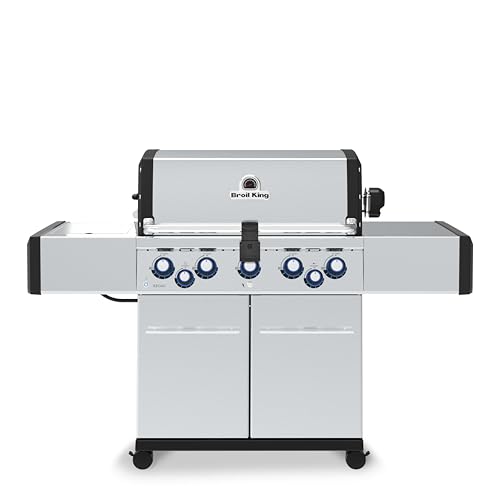
Broil King Regal S 590 Pro — Best Large Freestanding
The Regal S 590 Pro is Broil King’s professional-tier freestanding statement: five burners in a stainless body, in a natural gas configuration that suits homes plumbed for a permanent patio position. It is the large-format alternative for buyers who want flagship scale and Broil King’s even-heat engineering without entering the built-in world.
Strengths
- Five burners give genuine multi-zone control across a large grate
- Natural gas configuration ends tank management for a fixed patio installation
- Stainless Pro-tier construction from a maker known for heat evenness
Trade-offs
- Natural gas only in this configuration — propane households need the sibling model
- Large footprint demands a dedicated patio position
- Premium tier, positioned against the flagship competition
| Burners | 5-burner per Amazon listing |
| Fuel | Natural gas (this configuration) |
| Body | Stainless steel per Amazon listing |
| Verification | ASIN confirmed, 2026-11-20 |
Five burners is a cooking philosophy: it means a sear zone, a roasting zone, and a warming zone can coexist on one grate, which is how restaurant-style throughput happens in a backyard. For the household that grills complete meals — proteins, vegetables, and sides in choreographed sequence — that zoning is worth more than any single accessory.
The natural gas specification deserves emphasis because it shapes the installation: a plumbed line, a fixed position, and then a lifetime without tanks, refills, or the mid-cook empty-tank discovery. If your patio plan is permanent and your house offers the stub-out, the Regal’s configuration is the set-and-forget choice in this roundup.
Broil King’s support and parts posture in North America is strong, and the Regal line is its flagship — buy it as the decade grill it is intended to be, with a cover and a maintenance rhythm to match.
Best for: Large households with natural gas plumbed to a permanent patio position / Not suited for: Propane users or small patios
Check the current price on Amazon
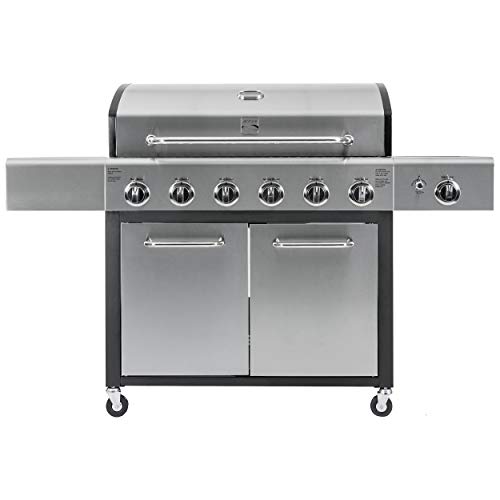
Kenmore 6-Burner Stainless Cabinet Grill — Best Big Stainless Value
The Kenmore brings the all-stainless look and big-grill format to a mainstream tier: six burners plus a side burner, a stainless steel cabinet body, cast iron cooking grates, and output rated at 73,000 BTU in the verified listing. For buyers whose priority is maximum grill — burners, area, presence — at an accessible price, it is the volume answer in this guide.
Strengths
- Six main burners plus a side burner — the most cooking zones in this roundup
- Stainless cabinet construction gives the premium look at a mainstream tier
- High total output suits large gatherings and full-grate cooking
Trade-offs
- Cast iron grates rather than stainless — excellent searing, but they need seasoning care to resist rust
- Material gauges and finish refinement sit below the premium built-in tier
- Long-term parts support is less certain than the specialist brands’
| Burners | 6-burner plus side burner per Amazon listing |
| Output | 73,000 BTU per Amazon listing |
| Grates | Cast iron per Amazon listing |
| Verification | ASIN confirmed, 2026-11-20 |
Honesty about the grates matters, because they define this grill’s maintenance personality. Cast iron sears superbly — many cooks prefer its heat retention — but it is not stainless, and it asks for the classic cast iron courtesies: keep it oiled, burn off residue, and do not let it sit wet under a cover in humid weather. Buyers happy with that rhythm get a lot of grill for the money; buyers who chose stainless specifically to avoid grate care should look up-tier.
As a gathering machine, the Kenmore’s arithmetic is hard to argue with: six zones let a single cook run burgers, chicken, vegetables, and a side burner pot simultaneously, which is the actual shape of feeding fifteen people. The stainless cabinet keeps the presentation premium while the party lasts.
Choose the Kenmore if your priority is maximum capacity and the stainless look on a mainstream budget, and you accept cast iron grate care as the trade. It is the volume pick, honestly labeled.
Best for: Big gatherings and maximum burner count on a mainstream budget / Not suited for: Buyers who want stainless grates and zero grate maintenance
Check the current price on Amazon
Comparison Table
Three built-ins, two freestanding flagships, one value giant. Match the format to your project first; the tier follows. If you are cross-shopping between the two stainless guides on this site, note that this one weights permanence and built-in duty, while the gas-specific guide weights freestanding value across more tiers.
| Pick | Badge | Key spec | Best for |
|---|---|---|---|
| Blaze LTE PRO 32 | Best Overall Built-In | 304 stainless, rear infrared, rotisserie kit | Outdoor kitchens built for the long term |
| Bull Angus | Best for Outdoor Kitchens | 75,000 BTU built-in head | High-volume island entertaining |
| Napoleon Built-In 500 | Best Marine-Grade | Marine-grade stainless, 7.5 mm grids | Coastal and lakeside islands |
| Weber Summit FS38 | Best Freestanding | Infrared broiler, rotisserie, smoker box | Flagship cooking without an island |
| Broil King Regal S 590 Pro | Best Large Freestanding | 5 burners, natural gas, stainless | Permanent plumbed patio installations |
| Kenmore 6-Burner | Best Big Stainless Value | 6 burners + side burner, 73,000 BTU | Maximum capacity on a budget |
How to Choose an All Stainless Steel Grill
Decide the format before anything else, because it decides the project. A built-in head is a component of an outdoor kitchen — budget the island, the utilities, and the installation around it. A freestanding grill is an appliance — budget the grill, a cover, and fuel. Buyers who blur this distinction end up with a grill head in a garage or an island designed around a cart grill, and both are expensive ways to learn it.
Next, read materials like an inspector. The listings that state a grade — 304, marine-grade — are telling you something; the ones that say only “stainless steel construction” are telling you something else. Confirm that burners and grates are stainless, ask about the firebox, and treat the hood and doors as the cosmetic layer they are. In coastal installations, grade is not a luxury: it is the difference between a five-year finish and a twenty-year one.
Then match power and size to your gatherings, honestly averaged. Most grilling is for four to six people; most islands are built for the four weekends a year when twenty arrive. A 32-inch head with strong output handles both realities better than an oversized head loafing at partial loads, and it leaves island budget for the refrigeration and storage that make outdoor kitchens actually convenient.
Finally, investigate the maker as you would a contractor: warranty schedule in detail, parts availability, and whether outdoor kitchens are their trade or their side line. A permanent appliance deserves a permanent company. The concentration of specialist brands in this guide is the market’s own answer to that investigation.
One more practical check belongs in every built-in decision: confirm who in your area services the brand. Outdoor kitchen dealers install and support the heads they sell, and a grill that can be serviced by the people who installed it lives an easier life than one supported only by a distant call center. Ask the question before the island is built, while the answer can still change your choice — afterward, it can only change your regrets.
How to Plan a Built-In Grill Installation
Start with the manufacturer’s cutout specification for your exact model — width, depth, height, and the required clearances to combustible materials — and design the island around those numbers, never the reverse. Islands are built from non-combustible framing and cladding when a grill head is involved, with ventilation vents placed as the grill and gas codes require: gas appliances in enclosed islands need venting for both combustion air and any leaked gas, and this is licensed-professional territory in most jurisdictions.
Plan the utilities before the structure. The gas line — sized for the grill’s total output, with a shutoff you can reach — and any electrical for lights, igniters, and rotisserie motors must be roughed in before counters close the island’s interior. Access doors beneath the grill are not decoration; they are how the gas connection, the drip tray, and the inevitable service visit happen. Place the grill’s landing zones deliberately: counter space on both sides, because hot platters and raw trays should never compete for one square foot.
Commission the installation like a kitchen, because it is one: leak-test every fitting, verify ignition on every burner, run the grill empty through a full heat cycle to burn off residues, and confirm the hood opens clear of any pergola or structure above. Then register the warranty, photograph the model plate, and file the cutout dimensions — the paperwork that makes a replacement, decades from now, a specification rather than an excavation.
Freestanding buyers have the lighter version of the same discipline: level ground, manufacturer clearances from siding and overhangs, a leak test at connection, a burn-off cycle, and a cover that fits. The rituals scale with the project; the care does not change.
Caring for Stainless in Harsh Environments
All-stainless construction buys resilience, not immunity, and the owners who keep these grills gleaming follow a short liturgy. Clean with the grain, always — cross-grain scrubbing leaves visible micro-scratches that catch light and grime. Use non-metallic pads and chloride-free cleaners on the finish, because chlorides are stainless steel’s specific enemy and they hide in pool chemicals, coastal air, and some household sprays. Rinse and dry after cleaning in coastal homes, where salt deposits left on the surface do slow, quiet damage between cooks.
Brush the grates with brass or bristle-free tools rather than carbon-steel bristle brushes, whose shed wires contaminate both the steel and, potentially, the food. Keep the firebox scraped and the grease management emptied; a grill that is clean inside corrodes less, flares less, and tastes better. In winter climates, a breathable cover and a mid-season check for trapped moisture extend life more than any product you can spray on the finish.
Do this and the premise of the category fulfills itself: a grill whose fifth year looks like its first, whose tenth year is a matter of burners and igniters rather than structure, and whose presence in the yard or the island reads as permanence — which is what “all stainless” was always really selling.
The Anatomy of a Built-In Grill Head
Understanding what you are buying helps explain the prices in this category. A built-in head is not a cart grill with the cart removed; its firebox is a fully welded or heavily formed stainless enclosure designed to sit inside a structure, shed heat safely to its clearances, and be serviced from the front for decades. The burners beneath the grates are typically cast or heavy tubular stainless, engineered for even output across a wide grate and for replacement without disturbing the island. Above them sit the heat-management components — sear plates, briquettes, or tents — that turn dripping fat into flavor vapor while shielding the burners from corrosion.
The hood is engineering, not a lid: counterbalanced or assisted on the better heads, double-lined on many to hold heat and protect the outer finish from discoloration, and fitted with a thermometer that — as always — reads hood air rather than grate temperature. The control panel’s valves and ignition are the service frontier; quality heads use components rated for outdoor permanence and reachable through the front or the access doors below. Even the drip tray is designed for the format: full-width, removable from the front, because an island does not let you walk around back.
When you compare heads, compare these systems rather than the silhouette. Two grills can share a width and a burner count while differing in every way that decides a twenty-year outcome: firebox construction, burner material, service access, and the maker’s commitment to the format. The picks in this guide were chosen at the level of these systems, which is why they cluster among the specialist brands.
Heat, Output, and What the Big Numbers Do Not Tell You
Total BTU figures are the most quoted and least informative numbers in grilling. They sum every burner at full throttle — including side and rear burners you may not use — and say nothing about how evenly that heat reaches the food or how well the grill holds temperature with the lid down and a cold load on the grate. A well-designed 4-burner head with quality burners and heavy grates will out-cook a higher-BTU grill with thin components and poor heat distribution, every time, because cooking happens at the food, not at the specification sheet.
What to value instead: burner quality and spacing, grate mass — heavy stainless rods or grids store heat and sear decisively — and the heat-management system between them. Infrared elements deserve their own accounting: a rear infrared burner is the correct tool for rotisserie, and an infrared sear zone delivers temperatures tube burners cannot, but neither substitutes for a sound main array. Judge a grill by the evenness of its grate at temperature — the bread-slice test after purchase, and the maker’s reputation for heat distribution before it.
Recovery is the third hidden variable. Load a grate with a dozen cold burgers and every grill’s temperature dives; the good ones climb back quickly because their burners and firebox are sized and built for the work. Party cooks feel recovery more than any other specification, and it is why the high-output heads in this guide — the Angus in particular — earn their numbers in practice rather than merely printing them.
The Long View: Renovation, Resale, and Permanence
An all-stainless grill, and especially a built-in one, participates in your home’s value story in a way seasonal appliances do not. A well-kept outdoor kitchen with a quality stainless head is a listing feature and a lifestyle argument to the next buyer; a rusted cart grill is a removal task. Even freestanding flagships participate modestly in this logic — a gleaming Summit on a maintained patio signals a cared-for home, which is the quiet currency of resale.
Permanence cuts the other way too, and honest planning admits it: an island commits a yard’s layout, and tastes and families change. The mitigation is to build islands with standard cutouts where possible — the common widths the industry repeats — so a future head swap is a purchase rather than a demolition. Keep the cutout documentation with the house’s papers, and the permanence you build today stays an asset instead of becoming a constraint.
None of this should inflate a grill purchase into a real-estate strategy. Buy the grill for the cooking you will do, in the format your life supports, from a maker who will answer for it in a decade. If it also happens to gleam in the listing photos someday, that is the category keeping its oldest promise: things built properly remain valuable.
Accessories That Complete an Outdoor Kitchen
A grill head alone does not make an outdoor kitchen, and the accessories worth budgeting alongside it follow a clear hierarchy. First, access doors or drawers beneath the grill — for the gas shutoff, the drip management, storage, and service access — are close to mandatory in an island build. Second, a fitted cover sized to the head protects the investment between cooks; in built-in installations, the cover is also what keeps water and debris out of the island’s interior through the grill opening. Third, a rotisserie kit, where not included, unlocks the rear burner’s purpose and pays for itself in Sunday chickens.
Beyond the essentials, spend in the order you will feel it: task lighting for evening cooking, a side burner or power burner if your cooking style boils and sears outdoors in volume, and refrigeration only if your entertaining truly stages food outside for hours. Skip the decorative until the functional list is complete — an island with doors, light, and a working rotisserie but plain finishes serves its owners better than a showcase with a grill head and nowhere to set a platter. The grill is the heart of the installation, but kitchens, indoors or out, succeed on workflow.
Common Buying Mistakes
The all-stainless category punishes a specific set of errors:
- Designing an island before confirming the grill head’s exact cutout and clearance specifications.
- Paying for marine-grade or 304 construction in a dry inland garage-kept context — or skipping it at the coast.
- Assuming a grill head includes the island, the gas work, or the doors beneath it.
- Choosing output by the biggest number rather than by your real gatherings and zone needs.
- Neglecting island ventilation and access — the invisible details that decide whether installation is legal, safe, and serviceable.
- Treating stainless as maintenance-free and discovering chloride staining the hard way.
- Forgetting the landing space: an island designed around the grill alone, with nowhere to set a raw tray or a finished platter, fails its first real cookout no matter how fine the grill head is.
Format first, materials second, maker third — in that order, this category rewards its buyers for decades. And if you are inheriting an island with an existing cutout, measure it three times and shop by those dimensions with the same rigor: the used-island buyer who matches a head to a documented cutout saves an entire construction budget, while the one who assumes “standard size” learns that the industry has several.
Final Recommendation
For an outdoor kitchen built to last, the Blaze LTE PRO 32 is this guide’s anchor pick — 304 construction, full features, and warranty confidence — with the Bull Angus as the high-power, single-ecosystem alternative and the Napoleon Built-In 500 as the coastal specialist in marine-grade steel. If two finalists remain tied after the format and materials checks, let local service decide: the head your area’s dealers install and support is the head that will still be cooking, with factory parts, long after a marginally prettier rival has become an orphan in a market that rewards the brands who stay.
Freestanding buyers should take the Weber Summit FS38 for flagship versatility or the Broil King Regal S 590 Pro for a large natural-gas installation, and value hunters who want the stainless look at maximum scale should look at the Kenmore 6-Burner with clear eyes about its cast iron grates. Build the project around the grill you choose — never the reverse — and the result will outlast every other appliance in the yard. That is the quiet truth of this category: chosen well, it is the last grill decision you make for a very long time, and every season afterward is just cooking.
Related reading on this site: Best All Stainless Steel Grills; Best All Stainless Steel Gas Grills; Best American Gas Grills; Best Aluminum Gas Grills; Best Gas Grills; Best Grills.
Frequently Asked Questions
What does “marine-grade” stainless actually mean?
It refers to stainless formulated for salt-water environments, with superior resistance to the pitting and crevice corrosion that chlorides cause. Around coasts and marinas it is the difference between a finish that lasts and one that freckles. Inland, it is insurance you may never claim on — valuable mainly if your grill will ever live near salt air. As a rule of thumb, if your car and your outdoor furniture show salt’s effects, your grill will too, and marine-grade specification stops being a luxury and becomes the baseline for anything built into masonry.
Can I put a freestanding grill into an island?
No — cart grills are not designed or warranted for enclosed installation; they vent heat and combustion products in ways islands obstruct, and clearances differ fundamentally. Buy a proper built-in head for an island, and keep freestanding grills freestanding. Some manufacturers sell specific models convertible between cart and built-in use; those are engineered exceptions, clearly documented as such. The reverse mistake is equally real: a built-in head needs an island or a proper cart, and improvising a stand for one creates the same clearance and stability problems from the other direction. Format is a safety specification, not a styling preference.
How big a built-in grill do I need?
For most households, a 32-inch, four-burner head is the sweet spot: full family capacity, proper zoning, and island budget left for the amenities that make the kitchen work. Go larger only if your gatherings regularly exceed what a 32-inch grate holds in one load — measure by your real parties, not your biggest one. A practical sizing trick: lay out your largest regular cook on your current grill or a sheet of cardboard cut to the grate dimensions you are considering. Paper does not sear, but it measures honestly, and it has saved many islands from housing a grill sized for a wedding the owners host once a decade.
Is stainless steel magnetic?
It depends on the grade: 430 stainless is magnetic, while 304 is generally not — which is why the magnet test is a rough field check for grade on panels. It is a clue, not a certification; the manufacturer’s stated specification remains the authority, and listings that state the grade plainly deserve more trust than showroom tests. Note also that cold working can make even 304 slightly magnetic at bends and corners, so a weak attraction at a folded edge does not convict a panel of being 430 — use the test on flat expanses, and treat the results as one input among several.
Do stainless grills need covers if the steel cannot rust?
Yes. Covers protect against more than rust: they keep water out of ignition systems and seams, block pollen, sap, and bird contributions, and slow the chloride deposition that stains finishes at the coast. A breathable, fitted cover is the cheapest longevity measure for any grill in this guide. For built-in heads, choose a cover made for the head’s dimensions that sheds water away from the island’s interior, and lift it occasionally in humid spells to confirm nothing damp is living underneath — two minutes of inspection that protects both the grill and the structure around it.
What wears out first on an all-stainless grill?
Igniters, then heat-management parts and burners over a longer horizon — the consumables of any gas grill. The structure is the last thing to go, which is precisely the category’s promise. Buy from makers who stock those parts and publish the diagrams, and wear becomes maintenance instead of mortality. A sensible owner budgets trivially for this: an igniter or a set of heat plates every several years is the rent a permanent grill charges, and it is a fraction of what replacing a lesser grill costs on the same schedule.


