Disclosure: airfryerkitchensupply.com is reader-supported. When you buy through links on our site, we may earn an affiliate commission at no extra cost to you.
Where to buy
If you are shopping for the best affordable grills, start with the verified shortlist below — every model on it was confirmed against a live Amazon listing before it earned a place here, and the list deliberately mixes fuel types so you can compare charcoal, gas, pellet, and electric side by side at the affordable end of the market.
Affordable means different things per fuel: a charcoal kettle can be genuinely cheap to buy and run, a two- or three-burner gas grill costs more up front but lights in seconds, and pellet and electric models trade raw searing power for convenience. Confirm the exact configuration on the listing before ordering and check the current price on Amazon, because burners, grate materials, and included stands vary by production run.
- Weber Original Kettle Charcoal Grill, 22-Inch (Best Overall Value) — Check the current price on Amazon
- Charbroil Classic 3-Burner Propane Gas Grill (Best Budget Gas Grill) — Check the current price on Amazon
- Charbroil Classic 2-Burner Propane Gas Grill (Best for Small Patios) — Check the current price on Amazon
- Z Grills ZPG 550B2 Pellet Smoker Grill (Best Affordable Pellet Grill) — Check the current price on Amazon
- George Foreman Indoor/Outdoor Electric Grill with Stand, 15-Serving (Best Balcony-Legal Electric) — Check the current price on Amazon
- Pit Boss 440 Mahogany Series Pellet Grill & Smoker (Best for Low-and-Slow Capacity) — Check the current price on Amazon
Finding the best affordable grills is less about chasing the lowest sticker and more about refusing to pay for the wrong things. At the affordable end of the market you give up thick stainless fireboxes, rotisserie burners, and app-connected everything — but you do not have to give up a real sear, honest temperature control, or a grill that is still lighting reliably three summers from now. The six picks in this guide were chosen because each one spends its budget on the parts that decide how food actually cooks: the grate, the burner or fire management, and a lid that seals well enough to hold heat where you want it.
The list is intentionally mixed-fuel. A charcoal kettle is the cheapest route to genuine high-heat searing and smoke flavor, and it has no burners, igniters, or valves to fail. A compact propane grill costs more but removes the lighting ritual entirely, which is why so many weeknight cooks end up using a modest gas grill more often than the big charcoal rig they dreamed about. Pellet grills appear here in their smallest, simplest form — set-and-forget temperature control is no longer a premium-only feature — and one large electric model covers balconies and patios where open flame is banned outright.
What affordable should never mean is disposable. Thin stamped-steel gas grills with mystery burners are the false economy of this category: they cook unevenly from the first month and rust through in two seasons. Every pick below comes from a maker with replacement parts actually available, and the reviews are blunt about where each model cuts corners — because at this end of the market, knowing exactly which corner was cut is how you decide whether you can live with it.
In this guide
Quick Picks
Weber Original Kettle Charcoal Grill, 22-Inch — Best Overall Value. The cheapest way to own a grill that sears like a much more expensive machine, with decades of parts support behind it.
Charbroil Classic 3-Burner Propane Gas Grill — Best Budget Gas Grill. Three burners and a family-size grate at the entry point of cart gas grilling, with side shelves included.
Charbroil Classic 2-Burner Propane Gas Grill — Best for Small Patios. The same budget formula shrunk for balconies and small patios, still with shelves and a real two-zone layout.
Z Grills ZPG 550B2 Pellet Smoker Grill — Best Affordable Pellet Grill. PID temperature control and 553 square inches at the entry point of pellet grilling — set it and walk away.
George Foreman Indoor/Outdoor Electric Grill with Stand, 15-Serving — Best Balcony-Legal Electric. A big electric grill on a stand that lifts off for tabletop use — the affordable answer where flame is banned.
Pit Boss 440 Mahogany Series Pellet Grill & Smoker — Best for Low-and-Slow Capacity. A compact pellet grill with a flame broiler for direct-fire finishing — but read the hopper note before buying.
How These Picks Were Chosen
Each candidate was verified against a live Amazon listing on the day this guide was written, and only models whose listing title matched the product we intended to recommend were kept. That verification step matters more at the affordable end than anywhere else, because budget grill listings are notorious for swapped photos, recycled model numbers, and configurations that changed between production runs.
The scoring criteria were cost of ownership rather than sticker alone. For charcoal, that means grate quality, vent control, and ash management. For gas, burner material, heat distribution across the grate, and whether the grease system is a removable tray or a rust-prone funnel. For pellet grills, controller type and hopper size relative to cook length. For electric, true wattage and whether the grill reaches searing temperature or merely warms food outdoors. Assembly time, parts availability, and how honestly each maker publishes specifications were all weighed.
Six picks survived, one per realistic affordable scenario: cheapest real sear, cheapest gas convenience, smallest patio footprint, cheapest pellet automation, cheapest balcony-legal electric, and cheapest route to low-and-slow smoking with real capacity. If none of those scenarios sounds like yours, the buying guide further down explains how to judge any other affordable grill you find using the same criteria.
A final methodological note: this guide deliberately contains no prices and no star ratings, because both go stale and both mislead. Prices in this category move with seasons and sales; the live listing is the only honest price, which is why every pick links out with a prompt to check it. Ratings counts reward age and marketing as much as quality. What does not go stale is construction, fuel economics, and parts support — the things this guide graded — because they are properties of the grill, not of the week it was sold in.
The 6 Best Affordable Grills

Weber Original Kettle Charcoal Grill, 22-Inch — Best Overall Value
The 22-inch Weber kettle is the default answer to affordable grilling for a reason: the design has been refined for decades, the porcelain-enamel bowl shrugs off weather, and the cooking grate is big enough for a family cookout or a two-zone fire with room to spare. It suits anyone willing to light charcoal in exchange for the best heat and flavor per dollar in this entire guide.
Strengths
- Genuine high-heat searing that budget gas grills cannot match
- One-Touch system sweeps ash into a removable catcher, so cleanup takes seconds
- Replacement grates, dampers, and parts are everywhere and inexpensive
Trade-offs
- No gas-style convenience: lighting and temperature control are manual skills
- No side shelves or storage on the base configuration
- Legs and wheels are functional rather than sturdy-feeling
| Fuel | Charcoal |
| Size | 22-inch kettle |
| Cleaning | One-Touch ash sweeping system (from Amazon title) |
What makes the kettle the value benchmark is thermal honesty. The deep bowl holds a full chimney of coals without the grate sitting inches from the fire, the dampers actually change the temperature when you move them, and the lid seals well enough for indirect cooking — ribs, whole chickens, even a small brisket flat with a two-zone setup. Budget gas grills at similar money cook with hot spots and flare-ups; the kettle cooks the way you arrange the coals, which is a skill, but a learnable and rewarding one. If your affordable grill budget can only stretch to one machine and you cook on weekends, this is the one that will still be earning its patio space in ten years.
Best for: weekend cooks who want real sear and smoke flavor for the least money / Not suited for: anyone who wants push-button weeknight convenience
Check the current price on Amazon

Charbroil Classic 3-Burner Propane Gas Grill — Best Budget Gas Grill
This is the affordable gas grill most households actually need: three burners under 360 square inches of porcelain-coated grate, side shelves for a tray and a drink, and a compact cart that fits a normal patio. It suits buyers who want to press a button on a Tuesday and grill burgers, chicken thighs, and vegetables without a charcoal ritual.
Strengths
- Three burners allow a genuine two-zone setup, unlike most two-burner budget rivals
- 360 sq. in. handles a family cookout without juggling batches
- Side shelves add the prep space small grills usually omit
Trade-offs
- Porcelain-coated grates need gentle cleaning to protect the coating
- Thin firebox loses heat in wind and cold weather
- Assembly is a multi-hour job with many small parts
| Fuel | Propane |
| Output | 30,000 BTU (from Amazon title) |
| Cooking area | 360 sq. in. (from Amazon title) |
| Grates | Porcelain-coated (from Amazon title) |
The honest way to judge a budget three-burner is heat distribution, and the Classic’s layout — three straight burners across a moderately sized grate — is easier to cook evenly on than the single H-burner designs that plague this tier. Output per square inch is modest, so preheating with the lid down is not optional, and thick steaks benefit from a cast-iron pan assist or a long rest at room temperature. Treat the porcelain grates kindly, keep the grease tray emptied, and this is a three-to-five-season grill that cooks far above its tier on weeknights, which is exactly the job it was bought for.
Best for: families wanting push-button gas convenience at the lowest sensible tier / Not suited for: high-heat steak specialists or anyone cooking in exposed, windy spots
Check the current price on Amazon

Charbroil Classic 2-Burner Propane Gas Grill — Best for Small Patios
Couples and small households do not need 500 square inches of grate, and this two-burner Classic proves it: 280 square inches is enough for four burgers and corn, or a spatchcock chicken with vegetables around it, in a footprint that leaves a small patio usable. It suits apartment and townhouse cooks whose building allows gas grills.
Strengths
- Compact cart footprint suits balconies and small patios
- Two burners still allow indirect cooking with one side off
- Lower fuel use per cook than larger budget grills
Trade-offs
- 280 sq. in. fills up fast when guests arrive
- Same porcelain-grate care requirements as its bigger sibling
- No cabinet storage; the tank sits exposed on the cart
| Fuel | Propane |
| Output | 20,000 BTU (from Amazon title) |
| Cooking area | 280 sq. in. (from Amazon title) |
Small grills fail in two predictable ways: they are too weak to sear, or so cramped that everything steams. With 20,000 BTU under a modest grate, this one concentrates its output better than oversized budget grills do, and a proper preheat produces respectable grill marks on burgers, sausages, and chicken. The discipline it demands is batch cooking — cook proteins first, rest them tented, then grill the vegetables — which is a reasonable trade for a grill that does not dominate the patio. Check your building rules first: some balconies ban propane entirely, in which case the electric pick in this guide is your answer instead.
Best for: couples and small households with limited patio space / Not suited for: anyone who regularly cooks for six or more people
Check the current price on Amazon

Z Grills ZPG 550B2 Pellet Smoker Grill — Best Affordable Pellet Grill
Pellet grills used to start at prices that made ‘affordable pellet grill’ a contradiction. The ZPG 550B2 is the model that broke that pattern for this guide: a PID controller that holds temperature the way an oven does, 553 square inches of cooking space, and a meat probe in the box. It suits cooks who want smoked ribs and brisket without tending a fire for six hours.
Strengths
- PID controller holds set temperatures far steadier than basic dial controllers
- 553 sq. in. fits a brisket or multiple racks of ribs
- Meat probe included, so doneness is measured rather than guessed
Trade-offs
- Pellet grills sear weakly compared with charcoal or gas; plan a cast-iron finish for steaks
- Hopper capacity suits cooks of several hours; very long smokes need a top-up
- Auger and electronics add failure points a kettle simply does not have
| Fuel | Wood pellets |
| Controller | PID with LCD, auto temperature control (from Amazon title) |
| Cooking area | 553 sq. in. (from Amazon title) |
| Probe | Meat probe included (from Amazon title) |
The cooking case for an affordable pellet grill is consistency. Dial in a low temperature in the morning and the controller meters pellets to hold it, which turns brisket, pork shoulder, and ribs from an all-day fire-tending project into a mostly hands-off one — and the gentle wood smoke flavor is the point of the exercise. Where you must be honest with yourself is searing: like nearly all pellet grills, this one tops out at temperatures that roast well but do not crust a steak the way charcoal does. Pair it with a cast-iron skillet for finishing and it covers weeknight roasting and weekend smoking in one footprint, at the lowest pellet entry price we could verify.
Best for: smoking and roasting fans who want set-and-forget temperature control / Not suited for: sear-first steak cooks or anyone without a covered spot for pellets and electronics
Check the current price on Amazon
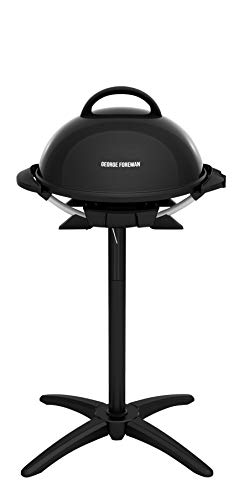
George Foreman Indoor/Outdoor Electric Grill with Stand, 15-Serving — Best Balcony-Legal Electric
When the lease, the HOA, or the fire code says no charcoal and no propane, the question stops being which grill is best and becomes which electric grill is big enough to matter. This George Foreman answers with a 15-serving domed cooking surface on a stand that removes for countertop use, indoors or out. It suits balcony cooks, dorm-adjacent living, and anyone whose grill must plug in.
Strengths
- Legal almost everywhere flame grills are banned
- Stand removes, so it works on a balcony or a kitchen counter
- Domed lid fits thicker cuts and whole chickens better than flat contact grills
Trade-offs
- Electric heat cannot match charcoal or gas searing intensity
- Needs a nearby outlet and dislikes extension-cord improvisation
- Nonstick surface requires non-metal utensils and gentle washing
| Fuel | Electric (standard outlet) |
| Capacity | 15-serving (from Amazon title) |
| Stand | Removable stand for indoor or outdoor use (from Amazon title) |
Judge this grill against other electrics, not against a kettle, and it wins its category on size and flexibility. The dome is the detail that matters: flat sandwich-style grills crush food and cannot take a thick chicken breast, while this one cooks with convective space under the lid. Temperature control is a simple dial and recovery after you lift the lid is slower than gas, so cook in smaller batches and keep the lid closed. Within those rules it produces genuinely grilled-tasting burgers, kebabs, and vegetables — and it does so in buildings where the alternative is no grilled food at all.
Best for: apartment and condo cooks banned from using flame grills / Not suited for: anyone with a yard who can run charcoal or gas instead
Check the current price on Amazon

Pit Boss 440 Mahogany Series Pellet Grill & Smoker — Best for Low-and-Slow Capacity
The Pit Boss 440 is the traditional alternative to the Z Grills pick: a compact pellet grill from the category’s value brand, with an LED digital controller, a 180–500°F range, and Pit Boss’s signature flame broiler — a sliding plate that exposes food to direct flame for finishing. It suits smaller patios and cooks who smoke for two to four people.
Strengths
- Flame broiler adds direct-fire finishing most pellet grills cannot offer
- Wide 180–500°F range covers smoking through roasting
- Compact footprint for a full pellet grill
Trade-offs
- The 5 lb hopper is small: long overnight smokes will need refilling
- LED controller is a step behind PID units for temperature swing
- Mahogany-look finish shows scratches more than plain black
| Fuel | Wood pellets |
| Cooking area | 518 sq. in. (from Amazon title) |
| Temperature range | 180°F to 500°F (from Amazon title) |
| Hopper | 5 lb (from Amazon title) |
This pick comes with the most important honesty note in the guide: a 5-pound hopper is fine for ribs, chicken, and evening cooks, but a brisket that runs ten hours will burn through it, so overnight unattended smoking is not this grill’s game unless you set an alarm to refill. Within that limit it is a strong compact smoker, and the flame broiler genuinely changes what a pellet grill can do — burgers and sausages can finish over open flame instead of tasting purely roasted. Choose it for capacity per patio inch and the broiler; choose the Z Grills above for controller precision and longer unattended cooks.
Best for: small-patio cooks who want pellet smoking plus a direct-flame finish / Not suited for: overnight brisket cooks who will not refill a small hopper
Check the current price on Amazon
Comparison Table
| Pick | Badge | Key spec | Best for |
|---|---|---|---|
| Weber Original Kettle Charcoal Grill, 22-Inch | Best Overall Value | 22-inch charcoal kettle, One-Touch ash cleaning | weekend cooks who want real sear and smoke flavor for the least money |
| Charbroil Classic 3-Burner Propane Gas Grill | Best Budget Gas Grill | 3 burners, 30,000 BTU, 360 sq. in. cooking area | families wanting push-button gas convenience at the lowest sensible tier |
| Charbroil Classic 2-Burner Propane Gas Grill | Best for Small Patios | 2 burners, 20,000 BTU, 280 sq. in. cooking area | couples and small households with limited patio space |
| Z Grills ZPG 550B2 Pellet Smoker Grill | Best Affordable Pellet Grill | PID controller, 553 sq. in., meat probe included | smoking and roasting fans who want set-and-forget temperature control |
| George Foreman Indoor/Outdoor Electric Grill with Stand, 15-Serving | Best Balcony-Legal Electric | Electric, 15-serving surface, removable stand | apartment and condo cooks banned from using flame grills |
| Pit Boss 440 Mahogany Series Pellet Grill & Smoker | Best for Low-and-Slow Capacity | 518 sq. in., 180–500°F range, flame broiler, 5 lb hopper | small-patio cooks who want pellet smoking plus a direct-flame finish |
How to Choose the Best Affordable Grills for Your Space and Fuel
Affordable grills reward buyers who decide the fuel question first and the brand question last. Work through the four decisions below in order — fuel, size, construction, and running costs — and the right model usually identifies itself.
Fuel decides flavor, convenience, and where you may cook
Charcoal delivers the strongest sear and real smoke flavor for the least purchase money, and asks for lighting time and ash cleanup in return. Propane is the convenience fuel: instant ignition, fast preheat, and easy two-zone cooking, at a higher purchase price and with tank refills to manage. Pellets automate temperature and add wood smoke, but need electricity, dry pellet storage, and accept a weaker sear. Electric is the permission fuel — the only option in many apartments — with the gentlest heat of the four. None of these is objectively best; the best affordable grill is the one whose fuel your space allows and whose routine you will actually follow on a Tuesday night.
Size the grate to your real headcount, not your biggest party
Manufacturers quote total cooking area including warming racks, which inflates the number. Look at the primary grate: roughly 100 square inches per person is a workable planning figure for mixed grilling. A couple needs 250–300 square inches; a family of five, 400 or more. Oversizing an affordable grill is a hidden cost — big cheap grills have weak burners spread thin, slow preheats, and worse hot spots than a smaller model at the same money. Buy for the forty ordinary cooks, and handle the two big parties a year with batch cooking or a borrowed second grill.
Construction tells you the lifespan before the warranty does
At this tier, look for a porcelain-enameled steel bowl or firebox rather than bare painted steel, burners in stainless or cast aluminum rather than thin stamped steel, and grates with some heft — porcelain-coated steel at minimum, cast iron if the budget stretches. Lids should sit flush without rocking; a wobbly lid leaks the heat you paid for. Wheels and legs are where budget grills feel cheapest, and that is acceptable — a grill that cooks well on slightly spindly legs beats a sturdy cart wrapped around a bad firebox. Finally, check that the maker sells replacement burners, grates, and igniters; a grill you can repair is affordable, and one you cannot is a subscription.
Count running costs before you call a grill cheap
Charcoal costs per cook are low but constant; a kettle’s lifetime fuel bill exceeds its purchase price many times over, which is still fine because the entry price is so low. Propane refills are predictable and a tank lasts many cooks. Pellets are the priciest fuel per hour and must be kept dry — a ruined bag of swollen pellets is a real and common loss. Electric is cheapest to run and needs no fuel storage at all. None of this should scare you off any fuel; it should simply be priced into the word affordable before you order, not discovered after.
Reading a budget grill listing like a reviewer
Listings at this tier reward skeptical reading. Confirm the fuel and configuration in the title words — not the photo, which is routinely shared across versions. Check whether the headline cooking area includes a warming rack, whether the ‘included’ cover or probe is actually in the box contents, and whether the grate material named in the specifications matches the one in the marketing copy. Every pick in this guide passed that reading; apply the same three checks to anything else and most of the category’s disappointments eliminate themselves.
When to buy: the calendar of grill value
Grills are seasonal products, and the affordable tier gets more affordable on a schedule: late-season clearances in early autumn, the holiday window (this program’s Traeger sale guide covers that pattern in depth), and early-spring promotions when new model years arrive. A buyer who can wait for one of those windows often steps up a full quality tier for the same money. A buyer who cannot wait should buy the repairable grill from a real maker at its ordinary price — that purchase beats a discounted disposable in every month of the year.
What ‘Affordable’ Should Never Cost You: Heat, Safety, and Parts
There is a floor below which a grill stops being a bargain and becomes a hazard or a chore, and it is worth naming the three things that floor protects. The first is heat where you need it. A grill that cannot preheat its grate properly will steam meat instead of searing it, and no recipe fixes physics. Every pick in this guide was chosen because its output is concentrated enough for its grate size — which is why you will not find a giant five-burner bargain-bin cart here: spreading a weak burner set across a huge grate is how cheap grills fake value.
The second is basic safety engineering. Gas grills need a grease path that ends in a removable, cleanable tray — grease that pools in a firebox is a flare-up waiting for a fatty cook. All grills need stable footing; a top-heavy cart on two small wheels is a tip risk around children and dogs. Pellet grills need their electronics kept dry and their fire pot vacuumed of ash on schedule, because ash buildup is the leading cause of pellet grill flameouts and hopper fires. None of the picks here asks you to accept a design that fails these basics.
The third is parts. Burners rot, igniters die, grates wear — on every grill at every price. The affordable grill that stays affordable is the one whose maker stocks those parts at sane prices years later. Weber, Char-Broil, Pit Boss, and Z Grills all maintain real parts channels, which is a quiet reason this list looks brand-conservative. An unknown badge with a slightly bigger grate and no parts catalog is the most expensive grill you can buy; you just pay for it in year three, all at once, by replacing the whole machine.
Accessories That Earn Their Money (and the Ones That Do Not)
An affordable grill plus the right three accessories outperforms a mid-range grill standing bare, which is why this section exists. The first accessory is a cover fitted to your grill’s shape — not for looks, but because weather is the leading cause of death in this category, ahead of use by a wide margin. The second is an instant-read thermometer. Every technique in this guide — two-zone cooking, pellet smoking, indoor grilling — resolves to internal temperature, and a thermometer converts guesswork into repeatability for less than the cost of one ruined brisket. The third depends on your fuel: a chimney starter for charcoal, a spare tank gauge for propane, a sealed pellet bin for pellet grills, a heavy-gauge short cord for electric.
The accessories that do not earn their money at this tier are equally predictable. Grill-top pizza ovens and elaborate multi-tools duplicate what a cast-iron pan and a good pair of tongs already do. Cheap wireless probe sets with unreliable connections teach you to distrust the one instrument you must trust. Decorative lights, branded aprons, and Bluetooth speakers shaped like flames are gifts, not equipment. Spend the accessory budget in the order the food notices: protection from weather, measurement of temperature, fuel management — then stop, and let the grill itself be the hobby.
One more accessory deserves its own sentence because it changes what affordable grills can cook: a heavy cast-iron skillet or plancha that lives with the grill. On gas it becomes the sear station the burners cannot be; on a pellet grill it is the steak finish; on a kettle it is breakfast. It costs little, lasts forever, requires no parts, and quietly closes the performance gap between the affordable picks in this guide and grills costing several times more. If you buy one thing beyond the grill, buy that.
Storage is the unglamorous final accessory decision. Affordable grills live longer under a roofline, in a garage corner, or under a quality cover on a sheltered side of the patio. Charcoal and pellets must live dry regardless — a sealed bin is not optional equipment for either fuel. Electric grills should come in from the worst weather entirely. None of this is shopping, exactly; it is the environment you build around the purchase, and it decides whether ‘affordable’ describes your grill’s price or its lifespan.
A Year of Affordable Grilling: Cooking With the Seasons
An affordable grill earns its keep across a calendar, not a summer, and the cooks who get the most from one plan loosely by season. Spring is for calibration: the first cooks after winter are when you relearn your grill’s hot spots, check its parts, and cook the forgiving foods — sausages, chicken thighs, asparagus and the first corn — that forgive you back. It is also the season when last year’s habits get audited: the grate that needed replacing, the technique you meant to learn. Start the year deliberately and the grill feels new again, which, mechanically, it nearly is.
Summer is volume season, and its lesson is throughput. The affordable grill’s answer to a crowd is not size but sequencing: dense, slow items first, quick items last, the warming zone or the cool side of a two-zone fire working as a holding oven. Summer is also when fuel economics show up — charcoal and pellet buyers feel consumption, propane buyers feel tank swaps — and when the cover discipline matters most, because a grill used three times a week and left uncovered between cooks ages in dog years.
Autumn is the affordable grill’s finest season and the one beginners miss. Cooler air makes low-and-slow cooking easier to hold, farmers’ markets make the menu, and the year’s accumulated skill cashes out in the cooks that define a grilling household: smoked shoulders for games, roasted birds, charred squash and peppers. It is also the smart buyer’s season — the sales calendar in the buying guide peaks as retailers clear stock — and the season to do the deep clean while the weather still cooperates.
Winter separates the owners from the renters of the grilling life. Every fuel works in the cold with adjustments: longer preheats, sheltered placement, more pellets burned per hour, lids opened less and mourned more. Electric and indoor picks from this guide quietly become the household’s winter grills, which is one more argument for the mixed-fuel thinking this list was built on. The household that grills in February owns its grill; the one that covers it in October is storing it for whoever buys it used. Be the first household — the food is better and the math is unbeatable.
How to Set Up and Run Your First Cook on a New Affordable Grill
Whatever fuel you chose, the first cook follows the same arc: assemble carefully, burn off the factory coatings, learn your hot spots, and only then cook food you care about.
- Assemble on a flat surface with the manual open, and do not fully tighten the leg and cart bolts until the frame is square — budget carts rack easily, and a squared frame stops the wobble that makes cheap grills feel cheaper than they are.
- Gas and pellet models: check every fuel connection before the first ignition. For propane, brush soapy water on the hose and regulator fittings and look for bubbles with the tank valve open. For pellet grills, run the initial priming cycle so the auger is loaded before you set a temperature.
- Do a burn-off: run the grill empty at high heat for 20–30 minutes to clear manufacturing oils, then let it cool. Food cooked before this step tastes like the factory, not the grill.
- Season the grates lightly: wipe cast iron or steel grates with a thin film of high-heat cooking oil while warm. Porcelain-coated grates need no seasoning, just a gentle wash.
- Map your hot spots with the bread test: cover the preheated grate with slices of plain bread for a minute or two and note where they brown fastest. Every affordable grill has a pattern; cooking well on it means using the pattern, not fighting it.
- Cook something forgiving first — sausages, chicken thighs, or burgers — and keep the lid closed as much as the recipe allows. Note how long preheating really took and how the temperature behaved; that notebook page is worth more than any review, including this one.
- After the cook, brush the grate while warm, empty the grease tray or ash catcher once cool, and cover the grill. Affordable grills die from weather and neglect far more often than from use.
From the second cook onward, change one variable at a time — coal arrangement, burner settings, pellet flavor — and you will learn your specific grill’s personality within a month. That familiarity is what people are actually describing when they say a cook ‘knows their grill,’ and it costs nothing but attention.
Common Buying Mistakes
Buying the biggest grate at the lowest price. Spread thin, weak burners and a cavernous thin lid produce the worst cooking in the category. A smaller grill from a real maker cooks better and lasts longer.
Ignoring your building or HOA rules until the grill arrives. Many balconies ban charcoal, some ban propane, and a few ban everything but electric. Check first; the electric pick in this guide exists precisely for that rulebook.
Judging a gas grill by total BTU alone. What matters is output relative to grate area and how evenly the burners cover it. A modest-BTU grill with tight coverage out-cooks a high-BTU grill with gaps.
Skipping the burn-off and the leak check. Factory oils ruin first-cook flavor, and an unchecked propane fitting is a genuine hazard. Twenty minutes of patience protects both dinner and eyebrows.
Storing pellets or charcoal where they get damp. Swollen pellets jam augers and damp charcoal will not light properly. Sealed bins in a dry spot are the cheapest accessory in grilling.
Scraping porcelain grates with aggressive metal tools. Chipped porcelain rusts, and then food sticks forever. Use a nylon or coil brush on coated grates and save the heavy scraper for cast iron.
Final Recommendation
For most buyers, the decision resolves quickly once fuel is settled. If charcoal is allowed where you live and you cook mostly on weekends, the Weber Original Kettle 22-Inch is the best affordable grill in this guide and one of the best values in outdoor cooking, full stop. If weeknight convenience decides it, take the Charbroil Classic 3-Burner for a family or the Classic 2-Burner for a small patio.
If smoking is the dream, the Z Grills ZPG 550B2 gives you PID control and room to work, while the Pit Boss 440 trades hopper size for a flame broiler and a smaller footprint. And if flame is banned where you live, the George Foreman 15-Serving on its stand is the rare electric grill big enough to feed people rather than merely feed a person. Every one of them will cook honestly for years if you keep it covered, keep the grease path clean, and buy the replacement part instead of the replacement grill when something small wears out.
- Weber Original Kettle Charcoal Grill, 22-Inch — Check the current price on Amazon
- Charbroil Classic 3-Burner Propane Gas Grill — Check the current price on Amazon
- Charbroil Classic 2-Burner Propane Gas Grill — Check the current price on Amazon
Keep exploring the grills in this series: Best Affordable Propane Grills Best Affordable Pellet Grills Best Affordable Indoor Grills Best Affordable Natural Gas Grills Best Affordable Electric Grills Best Affordale Grills
Frequently Asked Questions
What is the cheapest type of grill to buy and run?
Charcoal kettles are the cheapest to buy, and a basic 22-inch kettle like the Weber in this guide also has almost nothing to break, so lifetime repair costs are near zero. Per-cook fuel costs are modest for charcoal, propane, and electric alike; pellets are the most expensive fuel per hour. The true cheapest grill is the one that lasts — a slightly better-built model you keep for a decade beats a bargain model replaced every two years.
Can an affordable grill actually sear a steak properly?
Yes, if its heat is concentrated. A charcoal kettle sears superbly at any price because the coals sit close to the grate. Compact gas grills sear well after a full lid-down preheat. Pellet grills are the weakest searers and benefit from a cast-iron skillet finish, and electric grills produce good browning on thinner cuts but struggle with thick steaks. Match the fuel to the food you cook most.
How long should an affordable grill last?
A porcelain-enameled charcoal kettle can last a decade or more with a cover and occasional grate replacement. Budget gas grills typically give three to five seasons before burners or igniters need replacing — which is fine if parts are available, as they are for the brands in this guide. Pellet grills depend on keeping electronics dry; electric grills last longest when stored indoors or under a tight cover.
Is a 2-burner grill big enough for a family?
For a family of four cooking burgers, dogs, and vegetables, yes — around 280 square inches works with simple batch cooking. Families of five or more, or anyone who entertains, should step up to a three-burner or a 22-inch kettle. Remember that headline cooking areas often include the warming rack, so compare primary grate sizes where you can.
What should I verify on the listing before ordering an affordable grill?
Confirm the fuel type (some models are sold in near-identical propane and natural gas versions), the grate material, whether a stand, cover, or probe is actually included, and the assembled dimensions against your patio or balcony. Listings at this tier recycle photos across configurations, so the title and specification table — not the hero image — are what you are buying.
Do I need a cover for a cheap grill?
It is the highest-value accessory you can buy for one. Weather, not cooking, kills affordable grills: rain rusts burners, fills ash catchers, and ruins pellet hoppers. A basic fitted cover, or storing an electric or kettle grill under shelter, routinely doubles the useful life of a budget machine.
Should I buy one versatile grill or two specialized ones?
For most households, one well-chosen grill matched to your main fuel and headcount beats two half-used specialists. The exception is the sear-and-smoke household: a charcoal kettle plus an affordable pellet grill covers both extremes better than any single mid-range machine, and the pair can cost less than one premium do-everything grill. Decide by your two most-cooked meals, not by the full menu of your imagination.
What is the single best first cook on a new affordable grill?
Something fatty, forgiving, and thermometer-friendly: chicken thighs, sausages, or a pork shoulder depending on the fuel. These foods teach you the grill’s heat pattern and timing without punishing small errors, they season a new grate or firebox kindly, and they are nearly impossible to ruin while you learn. Save the expensive steak for the third cook, when the grill’s personality is data instead of mystery.


