Disclosure: airfryerkitchensupply.com is reader-supported. When you buy through links on our site, we may earn an affiliate commission at no extra cost to you.
Where to buy
Charcoal grills look simple, which makes their listings sloppy — diameters confused with cooking area, steel gauges unmentioned, ash systems renamed yearly. Every pick in this guide to the best affordable charcoal grills was verified against its live Amazon listing, so the diameter and configuration in each review is the product that ships. Check the current price on Amazon when you buy; charcoal grill pricing moves with the season like everything else.
- Weber Original Kettle 22-Inch Charcoal Grill — Best Affordable Charcoal Grill. Check the current price on Amazon.
- Weber Original Kettle Premium 22-Inch Charcoal Grill — Best Upgraded Kettle. Check the current price on Amazon.
- Weber Master-Touch 22-Inch Charcoal Grill — Best Premium-Affordable Kettle. Check the current price on Amazon.
- Char-Griller AKORN 20-Inch Kamado Grill — Best Affordable Kamado. Check the current price on Amazon.
- Char-Griller AKORN Jr. Portable Kamado Grill — Best Compact Kamado. Check the current price on Amazon.
- Weber Original Kettle 18-Inch Charcoal Grill — Best Budget Compact. Check the current price on Amazon.
Notice what this list is: three sizes of the classic kettle, two insulated kamados, and nothing else. That is not laziness — at affordable tiers, these are the designs that survive contact with weather and time, and the guide below explains why the rest of the budget charcoal shelf did not make it.
The best affordable charcoal grills live in a category where cheap and excellent overlap more than anywhere else in outdoor cooking. Charcoal hardware is simple — a fire bowl, a grate, a lid, airflow — which means a modest price can buy a genuinely great design, and an even more modest one can buy a rusting disappointment. This guide separates those two fates: six verified grills, all in the affordable tiers, spanning the 18- and 22-inch kettles, Weber’s upgraded Master-Touch, and Char-Griller’s insulated AKORN kamados in full and junior sizes.
Why so few brands? Because budget charcoal has a graveyard problem. Thin-steel barrel grills and no-name kettles fill the low shelf every spring and fill scrap yards every third autumn — legs wobble, enamel flakes, ash pans rust through, and parts do not exist. The survivors here share the opposite traits: porcelain enamel or insulated steel construction, ash systems that work, and manufacturers who still sell the grates and parts years later.
Within that survivor set, the choice is about size and insulation. Kettles are the classic: light, simple, versatile, and honest. Kamados add insulation, which buys fuel efficiency and temperature stability at a higher — still affordable — tier. Read by your headcount and your ambitions: the right affordable charcoal grill is in this list, and it will probably outlive the car you bring it home in.
In this guide
Quick Picks
The affordable charcoal field, distilled: kettles for classic value, kamados for efficiency — each size badged for its rightful owner.
- Best Affordable Charcoal Grill: Weber Original Kettle 22-Inch Charcoal Grill — the original 22-inch kettle — the value benchmark against which all budget charcoal is measured.
- Best Upgraded Kettle: Weber Original Kettle Premium 22-Inch Charcoal Grill — the Premium adds the thermometer and hinged grate that turn the classic into a precision instrument.
- Best Premium-Affordable Kettle: Weber Master-Touch 22-Inch Charcoal Grill — the Master-Touch — gourmet grate system, Tuck-Away lid holder, and the kettle fully dressed, still in affordable territory.
- Best Affordable Kamado: Char-Griller AKORN 20-Inch Kamado Grill — the full-size AKORN — insulated steel kamado efficiency and stability at a fraction of ceramic cost.
- Best Compact Kamado: Char-Griller AKORN Jr. Portable Kamado Grill — the AKORN Jr. — the insulated kamado experience in a portable, small-space, small-budget body.
- Best Budget Compact: Weber Original Kettle 18-Inch Charcoal Grill — the 18-inch kettle — Weber quality among the entry options in this guide, sized for two.
How These Picks Were Chosen
Every candidate was verified: model, diameter, and configuration matched to the live Amazon listing, with parts-only and cover listings excluded. We then applied the charcoal-specific screens: bowl and lid material (porcelain-enameled steel or insulated construction required), ash management design, grate material and replacement availability, and vent quality — because on a charcoal grill, the vents are the engine controls and stamped, sloppy vents make temperature a rumor.
Longevity evidence weighed heavily. These designs have production histories; their failure modes are known, slow, and cheap to fix — a grate here, an ash sweeper there. Budget rivals with one-season track records and no parts pipeline were cut even when their first-cook specifications looked competitive, because an affordable grill that must be replaced is not affordable.
Cooking range was the final screen. Each pick had to demonstrate, by design, both ends of charcoal cooking: a credible sear over direct coals and a credible low-and-slow setup with banked coals or a deflector arrangement. Grills that only grill, or only smoke, yielded to those that do both.
The 6 Best Affordable Charcoal Grills Reviewed

Weber Original Kettle 22-Inch Charcoal Grill — Best Affordable Charcoal Grill
The Weber Original Kettle 22 is the default answer to affordable charcoal, and decades of Springs have not produced a better one. Porcelain-enameled bowl and lid, a plated steel grate over a deep fire bowl, the One-Touch ash system, and a price that undercuts every gas grill worth owning — it is the simplest complete cooking machine in this entire program.
Strengths
- Proven design with essentially zero failure points
- One-Touch cleaning sweeps ash into a removable catcher
- Full 22-inch versatility: sear, roast, smoke, and bake with coal placement
Trade-offs
- No built-in thermometer — a probe thermometer is a necessary companion
- No work surfaces or storage; plan a side table
- Base plated grate will eventually want replacement with a heavier grate
| Diameter | 22 inches |
| Fuel | Charcoal |
| Cleaning | One-Touch cleaning system |
Everything about the kettle is a lesson in what charcoal cooking actually needs. The deep bowl holds enough charcoal for a real fire and enough airspace for convection; the vents — one set low, one in the lid — give you a throttle and a chimney; the enamel shrugs off weather that eats painted rivals. Two-zone cooking is a pile of coals on one side. Smoking is that same pile, smaller, with the vents nearly closed and a water pan beside it. Its limits are information and furniture: you supply the thermometer and the table. In exchange you get a grill whose ten-year cost is a bag of charcoal and one grate — the affordable charcoal champion, full stop.
Best for: most buyers — the first charcoal grill and the budget benchmark / Not suited for: cooks who want built-in temperature readouts or work surfaces included
Check on Amazon — check the current price on Amazon before you buy; listings, bundles and included accessories change over time.

Weber Original Kettle Premium 22-Inch Charcoal Grill — Best Upgraded Kettle
The Original Kettle Premium is the same great bowl with its two honest gaps filled: a built-in lid thermometer, so fire temperature stops being folklore, and a hinged cooking grate, so adding coals mid-cook stops being a juggling act. For a modest step up in tier, it is the kettle most charcoal cooks should actually buy.
Strengths
- Lid thermometer makes low-and-slow repeatable instead of guessed
- Hinged grate allows refueling without removing food
- Retains every virtue — enamel, One-Touch ash, accessory ecosystem — of the base kettle
Trade-offs
- Costs more than the base kettle for two features — worth it, but it is the step-up
- Still no shelves or storage in the design
- Lid thermometer reads dome air, not grate air; learn its offset
| Diameter | 22 inches |
| Fuel | Charcoal |
| Gauge | Built-in lid thermometer |
Information is the Premium’s whole argument, and it is a strong one. Low-and-slow cooking is temperature management over hours; without a gauge you are managing by hope and habit, and with the dome thermometer you are managing by number — imperfect (dome air runs hotter than grate air) but consistent, and consistency is what makes the third brisket better than the first. The hinged grate quietly fixes the kettle’s most annoying moment, the mid-cook refuel, which on the base model means finding somewhere to put a hot, loaded grate. If your charcoal ambitions include smoking as a regular practice rather than an experiment, buy this trim first and skip the upgrade path entirely.
Best for: charcoal cooks who smoke regularly and want temperature feedback built in / Not suited for: minimalists happy to run a probe thermometer on the base model
Check on Amazon — check the current price on Amazon before you buy; listings, bundles and included accessories change over time.

Weber Master-Touch 22-Inch Charcoal Grill — Best Premium-Affordable Kettle
The Master-Touch is the kettle with every refinement Weber offers short of a built-in table: a Tuck-Away lid holder that parks the lid at your side instead of on the ground, a gourmet hinged grate system with a removable center for accessories, and taller, more comfortable working height. It stays within the affordable charcoal conversation while feeling like the deluxe instrument it is.
Strengths
- Tuck-Away lid holder ends the where-do-I-put-the-lid dance forever
- Gourmet grate system accepts sear grates, griddles, and woks in the center insert
- Refined details — lid thermometer, better wheels, comfortable height
Trade-offs
- The top of the affordable tier — the base kettle cooks the same food for less
- Accessory inserts that exploit the grate system cost extra
- Same fundamental fire management as every kettle; no automation arrives with the price
| Diameter | 22 inches |
| Fuel | Charcoal |
| Lid | Tuck-Away lid holder |
Judge the Master-Touch on friction, because that is what it removes. The lid parks itself. The grate center swaps for a sear grate or griddle without tools. The thermometer is standard. None of this changes the fire; all of it changes the cooking, which becomes smoother, faster to adjust, and more pleasant across a long afternoon. For the committed charcoal cook — the one who will use this grill a hundred times a year for a decade — those refinements compound into the best value on this page despite the highest kettle price. For the occasional griller, the base kettle remains the rational buy. Both statements are true; your usage decides.
Best for: committed charcoal cooks who will use the refinements weekly for years / Not suited for: occasional grillers for whom the base kettle is the smarter spend
Check on Amazon — check the current price on Amazon before you buy; listings, bundles and included accessories change over time.

Char-Griller AKORN 20-Inch Kamado Grill — Best Affordable Kamado
The Char-Griller AKORN is the affordable route into kamado cooking: a 20-inch, triple-wall insulated steel body with cast-iron grates that holds smoking temperatures on a whisper of charcoal and still runs hot enough to sear like a forge. It delivers the kamado virtues — stability, efficiency, range — without ceramic weight, fragility, or pricing.
Strengths
- Insulated body holds low temperatures for hours with minimal fuel
- Cast-iron grates provide real searing mass
- Steel construction tolerates weather, moving, and enthusiastic use
Trade-offs
- 20-inch round grate limits the largest briskets and rib racks
- Vent control overshoots easily while you learn it — small adjustments, patience
- Heavier and more complex than a kettle, with more parts to maintain
| Diameter | 20 inches |
| Body | Triple-wall insulated steel |
| Grates | Cast iron |
| Fuel | Charcoal |
The AKORN’s party trick is what it does not burn. Seal a kettle and an AKORN side by side at 250°F and the kamado will finish the cook on its first load while the kettle asks for more — insulation is fuel economy, and fuel economy is money and convenience across every season you own it. Stability follows the same physics: a well-insulated, well-sealed chamber shrugs off wind and cold that bully thinner grills. The learning curve is real but short: kamados respond slowly and overshoot eagerly, so you approach temperature from below in small vent steps. Master that one habit and this is the most capable affordable charcoal grill in the guide.
Best for: low-and-slow enthusiasts who want kamado stability without ceramic prices / Not suited for: big-batch cooks or anyone wanting the lightest possible grill
Check on Amazon — check the current price on Amazon before you buy; listings, bundles and included accessories change over time.

Char-Griller AKORN Jr. Portable Kamado Grill — Best Compact Kamado
The AKORN Jr. compresses the kamado idea into a portable format: triple-wall insulated steel, cast-iron grates, and genuine temperature stability in a body that fits balconies, tailgates, and small patios. It smokes, sears, and sips charcoal like its big sibling — for one to three people at a time.
Strengths
- Real kamado insulation and efficiency in a portable size
- Extremely low charcoal consumption per cook
- Versatility — smoke, roast, sear — that no other portable matches
Trade-offs
- Small surface is a hard ceiling: two to three servings per batch
- Whole large cuts need trimming or creative geometry
- Vent skill required; it is a real kamado, not a toy
| Body | Triple-wall insulated steel |
| Grates | Cast iron |
| Fuel | Charcoal |
| Format | Portable kamado |
Small kamados are not novelties; insulation scales down beautifully, and the Jr. holds temperature with an authority that embarrasses full-size cheap grills. For a couple, it is arguably the perfect charcoal grill: a handful of charcoal, lit in minutes, cooks dinner and then shuts down to save the rest for tomorrow. Tailgaters get a smoker that travels; apartment dwellers (where charcoal is permitted) get efficiency in a footprint a kettle cannot match. The ceiling is purely dimensional — when the guest list grows past three, this becomes the second grill, not the only one. Within its size, nothing at the tier does more.
Best for: couples, tailgaters, and small-space cooks wanting kamado performance / Not suited for: families or entertainers cooking for four-plus regularly
Check on Amazon — check the current price on Amazon before you buy; listings, bundles and included accessories change over time.
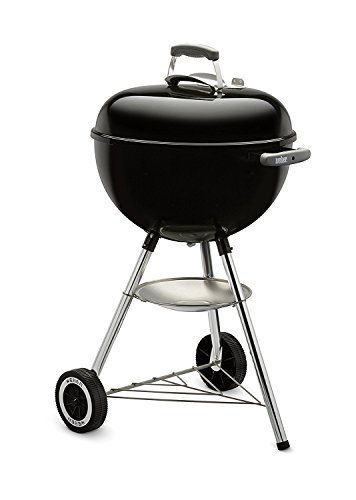
Weber Original Kettle 18-Inch Charcoal Grill — Best Budget Compact
The 18-inch Original Kettle is the entry ticket: the same enamel, ash system, and design integrity as the 22, in a compact size at the lowest tier here. For couples, small balconies, and first apartments, it delivers the complete charcoal experience without a wasted inch or dollar.
Strengths
- Lowest cost of entry to a grill that lasts for years
- Uses less charcoal per cook than any full-size pick
- Same parts family and durability as the larger kettles
Trade-offs
- Two-zone space is tight — indirect cooking needs care
- Family-size batches require cooking in waves
- No thermometer; pair it with a probe from day one
| Diameter | 18 inches |
| Fuel | Charcoal |
| Cleaning | One-Touch cleaning system |
Do not mistake the 18 for a toy. Its bowl geometry is the kettle’s, its enamel is the kettle’s, and its cooking — burgers, chops, chicken pieces, vegetables, even a spatchcocked chicken — is the kettle’s, scaled to two or three servings. What shrinks is only the margin for error: coals banked for two zones leave a modest indirect area, so fire placement becomes a skill you learn quickly and keep forever. As a first charcoal grill, a couple’s grill, or a cheap second grill for overflow and vegetables, it is the most honest small money in this guide.
Best for: couples, beginners, and small spaces on the tightest budgets / Not suited for: families of four-plus or whole-muscle barbecue ambitions
Check on Amazon — check the current price on Amazon before you buy; listings, bundles and included accessories change over time.
Comparison Table
| Pick | Badge | Key spec | Best for |
|---|---|---|---|
| Weber Original Kettle 22-Inch Charcoal Grill | Best Affordable Charcoal Grill | 22 inches — diameter | most buyers — the first charcoal grill and the budget benchmark |
| Weber Original Kettle Premium 22-Inch Charcoal Grill | Best Upgraded Kettle | 22 inches — diameter | charcoal cooks who smoke regularly and want temperature feedback built in |
| Weber Master-Touch 22-Inch Charcoal Grill | Best Premium-Affordable Kettle | 22 inches — diameter | committed charcoal cooks who will use the refinements weekly for years |
| Char-Griller AKORN 20-Inch Kamado Grill | Best Affordable Kamado | 20 inches — diameter | low-and-slow enthusiasts who want kamado stability without ceramic prices |
| Char-Griller AKORN Jr. Portable Kamado Grill | Best Compact Kamado | Triple-wall insulated steel — body | couples, tailgaters, and small-space cooks wanting kamado performance |
| Weber Original Kettle 18-Inch Charcoal Grill | Best Budget Compact | 18 inches — diameter | couples, beginners, and small spaces on the tightest budgets |
Use the table as a filter, not a verdict: eliminate the rows whose key spec fights your space, fuel rules, or headcount, and the best affordable charcoal grills decision usually narrows to two finalists whose full reviews above will settle it.
How to Choose an Affordable Charcoal Grill
Start with the only two architectures that survive at this tier: the kettle and the insulated kamado. Kettles are lighter, simpler, cheaper, and more versatile per dollar; kamados are heavier, pricier, steadier, and far more fuel-efficient. If your cooking is mostly grilling with occasional smoking, the kettle is the rational default. If low-and-slow is your main event and charcoal bills annoy you, the kamado earns its premium within the affordable tier. Everything else on the budget charcoal shelf — thin barrels, novelty shapes — is a loan against a future replacement.
Size by diameter, honestly translated
An 18-inch kettle feeds two to three. A 22-inch feeds four to six and smokes whole shoulders. A 20-inch kamado feeds three to five with superior stability. Diameter understates the kamado’s efficiency and overstates nothing about the kettles. Buy the smallest size that fits your regular headcount — charcoal grills are cheap to run but the bigger bowl still burns more fuel per small cook, and a right-sized grill heats faster for weeknight dinners.
Ash and vents: the two systems that decide daily happiness
You will operate the ash system after every cook and the vents during every cook, so judge them like controls, not footnotes. One-Touch sweeping (all three kettles here) turns ash into a ten-second task; tray-and-pan systems on budget rivals rust and spill. Vents should move smoothly and hold position — on the kamados, they are precision instruments; on the kettles, simple and effective. A grill whose vents wobble will not hold 250°F no matter what its listing promises.
Why Thin-Steel Budget Grills Did Not Make This List
Every spring, retailers fill with charcoal grills priced below the kettles in this guide, and every spring they look like bargains: big barrels, shiny paint, side shelves, chimney stacks. Here is their biography. The steel is thin enough to flex, so lids never seal and temperature control is fiction. The paint is not porcelain enamel, so it blisters off the firebox in the first season and rust moves in. The ash pan is a tray that warps, spills, and rusts through. And when the grate burns out — it will — there is no replacement, because the brand was a container-load, not a company.
The arithmetic is the indictment: three of those grills in six years cost more than one kettle in fifteen, and cook worse every single day of those six years. Affordable means low cost per season, and by that measure the “expensive” kettle is the cheapest charcoal grill sold, while the bargain barrel is among the most expensive. This list is short because the survivor set is short — and that honesty is the most money-saving paragraph in the guide.
Charcoal Economics: Briquettes, Lump, and the Kamado Dividend
Fuel is the charcoal grill’s running cost, so choose it deliberately. Briquettes burn evenly, predictably, and long — the right default for smoking and for beginners, because every chimney behaves like the last. Lump charcoal burns hotter and cleaner with less ash, lights faster, and varies by the bag — the choice for searing and for cooks who value response over uniformity. Many experienced cooks run both: lump for grilling nights, briquettes for the long smokes.
The kamado changes the math entirely. An insulated AKORN can hold smoking temperature on a fraction of the charcoal a kettle uses, and — because it seals tight at shutdown — unburned coals survive to cook again. Across a heavy smoking season, that dividend repays a real share of the kamado’s higher purchase price. Kettle owners get a smaller version of the same trick by shutting vents at the end of a grill session and reusing the survivors next time. Whichever you buy, dry storage is non-negotiable: damp charcoal lights badly, burns cool, and makes every other variable harder to read.
Kettle vs. Kamado: The Five-Year Cost and Happiness Ledger
Run the two architectures side by side across five years and the choice clarifies. Purchase: the kettle wins immediately and hugely — even the Master-Touch undercuts the full-size AKORN. Fuel: the kamado wins every single cook, using a fraction of the charcoal and reusing its survivors; a heavy smoker can burn the purchase gap back in charcoal savings across a few seasons, while a twice-a-month griller never will. Maintenance: the kettle asks for a grate every few years and nothing else; the kamado asks for gasket attention and more careful ash handling, still cheap in absolute terms.
Cooking happiness splits by temperament. The kettle is the lighter, simpler, more forgiving instrument — quicker to light for a small cook, easier to move, easier to lend your attention to. The kamado is the steadier long-cook machine, the one that holds 250°F through a windy night while you sleep in shifts. Cooks who grill often and smoke sometimes are happier on kettles. Cooks who smoke often and grill sometimes are happier on kamados. Both statements survive every budget argument, because happiness per season is the denominator of the whole ledger.
The honest verdict: at affordable tiers there is no loser in this comparison, only a mismatch. The guide’s structure — three kettles, two kamados, one mini of each philosophy — is the market’s own verdict rendered as a list. Choose by your calendar of cooks, and either architecture will pay you back in the only currency that matters here: dinners you are proud of, for years, at a cost per season that makes premium gas owners wince.
Charcoal Fire Management: The Three Fires Every Owner Should Know
Nearly everything charcoal cooks can be built from three fire layouts, and learning them deliberately — one per cook, across three cooks — compresses the charcoal learning curve into a single week. The first is the even spread: a full chimney distributed across the grate for direct grilling. Burgers, steaks, chops, vegetables — the weeknight fire. Its lesson is heat judgment: how a full chimney feels at grate level, how long it lasts, and how the vents trim it.
The second is the two-zone bank: coals piled against one wall, the other side empty. This is the working fire of serious grilling — sear over the coals, finish beside them, hold at the far edge. Chicken pieces, thick steaks, and anything that must both brown and cook through live here. Its lesson is migration: food moves across the fire as it cooks, and the cook’s job is traffic control. The third is the low snake or minion: a small number of lit coals touching a bed of unlit ones, burning slowly across hours for smoking. Its lesson is patience and vent discipline — set 250°F, then defend it with fingertip adjustments.
Every advanced technique you will ever read — reverse searing, rotisserie work, pizza on a stone, brisket overnight — is a variation on one of these three fires. The grills in this guide all run all three; the kamados stretch the third fire furthest, the kettles teach the first two fastest. Learn the three fires and you do not own a charcoal grill anymore. You operate one.
Charcoal Grill Safety and Storage: The Unglamorous Essentials
Charcoal is the safest fuel in grilling when respected and the least forgiving when improvised, so the essentials deserve print. Never grill in a garage, under an enclosed porch, or anywhere carbon monoxide can gather — charcoal produces it invisibly and in quantity, and “just this once, it is raining” is how tragedies phrase themselves. Keep the grill on a non-combustible surface, away from siding, railings, and dry vegetation, with a clearance you would defend to your insurer. Children and pets get a three-foot no-go zone that adults actually enforce.
Ash is the second discipline. Coals can hold live embers for a full day inside insulating ash; the rule is forty-eight hours of cooling in the grill or a lidded metal container before ash goes anywhere near a bin, a bag, or a compost pile. Water-dousing speeds cooling but makes a corrosive slurry — patience is cleaner. Store charcoal itself sealed and dry indoors; a damp bag is not a safety issue, merely a culinary one, but the sealed bin that keeps it dry also keeps it contained.
Storage of the grill follows from its material. Kettles can live outdoors under a cover for decades; kamados appreciate the same cover and a check of their gaskets each season. In high-wind country, a kettle’s light weight argues for a sheltered corner. None of this is complicated, and all of it is the difference between charcoal as a lifetime pleasure and charcoal as an incident report. The grills in this guide reward the respect; give it automatically.
From First Fire to First Brisket: A Charcoal Apprenticeship in Four Cooks
Cook one is burgers over an even spread of coals, and its only assignment is observation: how long the chimney takes, how the grate heat feels at six inches, how the burgers brown at the center versus the edge. Write it down. Cook two is chicken pieces on a two-zone bank, and its assignment is migration — sear, retreat, finish — until the movement of food across the fire stops being a decision and becomes a rhythm. By the end of cook two, you own the fundamental skill of charcoal grilling.
Cook three is ribs at a held 250°F, and its assignment is the vents: set them, wait, adjust by fingertips, and learn your grill’s personality under patience. The ribs will forgive the wobbles; the notebook should record them anyway. Cook four, when the first three feel ordinary, is the pork shoulder — the long cook that integrates everything: fire layout, vent discipline, temperature trust, and the humility of the stall. It will take most of a day and teach more than the previous three combined.
Notice what this apprenticeship never required: new equipment. The same kettle or kamado, the same chimney, the same charcoal — only the cook changed. That is the deepest sense in which charcoal is the affordable fuel: its tuition is time, paid in delicious installments, and its diploma is a skill no future grill purchase can obsolete. Start with burgers this weekend; the brisket is closer than it looks.
Charcoal and Weather: Cooking Well in Wind, Cold, and Rain
Charcoal is the fair-weather fuel by reputation, and the reputation is half earned — unmanaged fires suffer in weather, while managed ones barely notice it. Wind is the main adversary: it feeds oxygen unevenly, burns coals faster on the windward side, and bullies lid temperatures around. The countermeasures are placement and patience — turn the grill so its vents face away from the prevailing wind, use a fence, wall, or the house itself as a windbreak at a safe distance, and make vent adjustments smaller and rarer than instinct suggests, because the wind is already making big ones for you.
Cold is a fuel tax, not a barrier: expect to burn a third more charcoal on a freezing day, preheat longer, and forgive the grill its slower responses. Kamados pay the smallest tax — insulation is indifferent to the calendar — which is why northern smokers gravitate to them, while kettles pay honestly and still cook. Rain asks for a canopy or an umbrella strategy that keeps water off the fire without ever moving the grill under a roof or into a garage; a pop-up canopy beside the patio, with full clearance, is the standard solution and a reasonable one.
The reward for weather competence is the calendar itself: the charcoal cook who can run in February owns a twelve-month hobby while the fair-weather cook owns a five-month one. The grills in this guide — enamel kettles that shrug off wet, insulated kamados that ignore cold — were chosen partly for exactly this indifference. Dress for the weather, bank extra coals, and let the neighbors wonder; the food will explain everything.
Restoring a Neglected Kettle: A Weekend Rescue Guide
Because kettles live for decades, many are inherited in a state of advanced neglect — and nearly all of them can be rescued in a weekend for the price of a grate. Day one is assessment and ash: empty every gram of old ash (it holds moisture against the bowl and is the primary rust driver), then inspect the enamel for chips, the bowl for rust-through, the legs for wobble, and the ash sweeper for movement. Surface rust on hardware is cosmetic; a bowl perforated at the ash line is the one true death sentence, and it is rarer than the grill’s appearance suggests.
Day two is the deep clean and the parts order: a razor scraper and oven cleaner (used outdoors, per its label) strip years of carbon from the bowl; the cooking grate is usually replaced rather than saved, and a new charcoal grate and ash catcher complete the resurrection kit. Reassemble, run a hot empty fire to burn off the cleaning, season the new grate with oil, and cook burgers for the people who doubted. Total investment: a weekend, a grate set, and the satisfaction of returning a classic to service — the affordable charcoal philosophy in its purest form, and one more reason the designs in this guide dominate their category’s history.
The Charcoal Pantry: Storing Fuel, Starters, and Tools Like a System
Charcoal cooking runs on a small pantry, and organizing it once removes a dozen small frictions from every future cook. The fuel lives in a sealed, lidded bin indoors or under deep cover — briquettes and lump in separate bins if you run both, each labeled, because the two fuels are tools for different fires and grabbing the wrong one mid-light is a rookie error with a smell. Inside the bin’s lid, tape the two numbers that matter: how many chimneys a bag holds for your grill, and the date the bag was opened, since old, humidity-cycled charcoal lights slower and burns cooler than fresh.
Starters live with the fuel, not in the kitchen: paraffin cubes or tumbleweeds in a dry jar, the chimney hanging beside the bin, a long lighter that is checked monthly and replaced before it becomes a cook-day failure. Tools complete the system — tongs, spatula, brush, gloves — on hooks within reach of the grill rather than in a drawer across the house. The whole pantry occupies a corner and costs almost nothing to maintain, and its payoff is the removal of every “where is” and “we are out of” that has ever delayed a fire. Charcoal mastery is mostly fire; the rest is logistics, and logistics is a bin with a lid.
How to Light and Control a Charcoal Grill Like You Mean It
Charcoal skill is three skills: lighting cleanly, placing the fire for the food, and running the vents like a throttle. Master this sequence and every grill in this guide — kettle or kamado — becomes a precision instrument.
- Light with a chimney, never lighter fluid: fill the chimney with charcoal, light two paraffin cubes or a wad of newspaper beneath it, and wait fifteen to twenty minutes until the top coals are ashed over. Fluid-soaked charcoal flavors food with petroleum; a chimney costs little and ends that forever.
- Place the fire for the dish: spread coals evenly for direct grilling; bank them to one side for two-zone cooking; ring or bank a small pile for smoking. The placement is the recipe’s first instruction — decide it before the coals are lit.
- Preheat the grate and brush it: five minutes with the lid on and the grate over the fire burns off residue and heats the metal. A brass brush or a ball of foil in tongs cleans it; oil the food, not the grate.
- Run the bottom vents as the throttle: wide open for searing heat, a quarter open for roasting, barely cracked for smoking. Adjust in small steps and wait ten minutes — charcoal responds slowly, and chasing it overshoots.
- Use the lid vent for fine control and smoke direction: keep the lid vent over the food on indirect cooks so smoke and heat draw across it. Small lid adjustments fine-tune what the bottom vents set roughly.
- Shut it down and save the coals: close all vents when you finish. The fire starves and dies, the grill cools safely, and surviving coals — especially in a kamado — light again next cook. Ash comes out tomorrow, cold, into a metal container.
Three cooks with this sequence and the vents stop being mysterious. You will know what a quarter-open vent does on your grill, in your yard, with your charcoal — and that local knowledge, not any gadget, is what charcoal mastery actually is.
Common Buying Mistakes
Using lighter fluid. It flavors food, flares dangerously, and is entirely obsolete next to a chimney starter that costs less than two bottles of the stuff.
Cooking over coals that are not ready. Black, smoking coals are still lighting. Wait for the ash-grey surface — that is the fire telling you it has become a cooking tool.
Chasing temperature with constant vent changes. Charcoal responds in minutes, not seconds. Small adjustment, ten-minute wait, then judge. Impatience manufactures the swings people blame on their grill.
Dumping ash warm into plastic or paper. Ash insulates live embers for a day or more. Cold ash, metal container, every time — this is the charcoal rule with no exceptions.
Storing charcoal where it can get damp. A sealed bin indoors keeps charcoal lighting fast and burning hot. The bag on the patio floor is why your fires have been disappointing.
Final Recommendation
The default answer is the Weber Original Kettle 22-Inch Charcoal Grill — the most cooking for the least money in this entire guide — upgraded to the Weber Original Kettle Premium 22-Inch Charcoal Grill if you smoke often enough to want the thermometer and hinged grate, and dressed as the Weber Master-Touch 22-Inch Charcoal Grill if you cook on charcoal weekly and will feel the refinements for a decade.
Kamado buyers should choose by household: the Char-Griller AKORN 20-Inch Kamado Grill for family low-and-slow with fuel economy, the Char-Griller AKORN Jr. Portable Kamado Grill for couples and portability. The smallest budgets and spaces are honestly served by the Weber Original Kettle 18-Inch Charcoal Grill, which is a real Weber in miniature, not a toy.
Whichever you choose, add a chimney starter and a probe thermometer to the same order, keep the charcoal dry, and learn your vents across three patient cooks. Affordable charcoal is not the budget version of grilling — for flavor per dollar, it is the championship division.
Keep comparing within the same family before you decide: Best 22 Inch Charcoal Grills · Best Affordable Bbq Grills · Best Affordabke Grills.
Frequently Asked Questions
Briquettes or lump charcoal — which should a beginner buy?
Briquettes. They light predictably, burn evenly, and behave the same bag to bag, which makes learning vents and timing far easier. Add lump later for high-heat searing.
How long does charcoal take to be ready?
In a chimney starter, fifteen to twenty minutes until the top coals are covered in grey ash. Rushing this step is the most common beginner mistake.
Can a kettle really smoke a brisket?
Yes — banked coals, a water pan, vents nearly closed, and patience. Kettles have smoked countless briskets; the Premium’s thermometer makes the process repeatable.
Why is a kamado more fuel-efficient?
Insulation and sealing. Heat stays in the chamber instead of radiating away, and a tight shutdown starves the fire so unburned charcoal survives to the next cook.
How do I make a charcoal grill last?
Keep it covered, empty ash regularly (ash plus moisture corrodes), store charcoal dry, and replace grates when they thin. Kettles treated this way routinely pass a decade.
Is an 18-inch kettle big enough?
For two to three people, yes — burgers, chops, chicken pieces, and vegetables cook beautifully. Families and whole-muscle barbecue need the 22-inch.
Related reading: Best 8 Grills · Best Affordable Gas Grills · Best Adjustable 2 Pack Temp Gauge For Grills.


