Disclosure: airfryerkitchensupply.com is reader-supported. When you buy through links on our site, we may earn an affiliate commission at no extra cost to you.
Where to buy
BBQ means different iron in different regions — a kettle in one yard, a pellet smoker in another, a gas workhorse in a third. Every pick in this guide to the best affordable bbq grills was verified against its live Amazon listing, so the model and configuration you read about is the one that ships, and since no honest price survives a season in this category, none are printed: check the current price on Amazon when you are ready.
- Weber Original Kettle Premium 22-Inch Charcoal Grill — Best Affordable BBQ Grill Overall. Check the current price on Amazon.
- Char-Griller AKORN 20-Inch Kamado Grill — Best Affordable Kamado for BBQ. Check the current price on Amazon.
- Charbroil Performance Series 4-Burner Gas Grill — Best Affordable Gas BBQ Grill. Check the current price on Amazon.
- Z Grills ZPG-7002B Pellet Grill & Smoker — Best Affordable Pellet BBQ. Check the current price on Amazon.
- Coleman RoadTrip 285 Portable Propane Grill — Best Affordable Portable BBQ. Check the current price on Amazon.
- Weber Original Kettle 18-Inch Charcoal Grill — Best Compact Affordable BBQ. Check the current price on Amazon.
The list deliberately spans the BBQ spectrum at affordable tiers: charcoal kettle, kamado, gas, pellet, and portable. Your region’s definition of barbecue is respected here; your budget is the filter.
The best affordable bbq grills are not one category of machine, because barbecue is not one food. For some households BBQ means burgers and dogs at speed; for others it means ribs at noon that started at dawn; for others it is whatever the tailgate produces. This guide respects all three definitions and applies one filter to each: the grill must sit in the affordable tier of its style, carry replaceable parts and real manufacturer support, and be verified against its live Amazon listing before it earns a badge.
That filter cuts the field hard. The budget BBQ shelf is full of thin-steel offsets that cannot hold temperature, gas grills with unorderable burners, and pellet newcomers with no parts pipeline. What survived is a cross-section with a point of view: the kettle that defines value, a kamado that insulates like money, a family gas grill, an entry pellet machine, a portable that travels, and a compact charcoal classic for small spaces.
Choose by your barbecue, not by the badge order. If smoke is the point, start at the kettle, kamado, or pellet reviews. If speed and headcount rule, the gas pick is your anchor. If your BBQ happens away from home, the portable is the whole argument. Each review prints its trade-offs plainly, because an affordable grill you understand beats a premium grill you resent.
In this guide
Quick Picks
Six affordable ways into real barbecue — pick by the food you mean when you say BBQ, and every one of these will serve you honestly.
- Best Affordable BBQ Grill Overall: Weber Original Kettle Premium 22-Inch Charcoal Grill — the Premium kettle — lid thermometer, hinged grate, and the deepest accessory bench in BBQ, at a value tier.
- Best Affordable Kamado for BBQ: Char-Griller AKORN 20-Inch Kamado Grill — triple-wall insulated steel, cast-iron grates — kamado efficiency and stability without ceramic money.
- Best Affordable Gas BBQ Grill: Charbroil Performance Series 4-Burner Gas Grill — four burners and a cabinet — the family BBQ-night machine for people whose barbecue includes Tuesday.
- Best Affordable Pellet BBQ: Z Grills ZPG-7002B Pellet Grill & Smoker — 700 square inches and a PID controller — wood-fired barbecue on autopilot at the pellet entry tier.
- Best Affordable Portable BBQ: Coleman RoadTrip 285 Portable Propane Grill — the RoadTrip 285 — BBQ that folds, rolls, and cooks for the campsite crowd.
- Best Compact Affordable BBQ: Weber Original Kettle 18-Inch Charcoal Grill — the 18-inch kettle — the classic, shrunk for balconies, couples, and first apartments.
How These Picks Were Chosen
Candidates came from the affordable tier of each BBQ style and were verified: exact model, fuel, size, and headline configuration matched to the live listing. We excluded models with no reorderable wear parts, listings that misrepresented cooking area, and any product whose Amazon presence was only parts and covers rather than the grill itself.
Scoring weighted smoke capability and temperature stability for the BBQ styles that need them — a BBQ grill that cannot hold 250°F through a windy afternoon is a burger machine wearing a costume — and weighted speed, zoning, and parts depth for gas. Across all styles we applied the cost-per-season test: purchase tier divided by honest expected seasons, with maintenance demands stated in each review rather than hidden.
The result is intentionally plural. Barbecue culture argues about fuel the way it argues about sauce, and an affordable guide serves readers best by making each fuel’s best budget case well, then letting the cook’s own definition of BBQ cast the deciding vote.
The 6 Best Affordable BBQ Grills Reviewed

Weber Original Kettle Premium 22-Inch Charcoal Grill — Best Affordable BBQ Grill Overall
For the money, nothing barbecues like a 22-inch Weber kettle, and the Premium trim is the one to buy: the built-in lid thermometer tells you the fire’s truth, the hinged grate lets you feed coals during a long cook, and the kettle’s deep bowl does low-and-slow and high-and-fast in the same afternoon. As an affordable BBQ platform, it has no serious rival.
Strengths
- Genuine smoking and searing range from one simple, durable machine
- Lid thermometer and hinged grate fix the base kettle’s two real annoyances
- Accessory ecosystem — baskets, griddles, rotisseries — grows it for years
Trade-offs
- Temperature control is your skill with vents and coal placement
- No shelves or storage; plan a side table
- Long cooks need periodic attention a pellet grill would not ask for
| Diameter | 22 inches |
| Fuel | Charcoal |
| Gauge | Built-in lid thermometer |
The kettle’s BBQ credentials are earned in the bowl’s geometry: coals banked to one side create a smoke zone and a sear zone, the lid’s convection finishes thick cuts, and the vents give you a temperature dial that works in both directions if you learn it. Ribs, pork shoulders, whole chickens, and brisket flats are all within its honest range, and the Premium’s thermometer turns that range from folklore into repeatable numbers. Its running costs are charcoal and time; its lifespan is measured in decades; its parts are a grate every few years. In the affordable BBQ ledger, that combination is why it headlines this guide.
Best for: cooks who want real barbecue — smoke included — at the lowest honest cost / Not suited for: set-and-forget cooks or anyone under charcoal restrictions
Check on Amazon — check the current price on Amazon before you buy; listings, bundles and included accessories change over time.

Char-Griller AKORN 20-Inch Kamado Grill — Best Affordable Kamado for BBQ
The Char-Griller AKORN brings kamado barbecue to an affordable tier by building the insulated body from triple-wall steel instead of ceramic. The result holds low smoking temperatures with miserly charcoal use, climbs to fierce searing heat when asked, and shrugs off the knocks and weather that make ceramic owners nervous — a BBQ workhorse, not a garden ornament.
Strengths
- Insulation holds 225–250°F for hours on a small charcoal load
- Cast-iron grates sear properly and last for years
- Steel body tolerates moving, weather, and tailgate duty ceramics fear
Trade-offs
- Round 20-inch surface limits full briskets and big rib racks
- Vent-based control has a learning curve; overshooting heat is easy early on
- Steel insulation is excellent but not ceramic-equal in extreme cold
| Diameter | 20 inches |
| Body | Triple-wall insulated steel |
| Grates | Cast iron |
| Fuel | Charcoal |
Kamado barbecue is about stability, and stability is about insulation and sealing — the AKORN’s twin virtues. Once it settles at smoking temperature, it tends to stay there with minimal vent fiddling, sipping charcoal while a kettle would be asking for its second chimney. That efficiency compounds across a season of cooks. The cast-iron grates are the other grown-up feature at this tier: they hold sear heat like they mean it. Size is the honest limit — plan on brisket flats, two chickens, or a shoulder at a time rather than competition spreads. For the affordable BBQ cook whose menu is low-and-slow first, this is the efficiency champion.
Best for: low-and-slow specialists who want kamado stability at a steel price / Not suited for: big-batch competition cooking or total beginners wanting a dial
Check on Amazon — check the current price on Amazon before you buy; listings, bundles and included accessories change over time.

Charbroil Performance Series 4-Burner Gas Grill — Best Affordable Gas BBQ Grill
Not every BBQ night is a smoke session. For the household whose barbecue means grilled chicken, burgers, sausages, and vegetables for a family plus neighbors — on a schedule — the Charbroil Performance 4-burner is the affordable gas answer: full layout, side burner, closed cabinet, and the cheapest parts pipeline in the business standing behind it.
Strengths
- Four burners zone properly for mixed family BBQ menus
- Cabinet format and side burner complete the backyard kitchen
- Replacement parts are inexpensive and stocked everywhere
Trade-offs
- Gas flavor is clean, not smoky — a smoker box helps but does not transform it
- Value-grade materials want a cover and seasonal part checks
- Moderate per-burner output asks for full preheats on thick steaks
| Burners | 4 plus side burner |
| Cabinet | Closed cabinet cart |
| Model | 463253925 |
The Performance earns its seat by understanding the actual assignment: most family BBQ is grilled food for six to ten people, served hot and together, by a cook who also has a job tomorrow. Four burners deliver the zone map that makes that possible, the side burner keeps beans and sauce off the grate, and the cabinet keeps the operation tidy. Add a cast-iron smoker box with wood chips and you can lay a respectable smoke note over ribs and chicken — not pit barbecue, but a flavor gas alone never gives. Kept covered and fed a heat tent when the old one tires, it returns seasons of exactly the BBQ its buyers actually cook.
Best for: families whose BBQ is grilled food for a crowd, on weeknights too / Not suited for: smoke purists or uncovered storage
Check on Amazon — check the current price on Amazon before you buy; listings, bundles and included accessories change over time.

Z Grills ZPG-7002B Pellet Grill & Smoker — Best Affordable Pellet BBQ
Pellet barbecue trades tending for technology, and the Z Grills ZPG-7002B is its affordable doorway: a full 700 square inches for briskets and rib racks, a PID controller holding temperature with unusual precision for the tier, and a rain cover included in the box. Load the hopper, set the temperature, and the barbecue minds itself.
Strengths
- PID control holds smoking temperatures steadily for long cooks
- 700 sq. in. swallows briskets, multiple chickens, and rib collections
- Real wood smoke flavor with near-zero fire management
Trade-offs
- Searing is its weakness — finish steaks in cast iron or on a hot grate insert
- Pellets are a continuing cost and must be stored bone dry
- Requires household electricity; outages end cooks
| Cooking area | 700 sq. in. |
| Controller | PID temperature control |
| Extras | Rain cover included |
The honest pellet pitch is consistency: the 7002B will hold your set temperature through a pork shoulder’s long afternoon more patiently than most humans with a vent. PID control is the feature that separates pellet grills that merely work from those that cook evenly, because wide temperature swings dry the bottom of a brisket while the top waits. Smoke flavor is clean and gentle — wood-kissed rather than smokehouse-bold — which suits chicken, pork, and ribs for most palates. As the affordable entry to that whole style of barbecue, with family size and a cover included, it makes the strongest case pellet can make at this tier.
Best for: aspiring pitmasters who want smoke and sleep in the same night / Not suited for: hard-sear devotees or off-grid cooking
Check on Amazon — check the current price on Amazon before you buy; listings, bundles and included accessories change over time.
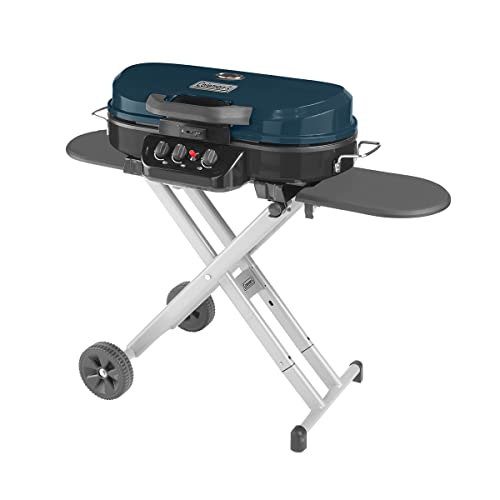
Coleman RoadTrip 285 Portable Propane Grill — Best Affordable Portable BBQ
Some of the best barbecue happens where there is no backyard: the lake, the lot, the campsite. The Coleman RoadTrip 285 is the affordable portable that cooks like it matters — three burners, 20,000 BTU, a full-size surface on a folding wheeled stand — and then goes home to serve small households as a primary grill.
Strengths
- Three-burner control is unique at this portable tier and price class
- Folding stand with wheels makes transport a one-person job
- Grill and griddle tops swap for breakfast-through-dinner coverage
Trade-offs
- Small cylinders burn quickly at full tilt; the tank adapter is near-essential
- Low lid rules out beer-can chicken and tall roasts
- Car-portable only — weight rules out hike-in sites
| Burners | 3 adjustable |
| Output | 20,000 BTU |
| Ignition | Instastart push-button |
Portable BBQ usually means accepting a shrunken, single-burner apology. The RoadTrip refuses: its three burners zone, its surface feeds six, and its stand sets up at working height instead of picnic-table crouch. That makes it a legitimate BBQ tool at the site — ribs are a stretch too far, but chicken halves, sausages, burgers, and grilled vegetables for a group are squarely in range, and the griddle top owns the next morning’s breakfast. At home it moonlights on balconies and small patios. One purchase, two lives, at an affordable tier: that is the portable case, fully made.
Best for: campers, tailgaters, and small-space households / Not suited for: low-and-slow purists or hike-in camping
Check on Amazon — check the current price on Amazon before you buy; listings, bundles and included accessories change over time.
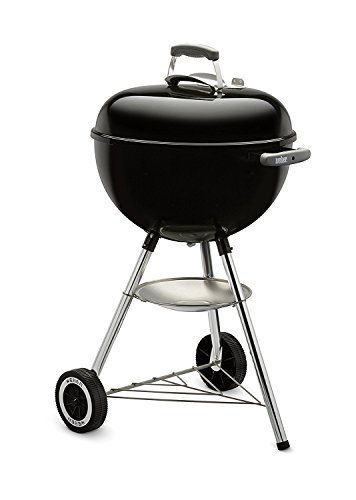
Weber Original Kettle 18-Inch Charcoal Grill — Best Compact Affordable BBQ
The 18-inch Weber kettle is the original affordable BBQ in miniature: the same porcelain-enameled bowl, One-Touch ash system, and charcoal honesty as its 22-inch sibling, sized for two to four people and priced at the very bottom of the full-grill market. For a first grill or a small-space grill, it is the classic done right.
Strengths
- Lowest entry cost of any pick here, with Weber durability behind it
- Perfect size for couples — less charcoal per cook than the 22
- Same accessory and parts family as the bigger kettles
Trade-offs
- Two-zone cooking is tight at this diameter — technique matters more
- Family batches mean waves, not single runs
- No lid thermometer in this trim; budget for a probe thermometer
| Diameter | 18 inches |
| Fuel | Charcoal |
| Cleaning | One-Touch cleaning system |
Small kettles teach great habits: with less room, you learn fire placement, vent discipline, and timing faster than on any forgiving machine, and the food — burgers, chops, chicken pieces, vegetables — is every bit as good as the big kettle’s. The 18-inch bowl also sips charcoal, which quietly lowers its running cost below even its sibling’s. Its ceiling is headcount and whole-muscle cooking: a spatchcocked chicken fits, a packer brisket does not. As the affordable BBQ for two, a starter grill that is not a toy, or a second grill for overflow duty, it has been the right answer for generations of cooks.
Best for: couples, small balconies, and first-time charcoal cooks / Not suited for: families or whole-brisket ambitions
Check on Amazon — check the current price on Amazon before you buy; listings, bundles and included accessories change over time.
Comparison Table
| Pick | Badge | Key spec | Best for |
|---|---|---|---|
| Weber Original Kettle Premium 22-Inch Charcoal Grill | Best Affordable BBQ Grill Overall | 22 inches — diameter | cooks who want real barbecue — smoke included — at the lowest honest cost |
| Char-Griller AKORN 20-Inch Kamado Grill | Best Affordable Kamado for BBQ | 20 inches — diameter | low-and-slow specialists who want kamado stability at a steel price |
| Charbroil Performance Series 4-Burner Gas Grill | Best Affordable Gas BBQ Grill | 4 plus side burner — burners | families whose BBQ is grilled food for a crowd, on weeknights too |
| Z Grills ZPG-7002B Pellet Grill & Smoker | Best Affordable Pellet BBQ | 700 sq. in. — cooking area | aspiring pitmasters who want smoke and sleep in the same night |
| Coleman RoadTrip 285 Portable Propane Grill | Best Affordable Portable BBQ | 3 adjustable — burners | campers, tailgaters, and small-space households |
| Weber Original Kettle 18-Inch Charcoal Grill | Best Compact Affordable BBQ | 18 inches — diameter | couples, small balconies, and first-time charcoal cooks |
Use the table as a filter, not a verdict: eliminate the rows whose key spec fights your space, fuel rules, or headcount, and the best affordable bbq grills decision usually narrows to two finalists whose full reviews above will settle it.
How to Choose an Affordable BBQ Grill by Your Definition of BBQ
Write down the last five things you actually barbecued or grilled. That list — not the fantasy list — is your buying brief. If it reads burgers, chicken, and vegetables, gas or a kettle serves you best and cheapest. If it reads ribs, shoulder, and brisket, you need temperature stability for hours: kettle with skill, kamado with efficiency, or pellet with automation. If half the list happened away from home, the portable outranks everything. Affordable means paying for your real menu once, not for three menus badly.
Smoke is a feature with a price in every currency
Charcoal smoke costs time and attention. Kamado smoke costs a little more money and much less charcoal. Pellet smoke costs the most money and the least attention, plus pellets forever. Gas “smoke” from a chip box costs almost nothing and delivers almost that. None of these is the fake option — they are the same flavor bought with different currencies. The affordable choice is the one whose currency you have: time-rich cooks should never pay pellet prices, and time-poor cooks should not pretend they will tend a kettle at dawn.
Size the grill to the 80-percent cook
The grill you need is the one that fits your ordinary big cook — Sunday family dinner — not the annual reunion. Batch-cooking twice a year is cheaper than feeding, covering, and maintaining a monster every week. Every pick here was sized honestly in its review; match your 80-percent number to those translations.
Can Affordable Grills Actually Smoke? An Honest Answer by Style
Yes — with different definitions of “actually.” A kettle with banked coals and a water pan will smoke a pork shoulder to a genuine bark and a pink ring; thousands of competition cooks started exactly there. Its cost is attention: expect to adjust vents and add coals across a long cook. A kamado like the AKORN smokes with the least fuel and the steadiest temperature of any charcoal format, and its attention bill is the smallest of the charcoal family. A pellet grill smokes with no attention at all and the gentlest flavor — real wood smoke, politely delivered.
Gas is the honest exception. A smoker box or foil pouch of chips over a burner lays a light smoke perfume on chicken and ribs, and for many eaters that is plenty — but it is seasoning, not barbecue smoke, and no accessory changes the physics. The affordable BBQ buyer should choose with eyes open: if smoke is the soul of your barbecue, spend on kettle, kamado, or pellet and save elsewhere. If smoke is a garnish on grilled food, gas plus a chip box is a rational, money-saving answer.
The Affordable BBQ Toolkit: What to Buy After the Grill
A budget grill plus forty dollars of tools out-cooks a premium grill with none. First, a chimney starter if you cook on charcoal — it replaces lighter fluid forever and lights evenly in fifteen minutes. Second, an instant-read thermometer: doneness by temperature ends the era of cut-and-peek, dried chicken, and guesswork ribs. Third, long tongs and a wide spatula — the two tools that handle ninety percent of BBQ food. Fourth, heat-resistant gloves for moving grates and pans around a live fire.
Buy them in that order and skip, for now, the gadget wall: the rib racks, beer-can stands, and branded brushes can wait until your cooking asks for them. The exception is a cover — buy it with the grill, not after it. Affordable grills live or die by water exclusion, and the cover is not an accessory; it is the second half of the purchase.
Regional BBQ on a Budget: Matching the Grill to the Tradition
Barbecue is a map before it is a menu, and the affordable grill that honors your region’s tradition will make you happier than a generic “best” ever will. In Texas, the centerpiece is brisket and the fire is post oak in an offset — the budget translation is not a thin offset (see the mistakes section) but a kettle or kamado run with patience, or a pellet grill whose wood you choose deliberately. In the Carolinas, the pig is pulled and the sauce is an argument; the cooking, though, is the same low-and-slow shoulder work every pick here handles, with the kettle the historical instrument.
Kansas City burns ends and sweetens sauce; its cooking is a tour of everything — ribs, brisket, chicken, sausage — which argues for the versatile kettle or the pellet’s consistency across a mixed spread. Memphis ribs, dry or wet, are a kettle-and-kamado home game. And in the vast territory where “barbecue” simply means cooking outside for people you like, the gas pick and the portable carry the tradition honorably, because the tradition there is the gathering itself.
The point is not regional cosplay. It is that your tradition defines your grill’s real job — the cut, the wood, the hours — and an affordable purchase aimed at that job will satisfy for years, while a generic one aimed at an imaginary average cook satisfies no one. The six picks span the map on purpose. Find your region’s row, and start there.
Wood, Chips, and Chunks: A Budget Guide to Smoke Flavor
Smoke is an ingredient with a supply chain, and the affordable cook should buy it as deliberately as the meat. On a kettle, wood chunks — fist-size pieces of oak, hickory, apple, or cherry — are the professional’s choice: two or three buried in the coals smolder for hours, where chips burn off in minutes and must be replenished through the hinged grate. On a kamado, fewer chunks do more, because the sealed chamber recirculates smoke instead of venting it. On a pellet grill, the wood choice is the pellet itself: competition blends for all-round work, pure hickory for bacon and ham notes, fruitwoods for poultry and fish.
Match wood to meat with a light hand. Hickory is the loudest voice — glorious on pork, bullying on chicken. Oak is the diplomat, right nearly everywhere and the brisket tradition for a reason. Apple and cherry are the sweet, mild pair that flatter poultry, ribs, and anything you would rather kiss than punch. Mesquite is a sprinter: intense, fast-burning, best in small doses on beef grilled hot rather than smoked long. Beginners oversmoke everything once; the cure is half the wood and a note in the cook log.
Budget discipline applies here too. Buy chunks and pellets dry, store them sealed indoors, and never pay a premium for celebrity-branded wood when the species and dryness are the same. A bag of good oak chunks costs less than the meat it will flavor, and it is the highest-leverage flavor purchase in all of barbecue — the affordable cook’s secret, hiding in plain sight.
The BBQ Cook’s Calendar: What to Cook in Your First Season
A new affordable grill deserves a curriculum, and barbecue’s is delicious. Month one belongs to chicken — thighs, halves, a whole bird spatchcocked — because chicken teaches fire control at forgiving prices and feeds people happily while you learn. Month two is ribs: the first true low-and-slow, where your grill’s temperature manners reveal themselves and the 3-2-1 style timelines give you a script to improvise from. Keep notes; barbecue memory is a liar, and a notebook is the cheapest upgrade in the entire hobby.
Month three is the pork shoulder, the long cook that graduates a beginner. It asks everything — steady temperature, patience through the stall, resting discipline — and repays it with the most forgiving, crowd-pleasing meat in the canon. Month four, with three cooks of knowledge banked, is brisket: the final exam, taken when your fire management is reflex and your thermometer habits are set. Between the monthly majors, weeknight grilling — burgers, sausages, vegetables, fish — builds the ordinary mastery that the majors depend on.
By season’s end the affordable grill has stopped being equipment and become a practice, which is the actual product barbecue sells. The cooks who stall in this hobby buy a grill and wait for inspiration; the cooks who thrive schedule the curriculum and let the grill teach them, one forgiving meat at a time. Every pick in this guide can run the full calendar. Choose yours, and start with chicken this weekend.
Building Your BBQ Pantry: Rubs, Sauces, and the Discipline of Less
Affordable barbecue extends past the grill into the pantry, where money leaks in small, delicious bottles. Resist the sauce wall. A working BBQ pantry needs one all-purpose rub you know by heart — salt, pepper, paprika, garlic, a little sugar — mixed in a jar for pennies, one pepper-forward rub for beef, and one sauce you genuinely love rather than six you are curious about. Everything else is a variation your hand can improvise from those bases with vinegar, mustard, honey, or heat.
The discipline matters because consistency is how cooks improve. When the rub never changes, the variable you taste is the fire — and learning your grill’s behavior, cook by cook, is the entire curriculum of the first season in this guide. The cook with nine rubs learns nothing nine times; the cook with one rub learns their kettle’s hot corner, their kamado’s overshoot, their pellet grill’s mood in wind. Flavor novelty can come later, layered onto mastery, where it belongs.
Spend the savings where this guide keeps pointing: good meat, dry wood, a working thermometer, and the cover that keeps the machine honest. A pantry of three jars and a grill you understand will beat a sauce collection and a mystery fire at every table in the neighborhood — and it will do it for less, which is, after all, the thesis of this entire page.
BBQ for Beginners: The Five Sentences That Prevent the Five Disasters
Sentence one: cook to temperature, not to time — every recipe’s clock is a suggestion written in someone else’s kitchen, and your thermometer is the only author who has met your brisket. Sentence two: if you are looking, you are not cooking — the lid is a tool, and every peek spends the heat and smoke you banked. Sentence three: the stall is not a problem — a shoulder that parks at 160°F for hours is evaporating, not failing, and the cook who waits or wraps wins while the cook who cranks the heat dries the meat.
Sentence four: rest is an ingredient — meat pulled straight from the fire sheds its juice on the board, while the same meat rested keeps it in the slice, and no rub or sauce can refund what impatience spends. Sentence five: write it down — the notebook beside the grill, with the cook’s fuel, weather, times, and results, is the difference between a first season that teaches and a fifth season that repeats the first. Five sentences, five disasters declined.
Everything else in barbecue is refinement. The affordable grills in this guide will carry you as far as your habits do — the kettle’s patience, the kamado’s steadiness, the pellet’s consistency, the gas grill’s speed — and the habits above are fuel-agnostic, price-agnostic, and region-agnostic. Learn them on cheap meat with a notebook open, and the barbecue world’s more expensive lessons will find a cook who is ready for them.
Fire Safety for Long Cooks: The Overnight and All-Day Rules
Long barbecue cooks — the shoulder that starts at dawn, the brisket that runs overnight — deserve their own safety paragraph, because unattended fire is a responsibility, not a setting. Site the cooker on its non-combustible surface with its full clearances, and walk the area once for the things long cooks attract: dry leaves blown in, a curious dog, a garden hose across the path you will walk half-asleep at 3 a.m. Keep the extinguisher where the cook actually passes, not in the garage behind the bikes.
For overnight cooks specifically, the pellet grill’s automation and a remote probe thermometer with a temperature alarm are the responsible pairing — the alarm is the cook, and you are its backup. Charcoal overnight cooks belong to experienced hands with stable kamados, generous fuel margins, and alarms set for both the meat and the pit. And no long cook, on any fuel, justifies sleeping beside an open fire indoors or in a garage: carbon monoxide does not care how good the brisket is. Run the long cooks with the same respect you run the hot ones, and barbecue’s greatest pleasure — waking to a finished shoulder — stays exactly as safe as it is delicious.
Leftovers Are a Cooking Method: Planning the Second Meal
Barbecue’s economics quietly improve when the cook plans for the second meal at the moment of the first. A pork shoulder yields pulled pork sandwiches today, carnitas-style crisped pork tomorrow, and a pot of beans enriched past decency on day three. Brisket flat slices for the table; the point becomes burnt ends or chili with a pedigree no fresh pot can fake. Ribs are the exception that proves the planning — they rarely survive — but even their bones stock a smoky broth.
This is not thrift theater; it is how barbecue households actually eat, and it changes the shopping. The affordable grill that cooks a shoulder on Sunday is feeding the family until Wednesday, which reprices the entire cook: the fuel, the wood, and the afternoon amortize across three dinners. Freeze in flat, labeled packs with the juices; reheat gently with a splash of the same juices; and keep the notebook entry for the cook attached to the plan, because the second meal is where the first cook’s lessons get tasted. Buy the bigger shoulder. Your future self, holding Wednesday’s dinner, has already decided.
How to Smoke a Pork Shoulder on an Affordable Grill
The pork shoulder is affordable BBQ’s proving ground: cheap meat, long cook, spectacular payoff — and every charcoal and pellet pick in this guide can do it. This is the kettle method; kamado and pellet adaptations follow from the same principles.
- Choose and season the meat: a bone-in pork shoulder (butt) of seven to nine pounds, rubbed with salt, pepper, paprika, and a little brown sugar the night before, or at least an hour ahead. Cheap meat, patiently seasoned, is the whole tradition.
- Build an indirect fire: light half a chimney of charcoal, bank it on one side of the kettle, and set a drip pan with water on the other side. The shoulder goes over the pan, fat side up, as far from the coals as the grate allows.
- Settle at 250°F and leave it alone: adjust vents until the lid thermometer holds near 250°F. For the first three hours, do not open the lid — smoke adheres to cold, moist meat early, and peeking costs heat and time.
- Manage the middle hours: add a handful of unlit coals every hour or so as needed, spritz the shoulder with apple juice or water if the bark dries at the edges, and start checking internal temperature after hour five.
- Push through the stall: around 160°F internal, the temperature will stop rising for what feels like forever. This is evaporation, not failure. Wrap in foil with a splash of liquid, or simply wait it out — both work; wrapping is faster.
- Rest, pull, and sauce lightly: the shoulder is done when the probe slides in like butter, typically near 200°F internal. Rest it wrapped for an hour, then pull by hand, discarding large fat, and dress with just enough sauce to gloss.
On a kamado, the same cook needs fewer coal additions and less vent work; on a pellet grill, it needs only a hopper check. The principles — indirect heat, patience, temperature over time — are identical, which is why an affordable grill, honestly run, produces barbecue that embarrasses expensive equipment in careless hands.
Common Buying Mistakes
Confusing grilling and barbecue when you shop. A grill that cannot hold 250°F for hours is a fine grill and a poor BBQ smoker. Match the machine to the food you actually mean.
Buying a thin offset smoker because it looks the part. Cheap offsets leak heat and smoke from every seam and demand constant feeding. A kettle or kamado at the same money smokes circles around them.
Lifting the lid to admire the meat. Every peek costs heat and adds time. If you are looking, you are not cooking — the oldest sentence in barbecue is also the truest.
Saucing early. Sugary sauce burns over long cooks and bitter bark is the result. Sauce goes on at the end, or at the table.
Skipping the rest. A shoulder pulled the minute it leaves the heat sheds its juices onto the board. The rest is not optional; it is where the moisture redistributes.
Final Recommendation
By the classic definition, the affordable BBQ crown sits on the Weber Original Kettle Premium 22-Inch Charcoal Grill — smoke, sear, and decades of service at a value tier — with the Char-Griller AKORN 20-Inch Kamado Grill as the efficiency upgrade for serious low-and-slow cooks and the Z Grills ZPG-7002B Pellet Grill & Smoker as the automation answer for those who would rather sleep than tend.
If your barbecue is grilled food for a family on a schedule, the Charbroil Performance Series 4-Burner Gas Grill is your anchor; if it happens at campsites and tailgates, the Coleman RoadTrip 285 Portable Propane Grill; and if it is dinner for two on a small balcony, the little Weber Original Kettle 18-Inch Charcoal Grill remains the best cheap seat in BBQ. Every pick was verified against its live listing before it was badged.
Pick by your menu, buy the cover and the thermometer with the grill, and give yourself three cooks to learn your machine. Affordable barbecue is not a compromise category — it is where barbecue started, and these six prove it still lives there.
Keep comparing within the same family before you decide: Best Affordabke Grills · Best Affordable Charcoal Grills · Best Affordable Gas Grills.
Frequently Asked Questions
What is the difference between grilling and barbecue?
Grilling is fast cooking over direct high heat — burgers, steaks, vegetables. Barbecue is slow cooking with indirect heat and smoke — ribs, shoulders, briskets. Many grills here do both; the reviews say which style each pick truly serves.
What is the cheapest way to get real smoke flavor?
A charcoal kettle with banked coals. It is the lowest-cost route to genuine barbecue smoke, paid for in attention rather than money.
Can a gas grill make barbecue?
It can grill beautifully and add light smoke with a chip box, but it will not produce deep barbecue smoke. If smoke is central to your cooking, choose charcoal, kamado, or pellet.
How long does a pork shoulder take on a kettle?
Roughly an hour to an hour and a half per pound at 250°F — seven to twelve hours for a typical butt. Cook to tenderness and internal temperature, not to the clock.
Is a pellet grill cheating?
It is automation, not cheating. The wood is real, the smoke is real, and the results win competitions. You trade some smoke intensity and all of the fire-tending for consistency.
What is the first BBQ I should cook on a new affordable grill?
A pork shoulder. It is inexpensive, forgiving of temperature wobbles, and teaches your grill’s behavior across a long cook better than any other food.
Related reading: Best 8 Grills · Best Affordable Electric Grills · Best 22 Inch Charcoal Grills.


