Disclosure: airfryerkitchensupply.com is reader-supported. When you buy through links on our site, we may earn an affiliate commission at no extra cost to you.
Where to buy
Short on time? If you are comparing the best 5 hibachi grills and want the short answer first, start with the Lodge Sportsman’s Pro for cast iron searing power or the IronMaster Mini for the purest tabletop yakitori format — they are the two safest buys in this guide. Every grill below is a current model sold through Amazon’s marketplace by the brand or authorised sellers. Confirm the exact size variant on the listing, because several of these grills come in multiple sizes, and check price on Amazon before you buy.
- Lodge Sportsman’s Pro Cast Iron Grill — Check price on Amazon; choose the listing sold or shipped by Amazon or the brand’s own storefront, and confirm the exact model variant before ordering.
- GIANTEX Portable Hibachi Grill, Cast Iron — Check price on Amazon; choose the listing sold or shipped by Amazon or the brand’s own storefront, and confirm the exact model variant before ordering.
- IronMaster Mini 100% Cast Iron Hibachi Grill — Check price on Amazon; choose the listing sold or shipped by Amazon or the brand’s own storefront, and confirm the exact model variant before ordering.
- Sungmor Compact Cast Iron Charcoal Grill, Tabletop — Check price on Amazon; choose the listing sold or shipped by Amazon or the brand’s own storefront, and confirm the exact model variant before ordering.
- IRONMAX Hibachi Grill, 100% Cast Iron, Yakitori Tabletop — Check price on Amazon; choose the listing sold or shipped by Amazon or the brand’s own storefront, and confirm the exact model variant before ordering.
- Cuisinart 14-Inch Portable Charcoal Grill CCG-190RB — Check price on Amazon; choose the listing sold or shipped by Amazon or the brand’s own storefront, and confirm the exact model variant before ordering.
The best 5 hibachi grills share a philosophy the big gas cabinets reject: small fire, fierce heat, food cooked in small batches and eaten as it finishes. A hibachi is a tabletop charcoal grill — traditionally cast iron, always intimate — built for skewers, steaks, chops and vegetables cooked close over coals for two to four people. This guide ranks a core five, plus one lidded bonus pick, across the format’s real range from heritage cast iron to adjustable modern minis.
We have ranked these grills on what decides hibachi cooking: heat retention and intensity at the grate, control over a small charcoal fire — vents, doors, grate height — and the honesty of their sizing. Hibachi marketing sometimes dresses ordinary portable grills in Japanese styling; every pick here is a genuine small charcoal grill whose design serves the format, verified, with specs quoted from the listings themselves.
Who is this guide for? Couples and small households who grill often and lightly, campers and picnickers who cook where they sit, and big-grill owners adding the small fierce tool their cabinet cannot be. A safety note belongs at the front, not the back: every hibachi is an outdoor-only appliance. Charcoal produces carbon monoxide, so these grills belong outside on a stable, heat-proof surface — never indoors, never in a tent or enclosed balcony, whatever their tabletop size suggests.
In this guide
Quick Picks
Here is the short list at a glance. The first five are the core best 5 hibachi grills; the sixth is a lidded portable alternative for campers who want a cover and a handle more than cast iron.
- Lodge Sportsman’s Pro Cast Iron Grill — Best Overall. The heavyweight of the format: cast iron body and grate, dual air vents and a removable grate at 9 x 16.75 inches. The sear benchmark for small charcoal grilling. — Check price on Amazon
- GIANTEX Portable Hibachi Grill, Cast Iron — Best Fire Control. A cast iron hibachi with an air regulating door, a fire gate, a double-sided grate and a lifter included. The most adjustable small fire in the guide. — Check price on Amazon
- IronMaster Mini 100% Cast Iron Hibachi Grill — Best True Yakitori Format. 100% cast iron in a true Japanese tabletop format, grate listed at 11 x 6.7 inches for two people. The purist’s skewer grill. — Check price on Amazon
- Sungmor Compact Cast Iron Charcoal Grill, Tabletop — Best Adjustable Grate. A compact cast iron tabletop grill whose adjustable grate height acts as a true temperature control, with wooden handles and a 12 x 7 surface for one to three people. — Check price on Amazon
- IRONMAX Hibachi Grill, 100% Cast Iron, Yakitori Tabletop — Best for Attentive Cooks. 100% cast iron with a coal door for feeding the fire and a draft door for metering air — the two controls yakitori cooks actually use, in a two-person format. — Check price on Amazon
- Cuisinart 14-Inch Portable Charcoal Grill CCG-190RB — Best Lidded Portable — Bonus Pick. A 14-inch lidded charcoal grill with a listed 196 sq in, dual vents and lid locks for one-handed carrying. The camper’s alternative to cast iron. — Check price on Amazon
How These Picks Were Chosen
We chose these picks to represent what a hibachi actually is — a small, charcoal-fired, usually cast iron tabletop grill — rather than padding the list with unrelated portables. Four of the core five are cast iron because the material is the format: iron stores charcoal’s heat and returns it evenly, which is the entire cooking proposition. Within the iron field we separated the picks by their control systems — vents, doors, adjustable grates — because managing a small fire is the skill the format demands, and the tools for it differ genuinely between models.
The bonus pick is labelled honestly: the Cuisinart is a lidded portable charcoal grill, not a hibachi, included because campers cross-shopping this category often want its lid and carry handle more than they want iron.
Sizing honesty governed the ranking throughout. A hibachi that claims to feed eight is describing a queue, not a dinner; the picks here state their true capacities — two people, one to three, two to four — and the guide treats those numbers as features, because cooking in waves, eating as food finishes, is the format’s social contract rather than its flaw.
The Best 5 Hibachi Grills Worth Buying, Plus a Bonus Pick

Lodge Sportsman’s Pro Cast Iron Grill — Best Overall
The Lodge Sportsman’s Pro is the hibachi-format grill in its most serious form: a heavy cast iron body, a removable grate, dual air vents and a cooking surface listed at 9 x 16.75 inches. It suits campers, tailgaters and backyard cooks who want cast iron’s ferocious heat retention in a portable, charcoal-fired package that will outlast every participant at the picnic. It is not suited to anyone who wants push-button convenience or a large grate — this is a focused, heavy, deliberate tool for two to four people.
Strengths
- Cast iron body and grate hold intense, even heat for superior searing
- Dual air vents give real temperature control over a charcoal fire
- Removable grate simplifies loading charcoal and cleaning ash
Trade-offs
- Heavy for its size — portable, but not backpacking portable
- Cooking surface suits small groups; crowds need batches
- Cast iron needs seasoning care and dry storage
| Size | 9 x 16.75 inches (per Amazon listing title) |
| Construction | Cast iron (per Amazon listing title) |
| Air control | Dual air vents (per Amazon listing title) |
| Fuel | Charcoal |
The Sportsman’s Pro descends from the hibachi grills American campers have used for generations, refined by a foundry that understands cast iron. The physics are the appeal: a thick iron body absorbs charcoal’s heat and radiates it back evenly, so the grate temperature stays fierce and steady instead of spiking and fading with the coals. Dual vents make that heat adjustable — open for a steak sear, damped for chicken pieces — which is more control than most small charcoal grills offer. The removable grate is the practical detail: charcoal loads and ash empties without gymnastics. Ownership is the cast iron covenant — keep it seasoned, keep it dry, and it will cook for decades; neglect it and rust will teach the lesson once. For skewers, steaks, chops and camp cooking for a few people, nothing in this guide concentrates heat and heritage in a smaller footprint.
Best for: campers and backyard cooks who want cast iron intensity for two to four people / Not suited for: anyone wanting push-button convenience or a large cooking surface
Check the current price on Amazon for the Lodge Sportsman’s Pro Cast Iron Grill.

GIANTEX Portable Hibachi Grill, Cast Iron — Best Fire Control
The GIANTEX hibachi builds a small cast iron charcoal grill around control: a double-sided grate, an air regulating door, a fire gate for managing coals and a grate lifter in the box. It suits picnickers and campers who want to adjust a live fire without lifting hot parts by hand, and backyard cooks with a tabletop spot for two-person grilling. It is not suited to large groups or to cooks who want a lidded grill — like most hibachis, this is open-top, high-heat cooking for small batches.
Strengths
- Air regulating door and fire gate give unusual fire control for the format
- Double-sided grate offers two cooking surfaces in one piece of iron
- Grate lifter included — hot adjustments without improvised tools
Trade-offs
- Small surface means small batches; plan menus accordingly
- Open-top hibachi format does not roast or bake like a lidded grill
- Cast iron weight adds up in a picnic kit
| Construction | Cast iron (per Amazon listing title) |
| Grate | Double-sided grate (per Amazon listing title) |
| Controls | Air regulating door and fire gate (per Amazon listing title) |
| Included | Grate lifter (per Amazon listing title) |
| Fuel | Charcoal |
What distinguishes the GIANTEX from generic tabletop charcoal grills is how much of the fire you can manage from outside the heat. The air regulating door meters oxygen — the real throttle on a charcoal fire — and the fire gate lets you tend coals without dismantling the cook. The double-sided grate is a genuinely useful piece of design: one side for the open pattern that marks steaks, the other for smaller items that would slip through wide bars. The included lifter acknowledges that hibachi cooking is interactive; you will move the grate mid-cook, and the right tool makes that safe instead of theatrical. Size discipline is the honest caveat: this is a grill for two to three people eating in waves, which is exactly how hibachi food is meant to be eaten — hot, small and continuous. For picnics and small-space outdoor cooking, it is one of the most complete packages in the format.
Best for: picnickers who want to manage a live fire without handling hot parts / Not suited for: large groups or cooks wanting a lidded grill
Check the current price on Amazon for the GIANTEX Portable Hibachi Grill, Cast Iron.
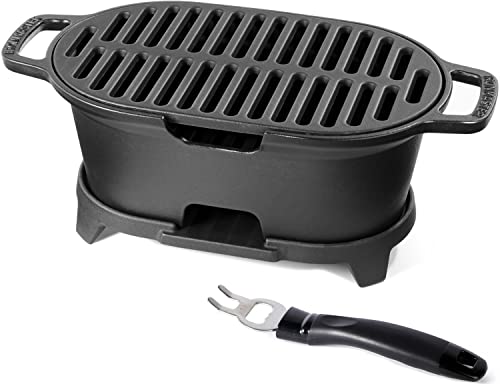
IronMaster Mini 100% Cast Iron Hibachi Grill — Best True Yakitori Format
The IronMaster Mini is the purist’s hibachi: 100% cast iron, a tabletop Japanese BBQ format and a grate surface listed at 11 x 6.7 inches, sized honestly for two people. It suits couples and solo cooks who grill yakitori-style — small pieces, high heat, eaten as they finish — and campers who want a grill that packs like a skillet. It is not suited to family dinners or to anyone who finds tending a tiny charcoal fire fiddly; the format’s intimacy is the point, and it asks for participation.
Strengths
- 100% cast iron construction (per Amazon listing title) for maximum heat retention
- True tabletop Japanese BBQ format for yakitori and small-piece grilling
- Compact 11 x 6.7 inch grate (per Amazon listing title) packs and stores easily
Trade-offs
- Strictly a two-person grill — groups will wait between batches
- Small charcoal loads need topping up on longer sessions
- Cast iron care rules apply: season it, keep it dry
| Grate surface | 11 x 6.7 inches (per Amazon listing title) |
| Construction | 100% cast iron (per Amazon listing title) |
| Capacity | Ideal for 2 people (per Amazon listing title) |
| Fuel | Charcoal |
Japanese hibachi cooking is a rhythm — skewers on, turn, glaze, eat, repeat — and the IronMaster Mini is built precisely to that rhythm. The small, thick iron grate sits close over a compact bed of charcoal, so heat is intense and immediate, and the whole unit lives on the table where the eaters are, which is how the format is social rather than solitary. For two people it is perfectly scaled: a few skewers, a couple of steaks sliced to share, vegetables in the gaps. The limitations are definitional. It will not cook a family dinner, its charcoal bed needs refreshing across a long evening, and cast iron demands its seasoning routine. Within its brief, though, it is the most authentic tool in this guide — the one that reproduces the Tokyo alley-grill experience on a balcony table or a campsite bench, with iron that will outlast the table it sits on.
Best for: couples who grill yakitori-style in small, hot batches / Not suited for: family dinners or anyone who finds small-fire tending fiddly
Check the current price on Amazon for the IronMaster Mini 100% Cast Iron Hibachi Grill.

Sungmor Compact Cast Iron Charcoal Grill, Tabletop — Best Adjustable Grate
The Sungmor Compact is a tabletop cast iron charcoal grill with an adjustable grate, wooden handles and a listed 12 x 7 inch cooking surface for one to three people. It suits small-space outdoor cooking — a sturdy table on a patio or at a campsite — where a full grill cannot go, and solo cooks who want real charcoal flavour without firing a big kettle for two skewers. It is not suited to indoor use under any circumstances, to large groups, or to cooks who want a lid for roasting; this is open, direct-heat grilling at tabletop scale.
Strengths
- Adjustable grate height is a real temperature control most mini grills lack
- Wooden handles stay cool enough to reposition the grill carefully
- Compact 12 x 7 surface (per Amazon listing title) suits 1-3 people honestly
Trade-offs
- Open-top format only — no lid for indirect or roasting cooks
- Surface size caps menus at small pieces and small batches
- Cast iron body is heavy relative to its cooking area
| Size | 12 x 7 inches, for 1-3 people (per Amazon listing title) |
| Grate | Adjustable grate (per Amazon listing title) |
| Handles | Wooden handles (per Amazon listing title) |
| Construction | Cast iron (per Amazon listing title) |
| Fuel | Charcoal |
Grate height is the hibachi cook’s secret control — closer to the coals for searing, higher for gentler cooking — and the Sungmor builds it in as an adjustable grate rather than leaving you to shuffle coals. Combined with wooden handles that let you shift the whole grill safely, it is a mini grill designed by someone who has actually cooked on one. The 12 x 7 surface is honestly sized: dinner for one to three, cooked in the hibachi rhythm of small batches eaten hot. Safety deserves a plain sentence here, because tabletop charcoal grills attract balcony and indoor misuse: charcoal produces carbon monoxide, so this grill is for outdoor use only, on a heat-proof surface, whatever its size suggests. Treated as the outdoor tabletop tool it is — seasoned, stored dry, and given small, frequent charcoal loads — it delivers genuine charcoal cooking in spaces a kettle grill cannot serve.
Best for: small-space outdoor cooks who want grate-height control / Not suited for: groups, or anyone wanting a lid for roasting
Check the current price on Amazon for the Sungmor Compact Cast Iron Charcoal Grill, Tabletop.

IRONMAX Hibachi Grill, 100% Cast Iron, Yakitori Tabletop — Best for Attentive Cooks
The IRONMAX hibachi pairs a 100% cast iron body with the two doors yakitori cooks actually use — a coal door for feeding the fire and a draft door for metering air — in a mini Japanese tabletop format for two people. It suits skewer specialists and couples who cook interactively at the table, topping up charcoal and adjusting draft as the evening goes. It is not suited to set-and-forget cooking or to groups; the design assumes a cook who enjoys running a small fire attentively.
Strengths
- Coal door lets you add charcoal without lifting the grate mid-cook
- Draft door meters airflow — the true throttle of a charcoal fire
- 100% cast iron (per Amazon listing title) for heat retention and longevity
Trade-offs
- Two-person scale; entertaining means cooking in waves
- Interactive format — the fire wants attention every few minutes
- Small parts and doors need ash kept clear to work smoothly
| Construction | 100% cast iron (per Amazon listing title) |
| Doors | Coal door and draft door (per Amazon listing title) |
| Style | Mini Japanese yakitori tabletop (per Amazon listing title) |
| Capacity | Ideal for 2 people (per Amazon listing title) |
| Fuel | Charcoal |
Yakitori masters manage two things constantly — charcoal supply and draft — and most mini hibachis make both awkward. The IRONMAX’s coal door solves the first: fresh charcoal slides in without disturbing the skewers on the grate. The draft door solves the second: airflow, not charcoal quantity, is how you fine-tune a small fire, and a door meters it precisely. The cast iron skillet-grill body holds the heat steady between adjustments, which is what makes the small format cook like a professional one. The format’s demands are the familiar ones — two people, small batches, an attentive cook — and its safety rule is absolute: outdoor use only, on a stable heat-proof surface. For couples who have discovered that grilling small and often beats grilling big and rarely, this is the most thoughtfully equipped mini hibachi in the guide.
Best for: skewer specialists who enjoy running a small fire attentively / Not suited for: set-and-forget cooks or groups
Check the current price on Amazon for the IRONMAX Hibachi Grill, 100% Cast Iron, Yakitori Tabletop.

Cuisinart 14-Inch Portable Charcoal Grill CCG-190RB — Best Lidded Portable — Bonus Pick
The Cuisinart CCG-190RB is the lidded alternative in this hibachi guide: a 14-inch portable charcoal grill with a listed 196 sq in of cooking area, a dual air vent system and three lid locks for one-handed carrying. It suits campers and picnickers who want a lid — for wind protection, for gentler cooks, for carrying the whole unit by its handle — in a hibachi-adjacent portable format. It is not a cast iron hibachi and does not pretend to be: the construction is lighter, the sear is milder, and in exchange you get portability the iron grills cannot match.
Strengths
- 196 sq in cooking area (per Amazon listing title) — the largest portable surface here
- Lid with dual vents enables covered cooking and wind shielding
- 3 lid locks and one-handed carrying make it genuinely grab-and-go
Trade-offs
- Chrome-plated grate lacks cast iron’s heat retention and searing mass
- Lighter construction will not outlast the cast iron picks
- Not a true hibachi — included as the lidded portable alternative
| Cooking area | 196 sq in (per Amazon listing title) |
| Size | 14 inches (per Amazon listing title) |
| Vents | Dual air vent system (per Amazon listing title) |
| Portability | 3 lid locks, one-handed carrying (per Amazon listing title) |
| Fuel | Charcoal |
Every guide needs the honest alternative, and in a hibachi list the Cuisinart is it: the portable charcoal grill for people who like the hibachi idea — small, charcoal, outdoors — but want a lid and a handle more than they want cast iron. The lid changes the cooking repertoire: close it and the little grill roasts and smokes gently instead of only searing, and it shields the fire from picnic-site wind that scatters open-hibachi heat. The dual vents give top-and-bottom airflow control, and the locking lid makes the whole unit a single carry item, which is why these live in car boots and camper vans. The trade is heat character: a chrome-plated grate over a light firebox will not lay down the crust a Lodge or IronMaster does, and the build is a seasons-long tool rather than a decades-long one. As the bonus pick for campers who prioritise the journey, it earns its place.
Best for: campers who want a lid, a handle and the largest portable surface here / Not suited for: sear purists who want cast iron’s heat retention
Check the current price on Amazon for the Cuisinart 14-Inch Portable Charcoal Grill CCG-190RB.
Comparison Table
| Pick | Badge | Key spec | Best for |
|---|---|---|---|
| Lodge Sportsman’s Pro Cast Iron Grill | Best Overall | Cast iron, 9 x 16.75 in, dual air vents | campers and backyard cooks who want cast iron intensity for two to four people |
| GIANTEX Portable Hibachi Grill, Cast Iron | Best Fire Control | Cast iron, air regulating door, double-sided grate | picnickers who want to manage a live fire without handling hot parts |
| IronMaster Mini 100% Cast Iron Hibachi Grill | Best True Yakitori Format | 100% cast iron, 11 x 6.7 in grate, for 2 people | couples who grill yakitori-style in small, hot batches |
| Sungmor Compact Cast Iron Charcoal Grill, Tabletop | Best Adjustable Grate | Adjustable grate, 12 x 7 in, wooden handles | small-space outdoor cooks who want grate-height control |
| IRONMAX Hibachi Grill, 100% Cast Iron, Yakitori Tabletop | Best for Attentive Cooks | Coal door and draft door, 100% cast iron | skewer specialists who enjoy running a small fire attentively |
| Cuisinart 14-Inch Portable Charcoal Grill CCG-190RB | Best Lidded Portable — Bonus Pick | 196 sq in, lidded, dual vents, carry locks | campers who want a lid, a handle and the largest portable surface here |
Read the table by control style: vents (Lodge), doors (GIANTEX, IRONMAX), grate height (Sungmor) and format purity (IronMaster) are four different answers to the same question — how do you run a small fire well? The bonus pick answers a different question entirely: how do you carry it?
How to Choose the Best 5 Hibachi Grills for Your Table
Start with capacity, stated honestly. Hibachi cooking is sequential — small batches, eaten hot — so the right question is not how many people the grill feeds but how many eat together in each wave. Two-person minis (IronMaster, IRONMAX) suit couples who cook and eat in rhythm. The Lodge, at 9 x 16.75 inches, stretches to four with a managed fire. If your table is regularly six, a hibachi is your second grill, not your only one — buy it for what it does superbly rather than asking it to be a cabinet.
Control is the second decision, and it is a choice of mechanism. Vents (Lodge) meter air at the fire’s base and lid — simple, proven, coarse. Doors (GIANTEX’s air door and fire gate, IRONMAX’s coal and draft doors) let you feed and throttle the fire without disturbing the food — the yakitori professional’s preference. Adjustable grate height (Sungmor) controls heat from the food’s side instead: closer for searing, higher for gentler cooking. None is best in the abstract; the best is the one your hands will enjoy using every few minutes, because hibachi cooking is continuous adjustment.
Material is the third decision and the shortest: cast iron is the format’s default for a reason — heat retention, searing, longevity — and every core pick here is iron. The commitment is care: seasoning, dry storage, and a tolerance for weight. If those are unacceptable, the lidded bonus pick trades intensity for lightness and simplicity, which is a legitimate trade made with open eyes.
Charcoal for Hibachis: Lump, Briquettes and the Small-Fire Craft
Fuel choice changes a hibachi’s character. Lump charcoal lights fast, burns hot and clean, and suits the hibachi’s short, intense cooks; its irregular pieces need arranging in a small firebox. Briquettes burn longer and more evenly at a lower peak, suiting longer sessions of chicken pieces and vegetables. Many hibachi cooks run a base of briquettes with lump on top for searing — the small fire makes blending easy and cheap to experiment with. Japanese binchotan is the connoisseur’s fuel: extremely hot, long and clean, at a price that reserves it for occasions.
The small-fire craft itself is simple and strict. Light charcoal in a chimney or a corner pile — never with lighter fluid in a grill whose food sits inches away — and wait for ash-grey coals before cooking. Arrange a gradient even at this scale: more coals under the searing side, fewer under the holding side. Add fresh charcoal in small amounts through the cook (the IRONMAX’s coal door exists for exactly this) rather than rebuilding the fire, and meter the vents or draft door instead of fanning frantically.
Ash is the hibachi’s silent throttle: a small fire chokes on its own ash faster than a big one. Shake or clear ash gently between batches on longer cooks, keep the vents and doors free of build-up, and let the fire die completely — vents closed — before ash goes into a metal container, never a bin with anything combustible. Small fires forgive nothing about disposal; treat the ritual as part of the cooking.
Hibachi Safety and Setup: Small Grill, Serious Rules
The rules scale down less than the grill does. Carbon monoxide: charcoal burning produces it in quantity, it is odourless, and it has killed people who treated a small grill as an indoor or tent appliance. Hibachis are for outdoor use in open air — full stop. A balcony must be genuinely open and permitted by your building and local fire rules; when in doubt, the answer is a ground-floor patio or a park, not a workaround.
The surface matters as much as the air. A hibachi’s body radiates serious heat downward and outward, so it belongs on stone, concrete, metal or a purpose-made heat-proof stand — never directly on a wooden or plastic table, however sturdy it looks. Keep the grill stable and level, away from table edges, and plan the landing zone for hot grates and lifters before the fire is lit. Children and pets get a clear boundary; tabletop grills sit exactly at small-child hand height.
Fire discipline completes the setup: water or sand within reach (not for a charcoal flare ritual — for genuine emergencies), a clear area around the grill, and no cooking under overhangs, umbrellas or tree canopies. After cooking, the iron stays hot far longer than it looks — announce it, guard it, and let it cool fully before moving or covering. Small grills cause outsized burns precisely because they look harmless; treat the Lodge’s iron with the respect you would give a stove burner, because that is what it is.
Serving at the Hibachi: How the Meal Flows Around a Small Fire
A hibachi meal is structured differently from a grilled dinner, and hosts who import dinner-party structure to it fight the format all evening. There are no courses and no plating moment; there is a fire, a cook seated with the eaters, and food arriving in waves sized to the grate — a few skewers, a sliced steak shared as it rests, vegetables from the cooler zone, then the next wave. Guests eat continuously and conversationally. The cook’s mise en place is therefore the whole event: everything cut, skewered, seasoned and within arm’s reach before the charcoal is lit, because once the fire is ready the cook does not leave it.
Seating and service follow from the fire’s scale. Diners sit close — the hibachi is table theatre — with small plates, dipping sauces in the tare tradition or your own, and drinks that do not require the cook’s hands. Rice and salads, made ahead, are the correct supporting cast: they ask nothing of the fire and they pace the waves. The host’s skill is rhythm, not volume — judging when a wave is two minutes out and starting the next, keeping the holding zone stocked without crowding it, and letting the fire, not the clock, set the evening’s tempo.
The ending is part of the form. The last wave is often the cook’s own favourites, eaten as the fire settles; then vents close, conversation continues around the cooling iron, and the grill is cleaned when it is cold — never hurried with water, which cast iron punishes. Guests remember hibachi evenings as occasions rather than meals, which is why a grill with the smallest cooking surface in this entire cluster earns its place in so many patios that also hold a cabinet gas grill: it does the one thing the big grill cannot, which is make the cooking itself the gathering.
How to Cook Yakitori-Style on a Hibachi: A First Session, Step by Step
Yakitori-style cooking is the hibachi’s native language: skewers and small pieces, cooked in waves over a managed fire. This first-session method works on every cast iron pick in this guide.
- Set up outdoors on a heat-proof, stable surface. Place the hibachi on stone, concrete or a metal stand with clear space around it, skewers and ingredients prepped, a tray for cooked food and water within reach. Confirm the vents or draft door move freely and the ash from any previous cook is cleared.
- Build a two-zone charcoal bed. Light a modest load of charcoal — lump for heat, or a lump-and-briquette blend for a longer session — and once the coals are ash-grey, arrange them deeper on one side (the sear zone) and shallower on the other (the holding zone). Even at hibachi scale, zones are the technique.
- Heat the grate and oil the food, not the grate. Set the grate over the coals for a few minutes to heat fully. Lightly oil the skewers and pieces themselves; oiling a ripping-hot hibachi grate mostly makes smoke. Season skewers simply for a first session — salt is the traditional starting point, with tare glaze reserved for the final turns.
- Cook in waves of a few skewers. Lay a small batch over the sear zone, turn frequently for even charring, and move finished skewers to the holding zone or straight to plates — hibachi food is eaten as it finishes, by design. Start the next wave as the previous one lands. The rhythm is the meal.
- Manage the fire little and often. Adjust the vents, draft door or grate height in small steps, and add a few fresh coals through the coal door or at the edge before the fire fades, not after. A hibachi rewards the cook who tends it continuously over the cook who rescues it dramatically.
- Close down with complete patience. When cooking ends, close vents and doors to starve the fire and let the grill cool fully — cast iron holds heat for a long time. Only when the ash is completely cold does it go, into a metal container. Brush the grate, and once the iron is cool and dry, a whisper of oil protects it until the next session.
After two or three sessions the rhythm becomes social rather than technical: the cook sits with the eaters, the waves keep coming, and the small fire does what it has done for generations — turns a meal into an occasion measured in skewers, not courses.
Common Buying Mistakes
Using a hibachi indoors, in a tent or in an enclosed space. This is the one mistake in this guide that is dangerous rather than disappointing. Charcoal produces carbon monoxide; a hibachi’s tabletop size does not reduce it. Outdoor open air only — no exceptions, no ‘just for a minute’, no garage with the door open.
Putting the grill directly on a wooden or plastic table. Cast iron hibachi bodies radiate enough heat to scorch, melt or ignite a table surface. Use stone, concrete, metal or a proper heat-proof stand, every time, even for a short cook.
Overloading the grate to feed a crowd at once. Packed skewers steam, char unevenly and cool the small fire. Hibachi cooking is waves: small batches, eaten hot, repeated. A queue at a hibachi is a feature — hungry people watching food cook is the format’s theatre.
Drowning the fire in lighter fluid or a huge charcoal load. Small fires need small, clean starts. Lighter fluid flavours food at hibachi distances, and an overfilled firebox removes your control. Light a modest load in a chimney, add coals little and often.
Neglecting the cast iron afterwards. Iron left ashy, wet or unoiled rusts — and a rusty hibachi gets abandoned, which is how good grills die. Cool fully, empty cold ash, brush, dry and oil lightly. Five minutes, every time, and the grill outlives its owner.
Judging the fire by flame instead of coal state. Flames mean the charcoal is still lighting; ash-grey coals with a steady glow are the cooking fire. Food over flaming charcoal soots and scorches. Patience at the start is the difference between a sear and a smudge.
Final Recommendation
For most buyers, the Lodge Sportsman’s Pro is the hibachi to own: the heaviest iron, the benchmark sear, vents that work and a size that stretches from couples to four people without lying about it. If fire control is your pleasure, the GIANTEX and IRONMAX — with their doors and gates — put more of the fire in your hands, and the IronMaster Mini is the purest expression of the yakitori format for two.
The Sungmor’s adjustable grate is the cleverest single mechanism in the guide, and the Cuisinart bonus pick serves campers who want a lid and a handle more than iron. Whichever you choose, honour the format’s terms — outdoors only, heat-proof surface, small batches, tended fire — and a hibachi will give you the most intense, social grilling in this entire cluster, from the smallest footprint of all.
- Lodge Sportsman’s Pro Cast Iron Grill — best overall pick.
- GIANTEX Portable Hibachi Grill, Cast Iron — best fire control pick.
- IronMaster Mini 100% Cast Iron Hibachi Grill — best true yakitori format pick.
Keep exploring the cluster: Best 5 Bbq Grills Best 4 Burner Propane Grills Best 5 Burner Gas Grills Best 6 Burner Gas Grills Best 4 Burner Lp Gas Grills Under 250.00 Best 5 And 6 Burner Gas Grills
Frequently Asked Questions
What is a hibachi grill, exactly?
A small, open-top charcoal grill — traditionally cast iron, tabletop-sized — originating in Japanese cooking and built for skewers and small pieces cooked close over a fierce little fire. Modern versions add vents, doors and adjustable grates for fire control. It is defined by scale and intimacy: food for two to four, cooked in waves and eaten as it finishes.
Can I use a hibachi grill indoors or on a balcony?
Indoors: never. Charcoal produces carbon monoxide, which is odourless and lethal in enclosed spaces, and a hibachi’s size does not change that. Balconies: only if genuinely open-air and permitted by your building’s rules and local fire code — many buildings prohibit charcoal entirely. When either answer is uncertain, treat it as no and cook in an open outdoor space.
What charcoal is best for a hibachi?
Lump charcoal for maximum heat and clean flavour in short cooks; briquettes for longer, steadier sessions; a blend of both for most evenings. Binchotan is the premium traditional choice for yakitori — extremely hot and long-burning — at a price most cooks reserve for occasions. Avoid self-lighting charcoal, whose additives sit unpleasantly close to the food at hibachi distances.
How many people can a hibachi feed?
Honestly: two to four per session, eating in waves. The two-person minis in this guide are couples’ grills; the Lodge stretches to four with fire management. A hibachi asked to feed eight feeds them sequentially, which is either a convivial evening or a catering failure depending on the plan — buy it as a second grill if crowds are your norm.
How do I stop cast iron hibachi grates from rusting?
The cast iron routine: let the grill cool fully, remove cold ash, brush the grate clean, dry the iron completely and wipe it with a whisper of cooking oil before storage under cover in a dry place. Seasoning builds with use. Rust that does appear is removable with a brush and re-seasoning — iron is forgiving if the routine resumes.
What do you cook on a hibachi besides skewers?
Anything small, quick and better for fierce heat: steaks and chops (the Lodge excels here), chicken pieces, sausages, prawns, mushrooms, peppers, corn sections, flatbreads and even fruit for dessert. The format fails at large, slow items — whole chickens, roasts, anything needing a lid — which belong on the bigger grills in this cluster.


