Disclosure: airfryerkitchensupply.com is reader-supported. When you buy through links on our site, we may earn an affiliate commission at no extra cost to you.
Where to buy
Every linked pick below was verified against Amazon’s catalog before this guide was published. Use these links to check the current price on Amazon, confirm the exact configuration (fuel type and trim), and read the full specification before you order:
- Best Built-In — SPIRE 36-Inch Built-In 6-Burner (All 304): Check the current price on Amazon
- Best Built-In for Large-Format Cooking — Coyote 36-Inch Built-In 4-Burner: Check the current price on Amazon
- Best Premium Built-In — Coyote 36-Inch CL-Series Built-In (Natural Gas): Check the current price on Amazon
- Best Griddle — Blackstone 36-Inch 4-Burner Griddle: Check the current price on Amazon
- Best Griddle Combo — Blackstone 2439 Original 36-Inch Omnivore Griddle with Airfryer: Check the current price on Amazon
- Best Premium Griddle — Weber Slate 36-Inch Griddle (Natural Gas): Check the current price on Amazon
The best 36 inch gas grills come in two distinct species, and knowing which one you are shopping for saves a lot of confusion. At 36 inches, the market splits between built-in grill heads for outdoor kitchens — wide, multi-burner appliances from brands like SPIRE and Coyote — and 36-inch flat-top griddles, the Blackstone format that has taken over backyard breakfast cooking. Freestanding lidded cart grills at exactly 36 inches are, honestly, rare; most cart grills are described by burner count instead.
This guide covers both species with the split made explicit in every badge. The built-ins — SPIRE’s all-304 six-burner and two Coyote heads — serve island builders who need width. The griddles — two Blackstones and Weber’s Slate — serve cooks whose menus run to smash burgers, fried rice, pancakes and cheesesteaks. Both are legitimate answers to a 36-inch search; they are not interchangeable, and the reviews never pretend otherwise.
Every pick is verified against Amazon’s catalog. Note the fuel types as you read: the griddle picks include propane and natural-gas versions, and the built-ins require an island — if you need a freestanding lidded grill, the honest recommendation is to shop by burner count in our four-burner guides instead.
Because this category splits into two species, the guide is organized to keep them honest: built-ins are compared with built-ins on construction and layout, griddles with griddles on plate and zones. The final recommendation at the end helps you choose the species itself if you arrived undecided.
In this guide
Quick Picks
Three built-in heads for islands (SPIRE, Coyote ×2) and three 36-inch griddles (Blackstone ×2, Weber Slate). The badges tell you which species each pick belongs to — choose your species first.
- Best Built-In — SPIRE 36-Inch Built-In 6-Burner (All 304): All-304 body stated in the listing, six burners, 915 square inches and a ceramic rear burner — the island centerpiece specification. Check the current price on Amazon
- Best Built-In for Large-Format Cooking — Coyote 36-Inch Built-In 4-Burner: Four wide burners under 875 square inches: broad zones for brisket flats and full sheet-pan loads. Check the current price on Amazon
- Best Premium Built-In — Coyote 36-Inch CL-Series Built-In (Natural Gas): Coyote’s CL-Series in natural gas for single-brand outdoor kitchens — with product-page specification checks required. Check the current price on Amazon
- Best Griddle — Blackstone 36-Inch 4-Burner Griddle: The original 36-inch flat top: four zones, 60,000 BTU and a generation of owners proving the format. Check the current price on Amazon
- Best Griddle Combo — Blackstone 2439 Original 36-Inch Omnivore Griddle with Airfryer: The Omnivore plate plus an integrated hood and a built-in airfryer — the full breakfast-station consolidation. Check the current price on Amazon
- Best Premium Griddle — Weber Slate 36-Inch Griddle (Natural Gas): Rust-resistant pre-seasoned carbon steel, a digital thermometer and natural-gas readiness, Weber-style. Check the current price on Amazon
How These Picks Were Chosen
We began by mapping what ’36 inch gas grill’ actually returns in the current market, then verified each candidate as a complete appliance. Built-ins had to be true 36-inch heads; griddles had to be true 36-inch plates. Accessories, covers and commercial countertop hot plates were excluded — a search for this size returns several commercial teppanyaki units that are not home grills at all.
Ranking within each species used the criteria that matter there: for built-ins, published construction grade, burner layout and cooking area; for griddles, plate design, zone control and the maintenance burden of the top. Cross-species comparisons are made only at the level of ‘which kind of cooking do you do’, because a griddle and a lidded built-in answer different questions.
The 6 Best 36 Inch Gas Grills

SPIRE 36-Inch Built-In 6-Burner (All 304) — Best Built-In
All-304 body stated in the listing, six burners, 915 square inches and a ceramic rear burner — the island centerpiece specification.
The SPIRE 36 leads with the credential 304-shoppers want: an all-304 stainless body, stated in the listing. Behind that headline is a serious specification — six burners, 73,000 BTU, 915 square inches, a ceramic rear burner for rotisserie work and interior lighting for evening cooks. It is sized as an island centerpiece rather than a modest insert, and the island must be planned around its cutout. Spire lacks the decades-long built-in résumé of Bull or Blaze, which is the honest trade for its aggressive specification. For a 36-inch build where published 304 construction is the priority, it is the most direct answer on the market.
SPIRE ownership centers on the island relationship: a 36-inch head is the kitchen’s anchor, and this one’s published all-304 body is specified for that permanence. The ceramic rear burner brings rotisserie into the specification without a separate accessory hunt, and interior lighting proves its worth at every evening cook. As a newer built-in brand, keep documentation and confirm parts channels at purchase — the same advice as any challenger brand, applied to a head whose specification outruns the establishment’s. Dual-fuel flexibility helps future-proof the installation if the home’s gas arrangements ever change.
Strengths
- The listing states an all-304 stainless body — the grade is published, not implied.
- Six burners across 915 square inches is true crowd capacity in one head.
- Ceramic rear burner and interior lighting are pro-tier inclusions.
Trade-offs
- 36-inch built-ins demand a larger island and cutout than the 32-inch standard.
- Spire is a newer name than Blaze or Bull in built-ins; support depth is still proving out.
- Dual-fuel flexibility still requires correct regulator and line setup for the chosen fuel.
Key specs (from the verified listing):
- 36-inch built-in, 6 burners
- All 304 stainless steel body (per listing)
- 73,000 BTU total (per listing)
- 915 sq. in. cooking space
- Ceramic rear burner
- Interior lighting
- Dual fuel
Check the current price on Amazon
Best for: Large outdoor kitchens wanting a published all-304 build at 36 inches with six-burner capacity. / Not suited for: Compact islands, or buyers who only trust long-established built-in brands.

Coyote 36-Inch Built-In 4-Burner — Best Built-In for Large-Format Cooking
Four wide burners under 875 square inches: broad zones for brisket flats and full sheet-pan loads.
This Coyote 36-inch head takes the fewer-but-wider approach: four burners under 875 square inches, which gives broad zones that fit brisket flats, multiple spatchcocked chickens or a full sheet of vegetables without juggling. The listing’s brevity means the product page carries the details — fuel type, output and steel grade all need confirming there. What the brand brings is outdoor-kitchen depth: matching components and a support structure aimed at permanent installations. For entertainers whose cooking is large-format rather than many-small-items, the wide-zone layout is arguably better than a six-burner alternative.
This head’s ownership pleasures are spatial: whole brisket flats, two spatchcocked chickens side by side, a full sheet pan of vegetables without Tetris. The wide-zone layout simplifies burner management — four zones, each broad enough to be forgiving. The product-page verification (fuel, output, grade) is the purchase-time task; island ownership after that follows the standard built-in rhythm. Coyote’s component ecosystem supports the surrounding kitchen. Entertainers who cook large-format will find this layout more useful than a six-burner’s many narrow zones, which is a genuine and underrated distinction in built-in shopping.
Strengths
- 875 square inches is genuine entertaining capacity in a single head.
- Four wide burners create broad, simple zones that suit large cuts and sheet-pan loads.
- Coyote’s outdoor-kitchen specialization supports the island around the grill, not just the grill.
Trade-offs
- The listing publishes limited detail beyond area and burners — verify output, fuel and grade on the product page.
- 36-inch islands are a substantial build commitment.
- Premium specialist-brand tier.
Key specs (from the verified listing):
- 36-inch built-in, 4 burners
- 875 sq. in. cooking area
Check the current price on Amazon
Best for: Entertainers cooking large-format loads in a 36-inch island (verify fuel on the product page). / Not suited for: Cooks wanting many narrow heat zones, or anyone skipping specification verification.

Coyote 36-Inch CL-Series Built-In (Natural Gas) — Best Premium Built-In
Coyote’s CL-Series in natural gas for single-brand outdoor kitchens — with product-page specification checks required.
Coyote’s 36-inch CL-Series head is the connoisseur’s entry in this size: a specialist brand, a permanent natural-gas installation, and construction aimed at owners who keep outdoor kitchens for decades. The listing itself is terse — model and fuel only — so this pick is recommended on the brand’s built-in track record, with the explicit homework of confirming burner output, grate material and steel grade on the product page before committing an island cutout. For builders already in Coyote’s ecosystem of doors, drawers and refrigeration, it keeps the kitchen single-brand coherent.
Coyote ownership is ecosystem ownership: the head matches the brand’s doors, drawers and refrigeration, and the support structure is built around permanent installations. The terse listing makes the pre-purchase specification check the main task — output, grates and grade confirmed on the product page before the cutout is committed. Natural gas makes the big head effortless to live with day to day. For builders already committed to a Coyote kitchen, this head keeps the installation coherent; for others, it is a premium alternative whose homework requirement is stated plainly in this guide rather than discovered later.
Strengths
- Coyote is an outdoor-kitchen specialist brand with a strong built-in reputation.
- The CL-Series targets serious home islands with commercial-leaning construction.
- Natural gas suits a permanent 36-inch island installation perfectly.
Trade-offs
- The listing title is minimal — full specifications and steel grade must be confirmed on the product page.
- Premium-tier brand positioning.
- Natural gas only in this configuration.
Key specs (from the verified listing):
- 36-inch built-in
- Fuel: natural gas
- Model C3CL36NG
Check the current price on Amazon
Best for: Natural-gas island builders who value specialist-brand construction and ecosystem coherence. / Not suited for: Propane users, or buyers who will not verify specifications on the product page.

Blackstone 36-Inch 4-Burner Griddle — Best Griddle
The original 36-inch flat top: four zones, 60,000 BTU and a generation of owners proving the format.
Blackstone’s 36-inch station essentially created the modern backyard griddle category, and the formula still works: four burners under a broad steel plate, each zone independently controlled, so eggs, bacon, burgers and onions can all run at once at their own temperatures. The 60,000 BTU total is honest working output for the plate size. Ownership means griddle discipline — season it, scrape it, oil it lightly after cooks — and in exchange it will out-cook any lidded grill on breakfast, smash burgers, fried rice and cheesesteaks. Buyers should be clear-eyed that it complements a grill rather than replacing one for roasting tasks.
Blackstone ownership is a rhythm: season, cook, scrape, oil, cover. Owners who internalize it get a decade of service and the best breakfasts in the neighborhood; owners who skip it meet rust and sticking and blame the plate. The folding legs make it the movable member of the 36-inch class — it can follow the party to a driveway or a campsite with a vehicle big enough to carry it. Parts and accessories are everywhere; the griddle ecosystem is the deepest in outdoor cooking. Treat it as a complement to a lidded grill and the pair covers virtually every outdoor menu a household cooks.
Strengths
- The original 36-inch griddle format: a huge flat top with four independent heat zones.
- 60,000 BTU across four burners heats the plate evenly edge to edge.
- Folding legs and a storage rack make it movable despite its size.
Trade-offs
- It is a griddle, not a lidded grill — no roasting, smoking or rotisserie.
- The steel top needs seasoning and post-cook oiling to stay rust-free.
- No hood on this classic configuration, so cheese-melting and steaming need a basting cover.
Key specs (from the verified listing):
- 36-inch flat-top griddle, 4 burners
- 60,000 BTU total (per listing)
- Foldable legs
- Grease pan
- Storage rack
- Fuel: liquid propane
Check the current price on Amazon
Best for: Griddle-first cooks feeding crowds breakfast, smash burgers and teppanyaki-style dinners. / Not suited for: Anyone needing a lid for roasting or smoking, or unwilling to maintain a seasoned steel top.

Blackstone 2439 Original 36-Inch Omnivore Griddle with Airfryer — Best Griddle Combo
The Omnivore plate plus an integrated hood and a built-in airfryer — the full breakfast-station consolidation.
The 2439 is Blackstone’s answer to the two accessories owners always added: a hood and an airfryer. The hood transforms the griddle’s range — cheese melts properly, vegetables steam-roast, and the plate stays cleaner between cooks. The 4-quart airfryer drawer handles the fries-and-wings side of the menu in the same footprint and fuel source. The Omnivore plate is engineered for evenness and efficiency over the classic plate. The cost is complexity and cleaning surface area. For households that would genuinely use all three functions weekly, consolidating them into one station is the right call.
The 2439 adds systems, and systems add cleaning: the airfryer basket wants a wash, the hood wants a degreasing wipe, and the plate wants its usual scrape-and-oil. In exchange, one station now covers the full diner menu — plate, melts under the hood, fries in the drawer — on one fuel connection. The Omnivore plate’s evenness reduces the zone-management learning curve for new griddle owners. It is a big, committed appliance; households that griddle weekly will use everything it offers, while occasional cooks should take the simpler classic and a basting dome instead.
Strengths
- The integrated hood fixes the classic Blackstone gap — now you can melt, steam and roast on the plate.
- A built-in 4-quart airfryer adds fries and wings without a second appliance.
- Omnivore plate design aims at more even heat with less fuel than the original plate.
Trade-offs
- More systems mean more cleaning: griddle plate, hood and airfryer basket all need attention.
- It is a large, heavy station even by 36-inch standards.
- Still a griddle at heart — no grate grilling or smoking.
Key specs (from the verified listing):
- 36-inch Omnivore griddle
- Integrated hood
- Built-in 4-quart airfryer
- BAR system
- Fuel: liquid propane
Check the current price on Amazon
Best for: Griddle households that also air-fry sides constantly and want one consolidated 36-inch station. / Not suited for: Minimalists, or anyone whose cooking needs a lidded grate grill instead.
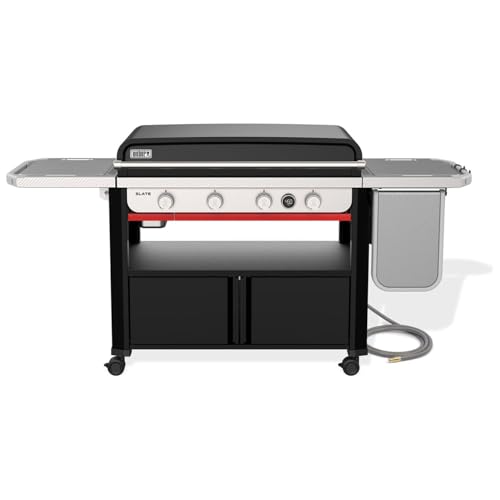
Weber Slate 36-Inch Griddle (Natural Gas) — Best Premium Griddle
Rust-resistant pre-seasoned carbon steel, a digital thermometer and natural-gas readiness, Weber-style.
The Slate is Weber entering the 36-inch griddle class with its usual thoroughness. The rust-resistant carbon-steel top arrives pre-seasoned and is designed to forgive the maintenance lapses that rust out ordinary plates. A digital thermometer replaces guesswork about plate temperature, the flip-up table and closed cabinet make it patio furniture as much as appliance, and natural gas means it is ready whenever. It does not try to be a grill — it tries to be the best-executed griddle station, with Weber’s parts and support behind it. For natural-gas households sold on flat-top cooking, it is the premium reference.
Slate ownership is griddle ownership with the anxiety removed: the rust-resistant top forgives a missed oiling, the digital thermometer replaces plate-temperature guesswork, and natural gas removes the tank from the routine entirely. Weber’s support and parts structure stands behind it, which no other griddle in this guide can claim at the same depth. The closed cabinet keeps the station tidy enough for finished patios. It is the premium griddle for households that have decided flat-top cooking is a permanent part of their lives and want the appliance version of that decision — plumbed, precise and built to be kept.
Strengths
- Rust-resistant, pre-seasoned carbon steel removes the classic griddle’s biggest maintenance fear.
- A digital thermometer and 500°F-plus capability bring precision griddles usually lack.
- Weber’s build and support applied to a natural-gas, always-ready station.
Trade-offs
- Natural gas only — propane patios need a different configuration.
- Griddle-only cooking; no grate, no lid-roasting beyond its cover design.
- Premium positioning within the griddle class.
Key specs (from the verified listing):
- 36-inch griddle, 4 burners
- Rust-resistant carbon-steel top
- Pre-seasoned surface
- Digital thermometer
- Flip-up side table
- Closed cabinet
- Fuel: natural gas
Check the current price on Amazon
Best for: Natural-gas households wanting a premium, low-maintenance 36-inch griddle station. / Not suited for: Propane users, or anyone needing grate grilling from the same appliance.
Comparison Table
| Pick | Badge | Key spec | Best for |
|---|---|---|---|
| SPIRE 36-Inch Built-In 6-Burner (All 304) | Best Built-In | 36-inch built-in, 6 burners | Large outdoor kitchens wanting a published all-304 build at 36 inches with six-burner capacity. |
| Coyote 36-Inch Built-In 4-Burner | Best Built-In for Large-Format Cooking | 36-inch built-in, 4 burners | Entertainers cooking large-format loads in a 36-inch island (verify fuel on the product page). |
| Coyote 36-Inch CL-Series Built-In (Natural Gas) | Best Premium Built-In | 36-inch built-in | Natural-gas island builders who value specialist-brand construction and ecosystem coherence. |
| Blackstone 36-Inch 4-Burner Griddle | Best Griddle | 36-inch flat-top griddle, 4 burners | Griddle-first cooks feeding crowds breakfast, smash burgers and teppanyaki-style dinners. |
| Blackstone 2439 Original 36-Inch Omnivore Griddle with Airfryer | Best Griddle Combo | 36-inch Omnivore griddle | Griddle households that also air-fry sides constantly and want one consolidated 36-inch station. |
| Weber Slate 36-Inch Griddle (Natural Gas) | Best Premium Griddle | 36-inch griddle, 4 burners | Natural-gas households wanting a premium, low-maintenance 36-inch griddle station. |
Reading the table: the six picks line up as follows — SPIRE 36-Inch Built-In 6-Burner (All 304) (36-inch built-in, 6 burners); Coyote 36-Inch Built-In 4-Burner (36-inch built-in, 4 burners); Coyote 36-Inch CL-Series Built-In (Natural Gas) (36-inch built-in); Blackstone 36-Inch 4-Burner Griddle (36-inch flat-top griddle, 4 burners); Blackstone 2439 Original 36-Inch Omnivore Griddle with Airfryer (36-inch Omnivore griddle); Weber Slate 36-Inch Griddle (Natural Gas) (36-inch griddle, 4 burners). The Key spec column shows each model’s headline verified specification from its listing; the reviews above carry the full spec boxes, and the guide sections below explain which of these numbers actually change what lands on the plate. Badges, not raw specifications, are the fastest route through this table: find the badge that describes your household, then read that model’s full review before deciding.
How to Choose a 36 Inch Gas Grill
First decision: lidded built-in or flat-top griddle
A lidded built-in grills, roasts and rotisseries: it is an outdoor oven with grates, suited to steaks, whole chickens, ribs and everything a conventional grill does, at island scale. A 36-inch griddle is a flat steel plate: unbeatable for eggs, bacon, smash burgers, fried rice, fajitas and cheesesteaks, and incapable of roasting or smoking. Households often end up owning one of each across a lifetime; the purchase order should follow the menu you cook most.
Be honest about the split in your own cooking. If eighty percent of your outdoor meals are breakfast-style or flat-top-friendly, the griddle is the main appliance and a smaller lidded grill can support it. If roasts and bone-in chicken dominate, the built-in is the anchor and the griddle is the accessory.
For built-ins: width, zones and the published grade
At 36 inches, burner layout philosophy splits: six narrower burners (SPIRE) create many zones for varied small items, while four wide burners (Coyote) create broad fields for large cuts. Neither is better; they suit different cooks. Construction grade matters more at this size because the head is a permanent island fixture — the SPIRE’s listing states an all-304 body, which is the standard to hold rivals to, and any head whose grade is unpublished needs a product-page confirmation before stonework.
Rear burners for rotisserie, interior lighting and hood assists are the features that prove out over a decade of island life. At 36 inches everything is heavy; a lift-assist or well-balanced hood is a daily ergonomic fact, not a luxury.
For griddles: plate, zones and the seasoning question
A griddle lives or dies by its plate. Thick steel holds heat evenly and recovers between batches; the Blackstone format’s four independently controlled burners let one plate run eggs gently and bacon hard simultaneously. Weber’s Slate attacks the format’s weakness — rust and seasoning upkeep — with a rust-resistant, pre-seasoned carbon-steel top, which is why it anchors the premium end.
Decide about the hood. Classic Blackstone stations are open; the 2439 adds an integrated hood that melts cheese properly and keeps the plate cleaner. If your griddle menu includes melts, steamed vegetables or held-warm batches, the hooded designs earn their premium quickly.
The 36-Inch Reality Check: Space, Islands and Alternatives
Thirty-six inches of grill implies infrastructure. A built-in head needs an island with a matching cutout, ventilation, gas supply and counter space on both sides to be useful — the head’s price is often less than half the finished installation. Shoppers early in the outdoor-kitchen journey should price the whole project before the head seduces them; our 32-inch guide covers the slightly more forgiving standard size.
A 36-inch griddle needs less infrastructure but more patio than buyers expect: the station, working room in front, and a safe zone behind for the grease management and heat. Measure the full working footprint, not the parked one. Both Blackstone picks fold or roll to soften this, but neither is a balcony appliance.
And if what you actually want is a big freestanding lidded grill, shop the four- and five-burner cart guides instead of the 36-inch label. Cart grills are sized by burners and grate area, and the best of them — Genesis-class four-burners and larger — deliver the cooking width people picture when they search 36 inches, without an island or a flat top.
Living With Width: Workflow on a 36-Inch Appliance
Width changes cooking workflow in ways brochures do not mention. On a 36-inch built-in, the far corners are a genuine reach — plan the layout so the hottest zone sits center-front, where tongs and arms work comfortably, and the gentle zones take the edges. On a 36-inch griddle, the same logic puts the breakfast chaos (eggs, the fastest food) at the front-center and the patient items (bacon rendering, onions caramelizing) at the back and sides where they can be visited rather than watched.
Batch rhythm matters more at this size, because the appliance invites volume. Stage ingredients in the order they hit the heat, keep a landing tray on the cool side, and resist filling every inch in the first minute — a 36-inch surface loaded edge to edge behaves like a steamer until the moisture clears. Experienced big-griddle and big-grill cooks load in waves, and their results show why.
Cleaning scales with width too. Build the scrape-and-wipe into the cook’s end rather than the next day’s beginning: a wide plate or grate left dirty overnight is a bigger, harder job, and on an island or station this size, the five-minute hot clean is the difference between an appliance that invites use and one that gets avoided.
Griddle or Built-In: A Menu-by-Menu Decision
Run your own menu through the two species honestly. Breakfast — eggs, bacon, pancakes, hash browns — belongs entirely to the griddle; a built-in can fake it with inserts, badly. Smash burgers, cheesesteaks, fried rice, fajitas and teppanyaki vegetables: griddle again, and it is not close. Now the other ledger: a whole chicken, a rack of ribs, a thick ribeye finished with lid heat, a rotisserie bird, anything smoked or roasted — built-in territory, where the griddle cannot follow at all. Most households’ menus contain both columns, which is why the species question is really a sequencing question: which do you cook more, this year?
Volume changes the answer too. The griddle’s party trick is simultaneity — breakfast for ten in one wave — while the built-in’s is range: one appliance that roasts, sears and bakes outdoors. A household that hosts brunches should weight the griddle heavily; a household that hosts Sunday roasts should weight the built-in. The 36-inch size amplifies both: these are commitment appliances, and the wrong species at this size is a large, expensive daily reminder.
The pragmatic resolution many households land on: the species that matches the majority menu goes in at 36 inches, and the minority menu gets a smaller companion later — a kettle, a portable griddle, a compact two-burner. Outdoor cooking setups are ecosystems, not single purchases, and this guide’s six picks are best read as anchor options for the ecosystem you actually intend to live with.
Covers, Tools and Prep Gear for Wide Appliances
Wide appliances need wide thinking about accessories, starting with the cover: a 36-inch built-in head or griddle station is a large sail in wind and a large target for weather, and the fitted cover for the exact model is the only version worth buying. Measure before ordering if the brand’s sizing is unclear, and choose a cover with vents — a sealed cover in humid climates traps the moisture it was bought to exclude. For built-ins, the cover is also the firebox’s defense against leaves, insects and nesting visitors between cooks.
Tools scale up too. Standard tongs feel short over a 36-inch surface’s back corners; long-handled tongs and a wide, sturdy spatula are the working pair, joined on griddles by two flat spatulas for smash work and a bench scraper that doubles as the cleaning tool. A basting dome earns its place on any open griddle — it is the cheese-melting and steaming lid the appliance did not ship with — and a squeeze bottle set for water and oil becomes part of the griddle’s permanent kit.
Prep infrastructure matters more at this width because the volume is real: a rolling cart or side shelf that holds two full sheet trays, a landing zone that separates raw from cooked, and a grease-management routine with spare liners or cups on hand. The cooks who love their 36-inch appliances have all built this small system around them; the cooks who sell theirs usually cite the chaos, not the cooking.
Finally, lighting. Wide appliances are evening appliances, and a proper light over the surface — hardwired on an island, a good grill light on a station — is a safety and quality upgrade disguised as a convenience. Interior lights on the SPIRE picks exist because manufacturers learned this; station owners should copy the lesson with whatever fixture their setup allows.
Island Safety: Ventilation, Clearances and Gas Work
A built-in grill is only as safe as the island around it, and propane islands carry one rule above all: ventilate low. Propane is heavier than air, so leaked gas pools at the bottom of an enclosed island instead of dispersing. Island structures for propane need vents positioned low, kept unobstructed, plus an access door that lets you reach the tank and shutoff without dismantling anything. If an existing island has no low vents, that is a builder conversation before the first cook, not after.
Clearances are the second pillar. The head’s specification sheet states the required distances to combustible materials above, behind and beside the unit — follow the sheet, not generic advice, because hood swing and rear-burner exhaust differ by model. Countertop materials near the head should be non-combustible, and the space beneath the head must respect the manufacturer’s insulation requirements, especially in framed (rather than masonry) islands.
Gas connections on a permanent installation deserve professional hands in most jurisdictions, and always deserve a leak test: every joint checked with soapy water under pressure, bubbles corrected before ignition. Know where your shutoff is — tank valve or line valve — and make sure the whole household knows. A built-in is a wonderful appliance precisely because it behaves like part of the house; it should be installed, ventilated and serviced with the same seriousness as the kitchen range indoors.
How to Season and Maintain a 36 Inch Griddle Top
For the griddle half of this guide, one skill decides ownership happiness: seasoning. This routine applies to Blackstone-style steel tops; the Weber Slate’s rust-resistant top needs only the lighter maintenance noted at the end.
- Start clean and dry. Wash a new plate with hot water and a drop of soap once — the only soap it should ever need — then dry it completely and heat it until every trace of moisture is gone.
- Apply a whisper-thin oil layer. With the plate hot, use a folded paper towel in tongs to spread a high-smoke-point oil until the surface looks almost dry. Thick layers season sticky; thin layers season hard.
- Heat until it smokes and darkens. Let the oil polymerize — the plate will darken in patches. That color change is the seasoning forming, not damage.
- Repeat three to five times. Each cycle deepens the non-stick layer. The plate should end up evenly darkened and dry to the touch.
- Cook something forgiving first. Onions or fatty bacon are traditional first cooks — they build the surface and forgive technique while you learn the plate’s zones.
- After every cook: scrape, wipe, oil lightly. Scrape debris to the grease trap while warm, wipe clean, and leave the thinnest possible oil film. That film is the rust barrier between cooks.
For the Weber Slate, follow the same scrape-and-wipe routine but skip aggressive re-seasoning — its rust-resistant pre-seasoned surface is designed to hold with ordinary care. For all griddles, a cover is non-negotiable: one rainy week on an unoiled plate undoes a season of discipline.
Common Buying Mistakes
Buying a built-in for a patio with no island plans. A 36-inch head is a component, not an appliance. Without the island project, it is an expensive ornament — choose a cart grill or griddle station instead.
Expecting a griddle to roast. No lid heat, no rotisserie, no smoking. Griddles are magnificent inside their repertoire and helpless outside it. Match the appliance to the menu.
Skipping griddle seasoning to ‘just start cooking’. An unseasoned plate sticks, rusts and discourages. One hour of seasoning buys years of easy cooking.
Comparing built-ins on width alone. Burner layout, published steel grade and rear-burner provision separate the decade heads from the disappointments. Width is the beginning of the specification, not the whole of it.
Forgetting fuel at 36 inches. These are hungry appliances. Propane users should plan tank capacity or a spare; natural-gas versions need the line sized for the load — confirm with your installer.
Final Recommendation
Island builders: the SPIRE 36 is the specification leader with its published all-304 body, while the Coyote heads suit large-format cooks and brand-loyal kitchens respectively. Griddle cooks: the classic Blackstone 36 remains the value reference, the 2439 consolidates hood and airfryer into the station, and the Weber Slate is the premium, low-maintenance, natural-gas answer.
The only wrong 36-inch purchase is the species mismatch — a griddle bought to roast, or a built-in bought without an island. Decide the species, verify the fuel and cutout, then check the current price on Amazon.
A final note for shoppers who arrived here expecting a row of identical freestanding grills and found two species instead: that surprise is the market being honest with you, and it is worth trusting. Manufacturers build what the size supports — at 36 inches, a cart grill becomes unwieldy, so the width migrated into islands and flat-tops where it thrives. If neither species fits your life, the correct move is not to force one; it is to step sideways into the four-burner cart guides, where the cooking width you pictured is sold by the burner count instead. But if one of the species does fit — the island centerpiece or the breakfast station — it will fit completely, and the picks above are the strongest current examples of each.
Whichever species you choose, give the appliance its first season generously: these are formats with learning curves, and the second month is unrecognizably smoother than the first. Griddle owners find their scrape rhythm; island owners learn their head’s zones and their kitchen’s traffic. Judge the purchase at the end of that season, not the end of the first weekend — by then, the 36-inch question that opened this guide will have answered itself in the only currency that matters, which is how often the appliance gets used, week after week.
Consider also what a 36-inch appliance says about commitment, because both species reward households that cook outdoors as a practice rather than an event. The island head integrates into a built environment; the griddle station anchors a cooking habit. Occasional outdoor cooks are genuinely better served by a good four-burner cart grill and a clear patio — an honest outcome this guide is happy to recommend. But for households whose weekends already orbit outdoor cooking, the step up to 36 inches in either species stops feeling like an upgrade and starts feeling like the appliance finally matching the life around it. That match, more than any specification, is what the picks above were chosen to deliver.
Related guides in this series: Best 32 Inch Propane Gas Grills For Outdoor Kitchens; Best 304 Barbeque Grills; Best 4 Burner Gas Grills; Best 4 Burner Grills; Best 3 Or 4 Burner Gas Grills
Frequently Asked Questions
Are 36 inch grills mostly built-ins and griddles?
Yes — that is the honest shape of the current market. Freestanding lidded cart grills are sold by burner count rather than width, so a 36-inch search returns island heads and flat-top griddles. This guide covers both and labels them clearly.
How many burgers fit on a 36 inch griddle?
A 36-inch plate typically handles around two dozen burgers in a single batch with working room — one reason the format dominates big breakfast and party cooking. The four zones also let other foods run simultaneously.
Which is better for steaks: a 36 inch built-in or a griddle?
The built-in, for thick steaks: grate searing plus lid heat cooks them through properly. Griddles excel at thin steaks, smash burgers and crust-all-over styles. Many serious cooks eventually run both.
Do 36 inch built-ins fit a standard island cutout?
There is no single standard — each head publishes its own cutout. The 36-inch class is less common than 32-inch, so islands are usually built around the chosen head. Verify the specification sheet before any stonework.
Is the Weber Slate really rust-resistant?
Its carbon-steel top is engineered and pre-seasoned to resist rust far better than a conventional plate, which is its headline feature. It still wants the basic scrape-wipe-cover routine, but it forgives lapses that would mark a standard top.
What fuel do 36 inch grills use?
Both, depending on model. In this guide the SPIRE is dual-fuel, the Coyote CL is natural gas, and the Blackstones are propane while the Weber Slate listed is natural gas. Fuel is in every pick’s name and spec box — confirm it matches your supply before ordering.
Can one person assemble and place a 36-inch griddle or built-in?
Griddle stations are a two-person lift in practice, and built-in heads should always be set by two people with the cutout checked first. Plan the help before delivery day.
Is 36 inches too big for a family of four?
For a built-in, it depends on hosting habits — the size earns itself with guests. For a griddle, families of four routinely love the 36-inch format because breakfast for four plus guests is exactly its home turf.


