Disclosure: airfryerkitchensupply.com is reader-supported. When you buy through links on our site, we may earn an affiliate commission at no extra cost to you.
Where to buy
Shopping for the best 2 burner grills under 200 dollars starts with one honest fact: this tier is where two-burner grilling actually lives for most households, but prices move with the season, so this guide prints none. Every pick below is a genuine two-burner grill verified against a live Amazon listing, positioned in the entry tier of the market — the models that orbit this budget and regularly sell within it. Check the current price on Amazon before ordering, and confirm the exact configuration on the listing, because grate and shelf details vary by production run.
- Charbroil Classic 2-Burner Propane Gas Grill (Best Overall in the Tier) — Check the current price on Amazon
- Megamaster Deluxe 2 Burner Gas Grill (Best Cooking Area) — Check the current price on Amazon
- Royal Gourmet GT2009 2-Burner Portable Gas Grill with Folding Cart (Best Folding Cart) — Check the current price on Amazon
- Kenmore 2-Burner Portable Gas Grill (Best Tabletop) — Check the current price on Amazon
- Nexgrill Tabletop 2 Burner Gas Grill, Stainless Steel (Best Tabletop Heat) — Check the current price on Amazon
- Coleman RoadTrip 225 Portable Tabletop Grill (Best Portable) — Check the current price on Amazon
What the Under-$200 Tier Actually Buys You
The best 2 burner grills under 200 dollars share a recognizable formula: two burners in the 17,000 to 28,000 BTU range, between roughly 200 and 420 square inches of stated cooking space, porcelain-coated or cast-iron grates depending on the brand, and a cart, folding cart, or tabletop format built from powder-coated and stainless steel. What the tier does not buy is thick-gauge construction, premium-brand parts depth, or a side burner — and any listing in this range promising all of that plus a rotisserie is describing a grill that does not exist.
That is not a warning against the tier; it is a description of a fair trade. A household grilling burgers, chicken, sausages, and vegetables a few times a month will be well served by every pick in this guide. The differences that matter at this level are practical: how much grate you actually get once warming racks are subtracted, whether the ignition is replaceable, whether the grill runs on a full-size tank or expensive small canisters, and whether the format — cart, folding cart, or tabletop — matches the space you actually have.
It is also worth saying who this tier is quietly perfect for: the household that grills in bursts — heavy in June, silent in November — and cannot justify a premium appliance sitting under a cover for half the year. A budget two-burner asks little, stores easily in its tabletop and folding forms, and if life changes — a move, a bigger patio, a growing family — it hands its job to a bigger grill without the sting of a large sunk cost. Many premium-grill owners started exactly here, learned what they actually cook, and upgraded with knowledge instead of guesses. There is no shame in the starter tier; there is only shame in a starter tier bought blind.
One more piece of honesty before the picks: grill pricing is seasonal and promotion-driven, and models drift in and out of this budget across the year. We therefore position each pick by its tier — entry-level models that live in or around this budget — rather than asserting a price we cannot guarantee on the day you read this. Use the budget as a filter, verify the live number on Amazon, and judge the grill on the hardware below.
In this guide
Quick Picks
- Best Overall in the Tier: Charbroil Classic 2-Burner Propane Gas Grill — a true compact cart with side shelves, 20,000 BTU, and 280 square inches. Check the current price on Amazon
- Best Cooking Area: Megamaster Deluxe 2 Burner Gas Grill — 28,000 BTU and the largest stated cooking space in this guide, with cast iron grates. Check the current price on Amazon
- Best Folding Cart: Royal Gourmet GT2009 — 349 square inches on a cart that folds flat for storage and travel. Check the current price on Amazon
- Best Tabletop: Kenmore 2-Burner Portable Gas Grill — a warming rack and compatibility with both small and 20 lb tanks. Check the current price on Amazon
- Best Tabletop Heat: Nexgrill Tabletop 2 Burner Gas Grill, Stainless Steel — a listing-rated 28,000 BTU in a 251 square inch tabletop with a locking lid. Check the current price on Amazon
- Best Portable: Coleman RoadTrip 225 Portable Tabletop Grill — 11,000 BTU, Instastart ignition, and a removable water pan for easy cleanup. Check the current price on Amazon
How These Picks Were Chosen
The first filter was absolute: exactly two main burners, verified from the manufacturer’s own Amazon listing — not from a category page, not from a roundup on another site. That filter matters more in this tier than anywhere, because budget searches are flooded with one-burner portables and three-burner carts wearing two-burner keywords.
The second filter was tier position. We looked for models that anchor the entry tier of the two-burner market — the grills a shopper with this budget actually cross-shops — and excluded premium-brand models that live permanently above it, however good they are. The third filter was format coverage: a standing cart, a high-area cart, a folding cart, and three distinct tabletops, so the guide serves a patio owner, a renter, and a camper equally.
Within the verified shortlist we weighed heat-to-area ratio, grate material, ignition type, tank compatibility, and the small logistics that decide whether a cheap grill is a bargain or a false economy: a locking lid for transport, foldable legs that actually fold flat, shelves where you need them. Specs quoted in the mini spec boxes come from the listed listing titles, verified 2026-11-20; where a figure looks optimistic — and one tabletop’s BTU claim does — the review says so plainly.
The 6 Best 2 Burner Grills Under $200

Charbroil Classic 2-Burner Propane Gas Grill — Best Overall in the Tier
If the budget is firm and the brief is “a real grill on a real cart,” the Charbroil Classic is where this tier starts. It suits first-time owners, small households, and anyone replacing a rusted-out budget grill who wants the same honest formula again. It does not suit daily grillers or thick-steak specialists, and its review below does not pretend otherwise.
Strengths
- A genuine cart format with side shelves at the entry end of the tier
- 20,000 BTU over 280 sq in — a sensible heat-to-area ratio for everyday food
- Compact footprint that fits the small patios this tier is bought for
Trade-offs
- Porcelain-coated grates mark food more gently than cast iron
- Lighter-gauge lid and firebox lose heat on windy days
- Front-to-back heat gradient means rotating food is part of the routine
Key specs (from the verified listing): 2 burners; 20,000 BTU; 280 sq in cooking area; porcelain-coated grates; compact cart with side shelves.
The Classic’s virtue is that nothing about it is pretending. The heat is adequate and honestly rated, the area is enough for a family of four cooking in one round, and the shelves — a detail budget rivals quietly delete — hold the tray, the tongs, and the sauce. Assembly is a single-session job, and the two-wheel cart moves easily around a small deck.
Manage it like the appliance it is and it performs: preheat a full ten minutes with the lid down, keep the grate oiled, and rotate pieces between the hotter back and cooler front. Chicken, burgers, brats, kebabs, and vegetables all come off this grill genuinely well cooked. What it will not do is put a steakhouse crust on a two-inch ribeye in February — no grill in this tier will, and any review claiming otherwise is selling you something. Within the budget, this is the benchmark.
Best for: first-time cart-grill owners and small households on a firm budget / Not suited for: daily grillers or high-heat searing purists — Check the current price on Amazon

Megamaster Deluxe 2 Burner Gas Grill — Best Cooking Area
The Megamaster Deluxe is the tier’s big-grate answer: the largest stated cooking space in this guide, cast iron grates, and the joint-highest heat output, in a four-wheel cart with foldable shelves. It suits families who cook for five or six and refuse to batch-cook burgers. It does not suit buyers who want premium-brand support behind the hardware.
Strengths
- 418 sq in stated cooking space — the roomiest two-burner in this guide
- Cast iron grates, the best grate material in the tier for searing
- 28,000 BTU with a built-in thermometer and electronic ignition
Trade-offs
- Stated area typically includes warming space — the main grate is smaller than the headline
- Four-wheel value carts need level ground to sit perfectly steady
- Long-term parts availability trails the big legacy brands
Key specs (from the verified listing): 2 burners; 28,000 BTU; 418 sq in stated cooking space; cast iron grates; built-in thermometer; electronic ignition; foldable shelves; four-wheel transport.
Space changes what you cook, not just how much. On 418 stated square inches — call it a genuinely generous main grate even after the usual warming-area accounting — you can run a full mixed load at once: burgers on the hot side, chicken finishing indirect, vegetables in the gaps. The cast iron grates are the second half of the story: they hold heat through a full load of cold burgers in a way the porcelain-coated wire on cheaper rivals cannot, so the last burger sears almost like the first.
The compromises are the tier’s usual ones. The frame and finish are built to a price, the wheels want a flat patio, and if a burner dies in year six you will be measuring for a universal replacement rather than ordering a model-specific part by number. None of that outweighs what you get per dollar of cooking capacity. For a family that grills weekly and counts capacity first, this is the strongest value in the guide.
Best for: families of five or six who want maximum grate and real searing heat in the tier / Not suited for: buyers prioritizing decade-long branded parts support — Check the current price on Amazon

Royal Gourmet GT2009 2-Burner Portable Gas Grill with Folding Cart — Best Folding Cart
The GT2009 solves the storage problem that defines this tier for renters and small-space owners: a two-burner grill with 349 square inches that stands at grilling height, then folds down and rolls away. It suits tailgaters, campers, and patio owners whose space serves double duty. It does not suit buyers who want a permanent fixture or maximum heat.
Strengths
- Folding cart with large wheels — genuinely portable over grass and gravel
- 349 sq in cooking area, large for anything that folds
- Side shelf and storage basket included, so the setup is complete out of the box
Trade-offs
- 17,000 BTU is the gentlest heat in this guide — preheat fully and sear in batches
- Folding hardware benefits from a seasonal bolt check
- Portable-first materials are lighter than a fixed cart’s
Key specs (from the verified listing): 2 burners; 17,000 BTU; 349 sq in cooking area; folding cart; large wheels; left basket and right-side shelf.
Judge this grill on logistics and it wins its category outright. It arrives at the campsite or the small patio as a complete station — shelf for the tray, basket for tools and fuel, wheels that handle a lawn — and it leaves as a flat package against the wall. The cooking area is honestly sized for four to six burgers plus sides, and the two burners still give you a working hot and cool zone.
Heat is the managed limitation. Seventeen thousand BTU means a patient preheat and a disciplined load: sear one batch, let the grate recover, sear the next. Burgers, dogs, brats, chicken pieces, and vegetables — the actual menu of most portable grilling — all cook well within that discipline. Buy it for where it goes and how it stores, and the heat is a fair trade; buy it expecting steakhouse output and you will blame the wrong specification.
Best for: tailgating, camping, and patios where the grill must fold away / Not suited for: maximum-heat cooking or permanent installations — Check the current price on Amazon
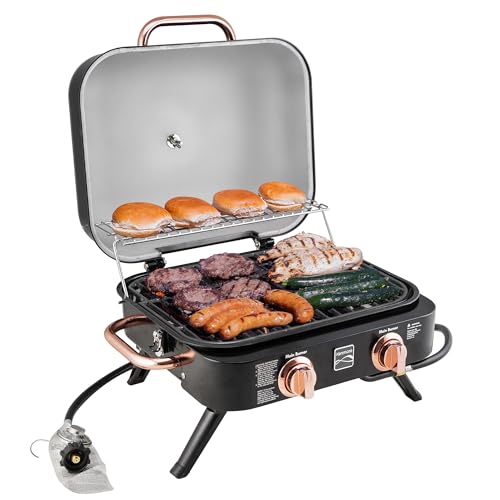
Kenmore 2-Burner Portable Gas Grill — Best Tabletop
The Kenmore is the tabletop that behaves like a small cart grill: it has the warming rack most tabletops delete, and it sips from a full-size tank at home instead of burning through small canisters. It suits apartment grillers, small families, and campers who want one grill for both lives. It does not suit anyone who needs a stand — the table is yours to supply.
Strengths
- Warming rack included — rare in tabletops, useful in every mixed cook
- Fits both 5 lb and 20 lb propane tanks, keeping home running costs low
- Foldable legs and a handsome black-and-copper finish for visible patio duty
Trade-offs
- No stand or cart in the box
- Stainless burners in a portable frame reward covered storage
- Capacity is a two-to-four-person surface
Key specs (from the verified listing): 2 burners; tabletop format with warming rack; foldable legs; stainless steel burners; fits 5 lb and 20 lb propane tanks.
The tank flexibility is the feature that pays you back every month. Tabletops that only accept one-pound canisters are camping tools; the Kenmore, plumbed to a 20 lb tank on the patio, is a home grill that can also go camping. The warming rack completes the picture — buns toast, finished burgers rest, and a two-person dinner with sides stops being a juggling act.
Care notes are the standard portable ones: the frame and burners last far longer under a cover, and the legs and latches appreciate being folded on a clean surface rather than a gravel lot. Treat it as the dual-role tool it is, and it covers more of a household’s grilling than any other pick in this tier.
Best for: apartment patios and dual home-and-camping duty / Not suited for: buyers who want a freestanding cart included — Check the current price on Amazon

Nexgrill Tabletop 2 Burner Gas Grill, Stainless Steel — Best Tabletop Heat
The stainless Nexgrill tabletop is the hot rod of this tier: a compact 251 square inch grill whose listing rates it at 28,000 BTU — a figure we flag below — with a locking lid and folding legs. It suits campers and tailgaters who sear seriously and travel light. It does not suit buyers who want a warming rack or a cart.
Strengths
- Listing-rated 28,000 BTU across two burners — exceptional heat density for a tabletop if it performs as rated
- Locking lid and folding legs make it genuinely travel-tight
- Stainless steel body wipes down and resists patio weather better than painted steel
Trade-offs
- The 28,000 BTU figure is the listing’s claim; treat it as a claim to verify against your own preheat times, as we note in the honesty discussion below
- 251 sq in is a two-to-four-person surface
- No warming rack in the verified listing
Key specs (from the verified listing): 2 burners; 28,000 BTU (listing-stated); 251 sq in cooking space; stainless steel; folding legs; locking lid; push-and-turn ignition; LP compatibility.
Heat density is the whole argument here. Even discounting the headline figure generously, two burners under 251 square inches produce a fast preheat and a confident sear for a tabletop — the class where most models are content to bake. The locking lid matters more than it sounds: a tabletop that cannot lock becomes a rattling, grease-shedding problem in a trunk, and this one is built to travel closed and secure.
About that BTU number: it is unusually high for the format, and this guide repeats it only as the manufacturer’s listing claim. The practical test is simple — if the grill preheats to searing temperature in about ten minutes and recovers quickly after cold food lands, the claim is doing its job regardless of the laboratory number. Buyers who want certainty over specifications should choose the Kenmore above; buyers who want the strongest tabletop heat in the tier, with eyes open, should choose this one.
Best for: campers and tailgaters who sear on the road / Not suited for: buyers wanting a warming rack or cart format — Check the current price on Amazon
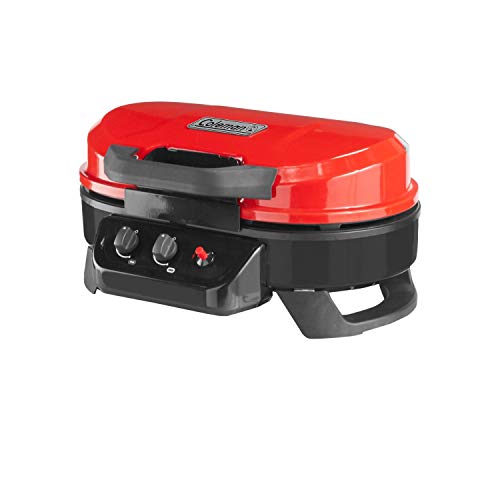
Coleman RoadTrip 225 Portable Tabletop Grill — Best Portable
The RoadTrip 225 is the legacy portable in the tier: a two-burner tabletop from Coleman’s long-running RoadTrip line, with matchless Instastart ignition and a removable water pan that catches drippings. It suits campers, tailgaters, and picnic grillers who value painless cleanup. It does not suit high-heat searing or cooking for more than four.
Strengths
- Instastart push-button ignition — no matches, no lighter, no drama
- Removable water pan catches drippings and makes cleanup genuinely easy
- Adjustable temperature control across two burners for basic zone cooking
Trade-offs
- 11,000 BTU is modest — this grill cooks; it does not blast
- Portable-first cooking area serves two to four people
- Stand is a separate accessory in this format
Key specs (from the verified listing): 2 burners; 11,000 BTU; Instastart ignition; adjustable temperature control; removable water pan; tabletop portable format.
Coleman has sold versions of this grill for years because the formula is right for its job: it lights every time, it cooks evenly at moderate temperatures, and the water pan turns the worst part of portable grilling — scrubbing burnt drippings out of a firebox in a campground — into tipping a pan into the trash. For burgers, dogs, chicken, and vegetables at a picnic table, that is the whole requirement list.
Know its ceiling. Eleven thousand BTU is picnic heat, not searing heat, and thick steaks are better finished another way. The RoadTrip 225 earns its place as the portable you actually bring — light, reliable, and easy to clean — rather than the portable with the biggest numbers. In a tier full of trade-offs, that is a respectable one.
Best for: camping, picnics, and tailgating where cleanup and reliability lead / Not suited for: high-heat searing or crowds — Check the current price on Amazon
Comparison Table
| Pick | Badge | Key spec | Best for |
|---|---|---|---|
| Charbroil Classic 2-Burner | Best Overall in the Tier | 20,000 BTU, 280 sq in, cart | First cart grill on a firm budget |
| Megamaster Deluxe 2 Burner | Best Cooking Area | 28,000 BTU, 418 sq in stated, cast iron grates | Families cooking in one round |
| Royal Gourmet GT2009 | Best Folding Cart | 17,000 BTU, 349 sq in, folding cart | Storage-limited patios and travel |
| Kenmore 2-Burner Portable | Best Tabletop | Warming rack, fits 5 & 20 lb tanks | Apartment and dual home/camp use |
| Nexgrill Tabletop Stainless | Best Tabletop Heat | 28,000 BTU listing claim, 251 sq in | Searing while traveling |
| Coleman RoadTrip 225 | Best Portable | 11,000 BTU, water pan, Instastart | Picnics and easy-cleanup camping |
How to Choose a 2 Burner Grill on This Budget
Decide the format first, because at this tier the format is the budget. A cart spends your money on structure — frame, shelves, wheels — and gives you a permanent patio station. A tabletop spends it on the grill head and asks you to supply the furniture. A folding cart splits the spend. Shoppers who buy the wrong format and then add a stand, a table, or a storage solution afterward have spent the premium they were avoiding.
Second, audit the cooking area. Stated areas in this tier routinely include warming racks, so a 418 square inch headline and a 349 square inch headline can be closer in practice than they look. For two to four people, anything from about 250 square inches of primary grate works; for five or six, prioritize the Megamaster’s grate and accept batch-cooking sides.
Third, check the fuel story. A grill that only takes one-pound canisters will cost more to run at home in a single season than the price difference between it and a tank-compatible rival. If the grill will mostly live at home, tank compatibility — like the Kenmore’s 5 and 20 lb flexibility — is a budget feature, not a convenience feature.
Fourth, spend your skepticism on the right specs. BTU claims in this tier are marketing-flexible, as the Nexgrill discussion above shows; grate material, ignition type, and locking lids are physical facts you can verify from listing photos. A thick cast iron grate and a replaceable igniter will still be serving you when the headline numbers are long forgotten.
How to Make a Budget Grill Last: Setup and Care That Pays
Budget grills are not disposable unless their owners treat them that way. At assembly, tighten every bolt fully and re-check them after the first month — value-tier frames loosen as they settle, and a wobbly cart ages fast. Before the first cook, run the soapy-water leak test on every gas connection, then burn the grill in on high for fifteen minutes to clear manufacturing oils, and oil the grates while they are warm.
During the season, the routine is short: brush the grates after each cook while hot, empty the grease tray monthly, and keep the grill covered. The cover is the single highest-value accessory in this tier — rain in the firebox is what turns a five-season grill into a two-season one. Once a season, pull the heat tents and brush out the firebox, check burner ports for blockages, and confirm the igniter still clicks strongly; a weakening igniter replaced early costs little and prevents the lighter-and-lid gymnastics that crack porcelain grates.
Store it dry for winter with the tank valve closed and the grates oiled. Follow that page of instructions and the picks in this guide routinely outlast the “cheap grill” reputation by years.
What Gets Cut to Hit This Price — and What Should Not Worry You
Understanding where the money comes out of a budget grill tells you which corners matter. The first cut is metal gauge: lids and fireboxes are thinner, so the grill loses heat faster on cold or windy days and the finish needs a cover to survive. This is a longevity and weather issue, not a cooking-quality issue on a calm evening. The second cut is grate mass. Thin porcelain-coated grates heat fast and cook everyday food perfectly well; what they cannot do is store enough heat to sear a thick steak without the temperature sagging when the meat lands. If your menu is burgers, chicken, sausages, and vegetables, you will rarely feel this cut at all.
The third cut is hardware: plastic knobs instead of metal, simpler igniters, two wheels instead of four, shelves that fold or do not exist. These are annoyances, not failures. The fourth cut is the one to actually watch — burner and heat-tent material. The burner is the heart of the grill and the part most exposed to heat, grease, and moisture; a budget grill whose burner is a common, replaceable size will outlive a slightly fancier one whose burner is proprietary and discontinued. When you compare listings, a visible, conventional burner layout in the photos is worth more than a cosmetic feature.
What should not worry you: the absence of a side burner, a rotisserie, or a sear station. At family scale those features are used rarely, and in this tier they would be built so lightly that they would disappoint anyway. The manufacturers of the picks above spent the budget on burners, grates, and format — which is the correct order of priorities, and a large part of why these six made the list.
Two-Zone Cooking on a Budget Grill
The most valuable technique in grilling costs nothing, and it works on every pick in this guide: run one burner hot and the other low or off. Budget grills, with their thinner lids, actually make the two zones more distinct, not less. Sear burgers and steaks over the hot burner for two minutes a side, then slide them to the cool side, close the lid, and let them finish gently while vegetables take their turn over the direct heat. Bone-in chicken cooked entirely on the indirect side, with the hot burner doing the work from across the firebox, renders its skin instead of burning it — the single biggest upgrade available to a new griller.
A practical sequence for a family dinner on the Charbroil or the Megamaster: preheat both burners on high for ten minutes. Turn the right burner to low. Chicken pieces go on the right, skin up, lid down, twenty-five minutes without touching them. Burgers go on the left in the last eight minutes. Corn, wrapped or husked, fills whatever space is left. Everything finishes within minutes of everything else, nothing burns, and a grill that cost less than a family restaurant meal has just produced a coordinated dinner. That is what this tier is actually capable of, and it is why the two-burner format — not one, not four — is the budget sweet spot.
Accessories Worth Buying in This Tier (and Two That Are Not)
Three accessories earn their money immediately. A fitted cover, for the reasons repeated throughout this guide: it is the difference between seasons of service. A second propane tank or, for canister models, a tank hose — running out of fuel mid-cook is the most common and most preventable budget-grill failure. And a simple instant-read thermometer, which removes the guesswork that makes new grillers overcook chicken “to be safe” into dryness.
Two popular accessories do not earn it here. A grill light is a solution to a problem a porch light already solves. And an elaborate multi-piece tool set duplicates what one good pair of long tongs and one wide spatula do better; in this tier especially, money spent on tools you will not use is money that should have gone to the cover. Buy the short list, skip the gift sets, and put the savings toward the next tank refill.
The Real Cost of a Budget Grill Over Three Seasons
The sticker comparison between a cart and a tabletop in this tier is misleading, because the formats consume money differently after the purchase. A cart grill’s running costs are close to zero beyond fuel: a 20 lb tank refill is the cheapest way to buy propane, and the grill asks for a cover and little else. A tabletop run on one-pound canisters at home can burn through several times that fuel cost in a single season of weekly grilling — which is why the Kenmore’s ability to run a full-size tank is treated in this guide as a headline feature rather than a footnote. If you choose a canister-only tabletop for home use, the “cheaper” grill quietly becomes the more expensive one by the second summer.
Replacement parts follow the same pattern. On the big legacy platforms — Charbroil’s Classic line above all — grates, heat tents, and igniters are stocked widely and priced gently, so a mid-life refresh is a small job. On value brands, the same refresh may mean measuring for universal parts. Neither path is wrong, but the shopper who knows which path they are on will not be surprised in year three. Budget for the cover and the first tank on day one, expect one modest parts refresh across the grill’s life, and the total cost of this tier stays genuinely low — that, and not the sticker, is the real under-$200 story.
What This Tier Cannot Do (and the Honest Alternatives)
Three jobs sit beyond this budget’s reach, and naming them saves returns. The first is the thick-steak sear in cold weather: thin lids and modest burners lose too much heat when the lid opens at 40 degrees, and no technique fully compensates. The second is true low-and-slow smoking — a two-burner grill can hold indirect heat for ribs with patience, but it is a workaround, not a smoker. The third is feeding ten people at once; batch cooking works, but if every gathering is that size, the grill is undersized for your life.
The honest alternatives are straightforward. If searing is the priority, stretch to the cast-iron-grate models in this guide and preheat longer, or accept a smaller grate with more heat density. If smoking matters, a dual-fuel combo from our hybrid guide adds charcoal to the same footprint. If headcount is the issue, the correct move is out of this tier entirely — a larger grill bought once beats a small grill resented weekly. Every pick above is excellent at the job it is actually for; this section exists so nobody asks one to do a different job.
Assembly and First-Cook Checklist for a Budget Two-Burner
Budget grills reward a careful first hour. Lay out every part against the manual’s inventory before touching a bolt — in this tier, the occasional missing washer is a known reality, and discovering it before assembly turns it into a quick message to the manufacturer instead of a half-built grill on the patio. Assemble the frame loosely first, square it on a flat surface, then tighten everything in sequence; a frame tightened crooked stays crooked, and doors and shelves will never quite align.
With the grill built, do the three checks that matter. First, the leak test: soapy water on every gas connection, tank valve opened slowly, no growing bubbles before any flame. Second, the ignition test: each burner should light from its own control within a couple of clicks; a burner that only lights with a match on day one gets reported on day one. Third, the burn-in: twenty minutes on high with the lid closed to clear manufacturing oils, followed by a cool-down and a light oiling of the grates.
For the first real cook, choose forgiving food — sausages, chicken thighs, or burgers — and run the toast test while the grill preheats: slices of white bread laid across the grate for a minute map your grill’s hot and cool spots more honestly than any specification. Write the map down mentally and use it from the second cook onward. That hour of setup is the difference between a budget grill that frustrates and one that simply cooks, and it costs nothing but attention.
Common Buying Mistakes
Before the mistakes themselves, a note on timing: this tier’s prices breathe with the calendar, falling as the season closes and firming up each spring, so a buyer with flexibility can let the calendar do part of the budgeting — the grill you choose matters more than the week you buy it, but the week is not worth nothing either.
The classic mistake in this tier is buying the biggest stated number — the largest square inches or the highest BTU — without asking what the number includes. Warming racks pad area figures; BTU is a fuel-consumption rating, not a searing guarantee. The second mistake is forgetting the setup costs: tank, hose, cover, and stand can add a third again to a tabletop’s real price, which can quietly promote a cart into the smarter buy.
The third mistake is treating seasonal pricing as permanent. A model slightly above budget in spring may sit inside it by late summer, and a model inside it today may drift out next month — which is why this guide positions picks by tier and sends you to the live listing for the number. The fourth mistake is skipping the cover to save money; in this tier, the cover is not an accessory, it is the warranty you buy yourself.
Final Recommendation
Start with the Charbroil Classic 2-Burner if you want the straightforward cart this budget is famous for. Choose the Megamaster Deluxe if grate size and searing heat lead your list, the Royal Gourmet GT2009 if the grill must fold away, and among tabletops pick the Kenmore for home-and-camp flexibility, the Nexgrill stainless for travel heat, or the Coleman RoadTrip 225 for the easiest cleanup in the tier. Keep researching with our companion guides: Best 2 Burner Grills, Best 2 Burner Propane Grills, Best 2 Burner Gas Grills Under $100 Dollars, Best 2 Burner Small Grills, and Best 2 Person Propane Grills.
Frequently Asked Questions
Can you get a good 2 burner grill under $200?
Yes — this tier contains genuinely capable grills, including cast-iron-grate carts like the Megamaster Deluxe. What the budget excludes is premium-brand construction and long-term parts depth, not cooking ability. Buy the format and grate material that fit your cooking and the tier serves you well. The buyers who regret a budget grill are almost never regretting the cooking; they are regretting a format that did not fit their space or a grill left uncovered to the weather — both avoidable with the guidance above, and neither has anything to do with the number on the box.
Why does this guide not print the exact prices?
Because grill prices move with seasons and promotions faster than any article can honestly track, and a printed price that is wrong helps no one. Each pick is positioned in the entry tier that orbits this budget; the live listing shows today’s number, and the check takes seconds.
Is a cart or a tabletop better on this budget?
A cart if the grill lives on your patio full-time — the shelves, storage, and stability are worth it. A tabletop if space, renting rules, or travel matter, remembering to budget for a stand and tank hose if you need them. The folding-cart GT2009 is the deliberate middle path.
How long should a budget two-burner grill last?
With a cover and the basic care routine in this guide, three to five seasons is a fair expectation for the tier, and many owners get more. The parts that usually end a budget grill’s life are burner and heat-tent corrosion — both slowed dramatically by keeping rain out of the firebox.
Are the BTU numbers on budget grills reliable?
Treat them as approximate. BTU describes maximum fuel draw, and listing figures in this tier are occasionally optimistic — one pick in this guide is flagged for exactly that. Preheat time and grate material tell you more about real searing than the headline number does.
Should I buy the extended warranty or protection plan on a budget grill?
Generally no. The failure modes of this tier — burner corrosion, igniter wear, grate coating breakdown — are wear items that most protection plans exclude or prorate into near-worthlessness, and the plan’s cost is a significant fraction of a budget grill’s price. The money does more work as a cover and a mid-life set of heat tents. The exception is a grill bought for a rental property or a shared space where misuse is likely; there, the paperwork can pay. For a household grill you will care for yourself, self-insure with maintenance.
Is it smarter to buy a used premium grill instead of a new budget one?
Sometimes — a used premium cart with sound burners and a solid firebox can out-cook anything in this tier. But inspect before you romanticize: lift the grates and check the burners and firebox floor for rust-through, confirm the model still has parts support, and price the replacement grates it will certainly need. A used grill needing burners, grates, and an igniter can cost more than the new Charbroil or Megamaster above while carrying no warranty at all. Buy used only when the firebox and burners are verifiably sound.
What else do I need to buy with a budget grill?
A propane tank if the grill does not include one, a cover, a brass-bristle-free grill brush suited to your grate coating, and long tongs. Tabletop buyers may also need a stand or a heat-safe table and, for home use, a hose to run a full-size tank. Add a spare igniter battery if your model uses one, a small bottle of high-smoke-point oil for the grates, and a drip-pan liner habit — three trivial purchases that remove the three most common reasons a budget grill gets cursed at in its first month.


