Disclosure: airfryerkitchensupply.com is reader-supported. When you buy through links on our site, we may earn an affiliate commission at no extra cost to you.
Where to buy
Every inverter linked below was verified against Amazon’s own catalog data before earning its place. The BELTTT 2000W Pure Sine Wave Inverter is the all-rounder for RV and off-grid use, the BESTEK 300W and BESTEK 500W cover car and laptop duty, and the BELTTT 1000W, LANDERPOW 1200W and BELTTT 3000W scale up to serious loads. Check the current price on Amazon for each model, and read the sizing guidance in this guide before ordering — with inverters, buying the right wattage class matters more than buying the right brand.
Introduction
Shopping for the best 110 12 volt inverter means translating between two electrical worlds: the 12-volt DC stored in a vehicle or battery bank, and the 110-volt AC that household devices expect. An inverter is the bridge, and like any bridge it has a load rating you ignore at your peril. Buy too small and it alarms, overheats or shuts down under the tool, appliance or medical device you actually bought it for. Buy absurdly large and you pay for capacity you will never use while inviting installation shortcuts — because big inverters demand big cables and real fusing, and punish the cigarette-lighter thinking that small inverters tolerate.
This guide only recommends pure sine wave inverters, and that is a deliberate editorial line. Pure sine wave output is electrically identical to household power, so it runs everything — laptops, televisions, power-tool chargers, variable-speed motors, sensitive electronics — without the buzzing, overheating and occasional outright refusal that cheaper modified sine wave units cause. A decade ago pure sine cost a clear premium; today the gap has narrowed enough that recommending modified sine to a general reader is hard to justify, especially for the mixed loads most people actually plug in.
All six picks were verified through Amazon’s catalog data, with wattage, surge rating and features taken from the manufacturers’ own listings. The range runs from a 300W plug-in unit for a car’s cupholder to a 3000W hardwired unit for an off-grid cabin — because “inverter” is not one product, and the best one is entirely a function of what you intend to run, for how long, and from what battery.
In this guide
Quick Picks
- Best Overall: BELTTT 2000W Pure Sine Wave Inverter — 4000W surge, LCD display, remote control and hardwire capability for RV, truck and solar use.
- Best for Cars and Laptops: BESTEK 300W Pure Sine Wave Inverter — a cigarette-lighter plug-in with PD 30W USB-C for laptops and travel electronics.
- Best Compact: BESTEK 500W Pure Sine Wave Inverter — dual AC outlets and dual USB in a glovebox-friendly form.
- Best Mid-Size: BELTTT 1000W Pure Sine Wave Inverter — 2000W peak with LCD display for tools, TVs and small appliances.
- Best Features: LANDERPOW 1200W Pure Sine Wave Inverter — three AC outlets, 30W USB-C and a remote control at a mid-size rating.
- Best High Power: BELTTT 3000W Pure Sine Wave Inverter — 6000W peak, 20A outlets and a 23-foot wired remote for cabins and big RV systems.
How These Picks Were Chosen
Verification came first: every inverter below was confirmed through Amazon’s product catalog data for this site, with brand, continuous wattage, surge rating and waveform all matching the manufacturer’s listing. Inverter listings are notorious for headline wattage games — surge figures printed where continuous figures belong — so we read for the continuous rating and treat the surge number as what it is: a few seconds of motor-starting grace, not a workload.
Waveform was a gate, not a preference: pure sine wave only, for the compatibility reasons in the introduction. Beyond that, criteria were continuous wattage class coverage across real use cases, installation honesty (plug-in units that respect what a cigarette lighter can actually deliver, versus wired units that include or expect proper cabling), display and remote features that matter in RV and cabin installations where the inverter lives in a compartment, and outlet configuration — including the 20A outlets on the larger BELTTT units that let them feed heavier appliances without adapters.
We also weighted brand behavior. BESTEK has sold car inverters for years and its small units are the category’s reference point; BELTTT and LANDERPOW represent the newer generation of high-value pure sine units with displays and remotes as standard. Every tier of real demand has a pick below, and no pick requires pretending a specification says something it does not.
The 6 Best 110/12 Volt Inverters

BELTTT 2000W Pure Sine Wave Inverter — Best Overall
The 2000W class is where inverters stop being accessories and become systems, and the BELTTT is the most complete expression of it in this guide: 2000W continuous pure sine wave output from 12V DC to 120V AC, a 4000W surge rating, an LCD display showing the numbers that matter, dual AC outlets including a 20A outlet, a hardwire port, USB charging, and a wired remote on a 23-foot lead so the unit can live in a compartment while its controls live at the dinette. For RVs, work trucks, solar sheds and off-grid cabins, this is the specification around which a real system gets built.
Strengths
- 2000W continuous with 4000W surge covers microwaves, power tools and most RV appliance loads.
- LCD display and long-lead remote make a compartment-mounted inverter genuinely manageable.
- Hardwire port and 20A outlet support proper installation instead of workarounds.
Trade-offs
- At this wattage, installation is a project: heavy cables, a fuse, and ventilation are requirements, not accessories.
- It will drain a single vehicle battery quickly at full load — it assumes a real battery bank.
- Oversized for laptop-and-phone users, who should save money with the BESTEK picks.
| Spec | Verified detail |
|---|---|
| Continuous output | 2000W pure sine wave |
| Surge | 4000W |
| Input / output | 12V DC to 120V AC |
| Display / control | LCD display, 23 ft wired remote |
| Outlets | Dual AC incl. 20A, hardwire port, USB |
| Efficiency (mfr claim) | 93% |
The honest way to think about a 2000W inverter is as an electrical appliance that happens to be portable. Wired correctly — short, heavy cables, a fuse near the battery, airflow around the case — it disappears into a system and simply delivers household power where no household wiring exists: the microwave in the RV, the circular saw at the off-grid build, the refrigerator through a home power outage fed from a battery bank. Wired casually, it becomes the cautionary tale in every inverter forum. The BELTTT gives you the hardware for the first story: the display to watch your battery, the remote to control it from the living space, and the surge headroom to start motors without drama. Bring the installation discipline and it is the best overall inverter in this guide by a clear margin.
Best for: RV owners, off-grid builders and anyone wiring a permanent 12V system. / Not suited for: casual car use or single-battery setups at sustained full load.
Check the current price on Amazon

BESTEK 300W Pure Sine Wave Inverter — Best for Cars and Laptops
At the other end of the scale, the BESTEK 300W is the inverter most people actually need most of the time: a pure sine wave unit that plugs into a car’s cigarette lighter socket and delivers 110V AC for a laptop, plus a PD 30W USB-C port for fast-charging modern devices directly. It exists for the road-warrior reality — a laptop that must charge between meetings, camera batteries on a shoot, a child’s device on a long drive — and it delivers clean power that will not make a laptop brick buzz or a charger overheat, which is exactly where cheap modified-sine plug-ins fail their owners.
Strengths
- True pure sine wave output in a plug-in form — safe for laptops and sensitive chargers.
- PD 30W USB-C fast charging handles modern phones and tablets without the AC side at all.
- BESTEK’s long track record in exactly this product class.
Trade-offs
- 300W is a hard ceiling: electronics yes, anything with a heating element or big motor no.
- Cigarette lighter circuits limit real draw — this is an electronics inverter, not an appliance inverter.
- Engine-off use drains a starter battery faster than intuition suggests; run it with the engine on for long sessions.
| Spec | Verified detail |
|---|---|
| Continuous output | 300W pure sine wave |
| Input / output | DC 12V to 110V AC |
| Connection | Cigarette lighter plug |
| USB | PD 30W USB-C fast charge |
What makes this pick easy to recommend is how completely it matches its job. The loads that live in cars — laptops, phones, tablets, camera gear, a portable monitor, a small fan — are precisely the loads that appreciate pure sine wave and never approach 300W. The unit asks nothing of its owner: no wiring, no fusing decisions, no installation weekend. It lives in a door pocket and earns its keep weekly. Buyers tempted to stretch it toward appliances should read the wattage on their appliance’s label and then look at the BELTTT picks above; the 300W’s honesty about its class is a virtue, and respecting it is the whole ownership skill.
Best for: drivers, remote workers and families powering electronics on the road. / Not suited for: appliances, tools or anything with a heating element.
Check the current price on Amazon

BESTEK 500W Pure Sine Wave Inverter — Best Compact
The 500W BESTEK is the plug-in concept with headroom: dual AC outlets, dual USB charging ports at 4.2A combined, and the same pure sine wave cleanliness as its smaller sibling, in a unit still sized for a vehicle cabin. Five hundred watts covers the two-laptop road trip, a small television for tailgating, a CPAP machine’s typical draw with margin (always confirm your device’s exact requirement), and the general run of chargers and small electronics that a 300W unit makes you ration. It is the compact pick for people whose load list is longer than one laptop but nowhere near appliance territory.
Strengths
- Dual AC outlets end the one-device-at-a-time rationing of smaller plug-ins.
- Pure sine wave output keeps chargers, TVs and electronics behaving exactly as they do at home.
- Still a simple plug-in — no installation, no wiring decisions.
Trade-offs
- Vehicle lighter sockets and their fuses cap sustained draw below the inverter’s ceiling in many cars — check your socket’s rating.
- Not a tool or appliance inverter despite the bigger number; motors with heavy startup loads belong on wired units.
- Fan noise under load is present, as with all compact inverters in an enclosed cabin.
| Spec | Verified detail |
|---|---|
| Continuous output | 500W pure sine wave |
| Input / output | DC 12V to AC 110V |
| Outlets | Dual AC |
| USB | Dual USB, 4.2A |
The 500W class is the thoughtful middle of car power: enough for a small family’s entire device ecosystem on a long drive, modest enough to live in the car permanently. Its best use pattern is the family road trip and the mobile office — two laptops, phones on USB, perhaps a small screen — where its dual outlets remove friction rather than enable heroics. Owners stepping up from the 300W usually cite exactly that: not more exotic loads, just fewer negotiations about whose device charges first. Keep it within electronics, keep the engine running for long sessions, and it is one of the highest-value items a car can carry.
Best for: families and mobile offices running several electronic devices in a vehicle. / Not suited for: power tools, kitchen appliances or sustained engine-off use.
Check the current price on Amazon

BELTTT 1000W Pure Sine Wave Inverter — Best Mid-Size
The 1000W BELTTT is the gateway to wired inverters: 1000W continuous pure sine wave with a 2000W peak, an LCD display, dual AC outlets and USB charging, sized for the loads that define the middle of the market — televisions, game consoles, power tool chargers and smaller tools, coffee-adjacent small appliances within rating, and the general electrical life of a van, boat or small cabin. It is the smallest inverter in this guide that should be wired to the battery with proper cables rather than plugged into a socket, and that installation step is precisely what unlocks its class.
Strengths
- 1000W continuous covers the TV-and-tools load class that plug-ins cannot touch.
- LCD display makes battery state visible — essential education for first-time system owners.
- 2000W surge handles motor and compressor startup spikes within its class.
Trade-offs
- Requires a real wired installation with suitable cables and fusing.
- A single 12V battery is a short runtime at high load; a proper bank is the assumed partner.
- Microwaves and large appliances sit above its ceiling — that is the 2000W pick’s territory.
| Spec | Verified detail |
|---|---|
| Continuous output | 1000W pure sine wave |
| Peak | 2000W |
| Input / output | 12V DC to 120V AC |
| Display | LCD |
| Outlets | Dual AC, USB |
Owners graduate to this class when a vehicle or small space becomes a place they live and work rather than pass through: the van conversion, the fishing boat with a real cabin, the workshop at the end of the garden. At 1000W the inverter stops being about charging and becomes about doing — running the tool, the screen, the lights, the small fridge’s startup surge. The BELTTT’s display is its quiet virtue here, because mid-size systems are where owners learn energy budgeting, and a visible battery voltage teaches faster than any manual. Install it with cables sized for its full draw, fuse it at the battery, and it will serve as the heart of a small system for years.
Best for: van life, boats and small cabins crossing from charging to doing. / Not suited for: large appliances or buyers unwilling to do a wired installation.
Check the current price on Amazon
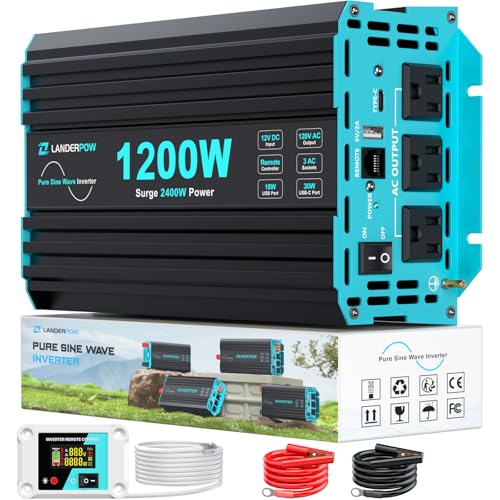
LANDERPOW 1200W Pure Sine Wave Inverter — Best Features
The LANDERPOW competes on completeness at the mid-size tier: 1200W continuous pure sine wave with 2400W surge, three AC outlets instead of the usual two, a 30W USB-C port alongside USB-A, and a remote control — a feature set aimed at RV and truck installations where the inverter is mounted out of sight and the loads are many and small rather than few and huge. The extra outlet and the modern USB-C are not garnish; in a lived-in vehicle, outlet count and native fast charging are daily quality-of-life specifications.
Strengths
- Three AC outlets plus 30W USB-C — the most connection-friendly mid-size pick here.
- Remote control suits compartment installations in RVs and trucks.
- 1200W continuous with 2400W surge gives the mid-size class a little extra headroom.
Trade-offs
- Newer brand than BESTEK or the commercial names; long-term support depth is still being proven.
- Same wired-installation and battery-bank requirements as every unit in its class.
- Feature richness tempts overloading — the 1200W ceiling still governs the total, however it is divided.
| Spec | Verified detail |
|---|---|
| Continuous output | 1200W pure sine wave |
| Surge | 2400W |
| Input / output | 12V DC to 110V AC |
| Outlets | 3 AC, 30W USB-C, USB-A |
| Control | Remote control |
Choose the LANDERPOW when your load list reads like a household rather than a workshop: entertainment, laptops on both sides of the RV, chargers for everything, a small appliance within rating. Its design center is distribution — many modest loads, conveniently connected, remotely controlled — rather than one heroic load. That is a legitimate and underserved design center, and the inclusion of proper USB-C fast charging shows the maker understands what modern vehicle life actually plugs in. Wire it as carefully as the BELTTT units, respect the total wattage, and it disappears into daily life exactly as a good inverter should.
Best for: RV and truck owners with many small-to-medium loads. / Not suited for: single heavy loads near or above its ceiling.
Check the current price on Amazon

BELTTT 3000W Pure Sine Wave Inverter — Best High Power
The top of this guide is the 3000W BELTTT: 3000W continuous pure sine wave, 6000W peak, dual AC outlets including 20A service, a hardwire port, USB, an LCD display and a 23-foot wired remote. This is cabin and large-RV territory — an inverter that can run a serious appliance roster, start stubborn motors, and serve as the AC heart of an off-grid system built around a substantial 12V battery bank. It is included with a clear condition: at 3000W, the inverter is the easy part. The battery bank, cables and fusing it demands are the real system, and buyers must budget for all of it.
Strengths
- 3000W continuous with 6000W surge runs appliance-class loads and hard-starting motors.
- 20A outlets and hardwire port support genuine household-style distribution.
- Display and long remote lead keep a big, remotely mounted unit under control.
Trade-offs
- Demands a large battery bank — at full load it draws current at a rate small banks cannot sustain.
- Installation is unambiguously a project: very heavy cables, serious fusing, planned ventilation.
- For many RV users the 2000W model is the rational ceiling; buy this for loads that truly need it.
| Spec | Verified detail |
|---|---|
| Continuous output | 3000W pure sine wave |
| Peak | 6000W |
| Input / output | 12V DC to 120V AC |
| Display / control | LCD display, 23 ft wired remote |
| Outlets | Dual AC incl. 20A, hardwire port, USB |
There is a point in off-grid building where the question stops being “can I run this appliance” and becomes “can I run my life” — refrigeration, cooking, tools, water pumping, entertainment, all from batteries and sun. The 3000W class is that point’s entry ticket, and this BELTTT is its value standard-bearer in this guide: the surge to start what needs starting, the outlets to distribute what needs distributing, and the monitoring to keep the system’s human informed. Respect its appetite — a 3000W load pulls roughly 250 amps from a 12V bank before losses, which is why serious installations at this level often step up to higher-voltage battery banks entirely. Bought with that understanding, it is a foundation. Bought as a bigger number for its own sake, it is an expensive way to learn arithmetic.
Best for: off-grid cabins, large RVs and serious battery-bank systems. / Not suited for: small battery banks, casual users, or anyone skipping the installation homework.
Check the current price on Amazon
Comparison Table
| Pick | Badge | Key spec | Best for |
|---|---|---|---|
| BELTTT 2000W | Best Overall | 2000W cont., 4000W surge, remote | RV and off-grid systems |
| BESTEK 300W | Best for Cars/Laptops | 300W, lighter plug, PD 30W USB-C | Road electronics |
| BESTEK 500W | Best Compact | 500W, dual AC, dual USB | Family device loads |
| BELTTT 1000W | Best Mid-Size | 1000W cont., 2000W peak, LCD | Vans, boats, small cabins |
| LANDERPOW 1200W | Best Features | 1200W, 3 AC outlets, remote | Many small loads |
| BELTTT 3000W | Best High Power | 3000W cont., 6000W peak, 20A outlets | Cabins and big systems |
How to Choose a 110/12 Volt Inverter
Start by listing your loads and their wattages — the label on every device tells the truth that marketing does not. Add the loads you will genuinely run at the same time, then buy an inverter whose continuous rating clears that sum with room to spare. Room matters for two reasons: motors and compressors draw a startup surge several times their running wattage, and an inverter run permanently at its ceiling runs hot and dies young. The surge rating on the box is for the first second of a motor’s life, not for your afternoon.
Then match the installation to the class. Up to roughly 300-500W, a plug-in unit is honest engineering — but check your vehicle’s socket and fuse rating, because the socket, not the inverter, is often the real limit. From 1000W upward, wire directly to the battery with cables sized for the full current over their actual length, and fuse the positive cable close to the battery. Cable sizing is where inverter installations succeed or fail: a 2000W inverter at 12V draws on the order of 170 amps at full load, and undersized cable turns that into heat and voltage drop instead of power.
Battery capacity is the third leg. An inverter does not create energy; it converts what the battery holds, at an efficiency loss. The arithmetic is simple — watts out divided by system voltage gives amps drawn — and it is brutal at high wattages: a 2000W load empties a single car battery in well under an hour of theory and much less of practice. Size the bank for the runtime you need, prefer lithium or deep-cycle batteries for regular inverter duty, and never plan to use a starter battery as an energy reservoir.
Budget in tiers with the whole system in view. The plug-in tier costs the price of the unit and nothing else. The wired tiers cost the unit plus cables, fusing and possibly batteries — often doubling the true project cost, and worth every cent when the loads are real. What no tier excuses is skipping the fuse or the ventilation; those are not upgrades, they are the installation.
How to Install and Use an Inverter Safely
For wired units, installation order matters: mount the inverter where air moves and water does not, run the negative and positive cables to the battery with the fuse holder on the positive line near the battery end, connect everything with the inverter switched off, and only then power up — first with no load, then with a small load, then with your real loads one at a time. Keep DC cable runs as short as the layout allows; if the inverter must live far from the battery, extend the AC side instead, because AC travels distance far more gracefully than high-current DC.
Grounding and protection deserve their moment. Follow the manufacturer’s grounding instructions for the chassis, keep the unit’s vents unobstructed, and never mount an inverter in an engine bay or a sealed, unventilated box. If the inverter will feed outlets around an RV or cabin, a proper transfer arrangement — never a cord with two male ends — is the only acceptable way to connect it to household wiring; backfeeding a panel through a suicide cord is how inverters hurt people.
Daily use is mostly battery awareness. Watch the display, learn what your loads draw, and shut down before the battery reaches depths that shorten its life — the inverter’s low-voltage alarm is a last resort, not a fuel gauge. For plug-in units in cars, the discipline is simpler: use them with the engine running for anything beyond brief charging, and remember that a quiet car with a running inverter is still consuming its battery.
Care is light: keep vents dust-free, check cable connections for tightness and corrosion a few times a year, and listen for fan behavior changes. An inverter maintained this way is a decade-long appliance.
Common Buying Mistakes
The classic mistake is buying by the surge number. The big figure on the box is a one-second allowance; the continuous rating — often half — is the inverter you actually own.
Second is plugging a large inverter into a cigarette lighter circuit. Sockets are fused for a fraction of what mid-size inverters draw; the fuse is protecting you from a wiring fire, so believe it.
Third is undersized DC cables on a wired install. Voltage drop and hot cables are the signature of this error, and it masquerades as a “weak inverter” in countless reviews.
Fourth is ignoring the battery. Runtime disappointments are almost never the inverter’s fault; they are arithmetic arriving on schedule.
Fifth is choosing modified sine wave to save a little money, then discovering which of your devices buzz, overheat or refuse to charge. Every pick in this guide is pure sine wave for a reason.
Final Recommendation
For most system builders, the BELTTT 2000W is the best 110 12 volt inverter: real capacity, real monitoring, real installation hardware. Drivers who only need clean laptop power should save their money and buy the BESTEK 300W, and cabin-scale builders should step up to the BELTTT 3000W with a battery bank to match. The rest of the mobile-power picture is in our guides to the Best 110 12 Volt Cooler, the Best 100ah Battery For 36 Volt Trolling Motor and the Best 110 220 Volt Converter.
Pure Sine Wave, Explained: What the Waveform Does to Your Devices
The waveform argument deserves more than a slogan, because it decides real purchases. Household AC power alternates as a smooth sine wave, and every device you own was designed against that shape. A pure sine wave inverter reproduces it faithfully. A modified sine wave inverter approximates it with steps — flat plateaus and abrupt jumps — and devices respond to that approximation according to how they use power. Simple resistive loads like a basic lamp barely notice. Anything with a motor, a transformer, a switching power supply or a timing circuit notices plenty: motors run hotter and hum, chargers charge slower and warmer, audio equipment picks up a buzz, some laser printers and medical devices refuse to operate, and a minority of equipment is damaged over time.
The subtle cases are the ones that matter most to modern buyers. Laptop and phone chargers are switching supplies that generally tolerate modified sine — but “generally tolerate” often means running hotter and aging faster, invisibly, inside a sealed brick you cannot inspect. Variable-speed tools and modern appliances with electronic controls are the least forgiving loads of all, because their controllers read the waveform itself as information. And anything involving audio or measurement — the musician’s amp, the technician’s instruments — treats waveform purity as a functional requirement, not a luxury.
This is why every pick in this guide is pure sine wave, across every tier from the 300W plug-in upward. A generation ago the premium for purity was steep enough to justify compromise for simple loads. At today’s pricing the compromise buys very little savings and imports a drawer full of small mysteries — the charger that died early, the tool that sounds wrong, the device that will not run at all — each of which costs more than the difference ever saved. Buy the waveform your devices were born expecting, and the question never needs asking again.
Sizing a Battery Bank for Inverter Duty
If the inverter is the bridge, the battery bank is the country on the far side — and most disappointing inverter systems are actually disappointing battery systems. The sizing logic is plain arithmetic done honestly. Start with energy: list each load’s wattage and the hours it truly runs per day, and sum the watt-hours. A television at 100W for four hours is 400 watt-hours; a microwave at 1200W for ten minutes is 200; lights, chargers and a fridge’s cycling add their shares. Then convert to the battery’s language: divide watt-hours by 12 volts for amp-hours, and then — the step everyone skips — divide by the fraction of the battery you may honestly use. Lead-acid banks should only give up about half their nameplate capacity if they are to live long; lithium banks can give up most of theirs. The result is the bank size your day actually requires, and it is commonly two to three times what first-time buyers guessed.
Power is the second constraint, independent of energy: the bank must also deliver the inverter’s peak current without its voltage collapsing. A single small battery asked for 200 amps will sag, trip the inverter’s low-voltage alarm, and teach its owner to blame the wrong component. Parallel batteries or larger-format cells share that current burden. Finally, charging must replace what the day consumed — from the alternator, from solar, from shore power — or the best-sized bank is merely a slower route to empty. Think of the inverter, bank and charging as one machine with three parts, size all three together, and the system will feel less like equipment and more like electricity: simply there when you reach for it.
Modified Sine Wave: When the Cheaper Waveform Is (and Is Not) Acceptable
This guide recommends pure sine wave exclusively, but intellectual honesty requires mapping the territory where modified sine wave survives, because readers will encounter those units at tempting prices and deserve a framework rather than a slogan. Modified sine wave is tolerable for a narrow class of loads: purely resistive devices without electronics — an old incandescent lamp, a simple heating element — and for the most forgiving switching chargers on a short trip where their slight extra warmth does no lasting harm. If a load has no motor, no audio, no timing circuit, no medical function and no microprocessor making decisions about the waveform, it will probably run.
The problem is how small that class has become. Modern life runs on the other list: laptops and phones with smart chargers, tools with electronic speed control, appliances with digital boards, CPAP machines, televisions, game consoles, LED lighting with drivers, anything with a motor that starts under load. For those loads modified sine ranges from annoying (buzz, heat, slow charging) to disqualifying (refusal to run, shortened life). And the buyer rarely knows in advance which of their devices belongs to which list — the discovery happens device by device, trip by trip, always at the least convenient moment. That uncertainty is precisely what the modest price difference buys its way out of. Pure sine wave is not the premium choice in 2026’s market; it is the default choice, and modified sine is the specialty tool for buyers who can enumerate their loads and prove they are all forgiving.
Vehicle Alternators, Idling and the True Cost of “Free” Power
A persistent piece of inverter folklore holds that running loads from a vehicle costs nothing because “the alternator makes power anyway.” The alternator makes power from fuel, at a conversion efficiency that would make a power station blush, and it makes only a limited surplus above the vehicle’s own needs — a surplus that shrinks at idle, exactly when inverter users most often draw on it. Sustained heavy inverter loads at idle overheat alternators, cook batteries with chronic undercharge, and convert cheap electricity into expensive wear at a rate no fuel gauge reports honestly.
The mature patterns are the ones this guide’s picks assume. Light electronic loads while driving: genuinely close to free, and the plug-in BESTEKs’ home territory. Serious loads: engine running and vehicle driven, or better, a dedicated battery bank charged deliberately — by the alternator through proper charging equipment while underway, by solar at rest, by shore power when available. The inverter is a converter, not a source; the source is always fuel, sun or grid, wearing a battery as a buffer. Owners who internalize that sentence design systems that satisfy them for years. Owners who believe in free power meet the alternator shop, where the tuition is considerably higher than this guide’s.
Inverter Generators, Power Stations and Other Neighbors of This Category
Buyers researching inverters inevitably meet two adjacent products and deserve a map of the borders. The first is the portable power station — a battery, an inverter and chargers in one box. It is, functionally, this guide’s wired picks with the battery included and the installation deleted, at a price per watt-hour that reflects the convenience. For renters, occasional users and anyone whose “system” must live in a closet between uses, it is often the right answer; for permanent RV and cabin installations, the component approach in this guide delivers more capacity for the money and lets each part be serviced or upgraded separately.
The second neighbor is the inverter generator, which uses inverter technology to produce clean AC from an engine. It answers a different question — not “how do I use stored power” but “how do I make power where none exists, for as long as fuel lasts” — and it pairs with, rather than replaces, battery inverters in serious off-grid setups: the generator charges the bank in a few loud hours so the inverter can serve loads in many quiet ones. Naming these borders matters because the most expensive inverter mistakes are category mistakes: a power station bought for a cabin’s permanent loads, a component inverter bought for weekend camping, a generator bought where silence was the point. The picks in this guide own their territory — stored 12V power, converted properly, at every scale from a cupholder to a cabin — and they own it completely for the buyers whose problem actually lives there.
Emergency Power at Home: The Inverter as the Quiet Generator
One use case deserves its own closing note because it converts so many casual researchers into buyers: the home power outage. A wired inverter on a vehicle or a modest battery bank will not run a house, but it runs the outage’s actual essentials — lights, phones, a laptop, the router that keeps a household connected, a fan, a small television for news — silently, indoors, at 3 a.m., without fuel runs or exhaust. In apartment and condo life, where generators are forbidden by lease, physics and neighbors alike, the inverter-and-battery pattern is often the only backup power available at all. The picks in this guide scale to that duty honestly: the 1000W class for the essentials of one room, the 2000W for a family’s core loads with discipline, always with the runtime arithmetic done in advance rather than discovered in the dark. Households in outage country should size for that night explicitly; it is the most defensible reason to own this equipment ever written, and it asks only that the battery be kept charged and the plan be made before the weather makes it for you.
Frequently Asked Questions
What size inverter do I need?
Add up the wattages of everything you will run simultaneously, check the largest motor or compressor load’s startup surge against the inverter’s surge rating, and choose a continuous rating comfortably above your running total. When in doubt between two sizes for wired systems, the larger unit run gently outlasts the smaller unit run at its limit.
Why pure sine wave instead of modified sine wave?
Pure sine wave output is the same waveform as household power, so everything runs correctly and coolly. Modified sine wave can make chargers and motors buzz and overheat, interferes with some electronics and audio, and is refused by certain devices entirely. The price gap no longer justifies those risks for most buyers.
Can I run a microwave on a 12V inverter?
Yes, with a wired inverter whose continuous rating clears the microwave’s input wattage — typically the 2000W class — fed by a battery bank that can sustain the draw for the minutes a microwave runs. It is not a plug-in inverter job under any circumstances.
How long will an inverter run from my battery?
Divide the load in watts by 12 to estimate amps drawn, then compare with your battery’s usable amp-hours. A 100Ah battery running a 1000W load is theoretically an hour and practically less, after efficiency losses and sensible discharge limits. Displays on the wired picks in this guide exist to make this visible in real time.
Can I leave an inverter connected all the time?
Wired inverters draw a small standby current even with no load, which will drain a battery over days. Use the remote or switch to turn the unit off when the system is idle, or account for the standby draw in your battery sizing.
Do I need to fuse the inverter cables?
Yes — a fuse on the positive cable, close to the battery, sized for the cable and the inverter’s maximum draw. It is the single most important safety component in the installation, and skipping it is the one shortcut that can turn a short circuit into a fire.
Can an inverter power my whole RV?
It can power the RV’s AC life within its rating — lights, entertainment, chargers, and appliances up to its continuous wattage, sequenced sensibly — but “whole RV” in the sense of everything at once, including air conditioning and every appliance simultaneously, exceeds what 12V systems in this guide are built to do. The 2000W and 3000W picks cover the realistic RV pattern: most loads, most of the time, with the largest ones taking turns. Air conditioning from batteries is a separate, much larger system conversation involving far bigger battery banks than a single inverter purchase implies.


