Disclosure: airfryerkitchensupply.com is reader-supported. When you buy through links on our site, we may earn an affiliate commission at no extra cost to you.
Where to buy
Every pick in this guide to the best 1.5 volt rechargeable batteries is sold on Amazon, and that is where we recommend buying. The range spans AA and AAA sizes, and each pick states its size in its name. One rule governs the whole list: these lithium-based rechargeable cells need their own dedicated chargers, so kits with the charger included are marked clearly, and cells-only picks say what you need to own already.
- Kratax 1.5V AA Lithium Rechargeable Batteries 12-Pack, 3500mWh — Best Overall: Check the current price on Amazon
- EBL Rechargeable Lithium AA Batteries 8-Pack, 3000mWh — Best for Outdoor Cameras: Check the current price on Amazon
- PHILIPS Rechargeable AA Lithium Batteries 8-Pack, 3600mWh — Best Brand Name: Check the current price on Amazon
- RayHom Rechargeable AA Lithium Batteries 12-Pack with Charger, 3700mWh — Best Kit Value: Check the current price on Amazon
- EBL AA/AAA Rechargeable Lithium Batteries with Charger, 8-Pack — Best Mixed Sizes: Check the current price on Amazon
- POWEROWL 1.5V Rechargeable Lithium AA Batteries with Charger 8-Pack, 3600mWh — Best Complete Value: Check the current price on Amazon
Capacities here are stated in milliwatt-hours, the unit this category uses, taken from each listing. Compare mWh against mWh when choosing between picks, and never against the milliamp-hour figures of NiMH cells, which are a different system measured in a different unit.
Introduction
The best 1.5 volt rechargeable batteries answer a question that ordinary rechargeables cannot. A standard NiMH rechargeable is a 1.2 volt cell, and a long list of devices, designed tightly around the 1.5 volts of a fresh alkaline, treat it as half-flat from the moment it is fitted: battery gauges complain, flashes recycle slowly, motors feel tired. The 1.5 volt rechargeable fixes the mismatch at its root. Inside its familiar AA or AAA can sits a lithium cell and a regulator that hands the device a constant, honest 1.5 volts for the whole charge, so the device cannot tell it apart from a fresh single-use battery, except that when it empties, you recharge it instead of binning it.
That one trick reorganises the economics and the experience of battery-powered devices. Performance stays at fresh-battery level until the charge is nearly gone, rather than sliding downhill from the first hour. High-drain devices, the cameras, flashes, controllers and motorised toys that chew through single-use cells, become cheap to run. And the household’s battery drawer stops being a graveyard of half-used alkalines, replaced by a rotation of charged sets that always perform like new, because in the only sense the device can measure, they are new.
The format demands two pieces of understanding, both covered in depth below. First, it is a system: dedicated chargers only, never a NiMH charger, and the kits in this list exist to make that pairing automatic. Second, its discharge is flat, so device battery gauges, which estimate life from voltage, go blind; the management habit is rotation and charged spares, not watching a meter. Neither point is a defect. They are the operating instructions of a genuinely better technology for the devices that suit it.
Every pick here was verified individually, and the list spans the format’s real range: the highest stated capacities, the most complete kits, a mixed AA and AAA system for varied households, and the makers, Kratax, EBL, Philips, POWEROWL and RayHom, who have built actual product lines around this technology rather than dipping a toe in it. Where a pick is cells-only, the review flags the charger you need in its first paragraph, because in this category an uninformed purchase is an incomplete one.
In this guide
Quick Picks
Six verified rechargeable systems and cell packs delivering constant 1.5 volts. If you own no charger yet, choose a kit pick; if you are already equipped, the cells-only packs offer the strongest capacities.
- Kratax 1.5V AA Lithium Rechargeable Batteries 12-Pack, 3500mWh — Best Overall: Twelve high-capacity cells at 3,500 mWh with up to 1,600 cycles and constant output, the strongest cells-only fleet in the format. Check the current price on Amazon
- EBL Rechargeable Lithium AA Batteries 8-Pack, 3000mWh — Best for Outdoor Cameras: EBL’s 3,000 mWh cells with a 1,600-plus cycle listing rating, aimed squarely at the Blink-class outdoor cameras that eat batteries for a living. Check the current price on Amazon
- PHILIPS Rechargeable AA Lithium Batteries 8-Pack, 3600mWh — Best Brand Name: The highest stated capacity from a household-name brand: 3,600 mWh, constant output and up to 1,200 cycles, cells only. Check the current price on Amazon
- RayHom Rechargeable AA Lithium Batteries 12-Pack with Charger, 3700mWh — Best Kit Value: The highest stated capacity in the guide as a complete kit: twelve 3,700 mWh cells and a twelve-slot charger included. Check the current price on Amazon
- EBL AA/AAA Rechargeable Lithium Batteries with Charger, 8-Pack — Best Mixed Sizes: The household that runs on two sizes: four AA at 3,000 mWh and four AAA at 1,200 mWh, with a dual-fit Type-C charger. Check the current price on Amazon
- POWEROWL 1.5V Rechargeable Lithium AA Batteries with Charger 8-Pack, 3600mWh — Best Complete Value: A complete eight-cell system at the 3,600 mWh class with charger included, from the value tier’s most familiar rechargeable name. Check the current price on Amazon
All six deliver the same constant voltage, so your choice is really about three things: capacity, whether the charger is in the box, and whether your household runs on AA alone or AA and AAA together. The reviews keep those three in front of you.
How These Picks Were Chosen
Each pick was verified individually through the manufacturer’s product data for this site: ASIN, exact listing title, stated capacity in milliwatt-hours, cycle claims and charger inclusion all confirmed before a product could be ranked. In a category where listings borrow each other’s language freely, that verification is what separates a guide from a collage, and it is why every figure quoted in the reviews is attributed to its listing.
Ranking weighed the completeness of the offer first. A rechargeable battery that arrives without its charger is half a product, so kits were favoured for the general reader, and the two cells-only picks earned their places on capacity and output that equipped owners will recognise as the format’s top end. Stated capacity in mWh came second, compared strictly within the category. Cycle claims came third, read as makers’ figures that indicate engineering intent even where they cannot be independently audited.
We excluded non-rechargeable lithium cells that share this keyword’s shelf, because a single-use battery in a rechargeable guide is a trap for the reader, however good the battery. We also excluded listings that hid their charger requirements or inflated capacity beyond the credible physical range for the format. What remains is a list we would hand to family without a follow-up phone call, which is the standard this programme applies everywhere.
The 6 Best 1.5 Volt Rechargeable Batteries
Each review states capacity as its listing states it, names the charger situation before anything else that matters, and identifies the devices the pick serves. Skim the charger line of each review and you will never make this category’s one bad purchase.

Kratax 1.5V AA Lithium Rechargeable Batteries 12-Pack, 3500mWh — Best Overall
Kratax has specialised in this format longer and more completely than most, and this twelve-pack of its 3,500 mWh AA cells is the fleet purchase at the format’s high end: constant 1.5 volt output, up to 1,600 cycles in the listing, fast-charge capability, aimed at controllers, toys and remote controls in the listing and, by extension of its output strength, the flashes and cameras that dominate real demand. Twelve matched cells is a household system: sets in devices, sets charged, sets in reserve.
The charger fact comes first in practice: this is a cells-only pack, so it belongs in a home that already owns a Kratax or compatible 1.5 volt lithium charger, or in a basket alongside one. For that equipped home, it is the best value route to the format’s top capacity class, because the charger’s fixed cost is already paid and every additional cell is pure capability. For a new home, the kits below are the correct first purchase and this pack is the correct second one.
The capacity figure deserves its calm note: 3,500 mWh sits at the credible top of what this can size holds, as the Philips and RayHom figures nearby confirm, and Kratax’s willingness to state cycles and output behaviour alongside it marks a maker describing a real product. Bought into the right home, this is the set that ends battery buying for years.
Strengths
- 3,500 mWh stated capacity across a full twelve-cell fleet
- Up to 1,600 cycles with constant 1.5 V output
- Fast-charge capable for equipped households
Trade-offs
- Charger not included: equipped owners only
- Twelve cells is a fleet commitment for small households
- Flat discharge curve requires rotation habits
| Output | Constant 1.5 V |
| Capacity | 3,500 mWh (per listing title) |
| Size | AA |
| Pack | 12 cells |
| Cycles | Up to 1,600 (per listing) |
Best for: Equipped households standardising demanding devices / Not suited for: First-time buyers without the dedicated charger
Check the current price on Amazon

EBL Rechargeable Lithium AA Batteries 8-Pack, 3000mWh — Best for Outdoor Cameras
The listing for this EBL eight-pack names its target without embarrassment: long-lasting power for Blink outdoor cameras, at 3,000 mWh per cell with a cycle rating the listing puts above 1,600. Outdoor cameras are the device class that made this format famous, because they combine every demand at once: voltage sensitivity, cold exposure, high-drain bursts for night vision and recording, and a location, up a wall, in the rain, where battery changes are a ladder job. Constant 1.5 volt rechargeable power answers all four demands in a way neither alkaline nor NiMH can.
EBL’s presence matters here. This is a maker whose core business is rechargeable batteries, selling a cell whose listing is specific about capacity, cycles and application. The 3,000 mWh figure sits a step below the 3,500 to 3,700 mWh peaks elsewhere in this list, and for camera duty the difference is a modest change in interval between charges, traded against EBL’s cycle rating and the confidence of a specialist brand in the device that guards your house.
Charger status: these are cells, and EBL’s ecosystem supplies the matching chargers and kits, including the charging-box kit in our AA-specific companion guide. Camera households already in the EBL system will find this the natural fleet pack; newcomers should start with a kit and return here for scale. Either way, the ladder trips become scheduled, brief and rare, which is the entire point.
Strengths
- Purpose-aimed at outdoor cameras’ real demands
- Cycle rating above 1,600 in the listing
- Specialist rechargeable brand behind the cells
Trade-offs
- 3,000 mWh is a step below the capacity leaders
- Charger not included in this pack
- Camera intervals still depend on each camera’s activity level
| Output | Constant 1.5 V |
| Capacity | 3,000 mWh (per listing title) |
| Size | AA |
| Pack | 8 cells |
| Cycles | 1,600+ (per listing) |
Best for: Outdoor security cameras and doorbells / Not suited for: Buyers chasing maximum capacity per cell
Check the current price on Amazon
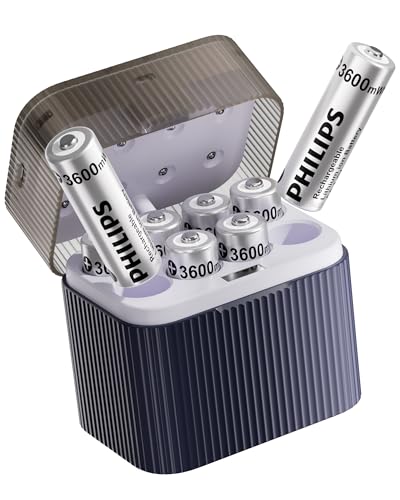
PHILIPS Rechargeable AA Lithium Batteries 8-Pack, 3600mWh — Best Brand Name
Philips’ cells-only eight-pack is the capacity flagship of a global brand: a stated 3,600 mWh per AA cell, constant 1.5 volt output, and up to 1,200 cycles in the listing, positioned for game controllers, remotes and household electronics. For the buyer who wants this technology’s top specification without leaving the comfort of a name they have bought since childhood, this is the product, and its specification sheet backs the instinct more often than not.
The positioning deserves one clarification the listing itself invites: remotes are named, but remotes are where this format’s premium is least observable, since any cell runs a remote for ages. The capacity and constant voltage earn their keep in the controllers the listing also names, and in the wider demanding fleet of flashes, toys and cameras. Buy these for the devices that work, not the devices that sip, and the specification makes sense.
As a cells-only pack it presumes the Philips fast-charger kit, or a compatible charger, already lives at home; the kit version appears in our charger guide for those starting out. The cycle claim, 1,200 against rivals’ 1,600, is the one specification where the brand flagship trails, and decade-scale planners should weigh it. For capacity-first buyers inside a trusted brand, it remains the peak.
Strengths
- Highest stated brand capacity at 3,600 mWh
- Global brand accountability and retail presence
- Constant output suits controllers and demanding devices
Trade-offs
- Charger not included
- Cycle claim of 1,200 trails the 1,600 class
- Premium wasted if spent on remotes and clocks
| Output | Constant 1.5 V |
| Capacity | 3,600 mWh (per listing title) |
| Size | AA |
| Pack | 8 cells |
| Cycles | Up to 1,200 (per listing) |
Best for: Capacity-first buyers who want a global brand / Not suited for: Cycle-life maximisers and the unequipped
Check the current price on Amazon
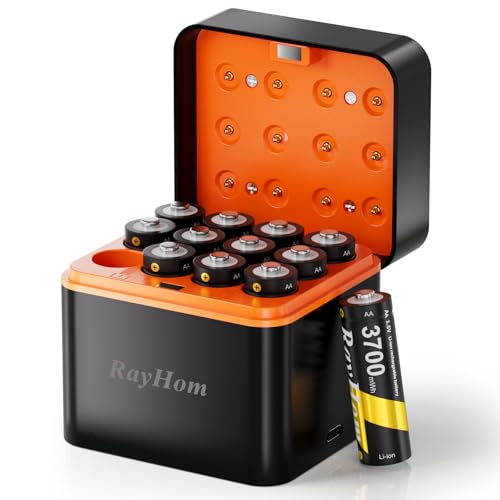
RayHom Rechargeable AA Lithium Batteries 12-Pack with Charger, 3700mWh — Best Kit Value
RayHom’s kit makes the boldest complete offer in this guide: twelve rechargeable AA cells at a stated 3,700 mWh, the highest capacity figure we verified, constant 1.5 volt output, up to 1,600 cycles in the listing, and a twelve-slot lithium AA charger in the box, aimed at Blink cameras. As a single purchase that takes a household from nothing to a full constant-voltage fleet, nothing else here matches its paper specification per box.
The twelve-slot charger is the detail that elevates the kit from big to coherent. A twelve-cell fleet charged four at a time is a queue; charged twelve at a time it is an overnight non-event, and fleet-scale charging is what makes a many-device household’s rotation effortless. Whoever specified this kit understood the system it belongs to, and that understanding is worth as much as the headline capacity.
The balancing fact is brand depth: RayHom does not carry the rechargeable history of EBL or the global weight of Philips, and its capacity figure, while within the format’s credible range, is a claim the buyer takes on the listing’s word. Value hunters feeding cameras today will find that trade easy to accept; buyers standardising a house for a decade may prefer the established names and accept a step less capacity. Both readings are defensible, and the badge reflects the value case.
Strengths
- Highest stated capacity at 3,700 mWh, as a complete kit
- Twelve-slot charger matches the twelve-cell fleet
- Up to 1,600 cycles with constant output
Trade-offs
- Brand track record thinner than EBL or Philips
- Capacity figure rests on the listing’s claim
- Large kit is oversized for one-device homes
| Output | Constant 1.5 V |
| Capacity | 3,700 mWh (per listing title) |
| Size | AA |
| Pack | 12 cells |
| Charger | 12-slot charger included |
Best for: Value-focused households wanting a complete fleet at once / Not suited for: Buyers who prioritise brand history over specification
Check the current price on Amazon
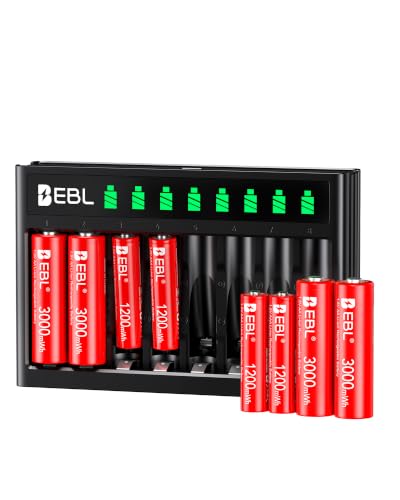
EBL AA/AAA Rechargeable Lithium Batteries with Charger, 8-Pack — Best Mixed Sizes
This EBL kit returns in this guide because the general keyword, unlike the AA-specific one, includes every household whose demanding devices span both sizes, and this is the only verified product that equips both in one box: four AA cells at a stated 3,000 mWh, four AAA at 1,200 mWh, constant 1.5 volt output from each, up to 1,200 cycles in the listing, and a charger that the listing states fits Ni-MH and Li-ion cells, powered by Type-C.
AAA is this format’s underserved size, and devices that use it, compact torches, smaller remotes with voltage opinions, laser pointers, small motorised gear, suffer the NiMH voltage mismatch just as AA devices do. A kit that treats AAA as a first-class citizen rather than an afterthought serves the real shape of a household’s devices, and the shared charger keeps the system to one box on the shelf.
The split fleet is the compromise: four cells per size equips perhaps two devices per size, so heavy users of either will outgrow it and graduate to the size-specific fleets above. As the starting system for a mixed household, and as the only AAA route in this guide, it earns its place on coverage alone, with EBL’s name as the reassurance behind it.
Strengths
- Only pick equipping AA and AAA in one system
- Dual-fit Type-C charger included
- Constant 1.5 V output in both sizes
Trade-offs
- Four cells per size is a starter fleet
- Cycle rating of 1,200 trails the top kits
- Heavy single-size users should buy size-specific packs
| Output | Constant 1.5 V |
| Capacity | AA 3,000 mWh / AAA 1,200 mWh (per listing) |
| Sizes | AA and AAA |
| Charger | Included, dual-fit, Type-C |
Best for: Households whose demanding devices span both sizes / Not suited for: Single-size fleets needing depth
Check the current price on Amazon

POWEROWL 1.5V Rechargeable Lithium AA Batteries with Charger 8-Pack, 3600mWh — Best Complete Value
POWEROWL closes the list by doing the simplest thing well: eight rechargeable lithium AA cells at a stated 3,600 mWh, the same capacity class as the Philips flagship, with the charger included in the box, aimed at Blink outdoor cameras and the demanding fleet generally. For a household that wants the complete system, at the top capacity class, without paying the global brand’s premium, this kit is the arithmetic answer.
Value in this category must always be audited as a system, and the included charger is what makes this kit’s arithmetic honest: there is no second purchase hiding behind the first. Eight cells equip two four-cell devices or a rotation for one hard-working camera pair, which covers the majority of households’ actual demanding fleets, and the system can grow with cells-only packs later once the charger is home.
The trade-offs are documentation and depth: the listing is quieter about cycle expectations than its rivals, and the brand’s history, while real in rechargeables, is shorter than EBL’s. Buyers who read specifications and value the complete box will find those acceptable. Buyers who want every figure stated and a decade of brand behind it have their picks above, at their prices.
Strengths
- Complete kit at the 3,600 mWh capacity class
- Charger included: no hidden second purchase
- Strong value against brand-name systems
Trade-offs
- Listing quieter on cycle-life expectations
- Brand depth behind EBL and Philips
- Eight cells may be a starting fleet for camera-heavy homes
| Output | Constant 1.5 V |
| Capacity | 3,600 mWh (per listing title) |
| Size | AA |
| Pack | 8 cells |
| Charger | Included |
Best for: Value-focused buyers wanting a complete system / Not suited for: Specification auditors wanting every figure stated
Check the current price on Amazon
Comparison Table
Constant voltage is the constant; everything else varies. The table compares stated capacity, pack scale and charger inclusion, the three variables that separate six products delivering the same 1.5 volts.
| Pick | Badge | Key spec | Best for |
|---|---|---|---|
| Kratax 1.5V AA Lithium Rechargeable Batteries 12-Pack, 3500mWh | Best Overall | 1.5 V constant, 3,500 mWh, 12-pack | Equipped households standardising demanding devices |
| EBL Rechargeable Lithium AA Batteries 8-Pack, 3000mWh | Best for Outdoor Cameras | 1.5 V constant, 3,000 mWh, camera-focused | Outdoor security cameras and doorbells |
| PHILIPS Rechargeable AA Lithium Batteries 8-Pack, 3600mWh | Best Brand Name | 1.5 V constant, 3,600 mWh, brand flagship | Capacity-first buyers who want a global brand |
| RayHom Rechargeable AA Lithium Batteries 12-Pack with Charger, 3700mWh | Best Kit Value | 1.5 V constant, 3,700 mWh, full kit | Value-focused households wanting a complete fleet at once |
| EBL AA/AAA Rechargeable Lithium Batteries with Charger, 8-Pack | Best Mixed Sizes | AA + AAA kit, dual-fit charger | Households whose demanding devices span both sizes |
| POWEROWL 1.5V Rechargeable Lithium AA Batteries with Charger 8-Pack, 3600mWh | Best Complete Value | 1.5 V constant, 3,600 mWh, complete kit | Value-focused buyers wanting a complete system |
The decision tree is short. No charger at home: pick a kit row. Charger at home: pick a capacity row. Both sizes at home: the mixed kit is your only row, and it is a good one. Everything else is preference between brands with real product lines.
How to Choose the Best 1.5 Volt Rechargeable Batteries
Choose by device before brand. This format belongs in voltage-sensitive and high-drain devices: outdoor cameras, flashes, game controllers, motorised toys, wireless audio, strong torches. In those devices, constant voltage is a performance feature you can feel. In remotes, clocks and other sippers, it is an invisible premium, and ordinary alkaline or NiMH serves better for less. A household that allocates this format to its demanding minority gets the technology’s full value; one that sprinkles it everywhere gets a large bill and no visible difference.
Choose the system before the cells. Your first purchase must include the dedicated charger, which means a kit, full stop. Cells-only packs are for equipped homes expanding a fleet. Confirm charger inclusion from the listing itself, and never assume a charger from another system, NiMH or otherwise, can substitute. The dedicated charger is not an accessory to this format; it is the format’s other half.
Compare capacity within the category’s own unit and credible range. Stated capacities in this guide run from 3,000 to 3,700 mWh, which is the honest span of the can size. Treat figures far above that span as marketing until independently proven, and treat cycle claims as comparative signals between makers rather than promises. A maker who states capacity, cycles and charger requirements plainly is describing a product; a maker who states only a giant number is describing an advertisement.
- Reserve the format for demanding, voltage-sensitive devices
- Make the first purchase a kit with the dedicated charger
- Never charge these cells in a NiMH charger
- Compare mWh within the category’s credible range only
- Keep charged spare sets: the flat curve gives little warning
1.5 Volt Rechargeable vs Single-Use Lithium and Alkaline
Against single-use lithium AA, the rechargeable’s case is economic and environmental: similar constant, high performance in demanding devices, but reusable hundreds of times, so a camera that eats a set a month stops generating a monthly battery bill and a monthly handful of waste. The single-use lithium keeps two advantages: it is available anywhere with no system to own, and it stores for years ready in emergency kits, where rechargeables’ self-discharge and system needs make them the wrong reserve.
Against alkaline, the case is performance: alkaline fades from the first hour and sags in cold and under drain, while the rechargeable holds its voltage and repeats the trick after every charge. Alkaline keeps the low-drain crown, because in a remote its years-long service makes any rechargeable system pointless. The mature shelf holds all three, each allocated to its work, and this guide’s format owns the demanding middle outright.
Understanding mWh, Cycles and Constant Voltage
Milliwatt-hours measure the total energy a cell holds, and this category uses the unit because its internal lithium cell runs at a higher voltage than the 1.5 volts it delivers. A 3,500 mWh cell therefore cannot be compared with a NiMH cell’s milliamp-hours by simply reading the numbers side by side; the units encode different voltages. Within this category, mWh comparisons are valid and useful, and the spread between 3,000 and 3,700 mWh represents a real, if modest, difference in run time between charges.
Cycle figures describe how many charges the maker rates the cell to survive, and constant voltage describes the shape of each discharge: flat at 1.5 volts, then a rapid end. Together they define ownership: a long, predictable plateau of full performance, repeated hundreds of times, managed by rotation rather than by watching gauges. Buyers who internalise those three ideas will never be surprised by this format, and surprise, in battery ownership, is almost always a cost.
How to Use 1.5 Volt Rechargeable Batteries in Your Devices
Ownership of this format is a small set of habits, each trivial, together transformative. The steps below take a new set from its box to a working household rotation, including the charger rule that must never be broken and the rotation habit that turns the flat discharge curve from a surprise into a non-event.
Step 1: Charge fully before first use, in the dedicated charger only
New cells often arrive partially charged. Fill them in the charger made for 1.5 volt lithium rechargeable cells, the kit charger or the maker’s own, before their first device session. Never place them in a NiMH charger, and label chargers if both systems live in your home, because the cells look like every other AA you own.
Step 2: Fit them to the demanding devices first
Allocate the new fleet where it earns: cameras, flashes, controllers, hungry toys. Moving a device from fading alkalines to constant voltage is the moment the format proves itself, and first impressions decide whether a household adopts a system. Leave the remotes on their existing cells without guilt.
Step 3: Run devices in matched sets
Fit and replace cells as complete sets from the same pack, as with any rechargeable system. Matched cells share age and behaviour, charge together and age together, and a set pulled and recharged as a unit keeps the rotation legible.
Step 4: Rotate on schedule, not on symptoms
Because the output stays flat until near the end, waiting for a device to complain means waiting until it stops. For important sessions, events, trips, a camera guarding an empty house, swap in a charged set beforehand. The spent set charges while the fresh set works, and the cycle never interrupts anything.
Step 5: Store charged, together, labelled
Keep each set in its case or a labelled box, charged, ready. Lithium-based cells prefer storage with charge, and a labelled set is a set that will never meet the wrong charger or dissolve into the general drawer. The case the kit came in is not packaging; it is equipment.
Step 6: Retire cells that fall behind their set
A cell that charges oddly fast, heats in the charger or empties far sooner than its siblings has reached its end. Remove it from the rotation, keep it apart, and recycle it through a battery collection point. Sets are healthiest when their weakest member is allowed to retire.
Problem: the device’s battery gauge shows full, then the device stops without warning. That is the regulated curve, not a fault: the cell delivered a true 1.5 volts until its charge was spent, and a voltage-based gauge cannot see it coming. The rotation habit in step four is the standing solution, and after a month it feels as natural as charging a phone nightly.
Problem: you are unsure whether a loose cell is a 1.5 volt lithium rechargeable or a NiMH. Read its markings: this format states 1.5 volts and milliwatt-hours; NiMH states 1.2 volts and milliamp-hours. If the markings are worn away, do not charge the cell in either charger. An unidentified cell is retired, not guessed with.
Common Buying Mistakes
Using a NiMH charger on them
The unbreakable rule, broken most often by tidy people who assume one charger serves all AA-shaped cells. It does not. The 1.5 volt lithium system has its own chargers, and the NiMH charger on the shelf is for the other fleet. Label both and the mistake becomes difficult to make.
Judging them in remotes and clocks
Fitting this format to a device that cannot reveal its virtues, then concluding it is overpriced, is an allocation error dressed as a review. Judge constant voltage where voltage matters: in a flash’s recycle time, a camera’s winter reliability, a controller’s consistency.
Comparing mWh to mAh across systems
The numbers look comparable and are not, because they are measured at different voltages. Cross-system number comparisons produce confident, wrong conclusions. Compare within the format by mWh, and across formats by how the device behaves.
Buying cells-only without owning the charger
A cells-only pack in a home with no compatible charger is an ornament. Kits exist to prevent exactly this, and the small saving of a cells-only first purchase is repaid immediately in a second, urgent purchase. System first, cells second.
Waiting for low-battery warnings
Regulated cells defeat voltage-based warnings by design. Households that run this format on warnings experience abrupt stops and blame the cells. Households that rotate on schedule experience none, and credit the system. The difference is a habit, not a product.
Who Should Skip This Format Entirely
An honest guide names its exits. If your household’s batteries live almost entirely in remotes, clocks and wall thermometers, this format has nothing to sell you: those devices run for years on anything, and a rechargeable system of any kind is infrastructure without a purpose. Buy a bulk alkaline pack from our companion guide and spend the difference on something visible. The same applies to emergency reserves, where single-use lithium’s decade of ready storage beats any rechargeable’s system needs.
If, on the other hand, you recognise your home in the demanding list, cameras blinking on the porch, flashes at family events, controllers that die mid-game, toys that eat a pack a month, then this format is not a premium indulgence but the correction of a standing inefficiency. The households that benefit most are the ones currently spending most on single-use cells for their hungriest devices, which is a sentence worth reading twice before deciding you are not one of them.
The middle household, a few demanding devices among many gentle ones, is where allocation earns its keep: a small kit for the demanding few, bulk alkaline for the gentle many, and no technology asked to do work it is bad at. That portfolio, not any single battery, is the actual best answer to the keyword, and every pick in this guide is a component of it.
Setting Up a Two-System Household Battery Shelf
Most households that adopt this format end up, correctly, with two rechargeable systems: NiMH for the general fleet and 1.5 volt lithium for the demanding devices, plus a dwindling stock of single-use cells for the roles they still own. The shelf that holds all three without incident is an organisational achievement, not a technical one, and it rests on three habits. Separate storage, physically distinct and labelled, so a cell’s system is known by where it lives. Separate chargers, labelled in words, so the pairing is never a memory test. And a charged-spare discipline for the lithium fleet, so its flat discharge curve never gets a vote.
The allocation map should be written down once, because households share battery duty and unwritten maps diverge. Which devices are lithium devices, which are NiMH, which still take single-use cells and why. The map will surprise its own author: most homes discover their demanding list is five devices long, which means a single kit serves it, and their NiMH fleet is doing quiet, adequate work everywhere else. Writing the map converts battery buying from a series of drawer-side improvisations into the execution of a decision already made.
Review the shelf twice a year, alongside the alarm checks this programme’s tester guide recommends. Retire tired cells, top up the fleets that have thinned, and confirm the labels still match reality. Fifteen minutes, twice a year, is the entire administrative cost of a battery shelf that never ambushes anyone, and it is the difference between households that own a system and households that own a drawer. The picks in this guide are the components; the shelf is the product.
A Note on Mixing Cells From Different Packs
One habit quietly undermines more rechargeable systems than any other: topping up a device with whatever cell is nearest, regardless of its age, brand or pack. Cells in the same device share one job and one fate. A fresh cell set beside a tired one does not average out; the device performs closer to the tired cell’s level, and the tired cell is driven hardest by every session. The visible result is a device that never quite delivers the constant-voltage promise, and the invisible result is good cells aging early in bad company.
The fix is the set discipline this guide keeps recommending, stated once more in its smallest form: cells travel in the sets they were bought in, get fitted together, charged together and retired together. If one cell of a set fails early, replace the device’s working set and move the survivors to a less demanding device or the spares box. It feels wasteful the first time and obvious every time after, because the devices simply start behaving the way the reviews said they would.
Final Recommendation
For equipped households, the Kratax twelve-pack is the fleet to standardise on, with the Philips cells as the brand-name capacity alternative and the EBL eight-pack as the outdoor camera specialist. For new households, the RayHom kit offers the boldest complete specification, the POWEROWL kit the complete value route, and the EBL mixed kit the only honest answer when AAA devices share the shelf.
Whichever door you enter by, the house rules are the same: dedicated charger, matched sets, charged spares, rotation over warnings. Follow them and this format quietly becomes the best battery decision in the house. The companions below cover the AA-specific cut of this category and the chargers in depth, for readers building the complete system.
Quick recap of the picks, for readers who scrolled straight to the verdict:
- Kratax 1.5V AA Lithium Rechargeable Batteries 12-Pack, 3500mWh — Best Overall: Check the current price on Amazon
- EBL Rechargeable Lithium AA Batteries 8-Pack, 3000mWh — Best for Outdoor Cameras: Check the current price on Amazon
- PHILIPS Rechargeable AA Lithium Batteries 8-Pack, 3600mWh — Best Brand Name: Check the current price on Amazon
- RayHom Rechargeable AA Lithium Batteries 12-Pack with Charger, 3700mWh — Best Kit Value: Check the current price on Amazon
- EBL AA/AAA Rechargeable Lithium Batteries with Charger, 8-Pack — Best Mixed Sizes: Check the current price on Amazon
- POWEROWL 1.5V Rechargeable Lithium AA Batteries with Charger 8-Pack, 3600mWh — Best Complete Value: Check the current price on Amazon
- Best 1.5 Volt Aa Rechargeable Batteries
- Best 1.5 Volt Battery Charges
- Best 1.5 Volt Battery
- Best 1.5 Volt And 9 Volt Battery Tester
- Best 1.2 Volt Rechargeable Batteries For Solar Lights
- Best 1 2 Aa Battery 3.6 Volt
Frequently Asked Questions
What are 1.5 volt rechargeable batteries, exactly?
They are rechargeable cells in AA or AAA size that deliver a constant 1.5 volt output. Inside, a lithium cell running at a higher internal voltage is regulated down to 1.5 volts, so devices see the same voltage as a fresh single-use battery for essentially the whole charge, and the cell can then be recharged hundreds of times in its dedicated charger.
Why not just use NiMH rechargeables?
NiMH cells are nominally 1.2 volts, and many devices notice: gauges report low battery early, flashes recycle slowly and some electronics underperform. NiMH remains excellent for undemanding devices and costs less as a system. The 1.5 volt rechargeable exists for the devices where the voltage difference is a real performance difference.
Can I charge them in any AA charger?
No. Only in a charger made for 1.5 volt lithium rechargeable cells, which is why most recommendations in this guide are kits. A NiMH charger is a different system and must never be used for these cells, nor these cells’ charger used for NiMH. The chargers should be labelled and the fleets stored separately.
How long do they run compared to alkaline batteries?
In high-drain devices they typically outrun alkaline substantially, because they hold full voltage under load instead of sagging, and they repeat that performance after every recharge. In low-drain devices the comparison hardly matters, because everything runs for ages and the rechargeable’s premium buys nothing observable.
Why does my device stop suddenly with no low-battery warning?
The regulated output holds 1.5 volts until the charge is nearly exhausted, so a gauge that estimates life from voltage sees a healthy battery until the end. This is the format working as designed. The management habit is to rotate sets on schedule and keep charged spares, rather than relying on warnings.
What capacity should I look for?
Within this category, compare the milliwatt-hour figures stated in the listings: the credible range verified in this guide runs from 3,000 to 3,700 mWh for AA cells. Figures far beyond that range should be treated as marketing. Cycle ratings, charger inclusion and brand accountability matter alongside capacity, and often matter more.


