Disclosure: airfryerkitchensupply.com is reader-supported. When you buy through links on our site, we may earn an affiliate commission at no extra cost to you.
Where to buy
Every pick in this guide to the best 1.2 volt batteries for outdoor solar lights is sold on Amazon, and that is where we recommend buying. Solar light batteries are a small, repeat purchase, so pack size matters as much as brand: count the lights you own before ordering, because most paths and borders use more cells than people remember, and a multipack that covers the whole garden in one fitting session is worth more than a small pack bought twice.
- Kruta AA Solar Batteries 1600mAh 1.2V Ni-MH — Best Overall: Check the current price on Amazon
- Panasonic eneloop AA Ni-MH Rechargeable Batteries 8-Pack — Best Premium: Check the current price on Amazon
- Howardly Ni-MH AA 600mAh Solar Batteries 12-Pack — Best for Small Pathway Lights: Check the current price on Amazon
- Lightalent Rechargeable Solar AA 600mAh Batteries 12-Pack — Best Budget Multipack: Check the current price on Amazon
- JINTION Ni-MH AA 800mAh Solar Batteries 4-Pack — Best Mid-Capacity: Check the current price on Amazon
- Panasonic eneloop AAA Ni-MH Rechargeable Batteries 8-Pack — Best for AAA Solar Lights: Check the current price on Amazon
One check before you order anything: open one of your lights and confirm the size. Most solar lights take AA cells, but smaller stake lights and some decorative strings take AAA, and the two are not interchangeable. Every pick below states its size in its name, and this list includes one AAA option for exactly that reason.
Introduction
Shopping for the best 1.2 volt batteries for outdoor solar lights usually starts the same way: the path lights that glowed until midnight last summer now fade by nine, and the problem is not the lights. It is the batteries inside them. Solar garden lights ship with the cheapest rechargeable cells that will pass a first-season demonstration, and those cells live a hard life: charged by a small panel all day, drained all night, baked in summer sun and frozen in winter. After a season or two, their capacity is a fraction of what it was, and the lights tell the story every evening.
The good news is that this is one of the cheapest upgrades in the garden. A solar light is a simple system: a small solar panel, a light sensor, an LED and one or two 1.2 volt nickel-metal hydride cells. Replace tired cells with decent ones matched to the light, and most lights return to their original run time the same night. The 1.2 volt figure in the keyword is the giveaway to the chemistry: NiMH cells are nominally 1.2 volts, and that is what solar lights are designed around. A standard 1.5 volt alkaline can be used briefly in some lights, but it is not rechargeable, the light cannot recharge it, and it defeats the entire design.
The confusing part is capacity. Solar replacement cells range from about 600 mAh to 1,600 mAh and beyond in AA size, and bigger is not automatically better. A small solar panel can only push so much charge into a cell during a day, and in winter far less. A very high-capacity cell in a light with a tiny panel may never fully charge, while a modest cell charges completely and delivers its full capacity nightly. Matching cell capacity to the light, which this guide explains pick by pick, matters more than chasing the largest number on a listing.
Every pick below was verified individually, and the list deliberately spans the real market: high-capacity cells for large lights, honest 600 mAh cells for small pathway lights, a premium long-life option from Panasonic’s eneloop line for people tired of replacing cells, and an AAA option for compact lights. What the list does not contain is any cell whose capacity claim we could not sanity-check against the format, and it contains no non-rechargeable substitutes, because a solar light battery has one defining job: to be recharged by the light itself, hundreds of times.
In this guide
Quick Picks
In a hurry? These six cells cover every common solar light, from small pathway stakes to large flood-style fixtures. The reviews below explain the capacity matching that decides which one your lights actually need.
- Kruta AA Solar Batteries 1600mAh 1.2V Ni-MH — Best Overall: A high-capacity 1,600 mAh Ni-MH AA cell aimed at solar lights, and honest enough to list remotes and flashlights as secondary uses. Check the current price on Amazon
- Panasonic eneloop AA Ni-MH Rechargeable Batteries 8-Pack — Best Premium: Panasonic’s benchmark low-self-discharge Ni-MH cell, for buyers who would rather replace solar batteries once in years than once a season. Check the current price on Amazon
- Howardly Ni-MH AA 600mAh Solar Batteries 12-Pack — Best for Small Pathway Lights: A 600 mAh twelve-pack matched to the small cells most pathway lights actually ship with, pre-charged and low self-discharge. Check the current price on Amazon
- Lightalent Rechargeable Solar AA 600mAh Batteries 12-Pack — Best Budget Multipack: Another honest 600 mAh twelve-pack, rated in the listing for 1,000 cycles, aimed at garden, string, step and pathway lights. Check the current price on Amazon
- JINTION Ni-MH AA 800mAh Solar Batteries 4-Pack — Best Mid-Capacity: An 800 mAh middle option for lights between the tiny-panel and large-panel classes, in a trial-friendly four-pack. Check the current price on Amazon
- Panasonic eneloop AAA Ni-MH Rechargeable Batteries 8-Pack — Best for AAA Solar Lights: The eneloop in AAA size, for the many compact solar lights whose holders will not accept an AA cell. Check the current price on Amazon
A pattern worth noticing: the premium pick is not the highest-capacity pick. For solar duty, charge acceptance and cycle life beat headline capacity, which is why an eneloop sits on this list next to cells rated far higher on paper.
How These Picks Were Chosen
We built this list from the lights backward. Solar fixtures divide into small pathway and decorative lights with modest panels, mid-size lights with larger panels, and a minority of big fixtures that can genuinely use a high-capacity cell. A useful shortlist has to serve all three groups, so we verified cells across the capacity range rather than crowning a single capacity class, and we checked each listing for the information a solar buyer actually needs: chemistry, size, stated capacity and pack count.
Cycle life and charge behaviour weighed as heavily as capacity. A solar cell is cycled daily, so a cell that tolerates many shallow daily cycles outlasts one with a bigger first-month capacity. Low self-discharge also matters more than people expect, because a light that sits under a tree or on a shaded border may store charge for days between sunny spells. Cells whose listings described low self-discharge and pre-charged readiness scored well for exactly that reason.
We excluded alkaline and lithium primary cells outright: a solar light cannot recharge them, and recommending them in this category would be a category error. We also excluded cells with capacity claims implausible for their size. What remains is a list we would hand to a neighbour without caveats beyond the matching advice in each review.
The 6 Best 1.2 Volt Batteries for Outdoor Solar Lights
Each review below names the lights the cell suits, the lights it does not, and the trade-off you are accepting. Capacity figures are the listings’ own stated figures, and the verdicts account for how solar panels actually charge, not just how big a number can be printed on a cell.
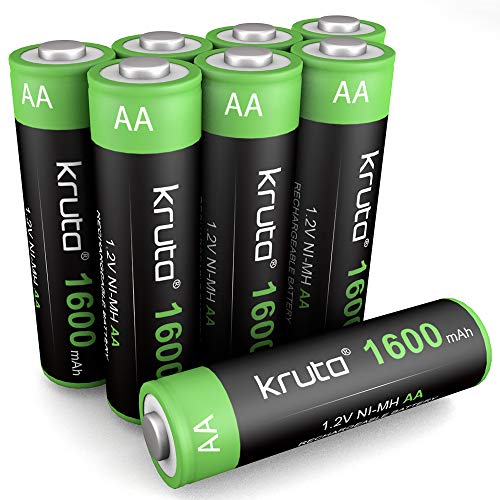
Kruta AA Solar Batteries 1600mAh 1.2V Ni-MH — Best Overall
For most standard solar lights, this Kruta cell hits the sweet spot. At a stated 1,600 mAh, it carries substantially more capacity than the 600 to 800 mAh cells most lights ship with, which translates directly into longer run time after a full charge: lights that faded mid-evening typically run hours longer. The listing is aimed at outdoor solar lights first, with battery string lights, remotes and similar devices as secondary uses, which is the right priority order for this purchase.
The capacity comes with one condition, and it is the condition that governs this whole category: your light’s panel has to be able to fill it. In a standard path light with a decent panel in a sunny position, a 1,600 mAh cell charges well through the long days and pays its capacity back at night. In a shaded border or through short winter days, the same cell may run partially charged, and a smaller cell would deliver similar real-world light. Place these in your sunnier, larger lights and they are the best default buy on this list.
As a value-brand cell, expectations should be set correctly: it will not match an eneloop’s multi-year consistency, and rotating or replacing cells seasonally is normal at this tier. Bought in the knowledge that solar cells are consumables with a hard life, the Kruta offers the strongest capacity-per-cost balance we verified.
Strengths
- 1,600 mAh stated capacity suits standard and larger solar lights
- Listing targets solar lights first, not as an afterthought
- Noticeable run-time upgrade over typical included cells
Trade-offs
- Needs a reasonably sunny position to charge fully
- Value tier: expect seasonal replacement rather than multi-year life
- Oversized for tiny decorative lights with very small panels
| Voltage | 1.2 V |
| Capacity | 1,600 mAh (per listing title) |
| Size | AA |
| Chemistry | Ni-MH rechargeable |
Best for: Standard path lights and larger solar fixtures in sunny spots / Not suited for: Small shaded decorative lights with tiny panels
Check the current price on Amazon

Panasonic eneloop AA Ni-MH Rechargeable Batteries 8-Pack — Best Premium
The eneloop is the cell rechargeable-battery enthusiasts measure others against, and it earns a place in a solar guide for a specific reason: solar lights are not always sunny. A light under a tree canopy or on a north-facing border may gather charge in bursts across several days, and a cell with high self-discharge quietly loses that charge between sunny spells. Eneloop’s low-self-discharge design, rated by Panasonic for up to 2,100 charge cycles in the listing, holds stored charge far better than ordinary Ni-MH cells, which is precisely the property shaded lights need.
In a sunny light, the eneloop behaves like what it is: a high-quality general-purpose Ni-MH cell that charges from the panel, runs the light, and repeats the cycle with unusual consistency year after year. Its capacity is in the standard eneloop class rather than the high-capacity class, so on a midsummer night a fresh 1,600 mAh cell may edge it for raw run time. Across three winters, the comparison reverses, because the eneloop is still performing close to its specification while budget cells have faded.
The cost is real: this eight-pack costs more per cell than any value pick here. The arithmetic works for lights that are awkward to reach, for a garden you do not want to re-battery every spring, and for anyone who has already replaced cheap cells twice and done the maths. It is also the safest pick for mixing duties, since the same cells serve remotes and other household devices superbly outside the garden season.
Strengths
- Low self-discharge suits shaded and intermittently sunny lights
- Rated for up to 2,100 cycles in the listing
- Multi-year consistency no value cell matches
Trade-offs
- Highest cost per cell on this list
- Standard capacity class, not the highest available
- Premium cell is partly wasted in a light that will be replaced soon anyway
| Voltage | 1.2 V |
| Size | AA |
| Chemistry | Ni-MH, low self-discharge |
| Cycle rating | Up to 2,100 cycles (per listing title) |
Best for: Shaded lights, hard-to-reach fixtures and long service intervals / Not suited for: Large sunny gardens needing dozens of cells on a budget
Check the current price on Amazon

Howardly Ni-MH AA 600mAh Solar Batteries 12-Pack — Best for Small Pathway Lights
Open a typical solar pathway light and the cell inside is usually rated around 600 mAh, because the light’s small panel can charge a cell that size completely even on an average day. Howardly’s twelve-pack is built to exactly that specification: 600 mAh Ni-MH AA cells, described in the listing as pre-charged with low self-discharge, sold in the quantity a real path actually needs. There is no specification inflation here, and that honesty is the point of the pick.
Matching capacity to panel size produces a counterintuitive result: in a small light, this 600 mAh cell can deliver more usable light than a 1,600 mAh cell, because it reaches full charge daily while the bigger cell idles at partial charge and degrades faster in that state. If your lights are the classic small stake design lining a path or driveway, this is the technically correct replacement, not a compromise.
Twelve cells cover most paths in one session, which matters more than it sounds: replacing every cell in a run of lights at once gives even brightness along the whole path, instead of a patchwork of strong new lights and weak old ones. Keep the count in mind when ordering for borders and steps as well, and you will likely find the twelve-pack is the pack size this category should have standardised on.
Strengths
- Capacity matched to small panels for complete daily charging
- Twelve-pack refreshes a whole path evenly in one session
- Pre-charged and low self-discharge per the listing
Trade-offs
- 600 mAh limits run time in larger lights
- Not the pick for big fixtures with large panels
- Value tier cycle life: plan on periodic refresh
| Voltage | 1.2 V |
| Capacity | 600 mAh (per listing title) |
| Size | AA |
| Pack | 12 cells |
Best for: Classic small pathway and stake lights / Not suited for: Large solar flood or spotlight fixtures
Check the current price on Amazon
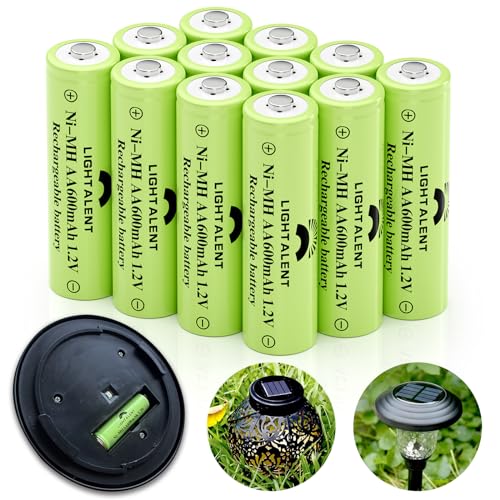
Lightalent Rechargeable Solar AA 600mAh Batteries 12-Pack — Best Budget Multipack
Lightalent’s twelve-pack competes head-on with the Howardly above, and having two credible options at the sensible end of this market is good for buyers. The specification is the same honest recipe: 600 mAh Ni-MH AA cells, pre-charged, with the listing citing up to 1,000 cycles and naming garden, string, step and pathway lights as the applications. That cycle figure, read as a listing claim, is in the believable range for daily shallow cycling, which again suggests a seller describing a real product rather than a fantasy one.
Choose between this and the Howardly on availability and pack pricing on the day, because in the lights themselves they do the same job: full daily charges in small fixtures, even brightness across a run of lights, and a seasonal refresh rhythm. The twelve-count format remains the key virtue. Decorative string and step lights in particular tend to be installed in sets, and set-sized battery packs are what keep them performing as sets.
As with every value-tier solar cell, go in with the consumable mindset. These cells work hard in heat and cold that no indoor battery endures, and even good ones decline. The budget multipack model accepts that reality and prices the refresh accordingly, which is why it is the rational choice for large gardens with many small lights.
Strengths
- Believable 1,000-cycle listing claim for daily solar duty
- Twelve-pack matches set-installed lights
- Applications named precisely: garden, string, step and pathway
Trade-offs
- Same 600 mAh ceiling as any small-light cell
- Seasonal refresh is part of the deal at this tier
- No premium low-self-discharge pedigree for deep-shade lights
| Voltage | 1.2 V |
| Capacity | 600 mAh (per listing title) |
| Size | AA |
| Pack | 12 cells; up to 1,000 cycles per listing |
Best for: Large gardens with many small set-installed lights / Not suited for: Buyers wanting a fit-and-forget multi-year cell
Check the current price on Amazon

JINTION Ni-MH AA 800mAh Solar Batteries 4-Pack — Best Mid-Capacity
Between the 600 mAh small-light cells and the 1,600 mAh high-capacity cells sits a gap that many real lights fall into: mid-size fixtures whose panels are bigger than a stake light’s but not generous, and lights in partial sun. JINTION’s 800 mAh cell is the pick for that gap. The listing describes a 1.2 volt Ni-MH AA with low self-discharge, up to 1,000 cycles, and applications spanning outdoor solar lights, lawn lamps, ground lights and lanterns, which is an accurate map of the mid-size fixture world.
The four-pack format is part of the appeal. If you are unsure which capacity class your lights belong to, a four-pack lets you test one run of lights for a few weeks before committing the whole garden. Watch how the test lights behave after bright days and dull ones: if they run to dawn in summer, the class is right, and you can scale up with confidence.
The compromise is inherent: 800 mAh will not transform a large light the way a high-capacity cell can, and it costs a little of the small-light advantage of always charging completely. It is the pick for the middle of the garden, and for buyers who value a tested decision over a guessed one.
Strengths
- Capacity class for mid-size and partial-sun lights
- Four-pack suits testing before a whole-garden refresh
- Low self-discharge and 1,000-cycle claims in the listing
Trade-offs
- Neither the cheapest nor the highest capacity here
- Partial-sun performance still depends on placement
- Four-pack is small for whole-garden replacement
| Voltage | 1.2 V |
| Capacity | 800 mAh (per listing title) |
| Size | AA |
| Pack | 4 cells |
Best for: Mid-size lights and testing a capacity class before scaling / Not suited for: Whole-garden refreshes needing large pack counts
Check the current price on Amazon

Panasonic eneloop AAA Ni-MH Rechargeable Batteries 8-Pack — Best for AAA Solar Lights
A meaningful share of solar lights, especially compact stake lights, decorative ornaments and some string lights, take AAA cells rather than AA. Fitting advice for those lights is useless if every pick is the wrong physical size, which is why this eneloop AAA eight-pack closes the list. It brings the same low-self-discharge design and up to 2,100-cycle listing rating as its AA sibling, scaled to the smaller format that compact lights are built around.
AAA solar cells live an even harder life than AA ones, because the light’s panel and the cell are both small, and cheap included AAA cells fade quickly. A quality AAA cell that charges fully from a small panel and holds its charge between sunny spells is a disproportionate upgrade in a compact light, often the difference between a decoration that works and one that glows for an hour. The eight-pack covers a typical set of compact lights with spares left over.
The usual eneloop caveat applies: you pay a premium per cell. In AAA solar duty the premium is easier to justify than almost anywhere, because the alternative is a cycle of cheap cells and dim lights. Confirm your lights really are AAA before ordering, since holders are not always labelled clearly, and this pick is the end of your search if they are.
Strengths
- Correct size for compact AAA solar lights
- Low self-discharge helps small panels and shaded spots
- Up to 2,100-cycle listing rating for long service
Trade-offs
- Premium cost per cell
- AAA capacity is inherently lower than AA
- Useless if your lights are AA: check the holder first
| Voltage | 1.2 V |
| Size | AAA |
| Chemistry | Ni-MH, low self-discharge |
| Pack | 8 cells |
Best for: Compact solar lights with AAA holders / Not suited for: Any light with an AA holder
Check the current price on Amazon
Comparison Table
All six picks share the same nominal 1.2 volts and Ni-MH chemistry, because that is what solar lights are designed for. What separates them is size, stated capacity, self-discharge behaviour and pack logic, which is what the table compares.
| Pick | Badge | Key spec | Best for |
|---|---|---|---|
| Kruta AA Solar Batteries 1600mAh 1.2V Ni-MH | Best Overall | 1.2 V Ni-MH AA, 1,600 mAh | Standard path lights and larger solar fixtures in sunny spots |
| Panasonic eneloop AA Ni-MH Rechargeable Batteries 8-Pack | Best Premium | 1.2 V Ni-MH AA, low self-discharge | Shaded lights, hard-to-reach fixtures and long service intervals |
| Howardly Ni-MH AA 600mAh Solar Batteries 12-Pack | Best for Small Pathway Lights | 1.2 V Ni-MH AA, 600 mAh, 12-pack | Classic small pathway and stake lights |
| Lightalent Rechargeable Solar AA 600mAh Batteries 12-Pack | Best Budget Multipack | 1.2 V Ni-MH AA, 600 mAh, 12-pack | Large gardens with many small set-installed lights |
| JINTION Ni-MH AA 800mAh Solar Batteries 4-Pack | Best Mid-Capacity | 1.2 V Ni-MH AA, 800 mAh | Mid-size lights and testing a capacity class before scaling |
| Panasonic eneloop AAA Ni-MH Rechargeable Batteries 8-Pack | Best for AAA Solar Lights | 1.2 V Ni-MH AAA, low self-discharge | Compact solar lights with AAA holders |
Read the table by light first and cell second. Identify the fixture class you own, small, mid-size, large or AAA, and the right row usually selects itself. Only when two rows fit the same light does brand and pack size become the deciding vote.
How to Choose the Best 1.2 Volt Batteries for Outdoor Solar Lights
Begin with the fixture, not the battery rack. Take one light apart and note three things: the cell size, the capacity printed on the included cell, and the size of the solar panel relative to the light. Those three facts place your light in its class. Small stake lights with modest panels were designed around cells of roughly 600 mAh. Mid-size lights sit higher. Large fixtures with panels the size of a paperback can genuinely use high-capacity cells. Replacing like with like, or one class up, is the reliable rule.
Then consider position. A light in open sun completes its charge by early afternoon and can support a bigger cell. A light under trees charges in patches, and a low-self-discharge cell protects that gathered charge. Two gardens with identical lights can need different cells purely because of shade, which is why blanket advice to always buy the highest capacity is wrong for this category.
Finally, buy for the whole installation. Count every light, add spares, and refresh a full run at once so brightness stays even. Solar cells are consumables in a way indoor rechargeables are not: heat, cold and daily cycling see to that. A buying pattern of one honest multipack per refresh, matched to your light class, will keep a garden lit better than any single premium purchase surrounded by dying cells.
- Check cell size (AA or AAA) in one light before ordering
- Note the included cell’s capacity and match its class
- Factor shade: low self-discharge matters under trees
- Refresh whole runs of lights at once for even brightness
- Treat solar cells as seasonal consumables, not permanent parts
Why 1.2 Volts Is the Right Voltage for Solar Lights
Solar lights are designed around nickel-metal hydride cells, whose nominal voltage is 1.2 volts. The light’s charging circuit, sized for its small panel, and its LED driver both assume that voltage and that chemistry’s charging behaviour. NiMH tolerates the gentle, variable, all-day trickle a solar panel provides, and it tolerates being cycled daily in shallow charges, which is a duty cycle that would punish many other chemistries.
This is also why substitutes disappoint. A 1.5 volt alkaline cell may light the fixture brightly at first, but the light cannot recharge it, so you have converted a solar light into a battery light with a decorative panel. Rechargeable lithium cells in AA shape run at higher voltages and need their own charging regime. The 1.2 volt NiMH cell is not a limitation of solar lights; it is the component the whole design is built around, and choosing a good one is the entire upgrade.
Getting More Light From the Batteries You Already Have
Before replacing cells, two free fixes rescue many lights. Clean the solar panel: a film of dirt and pollen can cut charging substantially, and a wipe with a damp cloth restores it. Then check placement: a light that has slipped into the shade of a grown shrub will undercharge any battery. Many ‘dead battery’ lights are simply dirty or shaded lights, and the honest first step of any battery guide is to say so.
When you do fit new cells, give them one full sunny day before judging them at night, because many are shipped at partial charge and a light’s first night is not a fair test. If a light still underperforms with a fresh, charged cell, the fault is likely the panel, the sensor or the LED, and further battery spending on that fixture is wasted. Knowing when the battery is not the problem is part of buying batteries well.
How to Replace the Batteries in Your Solar Lights
Replacing solar light cells takes minutes per light and no tools beyond, occasionally, a small screwdriver. Doing the whole run at once, in daylight, with the new cells ready, turns it into a single satisfying garden job. The steps below apply to the common stake and fixture designs; a light with a sealed battery compartment that will not open is telling you its battery was not designed to be replaced, and forcing it rarely ends well.
Step 1: Gather the lights and open one first
Bring the run of lights to a table in daylight. Open the first light, usually by twisting the top or removing small screws, and confirm the cell size and how the cell sits before opening the rest. Designs vary, and the first light is your instruction manual for the others.
Step 2: Remove the old cells and clean the contacts
Take out the old cells and look at the contacts. Outdoor lights corrode: if the terminals show white or green deposits, wipe them with a dry cloth or a pencil eraser until the metal shows. A fresh cell against a corroded contact performs like a tired cell, so this minute of cleaning is worth more than a capacity upgrade.
Step 3: Fit the new cells with correct polarity
Match the positive end to the marking in the holder. Solar lights usually take one or two cells; replace all cells in a light at the same time, never one new and one old, because the weaker cell drags the pair down and can be damaged by the stronger one.
Step 4: Charge before the first night
Reassemble the lights and set them in direct sun for a full day with the switch, if fitted, in the on or charging position. Many lights have a small switch under the cap that ships in the off position, and a surprising number of ‘faulty’ lights and batteries are simply switched off.
Step 5: Test at dusk and adjust placement
At dusk, check that each light wakes as darkness falls. A light that stays dark may have a covered sensor; a light that glows weakly after a full sunny day needs its placement or panel checked before its new battery is blamed. Mark any genuinely faulty fixture for repair or replacement.
Step 6: Recycle the old cells
NiMH cells should go to battery recycling rather than household waste where collection exists. Do not mix them into the same container as lithium cells for storage, keep them dry, and take them on your next trip to a collection point rather than letting them accumulate in a drawer.
Problem: new batteries, but the light still fades early. Work through the chain in order: panel cleanliness, shade, switch position, contact corrosion, and only then the cell. If the light performs in a sunny test spot but not in its garden position, the position is the fault, and moving the light a metre can matter more than any battery.
Problem: one light in a run is much brighter than the rest. That usually means the others are undercharging or their cells were not all replaced. Even, matched cells across a run are the goal, which is why this guide keeps recommending whole-run refreshes over one-light-at-a-time patching.
Common Buying Mistakes
Buying the highest capacity regardless of the light
A high-capacity cell in a small-panel light never fully charges, underperforms a matched cell and ages faster in partial-charge service. Capacity must match the panel. This single misunderstanding causes more disappointment in this category than any faulty product.
Fitting alkaline cells as a quick fix
An alkaline may glow brightly for a night or two, but the light cannot recharge it, the experiment ends in a flat cell, and a leaking alkaline can damage the light’s contacts. Solar lights need rechargeable NiMH cells, full stop.
Replacing one cell in a two-cell light
Mixing a new cell with a faded one gives you the performance of the faded cell and can damage it further. Cells in a shared holder work as a team and should be replaced as a team, ideally from the same pack.
Ignoring the panel and contacts
Dirt on the panel and corrosion on the contacts imitate battery failure perfectly. Cleaning both takes two minutes and should always precede a purchase, and should accompany every battery change thereafter.
Judging new cells on the first night
Cells shipped at partial charge, fitted on a dull day, will look weak on night one. Give any new set a full sunny day of charging before deciding the purchase failed; premature verdicts fill returns queues with perfectly good batteries.
How Solar Lights Actually Charge, and Why It Decides Your Purchase
A solar light’s panel is small, often no larger than a drinks coaster, and its output on a bright day is a gentle current rather than a fast charge. Over a long summer day that gentle current can fill a modest cell completely and a large cell partially. Over a short winter day it fills far less. This simple arithmetic is the hidden variable behind almost every solar battery review ever written: the same cell earns praise in a sunny garden in June and complaints in a shaded garden in December, without the cell changing at all.
Understanding this reframes how to read capacity. The usable capacity of a solar battery is not the number on its wrapper; it is the smaller of that number and what the panel can deliver in a day at your latitude and season. Buying beyond your panel’s daily delivery buys nothing except a cell that lives at partial charge. Buying matched capacity, and keeping the panel clean enough to deliver its best, is the whole game, and it is a game a modest cell played well wins against a premium cell played badly.
It also explains why low self-discharge matters. Charge gathered slowly across broken, cloudy days must still be there at dusk. A cell that leaks its charge internally wastes the panel’s patient work. In open sun the effect is minor; in the real gardens most of us have, with trees and fences and weather, it is often the difference between a light that performs and a light that decorates.
Winter Performance: Keeping Solar Lights Alive in the Dark Months
Winter is when solar lighting goes to be judged. The panel’s day shrinks to a fraction of its summer length, the sun rides low and weak, and the cell is asked to run the light through the longest nights of the year on the smallest charge of the year. Every weakness in the system, an undersized cell, an oversized cell that never fills, a dirty panel, a creeping shadow from a bare tree that was not there in June, is exposed at once. Understanding that winter is a different operating regime, not just a colder version of summer, is the key to buying batteries that survive it.
The winter strategy begins with capacity honesty. A cell that charges completely on a short December day delivers its full, if modest, capacity all night. A large cell that reaches only half charge delivers half its promise and ages in the attempt. This is why so many experienced gardeners run smaller cells in winter or accept shorter run times as the season’s terms, and why the low self-discharge picks in this guide earn their keep when every gathered milliamp must still be present at dusk. It is also why panel cleanliness matters most in winter: the margin is thinnest exactly when the dirt is doing its worst relative damage.
Practical winter habits follow. Clear panels after storms and leaf-fall. Accept that lights in deep winter shade may need moving to the winter sun line, which is not where the summer sun line was. Consider retiring the most shaded fixtures for the season and storing them charged, rather than grinding their cells through months of hopeless partial cycling. And judge any new battery purchase by a winter week, not a summer evening: a cell that keeps a path lit in January has told you everything; a cell that shines in June has told you almost nothing. Buy for the season that tests, and the other three seasons take care of themselves.
A Note on Mixing Cells From Different Packs
One habit quietly undermines more solar installations than any other: topping up a light with whatever cell is nearest, regardless of its age or pack. Cells in the same light share one circuit and one fate. A fresh cell paired with a faded one does not average out; the pair performs at the faded cell’s level, and the faded cell is driven harder than it should be by every cycle. The visible result is a light that never quite performs, and the invisible result is a good cell aging before its time in bad company.
The fix is the fleet discipline this guide keeps recommending, stated once more in its smallest form: cells travel in the sets they were bought in, get fitted together, and get retired together. If a single cell fails early, replace the light’s whole set and move the survivors to a less demanding single-cell light or to the spares box for testing duty. It feels wasteful the first time and obvious every time after, because the lights simply start working the way the reviews promised.
Final Recommendation
Most gardens should start with the Kruta 1,600 mAh cells for their standard and larger lights, or the Howardly or Lightalent 600 mAh multipacks for classic small pathway lights, choosing by which capacity class the fixtures belong to. Add the eneloop AA for shaded and hard-to-reach lights where replacement is a chore, the JINTION as the mid-size bridge, and the eneloop AAA if your compact lights need the smaller size.
Whichever set you choose, do the unglamorous things that make batteries look good: clean the panels, clear the shade, replace whole runs at once, and let the first charge complete before judging. Readers working through the wider battery shelf will find the companion guides below useful, including the rechargeable-focused version of this very topic.
Quick recap of the picks, for readers who scrolled straight to the verdict:
- Kruta AA Solar Batteries 1600mAh 1.2V Ni-MH — Best Overall: Check the current price on Amazon
- Panasonic eneloop AA Ni-MH Rechargeable Batteries 8-Pack — Best Premium: Check the current price on Amazon
- Howardly Ni-MH AA 600mAh Solar Batteries 12-Pack — Best for Small Pathway Lights: Check the current price on Amazon
- Lightalent Rechargeable Solar AA 600mAh Batteries 12-Pack — Best Budget Multipack: Check the current price on Amazon
- JINTION Ni-MH AA 800mAh Solar Batteries 4-Pack — Best Mid-Capacity: Check the current price on Amazon
- Panasonic eneloop AAA Ni-MH Rechargeable Batteries 8-Pack — Best for AAA Solar Lights: Check the current price on Amazon
- Best 1.2 Volt Rechargeable Batteries For Solar Lights
- Best 1.5 Volt Rechargeable Batteries
- Best 1.5 Volt Aa Rechargeable Batteries
- Best 1.5 Volt Battery
- Best 1 2 Aa Battery 3.6 Volt
- Best 100 Watt 12 Volt Solar Panel
Frequently Asked Questions
Why do my solar lights fade so early in the evening?
The usual cause is battery capacity loss after seasons of daily cycling in heat and cold, often combined with a dirty panel or growing shade. Clean the panel first; if run time is still short, the cells have faded and replacement is the fix. The capacity class of the replacement should match the light, as this guide explains.
Can I use regular alkaline batteries in solar lights?
Only as a brief test, and we do not recommend it. The light cannot recharge an alkaline, so it will go flat, and alkalines can leak and damage contacts. Solar lights are designed for 1.2 volt NiMH rechargeable cells, which is what all the picks in this guide are.
Is a higher mAh battery always better for a solar light?
No. The light’s small panel must be able to fill the cell. A very high-capacity cell in a small light may never fully charge, especially in winter or shade, and can perform worse than a modest cell that charges completely every day. Match capacity to the light and its position.
How often should solar light batteries be replaced?
Value cells in hard-working lights commonly need refreshing every season or two; premium low-self-discharge cells can serve considerably longer. Replace when run time after a full sunny day no longer meets your needs, and replace all the cells in a light, and ideally a whole run of lights, at the same time.
Why is one solar light dimmer than the others?
Uneven cells are the most common reason, followed by shade and a dirty panel on that fixture. If the whole run was refreshed together and one light still lags after cleaning and a sunny test position, the fixture itself, its panel, sensor or LED, is the likely fault.
Do solar light batteries need a charger?
No, the light itself is the charger: its panel charges the cells by day. A separate NiMH charger can be useful to pre-charge new cells before fitting or to test cells you suspect, but it is not required for normal solar light use.


