Disclosure: airfryerkitchensupply.com is reader-supported. When you buy through links on our site, we may earn an affiliate commission at no extra cost to you.
Where to buy
Below are the best 4 slice toasters today picks verified for this guide, each with a live Amazon link where the model is sold.
Every linked pick in this guide was verified against Amazon’s catalog data for this site at the time of writing, and each link leads to the live listing for that exact model. “Today” matters in this category because toaster lineups churn — models are refreshed, finishes rotate, and last year’s recommendation may be this year’s clearance listing — so confirm the model number, finish, and configuration on the listing itself, and check price on Amazon when you order rather than trusting any figure in a static article. All six picks below are current verified listings; none is not linked.
- KitchenAid KMT4115 4-Slice Manual Lift Toaster (Empire Red) — Check the current price on Amazon
- Cuisinart CPT-180P1 4-Slice Toaster — Check the current price on Amazon
- Hamilton Beach 4 Slice Toaster (24796, Digital) — Check the current price on Amazon
- Mecity 4 Slice Long Slot Toaster — Check the current price on Amazon
- West Bend 4-Slice Toaster — Check the current price on Amazon
- Mueller UltraToast 4 Slice Toaster — Check the current price on Amazon
The best 4 slice toasters today answer a moving question. Four-slice lineups refresh constantly — a classic gets a digital sibling, a long-slot variant appears, a budget brand adds a countdown timer — and a guide written from last year’s shelf can steer you to a discontinued model or miss the design that just fixed your exact complaint. This roundup is built from currently verified listings only, and it sorts the present-day field the way families actually shop it: the proven manual-lift classic, the dual-control stainless standard, the digital family model, the long-slot countdown design, the high-watt family value, and the LED-display artisan pick.
What four slices buy you is throughput with flexibility: two independent pairs in most designs, so one side runs dark toast while the other runs pale, or bagels on the left and waffles on the right. That dual-zone reality is why four-slice toasters own the family breakfast, and why the details that matter are per-side controls, slot width on both pairs, and heat recovery when all four slots fire back-to-back. The picks below were chosen against exactly those criteria, from what is actually listed and verifiable today — not from brand nostalgia.
A note on honesty in “today” guides: availability and finishes genuinely change, and any guide pretending otherwise is selling you a snapshot as a promise. What does not change is the engineering underneath — the models below earned their badges on slot geometry, control design, and build that will still make sense when the listings rotate again. Buy the engineering, verify the listing, and your four-slice toaster will outlast several generations of roundup articles, including this one.
In this guide
Quick Picks
The current verified four-slice field, sorted by family job: classic, standard, digital, long-slot, value, and artisan.
- KitchenAid KMT4115 4-Slice Manual Lift Toaster (Empire Red) — Best Overall: The enduring family classic: four extra-wide slots, dual independent controls, and a manual lift lever in Empire Red. Check the current price on Amazon.
- Cuisinart CPT-180P1 4-Slice Toaster — Best Dual-Control Stainless: Cuisinart’s stainless four-slice standard with dual independent controls and six-setting browning dials. Check the current price on Amazon.
- Hamilton Beach 4 Slice Toaster (24796, Digital) — Best Digital Family Pick: Digital controls join the full Hamilton Beach checklist: extra-wide slots, Toast Boost, auto-shutoff, defrost. Check the current price on Amazon.
- Mecity 4 Slice Long Slot Toaster — Best Long Slot with Timer: Long slots, a countdown timer, a warming rack, and 1,300 watts — the feature-maximalist of today’s field. Check the current price on Amazon.
- West Bend 4-Slice Toaster — Best High-Watt Value: 1,500 watts behind extra-wide, deep slots, with seven shades and a manual lift lever in black. Check the current price on Amazon.
- Mueller UltraToast 4 Slice Toaster — Best LED Display Value: Published 1.6-inch slots, an LED display, and six browning levels aimed at artisan bread, bagels, and waffles. Check the current price on Amazon.
How These Picks Were Chosen
This guide’s first filter was currency: every candidate had to resolve to a live, verifiable Amazon catalog entry for this site at writing time, with the model identity confirmed from the listing title. Stale or unverifiable former favorites were dropped without ceremony — that is the entire point of a “today” roundup. The verified shortlist was then scored on family throughput criteria: dual independent controls, slot width sufficient for bagels on both pairs, shade range and specialty modes (bagel, defrost, reheat), heat recovery across consecutive full loads, crumb management for four slots’ worth of debris, and footprint honesty, because a four-slice body is a real counter commitment.
Badges were assigned by present-day strength rather than historical reputation — which is why a countdown-timer long-slot model and an LED-display value pick sit beside the KitchenAid and Cuisinart classics. Each review states plainly who should skip it, so the list works as a decision tool rather than a ranking to obey.
Currency discipline cut both ways: two historically popular four-slice models were left out because their current listings could not be verified cleanly at writing time, and they will stay out until they can be. That is the cost of a ‘today’ guide done honestly, and it is worth paying — a recommendation you cannot buy helps no one, and a model number you cannot confirm is a rumor, not a pick.
The 6 Best 4 Slice Toasters Today

KitchenAid KMT4115 4-Slice Manual Lift Toaster (Empire Red) — Best Overall
The KMT4115 remains the four-slice benchmark because its formula has never needed fixing: four extra-wide slots, dual independent controls so each pair runs its own shade and bagel logic, adjustable shade control, and a manual lift lever that puts retrieval in your hand rather than a spring’s. In Empire Red it is also the best-looking appliance on most counters. It suits families who toast in mixed rounds daily; digital-display fans have a pick below.
Strengths
- Dual independent controls — two breakfasts at once, properly
- Extra-wide slots on both pairs for bagels and thick slices
- Manual lift lever gives controlled, quiet retrieval
Trade-offs
- Premium-mid tier pricing among today’s field
- Manual lift is a preference — some buyers want auto pop-up drama-free too, and it has it, but the lever feel is deliberate
- Large footprint, as any true four-slice body is
| Specification | Detail |
|---|---|
| Slots | 4 extra-wide slots |
| Controls | Dual independent controls |
| Shade | Adjustable shade control |
| Lever | Manual lift lever |
| Finish | Empire Red |
Dual independent controls are the feature that separates real four-slice toasters from two two-slice toasters sharing a shell, and the KMT4115 builds its whole case on them: left pair dark for one parent, right pair pale for the kids, bagel logic on whichever side needs it. The manual lift lever sounds old-fashioned until you use it — retrieval becomes smooth and silent, small items come up under your control, and nothing launches. Browning is the KitchenAid standard: even, repeatable, with a shade dial that means what it says. Against today’s digital challengers it offers no countdown and no display; against everything, it offers the most proven family formula in the category. That is why, today as for years, it takes Best Overall.
The KMT4115’s manual lever has one more family benefit: it is quiet. No spring pop announces toast to a sleeping household, and the lever’s resistance lets you raise a delicate slice — a thin gluten-free piece, a fragile pastry — without launching it. Empire Red also ages gracefully, hiding the minor marks of family service better than lighter finishes. It remains the toaster other four-slice models are photographed next to for a reason.
Best for: families toasting mixed rounds with different preferences / Not suited for: buyers wanting digital countdowns or the smallest footprint
There is a resale and hand-me-down logic to the KMT4115 as well: proven models with long production runs hold parts availability and documentation, and a toaster that can be handed to a college-bound kid with its manual still findable online is worth more than its breakfast output. Buy the classic when the purchase is meant to leave the house someday and keep working.
KMT4115 ownership is the classic tier’s promise kept: a heavy, documented, long-production model whose manual lever and dials will behave identically in year five. The Empire Red finish wants a soft wipe to keep its depth; the crumb trays (one per side in spirit, emptied as a pair) reward a weekly rhythm. Owners describe the same arc — initial delight at the look, then years of not thinking about it — which is what flagship money is supposed to buy.
Check on Amazon — check price on Amazon before you buy, because toaster pricing and stock move often.

Cuisinart CPT-180P1 4-Slice Toaster — Best Dual-Control Stainless
The CPT-180P1 is the Cuisinart counterpart to the KitchenAid formula: brushed stainless, extra-wide slots, dual independent controls, and six-setting browning dials per side, in the brand’s long-running Metal Classic design language. It suits stainless kitchens and buyers who prefer dials to levers-and-displays; households wanting a manual lift or a countdown should read on.
Strengths
- Dual independent controls with per-side six-setting dials
- Brushed stainless matches standard kitchen suites
- Extra-wide slots across both pairs
Trade-offs
- Six settings per side versus seven on some current rivals
- Stainless shows fingerprints in family service
- No countdown or progress display
| Specification | Detail |
|---|---|
| Slots | 4-slice, extra-wide |
| Controls | Dual independent controls |
| Browning | 6-setting browning dials |
| Body | Brushed stainless steel |
Everything about the CPT-180P1 is the mainstream of the category executed well: the dials fall to hand, the bagel and defrost logic behaves, the slots take real bagels on both sides, and the stainless body shrugs off family duty with a weekly wipe. Set beside the KitchenAid, the choice is tactile — dial-and-spring versus manual lift, brushed steel versus Empire Red — rather than functional, since both deliver dual-zone four-slice service properly. Set beside today’s digital models, it trades displays for simplicity that will never need a firmware thought. For the stainless kitchen buying once and buying proven, it is the natural pick.
CPT-180P1 ownership is deliberately uneventful: the dials stay accurate, the stainless wipes clean, and the dual controls become invisible infrastructure — each family member simply owns a side. That invisibility is the luxury the classic tier sells. Buyers cross-shopping the KitchenAid should decide on lever feel and finish; on toast itself, the two are peers.
Best for: stainless kitchens wanting proven dual-control simplicity / Not suited for: buyers wanting lift levers, countdowns, or seven-step dials
In one line: the CPT-180P1 is the four-slice equivalent of a reliable handshake — nothing surprising, everything delivered.
The CPT-180P1’s dials deserve a defense in a digital age: they work with wet hands, they work at a glance from across the kitchen, and they will work identically in year ten. For households that keep appliances long and value that determinism over displays, the Cuisinart’s analog confidence is not nostalgia — it is an engineering preference, and a defensible one.
CPT-180P1 ownership is Cuisinart-standard: keep the dials’ markings legible with gentle wiping (harsh scrubbing fades print on any brand), empty trays weekly, and let the dual controls become family infrastructure. Its long production run means documentation and community knowledge are deep — any question an owner can ask has been answered somewhere, which is an underrated form of product support.
Check on Amazon — check price on Amazon before you buy, because toaster pricing and stock move often.
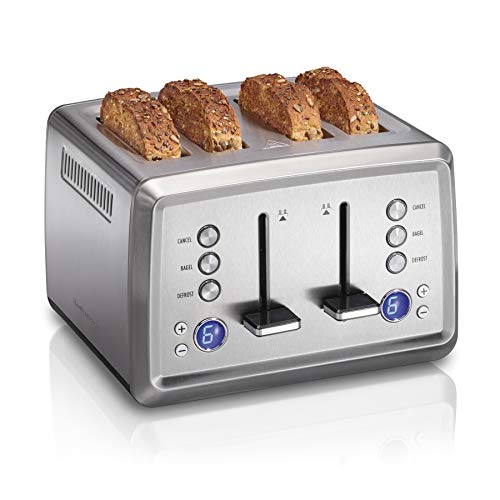
Hamilton Beach 4 Slice Toaster (24796, Digital) — Best Digital Family Pick
The 24796 brings digital control to the family four-slice brief while keeping every practical Hamilton Beach feature: extra-wide slots, bagel setting, Toast Boost, auto-shutoff, cancel, defrost, and a slide-out crumb tray in stainless. It suits families who like digital repeatability; dial loyalists have two classics above.
Strengths
- Digital controls for repeatable family settings
- Toast Boost and auto shutoff — the safety pair, included
- Extra-wide slots with bagel and defrost logic
Trade-offs
- Digital panel is one more surface to keep clean
- Mid-tier build versus the KitchenAid’s heft
- Stainless finish needs wiping
| Specification | Detail |
|---|---|
| Controls | Digital, with defrost function |
| Slots | 4 slice, extra-wide |
| Functions | Bagel setting, Toast Boost, cancel |
| Safety | Auto-shutoff |
| Crumb tray | Slide-out |
Digital control earns its place in a family toaster when several people share settings: a number is easier to communicate and repeat than a bit past the middle of the dial. The 24796 pairs that repeatability with the retrieval and safety features families actually use — boost for the muffin, shutoff for the rushed school morning — and slots wide enough that bagel duty needs no apology. It sits a tier below the KitchenAid in build gravitas and a tier above it in control modernity, which is precisely the trade its badge describes. In today’s field, it is the digital family default.
Digital panels reward a household convention: agree the numbers. Once ‘5 for Dad, 3 for the kids’ is the family language, the 24796 produces the right toast with zero negotiation, and guests can be told a number instead of a dial position. Keep a microfiber cloth nearby — the panel and stainless both show the morning’s fingerprints by design of their finishes.
Best for: families wanting digital repeatability with full safety features / Not suited for: dial loyalists or premium-build seekers
In one line: agree the numbers as a family and this digital Hamilton Beach quietly ends breakfast negotiation.
The 24796’s digital panel also helps households with accessibility needs: a legible number is easier to set precisely than a dial’s friction position, and the boost lift reduces the grip strength retrieval requires. Family appliances serve grandparents as often as parents, and this model’s interface choices quietly serve both ends of that range.
The 24796’s digital panel adds one ownership task: keep it dry-fingered. Wet hands on control panels are the modern toaster’s main interface complaint, and a tea towel by the sink solves it. The stainless body and slide-out tray follow the standard rhythm. Households that adopt the ‘agreed numbers’ convention find ownership nearly invisible — the machine simply produces the family’s toast, correctly, every day.
Check on Amazon — check price on Amazon before you buy, because toaster pricing and stock move often.

Mecity 4 Slice Long Slot Toaster — Best Long Slot with Timer
The Mecity is what the current generation of four-slice design looks like when a challenger brand loads the brief: long slots for four slices or wide bread, a countdown timer so the kitchen knows where breakfast stands, bagel, defrost, reheat, and cancel functions, a warming rack on top, six browning settings, and 1,300 watts in stainless. It suits artisan-bread families and feature seekers; traditionalists may find it busy.
Strengths
- Countdown timer ends breakfast timing guesswork
- Long slots take four slices or wide artisan bread
- Warming rack keeps finished toast and warms rolls
Trade-offs
- Long body demands counter depth
- Feature density means more to learn and clean
- Challenger brand versus the classics’ track records
| Specification | Detail |
|---|---|
| Power | 1,300 watts |
| Slots | Long slot, extra wide |
| Display | Countdown timer |
| Functions | Bagel, defrost, reheat, cancel |
| Extras | Warming rack, removable tray |
| Browning settings | 6 |
Two of the Mecity’s features change daily behavior rather than decorating a spec sheet. The countdown timer synchronizes a family kitchen — eggs timed to the toast, not the reverse — and the long slots quietly absorb the artisan loaves that twin-pair bodies reject. The warming rack is the sleeper feature: finished slices wait warm instead of steaming on a plate while the second round runs. The honest costs are footprint, complexity, and brand history; the classics above have decades behind them and this design does not. But judged on what is listed and verifiable today, the Mecity is the most complete answer to the modern family brief, and buyers whose bread is wide should start here.
The Mecity’s warming rack changes second-round strategy: instead of timing two rounds to land together, run them sequentially and park round one on the rack, where it stays warm without steaming. For a six-person breakfast from a four-slice machine, that is the difference between choreography and calm. The countdown display completes the system by telling the egg cook exactly where the toast stands.
Best for: artisan-bread families and feature seekers wanting a countdown / Not suited for: small counters or brand-history-first buyers
Challenger-brand ownership has one modern advantage: the Mecity’s feature set was specified against the classics’ known gaps — no timer, no long slot, no warming provision — so it reads like a point-by-point answer to a decade of reviews. Buyers comfortable trading track record for that responsiveness are exactly its market, and today’s listing makes the trade explicit.
Mecity ownership includes the warming rack’s care: it lifts away for washing, and crumbs that migrate upward during loading should be brushed off before they bake onto it. The countdown display stays legible with a soft wipe. As a challenger brand, keep the order documentation with the household files; the model’s feature density means the manual earns a drawer slot rather than the recycling bin.
Check on Amazon — check price on Amazon before you buy, because toaster pricing and stock move often.

West Bend 4-Slice Toaster — Best High-Watt Value
West Bend’s four-slice entry leads with the numbers families feel: 1,500 watts for fast, recovering heat, extra-wide and deep slots, seven shade settings, a manual toast lift lever, auto shut-off, and a removable crumb tray in black. It suits high-throughput households on a value tier; display seekers should take the Mecity or Hamilton Beach digital.
Strengths
- 1,500W — the strongest output in today’s verified field
- Deep slots suit tall slices and hearty breads
- Manual lift lever plus auto shut-off
Trade-offs
- Three functions only — a deliberately basic mode set
- Black finish shows crumbs and dust
- Utilitarian styling versus the design-led picks
| Specification | Detail |
|---|---|
| Power | 1,500 watts |
| Slots | 4-slice, extra-wide and deep |
| Shade settings | 7 |
| Lever | Manual toast lift lever |
| Safety | Auto shut-off |
| Crumb tray | Removable |
Deep slots are the under-sung four-slice spec: tall bakery slices and thick Texas-style cuts sit fully inside the heat instead of toasting with a pale stripe across the top. Pair that depth with 1,500 watts and seven shades, and the West Bend covers the hearty-bread family brief more directly than several pricier rivals. Its mode set is deliberately basic — three functions — which reads as honesty rather than lack: this is a throughput machine, not a feature showcase. In today’s field it is the value pick for households that measure a toaster in rounds served per morning, and on that metric it punches well above its tier.
Deep slots have a second beneficiary: frozen waffles and thick toaster pastries sit fully inside the West Bend’s cavity, so their tops brown instead of merely warming. Combined with 1,500 watts, frozen goods go from the freezer to the plate in one honest cycle. Households whose weekday breakfast is mostly frozen will feel this pick’s advantages more than any other in the field.
Best for: high-throughput families toasting tall, thick bread / Not suited for: buyers wanting digital displays or many specialty modes
The West Bend’s black finish and deep slots suit one more household: the bread-machine family. Home bakers cut tall, uneven loaves that defeat standard slots, and depth plus width plus wattage is the precise trio those loaves demand. If a bread machine lives on your counter, this is the four-slice pick that was effectively designed beside it.
West Bend ownership is throughput ownership: at family volume, the crumb tray fills fast, so the weekly rhythm becomes twice-weekly in heavy service — a small tax on the category’s strongest output. The deep slots should be checked monthly for a trapped crumb cake at the bottom (unplugged, cooled, inverted, shaken). The black finish hides the rest of the evidence, and the manual lever will outlast every electronic in the kitchen.
Check on Amazon — check price on Amazon before you buy, because toaster pricing and stock move often.

Mueller UltraToast 4 Slice Toaster — Best LED Display Value
The Mueller UltraToast publishes the widest slot figure in today’s field — 1.6 inches — with an LED display, six browning levels, and cancel, defrost, and reheat functions in stainless, aimed squarely at artisan bread, bagels, and frozen waffles. It suits width-first buyers on a value tier; dual-control traditionalists have the classics above.
Strengths
- 1.6-inch slots — the widest published in this guide
- LED display at a value tier
- Defrost and reheat alongside the standard cancel
Trade-offs
- Single control zone versus dual-control classics
- Value-tier build and brand depth
- Stainless finish needs regular wiping
| Specification | Detail |
|---|---|
| Slots | Extra-wide 1.6 in. |
| Browning levels | 6 |
| Display | LED display |
| Functions | Cancel, defrost, reheat |
| Crumb tray | Removable |
Slot width is where four-slice value picks usually cheat, and the Mueller instead leads with it: 1.6 inches swallows the thickest bagel halves and artisan cuts in this guide without squeezing. The LED display modernizes shade selection beyond the dial, and the function set covers the frozen-waffle reality of family mornings. What it gives back against the KitchenAid and Cuisinart is dual-zone control — one setting governs the load — so households with split shade loyalties should weigh that honestly. For a single-preference household that toasts wide and frozen, the UltraToast is today’s sharpest value in the category.
The UltraToast’s LED display pairs with its width in a specific way: artisan slices vary, so a legible, repeatable numeric setting lets you record what worked for a given loaf — ‘level 4 for the sourdough’ — and reproduce it all week. That reproducibility is what turns a wide-slot value pick into an artisan household’s daily driver rather than a compromise.
Best for: width-first households toasting artisan bread and frozen waffles / Not suited for: families needing two independent shade zones
In one line: the UltraToast proves that in today’s field, width is no longer a premium feature — it is a value brand’s headline.
Finally, the UltraToast makes the strongest case for renters in today’s field: flagship width and a modern display at a tier where a security deposit still matters more than an appliance. It moves well, stores reasonably, and toasts the artisan loaves that rental kitchens near good bakeries tend to produce. Value, correctly aimed, is a feature.
UltraToast ownership rewards the recording habit its display enables: keep a note of the level that worked for each regular loaf, and the LED’s precision becomes a household asset rather than a novelty. The wide slots need the standard crumb discipline, and the stainless wants its wipe. As a value-tier flagship, its documentation is thinner than the classics’ — another reason the household’s own notes matter.
Check on Amazon — check price on Amazon before you buy, because toaster pricing and stock move often.
Comparison Table
| Pick | Badge | Key spec | Best for |
|---|---|---|---|
| KitchenAid KMT4115 4-Slice Manual Lift Toaster (Empire Red) | Best Overall | Dual independent controls, extra-wide slots | families toasting mixed rounds with different preferences |
| Cuisinart CPT-180P1 4-Slice Toaster | Best Dual-Control Stainless | Dual controls, 6-setting dials | stainless kitchens wanting proven dual-control simplicity |
| Hamilton Beach 4 Slice Toaster (24796, Digital) | Best Digital Family Pick | Digital controls, Toast Boost | families wanting digital repeatability with full safety features |
| Mecity 4 Slice Long Slot Toaster | Best Long Slot with Timer | Countdown timer, long slots, 1,300W | artisan-bread families and feature seekers wanting a countdown |
| West Bend 4-Slice Toaster | Best High-Watt Value | 1,500W, deep extra-wide slots | high-throughput families toasting tall, thick bread |
| Mueller UltraToast 4 Slice Toaster | Best LED Display Value | 1.6 in. slots, LED display | width-first households toasting artisan bread and frozen waffles |
How to Choose the Best 4 Slice Toasters Today
Shop today’s field in three passes. First, controls: dual independent pairs (KitchenAid, Cuisinart) for split-preference families, digital (Hamilton Beach, Mueller) for repeatable shared settings, or long-slot single-zone (Mecity) for wide-bread households. Second, slots: confirm extra-wide claims on both pairs, look for published widths where offered — the Mueller lists 1.6 inches — and consider depth if your bread is tall, which is the West Bend’s specialty. Third, throughput: wattage and recovery decide back-to-back performance, with the 1,500-watt West Bend and 1,300-watt Mecity stating their numbers plainly.
Budget in tiers as the field currently stands: value buys width and wattage (West Bend, Mueller), mid buys digital polish or long-slot features (Hamilton Beach, Mecity), and the classic tier buys dual-zone engineering and build (KitchenAid, Cuisinart). Verify the exact model on the live listing before ordering — finishes and configurations rotate — and let your family’s actual bread and shade politics, not the badge order, make the final call.
What Changed in Four-Slice Toasters: Features Worth Having Now
Today’s four-slice field differs from the classic template in three ways that matter. Countdown and LED displays moved from novelty to genuinely useful kitchen coordination. Long-slot four-slice designs absorbed the artisan-bread demand that used to require a separate specialty toaster. And challenger brands began publishing the numbers — slot widths, wattages — that the classics historically left vague, which makes comparison shopping more honest than it used to be. What has not changed: dual independent controls remain the family feature that matters most, crumb trays still need emptying weekly, and no display ever toasted a slice. Use the new features where they solve your problem; ignore them where they do not.
Dual-Zone vs Single-Zone: The Four-Slice Decision That Matters Most
Every four-slice purchase reduces to one question: does your household toast alike, or differently? Dual independent controls — the KitchenAid and Cuisinart pattern — run two shades, two modes, two timings at once, and they are worth their premium the first morning one parent wants dark sourdough while a child wants a pale waffle. Single-zone designs — the Mecity, West Bend, and Mueller pattern — put the whole budget into slots, wattage, or displays instead, and for households with one shared preference they are not a compromise at all; they are the smarter allocation.
Be honest about your table before choosing. Families routinely overestimate their shade diversity (many discover everyone actually eats medium) and underestimate their bread diversity (bagels plus artisan plus frozen is a wider slot brief than they expected). If preferences truly converge, spend on width and wattage. If they genuinely diverge — and breakfast arguments are the diagnostic — dual-zone is not a luxury feature; it is the peace treaty, and it should be bought before any display or timer.
Reading Today’s Toaster Listings Like an Engineer
Current listings reward buyers who read them as specifications rather than advertisements. Extract five numbers and claims before anything else: slot width (a published figure like the Mueller’s 1.6 inches beats the phrase ‘extra-wide’ every time), slot count and zoning (four slots can still mean one control zone), wattage (stated plainly by the West Bend at 1,500 and the Mecity at 1,300; silence usually means a modest figure), the function list (bagel, defrost, reheat, cancel — in that order of daily importance), and the crumb system (slide-out or removable, or prepare for the inverted-shake routine).
Then discount the theater: finish names, lifestyle photography, and bundled adjectives carry no thermal information. Model numbers carry a great deal — the KMT4115 and CPT-180P1 designations have years of production behind them, which means parts, documentation, and a known service story; a brand-new model number with a long feature list is a bet on a shorter record. Neither choice is wrong, but it should be a choice. That reading discipline, applied to today’s field, is exactly how the six picks above were separated from the dozens of listings that did not make this guide.
Energy and Running Costs: What a Four-Slice Toaster Actually Uses
Buyers occasionally worry that a four-slice toaster doubles a two-slice model’s running cost, and the physics are kinder than the fear. A toaster’s energy use is its wattage multiplied by minutes actually toasting; a four-slice machine toasting a family’s load in two cycles uses roughly the energy of a two-slice machine running four, with less total time and fewer reheats from a cooling cavity. The genuinely wasteful pattern is the oversized machine run for a single slice — heating four slots for one piece of bread — which is why solo households belong in the two-slot guides in this cluster regardless of how attractive a four-slice deal looks.
Within the four-slice field, wattage differences (the 1,300-watt Mecity, the 1,500-watt West Bend) matter less as cost than as speed and recovery: higher output shortens cycles and stabilizes consecutive rounds, and the energy per slice stays broadly comparable because the cycle ends sooner. The honest efficiency levers are behavioral — toast full loads, use defrost rather than double cycles for frozen goods, and keep the crumb tray clean so elements work unobstructed. Today’s field, read correctly, contains no energy villain; it contains only right-sized and wrong-sized choices.
How We Will Judge This Field Next Season — and Why That Helps You Now
A ‘today’ guide should tell you how its own verdicts could change, because that reveals which purchases are robust. The classics — KitchenAid and Cuisinart dual-control models — would only lose their places to a genuine engineering successor, not to a seasonal refresh; buying them is robust against next year’s roundup. The challenger picks — the Mecity’s timer-and-long-slot formula, the Mueller’s width-first value — could be overtaken by next season’s iterations, but their current listings deliver their advantages today, at today’s tiers, which is the only honest basis any buyer ever gets.
The practical translation: if you replace appliances rarely, weight the proven end of this list; if you enjoy current features and replace willingly, the challenger end returns more per purchase. Either way, the verification habit is permanent — confirm the live listing, match the engineering to your bread, and let the badges argue. That discipline outlasts every season’s field, including this one.
The Four-Slice Upgrade Path: When Today’s Pick Should Be Tomorrow’s
Not every reader needs a four-slice toaster today, and this guide’s honesty extends to timing. Households of one or two with simple bread belong in the two-slot guides until life changes — a partner, a child, a parent moving in, a brunch habit forming. The signal to upgrade is queueing: when breakfast regularly waits on the toaster, capacity has become the binding constraint and no two-slot feature can relax it. At that moment, today’s field will be waiting, and the decision framework in this guide — zones first, slots second, wattage third — will still sort it correctly.
For households already queueing, delay has its own cost measured in weekend mornings, and the current field is a good one to buy into: the classics are mature, the challengers are genuinely innovative, and published specifications have never been easier to compare. Buy once, buy the zone configuration your family’s preferences demand, and the toaster question closes for years.
How to Run a Four-Slice Toaster for a Whole Family Breakfast
A four-slice toaster is a small production line; run it like one.
- Stage by preference. Load the dark-shade pair first — it finishes as the pale pair starts, and everything lands together.
- Use zones honestly. On dual-control models, set each side for its load rather than averaging; averaging satisfies nobody.
- Mind recovery. Between full four-slice rounds, give the elements a breath and drop the shade slightly — residual heat is real.
- Park finished toast properly. A warming rack (as on the Mecity) or a low oven beats a plate, where steam softens the crust you just made.
- Rotate the crumb routine. Four slots make four slots’ worth of crumbs: tray out weekly, slots brushed monthly, exterior wiped as needed.
- Freeze bread in slices. Defrost mode plus sliced frozen loaves is the freshest weekday system a family kitchen can run.
Common Buying Mistakes
Buying from an outdated roundup. Lineups churn; verify the model is a current listing, as every pick here was. Skipping dual controls for a split-preference family. One-zone four-slice toasters start daily arguments. Ignoring slot depth. Tall slices in shallow slots toast with a pale band — check depth as well as width. Overloading consecutive rounds at full shade. Residual heat darkens later batches; adjust down. Letting four slots’ crumbs accumulate. The tray fills twice as fast as a two-slice model’s. Paying for displays you will not use. Countdowns help coordinated kitchens; a solo toast eater needs none of it.
Final Recommendation
Today’s best 4 slice toasters answer, for most families, is the KitchenAid KMT4115 — dual-zone, extra-wide, and proven. Stainless dial loyalists take the Cuisinart CPT-180P1; digital families the Hamilton Beach 24796; wide-bread and countdown households the Mecity; throughput value the 1,500-watt West Bend; and width-first value the 1.6-inch Mueller UltraToast. Verify the live listing configuration and check price on Amazon before ordering. The rest of the cluster: Best 2 Slot Toasters, Best 2 Slots Toasters, Best 2 Slotted Toasters, Best 4 Slice Non Metal Toasters, and Best 4 Slice Camp Stove Toasters.
Finally, a word about buying timing in a churning category: there is no perfect season to buy a toaster, only a perfect fit to buy. Lineups will refresh again within the year, and a model that matches your family’s zones, slots, and bread today will still match them when it does. Verify the listing, confirm the model number, and let this be the last toaster guide you need to read for several years — that outcome, more than any single badge, is what this roundup was built to produce.
One practical closing note: whichever pick you choose, spend its first week deliberately. Run the white-bread evenness test, calibrate each zone’s shade for your actual loaves, agree the family’s settings out loud, and put the crumb tray on the calendar. A four-slice toaster set up with that much intention in week one becomes invisible infrastructure for years — and invisible, reliable breakfast infrastructure is the real product every badge in this guide was pointing at.
And when the next season’s field arrives with its new displays and finishes, resist the itch unless your household itself has changed. Toasters are not phones; the upgrade cycle that matters is the family’s, not the catalog’s. Buy for the breakfasts you will actually make, and today’s field will still be serving them long after several newer roundups have come and gone.
Frequently Asked Questions
Why buy a four-slice toaster instead of two-slice?
Throughput and flexibility: four slices per cycle, usually in two independently controlled pairs, so different shades and foods run simultaneously. For three or more regular toast eaters, it halves breakfast production time.
Are dual independent controls worth it?
For families with different shade preferences or mixed loads — bagels one side, toast the other — they are the single most valuable four-slice feature. Single-preference households can save with a one-zone model.
What slot width should a family four-slice toaster have?
Extra-wide as a minimum for bagels; published figures in today’s field run to 1.6 inches. Also check slot depth if your bread is tall — depth is the overlooked half of fit.
Do countdown timers and displays actually help?
In coordinated family kitchens, yes — other dishes get timed to the toast. For simple solo use they are decoration. Buy them when your mornings are choreographed; skip them when they are not.
How long do four-slice toasters last?
Classic dual-control models from major makers serve for years of daily family use with weekly crumb care. Challenger designs offer more features per tier but have shorter track records — weigh that in the price.
Can a four-slice toaster toast artisan bread?
Wide-slot models handle thick cuts, and long-slot designs like the Mecity take wide slices whole. Measure your loaf against the slot claims as you would with any toaster.


