Disclosure: airfryerkitchensupply.com is reader-supported. When you buy through links on our site, we may earn an affiliate commission at no extra cost to you.
Where to buy
Every product in this guide to the best air filter for weed smokers is a current listing we verified through Amazon, sold by the brand or established sellers. Listings and pack formats change, so buy by the full product name, confirm the size and format on the listing page, and check price on Amazon before you order. That two-minute check protects against the most common mistake in this category: ordering the right product in the wrong size, scent or pack.
- Sploofy PRO II Personal Smoke Air Filter (Black) – check price on Amazon; choose the listing sold or shipped by Amazon or the brand store where available.
- smokebuddy Original Personal Air Filter – check price on Amazon; choose the listing sold or shipped by Amazon or the brand store where available.
- Smoke Trap+ Personal Smoke Filter – check price on Amazon; choose the listing sold or shipped by Amazon or the brand store where available.
- LEVOIT Core 300S-P Smart Air Purifier – check price on Amazon; choose the listing sold or shipped by Amazon or the brand store where available.
- LEVOIT Core 300 Toxin Absorber Replacement Filter (Core 300-RF-TX) – check price on Amazon; choose the listing sold or shipped by Amazon or the brand store where available.
- WINIX 5510 Air Purifier – check price on Amazon; choose the listing sold or shipped by Amazon or the brand store where available.
Finding the best air filter for weed smokers starts with an honest split of the problem, because weed smoke escapes in two directions at once. Half of it is your exhale, a concentrated plume you control completely. The other half is side-stream smoke, curling off the end of a joint, bowl or blunt the entire time it is lit, and no exhale filter ever made touches that half. Any product roundup that ignores the split is selling you half a solution, so this guide is built in two layers: personal exhale filters for the breath, and room filtration for everything else.
The good news is that both layers are cheap, proven and available without any exotic equipment. Personal filters from Sploofy, smokebuddy and Smoke Trap+ trap the exhale at the source for the price of a takeaway lunch. Room air is handled by purifiers with real activated carbon, and the single most important upgrade in that world, a carbon-heavy toxin absorber cartridge, costs less than the machine it improves. What does not work is also worth naming: scented sprays over an active session, a candle as your only defence, and the homemade dryer-sheet tube, which perfumes the exhale slightly while doing nothing measurable to the smoke in it.
There is also a social arithmetic to get right. Most weed smokers are not trying to make a room smell like a dispensary never happened; they are trying to keep a shared house comfortable, a partner unbothered, and a hallway neutral. That is a much more achievable target than total erasure, and it is the target this guide is calibrated to. Set up the two layers properly and the smell of a session becomes a same-room, same-evening phenomenon instead of a whole-building announcement.
The six picks below are organised from the breath outward. Start with the personal filter that matches how often you smoke, add room filtration sized to the room you actually smoke in, and you have a system that lets a weed smoker share a house, a rental or a dorm without the smell announcing every session to the whole building.
In this guide
Quick Picks
The shortlist, before the detail. Each pick carries the badge it earned, and the same badge heads its full review below.
Sploofy PRO II Personal Smoke Air Filter (Black) – Best Overall Personal Filter. For weed smokers, the exhale is the loudest part of the smell, and this is the filter that handles it with the least effort per breath, which is why it anchors a shared-house setup. Check price on Amazon.
smokebuddy Original Personal Air Filter – Best for Simple, Proven Discretion. The original smokebuddy suits the smoker who wants one sealed device that simply works, at home or at a friend place, with no cartridges to keep track of. Check price on Amazon.
Smoke Trap+ Personal Smoke Filter – Best for Low-Waste, High Airflow. Smoke Trap+ fits the regular indoor smoker who has tired of throwing sealed units away and wants HEPA plus carbon on every exhale. Check price on Amazon.
LEVOIT Core 300S-P Smart Air Purifier – Best Room Purifier for a Smoking Corner. The Core 300S-P handles the half a personal filter cannot: the smoke that rises off the joint or bowl between draws, in the room where it happens. Check price on Amazon.
LEVOIT Core 300 Toxin Absorber Replacement Filter (Core 300-RF-TX) – Best Filter Upgrade for Core 300 Owners. If a Core 300 already sits in the smoking room, this carbon-heavier genuine cartridge is the cheapest meaningful upgrade to its weed-odour performance. Check price on Amazon.
WINIX 5510 Air Purifier – Best for a Dedicated Smoke Room. The WINIX 5510 is the heavy option for a room that hosts sessions daily, where a deep carbon stage earns its place over a compact unit. Check price on Amazon.
How These Picks Were Chosen
We chose these picks by matching verified products to the two halves of the weed smoke problem and then ranking within each half. Every product here was confirmed through the airfry site Amazon listing on 2026-11-20, so the models, formats and filter types described are the ones actually on sale, not catalogue ghosts. Personal filters were judged on exhale resistance, because a filter that is hard to blow through gets skipped, on whether the filter element is replaceable, and on realistic service life for a daily user.
Room products were judged on carbon, not on headline coverage figures. Smoke odour is a gas-phase problem, so a purifier earned its place by the depth and type of its activated carbon stage, and the toxin absorber cartridge is included because upgrading the carbon in a machine millions of people already own is the highest-value move in the category. We excluded ozone generators entirely, because ozone is a lung irritant that has no place in a room people sit in, and we excluded any product whose smoke claims rested on fragrance alone.
The 6 Best Air Filters for Weed Smokers
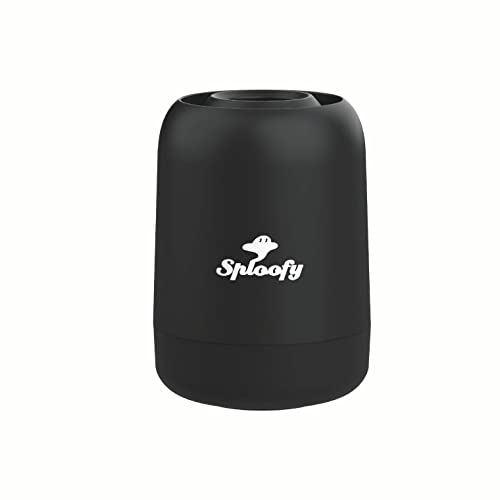
Sploofy PRO II Personal Smoke Air Filter (Black) – Best Overall Personal Filter
For weed smokers, the exhale is the loudest part of the smell, and this is the filter that handles it with the least effort per breath, which is why it anchors a shared-house setup.
Strengths
- Replaceable cartridges mean the body is bought once and running costs stay low
- Low exhale resistance compared with sealed one-piece filters, so it gets used consistently
- Discreet, odour-free exterior with nothing to plug in or charge
Trade-offs
- Only treats exhaled breath; it does nothing for smoke rising off the tip between draws
- Cartridges are a brand-specific reorder, so keep a spare
- Performance fades gradually rather than stopping, so users must judge replacement timing
Key specs (from the manufacturer listing):
- Replaceable cartridge design (listing)
- Brand-rated up to 500 uses per cartridge (listing)
- Handheld exhale-through format
The Sploofy PRO II is the personal filter for people who found the classic one-piece designs too restrictive to breathe through. A personal smoke filter only works if every exhale actually goes through it, and the number one reason they end up in a drawer is back-pressure: a filter that feels like blowing up a balloon gets skipped mid-session, and one skipped exhale carries more smell than the filter saves. The PRO II design answers that with a larger cartridge format and replaceable inserts, so airflow stays manageable and the economics work out to replacing cartridges rather than whole devices. The brand rates a cartridge in the hundreds of uses, and in practice the honest signal to change is rising resistance and returning smell. What it cannot do, and no personal filter can, is capture the smoke that curls off the end of what you are smoking between draws; that side-stream is a room problem, handled by the purifiers and ventilation advice elsewhere in this guide. As the exhale half of the system, this is the strongest design here.
Best for: buyers who want a pick whose defining strength is that replaceable cartridges mean the body is bought once and running costs stay low. / Not suited for: buyers who cannot accept that only treats exhaled breath; it does nothing for smoke rising off the tip between draws.
Check on Amazon – check the current price on Amazon for the Sploofy PRO II Personal Smoke Air Filter (Black).

smokebuddy Original Personal Air Filter – Best for Simple, Proven Discretion
The original smokebuddy suits the smoker who wants one sealed device that simply works, at home or at a friend place, with no cartridges to keep track of.
Strengths
- The original name in the category, with a design refined over many years
- Zero learning curve: exhale through it and the job is done
- Compact enough for a pocket, bag or car console
Trade-offs
- Sealed unit is a consumable; when it clogs, the whole device is replaced
- Exhale resistance rises noticeably as the filter loads up
- Does nothing for side-stream smoke or room odour generally
Key specs (from the manufacturer listing):
- Sealed one-piece personal filter (brand design)
- Travel cap included in the brand design
- No batteries, refills or setup
The smokebuddy Original is the product that defined this category, and its appeal is the total absence of a system: no cartridges to order, no parts to assemble, just a sealed filter you exhale through that traps smoke and odour at the point of breath. For a weed smoker whose problem is a shared house, a dorm or a rental with a strict landlord, that simplicity is the feature, because a device that lives in a pocket gets used every time rather than on motivated days. The life pattern is predictable. Resistance builds slowly as the internal media loads, and the end of life is obvious when exhaling becomes hard work; at that point the whole unit is replaced, which is the honest cost of the sealed design. It should be bought as one half of a two-part strategy, alongside control of side-stream smoke from the burning end, because no exhale filter touches that. Within its job, it remains the benchmark every rival in this section is compared against.
Best for: buyers who want a pick whose defining strength is that the original name in the category, with a design refined over many years. / Not suited for: buyers who cannot accept that sealed unit is a consumable; when it clogs, the whole device is replaced.
Check on Amazon – check the current price on Amazon for the smokebuddy Original Personal Air Filter.
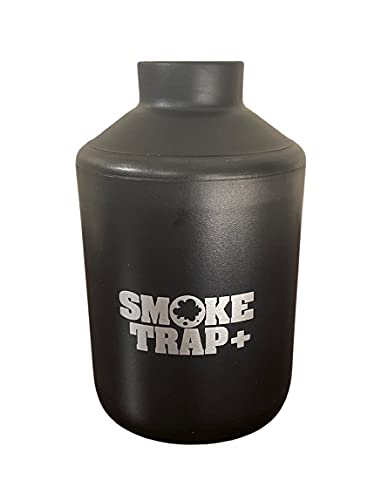
Smoke Trap+ Personal Smoke Filter – Best for Low-Waste, High Airflow
Smoke Trap+ fits the regular indoor smoker who has tired of throwing sealed units away and wants HEPA plus carbon on every exhale.
Strengths
- HEPA and carbon combination targets both the visible exhale and its smell
- Replaceable filters cut the plastic waste of sealed throwaway designs
- Airflow is a stated design priority, which keeps exhale effort low
Trade-offs
- Replacement filters are another proprietary reorder to keep track of
- Slightly bulkier in hand than the smallest sealed rivals
- Like every personal filter, blind to side-stream smoke
Key specs (from the manufacturer listing):
- HEPA plus activated carbon filter stage (listing)
- Eco-friendly replacement filters; zero plastic waste positioning (listing)
- Brand-rated at 500+ uses (listing)
Smoke Trap+ takes the personal filter brief and answers the two criticisms of the category at once: waste and airflow. The filter stage pairs HEPA media with activated carbon, which is the correct pairing for an exhale, because breath carries both particles and odour compounds and treating only one leaves the other to announce itself. The replacement filters are designed to be swapped into a reusable body, which matters to buyers who have thrown away a shelf of sealed units and done the maths on both cost and plastic. Airflow is treated as a headline feature rather than an afterthought, and that is the right priority, since a filter that is easy to exhale through is a filter that is used for every breath of every session. The brand use rating is in the hundreds, and real life will depend on session frequency and how completely each exhale is captured. Paired with a cracked window or a small purifier for side-stream smoke, it is the most complete personal option here.
Best for: buyers who want a pick whose defining strength is that hEPA and carbon combination targets both the visible exhale and its smell. / Not suited for: buyers who cannot accept that replacement filters are another proprietary reorder to keep track of.
Check on Amazon – check the current price on Amazon for the Smoke Trap+ Personal Smoke Filter.
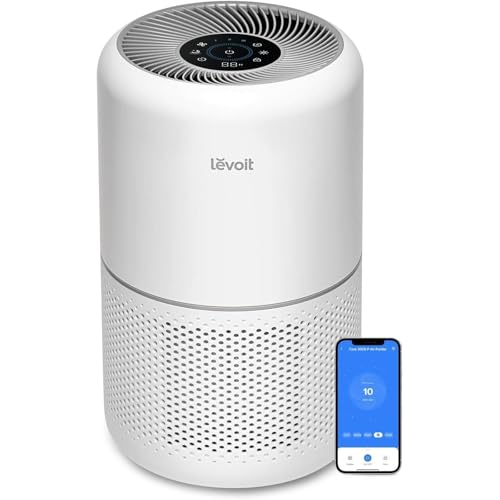
LEVOIT Core 300S-P Smart Air Purifier – Best Room Purifier for a Smoking Corner
The Core 300S-P handles the half a personal filter cannot: the smoke that rises off the joint or bowl between draws, in the room where it happens.
Strengths
- Compact footprint suits bedrooms and small smoking corners without dominating the room
- Smart app and voice control make it easy to run a high-speed clear-out before guests arrive
- Can be upgraded with the brand toxin absorber filter for heavier smoke and odour work
Trade-offs
- Standard filter is a general-purpose blend, so heavy daily smoke loads exhaust the carbon faster than a dedicated smoke filter would
- Sized for one room only; it will not rescue a whole flat from a smoking living room
- App features are wasted if you simply want two buttons and no account setup
Key specs (from the manufacturer listing):
- Filtration: 3-in-1 filter with HEPA stage and activated carbon (listing)
- AHAM Verifide (listing)
- Smart WiFi and Alexa control (listing)
- Sleep mode rated at 24dB in the listing title
The Core 300S-P is the purifier most smoking households end up buying first, and the reasons are practical rather than glamorous. It is small enough to live on a bedside table or beside the chair where someone actually smokes, it is quiet enough in sleep mode to run overnight, and the app control means the machine can be cranked up remotely for a fast clear-out after a session instead of sitting on a gentle setting that never quite catches up. For smoke specifically, the honest framing is that this is a particle machine with a useful carbon stage: the HEPA side traps the fine particulate that makes rooms look hazy and smell stale, while the carbon takes the edge off lingering odour between sessions. It is not a gas-phase specialist, and nobody should expect a compact unit to erase the smell from soft furnishings. Used in the room where the smoking happens, door closed, it keeps that room noticeably fresher and slows the spread of stale smoke smell into the rest of the home, which is exactly the job most buyers are hiring it to do.
Best for: buyers who want a pick whose defining strength is that compact footprint suits bedrooms and small smoking corners without dominating the room. / Not suited for: buyers who cannot accept that standard filter is a general-purpose blend, so heavy daily smoke loads exhaust the carbon faster than a dedicated smoke filter would.
Check on Amazon – check the current price on Amazon for the LEVOIT Core 300S-P Smart Air Purifier.

LEVOIT Core 300 Toxin Absorber Replacement Filter (Core 300-RF-TX) – Best Filter Upgrade for Core 300 Owners
If a Core 300 already sits in the smoking room, this carbon-heavier genuine cartridge is the cheapest meaningful upgrade to its weed-odour performance.
Strengths
- Upgrades an existing Core 300 machine for smoke and chemical odour without replacing the unit
- Genuine filter guarantees fit and seal, which third-party cartridges often compromise
- The single most cost-effective smoke improvement available to Core owners
Trade-offs
- Only fits the Core 300 family; useless to owners of any other machine
- Carbon-heavy filters still saturate, and faster in a daily smoking room
- Costs more than the standard cartridge it replaces
Key specs (from the manufacturer listing):
- Genuine brand filter for Core 300, 300-P and 300S-P models (listing)
- High-efficiency activated carbon formulation (listing)
- 3-in-1 construction with HEPA stage (listing)
This cartridge is the most useful accessory in the entire guide, because it fixes the known weakness of the most popular compact purifiers. The standard Core 300 filter is a generalist; the Toxin Absorber version rebalances the same 3-in-1 format toward high-efficiency activated carbon, which is the stage that deals with smoke odour and chemical compounds. Owners of a Core 300, 300-P or 300S-P who smoke in that room do not need a new purifier; they need this filter in it, and the genuine article matters because a purifier is only as good as its seal, and ill-fitting third-party cartridges leak unfiltered air around the edges. The expectations to set are about lifespan. A carbon-forward filter in a room smoked in daily is working hard, and its odour performance will taper months before the HEPA stage is spent; that tapering, a room that gradually smells again despite the machine running, is the signal to replace it. As an upgrade path it is cheaper than any new machine in this list.
Best for: buyers who want a pick whose defining strength is that upgrades an existing Core 300 machine for smoke and chemical odour without replacing the unit. / Not suited for: buyers who cannot accept that only fits the Core 300 family; useless to owners of any other machine.
Check on Amazon – check the current price on Amazon for the LEVOIT Core 300 Toxin Absorber Replacement Filter (Core 300-RF-TX).

WINIX 5510 Air Purifier – Best for a Dedicated Smoke Room
The WINIX 5510 is the heavy option for a room that hosts sessions daily, where a deep carbon stage earns its place over a compact unit.
Strengths
- Carbon filter is a separate, substantial stage rather than a token coated sheet
- Successor to a long-running smoke favourite, with app control added
- Auto mode and air quality feedback suit set-and-forget daily smoking homes
Trade-offs
- Carbon stage still saturates under chain-smoking loads and needs scheduled replacement
- Design is functional rather than decorative in a living room
- App setup is one more account for a machine that also works fine manually
Key specs (from the manufacturer listing):
- Coverage: rooms up to 1,881 sq ft in 1 hour (listing)
- True HEPA filter (listing)
- High deodorisation carbon filter (listing)
- Auto mode with app support (listing)
The WINIX 5510 matters for smokers because of one design decision: the carbon is a real filter stage in its own right, described by the brand as a high deodorisation filter, rather than the thin carbon-coated mesh many rivals use and still call odour control. Smoke odour is a gas problem, gas is a carbon problem, and carbon capacity is roughly a weight problem, so a machine that gives carbon its own substantial stage starts ahead. This model is the current generation of a line that smoking households have bought for years, updated with app support and auto mode, and sized for large rooms. In practice it is the purifier to shortlist when the complaint is smell first and haze second: a living room that hosts daily smoking, where the goal is that a visitor walking in does not immediately know. It will not perform miracles on curtains and upholstery that have absorbed years of smoke, but for ongoing control of a room in active use, its carbon-forward design is the right priority order.
Best for: buyers who want a pick whose defining strength is that carbon filter is a separate, substantial stage rather than a token coated sheet. / Not suited for: buyers who cannot accept that carbon stage still saturates under chain-smoking loads and needs scheduled replacement.
Check on Amazon – check the current price on Amazon for the WINIX 5510 Air Purifier.
Comparison Table
| Pick | Badge | Key spec | Best for |
|---|---|---|---|
| Sploofy PRO II Personal Smoke Air Filter (Black) | Best Overall Personal Filter | Replaceable cartridge design (listing) | Overall Personal Filter |
| smokebuddy Original Personal Air Filter | Best for Simple, Proven Discretion | Sealed one-piece personal filter (brand design) | for Simple, Proven Discretion |
| Smoke Trap+ Personal Smoke Filter | Best for Low-Waste, High Airflow | HEPA plus activated carbon filter stage (listing) | for Low-Waste, High Airflow |
| LEVOIT Core 300S-P Smart Air Purifier | Best Room Purifier for a Smoking Corner | Filtration: 3-in-1 filter with HEPA stage and activated carbon (listing) | Room Purifier for a Smoking Corner |
| LEVOIT Core 300 Toxin Absorber Replacement Filter (Core 300-RF-TX) | Best Filter Upgrade for Core 300 Owners | Genuine brand filter for Core 300, 300-P and 300S-P models (listing) | Filter Upgrade for Core 300 Owners |
| WINIX 5510 Air Purifier | Best for a Dedicated Smoke Room | Coverage: rooms up to 1,881 sq ft in 1 hour (listing) | for a Dedicated Smoke Room |
The table compresses; the reviews above it carry the reasoning. If two picks look alike here, the deciding factor is almost always in their trade-offs, not their strengths.
How to Choose an Air Filter for Weed Smoke
Choosing well means buying for both halves of the smoke and for your actual smoking pattern, not for the pattern you wish you had. These are the four decisions that matter.
Decide how much of the problem is exhale
If you smoke alone, at a window, a few times a week, the exhale is most of your problem and a personal filter plus the open window may be the whole answer. If sessions are social, long or daily, side-stream smoke dominates, because a joint burns continuously while each person only exhales occasionally, and room filtration becomes the main purchase with the personal filter as support. Be honest about which smoker you are, because the two situations want opposite spending priorities.
A useful test: if the room still smells an hour after everyone has finished, your problem is side-stream and room air. If the smell is mostly during the session and in the hallway outside a closed door, your problem is exhale discipline, and a better personal filter routine fixes it for very little money.
Judge personal filters on airflow first
Back-pressure is the hidden spec of this category. A personal filter loads gradually, resistance rises, and the day exhaling feels like hard work is the day users start blowing half the breath past the device, which defeats it entirely. Replaceable-cartridge designs from Sploofy and Smoke Trap+ hold their airflow longer and let you restore performance with a cartridge instead of a new device. Sealed designs from smokebuddy trade that serviceability for total simplicity, which suits lighter users perfectly.
Size the device to your frequency. Occasional users are best served by the smokebuddy Jr or the original Sploofy, daily users by the Sploofy PRO II, Smoke Trap+ or smokebuddy Mega, because media volume is what converts directly into months of easy breathing.
Judge room filtration on carbon, not coverage
Purifier listings lead with room coverage because it is the biggest number on the box, but for weed odour the deciding component is activated carbon mass. A compact purifier with a carbon-heavy toxin absorber cartridge will out-deodorise a larger machine running a thin standard filter, every time. Look for filters described as toxin absorber, high deodorisation or gas-phase, and treat a carbon-coated pre-filter sheet as a light extra rather than a solution.
Placement multiplies whatever you buy. The purifier belongs in the room where smoking happens, close enough to the usual spot that smoke reaches the intake before it reaches the door gap, running during the session and for at least half an hour afterwards, with the door closed.
Build the routine, not just the basket
The households that stay smell-free are running a small routine, not owning a miracle product. Exhale through the filter every time, keep the smoking near the purifier or an open window, run the machine on its higher setting during and after, and deal with ash and roaches immediately, because a full ashtray is a continuing odour source that no filter compensates for. Textiles are the memory of the room: a washable throw over the usual seat and a cushion cover that goes through the laundry weekly will do more for background smell than a second purifier.
Finally, respect the hard boundary of the category. Filtration reduces smell dramatically; it does not make indoor smoking undetectable to a motivated nose at the door, and it does not address lease clauses or household rules. Use it to be considerate, not to deceive a landlord who has banned smoking outright.
What about sploofs, smoke filters for bongs and other gadgets?
The accessory market around this problem is inventive, and some of it works. Carbon-filtered mouthpieces and downstem diffusers reduce what enters the room from specific devices, and smoke-collection hoods exist for dedicated setups. Judge every gadget by the same two questions used in this guide: does it treat the exhale, the side-stream, or genuinely both, and what is the filter medium and its replacement rhythm? Activated carbon and HEPA media are the answers that count; scented beads and novelty shapes are the answers that do not.
For most smokers the gadgets are refinements on top of the two-layer system, not replacements for it. Buy the personal filter and the room carbon first, run them for a month, and only then decide whether a device-specific accessory closes a gap you can still actually smell.
How to Use a Personal Smoke Filter and Purifier Together
The two layers work as one system when the sequence is right. This is the session routine that experienced indoor smokers settle into.
- Set the room before you start. Close the door, place the purifier within a few feet of the smoking spot with its intake facing the room, and switch it to a high setting before anything is lit, so the air is already moving in the right direction.
- Exhale through the filter, fully, every time. Seal your lips around the mouthpiece and empty your lungs through the device, including the last of the breath, which carries plenty of smell. Half-hearted exhales that leak around the mouthpiece are the main reason personal filters get blamed unfairly.
- Manage the burning end. Keep the joint, bowl or blunt near the purifier intake or an open window between draws, and knock ash into a lidded container. Side-stream smoke rises, so a small fan angled to push room air gently toward the purifier intake helps more than a fan blowing smoke around the room.
- Let the purifier finish the job. Leave the machine on its high setting for at least 30 minutes after the session ends, then drop it to auto or low. Switching it off with the last exhale leaves the room air half-processed, which is when smell migrates into fabrics.
- Clear the evidence sources. Empty the ashtray into an outside bin, seal roaches and ash in a smell-proof pouch or jar, and wipe the table. Filters treat air; they cannot treat a full ashtray still sitting in the room.
- Maintain on a rhythm. Swap personal filter cartridges when resistance rises, vacuum the purifier pre-filter monthly, and replace carbon stages when the room starts holding smell again despite the routine. The equipment only fails people who never maintain it.
Problem: the room smells fine during the session but stale by morning. That pattern almost always means the purifier was switched off too early and smoke settled into textiles overnight. Extend the post-session run, and put a washable throw over the smoking seat.
Problem: the personal filter suddenly feels hard to blow through. The media is loaded, which is the designed end of its life. Replace the cartridge or the sealed unit rather than blowing harder and leaking around the seal.
Weed Smoke vs Tobacco Smoke: Why the Filter Advice Differs
Weed smoke and tobacco smoke are cousins, not twins, and the differences shape what filtering has to achieve. Cannabis is usually smoked unfiltered, in larger, less frequent draws, often in a single room, and its smell is famously persistent and recognisable at very low concentrations. Tobacco in a home is more often a continuous, all-day background from a habitual spot. A weed setup therefore faces intense, episodic bursts with long quiet gaps, while a tobacco setup faces a lower, steadier load. The equipment overlaps heavily, but the sizing logic differs: weed smokers should buy for burst capacity and post-session purging, tobacco households for endurance and carbon longevity.
The resin and terpene load matters too. Weed smoke carries sticky compounds that coat filter media and room surfaces with enthusiasm, which is why personal filters clog by resistance rather than by calendar, and why the glass and hard surfaces in a weed smoking room repay a wipe-down routine that tobacco guides rarely emphasise. It is also why the exhale filter earns its keep so dramatically with weed: a large share of the total smell of a session leaves in those few concentrated breaths, and capturing them at the mouth removes the strongest plume before room air ever gets involved.
One more difference is legal and social context. In many places weed carries tenancy, dormitory or household rules that tobacco does not, which raises the stakes on discretion and pushes the personal filter from accessory to centrepiece. This guide has been honest throughout that filtration is odour control, not invisibility, and that honesty matters most exactly here: a good two-layer system makes a considerate housemate, not an undetectable one, and readers in no-smoking housing should treat the rules of their home as the boundary the equipment cannot cross.
Practically, the shopping list that falls out of all this is short. A personal filter sized to your frequency, a purifier whose carbon you respect, the toxin-absorber upgrade if that purifier is a Core 300, and the discipline to run the purge after every session. Everything else in the category is optimisation at the margins, and the margins only matter once the centre is built.
A final calibration for readers weighing cost against conscience: the two-layer system in this guide, personal filter plus carbon-minded room filtration, is not the cheapest possible response to weed smell, and it is not the most expensive either. It is the level at which the problem actually gets solved rather than managed cosmetically. Cheaper setups leave the side-stream half untouched and drift back to square one within a month; more elaborate setups add gadgets at the margins of a problem the centre has already closed. Buy the centre, run it with the discipline the how-to section describes, and the smell of a session becomes what it should be: a brief, local, forgettable event in a home that otherwise smells like a home.
Which Setup Fits Your Situation?
The shared house with a strict housemate. Your constraint is diplomacy, not personal comfort. Run the full two-layer system in your own room: Sploofy PRO II for every exhale, the Core 300S-P with the toxin absorber cartridge running through and after sessions, door closed, ash sealed away the same night. The hallway staying neutral is your real product, and it is achievable at this level of kit without asking the whole house to change anything.
The daily smoker in a studio or one-bed flat. In a small single volume, the purifier matters more than the personal filter, because side-stream smoke has nowhere else to go. Put the WINIX 5510 or the Core 300S-P beside the usual seat, keep the personal filter for the exhale plume, and put the washable-throw habit at the centre of the routine, because in a studio the sofa is also the bed, the office and the dining room, and it is the sink that decides the background smell.
The occasional weekend smoker. Your load is light and your risk is the one heavy session that perfumes the house for days. A smokebuddy Original or Jr covers the exhale, an open window or a borrowed hour of any household purifier covers the room, and the discipline that matters is the same-night clear-up: ash out, surfaces wiped, textiles aired. Spend on frequency you actually have, not on the daily system you do not need.
Common Buying Mistakes
Buying only a personal filter. An exhale filter handles breath and nothing else. The burning end produces smoke continuously, so a filter-only setup still leaves the room smelling. Pair it with room filtration or serious ventilation.
Buying a purifier on coverage numbers alone. A big coverage figure with a thin standard filter will move a lot of air and remove very little weed odour. Carbon depth is the spec that matters for smell.
Running the purifier on low during sessions. Low settings are for maintaining clean air, not for competing with an active smoke source. Use the high setting during and after, then let it settle down.
Trusting fragrance to hide weed smell. Sprays and candles layer scent over smoke and produce the unmistakable smell of both. Eliminators and carbon reduce the smoke note itself, which is the only approach that survives a visitor at the door.
Ignoring the ashtray and the textiles. Ash, roaches and smoke-loaded cushions keep emitting odour for hours. Filters treat air, so the sources in the room set the floor for how fresh it can ever get.
Smoking by a cracked window and calling it ventilation. A cracked window with no fan and no pressure direction mostly perfumes the curtain. Either exhale through the filter and let the purifier work on a closed room, or set a fan in the window blowing out and smoke beside it; the half-measure combines the worst of both.
Final Recommendation
For most weed smokers, the system that works is the Sploofy PRO II for the exhale and a carbon-minded purifier for the room: the LEVOIT Core 300S-P for a bedroom or small smoking corner, upgraded with the Toxin Absorber filter if the room hosts daily sessions, or the WINIX 5510 when the smoking room is the main living space. Lighter users can step down to the smokebuddy Original or Jr and lose nothing but capacity they would never use.
Whichever combination you choose, the routine matters as much as the receipt: filter every exhale, run the machine through the session and beyond it, and clear ash and textiles like they are part of the equipment, because they are. Readers building out the rest of the setup should also see our guides to the Best Air Purifier For Weed Smokers, the Best Air Filter For Smokers, the Best Air Cleaner For Smokers, the Best Air Purifier For Smokers and the Best Accessories For Weed Smokers.
Start here: Sploofy PRO II Personal Smoke Air Filter (Black), smokebuddy Original Personal Air Filter or Smoke Trap+ Personal Smoke Filter – check price on Amazon for each before you decide.
Frequently Asked Questions
Do personal smoke filters really work for weed?
Yes, for the exhale, which is the part they are designed for. A Sploofy, smokebuddy or Smoke Trap+ traps the particles and much of the odour in exhaled breath, so the plume that would cross the room largely disappears. They do nothing for smoke coming off the burning end, which is why this guide pairs them with room filtration.
Will an air purifier remove weed smell completely?
A purifier with a substantial activated carbon stage will remove most of the smell from the air of a closed room, especially run during and after a session. Complete removal is not a realistic promise, because smoke also settles into fabrics and soft furnishings, which keep releasing odour until they are washed.
What is the difference between the standard and toxin absorber LEVOIT filters?
Both fit the Core 300 family and both include a HEPA stage. The toxin absorber version carries a heavier activated carbon formulation aimed at smoke, fumes and chemical odours, so it deodorises noticeably better and is the right cartridge for a room that is smoked in regularly.
How long does a personal smoke filter last?
It depends on the model and how often you smoke. Cartridge designs are rated by their makers in the hundreds of uses, and sealed units last from weeks for a heavy daily user of the smallest sizes to months for a light user of the Mega. Rising exhale resistance is the reliable signal that the media is spent.
Is an ozone generator a stronger option?
No, and we recommend against them for occupied rooms. Ozone is a respiratory irritant, and using it where people sit and smoke trades one air problem for a worse one. Carbon filtration and ventilation achieve the goal without the health downside.
Can I just use a sploof made from a tube and dryer sheets?
A homemade tube mostly adds dryer-sheet fragrance to the exhale and does very little to the smoke itself, while a purpose-built filter uses carbon and HEPA media designed for the job. Given that real personal filters sit at the lowest price tier in this guide, the homemade version is a false economy.
Should I choose a sploof or a purifier first if I can only afford one?
If you smoke in one room of a shared home, the personal filter first: it removes the strongest plume, the exhale, for the lowest price in the guide, and it works from the first session. Add the purifier when the budget allows, because side-stream smoke is the half that remains, and it is the half that migrates through the house.


