Disclosure: airfryerkitchensupply.com is reader-supported. When you buy through links on our site, we may earn an affiliate commission at no extra cost to you.
Where to buy
Every candidate for the best 4 channel mixers below was checked against live Amazon listings on the day this guide was written, and all six picks carry confirmed listings so you can check the current price on Amazon from each review. Compact mixers are a category full of confusing input counts, so each review states exactly how its channels are composed. If you are also pricing cables, a small powered speaker or a microphone to complete the setup, the same listings make it easy to bundle the order.
- Pyle PMXU43BT 4 Channel Audio Mixer (Best Overall): Check the current price on Amazon
- TAVOSOP 4 Channel DJ Mixer (Best Budget): Check the current price on Amazon
- Yamaha MG06X (Best Sound Quality): Check the current price on Amazon
- Yamaha MG06 (Best No-Frills Reliability): Check the current price on Amazon
- Behringer Xenyx 502S (Best for Streaming): Check the current price on Amazon
- Mackie Mix5 (Best Build Quality): Check the current price on Amazon
Looking for the best 4 channel mixers usually means you have a small, specific sound problem: a couple of microphones, a laptop or phone for music, maybe an instrument, and one small mixer to bring them together for a meeting room, a classroom, a small stage, a stream or a home studio. Four channels is the size that covers that job without turning your desk or your gig bag into a flight case of unused capacity.
This guide compares six compact mixers that serve that four-source workflow. Two are true four-channel designs built for DJ and event work. The others are the compact mixers buyers cross-shop constantly — models whose makers count inputs differently, with five or six total inputs arranged around two microphone channels plus stereo line channels. We explain the counting in every review instead of hiding it, because the right question is not what the box is called but whether your four sources plug in the way you expect.
All six picks were verified, and they spread across the tiers honestly: budget event mixers with Bluetooth and effects, a streaming-focused USB model, and two Yamaha compact mixers whose preamps and build explain why the MG name has been a small-venue staple for years. No static prices are printed anywhere, because these models are discounted and bundled constantly; each review links to the live listing instead.
One more framing note: this category rewards buyers who shop by layout diagrams and rear-panel photos rather than by marketing names. Two mixers with different numbers in their titles can be near-identical tools, and two with the same number can serve different rigs. Every review below therefore leads with what plugs in where, and the comparison table reduces each pick to its badge, its key specification and the buyer it fits.
In this guide
Quick Picks
Pyle PMXU43BT 4 Channel Audio Mixer — Best Overall. The most complete true four-channel package at its tier: Bluetooth streaming, USB computer input, an MP3 player, phantom power for condenser microphones and built-in DSP effects for voices. Check price on Amazon.
TAVOSOP 4 Channel DJ Mixer — Best Budget. A budget four-channel board aimed squarely at DJ, karaoke and streaming use, with Bluetooth, USB and MP3 playback, phantom power and stereo inputs at the accessible end of the market. Check price on Amazon.
Yamaha MG06X — Best Sound Quality. The sound-quality pick. Yamaha counts six inputs — two microphone channels plus stereo line channels — which is the classic four-source compact layout, and adds its respected preamps and built-in effects. Check price on Amazon.
Yamaha MG06 — Best No-Frills Reliability. The effects-free sibling of the MG06X: the same four-source compact layout and Yamaha preamps, with XLR outputs and a simpler, set-and-forget character for installed and speaking work. Check price on Amazon.
Behringer Xenyx 502S — Best for Streaming. A tiny streaming-focused mixer: five inputs arranged as one microphone channel plus stereo lines, with a USB interface designed to feed a stream or recording with a proper microphone. Check price on Amazon.
Mackie Mix5 — Best Build Quality. The durability pick: a five-channel compact mixer — one microphone channel plus stereo lines — in the rugged metal construction Mackie built its live-sound reputation on. Check price on Amazon.
How These Picks Were Chosen
We started by defining the job rather than the label. A four-channel buyer typically connects some mix of microphones, a playback device, an instrument and a computer, and needs basic EQ, a headphone output and one clean feed to speakers or a recorder. We shortlisted compact mixers that cover that job, then verified each one by searching brand and model and matching the returned title, so the product in each review is the product the link sells.
Scoring weighted microphone preamp quality first, because in small mixers the mic channels are where cheap designs reveal themselves as hiss and harshness. After that came input flexibility, the usefulness of built-in effects for voices, USB behavior for streaming and recording, build quality for transport, and how honestly the maker describes the channel count. Event features like Bluetooth and MP3 playback counted for the event picks and were treated as neutral for the studio-leaning ones.
We also kept the guide transparent about near-class models. Two respected compact mixers with five and six inputs appear here because they are the units four-channel buyers actually compare, and in each case the review says exactly how the inputs are arranged so you can judge the fit yourself. A buying guide that pretends the market sorts neatly by headline numbers would be easier to write and much less useful.
We also sanity-checked each pick against its neighbors in the same maker line, because compact mixers are where model names blur together most. The MG06 and MG06X differ by an effects section; the Mix5 and Mix8 differ by size class; the 502S sits below the larger Xenyx boards. Where a sibling model is the smarter buy for a stated use, the review says so rather than pretending the reviewed model exists in isolation.
Prices were deliberately excluded from the scoring. Compact mixers are bundled with cables, cases and microphones so frequently that a printed price misleads more than it informs; tiers and value judgments in the reviews are based on feature completeness, sound and build, and the live listing is one click from every pick when you want the current number.
The 6 Best 4-Channel Mixers
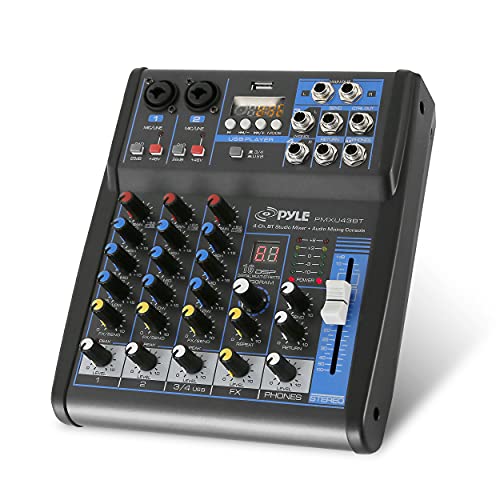
Pyle PMXU43BT 4 Channel Audio Mixer — Best Overall
The PMXU43BT is what most people picture when they type this query: four channels, every modern convenience, and a tier that does not require a committee meeting. Bluetooth covers phone playback, the USB connection handles a computer as source or recording destination, and the built-in effects give a speaking or singing voice the polish that dry small mixers lack.
It suits event hosts, small bands, karaoke and party DJs, streamers and community venues that need one box to do a bit of everything. Buyers who need the quietest possible microphone preamps for recording should look at the Yamaha picks below.
Strengths
- True four-channel layout with Bluetooth, USB and MP3 playback covering nearly any source
- Phantom power runs condenser microphones, which many budget mixers cannot do
- Built-in DSP effects add reverb and echo that make voices sound finished at events
Trade-offs
- Preamps are serviceable rather than studio-quiet under high gain
- Effects are preset-driven, offering convenience instead of deep editing
- The busy panel takes a session or two to learn by feel
| Channels | 4 |
| Verified features | Bluetooth, USB computer input, built-in MP3 player, 48V phantom power, 3-band EQ, 16-bit DSP effects (per Amazon listing title) |
The PMXU43BT wins this guide because it matches the actual four-channel job description most completely. In a typical small event — two microphones, music from a phone, a laptop for slides or backing tracks — every source has a home, the host voice can carry a touch of reverb, and the whole rig fits in a small bag. That completeness, at a budget tier, is exactly what this search is shopping for.
Its compromises live in refinement. Push a quiet condenser microphone hard and you will hear more hiss than the Yamaha models produce, and the effects are chosen from presets rather than sculpted. For live events, podcasts recorded in treated rooms and general small-venue work, those are fair trades. For a recording-first studio, they are the reason to keep reading.
Best for: Event hosts, small bands, karaoke and streamers who want one versatile four-channel box / Not suited for: Recording engineers who need the quietest possible microphone preamps
Check on Amazon to see the current listing for the Pyle PMXU43BT 4 Channel Audio Mixer.
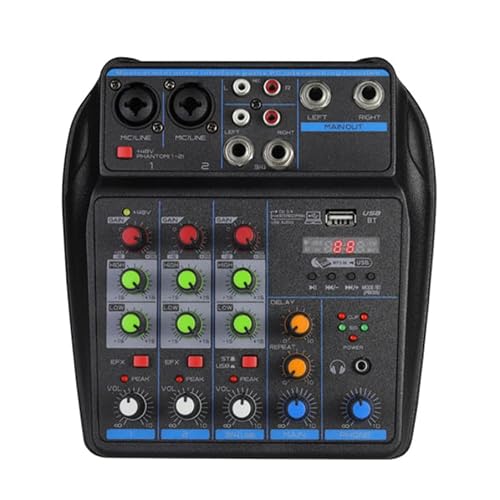
TAVOSOP 4 Channel DJ Mixer — Best Budget
The TAVOSOP board is the value play of this guide: a four-channel mixer that spends its budget on the connections small DJs, karaoke hosts and streamers actually use. Bluetooth for phones, USB and MP3 for computers and sticks, phantom power for a proper microphone, and stereo inputs for keyboards or media players cover the standard small-rig checklist.
It suits first-time mixer buyers, karaoke and KTV setups, bedroom streamers and anyone equipping a small event cheaply. Buyers who will move the mixer weekly for years should weigh the build quality of the Yamaha and Mackie picks.
Strengths
- Covers the full small-rig connection checklist at a budget tier
- Phantom power and stereo inputs make it flexible beyond DJ duty
- Simple layout is quick for beginners to learn
Trade-offs
- Build and component feel reflect the tier, with lighter knobs and faders
- Brand support and documentation are thinner than the established makers
- Preamp headroom is modest for demanding microphones
| Channels | 4 |
| Verified features | Bluetooth, USB/MP3 computer input, 48V phantom power, stereo inputs (per Amazon listing title) |
Budget mixers live or die on whether their compromises land in the right places, and this one mostly gets it right. The features a karaoke host or new streamer touches daily are present and obvious, while the savings show up in places — knob feel, chassis weight, manual quality — that matter more to professionals than to the buyers this board is for.
Treat it as a first mixer or a dedicated karaoke and streaming board and it makes strong sense. Treat it as a ten-year touring tool and you are asking the wrong product the wrong question, which is why this guide pairs it with sturdier alternatives rather than pretending one mixer serves everyone.
Best for: Karaoke hosts, new streamers and budget-conscious small-event setups / Not suited for: Weekly gigging and buyers who prioritize long-term build and support
Check on Amazon to see the current listing for the TAVOSOP 4 Channel DJ Mixer.

Yamaha MG06X — Best Sound Quality
The MG06X is why input counting needs explaining. Yamaha labels it a 6-input mixer: two microphone preamps plus two stereo line channels equals six input sockets, which in practice is the four-source workflow this whole guide is about — two mics, a stereo music source and a stereo instrument or second playback device. What you get for learning that arithmetic is the best microphone sound in this list.
It suits small venues, houses of worship, presenters, acoustic acts and home recordists who care about clean vocals. Buyers who need Bluetooth or USB recording should pair it with other gear or look at the Pyle and Behringer picks.
Strengths
- Yamaha D-PRE preamps deliver the cleanest, quietest microphone sound in this guide
- Built-in effects are voiced for voices and acoustic instruments
- Compact metal build suits both installed and portable small-venue work
Trade-offs
- No USB interface and no Bluetooth, so computers connect as plain audio sources
- The 6-input naming confuses buyers comparing headline numbers
- Only two microphone channels, like every mixer in this class
| Inputs | 6 total: 2 microphone channels + stereo line channels |
| Verified feature | Built-in effects (per Amazon listing title) |
| Format | Compact stereo mixer |
Microphone quality is where small mixers separate, and the MG06X separates itself from this field immediately. Voices come through clean at sensible gains, the EQ behaves predictably, and the effects add space without the artificial shimmer cheap DSP often produces. For a church, a classroom, a cafe stage or a presenter who lives on one microphone, that reliability is the product.
The honest cost is connectivity. There is no USB port to make it a streaming interface and no Bluetooth for a phone, so modern sources arrive by cable like they did for decades of perfectly good sound. If your workflow is a computer with a cable, nothing is missing. If your workflow is wireless and app-based, the Pyle above is the better-shaped tool.
Best for: Small venues, worship, presenters and acoustic acts that put microphone sound first / Not suited for: Streamers who need USB and buyers who want Bluetooth playback
Check on Amazon to see the current listing for the Yamaha MG06X.

Yamaha MG06 — Best No-Frills Reliability
The MG06 is the MG06X with the effects removed and the priorities clarified. If your mixer will sit in a meeting room, a school hall or a small venue running speech and playback, you may never open an effects section in its life — and paying for one buys nothing. This version spends everything on the preamps, the EQ and proper XLR outputs.
It suits installed small systems, presenters, schools, churches and anyone who values a mixer that can be set up once and trusted. Performers who want reverb on vocals should take the MG06X, and streamers should take a USB model.
Strengths
- Same respected Yamaha preamp quality as the MG06X at a simpler tier
- XLR outputs suit proper powered speakers and installed systems
- Nothing superfluous to misconfigure, which suits shared and installed spaces
Trade-offs
- No built-in effects, so voices run dry unless you add external processing
- No USB or Bluetooth connectivity
- Two microphone channels maximum, like the rest of this class
| Inputs | 6 total: 2 microphone channels + stereo line channels |
| Verified features | D-PRE preamps, XLR outputs (per Amazon listing title) |
| Format | Compact stereo mixer |
There is a particular kind of buyer the MG06 serves perfectly: the person responsible for sound in a space where non-experts also touch the mixer. A board with no effects menu and no modes cannot be left in a strange state by the previous user, and its sound quality forgives mediocre microphones and rooms better than any rival at its tier.
As a portable act mixer it still works well — two mics, stereo playback, clean output — it simply asks performers who love reverb to bring it themselves. In a guide full of feature lists, the MG06 is the reminder that leaving things out is also a design decision, and sometimes the right one.
Best for: Installed small systems, speech and playback work, and buyers who value simplicity / Not suited for: Performers who need built-in vocal effects and streamers who need USB
Check on Amazon to see the current listing for the Yamaha MG06.
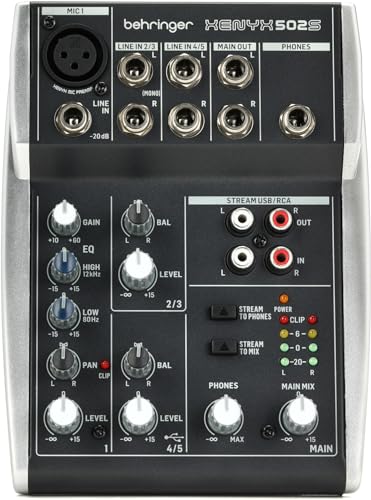
Behringer Xenyx 502S — Best for Streaming
The 502S is the smallest idea in this guide and the right one for a specific person: a streamer, podcaster or online teacher whose four sources are a microphone, game or music audio, a phone or console, and a computer. Its five inputs are arranged for exactly that desk, and its USB interface is built to stream the mix rather than merely record it.
It suits solo streamers, podcasters, online tutors and minimal desk setups. Anyone running two microphones, a small band or an event should step up to the Pyle or Yamaha picks, which have the inputs and outputs that work needs.
Strengths
- USB streaming interface purpose-built for sending a mixed feed to a computer
- Extremely compact, suiting small desks and mobile streaming kits
- Simple control set that new streamers can learn in one sitting
Trade-offs
- Only one microphone channel, which rules out two-host formats
- No built-in effects and minimal outputs compared with event mixers
- Not suitable for live sound reinforcement beyond tiny setups
| Inputs | 5 total: 1 microphone channel + stereo line channels |
| Verified feature | USB streaming interface (per Amazon listing title) |
| Signal path | Analog mixer with USB interface |
Streaming exposes a weakness in general-purpose mixers: getting the mixed result back into the computer cleanly, at the right level, while monitoring yourself. The 502S is designed around that loop, which is why streamers consistently find it easier than larger boards with more impressive spec sheets. One good microphone, properly gained, beats four mediocre channels for almost every stream.
Its ceiling is equally clear. The moment a second host, a live instrument or a room of people enters the picture, the single microphone channel becomes the whole story and the mixer becomes the wrong tool. Buy it for the desk it describes and it is excellent; buy it hoping to grow into events and you will replace it within the year.
Best for: Solo streamers, podcasters and online teachers with one microphone and several playback sources / Not suited for: Two-host shows, bands and any live event work
Check on Amazon to see the current listing for the Behringer Xenyx 502S.

Mackie Mix5 — Best Build Quality
The Mix5 appears in a four-channel guide because it is the compact mixer that four-channel buyers cross-shop most, and its inclusion is labeled honestly: it is a five-channel design, arranged as one microphone input plus stereo line channels. What it offers in exchange for learning that layout is build quality that embarrasses most of this category.
It suits keyboard players sub-mixing instruments, drummers mixing their own electronics, presenters, and anyone whose mixer travels constantly. Buyers who need two microphone channels or effects should look at the Yamaha and Pyle picks instead.
Strengths
- Rugged metal construction built for transport and stage-side abuse
- Clean, simple signal path that suits sub-mixing instruments and playback
- A trusted live-sound brand with broad dealer and support coverage
Trade-offs
- One microphone channel only, which limits speech and vocal work
- No effects, no USB and no Bluetooth — a deliberately basic tool
- Five-channel layout means it is a near-class alternative, not a true four-channel design
| Channels | 5: 1 microphone channel + stereo line channels |
| Format | Compact mixer, black (per Amazon listing title) |
| Build | Rugged compact chassis |
Sub-mixing is the Mix5 natural habitat: a keyboard rig with two instruments and a playback device, a drummer blending pads and click, a presenter with a laptop and a single microphone. In those roles its simplicity is the feature — a short, clean path from sources to the main mixer or speakers, in a box that survives being thrown in a cable bag for years.
Judged as a general four-channel mixer it is deliberately limited, and this guide badges it for build quality rather than versatility for exactly that reason. If your four sources are mostly line-level and your mixer lives a hard traveling life, the Mix5 may outlast two generations of feature-rich rivals.
Best for: Keyboard rigs, sub-mixing and traveling users who put durability first / Not suited for: Buyers needing two microphones, effects or streaming connectivity
Check on Amazon to see the current listing for the Mackie Mix5.
Comparison Table
The six picks split into three families: true four-channel event boards (Pyle and TAVOSOP), Yamaha compact mixers whose six inputs form the classic four-source layout, and two small streaming and sub-mixing specialists. Match your source list to the input layout column before comparing anything else.
| Pick | Badge | Key spec | Best for |
|---|---|---|---|
| Pyle PMXU43BT 4 Channel Audio Mixer | Best Overall | True 4-channel mixer with Bluetooth, USB input and 16-bit DSP effects | Event hosts, small bands, karaoke and streamers who want one versatile four-channel box |
| TAVOSOP 4 Channel DJ Mixer | Best Budget | 4-channel sound board with Bluetooth, USB/MP3 input and phantom power | Karaoke hosts, new streamers and budget-conscious small-event setups |
| Yamaha MG06X | Best Sound Quality | 6-input compact mixer with D-PRE preamps and built-in effects | Small venues, worship, presenters and acoustic acts that put microphone sound first |
| Yamaha MG06 | Best No-Frills Reliability | 6-input compact stereo mixer with D-PRE preamps and XLR outputs | Installed small systems, speech and playback work, and buyers who value simplicity |
| Behringer Xenyx 502S | Best for Streaming | 5-input analog mixer with USB streaming interface | Solo streamers, podcasters and online teachers with one microphone and several playback sources |
| Mackie Mix5 | Best Build Quality | 5-channel compact mixer with rugged Mackie construction | Keyboard rigs, sub-mixing and traveling users who put durability first |
How to Choose the Best 4 Channel Mixers: Count Sources, Not Sockets
The single most useful habit in this category is to list your sources before reading any product page. Write down each thing that will make sound: microphone one, microphone two, laptop, phone, keyboard, guitar. Then match that list against input layouts, remembering that a stereo source like a laptop or keyboard occupies a stereo channel, which makers may count as one channel or two inputs. Most four-source rigs need two microphone channels at most, and many need only one — which is why mixers that look different on paper serve the same desk.
Microphone count is the real dividing line. If two people speak or sing, you need two microphone preamps, and no adapter turns a line input into a good mic channel. If one person speaks and everything else is playback, a one-mic mixer like the 502S or Mix5 is not a compromise at all. Phantom power matters only if you use condenser microphones, but if you do — for streaming, recording or a good vocal mic — it is non-negotiable and worth checking before price.
Outputs deserve the same list treatment. Feeding powered speakers needs a main output; recording or streaming needs USB or a record path; monitoring yourself needs a headphone output with its own level. Small mixers trim outputs quietly, and discovering a missing headphone feed after purchase is the classic regret in this category. Check the back panel photo on the listing against your list before ordering.
Finally, decide whether effects are a need or a garnish. For live voices in untreated rooms, a touch of built-in reverb genuinely improves intelligibility and confidence, which is why the event picks carry DSP. For speech in a meeting room, streaming into software that has its own effects, or sub-mixing instruments, effects add cost and complexity without adding results. Buy the mixer whose feature list matches your list of sources and jobs, and this category stops being confusing.
Cables and accessories belong in the same decision. A compact mixer needs balanced cables for microphones, the right adapters for phones and laptops, and often a stand or shelf to sit at working height. Budget a small allowance for those from the start; a mixer chosen one tier lower with the correct cables will outperform a mixer one tier higher connected with whatever was in a drawer.
Channel Counts Explained: 4-Channel, 5-Input and 6-Input Mean Similar Things
Manufacturers count three different things and call all of them channels. Some count channel strips: the vertical rows of knobs you mix with. Some count input sockets: every jack on the back. A stereo strip has one set of knobs and two sockets, so the same mixer can honestly be described with two different numbers, and different brands choose differently — which is how this guide contains 4-channel, 5-input and 6-input mixers that all serve four sources.
The practical translation is simple. Two microphone strips plus two stereo line strips is the standard compact layout, sold as four channels by some brands and six inputs by others. One microphone strip plus two stereo strips is the smaller layout, sold as five inputs or five channels. Neither is deceptive once you read the layout, but comparing headline numbers between brands without reading layouts is how buyers end up with one microphone channel too few.
When a listing is ambiguous, the product photos settle it: count the microphone inputs with their XLR sockets, then count the stereo pairs. That ten-second check, applied to any compact mixer on any site, tells you more than the title, the badge or the marketing summary combined.
Budget Tiers for Small Mixers: What Each Step Up Actually Buys
This search carries no fixed price, so think in tiers and in what each tier buys. The budget tier, represented by the TAVOSOP and the smaller Pyle models, buys connectivity: Bluetooth, USB playback, phantom power and effects, in lighter construction with simpler preamps. For karaoke, home streaming and occasional events, that trade is rational and the results are genuinely good.
The middle tier buys sound and build. The Yamaha MG models show where the money goes: quieter preamps that stay clean with real microphones, EQ that behaves predictably, and construction that survives regular transport. You may actually lose features stepping up — the MG06 has no Bluetooth — because the budget moved from features into fundamentals.
The lesson generalizes beyond this list. In small mixers, features are cheap and fundamentals are expensive. Decide which of the two your use case punishes. A weekly karaoke night punishes a missing microphone input, not preamp hiss. A recording of a quiet vocalist punishes hiss and forgives a missing Bluetooth radio. Match the tier to the punishment and the purchase makes itself.
Small Mixer Care and Troubleshooting: The Problems Everyone Meets
Small mixers fail in predictable ways, and most of them are not failures at all. Hiss usually means a gain problem, not a broken preamp: a source turned down low with the mixer gain cranked to compensate will always be noisier than the same source run hot into moderate gain. Hum usually means a grounding or cable problem, most often a laptop power supply sharing a circuit with the speakers, and it is diagnosed by unplugging sources one at a time until the hum leaves with one of them. Crackle when a knob turns usually means dust in a control that has sat at the same position for months, and working the knob through its range a dozen times with the power off clears most cases.
Physical care is mostly about connectors. Compact mixers live in bags and on shelves where jacks collect dust and strain from cables left plugged in during transport. Unplug cables for travel, coil them without sharp bends, and give the mixer a soft case or at least a shelf away from drinks. The mixers in this guide are inexpensive by audio standards, but replacing one mid-season because a jack failed is still more expensive than a case.
When a channel truly dies, check the boring causes in order: the cable, the source, the channel selector or pad switch, and only then the mixer. Swap the suspect cable with a known good one and move the source to a working channel. Nine times out of ten the problem follows the cable or stays with the source, and the mixer — the most expensive item in the chain — was innocent all along.
How to Set Up a 4-Channel Mixer for Mics, Music and a Computer
This walkthrough covers the most common compact rig: two microphones, a stereo music source and a computer, feeding one pair of powered speakers — the setup behind most small events, classes, streams and worship spaces.
Step 1: Place the mixer and speakers before connecting anything
Put the speakers ahead of the microphones and facing the audience, and the mixer where the operator sits. Microphones behind speakers is the geometry that creates feedback, and no mixer setting fully rescues bad placement. Run power to everything but switch on in order: sources first, mixer next, speakers last.
Step 2: Connect microphones to the mic channels
Plug microphones into the XLR inputs of channels one and two. If a microphone is a condenser type, switch on phantom power only after it is plugged in; dynamic microphones do not need it. Keep the channel gains low until the system is live, because a fresh connection at high gain is how rooms get their first feedback squeal of the day.
Step 3: Connect the music source and computer
Run the phone, media player or keyboard into a stereo line channel with the correct cable, and connect the computer by USB if the mixer offers it or by its headphone output into the remaining stereo channel if it does not. Set the source device volume high — around three-quarters — and control the final level at the mixer, which keeps the signal clean.
Step 4: Set each channel gain with the source performing
Have each microphone spoken or sung into at real performance level while you raise its gain until the level is healthy and consistent, staying clear of the peak indicator. Repeat for the music and computer channels with typical content. This gain staging step is the difference between a system that sounds strained and one that sounds effortless, and it must be done per source, not guessed.
Step 5: Balance, add effects sparingly and check headphones
Bring the channel faders or level knobs up to balance voices against music, then add effects only to the voice channels and only enough to notice. Cue the mix in headphones to confirm every source is present and clean. If something is missing, check the channel selector, the cable and the source volume before touching anything else — in that order, those three solve most silent-channel problems.
Step 6: Do a feedback check at performance volume
Raise the master level to the volume you actually need and walk the room with a live microphone, listening for ringing at the edges. Lower the offending channel slightly or adjust speaker aim rather than fighting with EQ first. A system checked at real volume, in the real room, is a system that behaves when the audience arrives.
Write the final settings down or photograph the panel. Small mixers get shared, borrowed and bumped, and a photo of a working setup is the fastest restore point in live sound.
If the same space uses the mixer every week, small pieces of tape marking the usual fader positions turn setup from a skill into a routine that any volunteer can repeat.
After the first real use, revisit the gains with fresh ears. Rooms change when they fill with people — bodies absorb sound and raise the noise floor — and the settings that were perfect in an empty hall usually want a small, confident adjustment rather than a rebuild.
Common Buying Mistakes
Comparing headline channel numbers between brands
A 6-input Yamaha and a 4-channel Pyle can offer the same working layout, while two mixers both labeled five channels can differ by a whole microphone input. Compare layouts — mic channels plus stereo channels — and ignore the headline number entirely.
Buying one microphone channel for a two-person job
No cable or adapter makes a line input into a proper microphone channel with the gain and EQ a voice needs. If two people speak, present or sing, two mic preamps are the first requirement, ahead of effects, Bluetooth and every other feature.
Forgetting phantom power for a condenser microphone
Condenser microphones — including many popular streaming and vocal mics — produce almost no signal without 48V phantom power. Check that the mixer provides it before assuming the microphone is faulty; this mismatch is one of the most common returns in the category.
Plugging speakers into the wrong outputs or skipping the power-on order
Powered speakers should be switched on last and off first, every time, to avoid thumps that stress drivers. It takes five seconds and is the easiest equipment-preservation habit in small sound systems.
Using effects to fix a bad room or bad placement
Reverb on a voice in a reflective room adds mud, not polish. Fix placement first — speakers forward, microphone close to the mouth, gain set properly — and then add effects in small amounts for character.
Running source devices at low volume and the mixer at maximum
A phone or laptop at low volume forces the mixer gain up, which raises noise along with the signal. Run sources near their comfortable maximum and keep mixer gains moderate, and the same system sounds noticeably cleaner with no new equipment.
Final Recommendation
For most buyers, the Pyle PMXU43BT is the safest answer: a true four-channel layout with Bluetooth, USB, phantom power and effects at an event-friendly tier. If microphone sound is your priority and your sources arrive by cable, the Yamaha MG06X is the quality pick, with the MG06 as its simpler sibling for installed speech work. Solo streamers should take the Behringer 502S, and traveling sub-mixing users should take the Mackie Mix5 and its build quality.
The TAVOSOP board earns its budget badge by covering the connection checklist cheaply for karaoke and streaming. Whichever pick you choose, run the source-list test from the buying guide first — four sources, honestly counted, matched to the input layout. That one exercise prevents nearly every disappointment this category produces.
A note for buyers equipping a shared space — a classroom, a hall, a small church: choose for the least technical person who will operate the mixer, not the most. The Yamaha MG06 forgiving simplicity and the Pyle automatic conveniences both serve that reality better than a feature-maximal board that only one volunteer understands. Sound that happens reliably beats sound that is theoretically better but frequently misconfigured.
If you are still torn between two picks, choose by the microphone you own or plan to own. The microphone is the source every listener judges, and the mixer that serves it best — enough clean gain, phantom power if it needs it, and EQ that flatters rather than fights it — is the mixer your audience will think sounds professional.
Keep exploring the cluster: Best 3 Channel Dj Mixers Best 4 Channel Dj Mixers Best 4 Channel Mixers For Djing Best 5 Channel Mixers Best 5 Pro Sound Tablet Mixers
Frequently Asked Questions
How many microphones can a 4-channel mixer actually run?
Usually two. Most compact mixers in this class pair two microphone channels with stereo line channels for music and instruments. If your setup has three or four microphones, you need a larger mixer class, because line inputs cannot substitute for microphone preamps.
What is the difference between a 4-channel and a 6-input mixer?
Often nothing practical. Brands count differently: one counts channel strips, another counts input sockets including both sides of stereo pairs. The Yamaha MG06X in this guide is a 6-input mixer whose layout — two mics plus two stereo channels — is the classic four-source setup. Compare layouts, not headline numbers.
Do I need phantom power on a small mixer?
Only if you use condenser microphones, which include many studio vocal mics and popular streaming mics. Dynamic microphones do not need it. If there is any chance a condenser mic joins your setup, choose a mixer that provides 48V phantom power, as most picks in this guide do.
Can a 4-channel mixer record to a computer?
Models with a USB interface, like the Pyle PMXU43BT and the Behringer 502S, can send their mix to a computer for recording or streaming. Analog-only models like the Yamaha MG06 need a separate audio interface or recorder to do the same job.
Is Bluetooth on a mixer useful or a gimmick?
For events it is genuinely useful: a phone becomes a music source or a backup without cables, which solves real problems at parties, classes and ceremonies. For recording and critical listening, a cable is still the cleaner and more reliable connection.
What speakers connect to a compact mixer?
Powered speakers are the normal partner: the mixer main output feeds them directly with line-level cables, ideally balanced XLR or TRS for longer runs. Passive speakers need an amplifier between the mixer and the speakers, which is a different setup than most compact-mixer buyers are building.


