Disclosure: airfryerkitchensupply.com is reader-supported. When you buy through links on our site, we may earn an affiliate commission at no extra cost to you.
Where to buy
All six of the best 2 channel DJ mixers in this guide are current models sold on Amazon by their brands or authorised dealers, and every one was verified against Amazon’s catalogue through the manufacturer’s own listings before it earned a place here. If you want the short answer, buy the Pioneer DJ DJM-250MK2 for club-style mixing or the Numark Scratch if your sets live on the crossfader. Each review below links to the exact model — watch out for listings that bundle a mixer with turntables or cases at a very different total, and for older MK1 versions sold under similar names. Mixer prices shift with stock, so we do not print fixed prices; each pick links out so you can check the current price on Amazon in one click. One more buying note: a 2-channel DJ mixer is only half a rig. Budget for the decks, cartridges or control vinyl, headphones and cables you will run through it, because the best mixer in this guide cannot rescue a worn stylus or a humming ground wire.
Introduction: why two channels is still the DJ sweet spot
The best 2 channel DJ mixers dominate DJ booths for a reason that has nothing to do with nostalgia: two decks is how most DJs actually play. Whether you are mixing house on two turntables, cutting and scratching on a battle setup, or running a DVS system with control vinyl and a laptop, a focused two-channel mixer puts every control you touch — channel faders, a crossfader built to be abused, three-band EQ, a filter per channel — directly under your hands with zero menu-diving. Four-channel club mixers add inputs for extra decks and media players, but for the bedroom DJ, the mobile DJ, the hip-hop DJ and the open-format bar DJ, two channels done properly beats four channels done cheaply every single night.
This guide splits the field the way DJs themselves split it. Battle mixers — the Numark Scratch, Pioneer DJM-S5 and RANE Seventy — are built around the crossfader: its curve, its durability, its replaceability, plus performance pads and effects aimed at turntablists. Club-style mixers — the DJM-250MK2 and the Allen & Heath Xone:23 — prioritise sound quality, smooth EQ and long blends. The Reloop RMX-10 BT sits in its own corner as the compact budget option with a Bluetooth input for casual setups. Every pick here is a real, current product we could verify on Amazon; where a famous model could not be verified as a current standalone listing, we say so rather than inventing a link. Read the badges, match them to how you actually play, and you will not go wrong.
There is also a quieter reason the two-channel format endures: constraint is a teacher. With two decks and one crossfader, you learn selection, timing and touch — the things audiences actually remember — instead of hiding behind a third deck and a sync button. Many of the DJs now headlining on four-channel rigs will tell you their instincts were built on a two-channel battle or club mixer in a bedroom. Buy the right one of the six below and it will not just serve your current sets; it will shape the DJ you become over the next several years, which is a lot of responsibility for one small metal box — and exactly why choosing it deserves a guide this thorough.
In this guide
Quick Picks
- Best Overall — Pioneer DJ DJM-250MK2: The club-standard layout in miniature — Magvel crossfader feel, Sound Color FX per channel, a built-in USB audio interface for DVS, and sound quality that embarrasses bigger mixers.
- Best for Scratch DJs — Numark Scratch: A real Innofader crossfader, Serato DJ Pro and DVS included in the box, paddle effects and a price tier that makes it the value king of battle mixers.
- Best for Serato Performance — Pioneer DJ DJM-S5: Scratch-style layout with MAGVEL FADER PRO, effect levers, and a look and feel aimed squarely at open-format and battle DJs who live in Serato.
- Best Premium Battle Mixer — RANE Seventy: Akai MPC performance pads built in, dual USB for seamless DJ changeovers, metal construction throughout and the tightest crossfader ecosystem in the game.
- Best Sound Quality — Allen & Heath Xone:23: A pure analogue signal path with the famous Xone filter, voltage-controlled filter resonance and sound that hi-fi-minded DJs swear by. No USB, no gimmicks.
- Best Budget — Reloop RMX-10 BT: A compact two-channel mixer with a Bluetooth input channel for phone-based playback, ideal for first setups, backup rigs and casual home use.
How These Picks Were Chosen
We filtered the two-channel DJ mixer market on Amazon with four tests. First, currency: the mixer had to be a current model with a verifiable listing from the brand or an authorised seller — legendary discontinued battle mixers from the 2000s still trade at high prices second-hand, but they are not a responsible recommendation for a buyer who wants warranty support and parts. Second, crossfader quality: on a two-channel mixer the crossfader is the instrument, so we favoured models with proven fader hardware — magnetic or Innofader designs — and documented replaceability. Third, workflow honesty: DVS support, USB audio, effects and pads were judged on whether a working DJ would use them nightly, not on feature-count bingo. Fourth, sound: analogue warmth versus digital clarity is a legitimate preference, so the list deliberately includes both philosophies rather than declaring one winner.
Each pick was then assigned the badge it genuinely earns. The result is a list where a hip-hop DJ, a house DJ and a beginner can each find their board in under a minute — and where nobody is pushed toward a battle mixer for long blends or a purist analogue mixer for a Serato rig. Spec boxes only contain facts confirmed from the manufacturer’s listing for that exact model; if a number could not be verified, it does not appear.
Two honest exclusions are worth naming. Pioneer’s DJM-450 — a fine two-channel mixer with Beat FX that we verified on Amazon — missed the final six only because the DJM-250MK2 covers the same club-style brief with a friendlier tier and the S5 covers the performance brief better; if you find the 450 at a good moment, it is a legitimate alternative. And the beloved battle mixers of the 1990s and 2000s, which still circulate second-hand, were excluded deliberately: parts and service for discontinued models are a gamble, and a first mixer should come with a warranty, not a scavenger hunt. Everything recommended above can be bought new, today, with support behind it.
The 6 Best 2 Channel DJ Mixers

Pioneer DJ DJM-250MK2 — Best Overall
The DJM-250MK2 is the mixer that teaches you the club standard. Its layout mirrors Pioneer’s big club mixers — the same channel strip logic, the same Sound Color FX knob per channel, a smooth Magvel crossfader — shrunk to a two-channel footprint and a far friendlier tier. A built-in USB audio interface means it works as a DVS mixer with rekordbox out of the box, and the sound quality is the quiet shock of this class: clean, punchy and detailed enough that many DJs buy it as a home mixer even when the club provides something bigger.
Strengths
- Club-standard layout and Sound Color FX that transfer directly to big Pioneer rigs.
- Built-in USB audio interface with DVS support — no external box needed.
- Magvel crossfader feels smooth for blends and capable for cuts.
Trade-offs
- No performance pads or dedicated effects section — it is a mixer, not a controller.
- The crossfader, while good, is not the battle-hardened MAGVEL FADER PRO of the S-series.
- Only one microphone input and limited booth/aux flexibility for complex mobile rigs.
| Spec | Detail |
|---|---|
| Channels | 2 |
| USB audio | Yes — built-in interface, DVS-ready |
| Effects | Sound Color FX per channel |
| Crossfader | Magvel |
Who it suits is broad: the house or techno DJ who blends, the beginner who wants to learn on the layout they will meet in every club, the mobile DJ who needs one dependable mixer for weddings and bars. The three-band EQ is the full-isolator style Pioneer DJs expect, the channel faders have a satisfying resistance for long mixes, and the master and booth outputs cover both home and small-venue monitoring. Scratch DJs can absolutely cut on it — plenty do — but if scratching is the centre of your act rather than a garnish, the three battle mixers below are purpose-built for your hands. As an all-round two-channel DJ mixer, though, nothing else in this guide covers as many bases this well.
Best for: club-style DJs, beginners learning the standard layout, mobile DJs. / Not suited for: dedicated turntablists who need a battle-grade crossfader and pads.
Check the current price on Amazon

Numark Scratch — Best for Scratch DJs
Numark did something disruptive with the Scratch: they put a genuine Innofader — the crossfader brand battle DJs buy aftermarket to upgrade other mixers — into an affordable two-channel battle mixer, then included Serato DJ Pro and the DVS expansion in the box. The result is the mixer that ended the era of beginners learning to scratch on mushy, unreplaceable faders. The layout is classic battle orientation, the EQ is full-kill, and the dual paddle-style effect triggers put echo and flanger stabs exactly where a turntablist’s fingers already are.
Strengths
- Innofader crossfader with adjustable feel — the real thing, not a tribute.
- Serato DJ Pro and DVS included, so the true cost of a working DVS rig is unusually low.
- Paddle effect triggers and a looper-friendly layout built for performance tricks.
Trade-offs
- Sound quality is good rather than great — club purists will prefer the Pioneer or Xone.
- No onboard effects engine beyond the performance paddles’ basics; depth is limited.
- The build is solid metal-and-plastic rather than the all-metal tank of the RANE.
| Spec | Detail |
|---|---|
| Channels | 2 |
| Crossfader | Innofader |
| Software | Serato DJ Pro + DVS included |
| USB audio | Yes — built-in interface |
The Scratch earns its badge in daily use: the crossfader’s cut-in is sharp enough for crab scratches out of the box, the fader can be swapped when it eventually wears, and the whole mixer is light enough to live in a gig bag as a backup even for DJs whose main rig costs three times more. For a first battle mixer it is close to a default recommendation — the money you do not spend here goes into control vinyl, needles and records, which is where a learning turntablist’s budget actually belongs. Experienced scratch DJs stepping up will eventually want the RANE’s pads and dual USB, but many will keep a Scratch as the practice-room and travel board.
Best for: beginner-to-intermediate turntablists, hip-hop DJs, DVS users on a budget. / Not suited for: DJs who prioritise pristine sound quality or need performance pads.
Check the current price on Amazon

Pioneer DJ DJM-S5 — Best for Serato Performance
The DJM-S5 is Pioneer’s love letter to the Serato battle DJ: a two-channel scratch mixer with the MAGVEL FADER PRO crossfader, large effect levers inherited from the flagship S11, and a transparent red-and-black design that shows off the fader mechanism. It unlocks Serato DJ Pro and rekordbox performance features over USB, and its layout — pads handled by your controller or decks, effects by levers — assumes a modern DVS or controller-based rig rather than a vinyl-only one.
Strengths
- MAGVEL FADER PRO crossfader — Pioneer’s best scratch fader, with adjustable feeling.
- Big, tactile effect levers make echo-outs and noise stabs effortless mid-routine.
- Unlocks both Serato DJ Pro and rekordbox DVS — rare flexibility in one box.
Trade-offs
- No built-in performance pads, so pad workflows depend on your decks or a side controller.
- The see-through design divides opinion and shows dust and wear proudly.
- It sits in a premium tier — casual DJs pay for performance hardware they may not use.
| Spec | Detail |
|---|---|
| Channels | 2 |
| Crossfader | MAGVEL FADER PRO |
| Software | Serato DJ Pro / rekordbox unlock |
| Effects | Lever FX |
In the booth, the S5 feels like a performance instrument: the levers invite you to play the effects rather than set-and-forget them, the crossfader’s magnetic action stays consistent after months of abuse, and the channel strips are spaced for fast hands. It is the natural upgrade path for a DJM-250MK2 owner who has moved from blending to routines, and for Serato users it avoids the RANE ecosystem’s price of entry while keeping a genuinely professional fader. Vinyl purists should note it is happiest in a DVS rig; if your sets are wax-only, the Xone:23’s analogue purity or the Scratch’s value make more sense.
Best for: Serato performance DJs, open-format DJs, upgrading battle DJs. / Not suited for: vinyl-only DJs or buyers who need onboard pads.
Check the current price on Amazon

RANE Seventy — Best Premium Battle Mixer
The RANE Seventy is the battle mixer as flagship: an all-metal two-channel mixer with Akai Professional MPC performance pads on each deck, three magnetic MAG THREE crossfader-and-line-fader assemblies, dual USB ports so two laptops can share the mixer for painless changeovers, and an effects section with stackable per-channel processing. Everything about it — weight, knob feel, fader action — says professional tool rather than accessory, and its price tier says the same.
Strengths
- MPC performance pads built in — hot cues, rolls and samples without extra hardware.
- Dual USB connections make DJ-to-DJ handoffs seamless at shared gigs.
- All-metal construction and magnetic faders built for years of nightly abuse.
Trade-offs
- The highest tier in this guide by a wide margin — overkill for casual home use.
- Heavier than rivals, which matters for a truly portable rig.
- Its depth (pad modes, effect stacking) rewards Serato users most; vinyl-only DJs use half the mixer.
| Spec | Detail |
|---|---|
| Channels | 2 |
| Pads | Akai MPC performance pads |
| USB audio | Dual USB, Serato DJ Pro |
| Construction | All-metal |
The Seventy is the mixer competitive turntablists and busy open-format DJs buy when the mixer itself is part of the act. The pads are the genuine MPC article — velocity-sensitive and laid out for finger drumming between mixes — and the ability to run two laptops means a guest DJ plugs in and plays without a silent, cable-swapping gap in the night. Sound quality is pristine, the mic section is unusually complete for a battle mixer (useful for hosts and MCs), and RANE’s fader ecosystem means parts and adjustments are a solved problem for years. If your DJing earns money, this tier is defensible; if it does not yet, the Numark Scratch gets you eighty percent of the experience for a fraction of the commitment.
Best for: professional battle and open-format DJs, competition turntablists. / Not suited for: beginners, casual home DJs, or tight budgets.
Check the current price on Amazon
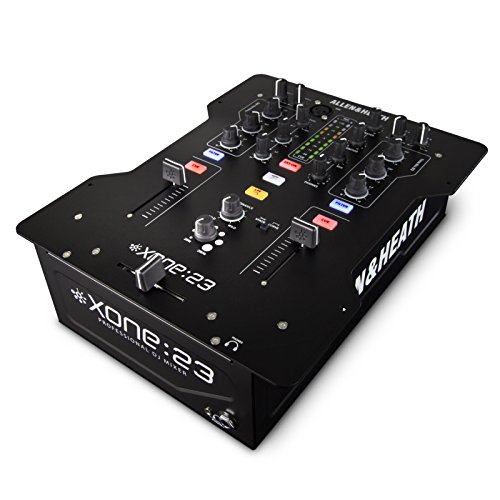
Allen & Heath Xone:23 — Best Sound Quality
The Xone:23 is the contrarian pick: a fully analogue two-plus-two channel mixer with no USB, no pads and no software — just Allen & Heath’s revered voltage-controlled filter, a three-band total-kill EQ, and a signal path that hi-fi DJs describe with words usually reserved for studio gear. It is the mixer for the DJ who mixes long, blends deep and believes the mixer’s job is to disappear sonically while adding one perfect filter.
Strengths
- Analogue sound quality that rivals mixers several tiers up.
- The Xone VCF filter with resonance — the most musical filter in this guide.
- Simple, indestructible layout with nothing to crash, update or unlock.
Trade-offs
- No USB audio — DVS users need an external interface, full stop.
- The crossfader is smooth for blends but not a battle fader; heavy scratchers should look elsewhere.
- No effects beyond the filter, and no performance features of any kind.
| Spec | Detail |
|---|---|
| Channels | 2+2 |
| Signal path | Analogue |
| Filter | VCF with resonance control |
| USB audio | None |
Play a record through the Xone:23 and through a digital mixer back to back and the difference is not subtle: low end has weight without boom, highs stay smooth at volume, and long blends gel instead of stacking. House, disco, techno and eclectic DJs who mix harmonically and ride the filter will find this the most satisfying mixer here at any price. Its limitations are equally clear — it is a vinyl-and-media-player mixer in a software world — but they are honest limitations, and for the right DJ they are not limitations at all. Pair it with two turntables and a crate of records and you have the purest rig in this guide.
Best for: vinyl DJs, house/disco/techno mixers, sound-quality purists. / Not suited for: DVS or software DJs, scratch DJs, anyone needing USB.
Check the current price on Amazon

Reloop RMX-10 BT — Best Budget
Every category needs an honest entry point, and the RMX-10 BT is this one: a compact two-channel mixer that adds a Bluetooth input to the classic layout, letting a phone or tablet stream straight into the mix. That single feature makes it the house-party and first-setup champion — friends can hand you tracks wirelessly, and your own decks or controller take the other channel. It is small, light and simple in the way a first mixer should be.
Strengths
- Bluetooth input channel — wireless playback from phones and tablets.
- Compact footprint suits bedroom setups, small booths and backup duty.
- Straightforward layout a first-time DJ understands in minutes.
Trade-offs
- Faders and knobs are built to a budget tier; heavy scratching will wear them fast.
- No USB DVS interface and no performance features.
- Sound quality is fine for home and casual use, not for critical club playback.
| Spec | Detail |
|---|---|
| Channels | 2 |
| Wireless | Bluetooth input |
| Format | Compact DJ mixer |
| USB audio | None |
Judge the RMX-10 BT by its job: getting a new DJ mixing this weekend, serving as the backup mixer in a mobile rig, or running a café’s decks-and-phone setup. At those jobs it is genuinely good — the EQ does what EQ should, the Bluetooth pairing is painless, and the whole unit costs less than a single premium crossfader for the mixers above it. The upgrade path is equally clear: when your technique outgrows its faders, you will know exactly which of the other five picks matches your style, and the Reloop retires to backup duty instead of a landfill.
Best for: beginners, house parties, backup rigs, casual home setups. / Not suited for: working club DJs, serious scratch practice, DVS users.
Check the current price on Amazon
Comparison Table
| Pick | Badge | Key spec | Best for |
|---|---|---|---|
| Pioneer DJ DJM-250MK2 | Best Overall | USB DVS interface, Sound Color FX | Club-style and mobile DJs |
| Numark Scratch | Best for Scratch DJs | Innofader, Serato Pro + DVS included | Turntablists on a budget |
| Pioneer DJ DJM-S5 | Best for Serato Performance | MAGVEL FADER PRO, lever FX | Serato performance DJs |
| RANE Seventy | Best Premium Battle Mixer | MPC pads, dual USB, all-metal | Professional battle DJs |
| Allen & Heath Xone:23 | Best Sound Quality | Analogue path, VCF filter | Vinyl and blend DJs |
| Reloop RMX-10 BT | Best Budget | Bluetooth input, compact | Beginners and backups |
How to Choose the Right 2 Channel DJ Mixer
Start with your style, not the spec sheet. If your sets are built on cuts, juggles and routines, the crossfader is your instrument and the battle trio (Scratch, S5, Seventy) is your shortlist. If your sets are built on long blends and harmonic mixing, crossfader finesse matters less than EQ smoothness and filter quality — that is DJM-250MK2 and Xone:23 territory. Buying across this line is the single most common mistake in the category: a house DJ with a battle mixer misses the filter, a turntablist with a club mixer destroys a fader never built for them.
Decide your source workflow. Vinyl-only DJs can happily choose the analogue Xone:23. DVS DJs need a mixer with a built-in USB interface and software unlocks — the DJM-250MK2 (rekordbox), Scratch and S5 (Serato, with the S5 also unlocking rekordbox) and the Seventy (Serato) all qualify, and the differences in included software change the true cost of the rig more than the sticker does. Controller DJs adding a mixer for turntables should check that the mixer’s phono inputs and grounding match their decks.
Think about the second laptop. If you play back-to-back or host guest DJs, dual USB (Seventy) eliminates the dead-air changeover. Solo bedroom and mobile DJs will never use it and should not pay for it.
Budget in tiers. The budget tier (RMX-10 BT) gets you mixing today. The mid tier (Scratch, DJM-250MK2) is where most working DJs should live — real faders, real software, real sound. The premium tier (S5, Seventy) buys performance hardware and build quality that only make sense once your technique or your income demands them. Whichever tier you choose, keep money aside for needles, control vinyl and headphones; they wear out faster than mixers do.
Crossfaders Explained: The Part That Decides Everything
On a two-channel DJ mixer, no component takes more abuse or shapes your technique more than the crossfader. Three technologies dominate this guide. Contact faders (the budget approach) use a physical wiper on a resistive track — fine for blends, doomed under heavy scratching. Optical and magnetic faders — Numark’s partner Innofader and Pioneer’s Magvel designs, RANE’s MAG THREE — sense position without contact, so they stay tight and consistent for years and can be adjusted or replaced in minutes. The curve matters as much as the mechanism: a sharp cut-in curve, where sound appears within a millimetre of fader travel, is what makes crab and flare scratches possible, while a smooth constant-power curve is what makes a two-minute blend disappear. Every battle mixer here offers curve adjustment; the club mixers favour the smooth end. When you demo a mixer, ignore the lights and play the crossfader for sixty seconds — your hands will file the only review that matters.
How to Set Up a 2 Channel DJ Mixer with Turntables and DVS
1. Ground everything first. Connect each turntable’s ground wire to the mixer’s ground terminal before any audio cables. Ninety percent of “my mixer hums” problems end here.
2. Wire the signal path. Turntable RCAs go into the phono inputs (or line inputs if your decks have built-in preamps — never both stages at once). Set each channel’s input selector to match: phono for vinyl and control vinyl, line/USB for digital sources.
3. Connect USB and install drivers before the gig. Plug the mixer into your laptop, let the DJ software recognise it, select the mixer’s DVS mode, and calibrate each deck with its control vinyl until the software shows clean, stable timecode circles.
4. Set gains with your loudest record. Play the loudest passage you own, set channel gain so peaks sit just below clipping, and leave headroom — a DVS system’s digital ceiling is unforgiving compared with vinyl.
5. Dial the crossfader curve to your style. Battle DJs: sharpest cut-in that still feels controlled. Blend DJs: smooth curve, and consider swapping the crossfader assign so both channels ride the upfaders for your finest work.
6. Rehearse the failure modes. Know how to flip a channel from DVS to real vinyl mid-set, and keep one actual record in the crate. When (not if) a laptop hiccups at a gig, that record is your career insurance.
Building the Rest of the Rig Around Your Mixer
The mixer is the centre of a two-channel rig, not the whole of it, and the smartest buying order surprises most beginners: mixer first is wrong. Start with the sources. Two turntables with healthy tonearms and fresh styluses, or two media players, or a controller-plus-turntable hybrid — your mixer choice follows from these. Vinyl and DVS DJs should budget for cartridges and control vinyl as consumables, not accessories; a worn stylus through a RANE Seventy still sounds worn. Headphones are the second purchase: a closed-back DJ headphone with a coiled cable and strong isolation is a working tool you will use for a decade, and it matters more to your mixing than any single mixer feature below the premium tier.
Amplification comes third, and here the mixer choice loops back in: powered speakers simplify a home or mobile rig and pair with any output set in this guide, while a separate amplifier and passive speakers suit fixed installs. Cables deserve a line in the budget too — balanced interconnects for the master output, short RCAs for the decks, a spare USB cable for the DVS laptop — because the gig you lose to a failed cable is never the one you expected. Finally, software: if your mixer unlocks Serato or rekordbox performance features, activate and learn them at home, set your cue points and crates before the first gig, and keep the laptop’s power plan and USB ports as rehearsed as your transitions. The DJs who sound effortless are the ones whose rig stopped surprising them months ago.
For beginners assembling all of this at once, the value play in this guide is hard to beat: the Numark Scratch with its included Serato Pro and DVS, a pair of entry direct-drive turntables, control vinyl and one good headphone is a complete, professional-capable rig for less than many single flagship mixers. The purist play is the Xone:23 with two turntables and real records. The club-career play is the DJM-250MK2, learned until it is muscle memory. All three are legitimate; the only wrong rig is the one bought for somebody else’s style.
Common Buying Mistakes
Buying a battle mixer for blending, or vice versa. Covered above because it bears repeating: match the mixer to the technique you actually practise nightly.
Ignoring the software bill. A cheaper mixer that unlocks nothing can cost more than the Scratch or S5 once you buy Serato or rekordbox expansions. Add the software to every price comparison in your head.
Forgetting the microphone and booth needs. Mobile and wedding DJs: check the mic input quality and whether there is a separate booth output for your monitor. Battle mixers vary wildly here; the RANE Seventy is unusually strong, others are minimal.
Chasing four channels you will never use. Two decks is the reality for most DJs. A great two-channel mixer beats a mediocre four-channel one at the same tier, every time.
Skipping the case. Mixers travel badly — knobs shear and faders bend. A flight case or padded bag is part of the purchase, not an accessory.
Analogue vs Digital: The Two-Channel Sound Debate
Every mixer in this guide makes a philosophical choice, and it is worth understanding before you spend money. Analogue mixers like the Xone:23 process your music as a continuous electrical signal from input to output. Their fans credit a warmth and cohesion that is hard to specify but easy to hear at club volume: bass feels physical, harsh digital recordings get a forgiving gloss, and the filter sweeps with a liquid quality that digital emulations chase. Their costs are equally real — no USB, no recording, no software integration, and features limited to what physical circuits can do at a sane price.
Digital mixers — the Pioneers, the Numark and the RANE here — convert audio to data at the input, process it with DSP and convert it back at the output. Done well, as it is in all four digital picks in this guide, the conversion is transparent and the payoff is everything analogue cannot do: DVS interfaces, performance effects timed to the BPM, pad control of your software, recording straight to a laptop, and crossfaders whose behaviour is defined in firmware rather than by worn carbon tracks. The honest summary is that sound quality at the top of both camps is excellent, and the decision should be made on workflow: if your rig involves a laptop, buy digital and never look back; if your rig is two turntables and a record bag, the analogue Xone:23 will make you happier than any feature list. Hybrid regrets — the analogue DJ who later wants DVS, the digital DJ who never opens the laptop — are the expensive kind, so be honest about the DJ you actually are this year, not the one you might become someday.
Outputs, Booths and Microphones: The Unglamorous Specs That Matter at Gigs
Buyers obsess over inputs and effects, but working DJs get bitten by outputs. A proper two-channel rig needs, at minimum: a master output for the house system (balanced XLR is the professional standard and rejects interference over long cable runs), a booth output with its own level control so the DJ can hear a monitor without touching the house volume, and a record output if you capture your sets. Check your shortlist against your venues: the club-style mixers here are well endowed, the battle mixers vary, and the budget RMX-10 BT keeps things basic, which is fine for home use and limiting in a hired hall.
The microphone input deserves the same scrutiny if you talk, host or play weddings. A good DJ mic channel has its own EQ and level that stays independent of the music, so announcements sit on top of the mix instead of fighting it. The RANE Seventy is the standout here, with a genuinely complete mic section; at the other end, some budget mixers treat the mic as an afterthought with a single shared control. Finally, headphone monitoring: cue mixing (blending cue and master in your headphones) is essential for bedroom practice at 2 a.m. and for booths where the monitor is weak. Every pick in this guide offers a usable cue section, but the layout and knob size differ — small thing, nightly difference.
Keeping Your Mixer Alive: Fader Care, Cleaning and Transport
A DJ mixer dies by dust, drink and gravity, in that order. Faders ingest dust and smoke residue from the top panel slots; the defence is a cover or decksaver when the mixer is idle and a soft brush or compressed air once a month, working debris away from the slots rather than into them. Scratchy pots respond to purpose-made fader lubricant used sparingly — flooding a fader with general contact cleaner is how good mixers become parts donors. Crossfaders on the battle picks here are user-replaceable by design; learn the swap on a quiet afternoon (it is a five-minute, few-screws job on the Scratch, S5 and Seventy) so a mid-tour failure is an inconvenience, not a cancellation.
Transport is the other killer. A mixer in a cardboard box in a car boot will arrive with bent fader stems and sheared knobs sooner or later; a padded bag is the minimum, a flight case is the answer for anyone gigging weekly. Coil cables rather than stuffing them, keep the power supply with the mixer (a labelled spare is cheap insurance), and photograph your knob positions before a shared gig so the next DJ’s settings do not become your soundcheck. Treat any of the six picks here this way and they will outlast several laptops, several needles and probably several residencies.
Recording and Streaming Your Sets from a 2 Channel Mixer
More DJs now publish their sets than play them in clubs, and a two-channel mixer handles the job well if you route it properly. The cleanest path is the mixer’s own USB connection: the DJM-250MK2, Scratch, S5 and Seventy all appear as audio interfaces, so your DJ software or a simple recorder can capture the master mix digitally with no extra hardware and no analogue noise floor. Set the recording level conservatively — digital clipping in a recorded mix cannot be undone, and a slightly quiet file can always be normalised later. If your mixer is analogue, like the Xone:23, use its record output into any small USB interface or a handheld recorder; the record output exists precisely so the recording level stays independent of how loud the room is playing.
Streaming adds one wrinkle: the platform hears what the mixer sends, not what the room hears, so monitor the stream feed in a second pair of ears or a phone check before you go live, and watch your microphone balance — voice that sits perfectly over a club system often buries the music on a laptop speaker, and vice versa. Battle DJs recording routines should capture video from a phone on a tripod and sync the mixer’s clean audio in editing; the difference between camera audio and mixer audio is the difference between a clip people share and one they scroll past. Every mixer in this guide can anchor that workflow — the digital four do it natively, the Xone:23 does it with one extra box, and even the little Reloop can feed a recorder from its master output for a first mixtape.
Final Recommendation
Most DJs should buy the Pioneer DJ DJM-250MK2 — it is the standard for a reason. Scratch DJs should start on the Numark Scratch and graduate to the Pioneer DJ DJM-S5 or the RANE Seventy as their routines and bookings grow. Vinyl purists and blend DJs will be happiest with the Allen & Heath Xone:23, and first-time buyers or backup-rig builders can start mixing this weekend on the Reloop RMX-10 BT. Also worth a look if you find it in stock: Pioneer’s DJM-450 adds Beat FX to the same club DNA. When you are ready to expand the rig, see our guides to Best 3 And 4 Channell Dj Mixers, Best 3 Channel Dj Mixers, Best 4 Channel Dj Mixers and Best 2 Channel Mixers for the neighbouring formats.
Frequently Asked Questions
What is the difference between a battle mixer and a club mixer?
Battle mixers are built around scratching: a sharp, durable, replaceable crossfader, battle-position layout with uncluttered fader area, performance pads or effect triggers, and usually a DVS interface. Club mixers prioritise smooth blending: musical EQ, per-channel filters, longer fader travel and pristine sound. Many DJs own one of each; beginners should buy for the style they practise most.
Do I need a DVS system to DJ with a 2 channel mixer?
No. A two-channel mixer works with pure vinyl, CDs, media players or a controller with no computer involved — the Xone:23 exists precisely for that world. DVS (digital vinyl system) is an option that lets turntables control music files on a laptop; it needs a mixer with a built-in USB audio interface, like the DJM-250MK2, Scratch, S5 or Seventy, plus control vinyl.
Can a 2 channel DJ mixer be used for parties and mobile gigs?
Absolutely — two channels covers two decks plus a microphone for announcements, which is all most parties need. Mobile DJs should check three things: a decent mic input, a booth or second output for a monitor speaker, and a backup input (the RMX-10 BT’s Bluetooth channel is genuinely handy when a client hands you a phone full of requests).
How long does a crossfader last?
It depends on the technology and your technique. Contact faders in budget mixers can feel loose within a year of heavy scratching. Magnetic and Innofader designs in the Scratch, S5 and Seventy are rated for years of nightly abuse and are user-replaceable when they finally wear. Blend DJs, who barely stress the part, may never replace one at all.
Is the Allen & Heath Xone:23 good for scratching?
It can handle occasional cuts, but it is not a scratch mixer: its crossfader is voiced for smooth blends and its layout serves long mixing. Occasional scratch accents in a house set? Fine. Daily turntablist practice? Buy the Numark Scratch instead — your technique will develop faster on the right tool.
Should I buy a 2 channel or 4 channel DJ mixer?
Buy four channels only if you genuinely play from three or four sources — extra decks, a drum machine, a second DJ’s rig. Most DJs play two decks for entire careers. The money a four-channel mixer spends on extra strips buys a much better crossfader, sound path and software bundle in a two-channel model at the same tier.


