Disclosure: airfryerkitchensupply.com is reader-supported. When you buy through links on our site, we may earn an affiliate commission at no extra cost to you.
Where to buy
Every machine below is sold on Amazon, and each verified pick links to its listing so you can check the current price on Amazon. We do not print prices — they change too often to stay honest — and every model was matched against Amazon’s product data feed for this site before it earned a link.
- Cuisinart PerfecTemp Thermal DCC-3400 — check the current price on Amazon
- KRUPS 12-Cup Programmable Thermal — check the current price on Amazon
- Breville Luxe Brewer Thermal BDC465 — check the current price on Amazon
- Breville Grind Control BDC650 — check the current price on Amazon
- Zojirushi EC-YTC100 Fresh Brew Plus — check the current price on Amazon
- Mr. Coffee 10-Cup Programmable Thermal — check the current price on Amazon
The best 12 cup thermal coffee makers exist to solve the oldest problem in home coffee: the pot is perfect at minute five and tired at hour two, because a warming plate keeps it hot by slowly cooking it. A thermal machine deletes the plate. It brews into a double-wall, vacuum-insulated carafe that holds temperature with physics instead of power, so the last cup tastes close to the first. This guide picks the six thermal brewers worth your counter, and explains the trade-offs honestly — because thermal is better, but it is not free of compromises.
The honest compromises, up front: a steel carafe hides the coffee level, weighs more than glass, and wants hand washing; insulation holds coffee well for two to three hours, not all day; and true 12-cup thermal machines are rarer than the search results suggest — several respected models in this space are 10-cup designs, two of which earn places below with their capacity stated plainly. If your household drinks a pot within forty-five minutes, a glass machine from our main 12 cup guide will serve you as well for less. If your coffee waits, read on — this is your category.
All six picks were verified product feed attached to this site, matched brand-and-model to live Amazon listings: Cuisinart’s programmable thermal flagship, KRUPS’ strength-flexible thermal, Breville’s premium thermal brewer and its grind-and-brew sibling, and the two best 10-cup thermal values from Zojirushi and Mr. Coffee.
In this guide
Quick Picks
Six thermal brewers, from the programmable all-rounder to the budget 10-cup that punches above its size. Badges name each one’s thermal personality.
- Cuisinart PerfecTemp Thermal DCC-3400 — Best Overall Thermal: The complete thermal package: a true 12-cup double-wall stainless carafe, PerfecTemp brewing heat, full programmability and strength control — the thermal machine for most households. — Check on Amazon
- KRUPS 12-Cup Programmable Thermal — Best Value Programmable Thermal: Programmable thermal with a household peace treaty built in: three brew strengths, so the scheduled pot can be the strength the day actually needs. — Check on Amazon
- Breville Luxe Brewer Thermal BDC465 — Best Premium Thermal: Breville’s premium thermal brewer: hot drip and cold brew from one machine, a thermal carafe, and the fit, finish and control polish of the brand’s top line. — Check on Amazon
- Breville Grind Control BDC650 — Best Grind and Brew Thermal: A built-in grinder feeding a thermal carafe: whole beans in, fresh-ground drip out, from a single cup to a full carafe — the freshest route to a thermal pot. — Check on Amazon
- Zojirushi EC-YTC100 Fresh Brew Plus — Best Insulation (10-Cup): A 10-cup brewer from the vacuum-insulation specialists — included, capacity stated plainly, because its carafe holds heat better than most 12-cup rivals hold anything. — Check on Amazon
- Mr. Coffee 10-Cup Programmable Thermal — Best Budget Thermal (10-Cup): The budget door into thermal: a programmable 10-cup machine with an insulated carafe and a Strong Brew selector at a price the true 12-cup thermals cannot approach. — Check on Amazon
How These Picks Were Chosen
We shortlisted every 12-cup-class thermal carafe machine leading this category on Amazon, plus the strongest 10-cup thermal models that 12-cup shoppers cross-shop, and verified each feed — links only where brand and model matched a live listing with certainty.
Criteria: (1) insulation quality — how long the carafe holds serving temperature and, just as importantly, how little the flavor drifts across that window; (2) brew quality — temperature and distribution, because insulation cannot rescue a badly brewed pot; (3) carafe craft — pouring, lid sealing, brew-through design, cleanability; (4) programming and daily usability; and (5) capacity honesty — true 12-cup machines were preferred, and the two 10-cup picks are labeled as such wherever they appear. Badges name the job each machine does best.
The 6 Best 12 Cup Thermal Coffee Makers

Cuisinart PerfecTemp Thermal DCC-3400 — Best Overall Thermal
The DCC-3400 is the default recommendation in this category: scheduled households, slow drinkers and anyone whose pot must taste right at hour two. It suits the mainstream thermal buyer completely. It does not suit buyers wanting a visible coffee level or a glass carafe’s dishwasher ease, and its lid needs the rinse routine described in its review.
Strengths
- True 12-cup thermal capacity — no sizing asterisk
- PerfecTemp heating targets proper extraction temperature
- Full programmability with strength control and small-pot logic
Trade-offs
- Steel carafe hides the level; judge by heft
- Lid brew-through channels need rinsing after every pot
- Hand-wash care for the carafe
| Capacity | 12-cup |
| Carafe | Double-wall stainless steel thermal |
| Heating | PerfecTemp |
| Programming | Fully programmable |
Most thermal machines ask you to choose between capacity, programmability and brew temperature. The DCC-3400 is the one that refuses the choice: a genuine 12-cup thermal carafe for the full household pot, Cuisinart’s complete programmable pattern for the schedule, and a heating system — PerfecTemp — designed to brew at the hotter, more accurate temperatures that mainstream machines often miss. The result is the category’s most complete daily experience: program the pot for the alarm, pour the first cup at seven, and pour the last at nine-thirty to find it still tasting like coffee rather than like storage. The carafe itself pours cleanly and seals well; its brew-through lid means the pot never leaves its thermal shelter during brewing. Ownership is thermal’s standard contract — hand-wash the carafe, rinse the lid’s channels after each pot, tablet-soak monthly — and in exchange the machine asks for no plate, no power for holding, and no apologies at hour two. For the household that has decided thermal is right, this is the machine the decision points to.
Preheating is the owner’s multiplier: a hot-water rinse of the carafe at loading time on cold mornings can add the better part of an hour of prime holding. It takes twenty seconds and is the difference between ‘good for two hours’ and ‘good all morning.’
Best for: households wanting true 12-cup thermal with full programming / Not suited for: glass-carafe households or visible-level devotees

KRUPS 12-Cup Programmable Thermal — Best Value Programmable Thermal
The KRUPS suits mixed-strength households on a schedule — the ones whose programmed pot is otherwise a daily compromise nobody chose. Its three strengths make the compromise adjustable, and its thermal carafe keeps the result patient. It does not suit buyers wanting a flagship interface, and it shares thermal’s usual carafe care.
Strengths
- Three programmable strengths — rare flexibility in thermal
- True 12-cup thermal carafe
- Straightforward, honest controls and programming
Trade-offs
- Interface is functional rather than refined
- Smaller parts and support ecosystem than Cuisinart
- Thermal carafe: hidden level, hand washing
| Capacity | 12-cup |
| Carafe | Thermal double-wall stainless |
| Programming | 24-hour programmable |
| Strengths | 3 settings |
The KRUPS makes its case with one feature competitors keep undervaluing: strength range in a programmable thermal machine. A scheduled pot is a single recipe imposed on every drinker, and households resolve the tension by brewing a compromise that fully satisfies no one. Three genuine strength settings turn that compromise into a dial — mild for the full-family weekday pot, strong for the milk-heavy weekend, middle for everything else — and because the carafe is thermal, a stronger pot waits without turning harsh the way plate-held strong coffee does. The rest of the machine is KRUPS’ clean European drip competence: balanced extraction, plain-spoken controls, no theatrical features. Against the Cuisinart it concedes heating-system branding and ecosystem depth; on combination value — programmable, thermal, strength-flexible, true 12 cups — it is arguably the smartest money in this guide. Households whose coffee arguments are about strength rather than schedule should start here.
A household system that works: assign strengths to days, not drinks — the calendar decides (mild weekdays, strong Saturdays) — so the nightly load never includes a negotiation. The machine remembers nothing; the routine remembers everything.
Best for: mixed-strength scheduled households wanting thermal value / Not suited for: interface connoisseurs or glass households

Breville Luxe Brewer Thermal BDC465 — Best Premium Thermal
The Luxe Brewer is for the household that wants thermal holding plus Breville’s premium experience — including genuine cold brew in the same footprint, which no other pick here offers. It suits quality-and-design buyers whose budget reaches the top tier. It does not suit bargain hunters, and households that never drink cold brew are paying for range they will not use.
Strengths
- Hot drip and cold brew in one premium machine
- Thermal carafe holding with top-tier fit and finish
- Breville’s control polish and brew tuning heritage
Trade-offs
- Top-tier pricing in this guide
- Cold brew capability is wasted on hot-only households
- Thermal carafe care as standard
| Carafe | Thermal, brushed stainless machine |
| Modes | Hot drip and cold brew |
| Tier | Premium |
| Brand line | Breville Luxe |
Breville’s Luxe line exists for buyers who experience appliances as objects as well as tools, and this thermal brewer is its coffee expression: brushed stainless, considered controls, and brewing that carries the brand’s temperature-tuning reputation into a carafe that then holds the result without power. The differentiator is the second discipline — real cold brew, produced by the same machine that makes the morning pot, which turns a seasonal second appliance into a mode. For households that drink cold coffee half the year, that consolidation is a genuine counter-space and budget argument, not a gimmick. Hot drip quality sits at the premium end of mainstream: accurate, even, and tuned for clarity. The thermal carafe performs as the category demands. The honest cautions are price and fit: this is the guide’s premium tier, and its value depends on using its range — the cold brew, the controls, the design — rather than buying a badge. Households that will, get the most complete thermal machine here; households that will not should buy the Cuisinart and keep the difference.
Cold brew through a thermal system has a quiet advantage: the same carafe that holds the morning’s hot pot can chill and hold the afternoon’s cold brew, and a household that learns both rhythms gets two appliances’ worth of service from one footprint.
Best for: premium buyers wanting hot and cold brew with thermal holding / Not suited for: hot-only households or value-first budgets

Breville Grind Control BDC650 — Best Grind and Brew Thermal
The Grind Control is for the freshness devotee who will not buy a separate grinder: it grinds per brew, calibrates dose to the volume chosen, and delivers into a thermal carafe. It suits households that taste the difference fresh grinding makes. It does not suit the noise-sensitive (grinders are loud at 6 a.m.), the simplicity-seeking (more parts, more cleaning), or anyone brewing for a sleeping household.
Strengths
- Integrated burr grinding: the freshest possible drip in this guide
- Calibrates grind amount to the chosen volume, cup to carafe
- Thermal carafe protects the fresh result for hours
Trade-offs
- Grinder noise is real — a household consideration at dawn
- More components to clean: chute, burrs, carafe
- Premium pricing and complexity
| System | Grind and brew, integrated grinder |
| Carafe | Thermal |
| Sizes | Single cup to full carafe |
| Calibration | Automatic dose by volume |
Every other machine in this guide brews coffee that was ground sometime — yesterday, last week, at a factory. The Grind Control brews coffee ground seconds before the water hits it, and the difference is not subtle: aromatics that pre-ground coffee loses within hours are still in the cup. Breville’s implementation is the mature one — the grinder doses by the volume you selected, the machine can brew a single cup or the full thermal carafe, and grind settings let you tune the extraction to your beans. The thermal carafe then does this guide’s usual work, holding the fresh pot without cooking away the advantage you paid for. The costs are the grind-and-brew category’s eternal ones: noise that will wake light sleepers, a grinder path that needs regular brushing and occasional deep cleaning to keep oils from building, and more parts between you and reliability. Households that accept those terms get the freshest thermal coffee in this guide and a one-machine footprint that replaces brewer plus grinder. Households that value silence and simplicity should buy the Cuisinart and a standalone grinder — or pre-ground coffee and peace.
Noise management is a solvable problem: the machine’s strength is dose calibration, so a household with a sleeping baby can grind the evening before into the sealed basket for the morning’s first pot — a small freshness compromise that buys a quiet house — and grind fresh for every pot after.
Best for: freshness devotees wanting grinder and thermal brewer in one / Not suited for: noise-sensitive or simplicity-first households

Zojirushi EC-YTC100 Fresh Brew Plus — Best Insulation (10-Cup)
Capacity honesty first: this is a 10-cup machine in a 12-cup guide, included because households whose ’12-cup’ demand is really four mugs will get better insulation here than anywhere else. Zojirushi’s whole heritage is heat retention. It does not suit true five-mug households, and its feature set is deliberately plain.
Strengths
- Best-in-guide insulation heritage and holding performance
- No plate, no cooking — coffee tastes fresh for hours
- Dense, quality build typical of the brand
Trade-offs
- 10-cup capacity — two cups short of this guide’s headline
- Plain feature set; the carafe is the technology
- Steel carafe hides the level
| Capacity | 10-cup |
| Carafe | Stainless thermal |
| Brand specialty | Vacuum insulation |
| Warming | None — insulation only |
Zojirushi has spent decades making vacuum bottles and rice cookers that hold temperature like it is a moral position, and this brewer applies that obsession to coffee: brew into the stainless thermal carafe, and hours later the coffee is still at serving temperature with its flavor close to intact. In pure holding performance, it embarrasses nominally larger machines whose carafes are thermal in name more than in fact. The brewer side is restrained — good temperature, simple controls, none of the programmable theater — because the design budget went where the brand believes it belongs. The trade is printed on the box: ten cups, about fifty ounces, four honest mugs. Households that truly need five should buy the Cuisinart or KRUPS and accept slightly less stellar insulation. Households whose real demand is four mugs and whose drinking stretches across a morning will find this the most satisfying thermal machine in the guide — capacity they use fully, holding they will appreciate daily, and a build that feels like it was made by people who find heat loss personally offensive.
Preheat the carafe without exception in this household: Zojirushi’s insulation rewards a warm start with holding times that surprise even thermal veterans — the last cup of a slow Sunday can still be properly hot, not merely warm.
Best for: four-mug households wanting the best holding performance available / Not suited for: households that genuinely need five mugs per pot
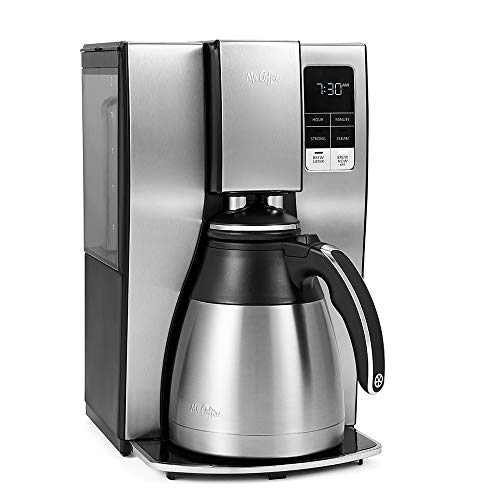
Mr. Coffee 10-Cup Programmable Thermal — Best Budget Thermal (10-Cup)
Also a 10-cup machine — stated plainly — and the pick for households that want thermal’s benefits on a strict budget: no plate cooking, a timer for the morning, a strong setting for milk drinkers. It suits first thermal buyers and offices. It does not suit households needing a full 12 cups, premium materials, or the longest holding times.
Strengths
- Thermal plus programmable at a budget tier — a rare combination
- Strong Brew selector for bolder pots
- Simple, learnable controls
Trade-offs
- 10-cup capacity, not 12
- Insulation is good for a couple of hours, not a whole morning
- Budget build materials
| Capacity | 10-cup |
| Carafe | Insulated thermal |
| Programming | Programmable |
| Extras | Strong Brew selector |
Thermal brewing has a price problem: the good carafes live on mid-tier and premium machines, which locks budget households into glass and plates. This Mr. Coffee is the exception that matters — a genuinely insulated carafe, real programmability and a strength selector, at the tier where rivals are still shipping warming plates. The compromises are the tier’s honest ones: the insulation holds a pot properly hot for a couple of hours rather than a long morning, the materials are budget plastics and thinner steel, and the capacity is ten cups rather than twelve. Within those lines, the daily experience is the thermal experience — coffee that does not cook while it waits — and for many households that is the entire point of the category, delivered at a price that leaves room in the budget for good beans, which will improve the cup more than a fancier badge would. Treat it kindly, descale it quarterly, and it will make the case for thermal to any household still living on a plate.
Set the household’s expectation at the two-hour mark and this machine never disappoints: pots brewed for a morning’s first half, drunk within it, taste exactly as thermal promises. The disappointment pattern for budget thermals is always an expectation problem, not a brewing problem.
Best for: budget households wanting thermal benefits without mid-tier pricing / Not suited for: true 12-cup demand or all-morning holding needs
Comparison Table
| Pick | Badge | Key spec | Best for |
|---|---|---|---|
| Cuisinart PerfecTemp Thermal DCC-3400 | Best Overall Thermal | 12-cup thermal, PerfecTemp, programmable | households wanting true 12-cup thermal with full programming |
| KRUPS 12-Cup Programmable Thermal | Best Value Programmable Thermal | 12-cup thermal, 3 strengths, programmable | mixed-strength scheduled households wanting thermal value |
| Breville Luxe Brewer Thermal BDC465 | Best Premium Thermal | Thermal carafe, hot + cold brew, premium | premium buyers wanting hot and cold brew with thermal holding |
| Breville Grind Control BDC650 | Best Grind and Brew Thermal | Grind & brew, thermal carafe | freshness devotees wanting grinder and thermal brewer in one |
| Zojirushi EC-YTC100 Fresh Brew Plus | Best Insulation (10-Cup) | 10-cup, insulation-specialist carafe | four-mug households wanting the best holding performance available |
| Mr. Coffee 10-Cup Programmable Thermal | Best Budget Thermal (10-Cup) | 10-cup programmable thermal, budget tier | budget households wanting thermal benefits without mid-tier pricing |
Use the table to compare roles at a glance, then read the full review of any pick you are seriously considering — the trade-offs matter more than the headline spec.
How to Choose the Best 12 Cup Thermal Coffee Maker
Thermal shopping is carafe shopping: the brewer matters, but the vessel is the category. Judge in this order — insulation, brew, then everything else.
Insulation: What ‘Thermal’ Should Mean
A real thermal carafe is double-wall stainless, ideally vacuum-insulated, and it should hold coffee at a satisfying drinking temperature for two to three hours without any power. Judge listings skeptically: ‘thermal’ is sometimes pasted onto thin single-wall pots that buy you forty minutes. Signals of the real thing: vacuum or double-wall language, substantial carafe weight, and a lid that seals and pours through a small aperture rather than opening the whole top to the air. Every pick in this guide is the real thing — the two 10-cup models included because their insulation outperforms nominally bigger rivals.
The Brew Still Matters
Insulation preserves; it cannot improve. A thermal machine with a weak heater locks in under-extracted coffee at a stable, disappointing temperature for hours. The picks here were chosen for their heating credibility — Cuisinart’s PerfecTemp emphasis, Breville’s tuning heritage, Zojirushi’s temperature discipline — before their carafes were considered. When comparing any thermal machine, ask the drip questions first (temperature? distribution? small-batch mode?) and the carafe questions second. A great pot held well is the goal; a mediocre pot held perfectly is a longer disappointment.
Capacity: The 12-Cup Thermal Scarcity
Shoppers should know the market’s open secret: true 12-cup thermal machines are few, because a 60-ounce insulated carafe is heavy, costly and tall. Many households type this query discover their real demand is four mugs — exactly a 10-cup pot — and that the best-insulated machines live at that size. Our advice: measure your household in mugs for one week. Five-plus mugs daily: buy the true 12-cup Cuisinart or KRUPS. Four mugs: the Zojirushi and Mr. Coffee enter the conversation with better value or better insulation. Do not buy capacity as insurance and pay for it in holding performance every day.
Thermal vs Glass: The Complete Honest Comparison
Glass wins on: purchase price, seeing the level, dishwasher ease, replacement cost, and the simple pleasure of watching coffee pour. Thermal wins on: flavor across time (the decisive one), energy (no plate), safety of holding (no hot surface), and taking the pot to the table, porch or desk without a cord. The crossover is about forty-five minutes: pots drunk faster than that taste the same from either vessel; pots that live longer diverge, and by hour two the comparison is not close. This is why the category decision should be made from your household’s clock, not from anyone’s brand loyalty — including ours.
Lids, Pours and Carafe Craft
Thermal carafes differ in the hand more than on the spec sheet. Brew-through lids (the Cuisinart pattern) keep the carafe sealed during brewing — the best thermal practice — while lids that must be removed to brew leak heat from the first minute. Pouring should be one-handed and drip-free at a tilt; a carafe that needs two hands and a prayer will eventually decorate a counter with coffee. The lid’s internal channels are the hygiene frontier: they trap coffee where brushes barely reach, so favor designs whose lids disassemble or rinse through cleanly, and build the rinse-after-every-pot habit regardless. Finally, check the carafe’s height against your machine’s clearance and your sink — thermal carafes are tall, and a carafe that cannot fit under your faucet for washing is a daily annoyance in the making.
The Physics of Holding: Why Insulation Beats Power
A warming plate and a thermal carafe solve the same equation from opposite ends. The plate accepts that coffee loses heat and replaces the loss continuously — spending energy, and spending the coffee’s flavor as the price of the replacement. The carafe refuses the loss in the first place: a vacuum gap between two steel walls blocks conduction and convection, the two paths heat actually travels, so the coffee’s own stored energy simply stays where it was brewed. That is why thermal holding is not a lesser substitute for a plate but a categorically better technology for any pot that lives past its first hour — and why it costs more to build. It also explains thermal’s limits honestly: insulation slows heat loss, it cannot stop it, and the curve steepens as the carafe empties and the air gap above the coffee grows. Brew full, pour promptly, keep the lid sealed — the physics rewards exactly the habits this guide teaches.
Thermal Coffee at the Table, the Desk and the Porch
An under-sold thermal virtue is mobility. A glass carafe is tethered to its plate by the need for heat; a thermal carafe is a serving vessel that travels — to the table for a long brunch, to the desk for a work morning, to the porch without an extension cord or a cooling cup. Households reorganize around this more than they expect: the pot leaves the kitchen, the kitchen gets its counter back, and the coffee’s location stops dictating the morning’s geography. For work-from-home drinkers this is the difference between a pot that lives at the desk all morning, tasting right, and four trips to a plate-cooked carafe in the kitchen. When you price a thermal machine, count the mobility as part of the purchase — for many households it ends up being the benefit used most, ahead of even the flavor preservation that justified the category.
Mobility has a hosting dimension too: a thermal carafe can be set in the middle of a table and forgotten, in the way of all good hosting, while the conversation does the work. No cord, no trips back to the kitchen, no host disappearing at the exact moment the story gets good. It is a small social technology, and it is built into every machine in this guide.
It also travels vertically, which apartment and office dwellers discover quickly: a pot brewed in a small kitchen can spend its morning in a home office two rooms or two floors away, still properly hot, still entirely right. The carafe turns one brewer into a building-wide coffee service for exactly as long as its window lasts.
Grind-and-Brew and Other Thermal Hybrids
The Breville Grind Control in this guide represents a hybrid worth understanding on its own terms: it attacks freshness at the grinding step and time at the holding step simultaneously. The logic is sound — the two fastest ways home coffee degrades are stale grounds before brewing and a hot plate after it — and a household sensitive to both gets a machine that addresses its actual enemies. The hybrid’s costs are equally structural: more mechanisms, more cleaning surfaces, more noise, more price. The general lesson extends beyond this model: in the thermal category, the premium tiers buy either freshness (grinding), range (hot and cold brewing), or refinement (materials and controls). None of those is the insulation itself, which the mid-tier Cuisinart and KRUPS already do well. Spend the premium on the axis your household will feel — and if none of the axes moves you, the mid-tier is not a compromise, it is the correct answer.
Thermal for Offices and Shared Spaces
Offices are thermal’s second home, for reasons beyond flavor. A plate machine in an office is a small appliance left heating unattended for hours — a safety conversation and an energy one — while a thermal carafe simply sits there, inert and patient, until the last person pours. The carafe also ends the office’s defining coffee tragedy, the 3 p.m. cup from a pot brewed at 9, which has ended more afternoons than meetings ever will. For a small office, the buying logic inverts the home logic: capacity and holding dominate, brew nuance matters less, and the Mr. Coffee and Cuisinart in this guide are the natural shortlist. One office-specific habit matters: assign the rinse. Shared carafes develop shared neglect, and a thermal carafe that nobody owns is a carafe that everybody’s coffee tastes of. A sticky note with a name on it has saved more office coffee than any machine feature.
What to Do With the Last Cup
Every thermal pot ends with a decision, and households handle it with varying wisdom. The good options: drink it within the window and enjoy the category working as designed; refrigerate it promptly for tomorrow’s iced coffee, where a slightly aged pot is no handicap under ice and milk; or build it into cooking — coffee is a legitimate ingredient in baking, sauces and marinades, and a strong last cup improves a chocolate cake more than it improves a fourth hour in the carafe. The bad options: reheating it repeatedly on a plate it was never brewed for, topping the carafe up with a fresh half pot (the old coffee seasons the new, and not kindly), or leaving it to be discovered tomorrow. Thermal ownership is mostly the discipline of respecting the window — brew what the window holds, and let each pot end with dignity rather than decline.
A Brief Note on Replacement Carafes
The carafe is the thermal machine’s wear item and its Achilles heel in one object: dent it, drop it, or damage its seal and the machine’s whole proposition is compromised. Before buying any pick here, spend two minutes confirming that its replacement carafe is findable and priced sanely — the mainstream brands in this guide (Cuisinart, KRUPS, Mr. Coffee, Breville, Zojirushi) all support their carafes, but prices vary enough to matter in a ten-year ownership calculation. Keep the carafe’s model number with the machine’s manual. And handle the original like the precision vessel it is: the vacuum inside a thermal carafe is invisible, irreplaceable at home, and lost in a single hard knock against a granite counter edge — the one accident no amount of descaling will ever fix.
When Thermal Is the Wrong Choice
The candid section every category guide owes its readers: thermal is wrong for some households. If your pot is brewed and finished within half an hour — a couple drinking two mugs each with breakfast — glass is cheaper, lighter, easier to wash and exactly as good in the cup; buy the glass machine and spend the difference on beans. If your household judges coffee by watching it — the level in the carafe is how you know the morning’s state — steel’s opacity will irritate you daily in a way no flavor benefit repays. If the machine must live where it will be knocked, dropped and dishwashered by many hands — a busy office kitchen — glass’s cheap replaceability beats steel’s dented dignity. Thermal earns its premium in one specific life: coffee that waits. If your coffee does not wait, let it not pay for patience it will never use.
How to Use a Thermal Coffee Maker for Maximum Holding
Thermal performance is half machine, half ritual. The ritual:
- Preheat the carafe, always. Fill it with hot water while the machine warms, dump, then brew. Cold steel steals the first pot’s heat; preheated steel guards every cup’s.
- Brew full when you can. A full thermal carafe holds temperature far better than a half one — more hot mass, less air. On small-pot days, accept a shorter prime window or brew into a smaller thermal vessel.
- Keep the lid sealed between pours. Every opening trades heat for air. Pour, close, and let insulation do its work undisturbed.
- Pour the last cup by the three-hour mark. Plan the pot’s life honestly: prime in hour one, good in hour two, acceptable in hour three, and a new pot after that rather than a reheated relic.
- Never put a thermal carafe on a stove or plate. Insulated vessels are not kettles; external heat damages seals and vacuum. If coffee must be reheated, the microwave and a mug are the honest tools.
- Rinse the lid after every pot; soak the carafe weekly. Thermal interiors hide residue invisibly. A cleaning-tablet soak keeps steel neutral so today’s pot never tastes of last week’s.
Thermal Carafe Care and Troubleshooting
Thermal carafes fail in two ways: slowly, by residue, and suddenly, by seal damage. Residue first: coffee oils film stainless invisibly, so wash the carafe with hot soapy water and a bottle brush after use, and soak it with a coffee-equipment cleaning tablet whenever a fingertip swiped inside comes away slick — never use abrasive pads, which scratch the finish and give future residue a grip. The lid needs its own routine: rinse its channels after every pot and soak it with the carafe weekly. Seal damage announces itself as a carafe that suddenly holds heat poorly; check that the lid is fully closed and its gasket seated before mourning the vacuum, because most ‘dead’ thermal carafes are lid problems. Troubleshooting: Problem: coffee is lukewarm at hour one → the carafe was not preheated, or the lid was left open. Problem: coffee tastes stale from a clean-looking carafe → invisible film; tablet-soak it. Problem: the pot brews weak → that is the brewer, not the carafe — descale and check the dose. Treat the carafe as the precision instrument it is and it will outlast the machine it came with.
Common Buying Mistakes
Thermal disappointment is almost always one of these six:
- Skipping the preheat. The single biggest thermal mistake. A cold carafe taxes the pot before the first pour, and owners blame the insulation they never gave a chance.
- Expecting all-day holding. Two to three good hours is the honest window. Households needing six should brew twice or use a commercial airpot, not blame the carafe.
- Buying ‘thermal’ by label alone. Thin single-wall pots wear the word too. Look for double-wall or vacuum construction and real weight.
- Leaving coffee in the carafe overnight. Residue bakes on invisibly and flavors tomorrow’s pot. Rinse the same day, every day.
- Putting the carafe on heat. Stovetops and warming plates damage seals and vacuum insulation. A thermal carafe is a thermos, not a kettle.
- Overbuying capacity. A half-filled 12-cup carafe holds heat worse than a full 10-cup. Buy the size your household fills.
Preheat, fill, seal, rinse — four habits, and a thermal machine delivers the freshest long-window coffee a home can make.
Final Recommendation
The Cuisinart DCC-3400 is our best overall thermal: true 12 cups, full programming, proper brewing heat. The KRUPS is the strength-flexible programmable value; the Breville Luxe Brewer is the premium hot-and-cold statement; the Breville Grind Control is the freshness maximalist’s one-machine answer. And the two honest 10-cups — the Zojirushi for insulation supremacy, the Mr. Coffee for budget thermal — will serve four-mug households better than lesser 12-cup machines would.
Prefer glass, or a different size? The companion guides cover the rest of the field:
- Best Overall Thermal: Cuisinart PerfecTemp Thermal DCC-3400
- Best Value Programmable Thermal: KRUPS 12-Cup Programmable Thermal
- Best Premium Thermal: Breville Luxe Brewer Thermal BDC465
- Best Grind and Brew Thermal: Breville Grind Control BDC650
- Best Insulation (10-Cup): Zojirushi EC-YTC100 Fresh Brew Plus
- Best Budget Thermal (10-Cup): Mr. Coffee 10-Cup Programmable Thermal
Best 12 Cup Coffee Makers Best 12 Cup Programmable Drip Coffee Makers Best 10 Cup Coffee Makers Best 10 12 Cup Coffee Makers Best 12 Cup Electric Coffee Makers
Frequently Asked Questions
How long does coffee stay hot in a thermal carafe?
In a good double-wall or vacuum carafe, coffee stays at satisfying drinking temperature for about two to three hours, with the best flavor in the first two. Preheating the carafe before brewing noticeably extends the window.
Is a thermal coffee maker better than one with a warming plate?
For coffee that waits more than about 45 minutes, yes — a plate slowly cooks coffee and degrades its flavor, while insulation simply keeps it hot. For pots drunk immediately, glass and a plate are cheaper and simpler, with no taste penalty.
Why are there 10-cup machines in a 12-cup thermal guide?
Because true 12-cup thermal machines are scarce, and the two 10-cup models here — labeled as 10-cup everywhere they appear — offer insulation or value that beats weaker 12-cup rivals for households whose real demand is four mugs. Measure your household in mugs before deciding.
Can I put a thermal carafe in the dishwasher?
Most manufacturers recommend hand washing to protect the seals, finish and insulation. The carafe body sometimes tolerates a dishwasher, but the lid’s channels and gaskets last longer with hand care — a bottle brush and hot soapy water take two minutes.
Why does my thermal carafe not keep coffee hot anymore?
Usually the lid: check that it is fully closed and its gasket is seated and clean. If the carafe was ever heated externally or dropped hard, the vacuum seal itself may be damaged. Residue build-up does not affect heat, but it does affect flavor — soak the carafe with a cleaning tablet.
Should I preheat a thermal carafe?
Yes — it is the highest-value habit in this category. A rinse of hot water before brewing stops the steel from stealing the pot’s heat and can add the better part of an hour of prime holding time.


