Disclosure: airfryerkitchensupply.com is reader-supported. When you buy through links on our site, we may earn an affiliate commission at no extra cost to you.
Where to buy
All six picks for the best affordable immersion hand blenders are sold on Amazon. Budget stick blenders are frequently re-listed under near-identical names, so match the brand, wattage, and attachment list to the pick before you order:
- Mueller Immersion Blender Handheld 800W 5-in-1 — Check the current price on Amazon
- OVENTE Electric Corded Hand Blender HS560B — Check the current price on Amazon
- Ganiza Immersion Blender 5-in-1 — Check the current price on Amazon
- KitchenAid Variable Speed Corded Hand Blender with Attachments KHBV83 — Check the current price on Amazon
- MasterChef Immersion Blender 400W — Check the current price on Amazon
- Turelar Immersion Blender 1100W 5-in-1 — Check the current price on Amazon
Introduction
The best affordable immersion hand blenders earn their place in a kitchen in one specific moment: a pot of soup, still on the stove, that needs to become smooth without being ladled into another appliance. That in-pot ability — blending food where it cooked, while it is hot, in whatever vessel it is already in — is the entire reason the immersion category exists, and it is the lens this guide uses. Raw power matters less here than control, guard design, and whether the tool behaves itself submerged in hot liquid.
Because “immersion hand blender” and “hand blender” are the same tool wearing two names, this guide deliberately goes deeper on the immersion craft than a general hand-blender roundup: how the underwater vortex works, how to blend boiling soup without wearing it, and which designs suit the pot versus the beaker. The picks overlap in spirit with the broader category but are ranked for immersion work specifically — sustained submerged blending in real cookware — and the set includes stronger multi-attachment systems for cooks whose immersion blender doubles as their small-prep station.
The affordable tier is the natural home of this tool. Immersion blending is mechanically simple, the motors are small, and the difference between a modest stick and a premium one is refinement — triggers, guards, quietness — rather than capability. Spend wisely in this tier and you get a tool that handles ninety percent of a home cook’s blending. The six below are the ones worth spending on.
A word on how to read the picks: they are ranked as immersion tools first, so a set with a slightly weaker headline motor but a better guard and finer low-speed control can outrank a stronger but cruder stick. If your blending life is mostly beakers and smoothies rather than pots, weight the beaker-and-set picks (Mueller, Ganiza) more heavily; if it is soups and sauces, weight control and shaft design (KitchenAid, MasterChef) — the verdict line under each review states plainly who should and should not buy it, so you can shortcut the ranking to your own kitchen with confidence.
In this guide
Quick Picks
- Best Overall: Mueller 800W 5-in-1 — the strongest motor in this guide, twelve speeds plus turbo, and a chopper, whisk, frother, and 20 oz beaker in the box. Check price on Amazon
- Best Budget: OVENTE HS560B — a straightforward 300W, two-speed stick that covers soups and purees for very little money. Check price on Amazon
- Best for Power and Attachments: Ganiza 5-in-1 — up to 1000W with sixteen speed settings, an 800ml beaker, a 600ml chopper, a whisk, and a frother. Check price on Amazon
- Best Premium Within Budget: KitchenAid KHBV83 — variable-speed trigger control, a removable 8-inch arm, and a blending pitcher, whisk, and chopper in one system. Check price on Amazon
- Best Simple Controls: MasterChef 400W — variable speed plus a turbo boost, an easy-clean stainless stick, and nothing to learn. Check price on Amazon
- Best for Baby Food and Family Prep: Turelar 1100W 5-in-1 — trigger variable speed, a food processor bowl, whisk, and frother for households blending everything from purees to smoothies. Check price on Amazon
How These Picks Were Chosen
Each pick was verified against current Amazon product data — brand, model, motor rating, speed system, shaft and attachment details — before earning a link. Ranking then followed immersion-specific criteria rather than generic hand-blender virtues.
First, submerged behavior: the blade guard had to circulate food in a pot without sealing to the bottom or spraying at startup, because that is where immersion blenders live. Second, hot-liquid suitability: shaft length and construction had to suit blending directly in stockpots of soup, the category’s defining job. Third, control at low speed, because immersion work begins gently — a stick that only knows “off” and “violent” redecorates kitchens. Fourth, system value: where attachments were included, they had to be attachments an immersion cook actually uses — chopper for aromatics, whisk for cream, beaker for dressings — driven by a motor strong enough to run them.
Excluded: commercial long-shaft sticks (covered in their own guide in this series), cordless models that cannot finish a large pot, and unbranded sticks with flexible shafts and no replacement parts. What remains is the affordable immersion field, ranked for the pot first.
One more filter deserves stating plainly: we did not rank by the length of the feature list. In this category, a long attachment list attached to a weak motor is worse than a short list attached to a strong one, because every attachment borrows the same motor. Sets appear at the top of this guide only where the base unit earns it — the Mueller and Ganiza motors run their choppers and whisks properly — and bare sticks appear where the honest recommendation is to spend less and blend simply. That discipline, applied across all six picks, is what makes the ranking trustworthy for the different kitchens reading it.
The 6 Best Affordable Immersion Hand Blenders

1. Mueller Immersion Blender Handheld 800W 5-in-1 — Best Overall
For immersion work, the Mueller 5-in-1 gets the fundamentals right and then adds everything else. The 800W motor is the strongest here, and it matters in the pot: dense soups — split pea, black bean, a thick squash puree — resist circulation, and this stick pulls them into a working vortex where weaker motors leave you stirring with the blender off. Twelve speeds plus turbo means the same tool starts a delicate emulsion gently and finishes a bean soup with authority, and the included chopper, whisk, frother, and 20 oz beaker cover the supporting jobs.
Strengths
- 800W motor with genuine pull in thick, dense soups
- Twelve speeds plus turbo — the widest control range here
- Full system: chopper, whisk, frother, and 20 oz beaker included
Trade-offs
- Most attachments to store and wash in this guide
- Power requires a gentle start in shallow liquid
- Heavier in hand than the simplest sticks
| Spec | Detail |
|---|---|
| Motor | 800 watts |
| Speeds | 12 speeds + turbo |
| Included | Chopper, whisk, frother, 20 oz beaker |
| Best tasks | Soup, smoothies, baby food, small chopping |
The immersion-specific virtue is stamina across a big pot. Pureeing six quarts of soup is a sequence of submerged bursts as you walk the stick around the vessel, and the Mueller’s combination of torque and speed range keeps each burst productive instead of theatrical. The chopper deserves its place in an immersion guide, too: the onions, garlic, and herbs that start most soups can be prepped by the same motor body, which in a small kitchen is the difference between one tool on the counter and three.
If you want one affordable immersion blender that will not be outgrown, this is the safest buy in the category — powerful enough for the thick jobs, controlled enough for the delicate ones, and complete enough to anchor a small kitchen’s prep.
Best for: cooks who blend big pots of soup and want one complete system / Not suited for: minimalists who will not store multiple attachments

2. OVENTE Electric Corded Hand Blender HS560B — Best Budget
The OVENTE HS560B is the immersion blender as a pure utility: a 300W motor, two mixing speeds, stainless steel blades, and an ergonomic handheld body, at the lowest price we can recommend with a straight face. For the classic immersion jobs — pureeing a pot of vegetable soup, smoothing a tomato sauce, blending baby food in the pan — it does everything required and asks almost nothing in return.
Strengths
- Lowest sensible price in the category
- Two speeds are genuinely enough for soups and purees
- Slim, light, and effortless to rinse and store
Trade-offs
- 300W motor works harder and slower in thick mixtures
- No attachments — no whisk, chopper, or beaker
- Basic construction throughout
| Spec | Detail |
|---|---|
| Motor | 300 watts |
| Speeds | 2 mixing speeds |
| Blade | Stainless steel |
| Best tasks | Smoothies, purees, baby food |
Judge the OVENTE by the physics of its job: in a pot of soup, the food is already soft and the liquid does most of the circulating, so a modest motor with a decent guard produces a smooth result — it simply takes an extra pass or two compared with the 800W Mueller. Where the budget shows is in the margins: very thick purees need patience, and there is no low-speed finesse for emulsions. For a first immersion blender, a cabin kitchen, or a backup stick, those are the right compromises at this price.
It is also, quietly, the most storable tool here — no attachments, no system, just a stick that lives in a drawer and comes out when soup happens.
Best for: first-time buyers, occasional soup makers, and the tightest budgets / Not suited for: thick-mixture regulars or cooks who want attachments
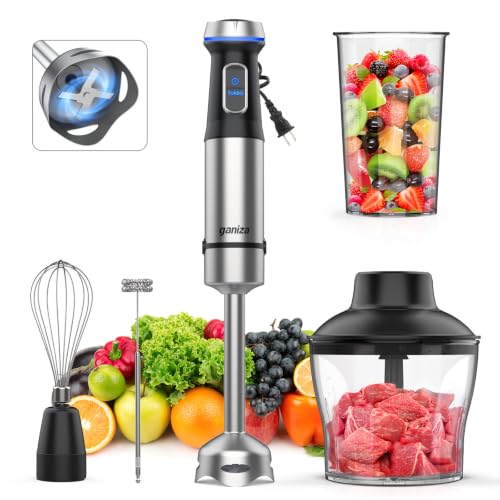
3. Ganiza Immersion Blender 5-in-1 — Best for Power and Attachments
The Ganiza plays the numbers game and wins it: a motor rated up to 1000W, sixteen speed settings, and a full attachment set — 800ml mixing beaker, 600ml chopper, whisk, and milk frother — at an affordable-tier price. If your immersion blender is also your smoothie maker, your salsa prep, and your whipped-cream machine, this is the maximalist option.
Strengths
- Up to 1000W — the highest-rated motor in this guide
- Sixteen speed settings for unusually fine control
- Generous beaker and chopper sizes among the included attachments
Trade-offs
- Sixteen speeds is more granularity than most cooks will use
- Full set demands storage space
- Peak power still works in bursts — it is not a continuous-duty motor
| Spec | Detail |
|---|---|
| Motor | Up to 1000 watts |
| Speeds | 16 speed settings |
| Included | 800ml beaker, 600ml chopper, whisk, milk frother |
| Blade | Stainless steel |
In the pot, the Ganiza’s advantage is torque at low-to-mid speeds: thick mixtures start moving without the all-or-nothing lurch of a two-speed stick, and the fine speed ladder lets you creep up on the right intensity for a bisque versus a bean soup. The 600ml chopper is big enough for a real batch of salsa or a couple of onions, and the 800ml beaker suits two smoothies or a family-size dressing. As with every set here, the honest cost is logistics — attachments need a home — but for cooks who will actually use them, this is the most capability per dollar in the guide.
Best for: multi-taskers who want maximum power and a full attachment set / Not suited for: buyers who want the simplest possible tool

4. KitchenAid Variable Speed Corded Hand Blender with Attachments KHBV83 — Best Premium Within Budget
The KHBV83 is what happens when a major appliance brand builds the affordable immersion blender properly. The variable-speed trigger — squeeze for speed, exactly like a power drill — gives the finest submerged control in this guide, which is precisely what immersion work rewards. The system includes a blending pitcher, a whisk, and a chopper attachment around a removable 8-inch blending arm, all in KitchenAid’s matte finish, with the parts support a big brand provides.
Strengths
- Variable-speed trigger for unmatched low-speed control
- Removable 8-inch blending arm reaches real stockpots
- Pitcher, whisk, and chopper included in one system
Trade-offs
- The premium end of the affordable tier
- Trigger control has a short learning curve
- System pieces need organized storage
| Spec | Detail |
|---|---|
| Control | Variable speed trigger |
| Blending arm | Removable, 8-inch |
| Included | Blending pitcher, whisk, chopper attachments |
| Best tasks | Soups, smoothies, sauces, emulsions |
The trigger’s immersion advantage shows in the first second of every blend: you can feather the motor awake inside a full pot without the explosive startup that coats rims and stovetops, then lean into full power as the vortex forms. The arm’s guard is shaped to reduce suction against the pot floor, which makes walking the stick through a big soup noticeably calmer than with basic bells. And when the blending is done, the arm detaches and rinses while the motor body stays dry — the workflow every immersion cook wants.
Choose the KHBV83 if you blend often enough to feel the difference control makes, and you would rather buy the refined tool once than the basic tool twice.
Best for: frequent immersion cooks who value control and brand support / Not suited for: the strictest budgets

5. MasterChef Immersion Blender 400W — Best Simple Controls
The MasterChef makes a case for simplicity: a 400W motor, variable speed control with a turbo boost, a stainless steel blending stick, and an easy-clean design — the immersion blender reduced to its essentials and done competently. There is no attachment ecosystem to manage and no speed ladder to memorize; you point it at soup, puree, or baby food and it works.
Strengths
- Variable speed plus turbo covers the real-world range
- 400W motor is a sensible middleweight for home pots
- Easy-clean stainless stick, minimal fuss
Trade-offs
- No whisk, chopper, or beaker included
- Less refined ergonomics than the KitchenAid or Braun class
- Not the pick for very thick, dense mixtures daily
| Spec | Detail |
|---|---|
| Motor | 400 watts |
| Control | Variable speed + turbo boost |
| Stick | Stainless steel, easy clean |
| Best tasks | Puree, baby food, soup |
In practice, the MasterChef’s variable dial handles the immersion rhythm well — start low, build speed, finish with a turbo burst to catch the strays — and its middleweight motor is honestly matched to family-size pots rather than catering vats. It is the pick for the cook who looked at the 5-in-1 sets, pictured the drawer chaos, and chose peace. Baby food parents in particular will appreciate a tool that goes from pot to rinse in under a minute with nothing to reassemble.
Best for: cooks who want a capable stick with no attachments and no learning curve / Not suited for: anyone who wants chopper or whisk functions in the same purchase

6. Turelar Immersion Blender 1100W 5-in-1 — Best for Baby Food and Family Prep
The Turelar pairs the highest headline wattage here with a trigger-style variable speed — a combination aimed at households that blend constantly and variably: baby food in small batches, smoothies, purees, sauces, and the food-processor jobs in between. Its set includes a food processor bowl, whisk, and frother, and the anti-scratch design consideration matters for the nonstick pots family cooking happens in.
Strengths
- 1100W rating with trigger variable speed
- Food processor, whisk, and frother attachments included
- Anti-scratch design suits coated cookware
Trade-offs
- Headline wattage is a peak figure — technique still rules
- Full set needs storage
- Trigger plus power demands a careful first second in shallow liquid
| Spec | Detail |
|---|---|
| Motor | 1100 watts (rated) |
| Control | Trigger variable speed |
| Included | Food processor, whisk, frother |
| Best tasks | Soup, puree, baby food, smoothies |
Baby food is secretly the perfect immersion job — small batches, soft ingredients, cooked in the pot they will be pureed in — and the Turelar’s fine low-end control produces the smooth, lump-free texture that stage-one weaning requires, while the processor bowl handles the chunkier stage-two mixes. For the wider family menu, the same control serves smoothies in the morning and soup at night. Treat the big wattage number as headroom rather than a promise, work in bursts, and this set covers a young family’s blending years in one purchase.
Best for: families, baby-food makers, and nonstick-pot households / Not suited for: buyers who prefer buttons to a trigger or want a bare stick
Read the table below as a map rather than a ranking: the Mueller and Ganiza compete on system completeness, the KitchenAid on refinement, the MasterChef on simplicity, the Turelar on family versatility, and the OVENTE on price — six different answers to the same question, each correct for a different kitchen. Your pot size, your recipes, and your storage drawers decide which column matters.
Comparison Table
| Pick | Badge | Key spec | Best for |
|---|---|---|---|
| Mueller 800W 5-in-1 | Best Overall | 800W, 12 speeds + turbo, full set | Big pots, complete system |
| OVENTE HS560B | Best Budget | 300W, 2 speeds | Occasional soups and purees |
| Ganiza 5-in-1 | Best for Power and Attachments | Up to 1000W, 16 speeds, big beaker/chopper | Maximum capability per dollar |
| KitchenAid KHBV83 | Best Premium Within Budget | Variable trigger, 8-inch arm, full system | Control and refinement |
| MasterChef 400W | Best Simple Controls | 400W, variable + turbo | No-fuss everyday blending |
| Turelar 1100W 5-in-1 | Best for Baby Food and Family Prep | Trigger variable speed, processor set | Families and baby food |
How to Choose an Affordable Immersion Hand Blender
Judge the guard, not the wattage
Immersion blending happens underwater, where the blade guard’s fluid dynamics decide everything. A good guard draws food in, passes it across the blade, and vents the flow without spraying or suction-locking to the pot floor. Wattage only sets the ceiling; the guard decides how much of that ceiling you can use. This is why a well-guarded 400–500W stick can out-puree a poorly guarded 1000W one — and why the rankings here weigh control systems and guard behavior ahead of headline numbers.
Speed architecture: two speeds, dials, and triggers
Two fixed speeds suffice for soups and purees. A multi-speed dial adds the gentle low end that emulsions and baby food want. A variable trigger — KitchenAid and Turelar in this guide — gives continuous, in-the-moment control and is the connoisseur’s choice for cooks who blend several times a week. Turbo buttons are finishing tools, useful for the last five seconds of a pot. Buy the architecture that matches your recipes, not the one with the most numbers on the dial.
Shaft length, material, and your cookware
Eight inches of shaft is the home standard because it keeps the blade submerged in a stockpot while the motor stays clear of the steam. Stainless shafts tolerate hot liquids and rinse clean; confirm the shaft detaches for washing. If your pots are nonstick, prioritize guards designed to minimize contact and never run the blade against the coating — or blend in a stainless or enamel vessel and spare the coating entirely.
Beaker work vs. pot work
Decide where your blending happens. Pot-first cooks need shaft length and heat tolerance. Beaker-first cooks — smoothies, dressings, single servings — need a guard that fits their cup and a beaker in the box, which is where the sets (Mueller, Ganiza) pull ahead. Many households do both, which is the practical argument for a mid-priced system over a bare stick.
Duty cycle and motor honesty
Every motor in this guide is intermittent-duty, and the honest way to compare them is not the wattage line but how they behave across a sequence of submerged bursts. A motor that delivers its power smoothly at low and mid speeds — the working range of immersion blending — is worth more than a higher peak figure that only arrives at a screaming top speed you will rarely use in a pot. Plan your blending in bursts, let hot motors rest, and treat any burnt smell as a stop signal rather than a challenge. Cooks who regularly blend at catering volume should step up to the commercial stick category rather than punishing a home tool.
Ergonomics you can verify from a listing
You cannot hold the product before it arrives, but listings reveal more than shoppers use: grip shape (tapered and textured beats straight and glossy), button placement (a trigger or top slide you can hold without cramping), total weight (a heavy stick punishes long soup sessions), and cord length (short cords tether you to the outlet nearest the stove, which is rarely where you want to stand). Cross-check those details against the picks’ descriptions above and you will rarely be surprised by what comes out of the box. When two picks otherwise tie, choose the one whose grip and controls suit the hand that will actually hold it — in immersion blending, the human is half the machine, and comfort is a performance specification.
The Physics of Immersion: Why the Underwater Vortex Is Different
A countertop blender builds a vortex in a sealed, shaped vessel and lets it run. An immersion blender builds one in the open, inside whatever pot the food is in — and that changes the technique completely. The guard’s bell creates a small, intense circulation cell: food is drawn up through the blade and expelled sideways, and the surrounding liquid feeds the cell only as fast as you move the stick through it. This is why immersion blending is a walking motion, not a waiting motion — hold the stick in one place and you polish one cylinder of soup while the rest of the pot stays chunky.
It also explains the category’s two classic failures. Suction-lock happens when the guard’s rim seals against a flat pot bottom, starving the cell; tilting the shaft a few degrees breaks the seal and restarts the flow. Splashing happens when the cell breaks the surface — the blade must stay submerged, because the moment the bell breaches, the vortex throws food instead of circulating it. Every technique rule in the next section is just these two facts wearing an apron: submerge fully, start gently, keep moving, tilt to break suction, and let the cell do the work.
Temperature adds one more variable. Hot liquids are less viscous than cold ones, so a soup at a simmer circulates more willingly than the same soup cold — one reason immersion blending of hot food feels easier than blending a cold, thick mixture of the same ingredients. The trade-off is that hot liquid also splashes more energetically when it does escape, which is why the discipline above matters more, not less, as the pot gets hotter. Work with the physics — hot, deep, submerged, moving — and an affordable stick performs like a far more expensive tool.
How to Blend Hot Soup Safely With an Immersion Blender
- Take the pot off the boil. Let soup come off a rolling boil for a minute or two. You can blend hot; you should not blend actively bubbling, which throws scalding droplets.
- Check the depth. The blade guard needs to sit fully submerged with liquid to spare. Very shallow soup blends better transferred to a narrower, deeper vessel.
- Submerge, then start low. Guard under the surface, motor off; start on the lowest speed and build as the vortex forms.
- Walk the pot slowly. Move the stick in slow passes, tilting to break any suction, working the edges and corners where chunks hide. Rest between passes on thick soups.
- Stop before you lift. Release the button, let the blade stop, then raise the shaft. A spinning blade leaving liquid is a spray cannon.
- Keep the cord clear. Drape it behind you, away from burners and the pot’s hot rim, and keep your free hand off the pot’s edge while blending.
- Rinse the shaft immediately. Hot soup dries into cement on a blade guard. A quick soapy-water blend and rinse now saves a scrubbing session later.
Troubleshooting Common Immersion Blending Problems
Problem: The soup is smooth in patches and chunky in others. The stick stayed in one place. Immersion blending only processes the food that passes through the guard’s circulation cell, so walk the pot in slow passes, tilt into the corners, and give thick soups a stir between passes to redistribute what is hiding at the edges.
Problem: The blender sprays when I start. The guard was not fully submerged, or you started at high speed. Submerge first, start on the lowest speed for two or three seconds while the vortex forms, then increase. In shallow liquid, transfer to a narrower, deeper vessel — depth is the cheapest anti-splash technology there is.
Problem: The guard keeps sucking onto the bottom of the pot. The rim has sealed against the flat floor. Tilt the shaft a few degrees to break the seal, keep the stick moving, and never press down while blending — let the circulation pull food in rather than forcing the guard through it.
Problem: The motor smells hot and slows down. The mixture is too thick for continuous running, or you have been blending without rests. Stop, let the motor cool for a minute, thin the mixture with a splash of stock or water if the recipe allows, and continue in shorter bursts. A hot smell ignored repeatedly is how affordable motors die young.
Problem: My mayonnaise will not thicken. The oil went in too fast or the stick started too high in the jar. Restart with the blade at the very bottom of a tall, narrow container, the base ingredients under the blade, and raise the stick slowly only after the bottom layer turns white and thick. Fine low-speed control — the trigger and wide-dial picks in this guide — makes this dramatically easier.
Problem: There is a sour smell from the blender even after washing. Residue is trapped under the blade or in the coupling. Soak the detached shaft in warm water with baking soda, work a bottle brush around the guard’s underside, rinse, and dry completely before reassembling. If the smell survives that, inspect the coupling for trapped food and clean it with a toothbrush.
Common Buying Mistakes
- Buying for the beaker, cooking in pots. A short-shafted stick that cannot stay submerged in your stockpot fails at the category’s main job.
- Believing peak-wattage marketing. Several picks here advertise maximum figures; sustained submerged performance depends on guard design and control, which is how we ranked them.
- Skipping the low end. A stick with no gentle speed will splash at every startup and break every emulsion. Control is a feature, not a luxury.
- Blending on a rolling boil. It is dangerous and unnecessary; sixty seconds off the boil changes nothing about the soup and everything about your safety.
- Using the stick as a masher. Forcing the guard through dense food bends shafts and burns motors. Let the vortex pull food in.
- Immersions of the wrong part. Only the shaft is submersible. The motor body meets water once, briefly, at the end of its life.
Soup by Soup: Matching the Pick to the Pot
Not all immersion work is equal, and the fastest way to choose among these six is to name your most common pot.
Smooth vegetable soups and bisques
Potato-leek, tomato, roasted red pepper — soft ingredients, generous liquid, texture goal of “silky.” Every pick here succeeds; the differentiators are manners. The KitchenAid KHBV83’s trigger makes the gentle work pleasant, the Mueller’s range finishes fast, and even the OVENTE gets there with an extra pass. If this is your whole immersion life, buy for ergonomics and quiet confidence rather than power.
Thick legume and squash soups
Split pea, black bean, lentil, butternut — dense, low-liquid, and stubborn. These pots expose weak motors and lazy guards. The Mueller 800W and Ganiza earn their rankings here, pulling thick mixtures into circulation where a 300W stick needs help from a spoon and your patience. If your soup pot leans legume, buy torque: it is the one immersion job where the strong end of this guide is not a luxury.
Chunky-to-smooth flexibility and family prep
Many cooks want partial blending — a soup left rustic with some body blended in — plus baby food, smoothies, and sauces in the same week. Partial blending is a control exercise: short bursts, constant motion, stop early. Trigger and wide-dial models (KitchenAid, Turelar, Mueller) make it repeatable, and the sets with beakers and processors cover the rest of the family workload. This is the most common real-world pattern, and it is why versatile systems dominate the top of this list.
Emulsions, Sauces, and Dressings: Where Immersion Blenders Beat Everything Else
Ask a professional cook which blender they would keep if they could keep only one, and the immersion stick wins surprisingly often — because of emulsions. Mayonnaise, aioli, hollandaise, and vinaigrettes are all built the same way: a thin stream of oil incorporated into a base until the mixture thickens into a stable sauce. In a countertop blender that process is violent and fussy; the vortex flings oil up the walls and the emulsion breaks if the pour is uneven. An immersion blender in a tall, narrow jar does it almost magically — the blade sits at the bottom under the base ingredients, oil pools on top, and as you start the motor and slowly raise the stick, the sauce emulsifies from the bottom up in a controlled column. It is the single most reliable home method for mayonnaise ever devised, and it works with the affordable sticks in this guide provided they have a genuinely gentle low speed — one more reason control architecture outranks wattage here.
The same qualities serve cooked sauces. A pan sauce finished with a ten-second immersion blend gains body without flour or cream; a tomato sauce loses its watery separation; a gravy with lumps is rescued in place, in the roasting pan, in seconds. These are thirty-second jobs that no one would dirty a countertop pitcher for, which is exactly the point: the immersion blender’s real competition is not other blenders but the whisk and the sieve, and it beats both on speed, smoothness, and washing-up. If your cooking leans French, saucy, or soupy, weight this section heavily in your choice — it is why the trigger-controlled KitchenAid and the wide-range Mueller rank where they do.
Immersion Blender Care: The Shaft, the Seal, and the Smell
Immersion blenders live hard lives — boiling soup, tomato acid, turmeric — and die predictable deaths. The good news is that nearly all of those deaths are postponed indefinitely by three habits.
First, clean the shaft immediately, every time. The blade guard’s underside is a maze of crevices where puree dries into concrete and bacteria throw parties. The sixty-second fix is a blend in warm soapy water right after use, followed by a rinse and a shake-dry. Detachable shafts — most picks here — make this trivially easy and many tolerate the dishwasher, though hand-rinsing keeps seals and finishes happier for longer.
Second, protect the coupling and the seal. The joint where shaft meets motor body is the machine’s wear point: rinse it, dry it, and never store the stick assembled and wet, which corrodes contacts and grows the sour smell that eventually perfumes every soup. If your stick develops a persistent odor, the culprit is almost always residue trapped under the blade or in the coupling — a soak of the shaft (never the motor body) in warm water with baking soda, followed by thorough drying, resolves it.
Third, respect the motor’s rhythm. Bursts, rests, and no forcing the guard through dense food as if it were a plunger. A stick treated this way — cleaned fast, stored dry, worked in bursts — routinely serves for years, and when the shaft eventually wears, the brands in this guide sell replacements, turning a tired tool new again for a fraction of a replacement machine’s cost. That parts ecosystem is the unglamorous reason this list is made of Muellers, KitchenAids, and their peers rather than cheaper names with better spec sheets.
Final Recommendation
The Mueller 800W 5-in-1 is the affordable immersion blender most cooks should buy: strongest useful motor here, widest speed range, and the attachments an immersion cook actually uses. The KitchenAid KHBV83 is the connoisseur’s step up for its trigger control, and the OVENTE HS560B proves how little you can spend and still puree a pot of soup properly.
Keep exploring the cluster: Best Affordable Hand Blenders, Best Affordable Blenders For Pureeing Hot Soup, Best 10 Commercial Stick Blenders, Best 2 Hand Blenders, and Best Affordable Blenders.
A closing thought for the undecided: the immersion blender is the rare appliance whose value compounds. The first month it makes soup easier; the sixth month it has quietly absorbed your dressings, your sauces, your baby food, and your whipped cream, and changed how you cook on weeknights — fewer transfers, fewer dishes, more sauces finished properly instead of skipped. Buying the right affordable one is less about the money than about removing the small frictions that decide whether a tool becomes a habit. Pick the stick above that matches your pot and your patience, learn its first-second manners, and it will earn its drawer space many times over.
Frequently Asked Questions
Are immersion blenders and hand blenders the same thing?
Yes — immersion blender, hand blender, and stick blender are three names for one tool. This guide simply ranks the affordable field through the immersion lens: in-pot performance, hot-liquid behavior, and submerged control.
Can I blend boiling soup with an affordable immersion blender?
Blend it hot, not boiling. Take the pot off the heat for a minute so the rolling boil subsides, keep the blade fully submerged, and start on low speed. The stainless shafts in this guide are built for hot liquids; the rolling boil is a safety problem, not an equipment limit.
Why does my immersion blender suction itself to the pot?
The guard’s rim has sealed against the flat bottom, starving the blade’s circulation. Tilt the shaft slightly to break the seal and keep the stick moving in slow passes rather than pressing it down in one spot.
How long should I blend a pot of soup?
Typically two to four passes of 20–40 seconds each, moving the stick around the pot, with brief rests between passes on thick soups. Total active blending is usually under two minutes; if chunks remain, the issue is coverage — work the edges — not more time in one spot. Finish with a quick stir and a visual check against the pot’s sides and bottom, where the last unblended pieces always hide, and give any strays one final short burst rather than re-blending the whole pot.
Can an immersion blender make baby food safely smooth?
Yes — it is one of the tool’s best jobs. Cook the food soft, blend in the pot or a beaker with enough liquid, and run the fine, low-speed control (the Turelar and KitchenAid here excel) until no lumps remain. Always check the temperature and texture before serving, and follow current pediatric guidance on ingredients and storage.
Do I need a chopper attachment with an immersion blender?
Only if your prep includes frequent small chopping — onions, herbs, salsa, breadcrumbs. Soup cooks who chop aromatics daily get real value from the Mueller or Ganiza sets; cooks with a food processor they already use can save the money and storage with a bare stick like the MasterChef.
Can an immersion blender whip cream and eggs?
With a whisk attachment, yes — whipped cream, meringue, and scrambled-egg mixtures are all comfortable work for the sets in this guide (Mueller, Ganiza, KitchenAid, Turelar). The bare blending shaft is not the tool for whipping, since its guard is designed to circulate liquid rather than incorporate air. If whipping matters to you, choose a set with the whisk in the box rather than planning to improvise.
What size pot can an affordable immersion blender handle?
Family stockpots in the four-to-eight-quart range are the home immersion blender’s natural habitat, worked in passes. The limits are depth — the blade must stay submerged — and density, not raw volume. Beyond that, or for continuous commercial service, step up to the commercial stick blenders covered elsewhere in this series, whose longer shafts and continuous-duty motors are built for vats rather than pots.


