Disclosure: airfryerkitchensupply.com is reader-supported. When you buy through links on our site, we may earn an affiliate commission at no extra cost to you.
Where to buy
Every personal blender below was verified against Amazon’s live catalog data for this guide — model, ASIN, and cup configuration confirmed — so the link opens the exact machine the review describes. Personal blender bundles change often; check the current price on Amazon and confirm the cup count on the listing before ordering.
- NutriBullet Pro 900 — Check on Amazon
- Ninja Fit Compact Personal Blender QB3001SS — Check on Amazon
- magic bullet Personal Blender MBR-1101 — Check on Amazon
- Ninja Nutri Blender BQ301 — Check on Amazon
- Ninja Nutri-Blender Pro BN401 — Check on Amazon
- Ninja Blast Portable Blender BC151BK — Check on Amazon
Introduction
The hunt for the best afforadble personal blenders — another of the cheerfully misspelled searches that lead to this category — is a hunt for a very specific kind of freedom: a smoothie in two minutes, in the cup you drink from, with almost nothing to wash. Personal blenders won their place in modern kitchens not by out-blending big machines but by out-conveniencing them, and the affordable end of the personal market is where that convenience is cheapest. The catch is that this tier also contains the weakest motors in blending, machines that leave frozen berries in chunks and burn out by spring. This guide separates the two populations. The six verified picks below all clear the bar that matters — they actually blend frozen fruit and greens into a smooth drink — and they span the format’s real range: a 900-watt benchmark, a budget Ninja, the tiny original Magic Bullet, a three-cup household set, an 1,100 peak-watt powerhouse, and a cordless blender that works anywhere at all.
One honest framing before the picks: a personal blender is a single-serving tool with a single-serving ceiling. Nothing in this guide will serve a family breakfast or puree a pot of soup, and the reviews will keep saying so, because the most common disappointment in this category is a buyer who needed a pitcher and bought a cup. If your blending is personal — shakes, smoothies, small sauces, baby food in small batches — you are in the right guide, and the affordable tier will serve you genuinely well.
In this guide
Quick Picks
- Best Overall: NutriBullet Pro 900 — the 900-watt benchmark of the category, with the power to make frozen fruit and greens genuinely smooth in a compact footprint. Check on Amazon
- Best Budget: Ninja Fit QB3001SS — a 700-watt personal blender with two 16-ounce cups, from the brand that treats ice as a personal enemy. Check on Amazon
- Best for Small Portions: magic bullet MBR-1101 — the tiny 250-watt original, perfect for shakes, sauces, and small jobs in the smallest kitchens. Check on Amazon
- Best Cup Set: Ninja Nutri Blender BQ301 — 900 peak watts and three 20-ounce cups, so nobody in the household waits for a clean cup. Check on Amazon
- Best Power: Ninja Nutri-Blender Pro BN401 — 1,100 peak watts with Auto-iQ programs and two 24-ounce cups, the strongest personal format here. Check on Amazon
- Best Cordless: Ninja Blast BC151BK — an 18-ounce USB-C rechargeable blender that works at the office, the gym, or a campsite. Check on Amazon
How These Picks Were Chosen
Personal blenders live or die on three things, and the selection weighted them in this order. First, verified power appropriate to the job: each pick’s motor rating was confirmed in its own listing, and the guide distinguishes true ratings from peak ratings wherever brands quote them. Second, the cup ecosystem: how many cups come in the box, in what sizes, and whether replacements are easy to find, because in this format the cups are the appliance as much as the base is. Third, honest fit: each pick had to be the best answer to a different personal-blending life — the daily smoothie devotee, the budget buyer, the dorm resident, the multi-person household, the power seeker, the traveler.
Excluded along the way: the swarm of anonymous personal blenders whose listings promise implausible wattages from motors the size of a fist, and whose cups and blade bases have no replacement supply. A personal blender’s blade base and gasket are wear parts by design; a machine whose wear parts cannot be replaced is a disposable, whatever its listing claims. Every pick here comes from a brand with a real catalog behind it.
A word on what “affordable” means in this particular guide, since the picks span a range: it means the personal-blender market’s sane shelf — the models sold by the format’s real brands at their everyday positioning, below the premium bundles and collector editions. Prices in this category swing with promotions, so the guide ranks by capability and fit rather than by a number that would expire. Use the links to see the current figure for each pick, and judge it against the years of mornings the machine is being bought for.
The Best Afforadble Personal Blenders, Reviewed

NutriBullet Pro 900 — Best Overall
The Pro 900 is the personal blender against which the category is measured, and at 900 watts it remains the sweet spot of power, size, and simplicity. The design is a study in removing steps: fill the cup, twist on the blade base, press onto the motor, and under a minute later swap the blade for a drinking lid. Frozen strawberries, banana, spinach, and protein powder — the standard morning load — come out smooth, with none of the graininess that gives personal blenders a bad name. The verified listing for this guide is the Special Edition in white, which suits bright, small kitchens where the appliance stays out. It suits one-to-two-person households with a daily smoothie habit. It does not suit batch blending or anyone who needs to crush large amounts of ice.
Strengths
- 900 watts delivers genuinely smooth results with frozen fruit and leafy greens.
- The twist-on workflow is the fastest in the category — about two minutes, cup to commute.
- Years on the market mean cups, lids, gaskets, and blade bases are available everywhere.
Trade-offs
- Strictly personal capacity; a second serving means a second cycle and a second cup.
- Press-and-twist operation offers less texture control than a dial.
- The white finish needs a wipe-down habit to stay looking clean.
| Spec | Detail |
|---|---|
| Motor | 900 watts |
| Format | Personal blender, Special Edition |
| Finish | White |
| Operation | Twist-on cup, press to blend |
The Pro 900’s real achievement is reliability of outcome. Personal blenders have a reputation for variance — great on Monday, chunky on Tuesday — usually because their motors are marginal for frozen loads. At 900 watts this machine has headroom, and headroom is consistency: the same smoothie comes out the same way every day, which is what turns a purchase into a habit. Respect the max-fill line, keep the gasket healthy, and it will run a morning routine for years. In a category full of almost-powerful-enough machines, the Pro 900 is the one that simply is powerful enough.
Best for: daily smoothie drinkers who want the category’s benchmark in a compact footprint. / Not suited for: families or batch work of any kind.
Check the current price on Amazon

Ninja Fit Compact Personal Blender QB3001SS — Best Budget
The Ninja Fit brings Ninja’s ice-hostile engineering down to the friendliest point in this guide: a 700-watt base and two 16-ounce cups with sip-and-seal lids. Sixteen ounces is the honest size of a personal smoothie — not a pitcher in disguise — and the Fit’s blades pull frozen fruit through that volume with the competence you would expect from the brand. The base is compact enough for a dorm shelf or a crowded counter corner, and the whole routine — blend, lid, go — takes minutes. It suits students, first apartments, office kitchens, and anyone whose blending is one shake or smoothie at a time. It does not suit big appetites or two-person mornings without a second cycle.
Strengths
- 700 watts is strong for a budget personal blender — frozen fruit blends without stalling.
- Two 16-ounce cups with travel lids cover the blend-and-go routine completely.
- Compact base stores almost anywhere, including a cabinet or a deep drawer.
Trade-offs
- 16-ounce cups are the smallest full-size servings in this guide.
- One cup in use means the second person’s smoothie waits its turn.
- Like all personal blenders, it is a cold-drink machine only.
| Spec | Detail |
|---|---|
| Motor | 700 watts |
| Cups | (2) 16 oz cups with lids |
| Format | Compact personal blender |
| Model | QB3001SS |
What makes the Fit the budget pick rather than merely a cheap one is that its compromises are all in size, none in competence. The smoothies are smooth; the ice in drinks gets crushed; the cups seal and travel. You give up volume and cup count, not results. For the buyer whose alternative was a no-name machine with a fantasy wattage and no replacement cups, the Fit is the rational floor of the category: the least you can spend while still buying a blender that does its whole job.
Best for: students, solo dwellers, and budget buyers who still want real blending. / Not suited for: large servings or multi-person mornings.
Check the current price on Amazon

magic bullet Personal Blender MBR-1101 — Best for Small Portions
The Magic Bullet is the original personal blender, and its modern 250-watt form is best understood as a specialist: not a smoothie powerhouse, but a tiny, tireless helper for the small jobs that fill a cooking day. Protein shakes, salad dressings, chopped garlic and herbs, baby food, whipped toppings, a single serving of salsa — the Bullet does these in seconds, in a 22-ounce cup, on a base the size of a mug. Its low power is a genuine limit with frozen fruit, and this guide will not pretend otherwise: frozen loads need thawed helpings and modest expectations. It suits small kitchens, light-duty users, and cooks who want a prep helper. It does not suit frozen-smoothie devotees — that is what the other five picks are for.
Strengths
- The smallest footprint in the guide — it lives where no other blender fits.
- Excels at the small-job repertoire: shakes, dressings, dips, chopping, grinding.
- Simple press-down operation with cups that double as storage and serving vessels.
Trade-offs
- 250 watts is genuinely light; frozen fruit must be partially thawed and loads kept modest.
- Short blend bursts are the rule — the motor is built for seconds, not minutes.
- Texture ceiling is the lowest here; silky green smoothies are beyond it.
| Spec | Detail |
|---|---|
| Motor | 250 watts |
| Cup | 22 oz cup, to-go cups included |
| Format | Personal blender, silver |
| Model | MBR-1101 |
Judged as a smoothie machine, the Magic Bullet is the weakest pick in this guide, and it is included anyway — because judged as a kitchen helper, it is one of the most useful small appliances ever sold. The buyers who love it use it six times a day for six different small jobs, none of which need 900 watts. The buyers who hate it asked it to be a frozen-fruit blender. This review exists to make sure you are in the first group before you buy it, because in its proper role the little machine is close to perfect.
Best for: small kitchens and cooks who want a tiny all-purpose prep helper. / Not suited for: frozen smoothies or any heavy daily blending.
Check the current price on Amazon

Ninja Nutri Blender BQ301 — Best Cup Set
The BQ301’s headline is logistics: 900 peak watts and three 20-ounce cups. In a household where two or three people blend at different times, the binding constraint is never power — it is whether a clean cup exists at 6:40 in the morning. Three cups dissolve that constraint, and the 20-ounce size is the generous end of personal servings. The peak-watt rating deserves its honest label: sustained performance sits with the strong personal class rather than with the 1,100-watt BN401, but for smoothies and shakes that class is entirely sufficient. It suits multi-person grab-and-go households and gym households with staggered schedules. It does not suit anyone needing a pitcher or maximum power.
Strengths
- Three 20-ounce cups — the best cup count and size combination in this guide.
- 900 peak watts handles frozen-fruit smoothies and shakes without drama.
- Cups travel well and the base stays compact on the counter.
Trade-offs
- Peak rating: a step below the BN401 in sustained crushing power.
- Still one serving per cycle; the cups solve washing, not batching.
- No automated programs — timing is by eye and habit.
| Spec | Detail |
|---|---|
| Motor | 900 peak watts |
| Cups | (3) 20 oz cups |
| Format | Personal blender |
| Model | BQ301 |
Think of the BQ301 as the household-systems pick. Its blending quality is solidly in the strong-personal tier — smoothies smooth, shakes lump-free — and its cup set quietly removes the friction that kills smoothie habits in shared homes. If you live alone, the Pro 900 or the Fit serves you better. If your kitchen runs on staggered mornings, this is the machine designed around your actual problem, and solving the actual problem is the highest form of value in this category.
Best for: households of two or three blending individual smoothies to go. / Not suited for: power seekers or pitcher jobs.
Check the current price on Amazon
Ninja Nutri-Blender Pro BN401 — Best Power
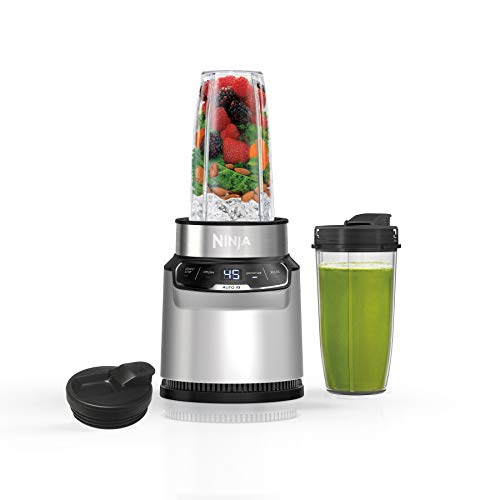
The BN401 is what happens when Ninja decides a personal blender should not compromise: 1,100 peak watts, Auto-iQ programs that run timed blend-and-pulse patterns for you, and two 24-ounce cups — the largest personal servings in this guide. The programs are the differentiator in daily use: press the button and the machine executes the pulse-rest-blend choreography that produces the smoothest result, while you do something else with your morning. Frozen fruit, ice in drinks, and fibrous greens all come out at a level that embarrasses the personal-blender stereotype. It suits serious smoothie drinkers, green-smoothie households, and anyone who wants personal format without personal-format results. It does not suit the tightest budgets or the smallest counters — it is a substantial base.
Strengths
- 1,100 peak watts is the strongest personal blending in this guide.
- Auto-iQ programs automate the pulse technique for consistently smooth results.
- Two 24-ounce cups serve generous single portions and smoothie bowls.
Trade-offs
- Peak-watt rating, and the price of the format’s top end.
- Larger, heavier base than the other personal picks.
- Power this concentrated is loud in a small cup — mornings are not silent.
| Spec | Detail |
|---|---|
| Motor | 1,100 peak watts |
| Cups | (2) 24 oz cups |
| Programs | Auto-iQ programs |
| Model | BN401 |
The BN401 closes the last argument against personal blenders — that they are toys next to real machines. On smoothies and green smoothies, its results stand comparison with full-size blenders costing far more, because power density in a small cup is a genuine physical advantage and Auto-iQ spends it optimally. What it cannot do is scale: it will never make soup for six. But for the buyer whose blending universe is the daily smoothie, made perfectly, this is the end of the personal-format road.
Best for: serious smoothie and green-smoothie drinkers wanting maximum personal power. / Not suited for: tight budgets or batch blending.
Check the current price on Amazon

Ninja Blast Portable Blender BC151BK — Best Cordless
The Blast removes the last constraint the other picks share: the wall outlet. This 18-ounce cordless blender recharges over USB-C and blends where life happens — at a desk, in a gym bag, at a campsite, in a hotel room. Cordless motors are necessarily gentler than corded ones, and the Blast is honest about its lane: protein shakes, fresh-fruit smoothies, and powdered drinks come out smooth; a cup packed with frozen bricks will test its patience and its battery. Used as intended, it is the only blender in this guide that can join you absolutely anywhere. It suits travelers, commuters, office workers, and outdoor households. It does not suit frozen-load purists or anyone blending for more than one.
Strengths
- True cordless freedom with USB-C charging — blends anywhere, stores anywhere.
- 18-ounce vessel is a complete personal serving that you drink from directly.
- Quiet, quick cycles suit offices and shared spaces where corded Ninjas cannot go.
Trade-offs
- Battery power trails every corded pick here on frozen loads.
- Charge management joins your routine — a dead battery means no smoothie.
- One serving, modest volume, by design.
| Spec | Detail |
|---|---|
| Format | Cordless portable blender |
| Capacity | 18 oz |
| Charging | USB-C rechargeable |
| Model | BC151BK, black |
The Blast is best understood as a second blender — the one that covers the blends your kitchen machine cannot reach. Office workers who buy lunch smoothies, travelers who keep a routine on the road, and gym members who blend at the locker all extract value from it that no corded machine can offer. Keep frozen expectations modest, keep soft and fresh ingredients as its staple, and charge it with your phone at night. Judged on freedom rather than force, it has no competitor in this guide.
Best for: travelers, office and gym blending, and anyone who blends away from a kitchen. / Not suited for: heavy frozen loads or multi-serving work.
Check the current price on Amazon
Job by Job: What Personal Blenders Actually Do Best
Smoothies and protein shakes — the core job
This is the format’s reason to exist, and the spread of results maps directly onto the power ladder. The Pro 900 and BN401 produce café-smooth results with frozen fruit; the Fit and BQ301 are a half-step behind on the most fibrous loads; the Magic Bullet needs thawed fruit and modest ambitions; the Blast prefers fresh fruit and powders. Protein shakes are easy everywhere — powder, liquid, thirty seconds — and are the one job where even the lightest machine is fully sufficient.
Green smoothies — a power-and-technique test
Greens punish weak personal blenders with strings and flecks. The BN401’s programs and the Pro 900’s headroom handle kale and spinach cleanly; the mid-power Ninjas do well with the greens-first technique described in the how-to section; the Magic Bullet and the Blast will leave evidence. If green smoothies are your daily ritual rather than an occasional experiment, buy from the top half of this list and do not look back.
Sauces, dressings, and dips — the quiet specialty
Small-batch wet work is where personal blenders secretly outshine pitchers, because a cup keeps a small volume in the blades instead of smearing it across a big jar. Vinaigrettes emulsify beautifully, pesto comes together in the right quantity for one meal, and a single serving of salsa or chimichurri takes seconds. The Magic Bullet built its legend here, but every pick in this guide does this work well.
Baby food and small purees — natural fit
Steamed vegetables and fruits puree in exactly the portions a baby eats, in a cup that goes straight to the fridge. Every corded pick handles this; the discipline is the same no-hot rule — let food cool before sealing a cup, and blend warm rather than steaming.
Frozen drinks — ingredient, not event
A personal blender makes a fine frozen drink for one: the Ninja models especially, with their ice-capable blades. What the format cannot do is the pitcher-for-the-table event. Treat frozen drinks as a personal serving here and the results will please you; ask for a party batch and you are shopping in the wrong guide.
Ownership: Cups, Gaskets, and the Care That Keeps Them Blending
Personal blenders have the simplest maintenance map in the kitchen, and ignoring it is the only way to make them unreliable. The blade base is the heart: rinse it immediately after every blend, because its gasket groove is where residue hides, and check the gasket itself monthly. A gasket should sit flat, feel springy, and show no nicks; when it flattens or tears, replace it before the leak, not after. Cups want normal care — no abrasive scrubbing, which clouds them, and no storage with lids sealed on damp interiors, which grows the smell every owner eventually complains about and blames on the plastic.
Corded bases need almost nothing: a wiped exterior, a dry storage spot, and respect for cycle lengths. The cordless Blast adds battery care to the list — regular top-ups rather than deep drains, and storage with a partial charge if it will sit for weeks. Owners who follow this short playbook routinely get years from machines the internet calls disposable, which tells you the disposability was never in the hardware. It was in the habits — and habits, unlike motors, are free to upgrade.
Comparison Table
| Pick | Badge | Key spec | Best for |
|---|---|---|---|
| NutriBullet Pro 900 | Best Overall | 900W, twist-on cups | Daily smoothies, compact kitchens |
| Ninja Fit QB3001SS | Best Budget | 700W, (2) 16 oz cups | Students and solo dwellers |
| magic bullet MBR-1101 | Best for Small Portions | 250W, 22 oz cup | Small prep jobs and shakes |
| Ninja Nutri Blender BQ301 | Best Cup Set | 900 peak W, (3) 20 oz cups | Multi-person grab-and-go homes |
| Ninja Nutri-Blender Pro BN401 | Best Power | 1,100 peak W, Auto-iQ, (2) 24 oz cups | Green smoothies and max texture |
| Ninja Blast BC151BK | Best Cordless | 18 oz, USB-C rechargeable | Office, gym, and travel blending |
Why Personal Blenders Took Over the Morning
It is worth understanding why this format won, because the reasons predict whether it will work for you. The traditional pitcher blender was designed for a household event: a batch, a table, a wash-up. The modern smoothie habit is the opposite shape — individual, daily, and squeezed into the margins of a morning. Personal blenders match that shape exactly. The cup is the serving, the serving is the storage, and the cleanup is a rinse. Each removed step compounds: a routine that takes two minutes survives busy lives in a way that a ten-minute routine, however superior its results, often does not.
The second reason is power density. A motor’s watts work on the volume in front of the blades, and a personal cup presents a fraction of a pitcher’s volume. That is why the affordable personal class can produce results that surprise people — a 700-watt personal machine concentrates its effort the way a much stronger pitcher machine does across a jar. The format is not a toy version of blending; it is blending rebalanced toward the serving size most people actually make. The third reason is economic: because the format is mechanically simple — a base, a blade, a cup — the affordable tier can be genuinely good rather than merely cheap, as the six picks in this guide demonstrate in six different ways.
None of this makes pitcher blenders obsolete. It makes them specialists for batches, cooking, and parties, while personal machines own the daily habit. Households that understand the split buy each format for its strength. Households that fight it own a big blender they resent washing and wonder why the smoothie habit never stuck. This guide exists so that your purchase lands on the right side of that line.
How to Choose an Affordable Personal Blender
Power: the one spec that decides texture
In personal blenders, wattage maps to results more directly than in any other format, because the cup concentrates the load. Under roughly 300 watts, as the Magic Bullet honestly shows, you have a shake-and-prep tool. In the 700-watt class, frozen fruit becomes a fair fight. At 900 watts and above, frozen fruit and greens become routine. Read peak ratings with care — the BQ301’s 900 peak watts and the Pro 900’s 900 rated watts are cousins, not twins — and let your dominant ingredient decide: the more frozen and fibrous your smoothies, the higher up this guide’s power ladder you should land.
Cups are half the product
Count the cups, size the cups, and check the lids before you fall for a motor. A household of two needs at least two cups or a fast wash in between; a solo drinker needs one cup that fits a car cupholder; a smoothie-bowl maker needs the 24-ounce class. Replacement availability matters as much as the count in the box, because cups crack, lids vanish, and gaskets age. The established brands in this guide all sell their cups and parts separately, which is a core reason they are in this guide.
Workflow: press, twist, or program
Three control philosophies divide the list. Press-down machines (Magic Bullet) are instant and manual. Twist-and-press machines (Pro 900, Fit, BQ301) lock the cup and let the motor run hands-free for the cycle. Programmed machines (BN401) choreograph pulses automatically and produce the most consistent texture for the least attention. None is wrong; choose by how much of your morning brain blending gets. At 6 a.m., most people discover they prefer the program.
The three steps of the affordable personal ladder
The entry step buys the format’s convenience with light power — the Magic Bullet’s territory — and suits shakes and prep. The middle step, where the Ninja Fit and BQ301 sit, buys real frozen-fruit competence and the cup counts that make households work. The top step, the Pro 900 and BN401, buys texture and headroom that end the upgrade conversation. None of the steps buys batch capacity, because the format itself is the ceiling. Decide which step matches your most frozen, most fibrous smoothie, and buy exactly that step — buying one step up “just in case” is how affordable categories quietly stop being affordable.
Noise: the roommate variable
Personal blenders are loud in short bursts, and the powerful ones are louder — a concentrated motor in a small cup has no mass to absorb the sound. In a house, this is trivia. In a dorm or a thin-walled apartment with a 6 a.m. routine, it is diplomacy. The cordless Blast is the gentlest machine here, and blending the night before (smoothies keep fine refrigerated overnight in their sealed cup) is the classic workaround for every model on the list.
Where will it live?
Personal blenders earn their keep by being present. Measure the counter corner, the cabinet shelf, or the desk where the machine will actually live, and let the Blast’s cordless format compete honestly for homes where the answer is “nowhere in the kitchen.” A blender that fits your space gets used; the most powerful machine in this guide, exiled to a high shelf, blends nothing.
How to Use a Personal Blender for Smooth Results Every Time
Personal blenders invert the pitcher rules, because the cup flips onto the base. Load in this order: liquid last. Frozen fruit and ice go in first, then fresh ingredients and greens, then powders, then liquid up to — never past — the max line. When you flip the cup, the liquid lands at the blade and starts the vortex that pulls everything else down.
- Add frozen ingredients first, in pieces no larger than a strawberry half, so the blade meets them with liquid behind them after the flip.
- Add greens and fresh produce next, then any powders, keeping powders away from the blade base so they hydrate instead of clumping.
- Pour liquid to the max line — not above it. Overfilled cups pack down, leak at the gasket, and blend badly, all three.
- Twist the blade base on firmly, flip, seat the cup, and blend in cycles: 30 seconds, a shake or tap to redistribute, then another 20 to 30 seconds for frozen loads.
- For green smoothies, give greens and liquid a head start: blend those alone briefly before adding frozen fruit, and strings disappear.
- Drink from the cup or swap on a storage lid; rinse the blade base immediately, because dried smoothie in a blade base is the category’s one real cleaning chore.
Safety in this format is mostly about pressure and heat. Never blend hot liquids in a sealed personal cup — steam has nowhere to go and can force the cup open. Never run a corded personal blender in long continuous minutes; these motors are built for cycles under a minute with rests. And keep the blade base’s gasket clean and seated, because it is both the seal and the most replaced part you own.
Build a weekly rhythm and the format becomes nearly thoughtless. Keep a freezer drawer stocked with portioned fruit — banana halves, berry mixes, mango — portioned to your cup size, so the morning decision is which flavor rather than whether to bother. Keep powders beside the base, cups stacked beside the sink, and the blade base rinsed and air-drying on a small mat. The owners who sustain a daily smoothie habit for years are rarely the ones with the strongest blender; they are the ones whose kitchen layout makes the habit the path of least resistance. Every pick in this guide is fast enough to honor that system — your job is simply to build it once.
Troubleshooting: Personal Blender Problems, Solved
Problem: The cup leaks during blending. The gasket is dirty, unseated, or worn, or the cup is overfilled. Clean and reseat the gasket, respect the max line, and replace the gasket if it looks flattened or nicked.
Problem: Frozen fruit sits in a lump and the blades spin free. The load packed without enough liquid at the blade. Add liquid, shake the cup to redistribute, and blend in shorter cycles with shakes between them.
Problem: The motor smells warm and stops. Thermal protection after a long or overloaded cycle. Rest the machine, reduce the load, and work in intervals — personal motors are sprinters.
Problem: Powder clumps stick to the cup wall. Powders went in dry against the wall or blade. Add powders after some liquid is present, or layer them between fresh ingredients.
Problem: The cordless blender dies mid-week. Battery discipline: charge after use, not before need. Treat the Blast like a phone — a nightly top-up keeps it ready.
Common Buying Mistakes
- Buying a 250-watt machine for frozen smoothies. The Magic Bullet is a wonderful helper and the wrong hero. Match the motor to your most frozen ingredient.
- Ignoring the cup count. One cup in a two-person household creates a daily negotiation. Cups are cheap; mornings are not.
- Overfilling past the max line. The single most common cause of leaks, lumps, and disappointment in this format. The line is engineering, not decoration.
- Blending hot soup in a sealed cup. A genuine hazard. Personal blenders are cold machines; hot work belongs to vented pitchers.
- Choosing by wattage alone. Cup size, gasket quality, and parts availability decide year two. Wattage only decides week one.
- Expecting pitcher jobs from a cup. Family batches and party drinks need a pitcher blender. Buy the format your life actually uses.
Matching a Personal Blender to Your Living Situation
The dorm resident: space is measured in inches and quiet hours are real. The Ninja Fit’s compact base or the Magic Bullet’s tiny footprint fits the shelf, and both clean up in a dorm sink. Blend after morning classes rather than before a roommate’s exam, whatever you buy.
The office worker: the Ninja Blast is the only pick that lives at work, charges from the same cable as everything else you own, and turns a sad desk lunch into a fresh smoothie. Keep a freezer stash of fruit portions at the office if a freezer exists, and the habit sustains itself.
The gym household: protein shakes are easy for every machine here, but the household that blends before and after workouts, at staggered hours, should buy cups, not watts — the BQ301’s three-cup set ends the clean-cup negotiation permanently.
The small-apartment cook: your blender is also your prep tool, so value the sauce-and-dip repertoire: the Magic Bullet as a helper alongside a stronger smoothie machine is the classic two-tool answer, and the Pro 900 alone covers both roles respectably if only one base may live on the counter.
The green-smoothie devotee: buy power and programs — the BN401 — and skip the regret cycle of upgrading through two weaker machines first. In this category more than any other, buying your final machine first is the affordable strategy.
The traveler and the camper: cordless or nothing. The Blast’s USB-C charging works from a car, a power bank, or a laptop, which makes it the only blender in this guide that has ever made a smoothie at a trailhead.
Final Recommendation
The NutriBullet Pro 900 remains the personal blender to beat: real 900-watt power, the fastest workflow, and the deepest parts ecosystem. Budget buyers should take the Ninja Fit without a moment’s regret, multi-person households the BQ301 and its three cups, and texture perfectionists the BN401. The Magic Bullet and the Ninja Blast cover the two special cases — tiny prep work and total portability — better than anything else in the class. Choose by your mornings — by the smoothie you actually make, in the kitchen you actually have, at the hour you actually wake — and any of these six will feel like the right machine, because each was picked to be exactly that for a different kind of morning.
Related guides in this cluster: Best Affordable Single Serve Blenders, Best Affordable Blenders, Best Affodable Blenders, Best 900 1000 Watt Blenders, and Best Affordable Blenders For Green Smoothies.
Frequently Asked Questions
How many watts does a personal blender need for frozen fruit?
About 700 watts is where frozen fruit becomes comfortable, and 900 watts is where it becomes effortless, as the picks in this guide demonstrate. Below that range, plan to thaw fruit partially and keep loads modest.
Can a personal blender crush ice?
Inside drinks, yes — the Ninja models here handle ice in smoothies and frozen drinks well. For plain crushed ice in quantity, a pitcher blender with stacked blades is the right tool. Match the machine to whether ice is an ingredient or the whole job.
Why does my personal blender leak?
Almost always the blade-base gasket: it needs cleaning, reseating, or replacement, or the cup was filled past its max line. Personal blenders seal with that one ring, so its condition is the whole story.
Are cordless blenders worth it?
For blending away from a kitchen — office, gym, travel — the Ninja Blast offers something no corded machine can. For home frozen smoothies, a corded pick from this guide is stronger and cheaper to run. Many owners treat cordless as a second blender, and that is its best role. Judge it the way you would judge a travel version of anything you own: not by whether it beats the home version, but by whether the blends it makes possible — the ones that would otherwise be a bought smoothie or no smoothie at all — are worth carrying it for. For a great many commuters, gym members, and travelers, they plainly and simply are.
How long do personal blenders last?
The base of an established model should run for years of daily use. The wear parts are the blade base and its gasket, which are replaceable on every pick here at small cost. Longevity is mostly a matter of respecting fill lines and cycle lengths, rinsing the blade base before residue dries in its grooves, and not asking a light machine to do a heavy machine’s frozen work every single day. Owners who treat the format kindly routinely report the kind of service life that makes the original purchase look very inexpensive indeed.
Can I make baby food or sauces in a personal blender?
Yes — small batches of sauces, dressings, and purees are a personal blender’s natural side job, and the Magic Bullet in particular built its reputation there. Work in small quantities, and remember the no-hot-liquids rule for sealed cups. For baby food, steam the produce first, let it cool until warm rather than hot, blend with a little of its cooking water, and portion into the fridge or freezer the same day. It is one of the kindest uses of this format: fresh, small, and exactly portioned, with a single cup to wash afterward.


