Disclosure: airfryerkitchensupply.com is reader-supported. When you buy through links on our site, we may earn an affiliate commission at no extra cost to you.
Where to buy
All six blenders below were verified against Amazon’s catalog data for this guide, so the model named in each review is the model the link opens. Affordable blenders sell in high volume and listings change bundles often — check the current price on Amazon and confirm the jar size and model number on the listing match the review before you order.
- Hamilton Beach Power Elite Blender 58148AG — Check on Amazon
- Oster Classic Series 8-Speed Blender — Check on Amazon
- Hamilton Beach Wave Crusher Blender 54221 — Check on Amazon
- BLACK+DECKER Blender BL2010BG — Check on Amazon
- Oster Vortex Glass Blender — Check on Amazon
- Hamilton Beach Blender and Food Processor Combo 58163 — Check on Amazon
Introduction
Searches for the best affodable blenders — yes, the misspelling is one of the most common ways people type this hunt — all come down to the same anxiety: can a blender from the budget shelf actually make a decent smoothie, or is it money thrown at a motor that will stall on the first frozen strawberry? The honest answer is that the affordable end of the blender market has quietly become good. The big brands’ entry models now carry 700-watt-class motors, glass jars, and ice-crushing blade systems that would have been mid-range features a decade ago. What you give up at this level is not basic competence; it is finesse — quiet operation, fine speed control, automated programs, and the ability to make nut butter without a fight. For smoothies, shakes, frozen drinks, and sauces, the six verified picks below cover the affordable class properly, and this guide explains exactly where each one’s limits sit so you do not discover them mid-recipe.
A quick reality check on the word “affordable” itself: in blender terms it describes the entry tier of full-size machines and the simpler personal models — the segment below the premium brands and below the high-wattage flagships. Prices in this tier move with sales and seasons, so this guide does not print figures that would be stale by next month. Instead, each pick is positioned by tier and by what it does better than its neighbors, and every link lets you check the current price on Amazon in one click.
In this guide
Quick Picks
- Best Overall: Hamilton Beach Power Elite 58148AG — a 700-watt, 40-ounce glass-jar blender whose Wave Action system keeps ingredients circulating, so smoothies come out even without stopping to stir. Check on Amazon
- Best Budget Classic: Oster Classic Series 8-Speed — the traditional glass-jar blender with an all-metal drive, eight speeds, and replacement parts available everywhere. Check on Amazon
- Best for Frozen Drinks: Hamilton Beach Wave Crusher 54221 — Ice Sabre blades and 14 functions aimed squarely at frozen drinks and crushed ice. Check on Amazon
- Best Simple Controls: BLACK+DECKER BL2010BG — a 6-cup glass jar and ten straightforward speeds, with nothing to learn and nothing to program. Check on Amazon
- Best Step-Up Pick: Oster Vortex — an 800-watt motor, a larger 54-ounce glass jar, and three automatic iBlend programs for buyers who can stretch slightly within the affordable tier. Check on Amazon
- Best with Food Chopper: Hamilton Beach 58163 Combo — a blender and 3-cup food chopper sharing one base, plus a travel cup, for small kitchens that need both jobs done. Check on Amazon
How These Picks Were Chosen
Affordable is a crowded claim, so the filters mattered. First, every pick had to be a current model from an established blender brand with a real parts and support ecosystem — no-name machines were excluded even when their listings looked tempting, because a budget blender you cannot buy a replacement jar for is not actually cheap. Second, the exact model and ASIN had to verify against live Amazon catalog data, so the review and the link describe the same machine. Third, each pick had to win a distinct job: the best all-rounder, the best classic, the frozen-drink specialist, and so on. A list of six interchangeable machines would be longer on words and shorter on help.
The evaluation then weighted what budget buyers actually experience: whether the jar is glass or plastic at this tier, how the machine handles the standard frozen-strawberry smoothie test, whether the lid and jar survive normal dishwasher use, and how the controls behave for someone who has never owned a blender. Raw wattage was treated as one factor among several, because in this tier the difference between a well-designed 700-watt machine and a poorly designed stronger one shows up in the glass, not on the spec sheet.
One more filter deserves stating plainly, because it shaped this list more than any other: nothing here is a marketplace-only brand with no history. Affordable blenders are bought by people who can least afford a bad purchase, and the surest protection available to them is a model that has been sold, reviewed, serviced, and re-ordered for years. Every pick on this page clears that bar, and several have cleared it for decades.
The Best Affodable Blenders: 6 Affordable Picks Reviewed

Hamilton Beach Power Elite Blender 58148AG — Best Overall
The Power Elite is the affordable blender most people should buy first, and the reason is a jar design detail rather than raw power. Hamilton Beach’s Wave Action system shapes the 40-ounce glass jar so the vortex continuously folds the top of the load down into the blades. In practice that means a frozen-fruit smoothie blends evenly without the stop-scrape-restart routine that defines cheap-blender ownership. The 700-watt motor and stainless blade handle ice for drinks, purees, and shakes without strain, and the 12 functions are really a sensible spread of speeds and pulses rather than gimmicks. It suits first-time buyers, small households, and anyone replacing a dead blender on a budget. It does not suit large families — 40 ounces is a two-to-three-serving jar — or anyone chasing silky nut butters.
Strengths
- Wave Action jar geometry keeps the load circulating, producing even smoothies without manual stirring.
- 40-ounce glass jar resists stains and odors and pours cleanly from a proper spout.
- 700 watts with ice-crush and puree functions covers the core home blending jobs honestly.
Trade-offs
- 40-ounce capacity means batch cooking and big family rounds need two cycles.
- At full speed on ice it is as loud as any budget blender — power at this tier is not quiet.
- No single-serve cup in the box; solo drinkers wash a full jar for one smoothie.
| Spec | Detail |
|---|---|
| Motor | 700 watts |
| Jar | 40 oz glass |
| Functions | 12 functions including puree and crush ice |
| System | Wave Action circulation |
What ownership feels like: this is the blender that disappears into a routine. Morning smoothies blend while coffee brews, the jar goes in the dishwasher, and the base wipes clean. Its limits appear at the edges of the category — a thick hummus will need added liquid and patience, and frozen drinks for six people means blending twice — but within the normal map of home blending it simply works. Among affordable blenders, that reliability is the whole game, and it is why the Power Elite leads this list.
Best for: first-time buyers and small households wanting one dependable all-rounder. / Not suited for: large families or nut-butter makers.
Check the current price on Amazon

Oster Classic Series 8-Speed Blender — Best Budget Classic
The Oster Classic is the blender your parents probably owned, refined rather than reinvented: a 6-cup glass jar, a Crush Pro 4 stainless blade, eight speeds, and the all-metal drive that made Oster’s reputation. That drive matters more than any single feature at this tier, because the coupling between motor and blade is where budget blenders go to die; a metal drive shrugs off years of ice that would strip a plastic coupling. The 700-watt motor is honest mid-tier power — smoothies, shakes, batters, and sauces are its home ground. It suits buyers who value repairability and a design that has been in production long enough for every part to be findable. It does not suit buyers who want programs, presets, or a modern look.
Strengths
- All-metal drive delivers the durability benchmark of the affordable class.
- 6-cup glass jar is the largest classic-format jar in this guide and handles family servings.
- Eight speeds plus pulse give real texture control for salsas and batters.
Trade-offs
- Frozen fruit needs a pulse-and-settle technique; there is no stacked blade doing the work for you.
- The design is proudly dated — this is a workhorse, not a countertop showpiece.
- Glass jar is heavy when full and is the one part you must not drop.
| Spec | Detail |
|---|---|
| Motor | 700 watts |
| Jar | 6-cup glass |
| Blade | Crush Pro 4 stainless blade |
| Drive | All-metal drive |
Blending with the Oster is a slightly more hands-on craft than with the Hamilton Beach: load liquids first, pulse to break the frozen layer, then run. Owners who learn that ten-second ritual get smoothies that are fully respectable, and they get them from a machine whose blade assembly, gasket, and jar can each be replaced for small money when they eventually wear. In a category full of disposable appliances, the Classic is the anti-disposable pick, and for budget buyers who think in years rather than seasons, that is the strongest argument on this page.
Best for: value buyers who want a repairable, long-lived classic. / Not suited for: buyers wanting presets or hands-off frozen-fruit blending.
Check the current price on Amazon

Hamilton Beach Wave Crusher Blender 54221 — Best for Frozen Drinks
The Wave Crusher takes the Power Elite’s formula and aims it at the freezer. Its Ice Sabre blades are designed to work through ice rather than bounce off it, the Wave Action jar keeps the frozen load moving, and the 14-function control panel leans into drink-making: crush, blend, puree, and the speeds in between. Frozen margaritas, daiquiris, and slush-style drinks are where it earns its badge, producing an even, drinkable texture instead of the layered shards-and-syrup result weak blenders serve. It suits households whose blender works hardest on weekends. It does not suit cooks who mostly blend hot soups and sauces — the Power Elite’s simpler layout serves them just as well for less fuss.
Strengths
- Ice Sabre blade system is purpose-built for ice and frozen drinks.
- Wave Action jar keeps frozen loads circulating for an even texture.
- 40-ounce glass jar suits drink batches for two to four people.
Trade-offs
- 700 watts is drink-class power; thick, low-liquid loads are beyond its brief.
- The 14 functions overlap heavily — you will live on three or four of them.
- Like its sibling, it is a two-to-three-serving machine, not a party-pitcher.
| Spec | Detail |
|---|---|
| Motor | 700 watts |
| Jar | 40 oz glass |
| Blades | Ice Sabre blades |
| Functions | 14 functions |
The fair way to judge the Wave Crusher is with a bag of ice and a bag of frozen strawberries, and on those two loads it performs a clear class above generic budget blenders. The blade geometry bites instead of skating, so the crush finishes faster, and a faster crush means less melt and a better drink. For smoothies it behaves like the Power Elite — even, reliable, done. Choose it over its sibling when frozen drinks are a weekly event rather than a monthly one; choose the Power Elite when your blending is more evenly spread across cooking jobs.
Best for: frozen drinks, slushies, and weekend margarita batches. / Not suited for: thick purees, doughs, or large-batch cooking.
Check the current price on Amazon

BLACK+DECKER Blender BL2010BG — Best Simple Controls
The BL2010BG is the minimalist of the group: a 6-cup glass jar, ten speeds, a pulse function, and a control layout a first-time user understands in one glance. BLACK+DECKER builds kitchen basics for people who do not want an appliance to have a learning curve, and that philosophy is the product here. Smoothies, shakes, and sauces come out as they should, the jar is generously sized for an affordable machine, and the whole unit stores without drama. It suits renters, dorm-adjacent kitchens, vacation homes, and anyone buying a blender as a utility rather than a hobby. It does not suit enthusiasts — there are no programs, no premium materials, and no pretense otherwise.
Strengths
- Ten speeds plus pulse cover the realistic range of home jobs with zero learning curve.
- 6-cup glass jar is family-sized, unusual at the simple end of the affordable tier.
- Straightforward design with a lid that doubles as a measuring cup in classic fashion.
Trade-offs
- Ice crushing is adequate for drinks but not in the Wave Crusher’s league.
- Fit and finish are functional rather than refined — expect a working appliance, not a showpiece.
- No travel cup or personal-blending option in the box.
| Spec | Detail |
|---|---|
| Jar | 6-cup glass |
| Controls | 10 speeds plus pulse |
| Format | Full-size countertop blender |
| Model | BL2010BG |
There is a specific buyer this blender serves perfectly: the person whose last blender died, who blends twice a week, and who wants the replacement to cost little, work immediately, and ask nothing. The BL2010BG is that appliance. Its smoothie texture is good rather than silky, its ice work is fine inside drinks, and its controls will never once be consulted in a manual. In a guide full of specialists, it is the honest general-purpose utility pick, and utility is an underrated virtue in a kitchen.
Best for: renters and utility buyers who want size and simplicity. / Not suited for: frozen-drink specialists or feature seekers.
Check the current price on Amazon

Oster Vortex Glass Blender — Best Step-Up Pick
The Vortex is what the affordable class looks like when it reaches upward: an 800-watt motor, a 54-ounce glass jar, reversible blades that change direction to pull food through the cutting zone, and three iBlend automatic programs that run timed cycles for common jobs. The reversible blade is the meaningful upgrade — by alternating direction, it reduces the dead zone where ingredients ride above the blades, which is the main texture flaw of traditional budget blenders. It suits buyers who blend daily, want a bigger jar, and are willing to sit at the top of the affordable tier to get closer to mid-range behavior. It does not suit the strictest budgets, and its programs, while useful, are not the adaptive systems of premium machines.
Strengths
- 800 watts is the strongest motor in this guide, with reversible blades that keep the load engaged.
- 54-ounce glass jar splits the difference between personal and party sizes.
- Three iBlend auto programs add genuine hands-off convenience for repeat jobs.
Trade-offs
- It sits at the ceiling of the affordable tier — the step up is real, if modest.
- Programs are fixed cycles; they do not sense load the way premium systems do.
- Glass jar at this size is a two-handed pour when full.
| Spec | Detail |
|---|---|
| Motor | 800 watts |
| Jar | 54 oz glass |
| Programs | 3 iBlend auto programs |
| Blades | Reversible blades |
Daily use reveals the Vortex’s pitch quickly: it asks less of you. The programs handle the standard smoothie cycle competently, the reversing blade rescues loads that would stall a classic Oster, and the jar size means one cycle serves a family breakfast. It is the pick for the buyer who has already owned a basic blender, knows its annoyances by name, and wants them reduced without leaving the affordable tier. First-time buyers on a tight budget should start with the Power Elite; experienced budget buyers will recognize the Vortex as the upgrade they actually wanted.
Best for: daily blenders who want the strongest, smartest machine still in the affordable tier. / Not suited for: the tightest budgets.
Check the current price on Amazon
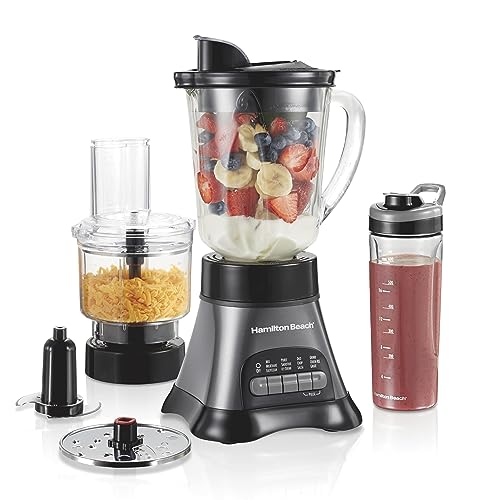
Hamilton Beach Blender and Food Processor Combo 58163 — Best with Food Chopper
The 58163 answers a small-kitchen problem: one base that blends and chops. The 700 peak-watt base drives a 40-ounce glass blending jar, a 3-cup food chopper bowl, and a travel cup, so the same motor that makes the morning smoothie also dices onions, makes salsa, and grinds breadcrumbs at dinner. For apartments, first kitchens, and anyone whose counter cannot host two appliances, that consolidation is worth more than a spec-sheet victory. It suits small households that cook varied food in small quantities. It does not suit anyone who needs full-size food processing — a 3-cup bowl is a helper, not a processor replacement — or big-batch blending.
Strengths
- One base covers blending, chopping, and a travel cup — three appliances’ worth of jobs.
- 40-ounce glass jar keeps the blending side fully legitimate, not a token attachment.
- The chopper handles salsa, onions, and nuts in quantities small kitchens actually use.
Trade-offs
- 700 peak watts is a peak rating; sustained power matches the 700-watt class norm.
- The 3-cup chopper is small — holiday cooking will outgrow it quickly.
- More parts to wash and store than a plain blender.
| Spec | Detail |
|---|---|
| Motor | 700 peak watts |
| Jar | 40 oz glass |
| Attachments | 3-cup chopper, travel cup |
| Format | Blender and food processor combo |
Judged purely as a blender, the 58163 is a peer of the Power Elite: same class of power, same glass-jar competence, same smoothie results. The chopper is the differentiator, and it earns its shelf space in kitchens that cook from scratch in small batches — salsa night, mirepoix for two, a quick crumb topping. The travel cup rounds out a package clearly designed by people who understand small kitchens. If your counter has room for exactly one motor, this is the most versatile affordable way to spend it.
Best for: small kitchens needing blending plus light food processing from one base. / Not suited for: big-batch cooking or full-size processing jobs.
Check the current price on Amazon
Job by Job: What Affordable Blenders Do Well, and Where They Stop
Smoothies and shakes — fully capable
This is the job the tier is built for. Every pick in this guide makes a good frozen-fruit smoothie, and the differences are about convenience — jar size, circulation design, cleanup — not about whether the result is drinkable. Protein shakes are even easier; any of these machines mixes powder without lumps. If smoothies and shakes are your whole blending life, the affordable tier is not a compromise at all.
Frozen drinks — capable with the right blade
Margaritas and daiquiris ask for ice work, and ice work is a blade-design question. The Wave Crusher’s Ice Sabre blades and the Power Elite’s circulation jar produce genuinely good frozen drinks. The classic Oster and BLACK+DECKER make acceptable ones with a pulse technique. Nobody at this tier produces the velvet texture of a high-end machine, but the gap is smaller than the price gap suggests.
Soups and sauces — capable, with a venting habit
Cooked vegetables puree easily at 700 watts, and glass jars handle warm ingredients well. The discipline is safety, not power: blend in batches, vent the lid, and keep fill levels modest with anything steaming. Cold sauces, salsas, and dressings are effortless across the whole list, and the 58163’s chopper extends the range to chunky preparations a blender alone would liquefy.
Batters, dips, and spreads — mostly capable
Pancake and waffle batters blend beautifully in any of these machines — arguably better than in overpowered ones, which whip in too much air. Hummus and bean dips work with added liquid and a scrape-down midway. The line is drawn at thick, dry pastes: nut butters, stiff doughs, and anything that needs a tamper to fold. Those jobs belong to the class above, and forcing them is how budget motors meet early ends.
Crushing and grinding extras — limited but useful
Breadcrumbs, coffee-adjacent grinding, and spice work are possible in short pulses in the classic models, though a dedicated grinder does them better and saves your blade assembly the abuse. Ice is the one hard job this tier has genuinely learned; dry grinding remains a side trick rather than a purpose.
Setting Up a First Blender Kitchen on a Budget
If this purchase is part of a first kitchen, a little planning stretches it further. Place the blender where it will live permanently — a machine that must be fetched from a cupboard gets used half as often, and in a small kitchen that means claiming one stretch of counter near the sink for the blender and the prep that feeds it. Keep the cups, lids, and gasket together in one drawer or bin; budget blenders generate small parts, and a lost gasket is a leaked smoothie and a bad morning. Buy one bag of frozen fruit and one of frozen spinach before the machine arrives, so the first week builds the habit while enthusiasm is high.
Then learn your specific machine’s personality in the first ten blends, treating those first smoothies as calibration rather than judgment of the machine you just bought. Every model in this guide has a fill level where its vortex forms perfectly and a sound that tells you the load is circulating rather than straining. Those two data points — learned once, remembered forever — are worth more than any upgrade you could buy later. The owners who love their affordable blenders are not the ones who bought the most powerful model; they are the ones who learned their machine’s habits early and blended within them.
Comparison Table
| Pick | Badge | Key spec | Best for |
|---|---|---|---|
| Hamilton Beach Power Elite 58148AG | Best Overall | 700W, 40 oz glass jar | Everyday smoothies and purees |
| Oster Classic Series 8-Speed | Best Budget Classic | 700W, 6-cup glass, all-metal drive | Long-term value and repairability |
| Hamilton Beach Wave Crusher 54221 | Best for Frozen Drinks | 700W, Ice Sabre blades | Margaritas and slush-style drinks |
| BLACK+DECKER BL2010BG | Best Simple Controls | 6-cup glass jar, 10 speeds | Utility blending with no learning curve |
| Oster Vortex | Best Step-Up Pick | 800W, 54 oz glass, iBlend programs | Daily use with a bigger jar |
| Hamilton Beach Combo 58163 | Best with Food Chopper | 700 peak W, chopper + travel cup | Small kitchens, varied cooking |
How to Choose an Affordable Blender Without Buying Twice
The most expensive blender is the cheap one you replace in a year. Choosing well in the affordable tier means spending your limited budget on the parts that determine lifespan and daily satisfaction, and ignoring the parts that only look good on a box. This section is the buying guide layer of this article: the criteria that separate the six good picks above from the dozens of lookalikes below them.
Start with your dominant job, not the spec sheet
Write down the three things you will blend most. If the list is smoothies, shakes, and sauces, any pick here works and you should optimize for jar size and cleanup. If frozen drinks lead the list, blade design becomes the deciding factor and the Wave Crusher’s Ice Sabre system earns its premium within the tier. If the list includes chopping and salsa at small scale, the 58163 combo consolidates two appliances. Buyers who skip this step tend to buy the highest wattage on sale and then discover the jar is the wrong size for their actual life.
Glass vs. plastic at the budget tier
Affordable blenders are where glass still thrives, and all six picks in this guide use glass jars — a genuine advantage of the tier. Glass does not absorb odors, does not cloud after a year of dishwashing, and handles warm sauces gracefully. Its costs are weight and fragility. Plastic at this tier is usually thinner than the pitchers on premium machines, so the usual advice inverts: in the affordable class, glass is often the better-built option, provided your household can be trusted not to drop it.
The drive system is the lifespan story
Ask any repair-minded cook what kills budget blenders and the answer is the coupling — the small connector between motor and blade. Plastic couplings strip under repeated ice loads; metal drives, like Oster’s long-running all-metal system, survive them. You cannot see the drive in a product photo, which is why brand and model research matters more in this tier than in any other. An established model with a known drive and available parts is a better buy than a stronger-on-paper unknown, every time.
Controls: speeds you will use vs. functions you will not
Function counts inflate quickly in this tier — 12 functions, 14 functions — but most are speed presets with food names. What actually matters is a usable low speed for control, a strong high speed for smoothies, and a pulse that responds instantly. The BLACK+DECKER’s plain ten speeds are honestly as functional as a 14-function panel. Spend attention instead on whether the buttons or dial will work with wet hands and whether the panel wipes clean, because those details decide daily satisfaction.
Reading budget listings without getting fooled
Budget listings compete on adjectives because they cannot compete on engineering, so learn to strip them. Convert every claim into a checkable fact: “powerful” should resolve to a wattage and a model number; “large capacity” should resolve to ounces; “ice crushing” should resolve to a named blade system. Watch for bundles photographed to look bigger than they are, and for model numbers that differ by one letter from the established machine you researched — a common way to inherit a good reputation with cheaper internals. Finally, check that the brand sells the jar, blade, and gasket for that exact model as spare parts. A listing that passes those tests, as all six picks here do, is a real product. One that fails them is a lottery ticket.
Budget tiers within the affordable class
Think of the affordable class as three steps. The entry step buys basic competence: a 700-watt-class motor and a glass jar from a real brand — the Power Elite and Oster Classic live here. The middle step adds a specialty: ice-focused blades, a chopper combo, or a larger jar. The top step, where the Oster Vortex sits, adds power and automation that begin to resemble mid-range machines. None of these steps buys quiet operation or professional torque; if those matter, the honest move is to save toward the class above rather than to buy the most expensive budget blender and expect it to be something it is not.
How to Use a Budget Blender Like a Pro
Technique is worth more than wattage in this tier. The loading order and cycle habits below will make any of these six machines perform a class above its price.
- Load liquids first, then soft ingredients, then frozen items last. The liquid starts the vortex; the frozen load presses down into it.
- Never fill past the jar’s maximum line with frozen ingredients. A slightly smaller batch that circulates beats a full jar that packs into a solid plug.
- Start low for a few seconds, then go high. Budget motors and blades work better when the load is already moving.
- Pulse frozen drinks in short bursts with rests, rather than running one long cycle — the crush comes out more even and the motor stays cooler.
- For smoothies, blend a full 45 to 60 seconds. Most grainy results in this tier are under-blended, not under-powered.
- Clean immediately: warm water, a drop of dish soap, 30 seconds on high, rinse. A jar cleaned in one minute never becomes a scrubbing project.
One safety note that matters more with glass jars: let hot soups cool slightly and vent the lid before blending, and never fill a jar with steaming liquid to the top line. Steam expands, pressure builds, and even a well-made budget lid is not designed to hold it. Blend hot liquids in smaller batches with the lid’s center cap loosened or removed and covered with a towel, the way cooks have always done it.
Troubleshooting: Problems Budget Blender Owners Actually Meet
Problem: The motor strains and the load stops moving. The jar is overfilled or too dry. Stop, remove a portion, add liquid, and restart on low. Repeated strain on a packed load is what strips couplings.
Problem: Smoothies have ice shards. The crush needs circulation, not more time. Pulse with a splash of liquid so the ice can move, or crush the ice first with a little water before adding the other ingredients.
Problem: The jar leaks at the base. Unscrew the blade assembly, reseat the gasket flat, and check it for nicks. Gaskets are wear parts; a replacement restores the seal on every classic design in this guide.
Problem: The blender smells like hot electronics. The motor is working at its limit. Rest it, reduce the batch, and add liquid. A brief warm smell on a heavy load is normal in this tier; a persistent smell on light loads is a warranty conversation.
Problem: Buttons respond poorly with wet hands. Common on membrane panels. Dry hands, or choose dial-and-button layouts like the Oster Classic’s when you replace the machine.
Common Buying Mistakes
- Buying the highest wattage from an unknown brand. A strong motor on a weak coupling is a short-lived machine. Brand and drive design outrank watts in this tier.
- Assuming affordable means disposable. The Oster Classic’s decades-long production run proves otherwise — but only if you choose established models with available parts.
- Ignoring jar size. A 40-ounce jar frustrates a family of five; a 6-cup jar annoys a solo drinker with washing-up. Match the jar to the household.
- Expecting nut butters and doughs. Those are torque jobs for the class above. Budget blenders asked to do them die young.
- Skipping the gasket check. Most leaks blamed on a “broken blender” are a two-dollar gasket. Learn your model’s assembly before you judge it.
- Paying for function counts. Fourteen functions that are really four speeds help no one. Buy jar, drive, and blade quality instead.
The Real Cost of a Cheap Blender: Parts, Wear, and Knowing When to Upgrade
The sticker is only the first payment. A realistic view of affordable-blender ownership includes three small, predictable costs, and planning for them is what separates a bargain from a false economy. The first is the gasket: a soft ring that flattens and nicks over a year or two of use, and the source of nearly every leak in the category. On established models it is a trivially cheap, user-replaceable part. The second is the blade assembly, which dulls slowly — not in months, but across years of ice — and is likewise replaceable on the classic designs. The third is the jar itself, which on glass models is a breakage risk and on any model is a standard catalog part for the big brands. Add those three together across a five-year life and the established affordable blender still costs a fraction of one premium machine — provided the parts exist. That proviso is the entire argument for buying brands with catalogs instead of listings with no yesterday and no tomorrow.
Knowing when to upgrade matters as much as knowing how to maintain. Upgrade when your jobs change, not when marketing suggests it: when smoothies for one become smoothies for four every day, when green smoothies turn fibrous enough to defeat a 700-watt vortex, or when you start making nut butters and hot soups weekly. Those are class changes, and the honest response is a class change in machine — toward the 900-to-1,000-watt band for power, or toward the professional tier for torque and heat. Upgrade is not warranted because a newer budget model has two more functions on its panel. The picks in this guide were chosen so that, for the jobs they claim, you will not need to think about replacing them for a long time — and when you finally do, it will be because your cooking outgrew them, not because they failed you.
Matching an Affordable Blender to Your Household
For a dorm room or first studio: counter space and simplicity rule. The BLACK+DECKER’s straightforward speeds or the Power Elite’s compact jar footprint fit the life, and both clean up in a small sink without a production. Blend earlier in the day if your walls are thin — budget motors announce themselves.
For a family on a budget: jar size is the deciding spec. The Oster Classic’s 6-cup glass jar and the BLACK+DECKER’s matching capacity are the two picks that serve a family breakfast in one cycle, and the Oster’s all-metal drive is the safer long-term bet under daily family loads.
For a household that cooks from scratch: the 58163 combo earns its place, because the chopper turns the same motor into a prep tool for salsa, onions, and crumbs. Cooks get more value from that versatility than from any single blending feature in this guide.
For a gift or a second home: choose the machine that asks nothing of its owner — the Power Elite for its forgiving circulation jar, or the BLACK+DECKER for controls that explain themselves. A blender that needs a tutorial makes a poor gift; these two do not.
For the daily smoothie devotee on a budget: the Oster Vortex is your pick. The programs, the bigger jar, and the reversing blade all serve the same master — a fast, consistent morning routine with minimal scraping and stirring — and it is the one machine here built to be used hard every single day.
Final Recommendation
Start with the Hamilton Beach Power Elite if you want one affordable blender that simply handles daily life. Choose the Oster Classic if you think in years and want the repairable all-metal drive, the Wave Crusher if frozen drinks run your weekends, and the Oster Vortex if you can sit at the top of the tier for more power, a bigger jar, and programs. Small kitchens that cook should look hard at the 58163 combo. Every pick here was chosen to be bought once and used for years — which is the only definition of affordable that matters.
Comparing across the wider budget landscape? See Best Affordable Blenders, Best Afforadble Blenders, Best Affordable Blenders For Smoothies, Best Affordable Single Serve Blenders, and the power-focused view in Best 900 1000 Watt Blenders.
Frequently Asked Questions
Can an affordable blender really crush ice?
Yes — for drinks. The Wave Crusher’s Ice Sabre blades and the Power Elite both handle ice inside frozen drinks well. What affordable blenders cannot do is crush ice continuously at commercial volume or produce shaved-ice desserts at the level of a dedicated machine.
How long should a budget blender last?
An established model with a metal drive and available parts should serve for years of regular use. The lifespan killers are overfilled frozen loads, neglected gaskets, and being asked to do torque jobs like nut butter weekly. Treat the machine within its class and it will not feel disposable.
Is glass or plastic better in this price range?
Glass, in most cases. Budget plastic jars are often thin and cloud quickly, while the glass jars on the picks in this guide are sturdy, stain-resistant, and easy to clean. The trade-off is weight and the risk of breakage if dropped.
What wattage do I actually need for smoothies?
A well-designed 700-watt machine handles frozen-fruit smoothies comfortably, as the picks here show. Wattage beyond that buys speed, finesse with fibrous greens, and headroom for thicker loads — worthwhile upgrades, but not requirements for a good smoothie.
Why do budget blenders leak?
Almost always the gasket between the blade assembly and the jar: it flattens, gets nicked, or is reseated crookedly after washing. Cleaning, reseating, or replacing that one inexpensive part fixes the great majority of leaks.
Should I buy a blender with many functions?
Only if the functions are real programs that run timed cycles, like the Oster Vortex’s iBlend settings. On most budget models, function counts are preset speed labels. A clean spread of speeds plus a responsive pulse does the same work. When two machines otherwise tie, choose the one with the better jar and drive, and let the function count go — your future self, blending on a weekday morning, will never once miss a fourteenth button.

