Disclosure: airfryerkitchensupply.com is reader-supported. When you buy through links on our site, we may earn an affiliate commission at no extra cost to you.
Where to buy
Every pick in this guide was verified against Amazon’s own catalog data before it earned a link, and stock in this power class moves fast because two of the biggest brands anchor it. Use the links below to check the current price on Amazon for each model, or jump to the detailed reviews further down.
- Ninja Professional Blender BL610 — Check on Amazon
- Ninja UltraCrush Professional Blender BP201 — Check on Amazon
- nutribullet Turbo Personal Blender NB50400 — Check on Amazon
- NutriBullet Pro 900 — Check on Amazon
- Ninja Nutri Blender BQ301 — Check on Amazon
- Oster Classic Series Heritage Blender — Check on Amazon
If a listing shows a different model number than the one named here, you are looking at a different machine. Model numbers matter more than brand names in this class, because the same brand sells 700-watt and 1,400-watt machines that look nearly identical on a shelf.
Introduction
Shoppers hunting for the best 900 1000 watt blenders are usually trying to solve a specific problem: a weaker blender that leaves ice chunks in smoothies, burns out on frozen fruit, or stalls when the jar gets full. The 900-to-1,000-watt band is the honest middle of the countertop market. It is strong enough to crush ice and frozen berries daily, yet it stops short of the price jump that comes with the 1,400-watt-plus flagship machines and the professional-grade brands. What surprises many buyers is how the band splits in two. Half of it is full-size 72-ounce pitcher blenders built for family batches, and the other half is personal blenders that pour all of that power into a single serving cup. Both approaches are legitimate, and this guide covers the strongest verified example of each style rather than pretending one format fits every kitchen.
One warning before the picks: wattage labels in this class are not standardized. Some brands print peak watts, which is the maximum the motor can draw in a burst, while others print the rated running wattage. A 1,000 peak-watt personal blender and a 1,000-watt full-size machine do not work equally hard, and the reviews below call out which figure each brand is using wherever the listing states it. Blade design, jar shape, and gear quality move real-world performance as much as the number on the box, which is why this guide weighs the whole machine instead of ranking by watts alone.
In this guide
Quick Picks
- Best Overall: Ninja Professional Blender BL610 — a 1,000-watt, 72-ounce pitcher blender that has anchored this class for years because it simply crushes ice without drama. Check on Amazon
- Best for Ice Crushing: Ninja UltraCrush Professional Blender BP201 — the newer 1,000-watt Ninja with simple manual controls and the same stacked-blade approach, tuned for frozen drinks. Check on Amazon
- Best Personal Blender in Class: nutribullet Turbo Personal Blender NB50400 — a true 1,000-watt personal blender in a gunmetal finish, built for shakes, smoothies, and food prep. Check on Amazon
- Best Compact 900-Watt Pick: NutriBullet Pro 900 — the 900-watt benchmark of the personal category, sized for one or two servings and small counters. Check on Amazon
- Best for Smoothie Cups: Ninja Nutri Blender BQ301 — rated at 900 peak watts and bundled with three 20-ounce cups, so a household can blend and go without washing between rounds. Check on Amazon
- Best Glass Jar: Oster Classic Series Heritage Blender — a 1,000 peak-watt machine with a 6-cup glass jar and a simple two-speed layout for buyers who avoid plastic pitchers. Check on Amazon
How These Picks Were Chosen
Every product in this guide had to pass three filters. First, the motor rating had to sit in or directly on the edge of the 900-to-1,000-watt band as stated in the manufacturer’s own Amazon listing — no rounding a 700-watt machine up or a 1,400-watt machine down to fill the list. Second, the exact model and ASIN had to verify against live catalog data, so the link you click is the machine the review describes. Third, the blender had to represent a genuinely different use case from the others on the list: a big pitcher machine, a personal cup machine, a glass-jar traditionalist, and so on. Six near-identical blenders would make a longer list and a worse guide.
Beyond those filters, the evaluation weighted the things that decide whether a blender is still pleasant in year three: whether the jar and blade assembly survive the dishwasher, whether replacement cups and gaskets are easy to find, how the machine behaves with a half-full load (the load most people actually blend), and how much counter and cabinet height it demands. Power matters, but a blender that lives in a closet because it is annoying to clean gets used twice a month, and that is the real failure mode in this category.
A note on honesty in this class: several well-known blenders advertise wattage figures that belong to a different model in the same lineup, and marketplace listings sometimes inherit the wrong number from a sibling product. That is why every wattage quoted in this guide comes from the verified listing of the exact model under review, and why the comparison table treats peak and rated figures as different species. If you cross-shop elsewhere, apply the same skepticism — check the model number first and the watt claim second.
The 6 Best 900 1000 Watt Blenders
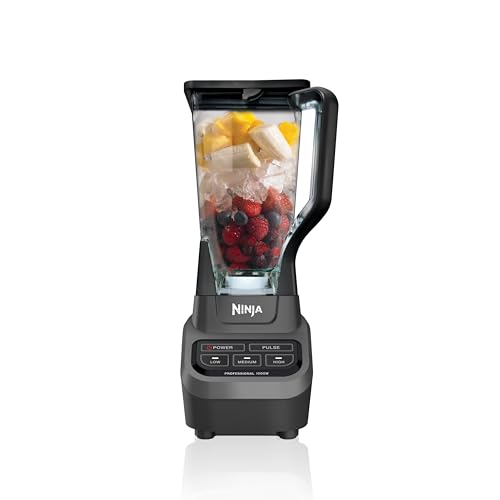
Ninja Professional Blender BL610 — Best Overall
The BL610 is the machine that defined this class, and it earns the top spot by being the most complete answer to the question most buyers are asking: a full-size blender, right at 1,000 watts, that turns ice into snow and frozen fruit into a smooth pour without technique, tamping, or prayer. The 72-ounce pitcher handles a family round of smoothies in one cycle, the stacked Total Crushing blade column pulls ingredients down from the top of the jar instead of only chewing at the bottom, and the controls are three speeds plus pulse — nothing to learn. It suits households that blend daily for more than one person. It does not suit someone who wants a quiet machine or a blender that also heats soup.
Strengths
- True 1,000-watt motor paired with a stacked blade column that processes the whole jar, not just the bottom layer.
- XL 72-ounce pitcher makes four large smoothies or a full batch of frozen drinks in a single cycle.
- Jar, lid, and blade assembly are dishwasher safe, which is why owners keep using it daily instead of shelving it.
Trade-offs
- It is loud at full speed — this is a wake-the-house blender, especially on ice.
- The pitcher is plastic, and the tall profile needs generous cabinet clearance for storage.
- No programs or speed dial finesse; texture control comes from pulsing, not from a low-speed setting.
| Spec | Detail |
|---|---|
| Motor | 1,000 watts |
| Pitcher | 72 oz, dishwasher safe |
| Blade system | Total Crushing stacked blades |
| Controls | 3 speeds plus pulse |
In daily use, the BL610’s party trick is consistency with lazy loading. Toss in frozen strawberries, ice, yogurt, and greens in almost any order and it still pulls the load down, because the blade column reaches up the jar rather than relying on a vortex alone. Where it shows its age is finesse work: nut butters and thick hummus need added liquid and patience, and the lowest speed is still brisk, so delicate emulsions are easier in a machine with a true slow setting. None of that changes the verdict for its core job. As a smoothie and frozen-drink machine for a household, it remains the reference point that everything else in the 900 1000 watt blenders class gets measured against.
Best for: households blending smoothies and frozen drinks for several people every day. / Not suited for: quiet-morning users or anyone who wants soup-heating and fine speed control.
Check the current price on Amazon

Ninja UltraCrush Professional Blender BP201 — Best for Ice Crushing
The BP201 is Ninja’s newer take on the same formula: 1,000 watts, a 72-ounce pitcher, and Total Crushing blades, but wrapped in a cleaner design with three manual speeds plus pulse and nothing else competing for your attention. Think of it as the pick for buyers who looked at the BL610 and wanted the same capability in a fresher model with the simplest possible control layout. It suits frozen-drink specialists — the household that makes margaritas, slushies, and crushed-ice drinks every weekend. It is less suited to buyers who want single-serve cups in the box, because this is a pitcher-only package.
Strengths
- 1,000-watt motor and Total Crushing blade stack produce fine, snow-like ice rather than gravel.
- Three speeds plus pulse give honest manual control for everything from salsa to smoothies.
- Dishwasher-safe parts keep the cleanup to a rinse-and-rack routine.
Trade-offs
- Pitcher-only bundle; single-serve drinkers will still wash a 72-ounce jar for one smoothie.
- Same Ninja loudness as its sibling when it hits a full load of ice.
- No automated programs, so smoothie timing is learned by ear and eye.
| Spec | Detail |
|---|---|
| Motor | 1,000 watts |
| Pitcher | 72 oz |
| Controls | 3 speeds plus pulse |
| Blade system | Total Crushing blades |
Ice is the hardest common load a blender faces: it is dense, it floats, and it resists the vortex that makes smoothies easy. The BP201’s stacked blades attack floating ice from above the liquid line, which is why it finishes a frozen drink with an even texture instead of a layer of shards on top. For smoothies it behaves like its sibling — fast, thorough, and indifferent to frozen fruit. The honest difference between the BP201 and the BL610 is mostly generation and styling rather than capability, so the choice between them usually comes down to which is in stock and which control panel you prefer looking at. Either way, you are buying the strongest ice performance this wattage class offers.
Best for: frozen drinks, slushies, and crushed ice at family scale. / Not suited for: solo smoothie drinkers who want blend-in-the-cup convenience.
Check the current price on Amazon
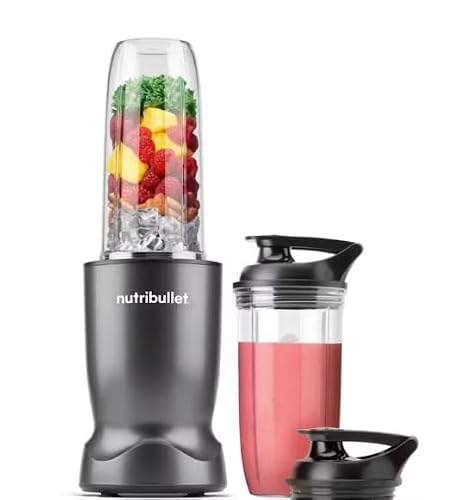
nutribullet Turbo Personal Blender NB50400 — Best Personal Blender in Class
The nutribullet Turbo puts a full 1,000 watts behind a personal blending cup, and that changes what a single-serve machine can honestly do. Where 600-watt personal blenders leave kale stems and frozen mango in chewy pieces, the Turbo’s extra headroom pulls a genuinely smooth result out of fibrous, frozen loads — in about the counter space of a coffee mug tree. The gunmetal finish looks more like a small appliance than a gadget, and the format suits commuters, gym households, and anyone blending for one. It does not suit batch cooking: the cup format that makes it fast also caps how much you can make at once.
Strengths
- A true 1,000-watt rating in a personal format, enough for frozen fruit and leafy greens without stalling.
- Blend in the cup you drink from, so cleanup is a cup and a blade base instead of a full pitcher.
- Small footprint suits dorms, desks-adjacent kitchens, and crowded counters.
Trade-offs
- Single-serve capacity; a family round means blending in sequence.
- Personal-blender blade bases need gasket care — a worn seal is the common failure point.
- Not a hot-liquid machine; soups must be blended by a different tool.
| Spec | Detail |
|---|---|
| Motor | 1,000 watts |
| Format | Personal blender, gunmetal finish |
| Model | NB50400 |
| Jobs | Shakes, smoothies, food prep, frozen blending |
What separates the Turbo from cheaper personal blenders is behavior under a bad load. Fill the cup with frozen berries and spinach — the load that makes budget personal blenders whine and leave chunks — and the 1,000-watt motor holds speed instead of bogging down, which is what actually produces a smooth texture. The workflow is the other half of the appeal: fill, twist, blend, swap the blade for a lid, and leave. For a single person, that two-minute loop beats dragging out a pitcher blender every morning, and it is why personal machines in this wattage class have quietly become the default smoothie tool in small households.
Best for: solo smoothie and shake drinkers who want full-size power without the pitcher. / Not suited for: families or anyone blending hot liquids.
Check the current price on Amazon

NutriBullet Pro 900 — Best Compact 900-Watt Pick
The Pro 900 is the machine that made the personal blender category mainstream, and at exactly 900 watts it is the purest expression of this guide’s brief. The design has barely changed in years because it does not need to: a compact base, cups that twist on, and enough power to turn frozen fruit and greens into a drinkable smoothie in under a minute. The verified listing for this guide is the Special Edition in white, which suits bright kitchens and buyers who want the appliance to disappear against pale counters. It suits one-to-two-person households and small kitchens. It does not suit anyone blending for a crowd or crushing large volumes of ice daily.
Strengths
- 900 watts in one of the smallest footprints in the class — real power, minimal counter claim.
- The twist-on cup system is the fastest fill-to-drink workflow of any pick here.
- A huge ecosystem of replacement cups, lids, and blade assemblies exists because the model is so established.
Trade-offs
- Capacity tops out at personal servings; batch work means repeat cycles.
- Press-down operation gives less texture control than a speed dial.
- The white finish shows smoothie stains more readily than darker models and needs a wipe-down habit.
| Spec | Detail |
|---|---|
| Motor | 900 watts |
| Format | Personal blender, Special Edition |
| Finish | White |
| Operation | Twist-on cup, press to blend |
Living with the Pro 900 teaches you its one rule: respect the max-fill line. Inside that line, the vortex in the cup is violent and efficient, and frozen strawberries come out fully smooth. Above it, the load packs down and the blades spin in a pocket. That is not a flaw unique to this machine — every personal blender behaves this way — but the Pro 900’s popularity means the lesson is well documented and easy to learn. For green smoothies specifically, it handles spinach and kale leaves well, though truly fibrous material like celery stalks and ginger root comes out smoother in the 1,000-watt Turbo or a full-size Vitamix-class machine. As a compact daily driver, it remains the safest recommendation in the 900-watt corner of the market.
Best for: one or two people making daily smoothies in a small kitchen. / Not suited for: batch blending, hot liquids, or heavy daily ice crushing.
Check the current price on Amazon

Ninja Nutri Blender BQ301 — Best for Smoothie Cups
The BQ301 takes a different route into this class: 900 peak watts driving a set of three 20-ounce cups. The three-cup bundle is the whole point. One person blending once a day will not care, but a household where two or three people leave at different times cares a lot, because yesterday’s unwashed cup no longer blocks this morning’s smoothie. The cups travel well, the base is compact, and the peak-watt rating is honestly labeled as peak — expect performance in line with the other strong personal blenders here rather than with the 1,000-watt full-size Ninjas. It suits multi-person grab-and-go households. It does not suit anyone who needs a pitcher for sauces, soups, or party batches.
Strengths
- Three 20-ounce cups in the box — the best cup count of any pick in this guide.
- 900 peak watts is enough for frozen fruit smoothies and protein shakes without drama.
- Compact base and travel-ready cups suit rushed mornings and gym bags.
Trade-offs
- Peak-watt rating: sustained power is a step below the true 1,000-watt machines here.
- No pitcher option in the bundle, so the format ceiling is one serving at a time.
- Ice crushing is fine in drinks but slower than the stacked-blade full-size Ninjas.
| Spec | Detail |
|---|---|
| Motor | 900 peak watts |
| Cups | (3) 20 oz cups |
| Format | Personal blender |
| Model | BQ301 |
The BQ301 is a workflow purchase. Its blending quality sits comfortably in the strong-personal-blender tier — smoothies come out smooth, shakes come out lump-free, and frozen fruit blends cleanly when you add enough liquid. What you are really buying is the removal of friction: a clean cup always ready, a lid that goes straight into a cup holder, and a base small enough to leave out. Households that already own a full-size blender often add a machine like this and then discover the big blender only comes out on weekends. If your blending life is measured in single servings, that trade is usually worth it.
Best for: households of two or three who each blend their own smoothie to go. / Not suited for: anyone who needs pitcher capacity or sustained full-power blending.
Check the current price on Amazon

Oster Classic Series Heritage Blender — Best Glass Jar
The Heritage is the traditionalist in the class: a glass 6-cup jar, a two-speed control, and a motor rated at 1,000 peak watts driving Oster’s long-running all-metal drive system. Buyers choose it for reasons that have nothing to do with programs. Glass does not stain with turmeric, does not hold garlic odors, and handles warm ingredients more gracefully than plastic. The design has survived for decades because the failure-prone parts — the blade, the gasket, the jar — are cheap and everywhere. It suits cooks who blend sauces, batters, and purees as often as smoothies. It does not suit smoothie specialists who want maximum ice destruction or single-serve convenience.
Strengths
- 6-cup glass jar resists stains and odors and suits warm sauces and batters.
- All-metal drive is the durability benchmark in this price class, with inexpensive replacement parts.
- Dead-simple two-speed operation — nothing to program, nothing to break electronically.
Trade-offs
- 1,000 watts here is a peak rating; sustained crushing power trails the Ninja pair.
- Two speeds give limited texture control for finesse work.
- Glass is heavy and breakable — a real consideration in busy or kid-filled kitchens.
| Spec | Detail |
|---|---|
| Motor | 1,000 peak watts |
| Jar | 6-cup glass |
| Controls | 2 speeds |
| Drive | All-metal drive system |
In the kitchen, the Heritage behaves like the blenders many people grew up with, in the good ways and the limiting ones. It purees soups and sauces evenly, handles pancake batter and milkshakes without thought, and makes a respectable smoothie — though frozen fruit needs a pulse-and-shake assist that the stacked-blade Ninjas do not. Its longevity story is the real argument: this is a design measured in decades, and a worn blade assembly or cracked jar is a small replacement purchase rather than a new blender. For buyers who rank repairability and glass over raw crushing theater, it is the right end of this list to land on.
Best for: cooks who want a glass jar, simple controls, and a repairable classic design. / Not suited for: smoothie perfectionists or anyone wanting automated programs.
Check the current price on Amazon
What 900–1000 Watts Actually Buys You, Job by Job
Wattage is an input; what buyers care about is output, job by job. Here is how this class honestly performs across the work people actually give a blender, so you can match the class to your kitchen before matching a model to your counter.
Smoothies and protein shakes
This is the class’s home turf, and every pick in this guide does the job well. Frozen fruit, yogurt, greens, and protein powder all come out smooth at 900 to 1,000 watts, with the personal blenders matching the pitcher machines serving for serving. If smoothies are 90 percent of your blending, anything on this list will satisfy you, and your choice should be made on format and cleanup instead of power.
Ice and frozen drinks
Ice separates blade designs more than motor sizes. Stacked-blade machines (both Ninjas) produce the finest, most even crush. Cup-based extractors handle ice inside a drink well but are not the tool for a tray of plain crushed ice. Traditional bottom-blade machines like the Oster Heritage make good frozen drinks with a pulse technique and a splash of liquid, but they will leave the occasional shard that a Ninja would not. If frozen drinks are your headline use, let blade design lead your decision.
Leafy greens and fibrous ingredients
Spinach disappears in any of these machines. Kale ribs, celery, and ginger are the honest test: the nutribullet Turbo’s full 1,000 watts in a small cup does surprisingly well, the big Ninjas do well with enough liquid and a full cycle, and the Pro 900 handles leaves better than stalks. Buyers whose green smoothies lean heavily on fibrous stalks are the one smoothie audience that should consider stepping up a class.
Sauces, salsas, and purees
Wet jobs are easy jobs. Everything here purees cooked vegetables, blends salsas, and emulsifies dressings competently. The differences are control-related: pulse-driven machines let you stop at chunky, while press-and-hold personal blenders overshoot toward liquid quickly. The Oster Heritage’s simple speeds and glass jar make it the natural cook’s pick of the six for this work.
Nut butters, doughs, and thick pastes
Here the class honestly runs out. Thick, low-liquid loads need sustained torque, a tamper, and jar geometry designed to fold the load back into the blades — the professional-grade formula. The machines in this guide can make a small batch of nut butter with added oil, patience, and rest breaks for the motor, but it is their weakest job, and regular nut-butter makers should budget for the class above. Saying so plainly is part of what this guide is for: a 1,000-watt rating does not make a blender a food processor.
Comparison Table
| Pick | Badge | Key spec | Best for |
|---|---|---|---|
| Ninja Professional Blender BL610 | Best Overall | 1,000W, 72 oz pitcher | Family smoothies and frozen drinks |
| Ninja UltraCrush BP201 | Best for Ice Crushing | 1,000W, 72 oz, 3 speeds | Slushies and crushed-ice drinks |
| nutribullet Turbo NB50400 | Best Personal Blender in Class | 1,000W personal format | Solo smoothies with fibrous greens |
| NutriBullet Pro 900 | Best Compact 900-Watt Pick | 900W, twist-on cups | Small kitchens, one or two servings |
| Ninja Nutri Blender BQ301 | Best for Smoothie Cups | 900 peak W, (3) 20 oz cups | Multi-person grab-and-go mornings |
| Oster Classic Heritage | Best Glass Jar | 1,000 peak W, 6-cup glass jar | Sauces, batters, and repairable design |
How to Choose the Right 900–1000 Watt Blender
The first decision in this class has nothing to do with watts: pitcher or personal? A 72-ounce pitcher blender like the BL610 or BP201 makes blending a batch event — one cycle serves the table, and the jar doubles as a serving vessel. A personal blender like the nutribullet Turbo or Pro 900 makes blending a personal habit — faster per serving, trivial to clean, but strictly one drink at a time. Households that entertain or cook sauces should start with a pitcher. Solo drinkers and couples with a morning routine should start personal. Buyers who genuinely do both are the rare case where owning one of each is rational rather than indulgent.
Peak watts vs. rated watts: read the label like an engineer
A motor’s peak wattage is the most it can draw for a moment under load; its rated wattage is what it sustains. Brands in this class mix the two freely. Ninja’s BL610 and BP201 carry a straight 1,000-watt rating, the Oster Heritage and Ninja BQ301 quote peak figures, and the nutribullet Turbo quotes a full 1,000 watts for a personal machine. None of these is dishonest, but they are not interchangeable numbers. As a working rule, a peak-rated machine performs roughly like a sustained machine rated somewhat lower, and blade design closes much of the remaining gap. Judge by the job tests in each review — ice, frozen fruit, fibrous greens — rather than treating the watt figure as a score.
Blade design matters as much as motor size
Three blade philosophies appear in this guide. Stacked column blades (Ninja) place cutting edges at several heights, so floating ice and the top of the load get processed instead of riding above a vortex. Extractor blades (nutribullet) spin a small, fast vortex inside a cup, using the cup’s narrow shape to keep everything in the cutting path. Traditional bottom blades (Oster) rely on jar taper and a strong vortex, which is excellent for liquids and purees and merely good for dry-ish loads like frozen fruit with little liquid. Match the philosophy to your dominant job and the wattage number becomes much less important.
Jar material and capacity
Plastic pitchers are light, survive drops, and dominate the high-power end because big glass jars get heavy fast. Glass resists stains and odors and feels better with warm ingredients, but a full 6-cup glass jar is a two-hand pour. Capacity should follow your real batch size: a 72-ounce pitcher run half-empty blends worse than a personal cup run at its fill line, because vortex formation needs the right fill ratio. Buy the size you will fill correctly most days, not the size you need twice a year at parties — party batches can run in two cycles.
Controls: programs vs. manual speeds
None of the picks in this particular guide leans on elaborate programs, and that is typical of the class: at this level you get speeds and pulse, and texture comes from your timing. That is fine for smoothies and frozen drinks, which are forgiving. It matters more for emulsions, baby food, and nut butters, where a true low speed and a tamper earn their keep — and those jobs honestly belong to the professional-grade class above this one. Within this guide, choose manual simplicity (Oster, BP201) if you value durability, and cup-based simplicity (nutribullet, BQ301) if you value speed of routine.
How to Use a 900–1000 Watt Blender for Perfect Ice and Smoothies
Technique closes most of the gap between a good blender and a great result. Follow this loading order for pitcher blenders: liquids first, then soft ingredients, then greens, then frozen fruit, and ice last on top. The liquid at the blade starts the vortex, and the heavy frozen load presses everything down into it. For personal blenders the order inverts, because the cup flips: frozen ingredients go in first, liquid last, so that after flipping, liquid sits at the blade.
- Add liquid to the pitcher first — roughly one cup for a full smoothie batch — so the blades start in fluid, not in a dry jam of frozen fruit.
- Layer soft and fresh ingredients next, then frozen fruit, then ice on top where the stacked blades or vortex can pull it down progressively.
- Start on the lowest speed for three to five seconds to establish the vortex, then move to high. Jumping straight to high throws ingredients onto the lid and walls.
- Blend a full smoothie cycle of 45 to 60 seconds. Most under-blended smoothies are simply stopped at 20 seconds, while the texture is still grainy.
- For crushed ice alone, work in pulses with a splash of water; the water gives the ice mobility and produces an even, snow-like result.
- Rinse the jar immediately, or run a self-clean cycle with warm water and a drop of dish soap for 30 seconds, then rinse. Dried smoothie residue is the main reason blenders become unpleasant.
Two safety habits matter at this power level. Never reach into a jar that is seated on a powered base — unplug before scraping down sides. And let hot liquids stay below the jar’s rated use: none of the picks in this guide is a soup-heating blender, and hot liquid in a sealed personal cup is a genuine hazard, because steam pressure has nowhere to go. Blend hot soups only in vented pitcher machines designed for it, which live in a different guide.
Living With a 900–1000 Watt Blender: Noise, Storage, and Upkeep
Specifications decide which blender you buy; daily friction decides whether you keep using it. Three ownership realities show up in this class again and again, and it is worth picturing them before you order. The first is noise. A 1,000-watt motor driving stacked blades through ice is doing violent work, and the Ninja pair in particular make no attempt to hide it. In a household of adults on similar schedules, that is a non-issue. In an apartment with a sleeping baby or a roommate on night shifts, a 6 a.m. smoothie becomes a negotiation. Personal blenders run for shorter bursts — 30 to 45 seconds — which makes their noise easier to live with even at similar peak volume, and that is one underappreciated reason the nutribullet format wins so many converts.
The second reality is storage geometry. A 72-ounce pitcher on its base is tall — measure your counter-to-cabinet clearance before assuming any full-size pick will live under upper cabinets, because a blender stored in a cupboard gets used half as often as one that lives on the counter. The Oster Heritage’s classic profile is a little shorter and wider, and the personal blenders sidestep the issue entirely: a nutribullet base fits almost anywhere, and the cups stack in a cabinet. If your kitchen is small, footprint is not a footnote; it is the feature that decides whether the machine becomes a habit.
The third reality is upkeep, and it is refreshingly light in this class if you build two habits. Rinse or self-clean the jar immediately after use, before smoothie residue dries into cement, and check the blade-base gasket on personal blenders every month or so — a gasket that has gone flat or nicked is the source of nearly every leak complaint in the category, and it is a cheap, user-replaceable part. Blades themselves dull slowly over years rather than months; when a once-sharp machine starts leaving chunks it used to pulverize, a replacement blade assembly usually restores it fully, which is another argument for established models with deep parts catalogs.
When to step up above this class — and when to step down
Step up to the 1,400-watt and professional-grade class if your blending includes hot soups pureed in the machine, nut butters made weekly, or doughs and thick batters that need a tamper and a true low speed. Those jobs are about sustained torque and jar design, not headline watts, and they are where Vitamix-class machines justify themselves. Step down to the 600–700-watt budget class if your blending is protein shakes, soft-fruit smoothies, and the occasional milkshake; you will give up frozen-fruit authority you may never miss. The 900-to-1,000-watt band exists precisely for the large middle: frozen smoothies and ice drinks, made daily, without paying for capabilities that belong to a cooking appliance. Most buyers who land here after honest self-assessment stay here through several machines, which is the strongest signal that the class is sized correctly.
Troubleshooting: Five Problems Every Owner Meets
Problem: The blender runs but the top of the load just sits there. The vortex never formed, usually because the load is too dry or the jar is overfilled. Stop, add a quarter cup of liquid, tamp the load down with a spatula while the machine is off and unplugged from the base, and restart on low before going to high.
Problem: A personal blender leaks at the blade base. Nine times out of ten this is the gasket: remove it, wash it, reseat it flat, and check for nicks. If the gasket is flattened or torn, replace it — it is a wear part, and a leaking cup blended daily will eventually reach the motor base.
Problem: Smoothies taste smooth but look flecked with green. The machine has the power; the cycle is too short or the greens went in dry on top. Add greens early with the liquid, and run the full cycle. Leaf flecks are a technique issue, not a wattage issue, at this power level.
Problem: The motor smells hot and shuts off mid-blend. That is the thermal protection doing its job on an overloaded or overly long cycle. Let the machine rest until the base feels cool, reduce the load, add liquid, and work in shorter cycles. Repeated thermal trips on normal loads mean the machine is being asked to do a job above its class.
Problem: Ice comes out as a mix of snow and boulders. The load was too dry for the blades to keep the ice moving. Pulse with a splash of water so the ice can circulate, and crush in two smaller batches rather than one full jar — circulation, not raw power, is what evens out a crush.
Common Buying Mistakes
- Comparing peak watts to rated watts as if they were the same number. A 1,000 peak-watt machine and a 1,000 rated-watt machine are not twins; check which figure the listing quotes before ranking.
- Buying a 72-ounce pitcher for one daily smoothie. Oversized jars blend small loads badly and add washing-up that quietly kills the habit.
- Assuming more watts means quieter or better built. In this class the strongest machines are often the loudest, and build quality shows in the drive system and gaskets, not the watt label.
- Ignoring replacement-part availability. Cups, blade assemblies, and gaskets are wear items. Established models like the BL610 and Pro 900 have deep parts ecosystems; obscure models may not.
- Blending hot liquid in a sealed personal cup. Steam pressure can force the cup open mid-blend. Personal blenders are cold-drink machines, full stop.
- Judging by the first smoothie. Every blender here improves once you learn its fill line and cycle time. Give a new machine a week of technique before declaring it weak.
Final Recommendation
For most households, the Ninja BL610 is the answer: a true 1,000 watts, a family-size pitcher, and the most forgiving ice and frozen-fruit performance in the class. If your blending life is personal, the nutribullet Turbo brings the same wattage to a cup format, while the NutriBullet Pro 900 remains the compact benchmark at exactly 900 watts. Glass-jar loyalists should take the Oster Heritage and its repairable all-metal drive. Any of these six will out-blend the machine most buyers are replacing; the right choice is the format you will actually use every day.
Still deciding? Compare this class with its neighbors in Best 1000 Watt Blenders and Best 1500 Watt Blenders, or stay in budget territory with Best Affordable Blenders, Best Affordable Blenders For Smoothies, and Best Affordable Single Serve Blenders.
Frequently Asked Questions
Is 900 to 1,000 watts enough to crush ice properly?
Yes, with the right blade design. The stacked-blade Ninjas in this guide turn ice into snow-like crystals, and the personal nutribullet Turbo handles ice inside drinks well. What this class cannot do is run a continuous commercial ice-crushing shift; for home drinks, it is genuinely sufficient.
What is the difference between peak watts and regular watts?
Peak watts describe the maximum power the motor can draw in a short burst under heavy load. Rated watts describe sustained running power. Peak figures always read higher, so compare like with like when two listings use different conventions.
Can a 1,000-watt personal blender replace a full-size blender?
For smoothies, shakes, and small sauce jobs, yes — the nutribullet Turbo and Pro 900 cover those completely. For family batches, soups, and party volumes, no: capacity, not power, is the limit. Many households end up using a personal blender daily and a pitcher machine occasionally.
Why does my smoothie come out chunky even with a strong blender?
Usually one of three causes: too little liquid for the vortex to form, overfilling past the max line so the load packs down, or stopping the cycle too early. Add liquid, respect the fill line, and blend a full 45 to 60 seconds before changing anything else.
Are glass jars better than plastic pitchers?
Glass resists stains and odors and handles warm ingredients well, but it is heavy and breakable. Plastic is lighter and tougher and dominates large pitchers for practical reasons. Neither is universally better; the Oster Heritage covers glass loyalists, and the rest of this guide covers everyone else.
How long should a blender in this class last?
With daily use, expect several years from the established models here, provided wear parts are replaced as needed — blade assemblies dull, and gaskets age. Designs with all-metal drives and widely available parts, like the Oster Heritage and Ninja BL610, have the longest practical service lives.


