Disclosure: airfryerkitchensupply.com is reader-supported. When you buy through links on our site, we may earn an affiliate commission at no extra cost to you.
Where to Buy
Short on time? Start with the best 1000 watt blenders shortlist below — every linked model was checked against a live listing before this guide was published.
Every pick below carries a 1000-watt rating confirmed from its live Amazon listing — the wattage is in each product’s listing data, not inferred. Listings change, so confirm the rating on the page before ordering.
- Ninja Professional Blender BL610 (1000W, 72 oz) — Check the current price on Amazon
- Ninja UltraCrush Professional Blender BP201 (1000W, 72 oz, 3 Speeds) — Check the current price on Amazon
- nutribullet Turbo Personal Blender (1000W) — Check the current price on Amazon
- KOIOS Immersion Blender (1000W, 12 Speed + Turbo) — Check the current price on Amazon
- MEGAWISE Hand Blender (1000W, 5-in-1) — Check the current price on Amazon
- 220 Volt Hand Blender (1000W, 3-in-1) — 220V Regions Only — Check the current price on Amazon
The best 1000 watt blenders sit at the most contested point in the blender market: powerful enough to crush ice and frozen fruit without apology, priced well below the premium high-speed machines. One thousand watts is where a blender stops being a smoothie accessory and becomes a general kitchen tool — and it is also where spec sheets start to need reading, because peak watts, rated watts, and marketing watts are three different numbers wearing the same costume.
This guide covers the class across all three formats that genuinely ship at 1000 watts: full-size countertop machines with 72-ounce pitchers, a personal blender built for single servings, and two 1000W immersion blenders for in-the-pot work. The final pick is a 1000W hand blender wired for 220-volt regions, included with its voltage warning in lights, because readers outside North America land on this search too.
Every model was verified against a live Amazon listing on 2026-11-20. Where a famous name does not actually sell a 1000-watt model — several stop at 900 or jump to 1200 — we left it out rather than rounding its spec sheet up to fit the title.
A note on who this class serves best: the 1000-watt buyer is usually upgrading from a first blender that rattled, stalled, or surrendered to ice. If that is you, the good news is that every pick here represents the end of that experience for the jobs listed. If your first blender died doing something more exotic — grain milling, commercial service, daily nut butter in quantity — the honest answer sits a class above, and our 1500-watt guide is the right next read.
One more audience note: this class is also the right answer for the cook who has been borrowing performance from technique — pre-soaking, pre-cutting, blending in stages to coax a weak machine along. Those are good skills and they will make a 1000-watt machine perform even better, but you have earned the right to stop needing them. If the budget allows one appliance upgrade this year and the blender is your daily frustration, this class is where the money visibly changes breakfast.
In this guide
Quick Picks
Two countertop machines, one personal blender, two immersion sticks, and one clearly-labelled 220-volt pick. Start from the format your kitchen actually uses. The table’s order is a rough value gradient rather than a ranking: the pitcher picks lead because most 1000-watt searches are pitcher searches, and the sticks close the list because their buyers already know their format. Your format answer, not the table’s order, should drive which review you read first.
- Ninja Professional Blender BL610 (1000W, 72 oz) — Best Overall: The reference 1000W countertop blender: a 72-ounce pitcher, Total Crushing blade stack, and a long production history of turning ice into snow without drama. Check price on Amazon.
- Ninja UltraCrush Professional Blender BP201 (1000W, 72 oz, 3 Speeds) — Best Simple Controls: The newer 1000W Ninja with just three speeds plus pulse — the pick for households that want power without a dashboard of programs. Check price on Amazon.
- nutribullet Turbo Personal Blender (1000W) — Best Personal Blender: A genuine 1000 watts in single-serve format, with 32 oz and 24 oz cups and flip-top travel lids — the weekday-morning pick of the class. Check price on Amazon.
- KOIOS Immersion Blender (1000W, 12 Speed + Turbo) — Best 1000W Hand Blender: A 1000W stick with 12 speeds plus turbo, an anti-scratch blade guard, and whisk and frother attachments — the most powerful in-pot option here. Check price on Amazon.
- MEGAWISE Hand Blender (1000W, 5-in-1) — Best 1000W Hand Blender Set: The other 1000W stick, sold as a full 5-in-1 kit: chopper, whisk, frother, and beaker around a detachable stainless shaft. Check price on Amazon.
- 220 Volt Hand Blender (1000W, 3-in-1) — 220V Regions Only — Best for 220-Volt Regions Only: A 1000W 3-in-1 hand blender wired for 220-240V — blending shaft, chopper bowl, beaker, and whisk. Not for use in the USA; included for readers in 220-volt regions. Check price on Amazon.
How These Picks Were Chosen
The filter for this guide was mechanical: a pick had to carry a 1000-watt rating in its live Amazon listing data, verified on 2026-11-20. That sounds obvious, but it cut several famous models whose ranges step from 900 watts to 1200 without a 1000-watt stop, and it cut listings that used ‘1000W’ in a title for a different component than the motor. What survived is the honest class: two Ninja countertop machines, one nutribullet personal blender, two immersion sticks, and one 220-volt kit.
Within the class we ranked by format coverage rather than pretending a stick and a pitcher compete head-on. The countertop pair lead because most searchers mean a countertop machine; the personal and immersion picks follow as the strongest verified options in their formats.
A note on wattage honesty: manufacturers variously quote rated, peak, and locked-rotor figures. We report the rating as listed for each model and compare within the class on design and format, not on decimal points of a number that is not measured identically across brands.
We also applied a consistency check across each manufacturer’s own range: where a brand sells the same design at several wattages, we confirmed the 1000-watt variant is a distinct, orderable configuration rather than a bundle headline. Two listings failed that check and were cut, which is why some familiar shapes appear here in one variant only.
Screening also considered the second-order spec nobody advertises: how each model behaves at half load. A 1000-watt machine that only performs with a full jar is a poor household tool, so we favoured designs — the personal cup, the right-sized sticks, the established Ninja jars — whose working range covers the small, everyday blends as competently as the headline full-load jobs.
One more pattern from the screening is worth passing on: this class is where marketplace bundles multiply fastest — extra cups, spare blades, recipe books — and bundle contents were ignored entirely in scoring. A pick here earned its place as a base machine; treat any bundle extras as a bonus, never as the reason, because bundles change weekly and motors do not.
The Best 1000 Watt Blenders in Detail
Every wattage below is the figure from the model’s own listing. Spec boxes deliberately omit any number we could not confirm there. Note how the verdict lines in this guide are organised by format regret — the most common 1000-watt disappointment is not a weak motor but the right motor in the wrong shape, bought by someone who shopped the number and skipped the format question.
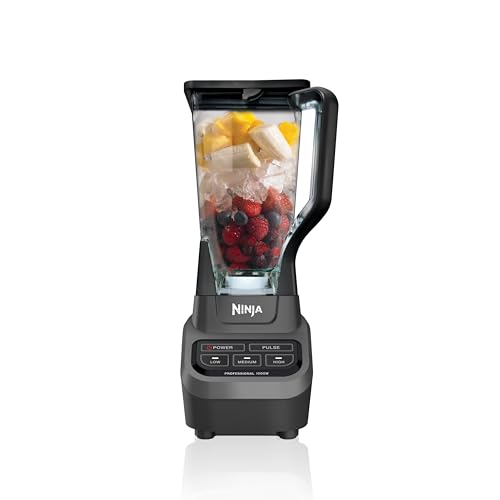
1. Ninja Professional Blender BL610 (1000W, 72 oz) — Best Overall
The BL610 is the machine most people picture when they picture this class, and it has earned the position. Its 1000-watt motor drives a stacked-blade 72-ounce pitcher that handles family smoothies, frozen drinks, and sauces with the same recipe: load, run, pour. Controls are deliberately simple — a few speeds and pulse — which suits a shared household appliance. Dishwasher-safe parts close the deal for daily use.
Strengths
- Proven 1000W platform with a big 72 oz family pitcher
- Stacked Total Crushing blades excel at ice and frozen fruit
- Simple controls and dishwasher-safe parts suit daily family use
Trade-offs
- Stacked blades are sharp on all sides — wash with respect
- No presets or smart programs for walk-away blending
- Tall pitcher needs cabinet clearance, like all 72 oz designs
| Motor | 1000W |
| Pitcher | 72 oz |
| Blade system | Total Crushing stacked blades |
| Care | Dishwasher-safe parts |
The BL610’s longevity in the market is itself evidence: 1000-watt blenders live or die on whether they survive daily ice, and this design has been doing it for years. The stacked blade is the key difference from bottom-blade rivals — it works the whole column of the pitcher, so a full jar of frozen strawberries becomes a uniform blend instead of a smooth bottom layer under floating chunks. If your household blends daily and your budget stops below the premium tier, this remains the default recommendation in the class.
A detail BL610 owners learn in the first week: the stacked blade makes the jar top-heavy to pour when full, so pour with two hands and a thumb on the lid. It is a small ergonomic tax on the design that produces the best ice in the class, and most owners pay it happily.
Long-term BL610 ownership has one predictable chapter: the jar’s gasket and the blade assembly age before the motor does. The design’s popularity means those parts are easy to find years later — an unglamorous advantage that quietly decides which decade-old blenders are still on counters.
Best for: Families blending smoothies and frozen drinks daily in full pitchers / Not suited for: Cooks wanting presets, hot-soup programs, or a tamper-based high-speed system
Check the current price on Amazon

2. Ninja UltraCrush Professional Blender BP201 (1000W, 72 oz, 3 Speeds) — Best Simple Controls
The BP201 answers a fair question about its older sibling: what if the same 1000 watts and the same 72-ounce pitcher came with even simpler controls? Three speeds and a pulse button are the entire interface. Low for sauces and batters, medium for smoothies, high for ice and frozen fruit, pulse for control. For households where several people use the blender — including teenagers and grandparents — that simplicity is a feature money usually cannot buy at this power level.
Strengths
- Three speeds plus pulse — nothing to misconfigure
- Same 1000W / 72 oz working capacity as the class leaders
- Dishwasher-safe parts keep daily cleanup painless
Trade-offs
- No low-and-slow finesse for delicate emulsions
- Fewer years of ownership history than the BL610
- Basic feature set will bore gadget-minded buyers
| Motor | 1000W |
| Pitcher | 72 oz |
| Speed control | 3 speeds + pulse |
| Care | Dishwasher safe |
There is a real design argument for the BP201’s minimalism: most blending tasks genuinely are three-speed tasks, and every preset you never use is a button you clean around. In side-by-side terms it occupies the same performance envelope as the BL610 — ice, frozen fruit, family batches — while trading program variety for immediacy. Choose between them by household: the BL610 for the cook who likes options, the BP201 for the kitchen that wants the blender to just work.
The BP201’s three speeds reward a specific habit: use speed one as a genuine starting gear for every blend, not just delicate ones. The load assembles itself at low speed, and the jump to three then finishes in half the time with a fraction of the noise complaints from the household.
The BP201’s three speeds reward households that label their habits: speed one for the morning sauce, three for the Friday frozen round. Because the control has only three positions, everyone in the house converges on the same settings, and the machine produces unusually consistent results across different users.
Best for: Shared households wanting full 1000W power with the simplest possible controls / Not suited for: Enthusiasts who want programmed cycles and variable-speed precision
Check the current price on Amazon
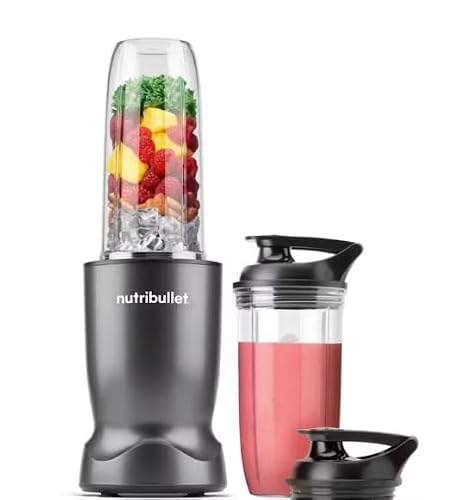
3. nutribullet Turbo Personal Blender (1000W) — Best Personal Blender
Personal blenders usually top out well below this class, which is why the nutribullet Turbo stands out: a full 1000 watts behind a 32-ounce cup changes what a single serving can be. Frozen fruit, ice, nuts, and seeds that stall lesser personal blenders blend properly here, and the cup you blend in is the cup you take, sealed with a flip-top lid. It comes with the 32-ounce and a 24-ounce cup, covering big gym smoothies and smaller daily blends.
Strengths
- Full 1000W in a personal format — frozen loads blend smooth
- Blend-and-go cups with travel lids cut washing up
- Compact footprint suits small counters and offices
Trade-offs
- Single-serve only — no family batches
- Cup format cannot handle hot liquids
- Less versatile than a pitcher machine for sauces and soups
| Motor | 1000W |
| Cups | 32 oz + 24 oz |
| Lids | Two flip-top travel lids |
| Format | Personal / single-serve |
The personal format’s dirty secret is that most of its members are underpowered for the frozen smoothies in their own advertising. The Turbo’s 1000-watt rating closes that gap, and the difference shows up exactly where you would expect: ice disappears instead of rattling, and frozen berries blend without the shake-the-cup routine. If your blending life is one smoothie at a time, made fast and taken with you, this is the strongest tool for it in the entire 1000-watt class.
nutribullet Turbo owners should know the cups are the consumable: seals age and blades dull with daily frozen work. Budget the machine as a base plus an occasional cup refresh, and its cost-per-smoothie across years stays remarkably low.
The nutribullet Turbo’s flip-top lids are its most-used engineering: a lid that seals, travels, and drinks well is used twice a day, every day, which is more contact than any blade gets. Judge personal blenders by their lids as seriously as by their motors — this one’s lids justify the pick almost alone.
Best for: Solo smoothie drinkers and gym households blending one serving at a time / Not suited for: Families or anyone blending for more than two people at once
Check the current price on Amazon

4. KOIOS Immersion Blender (1000W, 12 Speed + Turbo) — Best 1000W Hand Blender
Immersion blenders at 1000 watts are rare — most sticks run at half that — and the KOIOS uses the extra power the way you would hope: thick soups, bean purees, and chunky sauces that make ordinary sticks labour are handled without the wrist-wrestling. Twelve speeds plus a turbo button give a wider control range than most countertop machines, and the anti-scratch guard lets you blend in coated and enamelled pots without marking them. Whisk and milk frother attachments round out a genuinely versatile kit.
Strengths
- 1000W is exceptional power for the immersion format
- 12 speeds + turbo cover delicate and heavy work alike
- Anti-scratch guard is safe in coated and enamel cookware
Trade-offs
- Power demands respect — start low in shallow liquid or wear the soup
- Brand is newer than the legacy stick makers
- Corded design ties you to an outlet, as all full-power sticks are
| Motor | 1000W |
| Speed control | 12 speeds + turbo |
| Attachments | Whisk, milk frother |
| Guard | Anti-scratch design |
Judge a powerful stick by its low speeds, not its top one. Anyone can spin a blade fast; keeping a 1000-watt motor gentle enough to emulsify a dressing without splashing is the engineering trick, and the KOIOS’s twelve-step range is its answer. Work through the range honestly — most soup work lives at the middle speeds, turbo is for the final polish — and this is the most capable immersion blender in the 1000-watt class by a clear margin.
The KOIOS’s anti-scratch guard deserves emphasis for owners of enamelled cast iron: it is the difference between blending in your best pot and blending in a transfer bowl you then wash. That single design choice eliminates a whole step from soup night.
KOIOS owners should exploit the middle speeds for the job nobody markets: reheating and smoothing pan sauces directly in the pan, off the heat, in twenty seconds. It is the task that turns a powerful stick from an occasional tool into a nightly one, and the fine speed steps exist for exactly that gentleness.
Best for: Soup and sauce cooks wanting maximum in-pot power with fine speed control / Not suited for: Anyone who finds multi-speed sticks fiddly — the two-speed guides on this site suit you better
Check the current price on Amazon
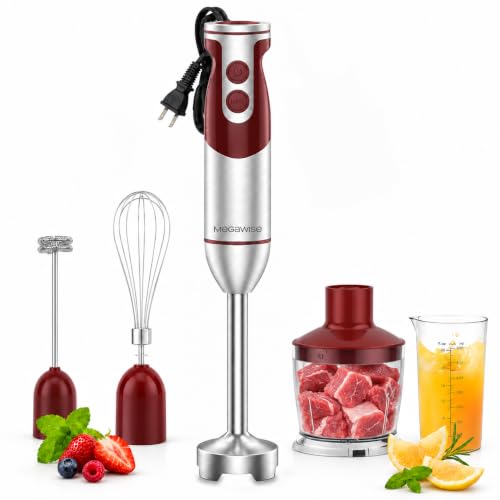
5. MEGAWISE Hand Blender (1000W, 5-in-1) — Best 1000W Hand Blender Set
The MEGAWISE takes the opposite approach to the KOIOS: same headline 1000 watts, but sold as a complete small-job system. The chopper handles onions, nuts, and herbs; the whisk does eggs and cream; the frother does lattes; the beaker gives the stick its own blending vessel. The detachable stainless shaft rinses clean in seconds. For a small household that wants one drawer-friendly tool to cover all the little blending jobs, this kit logic is hard to argue with.
Strengths
- Full 5-in-1 kit covers chopping, whisking, frothing, and blending
- Detachable stainless shaft is quick to clean and store
- 1000W motor gives the stick real headroom on thick mixtures
Trade-offs
- Kit parts multiply drawer clutter and washing up
- Less refined speed control than the KOIOS
- Chopper bowl is sized for small jobs only
| Motor | 1000W |
| Format | 5-in-1 hand blender set |
| Attachments | Chopper, whisk, frother, beaker |
| Shaft | Detachable, stainless steel design |
Value in this class is measured in jobs covered per dollar and per drawer. The MEGAWISE covers the most jobs of any pick here: it is a stick blender, a mini chopper, and a whisk station in one box, with the power to do each job credibly. It gives up the KOIOS’s fine speed gradations and anti-scratch refinement, so cooks with delicate cookware should lean the other way — but as a first serious hand blender kit, it is the breadth pick of the 1000-watt class.
MEGAWISE kit discipline: the chopper and frother live or die by storage. Keep the attachments in one labelled bin with the motor body, or within a month you own a plain stick and a drawer of mysteries. Bought as a system, stored as a system, it stays one.
The MEGAWISE chopper earns a specific warning that applies to every kit chopper: pulse nuts and hard items in short bursts and let the motor rest between them. Kit choppers are sprinter attachments; treated as sprinters, they last for years, and treated as processors, they teach an expensive lesson.
Best for: Small households wanting one kit for blending, chopping, whisking, and frothing / Not suited for: Cookware-protective cooks — the KOIOS anti-scratch guard is the safer match
Check the current price on Amazon

6. 220 Volt Hand Blender (1000W, 3-in-1) — 220V Regions Only — Best for 220-Volt Regions Only
This pick carries the clearest warning in the guide: it is built for 220-240 volt mains and is explicitly not for use in the USA. It is included because a share of readers searching this class live in Europe, Asia, Africa, and Oceania, where 220 volts is the standard and a US-spec blender is the wrong purchase. For them, this is a complete 1000W kit — blending shaft, a 500 ml chopper bowl, a 700 ml beaker, and a whisk — at the class’s full power rating.
Strengths
- Native 220-240V wiring — no converter needed in 220V regions
- Full 1000W with a complete 3-in-1 attachment set
- Beaker and chopper sizes suit everyday small-batch work
Trade-offs
- Absolutely not for North American 120V outlets
- Generic-brand support varies by region
- US readers should choose any other pick in this guide
| Motor | 1000W |
| Voltage | 220V / 240V — not for use in USA |
| Attachments | Blending shaft, 500 ml chopper, 700 ml beaker, whisk |
| Format | 3-in-1 hand blender |
Voltage is the one blender spec that cannot be adapted cheaply or safely after the fact — plugging a 220V appliance into the wrong supply, or running a 120V motor through a lightweight travel converter, ends in a dead motor or worse. If you live in a 220-volt region, buy a native 220V machine like this one and ignore the US-spec picks above, however good their reviews are. Our dedicated guide to 220-volt blenders, linked at the end, works through the options in full.
For the 220V pick, one practical addition: photograph the rating plate when the machine arrives and keep the photo with your appliance documents. If you later move between countries, that photo settles every ‘will it work there?’ question in seconds — the same verification habit this guide recommends throughout.
The 220V kit’s beaker deserves a measurement note for its actual audience: 700 ml is a genuinely useful household size — a two-person smoothie, a dressing batch, a soup for one with leftovers. In a category full of oversized accessories, the proportions here are refreshingly honest.
Best for: Readers in 220-240V regions wanting a 1000W hand blender kit / Not suited for: North American readers — this appliance is not wired for your outlets
Check the current price on Amazon
Comparison Table
Format first, then power delivery. All six picks are verified 1000-watt machines; the last column is the honest separator.
| Pick | Badge | Key Spec | Best For |
|---|---|---|---|
| Ninja Professional Blender BL610 (1000W, 72 oz) | Best Overall | 1000W, 72 oz pitcher, Total Crushing blades | Families blending smoothies and frozen drinks daily in full pitchers |
| Ninja UltraCrush Professional Blender BP201 (1000W, 72 oz, 3 Speeds) | Best Simple Controls | 1000W, 72 oz pitcher, 3 speeds + pulse | Shared households wanting full 1000W power with the simplest possible controls |
| nutribullet Turbo Personal Blender (1000W) | Best Personal Blender | 1000W personal blender, 32 oz + 24 oz cups | Solo smoothie drinkers and gym households blending one serving at a time |
| KOIOS Immersion Blender (1000W, 12 Speed + Turbo) | Best 1000W Hand Blender | 1000W immersion, 12 speeds + turbo, whisk + frother | Soup and sauce cooks wanting maximum in-pot power with fine speed control |
| MEGAWISE Hand Blender (1000W, 5-in-1) | Best 1000W Hand Blender Set | 1000W, 5-in-1 kit with chopper, whisk, frother, beaker | Small households wanting one kit for blending, chopping, whisking, and frothing |
| 220 Volt Hand Blender (1000W, 3-in-1) — 220V Regions Only | Best for 220-Volt Regions Only | 1000W, 220/240V only, 3-in-1 kit | Readers in 220-240V regions wanting a 1000W hand blender kit |
How to Choose the Best 1000 Watt Blenders: Rated Watts, Peak Watts, and What Actually Blends
Wattage is a ceiling, not a result. It tells you the most power the motor can draw, not how much of it reaches the food — blade design, jar shape, and gearing decide that. This is why two 1000-watt blenders can perform differently, and why this guide weighs format and blade system alongside the number. Use watts to set the class, then choose within it on design.
Watch for the word ‘peak’. Some listings quote a momentary peak figure rather than a sustained rating. Neither is fraudulent, but they are not comparable, and a blender bought on a peak number may disappoint on a long frozen blend. The picks here are the class’s established ratings as listed; when you compare outside this list, compare like with like.
Finally, match the format to the dominant job. Pitcher machines blend volume; personal cups blend speed and convenience; sticks blend in the pot you already cooked in. A 1000-watt rating in the wrong format is worth less than 600 watts in the right one.
Is 1000 Watts Enough? The Jobs This Class Does and Does Not Do
Yes, for the core domestic repertoire: smoothies with frozen fruit, crushed-ice drinks, milkshakes, salsas, purees, batters, and nut-adjacent jobs like seed butters in modest quantities. The countertop picks here handle full pitchers of frozen ingredients, which is the practical test most households actually set.
Where the class thins out is at the extremes: milling hard grains into flour, very long hot-soup cycles, and commercial duty cycles belong to the premium high-speed tier above it. And no wattage makes a personal cup blend for a family, or a pitcher machine blend a single egg-white foam sensibly. Power is necessary; format is decisive.
Pitcher, Cup, or Stick: Picking the 1000W Format for Your Kitchen
Choose the pitcher if you blend for three or more people, make frozen drinks for guests, or batch soups and sauces to freeze. Choose the personal cup if mornings are a solo smoothie against the clock and counter space is tight. Choose the stick if your blending is mostly finishing work — soups in the pot, sauces in the pan, dressings in a bowl — and you value a tool that rinses in ten seconds and lives in a drawer.
Many households honestly need two formats, and at this price tier that is a reasonable answer: the BL610 plus the KOIOS, for example, covers the entire domestic repertoire between them for less than one premium high-speed machine.
The 1000-Watt Owner’s Upgrade Path: When to Stay and When to Move Up
Stay in this class if your blends are smoothies, frozen drinks, sauces, and soups in household volumes, made once or twice a day. The class handles that life indefinitely, and money saved against the premium tier buys years of ingredients. The owners who outgrow 1000 watts share a profile: batch sizes grow (a family becomes a team breakfast), frequency grows (a café side-hustle, a gym household), or the job list grows (dough, processing, milling). Any one of those is a legitimate trigger to move up; none of them is a criticism of the machine you own.
When you do move up, the format lesson from this guide travels with you: the household that loved its BL610 usually buys a bigger pitcher machine, and the household that loved its KOIOS usually buys a better stick, not a different format. Wattage is the variable; format is the constant of your kitchen’s habits.
The Used-Market and Hand-Me-Down Reality of the 1000-Watt Class
This class is the sweet spot of the second-hand market, because the established models are durable, common, and cheap to verify: a used BL610 with a sound jar and a quiet bearing is one of the best-value appliances a kitchen can acquire. Verify three things on any used unit — the jar for cracks at the handle and base, the drive coupling for rounded teeth, and the motor’s smell after thirty seconds of running (hot varnish is a warning, not a personality trait).
Hand-me-down logic runs the other way too: a 1000-watt machine is the ideal blender to give a student or a first-apartment cook, because it is powerful enough to be respected and simple enough to survive inexperience. Several picks in this guide have launched more cooking habits than any premium machine, precisely because they were handed down instead of sold.
Noise, Neighbours, and the 7 A.M. Problem
A 1000-watt blender at full speed is a loud appliance for roughly the minute it runs. Households with sleeping babies, thin walls, or dawn smoothies should plan around the minute rather than pretend it away: blend the night before (smoothies keep acceptably overnight in the fridge), choose the personal-cup format whose cycle is shortest, or use the stick in its beaker, which is noticeably gentler on the house than a pitcher at full song.
What not to do is buy a weaker machine for quietness: a long, straining blend is louder in total and worse in the glass. In blender acoustics, power is mercy — the job ends sooner.
What 1000 Watts Does to Texture: A Short Field Guide
Texture is where this class announces itself. A 1000-watt vortex pulls ingredients down continuously, so soups come out uniform without straining, smoothies lose the fibrous threads that weaker machines leave, and frozen drinks hold a slush instead of separating into ice and juice. The tell-tale failure of the class below — the smoothie that is sweet at the bottom and watery at the top — is a circulation failure, and circulation is precisely what the verified picks here were chosen for.
The class’s texture ceiling is equally specific: it will not give you the silk of a high-speed premium machine on a raw vegetable soup, and it will not powder nuts. Within its repertoire, though, the difference between a verified 1000-watt pick and a bargain one is not power on paper but whether the vortex survives a full, frozen load — which is a design question, and why this guide’s screening weighed jar and blade geometry as heavily as the rating.
How to Use a 1000-Watt Blender for Perfect Frozen Smoothies
A 1000-watt machine has the power for frozen smoothies; the routine below is what turns that power into a smooth result instead of a noisy jar of chunks. Before the steps, check your ice: cubes from a tray or a fridge dispenser behave predictably, while a solid bag-frozen block must be broken up first. The routine assumes loose cubes or frozen fruit pieces — thirty seconds of bag-breaking at the sink is the difference between a smooth run and a stalled one.
- Load in order. Liquids first, then powders and soft ingredients, then frozen fruit, then ice last. The liquid gives the blade a vortex to start; the frozen load feeds down into it.
- Use enough liquid. Frozen blends stall for lack of liquid more than lack of power. Keep the liquid level at least level with the frozen ingredients before you start.
- Start low, finish high. Five seconds on low pulls the load together without an air pocket; then go to high for the main blend. On a three-speed machine, that is speed one, then speed three.
- Listen for the change. A working blend sounds even and deep. A high, rattling whine means cavitation — stop, add a splash of liquid or stir, and restart.
- Rest between back-to-back batches. Two full frozen batches in a row is real work. A minute’s pause between them keeps a 1000-watt motor in its comfort zone for years.
- Clean while it is easy. Warm water, a drop of detergent, a short blend, rinse. Frozen smoothie residue sets like cement if it dries in the jar.
Freeze your smoothie fruit in flat bags so it breaks apart by hand before loading — smaller frozen pieces are the cheapest performance upgrade any blender can get. If your smoothies separate in the glass, the fix is rarely more power: it is a teaspoon of something with body — yogurt, nut butter, or a few oats — blended in at the start. A 1000-watt machine emulsifies eagerly when it is given an emulsifier to work with.
Common Buying Mistakes
Comparing peak watts to rated watts. A peak figure and a sustained rating are different measurements. Compare sustained to sustained, or you will buy the smaller motor with the bigger number.
Buying a pitcher for a solo habit. A 72-ounce pitcher blending one small smoothie wastes ingredients and washes badly. Match the format to the serving count you actually make.
Running a 220V appliance on the wrong mains. Voltage is not a suggestion. The 220-volt pick in this guide is for 220-volt regions only; North American readers must buy 120V machines, and vice versa.
Starving frozen blends of liquid. Most ‘underpowered blender’ complaints are under-liquided recipes. Give the vortex something to work with before blaming the motor.
Ignoring the duty rhythm. Back-to-back full frozen batches without a pause age a motor fast. Thirty to sixty seconds between batches is cheap insurance.
Judging the class by its cheapest member. A weak 1000-watt listing with a peak-only rating gives the class a bad name it does not deserve. The verified picks here are the class as it should be judged.
Blending with the jar overfilled to ‘save a batch’. An overfilled jar blends worse, not just messier: the vortex drowns and the top third never circulates. Two honest batches beat one drowned one, in less total time than the cleanup suggests.
Final Recommendation
For most households, the Ninja BL610 is the 1000-watt blender to buy: proven, capacious, and strong on exactly the jobs this class exists for. The BP201 matches it for shoppers who prefer three speeds and nothing else. Solo smoothie drinkers should skip both and take the nutribullet Turbo, the strongest personal blender in the class.
In-pot cooks are genuinely well served at this wattage for once: the KOIOS for control, the MEGAWISE for kit breadth. And readers in 220-volt regions — buy the native-voltage machine and never think about converters. One thousand watts, in the right format and the right voltage, is all the blender most kitchens need.
A closing thought on the class as a whole: 1000 watts is where blender marketing and blender reality most nearly agree. The number promises a capable, general-purpose machine, and the verified picks deliver exactly that, in four different shapes. Choose the shape honestly and this may be the last blender class you ever need to read about.
Keep exploring the cluster: Best 900 1000 Watt Blenders Best 1500 Watt Blenders Best 10 Cup Blenders Best 220v Blenders Best Affordable Blenders For Smoothies
Related guides
Frequently Asked Questions
Is 1000 watts enough to crush ice?
Yes. Both countertop picks in this guide are built around ice crushing, and the personal nutribullet Turbo handles ice in single servings. Technique matters: add ice to liquid rather than blending dry ice alone, and let the machine reach full speed.
What is the difference between 1000 watts and 1500 watts in a blender?
Headroom. A 1500-watt machine sustains heavy, full-pitcher frozen loads and long blends with less strain, and usually adds programs and build quality. For typical household smoothies and drinks, 1000 watts does the same jobs; the higher class earns its money on volume and duty, not on a different result in the glass.
Are 1000-watt immersion blenders really as strong as countertop models?
The rating is real, but the jobs differ. A 1000W stick is exceptionally strong for in-pot work — soups, purees, sauces. It will not crush ice or make frozen drinks like a pitcher machine, because the format, not the motor, decides that.
Can I use a 1000W US blender in Europe with a plug adapter?
No. A plug adapter changes the shape, not the voltage. A 120V motor on 230V mains will fail, possibly dangerously. You need either a native 220-240V appliance, like the final pick in this guide, or a properly rated heavy-duty voltage converter — and for motors, the native appliance is always the better answer.
Which 1000-watt blender is best for a single person?
The nutribullet Turbo. Its 1000 watts are unusual in the personal class, its cups travel, and it avoids the small-load problem that big pitchers have with single servings.
Do I need more than 1000 watts for green smoothies with kale and frozen fruit?
No — the countertop picks here handle fibrous greens and frozen fruit well, especially with enough liquid and a low-then-high start. Blend a few seconds longer for the silkiest result.
How long do 1000-watt blenders typically last?
With daily household use and prompt cleaning, the established models in this guide are multi-year appliances. The usual end-of-life story is not the motor but wear around it — seals, jars, and drive couplings — which is why brands with good parts availability age better than brands without.
Is 1000 watts enough for nut butter?
For occasional, small batches with patience and scraping, the strongest pitcher pick here can manage it; as a weekly habit, nut butter belongs to the 1500-watt class or a food processor. The honest boundary of this class is sustained, thick, low-liquid work — smoothies and soups never approach it, nut butter lives beyond it.
Should I buy a 1000-watt blender or save longer for a premium one?
If the premium machine’s extra abilities — milling, heating, decade-scale duty — are not on your job list, buy this class now and cook. The premium premium buys capabilities and longevity, not a different smoothie. Households that blend daily for years eventually justify the flagship; households that blend daily for smoothies were already served here.


