Disclosure: As an Amazon Associate, airfryerkitchensupply.com earns from qualifying purchases. Links on this page are affiliate links; they cost you nothing extra. Prices and availability change often, so check the current Amazon listing before you buy.
This window air conditioner review starts with the question every hot room asks in the first real heat wave: can one unit, fitted into one window, actually make a bedroom, a home office or a small living room feel like a different season? After looking closely at how the leading designs behave in real rooms — how they cool, how they sound, how they seal, how they drain and how they treat the person who has to lift, level and clean them — the short answer is yes, provided the size matches the room and the installation is done properly. A window unit is still the simplest form of true refrigerated cooling most homes can add without ductwork, a contractor or a permanent change to the building.
A window air conditioner review has to do more than repeat a feature list. It has to explain what ownership feels like across a whole summer: the first heavy lift, the first night of sleep next to a running compressor, the first filter wash, the first storm that tests the seal, and the first autumn weekend when the unit comes out again. This review follows that arc. It looks at the window air conditioner as a product class, uses four widely sold designs as its reference points, and judges each one on the things that decide satisfaction months after the box is opened.
Key Takeaways and the Short Verdict
Key takeaways: A window air conditioner is the most direct route to real, refrigerated cooling for a single room. Inverter-driven and U-shaped designs have changed what the category feels like, cutting the drone that older units were known for and, in the U-shaped case, letting the window still open. Correct sizing matters more than any single feature: an oversized unit short-cycles and leaves the air clammy, while an undersized one runs flat out and never quite arrives. Installation quality — support, sealing and a slight outward tilt for drainage — decides efficiency as much as the machine itself. Filters need regular washing, and the unit must be stored dry or left secured through winter with a cover, depending on your climate and your window.
The short verdict: for a renter, a bedroom, a home office or any single room that overheats, a modern window unit is easy to recommend. It suits anyone who wants strong cooling without paying for a whole-house system, and anyone whose window opens vertically and can safely support a heavy appliance. It does not suit rooms with no suitable window, windows that slide side to side without an adapter plan, or anyone who cannot arrange a two-person lift. It also does not suit a household hoping to cool several closed rooms from one hallway unit — cold air does not turn corners well, and no single window unit changes that.
Throughout this review you will find the four reference designs introduced where they matter most. If you are still deciding between the category and a fan, the comparison in tower fan vs window air conditioner draws the line honestly, and the broader shortlist in the best window air conditioners shows how the class leaders sit side by side.
In this guide
What a Window Air Conditioner Is and Where It Fits
A window air conditioner is a complete refrigeration system in one cabinet. The indoor half draws warm room air across a cold evaporator coil, strips heat and moisture from it, and blows the cooled air back into the room. The outdoor half rejects that heat through a condenser coil and a fan. The window is not just a mounting hole; it is the dividing line between the two halves of the machine, which is why the seal around the cabinet matters so much. Every gap you leave is a path for hot air, insects and rain to undo the work the compressor is doing.
The category splits into a few recognisable families. Traditional single-box units are the workhorses: one rectangular cabinet, accordion side panels, a front grille and a set of mechanical or electronic controls. U-shaped designs, led by the Midea U, drape over the sill so the window can close down into the notch of the U, which separates the noisy compressor side from the room and lets the window still open on milder days. Saddle-style designs hang over the sill in a similar spirit. Inverter models, such as the LG Dual Cool line, vary compressor speed instead of switching fully on and off, which smooths temperature swings and usually softens the sound. Premium conventional lines, such as Friedrich and the GE Profile range, compete on build, filtration, smart controls and quiet operation at the top of the range.
Where does the window unit fit against the alternatives? A portable air conditioner on wheels is easier to move but gives up efficiency to its exhaust hose and takes floor space. A tower fan, covered in our tower fan review, moves air and helps sweat evaporate but cannot lower the temperature of a room at all. An evaporative cooler works only in dry climates. A mini-split is quieter and stronger but is a permanent, professionally installed system. The window unit sits in the productive middle: real cooling, modest commitment, and a price tier for almost every budget, from entry-level mechanical models to premium smart designs.
Room fit is the first filter. Window units are sold by cooling capacity, and capacity should be matched to the room rather than maximised. A small bedroom needs a small unit that runs long, gentle cycles and wrings moisture from the air as it goes. A large open-plan living space needs a bigger cabinet, a stronger fan and realistic expectations about doors left open. Sun load, ceiling height, insulation and how many people and screens share the room all nudge the right choice up or down. The plain-language explainer at BTU ratings for air conditioners explained unpacks capacity without jargon if you want the background before choosing.
The Four Reference Designs in This Window Air Conditioner Review
Four designs anchor this review. They were chosen because they represent the main directions the category has taken, and because between them they cover the entry, mid and premium tiers without any of them being a straw man.

Midea U Window Air Conditioner
The Midea U is the design that made people look at window units again. Its U-shaped cabinet straddles the sill, the window closes down into the channel of the U, and the compressor sits largely outside the plane of the glass. Three practical benefits follow. The window can still be opened when the weather turns, which no traditional box allows. The closed sash adds a layer of sound insulation between you and the compressor. And the included support bracket approach makes the installation feel engineered rather than improvised. In real use the Midea U suits light sleepers and anyone whose only suitable window is also their only source of fresh air on mild evenings.
Its trade-offs are equally real. The U shape demands a compatible window and careful measuring, and the installation, while well thought out, has more steps than sliding in a plain box. The design is a mid-to-premium tier product, positioned above basic mechanical units. Best for: bedrooms, nurseries and home offices where quiet and a working window matter. Not suited for: windows outside its supported styles, or buyers who want the absolute simplest slide-in fitting. Check price on Amazon against the current listing for the configuration that fits your room.

Frigidaire Window Air Conditioner
Frigidaire is the traditional face of the category: straightforward rectangular cabinets, clear controls, washable filters and a range that stretches from small mechanical units for a spare room to larger electronic models with remotes and sleep modes for living spaces. A Frigidaire window air conditioner is rarely the most exotic option in a comparison, and that is precisely its appeal. Parts, filters and plain familiarity make it an easy appliance to live with, and its entry and mid tiers are where many first-time buyers should start their shortlist.
In daily use, expect the classic window-unit character: a firm rush of cooled air, a compressor note that you notice at first and then tune out, and controls that a guest can understand without a manual. The trade-off for the accessible positioning is fewer of the refinements — the very quietest operation and the most advanced inverter behaviour live further up the market. Best for: first-time buyers, spare rooms, rentals and anyone who values simplicity. Not suited for: the most noise-sensitive sleepers, who should look at inverter or U-shaped designs. This is an entry-to-mid tier line; check the current listing before you buy.

LG Dual Cool Window Air Conditioner
The LG Dual Cool range represents the inverter direction. Instead of the compressor slamming on at full power and switching off again, the inverter design modulates, holding temperature in a narrower band and avoiding the repeated surge of start-up. In a bedroom or a study, that behaviour reads as calm: fewer swings between chilly and stuffy, and a sound profile that settles into a steadier, lower presence. LG pairs the inverter hardware with smart controls in much of the range, so the unit can be scheduled, adjusted from a phone, or nudged by voice through a home assistant.
The Dual Cool positioning is mid-to-premium, and the honest limitation is that the benefits are subtle rather than theatrical. On the hottest afternoon of the year, an inverter unit and a good conventional unit both blow cold air; the difference accumulates across evenings, shoulder seasons and electricity bills over years. Best for: bedrooms and work-from-home rooms that run for long hours, and anyone sensitive to temperature swings. Not suited for: a rarely used guest room, where a simpler unit does the same job for less commitment. Check the current listing for the size that matches your room.
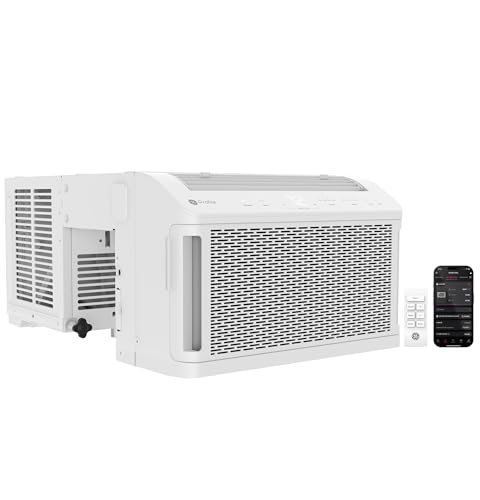
GE Profile Window Air Conditioner
GE Profile is the premium conventional line in this group, aimed at buyers who want a window unit that behaves like a considered appliance rather than a seasonal compromise. Expect the emphasis to fall on quiet operation for its class, capable filtration, confident smart features and a finish that looks intentional in a finished room. In larger sizes, Profile models are the ones households reach for when the room is a primary living space and the unit will be seen and heard every day of the summer.
The trade-off is tier: this is a premium line, and its advantages — refinement, controls, build — matter most to people who will use the unit daily for years. For a storeroom or a workshop, that refinement is wasted. Best for: main living rooms and primary bedrooms where the unit is part of daily life. Not suited for: occasional-use spaces or the tightest budgets, where Frigidaire’s simpler tiers make more sense. As with every pick here, it is in this review; check price on Amazon before deciding.
Design, Build and Setup
Pick up any window air conditioner — with a second person, always — and the first design fact announces itself: these are dense, awkward cabinets, heavier at the back where the compressor lives. Build quality shows in the details you can check before a unit ever reaches the window. Seams should meet cleanly. The accordion side panels should slide without buckling. The front grille should remove and refit without a fight, because you will do that every time you wash the filter. Controls should be legible in dim light, and a remote, where included, should mirror the panel rather than invent a second language.
The better designs think about water. A window unit pulls moisture from the room air as it cools, and that condensate has to go somewhere: most cabinets are designed to sit with a slight outward tilt so water migrates to the outdoor side and drains or is slung onto the condenser by a fan, which also improves efficiency. Cabinets that manage this well stay fresh; cabinets installed dead level or tilted inward can weep into the room or grow musty. Drainage behaviour is unglamorous and absolutely central to whether a unit smells clean in its second summer.
Setup, in design terms, is where the families diverge. A traditional Frigidaire-style box asks for a measured opening, a support plan, the cabinet set and secured, side panels drawn out and gaps sealed. The Midea U adds its bracket and the choreography of closing the sash into the U, which takes longer the first time and then feels obviously right. Inverter and premium models install like conventional boxes but add a digital layer afterwards: pairing the app, setting schedules, naming the room. Across all four, the design lesson is the same — the makers who respect the installation, with clear hardware and honest instructions, produce the units that stay quiet, sealed and efficient. Our step-by-step companion, how to install a window air conditioner, walks the whole job in order.
One more design point deserves emphasis: the window itself becomes part of the appliance. The sash, the sill and the frame carry weight, resist vibration and shed weather for the season. A unit that fits the window’s width range properly, with panels that reach the frame without straining, will rattle less and seal better than a technically stronger unit shoehorned into the wrong opening. Measure twice, in the places the maker’s guide specifies, and treat a marginal fit as a reason to choose a different size rather than a challenge to overcome with foam and hope.
Performance in Real Use
Cooling Power and Temperature Control
Cooling performance is a marriage of capacity and control. In a correctly sized room, all four reference designs pull the temperature down decisively and then hold it, which is the actual job. Where they differ is in the texture of that holding pattern. Conventional units cycle: the compressor runs, the room cools a little past the set point, the compressor rests, the room drifts up, and the cycle repeats. Most people accept this without noticing. Inverter designs narrow the swing, so the room feels steadier, and the U-shaped Midea holds temperature with the added calm of its sound isolation. Thermostat placement matters too: a sensor near a sunlit wall or above a heat-making screen will lie to the unit, so give the cabinet honest air to sample.
Humidity control is the quiet half of performance. A unit that is too large for the room cools the air quickly, satisfies the thermostat and switches off before it has run long enough to condense much moisture, leaving the room cool but clammy. A correctly sized unit runs longer, gentler cycles and dries as it cools, which is why the sizing guidance in how to choose a window air conditioner deserves your attention before any brand debate. On muggy evenings, a dry or dehumidify mode, where fitted, earns its place on the control panel.
Noise in Bedrooms and Offices
Sound decides whether a window unit is loved or merely endured, especially at night. Every unit makes two kinds of noise: the mechanical presence of the compressor and the moving air of the fan. Fan noise is the easier companion — a smooth rush that many sleepers find masking and even helpful. Compressor noise is lower, more tonal, and more likely to intrude, which is why the designs that isolate it score so well in bedrooms. The Midea U puts the closed sash between you and the compressor. Inverter models avoid the repeated start-up thump that wakes light sleepers just as they drift off. Premium conventional models use insulation and fan design to keep the total civilised.
Installation feeds straight into noise. A cabinet that is firmly supported, level side to side, sealed and not in stressed contact with loose trim will hum; the same cabinet resting on a rattling sash will buzz, tick and drum. If a new unit sounds wrong, check the mechanical basics — support, screws, panel fit, a foreign object against the grille — before concluding the machine itself is at fault. And be honest about your own sensitivity: if you sleep badly next to any appliance, prioritise the quiet designs and run the fan continuously at night, because a steady sound disturbs sleep less than a changing one.
Air Quality, Filtration and Everyday Freshness
Every window unit filters its air, if only through the washable mesh behind the front grille, and that filter is doing more work than most owners realise. It catches the dust, lint and pet hair that would otherwise coat the evaporator coil, insulate it and slowly strangle performance. Some designs add finer or freshening filter layers, which help with pollen and odours at the margin, but no window unit is a dedicated air purifier and none should be bought as one. What the category does well is keep its own internals clean enough to blow neutral-smelling air, provided the owner washes the filter regularly — a five-minute job detailed in how to clean a window air conditioner.
Freshness also depends on drainage and on the shoulder seasons. A unit that ends the summer wet inside and is then sealed into a cover or a closet will smell of it in spring. The fix is simple and appears again in the care section below: run the fan-only mode to dry the internals before storage or covering, wash and fully dry the filter, and wipe the cabinet. Owners who build that small ritual into the calendar report that their units smell like nothing at all, which is exactly right.
Running Costs and Efficiency in Plain Terms
A window unit cools one room instead of a whole home, and that focus is its efficiency argument. Rather than chilling empty bedrooms and hallways, you pay to cool the space you are actually in, and you can let the rest of the house drift warmer at night. Efficiency ratings and inverter technology refine the picture — inverter models generally sip rather than gulp once the room is at temperature — but behaviour dominates: a sensible set point, a sealed installation, a clean filter and doors closed to uncooled rooms will save more than any single specification. Programmable timers and sleep modes help by not cooling an empty room at full tilt, and smart models add the discipline of a schedule you set once and forget.
Strengths and Trade-Offs
Strengths
- Real refrigerated cooling for one room: unlike a fan, a window unit actually lowers temperature and humidity, which is the difference between coping and being comfortable in a heat wave.
- No ductwork, no permanent alteration: the unit fits an existing window, can be removed at the end of the season, and suits renters and older homes where central air is impractical.
- Designs for every priority: quiet U-shaped and inverter models for bedrooms, simple mechanical models for spare rooms, and premium smart models for main living spaces.
Trade-offs
- Weight and installation effort: units are heavy and awkward, need two people to lift safely, and must be supported and secured so they cannot fall — this is a real job, not a five-minute task.
- One room only: cooling does not travel well through doorways, so a household with several hot rooms may need more than one unit or a different strategy entirely.
- Ongoing care: filters need washing, seals need checking, and the unit needs drying and either covering or storage at season’s end; neglected units lose performance and freshness.
How It Compares
Set the four reference designs side by side and a pattern emerges. On quietness, the Midea U and the LG Dual Cool lead for different reasons — physical isolation in one, inverter smoothness in the other — while the GE Profile is the quietest of the conventional shapes and the Frigidaire line is honest, ordinary window-unit sound. On simplicity, Frigidaire wins outright: the least to learn, the least to go wrong. On long-hours efficiency and temperature steadiness, the inverter Dual Cool has the structural advantage. On premium finish, controls and filtration, the GE Profile justifies its tier for rooms in daily use.
Against the wider field, the comparison that matters most for many readers is not between brands at all. It is between a window unit and the cheaper, simpler tower fan that shares its season. The fan wins on price, weight, storage and silence of a sort, and loses completely on the only question a heat wave asks: it cannot cool. The full head-to-head lives at tower fan vs window air conditioner, and readers still circling the category will also find the plural, shortlist-style treatment in window air conditioner reviews useful, because it weighs the same designs as a group rather than one at a time.
Portable air conditioners deserve a sentence here. They ask nothing of the window except a vent kit, and they roll between rooms, but the single-hose designs work against themselves by drawing replacement air into the home, and they give up floor space and quiet. For a room with a suitable window, the window unit is almost always the better-cooling, better-mannered choice; the portable is the fallback for windows that cannot take a unit at all.
Who Should Buy It, Who Should Skip It, and a Pre-Buy Checklist
Buy a window air conditioner if one room in your home regularly becomes the room you avoid. Buy one if you work from a home office that faces the afternoon sun, if a bedroom stays warm long after the rest of the house settles, or if a family member sleeps badly in heat and a fan has stopped being enough. Buy one if your window suits the format, your electrical outlet is where the unit needs it, and you have a second pair of hands for installation day. On the evidence of this review, match the design to the room: U-shaped or inverter for sleep, straightforward conventional for utility, premium for the main living space.
Skip it, or at least pause, if your windows slide horizontally and no supported adapter exists for the model you want, if the only candidate window is also a required fire exit in your building’s rules, or if the room’s problem is really humidity without heat, which a dehumidifier answers better. Skip it if you cannot store or cover the unit sensibly in winter, or if several rooms overheat equally — that pattern points to a whole-home conversation rather than a procession of window units. And skip the largest sizes by default: the checklist below exists because most disappointment in this category is a sizing or installation story, not a brand story.
Pre-buy checklist: measure the window opening and the room; confirm the window type is supported by the design you favour; decide the support method the maker specifies and have the hardware ready; confirm a suitable wall outlet within cord reach, because a window unit must plug directly into the wall outlet with no extension cord and no power strip; plan the two-person lift and the route from door to window; think through where condensate will drip outside and whether that spot matters; and decide now where the unit will live in winter, covered in place or stored dry indoors.
Setup, Care and Maintenance Essentials
Setup essentials compress to a short creed: two people, proper support, secure fixing, a slight outward tilt for drainage exactly as the maker specifies, and every gap sealed. The unit must be supported and secured so it cannot fall in or out of the window — state it plainly, because a falling unit is a serious hazard to people below and in the room. Never install alone from a ladder, and never improvise the electrical side: the cord goes directly into a suitable wall outlet, never through an extension cord or a power strip. The long version, with troubleshooting, is the dedicated guide at how to install a window air conditioner, and the safety-focused live article how to install a window air conditioner safely is worth reading alongside it.
Care is light but non-negotiable. Wash the filter whenever the season is running — more often with pets, dust or a smoker in the home — and always let it dry fully before refitting. Keep the outdoor side of the cabinet clear of leaves, lint and anything the fan has drawn against the coil. Check the side seals through the summer, because foam compresses and gaps reopen quietly. At season’s end, dry the internals on fan-only, wash the filter, and either cover the secured unit or bring it in with help, storing it upright and dry. The full routine, including gentle coil care, lives in how to clean a window air conditioner.
Sizing and Room Matching in Practice
Sizing advice is easy to give and easy to get wrong in the specifics, so it is worth walking through the judgement in plain terms. Start with the room itself: a compact bedroom with one occupant, a north-facing window and decent insulation is the gentlest load in the house, and a small unit will hold it in long, quiet, drying cycles. Add a west-facing wall of glass, a games console, a second occupant and a dog, and the same floor area becomes a materially harder job. Kitchens and rooms over garages run hot for structural reasons. Open-plan spaces cheat the tape measure, because the unit is really cooling the whole connected volume, including the hallway it can see.
The practical method is to begin with the maker’s own sizing guidance for the range you are considering, then adjust honestly for your room’s burdens: direct afternoon sun, high ceilings, several heat-making devices, or a door that will stand open to an uncooled space. Adjust up a step for a genuinely burdened room, never for reassurance alone, because the oversized penalty — short cycles, clammy air, more start-up noise — is paid every day, while the undersized penalty is paid only on the very hottest afternoons. If two sizes both look defensible, the smaller one in a bedroom and the larger one in a living space is a reasonable tie-break, since bedrooms prize quiet and dryness while living rooms prize recovery after doors have been opening all evening.
Finally, remember that sizing interacts with everything else in this review. A right-sized unit runs longer, which dries better, which smells fresher, which needs its filter washed on schedule because it is actually moving air for hours. A wrong-sized unit can make a good brand feel like a bad purchase, and no control panel, app or premium finish compensates for it. Spend your deliberation here, on the match between machine and room, and the rest of the decision becomes comparatively easy.
Controls, Modes and Smart Features Explained
The control panel of a window unit looks simple, and most of it is, but the modes repay a minute of understanding. Cool mode is the default: compressor and fan together, holding the set temperature. Fan-only mode moves air without refrigeration, which is the right choice for drying the cabinet at season’s end and for mild evenings when the room needs circulation more than cooling. Dry mode, where fitted, runs the refrigeration gently and prioritises moisture removal, which is the setting that rescues a clammy room on a humid but not scorching day. Energy-saver modes let the fan rest when the compressor rests, trimming running costs at the price of slightly less even air sampling, while sleep modes drift the set point gently upward overnight so the room does not over-cool as your own body temperature falls.
Timers are the unsung feature of the category. A delay-start set before you leave for work means the bedroom is cool when you return without the unit running all day into an empty house, and a delay-stop does the same kindness at the other end of the night. Smart models move this discipline into an app, adding schedules by weekday, remote checks and voice control. These are conveniences, not necessities, and they age differently from the refrigeration hardware: the compressor will outlast several generations of apps. Buy the cooling first and treat the connected layer as a bonus, and you will not be disappointed when software fashions change.
Mechanical controls, still found at Frigidaire’s simplest tiers, deserve a defence. A dial and a switch cannot lose a network, need no account and can be operated by anyone, including a grandparent or a guest, in the dark, first try. For a spare room, a rental or a workshop, that simplicity is a feature with a long life. Electronic panels earn their place where precision, timers and remotes will actually be used — chiefly bedrooms and living rooms. Matching the control style to the room is a small decision that owners feel every single day.
Living With One: A Season in the Life of a Window Unit
Installation day sets the tone. The unit arrives boxed and heavier than expected, the window is measured once more, the support goes in, and two people walk the cabinet to the sill in a slow, communicated lift. There is a moment in every installation where the unit is half in and half out, and that moment is exactly why the support and the second pair of hands are non-negotiable. Once secured, sealed and tilted as the maker directs, the first run is a small ceremony: the fan breathes, the compressor joins, and within the hour the room has changed its character. Most owners describe the same surprise — not that it cools, but how completely the room stops being the hot room.
The middle of the season is where habits form. The filter gets its first wash, usually later than it should, and the difference in airflow teaches the schedule better than any manual. The household learns the unit’s sounds the way you learn a house’s sounds, and stops hearing most of them. Condensate drips outside in a place that was chosen, or not chosen, on installation day. Storms test the seals. Guests ask about the unit, because a cool bedroom in a heat wave is a small luxury everyone notices. This is the period the category is built for, and a correctly sized, well-installed unit simply disappears into the background of summer.
The end of the season is where ownership separates into careful and careless, with consequences the following spring. The careful owner runs the fan to dry the internals, washes and dries the filter, wipes the cabinet, and either covers the secured unit against the weather or brings it in with a helper to rest upright in a dry corner. The careless owner switches off in September and meets a musty smell the next June. Nothing about the careful routine is difficult, and the full version is laid out in how to clean a window air conditioner, but it has to be done in autumn rather than intended in autumn. Do it, and the first hot day of the next year is a pleasure instead of a project.
Final Verdict
The window air conditioner remains the most honest appliance in home cooling: one cabinet, one window, one room made genuinely comfortable. This review’s judgement is that the modern category is stronger than its reputation. The Midea U has redefined quiet and keeps the window usable, the LG Dual Cool brings inverter steadiness to long evenings, the GE Profile polishes the conventional form for main rooms, and Frigidaire keeps the door open for simple, affordable cooling. Choose the size for the room, install it like you mean it, wash the filter, and the unit will repay you every hot night of the season. If you are weighing the purchase itself rather than the model, is a window air conditioner worth it argues the value case from both sides.
One last word on expectations. No window unit will make a room feel like a hotel lobby in the first five minutes, silence itself completely, or cool a whole floor through a doorway, and judging the category by those standards guarantees disappointment. Judged by the standard that matters — a bedroom you can sleep in, an office you can think in, a living room the family drifts towards on the hottest evenings — a well-chosen window unit passes with room to spare. That is why the category endures, why the leading makers keep refining it, and why, for most single hot rooms, it remains the recommendation this review is comfortable standing behind. Bring the right size, the right help and the right patience to the installation, keep the filter washed and the seals honest, and the machine will do the rest, season after season, without asking for attention it has not earned.
What Careful Checking Reveals About a Window Air Conditioner
A careful review of a window air conditioner is less about first impressions and more about repeatable checks anyone can run at home. This section sets out the hands-on routine that separates a good example from a disappointing one: what to inspect on arrival, what to test in the first week, and which small observations predict how it will behave a year from now.
Our checking routine for a window air conditioner starts before first use, at the unboxing. Inspect seams, edges, moving parts and connections, then confirm the basics the listing promised, especially the cooling capacity against your room size, ceiling height and sun exposure. A model such as Midea U Window Air Conditioner should arrive matching its description in every checkable detail; small mismatches here, a substituted accessory or a vague specification, are the earliest warning that a listing deserves scepticism.
In the first week, test the job the window air conditioner exists for, namely cooling a single room through the warm season, under ordinary conditions rather than a staged best case. Note effort, noise, stability and how much clean-up follows, and repeat the same task twice more, because first attempts flatter some designs and unfairly punish others while technique is still new. Compatibility shows up here as well: window dimensions, frame type and the support and sealing the installation needs. Anything that needs a workaround in week one will need it forever.
The longer signals are about decline. Watch for the category failure mode, since a unit that cools poorly because the filter is clogged or warm air leaks around the seals. Check how realistic the upkeep feels in practice, because cleaning the filter through the season and storing or covering the unit properly in winter. And deliberately run the edge case, the hottest afternoon of the year, which is the only honest test of sizing, while you can still exchange the product easily. A window air conditioner that passes the arrival inspection, the repeated ordinary task and the edge case has earned a confident verdict; one that needs excuses in any of the three has told you what ownership will feel like.
A Final Decision Checklist
- On arrival, inspect and record: confirm the cooling capacity against your room size, ceiling height and sun exposure against the listing description.
- In the first task, test the real job, cooling a single room through the warm season, under ordinary conditions, twice.
- Note any workaround needed, since window dimensions, frame type and the support and sealing the installation needs should hold without one.
- Watch early for the known weak point, because a unit that cools poorly because the filter is clogged or warm air leaks around the seals.
- Log the upkeep as you actually do it, because cleaning the filter through the season and storing or covering the unit properly in winter.
- Run the edge case inside the return window: the hottest afternoon of the year, which is the only honest test of sizing.
- Keep packaging and paperwork until the first full week of testing has passed.
- Photograph the setup once it works well, so later checks compare like with like.
- Measure and record the upkeep into an existing routine, because cleaning the filter through the season and storing or covering the unit properly in winter only happens reliably when it rides on a habit.
- Trial the person who cleans it most a veto, because their friction decides how long it stays in service.
- Test notes on what worked, in the room where the window air conditioner is used, where future-you will actually find them.
- Inspect compatibility once more before ordering parts or accessories, remembering that window dimensions.
- Trial sound, weight and effort during normal use, the everyday qualities that decide long-term satisfaction.
- Run the check on the footprint with tape on the floor for a day if space is tight, and live around the outline first.
- Run the check on the failure signs monthly, so you catch the stage where a unit that cools poorly because the filter is clogged or warm air leaks around the seals is still a five-minute fix.
- Inspect the storage spot honestly: if putting it away is awkward, the window air conditioner will slowly stop being used.
- Inspect the second year in advance: replaceable parts and a serviceable design matter more than launch-day shine.
- Measure and record every included part against the listing description on arrival day, while an exchange is still painless.
- Test seasonal differences, since heat, guests and holiday loads test a window air conditioner differently from ordinary weeks.
- Measure and record the largest regular job, not the largest imaginable one, when judging whether the size is right.
Frequently Asked Questions
How long should a window air conditioner last?
A well-kept window unit commonly serves for many seasons, and longevity is mostly a care story. Wash the filter, keep the outdoor coil clear, dry the cabinet before storage or covering, and store it upright in a dry place if you remove it. Units that are left dirty and damp deteriorate fastest, because corrosion and mould take hold in the off-season. Treat installation and end-of-season care as part of the product, and a mid-tier unit will usually outlast expectations, while a neglected premium unit can disappoint surprisingly early.
Can one window unit cool more than one room?
Only in the limited sense that cool air spills through an open doorway into an adjoining space. It will take the edge off a small, open-plan layout, but it will not make a closed second bedroom comfortable, because cold air pools low, moves sluggishly and does not turn corners. Households with two hot bedrooms generally do better with two smaller, correctly sized units than with one large unit straining in a hallway. Sizing honestly for the room the unit actually sits in is the reliable path to comfort.
Is a window air conditioner expensive to run?
It is usually one of the more economical ways to be genuinely cool, because you are cooling a single room rather than an entire home. Actual cost depends on your electricity tariff, the set point you choose, how well the installation is sealed and how hot the summer runs. Inverter models tend to use less once the room is at temperature, and timers, sleep modes and a clean filter all trim waste. The biggest saving is behavioural: close the door, set a reasonable temperature and let the unit work steadily instead of in bursts.
What size window air conditioner do I need?
Match the capacity to the room rather than buying the largest unit on offer. A small bedroom needs a small unit, a large living room needs a larger one, and factors like direct sun, high ceilings, poor insulation and several occupants push the requirement up. An oversized unit is not a luxury: it cools the air quickly, switches off, and leaves humidity behind, so the room feels clammy. Makers publish sizing guidance for their ranges, and following it closely gives better comfort than any rule that simply says bigger is better.
Can I install a window air conditioner myself?
Yes, with conditions that are not optional. You need a second person for the lift, because the units are heavy and awkward and should never be installed alone from a ladder. You need the support and securing method the maker specifies, so the unit cannot fall in or out of the window. You need a slight outward tilt for drainage where the maker requires it, sealed gaps, and a suitable wall outlet the cord can reach directly, with no extension cord or power strip. If any of that is beyond your situation, hire help for the fitting.
What should I do with the unit in winter?
Either remove it or protect it in place, depending on your climate, your window and your storage space. Removal, with a helper, frees the window and lets the unit rest upright and dry indoors after a fan-only drying run and a filter wash. Leaving it in place is acceptable for many households if the unit is secure, the gaps are sealed against drafts and an exterior cover keeps weather off the outdoor side. What matters is that the cabinet goes into winter clean and dry, so it comes out of winter the same way.
Related Guides
window air conditioner reviews · is a window air conditioner worth it · how to install a window air conditioner · how to clean a window air conditioner · the best window air conditioners · how to clean a tower fan
