Where to buy: All six blenders below are sold on Amazon during Black Friday Week. The three to look at first are the nutribullet Full-Size Blender Combo 1200W if you want one machine that does personal cups and a full pitcher, the nutribullet Personal Blender 700W for a straightforward smoothie machine at a sale price under fifty dollars, and the magic bullet Personal Blender if your blending life is small, quick, and cheap. Prices move hourly during the sale, so check the live price on the listing before you check out.
As an Amazon Associate, airfryerkitchensupply.com earns from qualifying purchases. When you buy through links on this page, we may earn a commission at no extra cost to you.
NutriBullet Black Friday Deals: Which Blender Is Actually Worth Buying
Amazon Black Friday Week runs from November 19 to November 30, 2026, with Black Friday itself on Friday, November 27 and Cyber Monday on Monday, November 30. NutriBullet occupies a peculiar and useful corner of the blender market: it turned the personal blender — blend in the cup, twist on a lid, walk out the door — into the default way millions of people make a smoothie, and its Black Friday pricing is usually where that convenience gets genuinely cheap. This year is no exception.
The NutriBullet range divides into three honest questions. First: do you blend for one, in a cup, or for a household, in a pitcher? The brand now sells both, including combo machines that refuse to make you choose. Second: how hard is your food? A 250-watt magic bullet is a fine machine for soft fruit and protein shakes and a poor one for frozen mango and ice; wattage in this category is not vanity, it is the difference between a smoothie and a chunky refusal. Third: how much machine do you want to wash? The personal format’s entire appeal is that the cup is the blender jar, the drinking vessel, and the dishwasher load, all in one. The six picks below are ordered so that each answers a different combination of those questions, and the sections after the reviews explain how to choose, how to verify a deal, and the mistakes that leave new owners with a blender that lives in a cupboard by February.
A note on scope: this guide covers the NutriBullet family itself, including its magic bullet sibling line, because that is what the search promises and what the sale actually discounts under this brand umbrella. Buyers cross-shopping the wider blender market will find the category context in our Best Black Friday Kitchen Appliance Deals 2026 roundup, and gift buyers should start with the Best Kitchen Gifts Black Friday 2026 guide, where blenders do heavy duty every year.
In this guide
Before You Buy
| Deal | Key spec | Price |
|---|---|---|
| magic bullet Personal Blender MBR-1101 | 250W, 22 oz cup, three to-go cups, compact personal format | Check current price on Amazon |
| nutribullet Personal Blender NB30150 | 700W, 21 oz tumbler cup and 18 oz cup, two to-go cups with travel lid | Check current price on Amazon |
| nutribullet Turbo Personal Blender NB50400 | 1,000W, 32 oz and 24 oz cups, two flip-top to-go lids, built for frozen blending | Check current price on Amazon |
| nutribullet Full-Size Blender Combo NBF50500 | 1,200W, 64 oz pitcher plus 24 oz tumbler cup, single-serve and full-size in one | Check current price on Amazon |
| nutribullet Pro+ Personal Blender N12-1001MK | 1,200W with pulse, 32 oz and 24 oz to-go cups with travel lids | Check current price on Amazon |
| nutribullet SmartSense Blender Combo NBF50700 | 1,400W, smart auto cycle that adjusts speed and time, combo pitcher and personal format | Check current price on Amazon |
How These Picks Were Chosen
These picks come from comparing product listings and maker specifications for different needs. We have not physically tested them. Prices and availability change quickly, especially during sale events, so check the current price on Amazon before you buy.
The Deals in Detail

1. nutribullet Full-Size Blender Combo NBF50500 — Best Overall
Badge: Best Overall. The Blender Combo is the machine for the household that has been having the personal-versus-full-size argument with itself, because it ends the argument by being both. A 1,200-watt base drives a 64-ounce pitcher for family smoothies, soups, sauces, and batch drinks, and the same base takes a 24-ounce tumbler cup for the classic blend-and-go weekday routine. Single-serve and large capacity, in the listing’s own framing, from one motor and one footprint.
The 1,200 watts matter more than the dual format. That is full-size blender power, enough for frozen fruit and ice in the pitcher and for the dense, fibrous blends — kale stems, frozen berries, nut-butter-thick shakes — that expose weaker personal machines. Households upgrading from an aging entry blender will feel the difference in texture first: smoother smoothies, fewer unblended chunks hiding at the bottom of the cup, less need to stop, shake, and re-blend. The pitcher-and-cup combination also future-proofs the purchase against the two directions a household’s habits drift: toward more people, or toward faster mornings.
That is the second-deepest percentage cut in this guide, applied to the brand’s most versatile machine, and it lands the Combo below the price of the personal-only Pro+ further down this page. When the do-everything machine is also the discounted machine, the recommendation writes itself, and this section is happy to let it.
Trade-offs: A pitcher is one more thing to wash on personal-cup days, and the full-size format takes real counter or cupboard space; buyers who will never blend for more than one should save the money and take the Turbo below.
Best for: households, smoothie families, and anyone replacing a full-size blender and a personal blender with one machine. Not suited for: strict solo users in small kitchens. Check the live price on Amazon, and review the pitcher and cup configuration on the listing to confirm this Dark Gray configuration is the one in your cart.

2. nutribullet Pro+ Personal Blender N12-1001MK — Best Personal Blender
Badge: Best Personal. The Pro+ is the personal format taken seriously: 1,200 watts — the same power as the full-size Combo — dedicated entirely to cups. It ships with 32-ounce and 24-ounce to-go cups with travel lids, and adds the feature experienced personal-blender owners ask for by name: a pulse button. Pulse is control. It lets you chop, knock down a frozen chunk sitting above the blade line, and manage texture instead of accepting whatever one continuous blast produces. For the daily smoothie maker who has outgrown an entry machine — who blends frozen fruit every morning, adds seeds and greens, and wants it smooth in one cycle — this is the personal blender in the range built for them.
That power-in-a-cup focus defines both its appeal and its boundary. The Pro+ will not blend a family pitcher of margaritas or a batch of soup; it is a one-to-two-serving instrument, perfected. Its matte black finish and compact base also make it the best-looking resident of a small counter in this guide, which is not a trivial point for an appliance that, in a personal-blender household, never gets put away.
The Pro+ justifies itself only for buyers certain the pitcher would be cupboard ballast — buyers paying for pulse, for the larger 32-ounce cup, and for the most powerful personal-only format NutriBullet makes. For that buyer, this is a strong price on the right machine.
Strengths: Full 1,200W power in a personal format; pulse control for texture and frozen chunks; generous 32 oz and 24 oz cups with travel lids; compact, counter-worthy design.
Best for: committed daily smoothie makers, one- and two-person households, and upgraders from entry personal blenders. Not suited for: families, entertainers, or soup makers. See the Pro+ listing on Amazon for the live price, and check the cup sizes and pulse details there — they are the whole argument for this machine.

3. nutribullet Personal Blender NB30150 — Best Budget NutriBullet
Badge: Best Budget. This is the entry point that carries the actual NutriBullet name, and it is a well-judged one: a 700-watt base — nearly three times the power of the magic bullet below — with a 21-ounce tumbler cup and an 18-ounce cup, two to-go cups and a travel lid in the box, and parts that go in the dishwasher. Seven hundred watts is the threshold where a personal blender stops being a soft-fruit accessory and becomes a real smoothie machine for fresh and moderately frozen ingredients, which is precisely the workload of the average morning: banana, berries, yogurt, spinach, protein powder, a handful of ice.
Choose this machine if you are buying your first personal blender and want the genuine article at a starter price, if you are furnishing a second location, or if you are gift-buying for someone whose blending ambitions are real but unproven. It is also the sensible replacement purchase: households whose original entry blender has died after years of service will find this a straight upgrade in power at a Black Friday price below what the old machine likely cost.
In a guide where every pick is discounted, this is the one whose discount lands it in impulse territory: under forty-five dollars for the named, 700-watt version of the format that built the brand. If the live price is still in the forties when you check, the analysis can be brief.
Strengths: Real NutriBullet power at an entry price; two useful cup sizes with travel lid included; dishwasher-safe parts; the lowest-risk first personal blender in this guide.
Trade-offs: Heavy frozen loads and dense fibrous blends will still work it harder than the 1,000W and 1,200W machines above; no pulse control; personal format only, with the serving limits that implies.
Best for: first-time buyers, everyday fresh smoothies and shakes, gifts, and second kitchens. Not suited for: daily frozen-fruit devotees — step up to the Turbo. Confirm the live price on the listing, and glance at the included cups and lids before you buy, since the to-go setup is half the point.
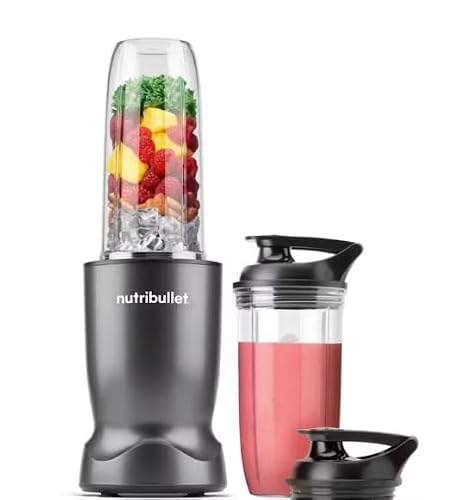
4. nutribullet Turbo Personal Blender NB50400 — Best for Frozen Blending
Badge: Best Mid-Priced. The Turbo is the pick this guide keeps circling back to when readers describe a specific life: frozen fruit every day, gym shakes with ice, smoothie bowls thick enough to hold a spoon upright — in a personal format, at a mid price. Its 1,000-watt motor is explicitly built, in the listing’s own words, for shakes, smoothies, food prep, and frozen blending, and it arrives with the big cups that kind of blending needs: a 32-ounce cup and a 24-ounce cup, with two flip-top travel lids. The gunmetal finish does not blend anything, but it does make the machine look like it belongs on the counter it will live on.
The gap between the Turbo and the 700W machine above it is the gap this category is really about. Buyers deciding between the two should decide by freezer, not by budget: if your smoothie ingredients live in the freezer, this is your machine; if they live in the fruit bowl, save the twelve dollars.
A flagship-tier discount rate on a current, purpose-built model is exactly what Black Friday is supposed to look like, and it is why the Turbo, rather than either neighbor, is the pick we would hand to the frozen-smoothie household that asked for one recommendation and no homework.
Strengths: 1,000W explicitly rated for frozen blending; the deepest verified percentage cut here; two large cups and two flip-top lids included; personal format keeps washing to a cup and a blade.
Trade-offs: No pitcher and no pulse button — the Pro+ and Combo cover those wants at higher prices; and like all personal blenders, it blends servings, not batches.
Best for: frozen smoothie daily drivers, gym households, and smoothie-bowl makers. Not suited for: batch blending or buyers who want one machine for the whole family’s breakfast. See Turbo’s live price on Amazon and cup and lid set on the listing for current details.

5. nutribullet SmartSense Blender Combo NBF50700 — Best Premium
Badge: Best Premium. The SmartSense is NutriBullet’s flagship idea: take the brand’s most powerful motor — 1,400 watts — in the combo format of pitcher plus personal blending, and remove the guesswork from using it. Its smart auto cycle senses the load and automatically adjusts speed, time, and blend function as it goes. Every experienced blender owner knows the failure this targets: the blend that starts too fast and cavitates, or runs too long and warms the smoothie, or stops while the bottom is still chunky. A machine that watches its own work and adapts is a genuine step, not a gimmick, for households that blend constantly and value a walk-away routine.
Who should pay the premium? High-frequency blenders: the household making smoothies twice a day, every day, where consistency without supervision is worth real money, and where the pitcher earns its place weekly in soups, sauces, or batch drinks. The SmartSense is the connoisseur’s version of the same idea, and at a Black Friday price barely above a hundred dollars, it is priced like a mid-range machine while it lasts.
That compression is the deal.
Strengths: The most powerful motor in the NutriBullet range at 1,400W; smart auto cycle adjusts speed, time, and function to the load; full combo versatility of pitcher and personal formats; the biggest dollar saving in this guide.
Trade-offs: The highest price here; the smart cycle’s value scales with how often you blend — rare users are paying for supervision they do not need; full-size format needs full-size storage.
Best for: high-frequency households, texture perfectionists, and buyers who want the flagship once rather than the ladder of upgrades. Not suited for: occasional blenders, for whom the standard Combo is the smarter spend. Review the SmartSense listing for the live price and the smart cycle details — if hands-off consistency is your want, this is the only pick that sells it.

6. magic bullet Personal Blender MBR-1101 — Cheapest Way In
Badge: Best Under $30. The magic bullet is the original personal blender and NutriBullet’s sibling line, and it closes this guide as the honest floor of the whole category: a 250-watt base, a 22-ounce cup, three to-go cups and a travel lid in the box, and a footprint small enough for the tiniest counters, dorm-adjacent kitchens, office break rooms, and RV galleys.
Honesty about the 250 watts is the whole review. That power blends soft fruit, bananas, berries that are not frozen solid, protein shakes, milkshakes, and simple sauces happily, and it will chop and mix light food-prep jobs. It is not a frozen-fruit machine and not an ice crusher, and owners who respect that boundary get years from these little blenders, while owners who demand frozen mango from them get a warranty conversation. Buy it for the jobs it is built for — or as the second blender, the travel blender, the desk blender — and it is one of the best-value items in the entire sale.
As with the budget coffee maker in our companion guide, the percentage is not the story; the absolute price is.
Strengths: The lowest price in this guide by a wide margin; three to-go cups included, more than pricier picks offer; tiny footprint suits dorms, offices, and small kitchens; dead simple to use and to wash.
Trade-offs: 250W is soft-ingredient power — frozen loads and hard ice are beyond its design; small 22 oz cup caps serving size; no pulse, no programs, no pretense.
Best for: protein shakes, soft smoothies, small kitchens, students, and second-blender duties. Not suited for: frozen smoothie devotees — that is the Turbo’s job, at twice the price and four times the power. See magic bullet listing and included cup set for current details.
Comparison Table
| Pick | Power / format | Best for | Deal check | Price |
|---|---|---|---|---|
| magic bullet MBR-1101 | 250W, personal, 22 oz cup | Soft shakes, tiny kitchens, cheapest entry | Check the listing | Check current price on Amazon |
| nutribullet Personal NB30150 | 700W, personal, 21 oz + 18 oz cups | Everyday fresh smoothies, first buyers | Check the listing | Check current price on Amazon |
| nutribullet Turbo NB50400 | 1,000W, personal, 32 oz + 24 oz cups | Frozen blending in a personal format | Check the listing | Check current price on Amazon |
| nutribullet Combo NBF50500 | 1,200W, 64 oz pitcher + 24 oz cup | Households wanting both formats | Check the listing | Check current price on Amazon |
| nutribullet Pro+ N12-1001MK | 1,200W with pulse, personal | Power users who blend for one or two | Check the listing | Check current price on Amazon |
| nutribullet SmartSense NBF50700 | 1,400W, smart auto cycle, combo | High-frequency blenders, flagship buyers | Biggest dollar saving in this guide | Check current price on Amazon |
How to Choose a NutriBullet This Black Friday
Match the watts to your freezer. This is the single decision that determines satisfaction in this category. Soft ingredients — fresh fruit, yogurt, protein powder, leafy greens — blend happily at 250 to 700 watts. Frozen fruit, ice, and dense additions like frozen banana chunks and nut butters want 1,000 watts and up. There is no technique that repeals this; there is only buying the right motor the first time. Read your own last twenty smoothies, not your aspirational ones, and buy for the ingredients actually in them.
Decide the format question honestly. Personal blenders win on washing, storage, and speed-to-door. Full-size pitchers win on volume, soups, and entertaining. The combo machines in this guide exist because many households genuinely live in both worlds across a single week — but “genuinely” is doing work in that sentence. If your pitcher use is a hypothetical dinner party, buy the personal machine and borrow a pitcher mentality twice a year. If your household blends breakfast for four, no personal cup will save you, whatever its wattage.
Count the cups, lids, and mouths. The included cup set is a real part of the value: households with two morning drinkers need two cups in rotation or a dishwasher running nightly. Flip-top lids suit commuters; flat travel lids suit fridge storage. The magic bullet’s three included cups, the Turbo’s two large cups with flip-tops, and the Pro+’s 32-ounce option are not packaging trivia — they are the daily-use difference between these machines, and they are all spelled out in each review above.
Respect the fill line and the sixty-second rhythm. Personal blenders are sealed systems: overfilling builds pressure and leaks, and running any of them in long continuous blasts heats the blend and stresses the motor. The owners who keep these machines for five years blend in bursts, keep liquid at the level the recipe actually needs, and let frozen ingredients sit in liquid for a few minutes before blending on the lower-powered models. None of that is in the sale copy, and all of it decides whether your Black Friday bargain is still blending next Black Friday.
Think about who else is shopping this counter. A blender rarely lives alone. If your kitchen plan for this sale also includes a coffee upgrade or a countertop workhorse, our Best Black Friday Deals On Kitchen Gadgets guide covers the smaller tools, and the drip coffee maker deals guide in this same series applies the identical verified-price method to the morning’s other machine.
How to Check Whether a NutriBullet Deal Is Real
That pairing is what makes a deal checkable.
Beware the finish shuffle. NutriBullet sells near-identical machines in multiple finishes, and sale pricing often applies to one color while the product page defaults to another. Before checkout, confirm the finish in your cart is the finish whose price you researched. A ten-dollar surprise at checkout is usually this, not a changed deal.
The most expensive mistake in this category is not overpaying — it is buying the wrong wattage cheaply and buying the right one in January at full price.
Use the calendar, do not fear it. Black Friday Week runs through November 30, and popular configurations — the Combo especially, at a price like this — can sell out in a specific finish while remaining in another.
Common Mistakes
Buying wattage for your intentions instead of your ingredients. The January gym smoothie with frozen everything is a real recipe; the one in the photograph is not. Audit your freezer and your last month of actual blending, then choose. The Turbo exists for frozen households, the 700W machine for fresh ones, and confusing the two in either direction wastes money or burns motors.
Overfilling the cup. The max line on a personal blender cup is a pressure limit, not a serving suggestion. Overfilled cups leak, blend unevenly, and strain seals. If your smoothie does not fit, your format is wrong — that is the Combo’s entire reason for existing.
Blending hot liquids in a sealed personal cup. Personal cups are not soup vessels; steam in a sealed container is a safety problem, not a recipe variation. Hot blending belongs in a vented pitcher. This is the one mistake in this list with consequences beyond a bad smoothie, so it gets its own paragraph and no jokes.
Running long, continuous blends. Personal blenders are sprinters. Short bursts with brief rests protect the motor and keep friction heat out of your smoothie. The SmartSense’s auto cycle manages this for you; on every other pick, your thumb on the cup is the cycle manager, so manage it.
Ignoring the second cup. One cup, two drinkers, no dishwasher run: this arithmetic defeats more personal-blender households than any motor failure. Check the included cup count against your household before you buy, not after the first shared morning.
Final Recommendation
Ownership Costs, Accessories, and Making the Deal Last
The machine is the cheap part; the habit is the product. A personal blender’s lifetime cost is dominated not by accessories but by ingredients and by whether the machine survives its warranty era. Replacement extractor blades and cup sets exist for this range and are inexpensive relative to a new machine, which is one of the underappreciated arguments for buying inside a mature brand family at Black Friday rather than an unknown badge at a similar price: parts, cups, and lids remain findable years later.
Buy the second cup now, not the second machine later. The most common upgrade path in this category is not a bigger motor; it is a household discovering that one cup cannot serve two morning routines. Several picks above solve this in the box — the magic bullet’s three cups, the Turbo’s pair of large cups, the Pro+’s two sizes — and buyers of the single-cup configurations should treat an extra cup as part of the purchase price when they compare totals. A machine that is five dollars cheaper and one cup short is not cheaper in any week containing two weekday mornings.
Protect the gasket and the blade, and the deal protects itself. The wear items on every personal blender are the cup gasket and the extractor blade. Rinsing both immediately after blending — before smoothie residue dries into cement — doubles their comfortable life, and blending in the short bursts described earlier keeps heat from warping seals. None of the six picks requires exotic care; all of them punish neglect in the same predictable way. A Black Friday price is only a bargain if the machine is still earning it in year three, and in this category that outcome is decided almost entirely by these small habits rather than by which wattage you chose.
Gifting one of these? Buy for their freezer, too. Blenders are a top-tier kitchen gift precisely because the recipient’s routine is knowable: the gym bag by the door means frozen shakes and points to the Turbo; the new apartment with no counter to spare points to the magic bullet or the 700W Personal; the family kitchen with a dying full-size blender points to the Combo. The Best Kitchen Gifts Black Friday 2026 guide works through the same logic across the whole gift list, and it is worth a read before you default to the most expensive machine in this guide for a recipient whose actual blending life is a Saturday protein shake.
How do I get a thicker smoothie from a personal blender?
Thickness comes from frozen ingredients, modest liquid, and loading order rather than from wattage alone. Put liquid in first so the vortex forms, add soft ingredients next, and finish with frozen fruit on top so it feeds down gradually. Stop and tamp or shake the cup if a pocket forms, and blend in short extra bursts instead of one long run that warms the mixture. The Turbo and Pro+ models in this guide handle frozen loads with more margin, but technique matters on every machine. If the result is thin, add frozen fruit rather than ice, which dilutes flavour as it melts.
Which pick suits a dorm room or a very small kitchen?
The magic bullet is the smallest commitment in this guide, and the budget NutriBullet NB30150 is the step up for soft-ingredient blending in a tight space. Both store in a fraction of the room a full-size pitcher needs and wash quickly in a small sink. Check the building’s rules on small appliances before buying for a dorm, and consider noise: a short morning blend is still a loud one in a shared room. For a small kitchen where smoothies are the main job, a personal format is not a compromise at all; it is the format the routine actually calls for.
How do I protect the blades and seals so the blender lasts?
Do not run the motor in long, continuous bursts on a thick load, because heat is what ages seals and stresses a compact motor. Blend in pulses, let stubborn mixtures rest briefly, and never fill past the marked line, which causes leaks that work into the base. Rinse the cup and blade assembly straight after use so sugars and fibres do not dry onto the gasket, and dry the seal before reassembling. These habits matter most on the smaller machines in this guide, but they extend the life of the 1,200W and 1,400W combos just as surely.
Can I blend hot soup in any of these machines?
Do not assume so. Personal cups are sealed for blending and are not designed for hot liquids, which expand and pressurise a closed container. Whether a full-size pitcher on the Combo or SmartSense models is suitable for hot work depends on that pitcher’s specific design and venting, so follow the guidance supplied with the exact model rather than general blender habits. For most NutriBullet buyers, the honest routine is to blend soup ingredients with stock in a pan using a stick blender, and keep the NutriBullet for the cold drinks, sauces, and smoothies it is genuinely built for.
What should I check in the box during the return window?
Unpack against the model’s own contents list and account for every cup, lid, blade assembly, and, on the combos, the pitcher and its parts. Run water first to check for leaks at the seal, then blend something soft, listening for rattles that suggest a blade assembly is not seated. Try each cup you plan to use daily, because a lid that annoys you will still annoy you in March. Keep the packaging until those checks pass. Faults and missing parts are far easier to resolve while the sale stock and your paperwork are both still current.
How do I choose the right extra cups and accessories later?
Buy accessories for the exact model family you own, because cups, seals, and blade assemblies are not universal across this range, even within one brand. Decide from your routine: a second large cup helps households where two people blend back to back, while travel lids matter only if the cup genuinely leaves the house. Avoid building a drawer of speculative extras during the sale; the machine’s included kit covers the first months for most owners. Once you know which cup you reach for daily, a spare of that one is a smarter purchase than a bundle of pieces you may never use.
Is a combo blender worth it for a single-person household?
It depends on whether you batch-cook. A single person who meal-preps soups, sauces, or large smoothie batches for the freezer can use the pitcher on the Full-Size Combo or SmartSense every week, making the larger footprint rational. A single person whose blending is one morning smoothie should take the Pro+ or the budget personal model and keep the counter and cupboard space. Headcount alone does not decide this; weekly volume does. Look at what you blended in the last month, count the times you wished for a pitcher, and let that honest tally choose the format.
How noisy are these blenders early in the morning?
All of them are loud for the short time they run, and the more powerful frozen-capable models announce themselves clearly through a flat or a thin-walled house. If early blending disturbs others, prep cups the night before and blend briefly, keep the machine on a folded towel to damp vibration against the worktop, and close the kitchen door if you have one. The smaller magic bullet runs are shorter and somewhat less imposing, but no pick in this guide is quiet. Planning around thirty loud seconds is more realistic than shopping for a silent blender that does not exist in this category.
How do I blend for two people without buying a full-size machine?
Blend sequentially in the larger personal cups and treat the second smoothie as a thirty-second job rather than a problem to engineer away. Make the shared base first if the flavours allow it, split it between cups, and finish each with its own additions. The Pro+ and Turbo models in this guide suit this rhythm because their cups and power handle back-to-back frozen blends comfortably. Where two people blend different drinks every single morning at the same time, that pattern is the honest signal that a combo’s pitcher, or simply a second personal unit, will earn its space.
What is the best way to clean a cup straight after a morning blend?
Rinse immediately, then blend warm water with a drop of washing-up liquid for a few seconds if anything sticky remains, and rinse again. This quick routine prevents protein powders, nut butters, and berry seeds from drying onto the seal and blade area, where they become a scrubbing job and a source of stale smells. Take the gasket out periodically for a proper wash, and let everything dry fully before reassembling, especially if the cup will sit closed in a cupboard. Owners who build this thirty-second habit rarely face the stained, lingering-odour cups that put people off personal blenders. The same routine works after evening sauces and desserts, and it takes less time than scrolling a phone while the kettle boils, which is precisely why it survives as a habit when longer, fussier cleaning routines quietly stop happening within a few weeks of ownership for most people in real kitchens everywhere. Consistency, not effort, is what keeps these machines pleasant to own and ready for tomorrow morning without any lingering smells or stubborn residue left behind.
Related guides
Frequently Asked Questions
What is the best NutriBullet deal this Black Friday?
The right answer depends on your format and your freezer, and the reviews above separate the three.
How many watts do I need for frozen fruit?
For daily frozen blending, treat 1,000 watts as the comfortable threshold — the Turbo in this guide is built and listed for frozen blending at exactly that power, and the 1,200W and 1,400W machines add margin. A 700W machine handles fresh ingredients and light frozen additions; a 250W machine should be kept to soft ingredients if you want it to last.
Personal blender or full-size — which format is better?
Neither; they solve different mornings. Personal format wins on washing, storage, and taking the cup with you. A pitcher wins on volume and hot or batch work. Households that truly do both should buy a combo — it is why the Combo and SmartSense top this guide’s recommendations — and households that do only one should not pay for the other.
Can a NutriBullet replace my full-size blender?
A personal-only model cannot replace a pitcher’s volume, whatever its wattage. The combo models can: the standard Combo and the SmartSense both pair a 64 oz-class pitcher role with personal cups on full-power bases. If replacement is the goal, those are the two picks written for it.
Should I wait for Cyber Monday?
Cyber Monday is November 30, 2026, the last day of the sale window. Some configurations may cut further; specific finishes of popular models may also sell out first. If you are flexible on finish and model, waiting costs little.
Related reading: Nutribullet Buying Guide · Best Personal Blenders · Best Blenders Under $100 · Best Black Friday Kitchen Appliance Deals 2026 · Smoothie Recipes For Personal Blenders


