Disclosure: As an Amazon Associate, airfryerkitchensupply.com earns from qualifying purchases. Links on this page are affiliate links; they cost you nothing extra. Prices and availability change often, so check the current Amazon listing before you buy.
Learning how to clean a garlic press properly takes one read and saves years of picking at sieves, because how to clean a garlic press is ninety percent timing and ten percent technique. Rinse within a minute and the job is nearly nothing; wait until after dinner and the same job becomes a soak, a brush and a lesson. This guide covers the quick routine, the deep clean, and the rescue procedure for a press that was forgotten overnight. our guide to the best garlic presses
Key Takeaways
Key Takeaways: Rinse immediately, always; it is the entire secret. Work residue out of the sieve from the back, the way it went in. Warm soaking rescues dried garlic; forcing the handles never does. Dry before storing to protect hinges and coatings. Best for: every press owner, new or veteran. Not suited for: anyone hoping a dishwasher alone will undo a night of dried residue.
In this guide
What You Need
Required: warm water, washing-up liquid, and a small brush, an old toothbrush being ideal. Strongly recommended: the cleaning tool that came with your press, whose pins match its hole pattern. Optional but genuinely useful: a wooden skewer for individual blocked holes, a mug dedicated to soaking, and a microfibre cloth for drying around the hinge. Nothing on this list is specialised, and that is the point: cleaning a press is a habit problem wearing a tools costume.
A garlic press lives in a drawer, and drawer life is unkind to fussy mechanisms. Ejector buttons get pressed by neighbouring tools, cleaning tools unclip and migrate to the drawer’s dark corners, and rocking tools slide under everything. None of this is a reason to avoid a design you like; it is a reason to give the press a consistent home, ideally in a utensil crock or the same drawer section every time, so the small parts and your habits stay together.
The honest benchmark for every press is a knife and a board, which together cost nothing extra because you already own them. A practiced cook can mince a clove in well under a minute, and the flat of the blade plus a pinch of salt will produce a paste when a paste is truly wanted. What the press sells is not capability but consistency and speed at volume: identical results on clove one and clove twelve, with no knife skills assumed and no board to scrub afterwards. Judge it on that basis and the decision gets much clearer.
Volume is where the press earns its drawer space. One clove for a dressing is a knife job by any sensible measure. Six cloves for a soup, a whole head for a marinade, or a double batch of garlic butter is where pressing pulls away: each clove takes seconds, the output is uniform, and your hands stay clean enough to move straight to the next task. Households that cook garlic-heavy food several nights a week feel this arithmetic weekly; occasional garlic users may never feel it at all.
Safety and Before You Start
Work with the press open and unloaded, and never force the handles together against a clogged chamber; the load goes into the hinge, not the residue. Keep fingers on the outside of the sieve when pushing residue through from behind, and use the brush or cleaning tool as the intermediary. If a press has been soaking, empty the water before scrubbing so you can see the holes you are clearing. These are small cautions for a small job, but they are the difference between maintenance and damage.
Stainless steel is the reference material for presses because it resists garlic’s sulphur compounds, shrugs off the dishwasher and does not flex under load. Die-cast aluminium and zinc alloy presses can be excellent and lighter, but their coatings deserve respect: once a coating chips at the sieve edge, the metal beneath can discolour and cleaning gets harder. Plastic-bodied presses keep weight and cost down and suit occasional use, yet the hinge is where they eventually confess their limits, usually mid-recipe and always at the worst moment.
The hinge is the press’s quiet weak point. Every squeeze loads it, every wash wets it, and on cheaper designs it is a simple pin through cast lugs that slowly develops play. A press with hinge play wastes force sideways, so the handles travel further for the same pressure and the chamber misaligns with the sieve. When you handle a press, squeeze it empty and feel for lateral wobble. None when new is the standard to demand, because wobble never improves with age; it only announces itself earlier each year.
Handle comfort is not a luxury detail on a tool whose entire job is being squeezed hard. Wide, slightly soft handles spread the load across your palm and fingers, while thin metal handles concentrate it into lines that ache by the fourth clove. This matters most for cooks who batch-prep, and it matters in a different way for anyone whose grip is not what it was: a press that needs a two-handed squeeze for a big clove is a press that will quietly stop being used, whatever its other virtues.
How to Clean a Garlic Press in Five Steps
Step 1: Rinse the Moment You Finish Pressing
Put the press under a running tap before you do anything else, while the residue is still wet and cooperative. Open and close it gently under the water so the flow reaches both faces of the sieve and the inside of the chamber. Most of the garlic lifts away in this step alone when it is done promptly. The common mistake is setting the press down ‘for a second’ beside the board; that second becomes the meal, and the meal becomes the problem.
Pressing unpeeled cloves is the feature that sells presses, and it mostly works: the skin stays in the chamber while the flesh extrudes through the holes. Mostly is the honest word. A dry, papery skin separates cleanly, while a fresh, tight skin can tear and send fragments through with the garlic, and very small cloves can slip sideways and jam half-pressed. Treat unpeeled pressing as a convenience for robust cloves, not a promise, and keep a quick peel in your routine for the small or stubborn ones.
Pressed garlic is not minced garlic with less effort; it is a different ingredient. Pressing ruptures far more cells, so the flavour arrives sharper, hotter and more immediate, and it disperses through a sauce until no single bite announces itself. Minced garlic keeps small pieces intact, giving gentler pockets of flavour and a little texture. Neither is better in the abstract. Pressed garlic disappears beautifully into dressings, marinades and pan sauces; minced garlic behaves better where garlic should stay distinct, and it browns more predictably because the pieces are larger.
Step 2: Clear the Sieve Face
With the press open, sweep the flat face of the sieve with the cleaning tool or brush to lift the film of garlic that pressing leaves behind. Work across the whole face, including the edges where paste hides against the rim. On designs with a built-in scraper, opening the press does part of this for you; finish the job manually rather than trusting the mechanism to have caught everything.
The single most valuable habit in this entire subject costs nothing: rinse the press immediately. Garlic residue that is rinsed within a minute lifts away under the tap with almost no effort, while the same residue left through dinner dries into a cement that glues itself into every hole. If you cannot wash straight away, drop the press into a mug of water beside the sink. Soaking is the difference between a ten-second rinse and a ten-minute excavation, and it matters more than any cleaning tool bundled in the box.
Stainless steel is the reference material for presses because it resists garlic’s sulphur compounds, shrugs off the dishwasher and does not flex under load. Die-cast aluminium and zinc alloy presses can be excellent and lighter, but their coatings deserve respect: once a coating chips at the sieve edge, the metal beneath can discolour and cleaning gets harder. Plastic-bodied presses keep weight and cost down and suit occasional use, yet the hinge is where they eventually confess their limits, usually mid-recipe and always at the worst moment.
Step 3: Push Residue Out From the Back
Whatever remains in the holes should leave the way it arrived: from behind. Press the cleaning tool’s pins, or the brush bristles, into the holes from the rear face so fragments pop out of the front. Working from the front packs residue deeper and wedges fibres tighter. Hold the press up to the light when you think you are done; clear holes show as clean points of light, and the stragglers identify themselves.
Dishwasher-safe on the box and dishwasher-happy in practice are different claims. Stainless presses genuinely tolerate the dishwasher for years. Coated alloy presses often survive it too, but detergents are hard on coatings and on the polished finish of handles, and garlic residue baked on by a hot wash is harder to remove than residue rinsed first. The sensible routine, whatever the label says, is rinse immediately, then choose: hand-wash in seconds, or rack it knowing the rinse already did the real work.
A garlic press lives in a drawer, and drawer life is unkind to fussy mechanisms. Ejector buttons get pressed by neighbouring tools, cleaning tools unclip and migrate to the drawer’s dark corners, and rocking tools slide under everything. None of this is a reason to avoid a design you like; it is a reason to give the press a consistent home, ideally in a utensil crock or the same drawer section every time, so the small parts and your habits stay together.
Step 4: Wash, Including the Hinge and Chamber Corners
Give the whole tool a short wash in warm soapy water, paying attention to the chamber corners where skin fragments collect and the hinge where moisture lingers. If your press is stainless and rated for the dishwasher, it may go in now, already rinsed; coated designs are better served by this brief hand wash. Rinse in clean water so no detergent film dries on the sieve.
Garlic hands are the press’s smallest and most persuasive argument. Mincing leaves your fingers carrying the smell through the evening, and it transfers to everything you touch. A press keeps fingers mostly clear of the cut surfaces, especially with unpeeled cloves, and a stainless press has a side benefit many cooks swear by: rubbing your hands on stainless under water afterwards noticeably reduces the lingering smell. It is a modest gain, but it is the one owners mention first when asked why the press stayed.
What happens to the skin tells you a lot about a press. In a well-shaped chamber the skin flattens into a neat disc that lifts out in one piece, sometimes with the help of the ejector or a fingertip. In a poorly shaped one the skin shreds, mixes with unpressed flesh and turns emptying into picking. When you read product descriptions, look for language about the chamber shape and the peel’s exit, not just pressing power; the peel’s journey is the part you repeat most often.
Step 5: Dry Before It Goes Back in the Drawer
Shake off the water, dry the hinge and handles with a cloth, and leave the press open on the draining board for a few minutes before storing. Storing any press wet invites musty smells in the chamber and slow corrosion at the pin. Drying is the step everyone skips and the step that quietly decides how the tool ages.
Leverage is the whole physics of a garlic press. The clove resists, the sieve resists, and the only thing standing between you and a clean press is how efficiently the handles multiply the force in your hand. Long handles with the pivot set well forward feel dramatically easier than short handles with the pivot near the chamber, even when the chambers look identical on a shelf. When you test a press in a shop, mime the squeeze: if your fingers are already fully closed before the imaginary clove would give way, the geometry is working against you, and every clove after the third will feel like hard work.
Chamber size decides how a press fits your cooking rhythm. A chamber that swallows one very large clove or two ordinary ones suits weeknight cooking, where garlic goes in by the spoonful rather than the head. An oversized chamber sounds better but can spread a single small clove thinly across the sieve, so half of it smears rather than extrudes. Match the chamber to the cloves you actually buy: the tight, small cloves of hardneck garlic behave very differently from the fat, mild cloves sold loose in most supermarkets.
Troubleshooting and Common Mistakes
The classic failure is the overnight press: residue dried to cement in every hole. Rescue it with a soak in warm water, then repeat the back-to-front clearing with patience; a skewer frees individual holes. Never substitute force for soaking. Other mistakes include scrubbing only the visible face, storing the press closed and wet, losing the cleaning tool in a drawer, and using metal picks that scratch coatings and give future residue more to grip.
Garlic hands are the press’s smallest and most persuasive argument. Mincing leaves your fingers carrying the smell through the evening, and it transfers to everything you touch. A press keeps fingers mostly clear of the cut surfaces, especially with unpeeled cloves, and a stainless press has a side benefit many cooks swear by: rubbing your hands on stainless under water afterwards noticeably reduces the lingering smell. It is a modest gain, but it is the one owners mention first when asked why the press stayed.
What happens to the skin tells you a lot about a press. In a well-shaped chamber the skin flattens into a neat disc that lifts out in one piece, sometimes with the help of the ejector or a fingertip. In a poorly shaped one the skin shreds, mixes with unpressed flesh and turns emptying into picking. When you read product descriptions, look for language about the chamber shape and the peel’s exit, not just pressing power; the peel’s journey is the part you repeat most often.
Hole size is a texture dial. Small holes produce a fine, wet paste that melts into sauces and dressings and all but vanishes. Larger holes give a coarser crush closer to a rough mince, which holds up better in a hot pan and reads as garlic rather than garlic essence. There is no universal right answer, only a match to your cooking: sauce-led cooks should favour fine holes, while cooks who start everything in a frying pan often prefer the coarser output and the slower browning that comes with it.
Dried residue deserves its own warning because it defeats good presses and bad ones equally. Once garlic paste dries inside the holes, water alone struggles: the fibres swell, grip, and resist. The rescue routine is a soak in warm water, then working from the back of the sieve with a brush or the press’s own cleaning tool, pushing residue out the way it came in. A wooden skewer handles individual blocked holes. What never helps is forcing the handles together on a clogged press, which loads the hinge for no benefit.
Gear That Makes Cleaning Easier
Design decides how much cleaning a press demands, so the four most relevant designs are summarised here in prose, with tiers in words.
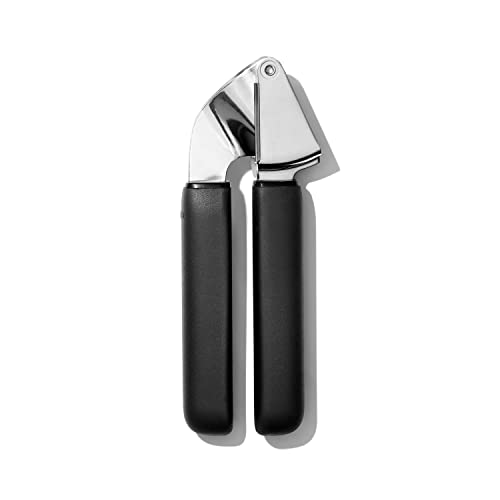
OXO Good Grips Garlic Press
The OXO Good Grips Garlic Press is the familiar mid-tier all-rounder, positioned in the mid-tier of the market, and its defining idea is wide soft handles, a generous chamber and a built-in cleaning tool stored in the handle. In daily use that idea matters more than any single specification: you feel it in how the chamber loads, how the handles travel, and how the tool behaves at the sink afterwards. It presses standard supermarket cloves without drama, handles two small cloves together when a recipe is generous, and produces the fine, wet paste that sauces and dressings want. Check price on Amazon if you are buying with a link later; in prose terms, judge it against the tier described here rather than against the cheapest press on the shelf.
Strengths in real use are consistency and predictability. The output from the first clove matches the output from the sixth, the skin behaves itself more often than not, and the cleaning routine is learnable in one wash: rinse at once, clear the sieve face, open it fully where the design allows, and let it dry before the drawer. Its honest limitation is the one every press shares and this design only softens: some garlic always stays behind, dried residue always fights back, and a knife still wins for a single clove when the board is already out. Choose this one if easy everyday pressing matters more than squeezing out the last premium refinement.
Best for: cooks whose habits match the design idea described above. Not suited for: anyone expecting any press to make cleaning disappear entirely, or cooks who mince once a month and already enjoy doing it by hand.
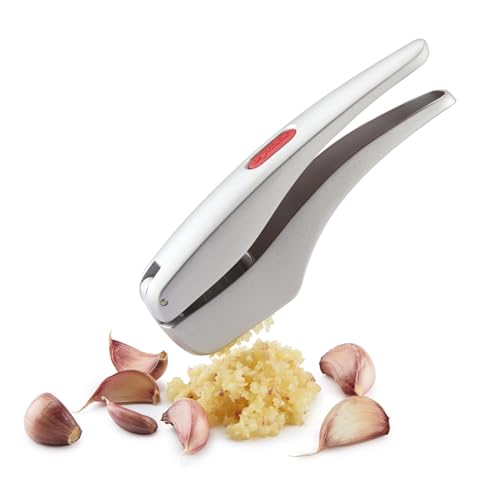
Zyliss Susi 3 Garlic Press
The Zyliss Susi 3 Garlic Press is the lightweight integrated-cleaner design, positioned in the mid-tier of the market, and its defining idea is a lighter body, an integrated cleaning tool that clips in place, and a chamber shaped to take a large clove without peeling first. In daily use that idea matters more than any single specification: you feel it in how the chamber loads, how the handles travel, and how the tool behaves at the sink afterwards. It presses standard supermarket cloves without drama, handles two small cloves together when a recipe is generous, and produces the fine, wet paste that sauces and dressings want. Check price on Amazon if you are buying with a link later; in prose terms, judge it against the tier described here rather than against the cheapest press on the shelf.
Strengths in real use are consistency and predictability. The output from the first clove matches the output from the sixth, the skin behaves itself more often than not, and the cleaning routine is learnable in one wash: rinse at once, clear the sieve face, open it fully where the design allows, and let it dry before the drawer. Its honest limitation is the one every press shares and this design only softens: some garlic always stays behind, dried residue always fights back, and a knife still wins for a single clove when the board is already out. Choose this one if low weight and a stored cleaning tool solve the two annoyances you actually have.
Best for: cooks whose habits match the design idea described above. Not suited for: anyone expecting any press to make cleaning disappear entirely, or cooks who mince once a month and already enjoy doing it by hand.

Kuhn Rikon Epicurean Garlic Press
The Kuhn Rikon Epicurean Garlic Press is the premium stainless lever design, positioned in the premium of the market, and its defining idea is an all-stainless build, a swing-out sieve that opens fully for rinsing, and long handles that convert grip into pressure efficiently. In daily use that idea matters more than any single specification: you feel it in how the chamber loads, how the handles travel, and how the tool behaves at the sink afterwards. It presses standard supermarket cloves without drama, handles two small cloves together when a recipe is generous, and produces the fine, wet paste that sauces and dressings want. Check price on Amazon if you are buying with a link later; in prose terms, judge it against the tier described here rather than against the cheapest press on the shelf.
Strengths in real use are consistency and predictability. The output from the first clove matches the output from the sixth, the skin behaves itself more often than not, and the cleaning routine is learnable in one wash: rinse at once, clear the sieve face, open it fully where the design allows, and let it dry before the drawer. Its honest limitation is the one every press shares and this design only softens: some garlic always stays behind, dried residue always fights back, and a knife still wins for a single clove when the board is already out. Choose this one if you press often, wash seriously, and want the tool to feel unchanged after years of service.
Best for: cooks whose habits match the design idea described above. Not suited for: anyone expecting any press to make cleaning disappear entirely, or cooks who mince once a month and already enjoy doing it by hand.
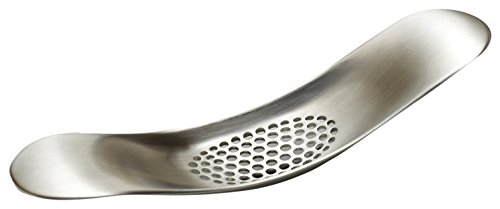
Joseph Joseph Garlic Rocker
The Joseph Joseph Garlic Rocker is the press-free rocking alternative, positioned in the entry-to-mid tier of the market, and its defining idea is a curved rocking body with no moving hinge at all: you rock it over a peeled clove and scrape the crushed garlic from its surface. In daily use that idea matters more than any single specification: you feel it in how the chamber loads, how the handles travel, and how the tool behaves at the sink afterwards. It presses standard supermarket cloves without drama, handles two small cloves together when a recipe is generous, and produces the fine, wet paste that sauces and dressings want. Check price on Amazon if you are buying with a link later; in prose terms, judge it against the tier described here rather than against the cheapest press on the shelf.
Strengths in real use are consistency and predictability. The output from the first clove matches the output from the sixth, the skin behaves itself more often than not, and the cleaning routine is learnable in one wash: rinse at once, clear the sieve face, open it fully where the design allows, and let it dry before the drawer. Its honest limitation is the one every press shares and this design only softens: some garlic always stays behind, dried residue always fights back, and a knife still wins for a single clove when the board is already out. Choose this one if you dislike hinges and baskets and want the simplest possible thing to rinse.
Best for: cooks whose habits match the design idea described above. Not suited for: anyone expecting any press to make cleaning disappear entirely, or cooks who mince once a month and already enjoy doing it by hand.

Dreamfarm Garject
The Dreamfarm Garject is the self-cleaning ejector design, positioned in the premium of the market, and its defining idea is a press with a built-in scraper that sweeps the sieve as you open it and an ejector button that flicks the spent peel away. In daily use that idea matters more than any single specification: you feel it in how the chamber loads, how the handles travel, and how the tool behaves at the sink afterwards. It presses standard supermarket cloves without drama, handles two small cloves together when a recipe is generous, and produces the fine, wet paste that sauces and dressings want. Check price on Amazon if you are buying with a link later; in prose terms, judge it against the tier described here rather than against the cheapest press on the shelf.
Strengths in real use are consistency and predictability. The output from the first clove matches the output from the sixth, the skin behaves itself more often than not, and the cleaning routine is learnable in one wash: rinse at once, clear the sieve face, open it fully where the design allows, and let it dry before the drawer. Its honest limitation is the one every press shares and this design only softens: some garlic always stays behind, dried residue always fights back, and a knife still wins for a single clove when the board is already out. Choose this one if the scrape-and-eject routine matches how you cook: fast, repetitive, and intolerant of picking at sieves.
Best for: cooks whose habits match the design idea described above. Not suited for: anyone expecting any press to make cleaning disappear entirely, or cooks who mince once a month and already enjoy doing it by hand.
Maintenance and Keeping It Working
Monthly, check the hinge for play and the sieve for bent or blocked holes. If a cleaning tool is lost, replace the habit with a dedicated brush kept at the sink, because a tool that lives elsewhere will not be used. Coated presses should be retired from dishwasher duty if the coating chips at the sieve edge. Stainless presses ask for almost nothing beyond the routine above, which is the deepest reason they dominate recommendations.
Dried residue deserves its own warning because it defeats good presses and bad ones equally. Once garlic paste dries inside the holes, water alone struggles: the fibres swell, grip, and resist. The rescue routine is a soak in warm water, then working from the back of the sieve with a brush or the press’s own cleaning tool, pushing residue out the way it came in. A wooden skewer handles individual blocked holes. What never helps is forcing the handles together on a clogged press, which loads the hinge for no benefit.
Batch prep changes the ranking of almost every design. A press that is delightful for two cloves can become tedious at twenty if the chamber needs picking clean between cloves, while a design with a scraper or ejector keeps its rhythm: press, open, flick, reload. If you regularly make big pots, sauces for the freezer or infused oils for gifts, weigh the emptying action as heavily as the pressing action. Throughput is a system, and the slowest step in the system is the one you will feel.
A garlic press makes a quietly excellent gift for a new household precisely because it is useful weekly and rarely bought well for oneself. The gifting rules are simple: choose stainless or a respected mid-tier design, favour easy cleaning over novelty mechanisms, and avoid anything so specialised that the recipient needs instructions. Paired with a board and a head of good garlic, it reads as thoughtful rather than gadgety, and it will be used long after more theatrical kitchen gifts have been rehomed.
Leverage is the whole physics of a garlic press. The clove resists, the sieve resists, and the only thing standing between you and a clean press is how efficiently the handles multiply the force in your hand. Long handles with the pivot set well forward feel dramatically easier than short handles with the pivot near the chamber, even when the chambers look identical on a shelf. When you test a press in a shop, mime the squeeze: if your fingers are already fully closed before the imaginary clove would give way, the geometry is working against you, and every clove after the third will feel like hard work.
Cleaning a Garlic Press Without Causing the Damage You Are Trying to Prevent
The purchase is the easy part. A garlic press proves itself at the prep area beside the board, mid-recipe, in the middle of crushing cloves quickly while a pan is already heating, long after the packaging has gone. This section therefore starts with your routine rather than the product, because features only matter once they survive contact with your space, your schedule and your household. Start with whether unpeeled cloves, cleaning pins or a removable basket suit how you cook. If that check fails, stop there, since the remaining virtues of any garlic press are built on a foundation your home has already rejected. Ask which part of the garlic press will look tired first and whether that tiredness is cosmetic, cleanable, repairable or terminal, because the answer sets the realistic lifespan.
Picture the busiest realistic version of your week, with guests arriving, children underfoot, a meal running late or the weather turning, whichever applies, and ask whether the garlic press still works then. If two options still look equal, choose the one whose weaknesses land where you care least, because every design trades something away and the honest question is which trade your household tolerates best. The easiest items to own are the ones that ask for nothing between uses. If a garlic press asks for something, make sure the routine gives it automatically rather than relying on memory. Long-term performance usually comes down to whether you keep up with one routine: rinsing it immediately, before garlic dries on, and drying the hinge area fully. Decide honestly whether your household will do it before you rely on it.
- Work in sequence and change one habit at a time.
- Finish by resetting, cleaning and drying as the task requires.
- Set out the space and materials before beginning.
- Stop at resistance and diagnose before applying force.
- Record problems and change one thing next time.
Add up the minutes honestly: the washing, wiping, descaling, emptying, airing or reassembly a garlic press demands each week is part of its real specification. Give the decision a checkpoint: after a month of real use, ask whether the garlic press does its three jobs without being thought about, because invisibility is the sign of a genuinely good match. Guests are an honest test: anything that needs explaining, warning or apologising for when visitors use the garlic press is telling you something about its everyday fit as well. Every household has an unusual week, and for yours it may be that recipes needing one small clove, where a knife may honestly be faster; buy for that week as well as the ordinary one.
Plan the end at the beginning: a garlic press should be repairable, passable on, recyclable or at least easy to dispose of responsibly when its service ends, and designs differ widely on this. For items that suffer from constant use without rest, a planned spare is not extravagance; it is how the routine survives the day the main one is wet, dirty, broken or missing. Equally, beware of under-buying for a routine that happens daily, since a small saving at purchase is repaid in irritation every week the garlic press stays in service. Most disappointment with a garlic press traces back to residue drying in the holes, turning a quick tool into a slow cleaning job. It is a slow, predictable process, which is good news, because predictable problems can be designed out before you buy.
Problems deserve a sequence, not a panic. Check the simple, free causes first, in the order a technician would, and only suspect the garlic press itself once those are ruled out. Think about what the garlic press has to live alongside. The neighbouring furniture, fittings and appliances in your home are fixed facts, and the newcomer is the one that has to fit in. The most future-proof question is also the simplest: if your routine changed moderately, would this garlic press adapt, or would it become the wrong tool kept out of guilt? If a shortlist is already forming, run these checks against the exact listings you are comparing, for example the OXO Good Grips Garlic Press and the Zyliss Susi 3 Garlic Press, reading the current listing details rather than relying on memory.
Frequently Asked Questions
What is the fastest way to clean a garlic press?
Rinse it under the tap the moment you finish pressing, open and close it gently under the water, sweep the sieve face with its cleaning tool, and set it to dry. Done at that moment, the whole routine takes well under a minute and needs no soaking, no scrubbing and no special products. Speed in cleaning a press is purchased entirely with immediacy.
How do you clean a garlic press that was left overnight?
Soak it in warm water until the dried residue softens, then clear the holes from the back with the cleaning tool or a brush, using a wooden skewer for individual blocked holes. Repeat the soak if needed rather than forcing anything. Once clear, wash and dry normally. The press is almost never ruined by one forgotten night; it is only made temporarily tedious.
Can you put a garlic press in the dishwasher?
Stainless presses generally can, and quality alloy presses often tolerate it, though detergents are hard on coatings over time. In every case, rinse first: a dishwasher will not reliably remove dried garlic from small holes, and a hot wash can bake residue on harder. The dishwasher is a finishing step for an already-rinsed press, not a rescue service.
How do you get garlic smell out of a garlic press?
Wash it in warm soapy water and dry it fully; lingering smell usually lives in residue trapped in holes or in a chamber stored wet and closed. A soak with a little bicarbonate of soda in the water helps a neglected press. Stainless models hold the least odour. If the smell survives a thorough clean, look again for hidden residue, especially behind the sieve rim.
What can you use if you lost the cleaning tool?
An old toothbrush is the best substitute, worked from the back of the sieve. A wooden skewer or cocktail stick clears single holes without scratching. Some cooks keep the press’s tool in the same drawer slot every time to prevent the loss in the first place. What matters is the back-to-front direction and the promptness, not the brand of the implement.
How often does a garlic press need a deep clean?
If you rinse after every use, a deliberate deep clean is rarely needed; a monthly check of the hinge, chamber corners and any stubborn holes is plenty. Presses used for batch cooking benefit from a soak after big sessions. The deep clean exists to correct drift, not as a standing appointment, and good daily habits keep it that way.
Related Guides
Keep exploring the same corner of the kitchen: our companion guide: garlic press review our companion guide: garlic press reviews our companion guide: garlic press buying guide our guide to the best garlic presses best garlic roasters for mellow oven garlic best ginger graters for the other pungent prep job.
Extra Field Notes
Field note, in the test kitchen: what happens to the skin tells you a lot about a press. In a well-shaped chamber the skin flattens into a neat disc that lifts out in one piece, sometimes with the help of the ejector or a fingertip. In a poorly shaped one the skin shreds, mixes with unpressed flesh and turns emptying into picking. When you read product descriptions, look for language about the chamber shape and the peel’s exit, not just pressing power; the peel’s journey is the part you repeat most often.
Field note, in the test kitchen: hole size is a texture dial. Small holes produce a fine, wet paste that melts into sauces and dressings and all but vanishes. Larger holes give a coarser crush closer to a rough mince, which holds up better in a hot pan and reads as garlic rather than garlic essence. There is no universal right answer, only a match to your cooking: sauce-led cooks should favour fine holes, while cooks who start everything in a frying pan often prefer the coarser output and the slower browning that comes with it.
Field note, in the test kitchen: dried residue deserves its own warning because it defeats good presses and bad ones equally. Once garlic paste dries inside the holes, water alone struggles: the fibres swell, grip, and resist. The rescue routine is a soak in warm water, then working from the back of the sieve with a brush or the press’s own cleaning tool, pushing residue out the way it came in. A wooden skewer handles individual blocked holes. What never helps is forcing the handles together on a clogged press, which loads the hinge for no benefit.
Field note, in the test kitchen: batch prep changes the ranking of almost every design. A press that is delightful for two cloves can become tedious at twenty if the chamber needs picking clean between cloves, while a design with a scraper or ejector keeps its rhythm: press, open, flick, reload. If you regularly make big pots, sauces for the freezer or infused oils for gifts, weigh the emptying action as heavily as the pressing action. Throughput is a system, and the slowest step in the system is the one you will feel.
Field note, in the test kitchen: a garlic press makes a quietly excellent gift for a new household precisely because it is useful weekly and rarely bought well for oneself. The gifting rules are simple: choose stainless or a respected mid-tier design, favour easy cleaning over novelty mechanisms, and avoid anything so specialised that the recipient needs instructions. Paired with a board and a head of good garlic, it reads as thoughtful rather than gadgety, and it will be used long after more theatrical kitchen gifts have been rehomed.
Field note, in the test kitchen: leverage is the whole physics of a garlic press. The clove resists, the sieve resists, and the only thing standing between you and a clean press is how efficiently the handles multiply the force in your hand. Long handles with the pivot set well forward feel dramatically easier than short handles with the pivot near the chamber, even when the chambers look identical on a shelf. When you test a press in a shop, mime the squeeze: if your fingers are already fully closed before the imaginary clove would give way, the geometry is working against you, and every clove after the third will feel like hard work.
Field note, in the test kitchen: chamber size decides how a press fits your cooking rhythm. A chamber that swallows one very large clove or two ordinary ones suits weeknight cooking, where garlic goes in by the spoonful rather than the head. An oversized chamber sounds better but can spread a single small clove thinly across the sieve, so half of it smears rather than extrudes. Match the chamber to the cloves you actually buy: the tight, small cloves of hardneck garlic behave very differently from the fat, mild cloves sold loose in most supermarkets.
Field note, in the test kitchen: pressing unpeeled cloves is the feature that sells presses, and it mostly works: the skin stays in the chamber while the flesh extrudes through the holes. Mostly is the honest word. A dry, papery skin separates cleanly, while a fresh, tight skin can tear and send fragments through with the garlic, and very small cloves can slip sideways and jam half-pressed. Treat unpeeled pressing as a convenience for robust cloves, not a promise, and keep a quick peel in your routine for the small or stubborn ones.
Field note, in the test kitchen: pressed garlic is not minced garlic with less effort; it is a different ingredient. Pressing ruptures far more cells, so the flavour arrives sharper, hotter and more immediate, and it disperses through a sauce until no single bite announces itself. Minced garlic keeps small pieces intact, giving gentler pockets of flavour and a little texture. Neither is better in the abstract. Pressed garlic disappears beautifully into dressings, marinades and pan sauces; minced garlic behaves better where garlic should stay distinct, and it browns more predictably because the pieces are larger.
Field note, in the test kitchen: pressed garlic browns faster than minced garlic, and burns faster too, because the fine, moist paste presents enormous surface area to a hot pan. The practical adjustment is timing: where minced garlic can go into hot oil at the start of a dish, pressed garlic often does better added a minute later, or bloomed briefly and then joined by liquid or vegetables that drop the pan temperature. Cooks who complain that pressed garlic tastes bitter are usually describing scorching, not the press itself, and the fix is sequence rather than equipment.
Field note, in the test kitchen: every press leaves something behind. A film of garlic stays on the sieve face, fibres lodge in the holes, and a portion of the clove never extrudes at all. Good designs accept this and make the residue easy to remove: sieves that swing out, surfaces that open flat, and cleaning tools shaped to the hole pattern. Poor designs hide the residue in a fixed basket you can only reach with a fingertip and hope. Judge any press by its worst moment, which is not the first squeeze but the washing-up afterwards.
Field note, in the test kitchen: the single most valuable habit in this entire subject costs nothing: rinse the press immediately. Garlic residue that is rinsed within a minute lifts away under the tap with almost no effort, while the same residue left through dinner dries into a cement that glues itself into every hole. If you cannot wash straight away, drop the press into a mug of water beside the sink. Soaking is the difference between a ten-second rinse and a ten-minute excavation, and it matters more than any cleaning tool bundled in the box.
Field note, in the test kitchen: stainless steel is the reference material for presses because it resists garlic’s sulphur compounds, shrugs off the dishwasher and does not flex under load. Die-cast aluminium and zinc alloy presses can be excellent and lighter, but their coatings deserve respect: once a coating chips at the sieve edge, the metal beneath can discolour and cleaning gets harder. Plastic-bodied presses keep weight and cost down and suit occasional use, yet the hinge is where they eventually confess their limits, usually mid-recipe and always at the worst moment.


