Disclosure: As an Amazon Associate, airfryerkitchensupply.com earns from qualifying purchases. Links on this page are affiliate links; they cost you nothing extra. Prices and availability change often, so check the current Amazon listing before you buy.
This cake stand buying guide exists because cake stands look simple and are bought badly with remarkable consistency. The failures are nearly always the same: a dome that does not fit the household’s cakes, a fragile stand in a rough-and-tumble kitchen, a pedestal too tall for its base, a beautiful piece with nowhere to live. Every one of those failures is decided before purchase, by measurement and honesty — which is what this guide is for.
Key Takeaways
- A stand displays and serves; it never stores. Leftovers need an airtight container.
- Measure the frosted, decorated cake against the dome’s interior before buying.
- Material is a household decision: glass for beauty, metal for forgiveness.
- Plate a little wider than the cake; base wide enough for calm slicing.
Cake Stand Buying Guide: What a Cake Stand Does and the Main Types
Pedestal Stands
A cake stand does two jobs and only two: it displays and it serves. The pedestal lifts a cake to a height where it can be admired and easily sliced, turning an ordinary bake into the centre of a table. That is the whole case for owning one, and it is a good case — presentation is part of hospitality, and a cake on a stand signals that the occasion matters. But a stand is not storage. A cake left out on a stand, even under a dome, is a cake exposed to room air, and it will stale and dry out as the hours and days pass. The stand is for the celebration; leftovers belong in an airtight container, in the fridge where the filling requires it.
Height and stability trade against each other. A taller pedestal makes a more dramatic presentation and lifts a cake clear of a crowded buffet, but it also raises the centre of gravity of a heavy cake, so the base must be wide and weighty enough to keep the whole arrangement calm when someone slices firmly or a table gets bumped. A lower stand is steadier and easier to carry loaded, at the cost of some theatre. Carrying any loaded stand with two hands, from the base rather than the plate edge, is a habit worth forming before the first wobble teaches it the hard way.
Stands With Domes
Dome fit is the most common cake stand disappointment, and it is entirely avoidable. A dome must clear the cake in height — including frosting, decorations and any topper — and in width, with room to lower it straight down without clipping the sides of the frosting. Bakers consistently underestimate how tall a frosted layer cake becomes. The honest method is to measure your typical finished cake at its proudest point and compare it against the dome’s interior, not its exterior, before buying. If your signature bake is a tall celebration cake, buy the stand and dome around that cake. If you mostly bake low, wide cakes and tarts, almost any dome will do and the plate matters more.
The dome adds the hours between frosting and serving: protection on the counter, a settled cake, and a small moment of theatre when it is lifted at the table. It also adds the category’s biggest buying risk, because a dome is a fixed interior space and cakes are not fixed at all. Buy the dome around your own signature bake, measured at its proudest, and the combination will feel made for you.
Rotating Decorating Stands
Rotating stands are the workbench branch of the family, built for frosting, smoothing and piping, and usually plainer and lower than display pedestals. If your baking joy is in the decorating, this type serves you twice — once in the making and once, more modestly, at the table. If your joy is in the finished presentation, a pedestal is the honest choice and the rotating stand is a second purchase for later.
Tiered and Mini Stands
Tiered stands stack plates for cupcakes, scones and party spreads, trading the single dramatic cake for a composed display of many small things. They are party equipment more than baking equipment, and they store awkwardly, so buy them for a real calendar of gatherings rather than an imagined one. Mini single-serving stands exist for the sheer pleasure of presentation and ask only to be chosen with a smile and a small cupboard.
In this guide
Top Picks at a Glance
Five representative designs cover the category’s main schools — classic, domed, rotating, glass and metal. Badges are qualitative judgements about fit, never figures.
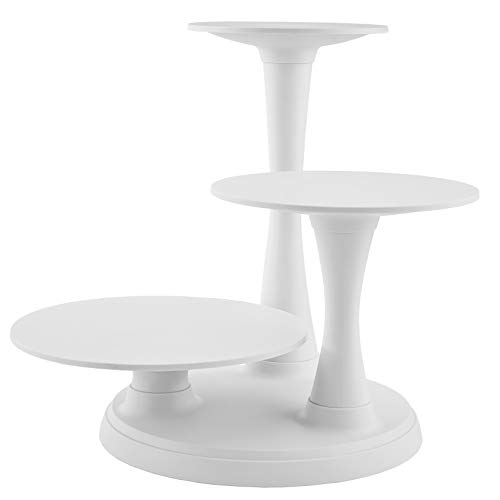
Wilton Cake Stand — the baker’s straightforward classic
Wilton is a name bakers meet early, and the Wilton Cake Stand reflects that decorating-first heritage: a clean, unfussy plate on a pedestal that exists to present the cake rather than compete with it. It suits home bakers who frost, pipe and photograph their work, because a plain stand flatters decorated cakes and wipes down easily between projects. The pedestal height gives a layer cake presence on the table without making slicing awkward, and the whole thing stores more easily than ornate alternatives. Its trade-off is restraint — if you want a stand that doubles as table theatre, this is deliberately not that. Choose it as a first serious stand or a baker’s everyday stand, and pair it with a separate dome only after measuring, because dome fit is its own conversation covered later in this guide.
Best for: households whose kitchen matches the use described above. Not suited for: anyone whose shelves, cakes or habits clash with the trade-off named in this mini review. This pick is positioned in the entry-to-mid tier of its category by its materials and design rather than by any fixed figure.

HBlife Cake Stand — the versatile stand with a dome
The HBlife Cake Stand is built around flexibility: a plate and pedestal that present a cake properly, commonly paired with a clear dome so the same piece can cover, carry the eye, and serve. The dome is the headline, and it is genuinely useful for the hours between frosting and serving, keeping a finished cake settled and protected on the counter while the rest of a meal comes together. Versatility is the strength; the honest caveat is fit. A dome only works when the cake, fully frosted and decorated, clears it in both height and width, and bakers who love tall layer cakes must measure before assuming. Treat this as a serving-and-presenting piece for the day of the bake, not as storage, and it will earn its cupboard space happily.
Best for: households whose kitchen matches the use described above. Not suited for: anyone whose shelves, cakes or habits clash with the trade-off named in this mini review. This pick is positioned in the entry-to-mid tier of its category by its materials and design rather than by any fixed figure.

Kootek Cake Stand — the rotating decorator’s stand
The Kootek Cake Stand answers a different need: it rotates, because it is aimed at the decorating process itself as much as at the table. A revolving plate lets a baker turn the cake smoothly while frosting, smoothing and piping, which is why stands in this style are often aluminium and unadorned — they are tools first. Used for serving, the same rotation passes slices around a table gracefully, though a decorating stand is plainer than a pedestal display piece and sits lower. Choose it if your cakes are made as much as they are shown, and if your household bakes often enough that frosting technique is a real hobby. Skip it if what you actually want is height and ceremony for finished cakes; a pedestal serves that wish better.
Best for: households whose kitchen matches the use described above. Not suited for: anyone whose shelves, cakes or habits clash with the trade-off named in this mini review. This pick is positioned in the entry-to-mid tier of its category by its materials and design rather than by any fixed figure.

Jusalpha Cake Stand — the glass display piece
The Jusalpha Cake Stand is the glass option: a fine ceramic or glass plate on a stand, frequently offered with a glass dome, made to be looked at as much as used. Glass and glazed ceramic present cakes beautifully, catch light on a buffet, and suit households that entertain and enjoy a table that looks composed. The material honesty matters here. Glass and ceramic can chip at the edge if knocked against a tap or a granite counter, and a chipped rim is a retire-the-piece event, because a damaged edge near food is not worth the risk or the look. Hand-washing, careful storage with a cloth between stacked pieces, and two hands when carrying a loaded stand are the price of the beauty — a fair price, but one to accept knowingly.
Best for: households whose kitchen matches the use described above. Not suited for: anyone whose shelves, cakes or habits clash with the trade-off named in this mini review. This pick is positioned in the entry-to-mid tier of its category by its materials and design rather than by any fixed figure.
Ender Online Cake Stand — the simple metal serving stand
The Ender Online cake stand represents the straightforward metal school: a plate on a pedestal, wipe-clean, unbothered by the small knocks that would end a glass piece, and easy to live with in a busy family kitchen. Metal stands rarely have the delicacy of glass, but they forgive everyday handling, suit outdoor tables and children’s parties where a stand will be bumped, and clean up without any of the care rituals fragile materials demand. For many households this is the sensible first stand: presentable enough for a birthday cake, tough enough for Tuesday muffins. Its limitation is formality — at a very dressed table it can look plain — and like every stand here it is a display and serving piece, not a place for a cake to live for days.
Best for: households whose kitchen matches the use described above. Not suited for: anyone whose shelves, cakes or habits clash with the trade-off named in this mini review. This pick is positioned in the entry-to-mid tier of its category by its materials and design rather than by any fixed figure.
Will the Dome Fit Your Cake?
Dome fit is the most common cake stand disappointment, and it is entirely avoidable. A dome must clear the cake in height — including frosting, decorations and any topper — and in width, with room to lower it straight down without clipping the sides of the frosting. Bakers consistently underestimate how tall a frosted layer cake becomes. The honest method is to measure your typical finished cake at its proudest point and compare it against the dome’s interior, not its exterior, before buying. If your signature bake is a tall celebration cake, buy the stand and dome around that cake. If you mostly bake low, wide cakes and tarts, almost any dome will do and the plate matters more.
What goes wrong with cake stands is also consistent. Domes are bought without measuring and never fit the household’s real cakes. Cakes are left displayed for days and served stale to disappointed guests. Glass stands are washed carelessly against taps and chip, then kept in service with damaged edges. Each failure is avoidable with the habits in this guide: measure the cake, serve the same day, wash with care, retire a chipped piece. A stand is simple equipment; its failures are almost always habit failures, and habits are free to fix.
Glass, Ceramic, Metal or Wood?
Plate size should be chosen around your actual cakes. A plate slightly wider than the cake gives room for a server, a few decorative crumbs and safe slicing; a plate exactly the cake’s size looks sleek in photographs and sheds crumbs onto the table in real life. Bakers who use cake boards should match the stand to the board they actually buy. And consider the cupboard honestly: stands are awkward shapes, domes especially, and a stand that cannot be stored without a negotiation will be used less. Measure the shelf or cupboard the stand will live in as carefully as you measure the cake.
Breakage deserves plain speech. Glass and ceramic stands are beautiful and fragile in specific ways: they chip at edges when they meet taps, sinks and stone counters at the wrong angle, and they can crack if a heavy cake server is dropped onto the plate. A small chip is not a cosmetic shrug — a chipped edge near food should retire the piece, because the damaged edge can shed fragments and cannot be cleaned with the same confidence as an intact glazed surface. Households with young children, crowded counters or a relaxed attitude to washing up should weigh metal or sturdy alternatives honestly. Beauty that makes you anxious at every party is not hospitality equipment; it is a worry with a pedestal.
How Much Height Is Right?
Height and stability trade against each other. A taller pedestal makes a more dramatic presentation and lifts a cake clear of a crowded buffet, but it also raises the centre of gravity of a heavy cake, so the base must be wide and weighty enough to keep the whole arrangement calm when someone slices firmly or a table gets bumped. A lower stand is steadier and easier to carry loaded, at the cost of some theatre. Carrying any loaded stand with two hands, from the base rather than the plate edge, is a habit worth forming before the first wobble teaches it the hard way.
Food-contact washing is the unglamorous half of owning a stand. Frosting is fat and sugar; it smears into pedestal joints, under plates and around dome rims, and a quick rinse leaves a greasy film that dulls glass and flavours the next bake faintly. Wash the plate and dome in warm soapy water after every use, dry glass promptly to keep it sparkling, and check the junction where plate meets pedestal, where crumbs and icing hide. Stands with separate domes need the dome washed inside as well as out — condensation from a warm cake settles there. None of this is hard, but a stand bought for beauty deserves the two extra minutes that keep it beautiful.
How to Prioritise by Use Case
The celebration baker should prioritise the dome fit and the plate size around their signature cake, because those two numbers decide whether the stand feels bespoke or borrowed. The decorating enthusiast should prioritise rotation and a working height, and treat table presence as a bonus. The family party household should prioritise material toughness and a steady base, because the stand’s working conditions will be joyful and chaotic in equal measure. The entertainer with a dressed table should prioritise the material’s beauty and a planned storage home, since the stand will be seen as much as used. Every profile in this cake stand buying guide is really buying a different stand, which is why generic best lists serve nobody well.
First Setup and Care Essentials
Using a stand well starts before the cake lands on it. Wash and dry the plate, place the empty stand where it will serve — moving a loaded stand is the risky version of the job — and put a small dab of frosting or a non-slip mat under the cake board so the cake cannot skate while you slice. Lower a dome straight down, watching the frosting’s edges, and lift it straight up for the same reason. When the last slice is served, move leftovers to an airtight container the same day; the stand gets washed, dried and put away rather than beginning a second career as a counter ornament holding a drying cake.
Caring for a stand is mostly about edges and joints. Wash glass and ceramic by hand where possible, keep them away from the tap’s hard edges while you work, and dry them with a soft cloth so water spots do not dull the display. Inspect the rim of the plate and dome regularly, running a fingertip lightly around it: a chip you can feel is the signal to retire the piece from food service. Store domes where they cannot be knocked, with a cloth protecting rims if pieces nest. Metal stands ask for the least — wash, dry, done — which is precisely their charm in a busy kitchen.
A few habits keep both cake and stand at their best. Never cut with a heavy knife directly against a glass plate’s edge; slice with the server supporting each piece. Keep a filled stand away from the table’s edge and from the enthusiastic reach of small children. If a dome fogs with condensation from a still-warm cake, wait — cakes go under domes fully cool, both for the frosting’s sake and the dome’s clarity. And when a stand is not in use, let it hold something honest like whole fruit for a day or two at most, or put it away; a stand permanently cluttered stops being an occasion and starts being a shelf.
Mistakes to Avoid
What goes wrong with cake stands is also consistent. Domes are bought without measuring and never fit the household’s real cakes. Cakes are left displayed for days and served stale to disappointed guests. Glass stands are washed carelessly against taps and chip, then kept in service with damaged edges. Each failure is avoidable with the habits in this guide: measure the cake, serve the same day, wash with care, retire a chipped piece. A stand is simple equipment; its failures are almost always habit failures, and habits are free to fix.
The final classic mistake is storing a cake on the stand for days and blaming the stand when it is served stale. The stand did its job at the table. Give leftovers their airtight container, wash the stand the same day, and the relationship stays happy for decades.
A Deeper Look at Living With a Cake Stand
One more versatility note, with its boundary kept clear. A stand makes a fine temporary centrepiece — whole fruit, a stack of warm muffins for a brunch, a tart still in its tin’s prettier replacement. Temporary is the operative word. The stand that becomes a permanent counter fixture holding permanent food has stopped being serving equipment and become open storage, with staleness as its house policy. Use it, wash it, put it away, and let its appearances stay occasions.
Start with the bake you actually make. Stands are bought in the abstract and used on specific cakes, so name yours: the birthday layer cake, the Sunday sponge, the cheesecake that goes to every family gathering. Its height frosted, its width on its board, and how often it appears — those three facts choose the plate size, the dome and the pedestal height more accurately than any best list. A stand bought around a real cake feels bespoke. A stand bought around an imagined cake feels borrowed, and gets used like it too.
The moment of the reveal deserves its own consideration. A dome lifted at the table is a small piece of theatre, and it works because the cake arrives as a surprise even to people who watched it being frosted. That theatre is part of what a household is buying, and there is no need to be embarrassed about it — hospitality has always included presentation, from the good tablecloth to the warmed plates. Choose the dome and stand combination that makes that moment graceful in your hands, at your table, with your cake.
Slicing technique improves on a stand in ways worth spelling out. Turn the cake, not your body, so each cut is made from the same comfortable angle. Let the server support each slice fully before lifting, especially with soft frostings that would rather slide than travel. Wipe the knife between slices for the clean edges that make a homemade cake look professional. None of this requires talent — it requires a stable, raised surface, which is precisely the equipment under discussion, quietly justifying itself at every birthday.
Cheesecakes and chilled cakes add a wrinkle: they arrive from the fridge, often on the stand they were served from, and condensation forms as they meet warm room air. Serve them promptly, keep the display window short, and return leftovers to the fridge in their container rather than on the stand. A stand that spends its life commuting in and out of the cold is being used as storage again, with the same staling and safety story as before, plus a fogged dome for its trouble.
Outdoor serving changes the calculation again. Garden tables are uneven, breezes are real, and insects are interested in cake. A dome earns its keep outside more than anywhere — as a shield while the cake waits its moment — and a lower, heavier stand beats a tall elegant one on a wobbly patio table. Metal’s forgiveness also argues for itself outdoors, where a stand may be carried across grass and set down on stone. Choose the outdoor stand by the outdoor rules, not by how it looks in the dining room.
There is an inheritance angle to a good stand that buyers rarely consider and often enjoy. Stands are among the kitchen objects that get kept: they carry birthdays in their history, they do not wear out, and they suit every kitchen style a household passes through. A sturdy, classic stand bought in a first kitchen can plausibly serve a grandchildren’s birthday. That is not a reason to overspend, but it is a reason to buy the sound version of the design you like rather than the flimsy one — decades divide the cost kindly.
Storage, revisited, because it decides more purchases than any feature: the stand must have a home that is reachable in one movement. A dome stored on a high shelf will be left there on busy days. A pedestal stored behind the food processor will be skipped. Walk the route from cupboard to table before buying and count the obstacles honestly. If the route is bad, choose the smaller, simpler stand that fits the good shelf — the stand that gets used beats the beautiful stand that gets visited.
A word about sets and matching. A stand does not need to match your dinner service, and the anxiety about it is wasted. Plain stands — white ceramic, clear glass, simple metal — sit comfortably beside almost any tableware ever made, which is why the classics are classics. Patterned and coloured stands are a style commitment: lovely when the table is built around them, limiting when it is not. First stands should be plain. Second stands, bought by households that know their table, can be as theatrical as they like.
Children and stands deserve a practical paragraph rather than a warning label. Let children carry the empty stand. Let them place the dome, carefully, on an unbreakable cake substitute until the straight-down movement is learned. Give the real cake its entrance carried by adult hands, from the base, and let the children own the reveal instead. That division keeps the celebration joyful, the glass intact, and the small helpers genuinely included — which is, after all, the entire point of the cake.
When a stand finally chips or cracks, the retirement rule has a gentle second act. A chipped stand leaves food service, but it can hold a plant, a pile of napkins, candles at a party, or fruit for a photograph. What it must not do is drift back under a cake because it was there and the good stand was in the wash. Mark the retired piece if you must. The rule exists because edges near food are unforgiving, and a household that keeps the rule can buy beautiful fragile things with confidence for a lifetime.
Judge a stand after a season of gatherings, not after its first photograph. The questions that matter are whether the dome fit every real cake, whether slicing felt calm, whether washing it annoyed anyone enough to skip it next time, and whether it was reached for or reached past. A stand that passes those four tests has earned its cupboard permanently. A stand that fails them has taught you exactly which stand to buy next, which is also a form of value — most households only ever buy two.
Worked Examples and Long-Term Ownership
Worked example one: the birthday layer cake, frosted tall. This is the cake that breaks unmeasured domes, so the household that bakes it should choose backwards from it: its frosted height sets the dome, its width sets the plate, and the stand that fits it will fit every lesser cake the year produces. Bought that way, the stand feels custom-made at the one moment it matters most, with a child watching and candles waiting. Bought any other way, the dome sits in the cupboard while the cake travels to the table uncovered, and the purchase quietly fails its main exam.
Worked example two: the Sunday sponge for two people who take tea seriously. No dome needed, no drama — just a plain pedestal that lifts a modest cake into a small ceremony at the end of the week. This example matters because it corrects the idea that stands are party equipment. They are ritual equipment, and rituals come in sizes. The couple’s stand, used weekly for years, will out-serve the party stand of a household that entertains twice a year, which is worth remembering when choosing how much stand to buy.
Worked example three: the bake-sale contribution. Here the stand’s job is pure presentation among strangers’ cakes, and it does it well — height and a clean plate make a homemade cake look like the one to buy. But the travelling rule applies: the cake goes to the sale in a carrier and meets the stand on arrival, or it goes on the stand only if the journey is a carried walk of a few minutes. Presentation matters enormously at a bake sale; so does the cake arriving as a cake.
A note on buying in a shop versus from a listing. In a shop, press the edge of the plate and feel for flex and wobble, run a fingertip around every rim hunting for the chip that discounts hide, and lift the dome to feel whether its weight sits calmly in one hand. From a listing, lean on measurements — the plate against your cake, the dome’s interior against your frosting — and on the material’s honest description. Photographs make every stand look serene; measurements tell you whether yours will be.
What about the tiny kitchen with one cupboard shelf to spare? The honest answer is that a stand must earn that shelf against real competition, and for a household that bakes twice a year it may not. A single, simple, mid-size stand that doubles for fruit and cheese is the proportionate choice, or the discipline to borrow one for birthdays and own none. There is no virtue in owning serving equipment that serves twice a year at the cost of daily storage pain — the guide that tells you otherwise is selling, not advising.
The wedding and celebration end of the market deserves one paragraph of calm. Multi-tier displays and ornate stands exist for once-in-a-decade events, and for almost every household the correct way to acquire one is to borrow, hire or buy the simple version and dress it with flowers and fruit. The stand bought for one enormous imagined party becomes the largest piece of clutter in the house for the other three hundred and sixty-four days. Buy for your real calendar; celebrate the exceptional day with rented grandeur.
Longevity favours the classic shapes. A plain pedestal in glass, white ceramic or simple metal has no fashion to fall out of and no mechanism to fail, which is why stands are inherited more often than almost any other kitchen object. The trendy silhouette bought this year dates the table by the year after next. If a stand is a decades-long purchase — and it should be — let it be a classic one, and let the cakes provide the novelty, as they reliably do.
The environmental footnote is short. A stand is a buy-once object with no consumables, no energy use and a near-certain second life — as another family’s stand, a plant riser, or a charity shop’s quickest sale. The flimsy version that chips in a season is the wasteful purchase, however little it cost. As with most durable kitchenware, the greenest choice and the most satisfying choice are the same one: the sound version of a design you will still like in twenty years.
If you take one procedure from this entire guide, make it the post-party ten minutes: leftovers into their container, stand washed in warm soapy water including under the plate and inside the dome, dried properly, rims checked with a fingertip, and the whole thing returned to its planned home while the table is being cleared anyway. That ritual is why some stands gleam after a decade of birthdays and others quietly dull, chip and disappear. The difference was never the purchase; it was the ten minutes.
And a closing thought on expectations. A stand will not improve the cake. It will improve everything around the cake — the arrival, the admiring, the slicing, the serving, the photograph, the memory — which turns out to be a large share of what a celebration cake is for. Judged against that exact promise, a well-chosen stand is among the best-value objects a baking household can own. Judged as storage, it fails by design. Buy it for the promise it actually makes.
More Scenarios and a Final Buying Note
And if the stand disappoints? Check the fit before blaming the object. A dome that fouls one tall cake may be perfect for the household’s other eleven months of baking; a pedestal that wobbles under a fruit cake may be calm under everything else. Match the disappointment precisely and the fix is usually a habit — measure, centre, serve same-day — rather than a replacement. Only a stand that chips, cracks or cannot hold your signature cake has truly failed, and the fingertip rim check will tell you which verdict you are holding.
One more scenario deserves space: the milestone birthday with the tall cake, the crowd and the camera. This is the stand’s cup final, and everything in this guide converges on it — the measured dome clearing the frosting as it lifts, the steady base under a firm slice, the turn of the plate bringing each new cut to the same comfortable angle. When those details are right, nobody notices the stand at all; they notice the cake, the birthday and each other. Equipment that disappears into a celebration has done the finest work equipment can do.
Consider the stand at a quieter ritual: the first bake in a new home, carried to a table that is still half unpacking boxes. A stand makes that table feel intentional before anything else in the house does. Kitchen objects that create occasion out of proportion to their size are rare, and they tend to be kept, used and remembered. It is a perfectly rational reason to own one, and households should not let purely practical accounting talk them out of the small ceremonies that make a house feel lived in.
A final buying note on buying two. Many households eventually own a working stand and a beautiful stand — the metal one for the garden and the children, the glass one for the dressed table. That is a sensible destination, but buy them in the order your life demands, which is usually the tough one first. The beautiful second stand, bought later with full knowledge of your cakes and your cupboard, will be chosen better than any first purchase could be. Sequence is a buying skill, and stands reward it.
A Closing Note
There is one last habit that separates the households whose stands gleam for decades from those whose stands quietly disappear: the stand is put away clean, dry and checked, every time, as part of clearing the table rather than as a separate chore postponed to a worse moment. Habits attached to an existing routine survive; habits scheduled for later evaporate. Attach the stand’s ten minutes to the party’s clearing-up, and the ritual costs nothing while buying the stand its long, beautiful life.
So the closing advice is deliberately simple. Measure your real cake, choose the material your household can love without anxiety, serve on the day, wash with care, retire a chipped edge without arguing with the rule, and let a well-chosen stand turn your bakes into occasions for as many years as you care to bake. Few kitchen purchases repay their shelf space so reliably, or ask so little in return.
One more consideration belongs in any honest buying guide: the stand you choose will teach your household how it celebrates. A cake that arrives on a pedestal tells children that baking is an event and effort is honoured, and that lesson, repeated across birthdays and Sundays, is worth more than any single feature compared in these pages. Buy the stand that makes your table feel like your table at its best, in the material your hands can care for happily, and it will never be the wrong purchase.
A Pre-Purchase Fit Audit for Cake stand: Space, Habits and the Constraints Listings Skip
Specifications and shortlists only get a buyer so far. What decides whether a cake stand works out is the fit between the product and the table or counter where it will display and serve, and that fit can be audited before any money moves. Work through the checks below in order, because each one eliminates a different kind of disappointment: the wrong size, the wrong format for the routine, and the right product undermined by one ignored constraint in the room or the household.
Treat this first check as a gate, not a preference. Start with fit, because fit failures cannot be fixed by enthusiasm later. In practice that means three things: measure your largest cake including decoration height if a dome will cover it; check the plate diameter against the boards or bases your cakes actually sit on; and confirm the stem and base footprint fit the shelf or cupboard where it will be stored. Write the answers down rather than holding them in your head, because a cake stand is usually chosen over several browsing sessions, and the constraint you checked on Monday is the one forgotten by Friday. If any of the three checks produces an awkward answer, treat it as information about format, not as a problem to wave away — a different format of cake stand often removes the conflict entirely, while a compromise on fit tends to be re-litigated every time the product is used.
On a shortlist, this is where weak candidates quietly fall away. Then picture the product in its real situations rather than its best one. The routine cases are easy to imagine: a birthday table where the stand raises the cake clear of other dishes, or a bakery-style counter display for a weekend of visitors. The more useful exercise is the harder day: a tall celebration cake whose weight tests how steady the stem feels when carried; and outdoor parties where wind and uneven tables make lightweight stands risky. A cake stand does not need to be perfect in those moments, but it does need a workable answer to them — a way to be moved, covered, adjusted, cleaned or simply tolerated until conditions improve. If the honest answer is that the hard day would make you stop using it altogether, that is a decision-grade fact, and it is far cheaper to learn it now than after delivery.
Reviewers rarely mention this point, yet owners raise it constantly. Most disappointments trace back to a short list of avoidable errors. The common ones here are: buying the prettiest stand without checking it fits the cupboard it must live in; placing a warm cake on a cold stand so condensation loosens decoration; and using a decorative stand as a cutting board and scoring its surface. Notice that none of them is really about build quality. They are sequencing errors — deciding before measuring, assuming instead of checking, or copying someone else’s setup whose space and habits differ from yours. Reading any listing for a cake stand with those three errors in mind is a fast filter: if the page in front of you encourages one of them, slow down and return to your own measurements and routine.
Budget for this in time, not just money, before you commit. Ownership also has a rhythm, and it is worth pricing that rhythm in before you commit. For a cake stand, the upkeep that keeps it pleasant is modest but specific: wash and dry the stem joint carefully, because trapped moisture dulls metal and clouds glass; store the stand upright or with padding between pieces if it separates; and check any rotating mechanism for crumbs that make it grind or wobble. None of that is onerous on its own. The question is whether it attaches to a routine you already have — a weekly clean, a seasonal tidy, a habit of putting things away properly — or whether it requires a new routine invented from scratch, which is the kind that quietly lapses by the second month.
Frequently Asked Questions
Is a cake stand just for decoration?
No — the decoration is real, but so is the function. A raised cake is easier to slice because the stand can turn as you cut and the server slides under each slice without fighting a flat plate. Height also keeps a cake findable on a crowded buffet and clear of passing dishes. Presentation is the headline benefit and it matters for hospitality, but a stand that only looked good would not get used as often as good stands actually do.
Will a dome keep a cake fresh?
For the hours between frosting and serving, a dome is genuinely helpful: it settles the cake, shields it on the counter and keeps the presentation intact while a meal comes together. It is not storage. Over days, a cake under a dome at room temperature stales and dries out, and fillings that need refrigeration are not made safe by glass. Serve the cake the day it is displayed, then move leftovers into an airtight container, refrigerated where the filling requires it.
How do I know if a dome will fit my cake?
Measure the finished cake — fully frosted, decorated and topped — at its tallest and widest points, then compare against the dome’s interior dimensions, not its exterior. Lowering a dome is a straight-down movement, so the frosting needs clearance on the way down as well as at rest. Bakers consistently underestimate frosted height, so measure your signature bake honestly. If your cakes run tall, choose the stand and dome around that cake rather than hoping a standard dome will stretch.
What should I do if my cake stand chips?
Retire it from food service. A chipped glass or ceramic edge can shed fragments and cannot be cleaned with the same confidence as an intact glazed surface, so it does not belong in contact with food. This is the standing rule for fragile stands, and it is why households that dislike the rule should choose metal from the start. A chipped piece can live on as a plant stand or a candle base if you love it — just not under a cake.
How do I wash a cake stand properly?
Wash the plate and dome in warm soapy water after every use, because frosting is fat and sugar and it smears into pedestal joints, under plates and around dome rims. Wash the inside of the dome too, where condensation from the cake settles. Dry glass promptly with a soft cloth to keep it clear, check the junction where plate meets pedestal for hidden crumbs and icing, and handle glass and ceramic away from the tap’s hard edges while you work.
Can I store a cake on its stand in the fridge?
Only briefly and only if it fits without a struggle. A stand is an awkward fridge guest: tall, wide and fragile under a dome, and most fridges shelter it poorly. The better habit is to serve from the stand, then transfer remaining slices to an airtight container that seals properly and stacks sensibly. The stand returns to its cupboard washed and dry, ready for the next occasion, instead of spending the week as an improvised and not very effective storage box.
Related Guides
Keep reading: cake stand pros and cons in full
Keep reading: is a cake stand worth it
Keep reading: our cake stand review
Keep reading: cake stand reviews compared
Keep reading: cake pans for even layers
Keep reading: cake levelers for straight layers
Keep reading: small cake pans for air fryers
Keep reading: air fryer cake pan sizes and fit