The best water cookers, known in most kitchens as electric kettles, do one job fast: they turn cold tap water into boiling water in minutes, with no stove, no whistle and no watching. A good kettle matters more than its simple job suggests, because hot water starts the day for tea and coffee, cooks noodles and oatmeal, and fills a hot water bottle on a cold night. The six kettles below are all genuine electric water boilers verified through the site catalog, from a compact 1-liter model for a single cup to a 1.8-liter family kettle with temperature control, and each one shuts itself off when the water boils.
Choosing a kettle comes down to size, material and control. A 1-liter kettle suits one or two people and boils fast, while a 1.7 or 1.8 liter kettle suits a family or a household that makes several cups at once. Glass and stainless steel keep the water free of plastic contact, which many buyers now want, and a wide opening makes cleaning easy. Temperature control matters for tea drinkers, because green tea and black tea want different temperatures, while a simple on-and-off kettle suits anyone who just wants boiling water. Cooks building a hot-drinks corner may also want our guides to electric kettles and kettles and toasters.
In this guide
Quick picks: best water cookers
| # | Product | Where to buy |
|---|---|---|
| 1 | Cosori Electric Kettle 1.7L | Check on Amazon |
| 2 | Chefman Electric Kettle 1.8L | Check on Amazon |
| 3 | Chefman Electric Kettle with Temperature Control | Check on Amazon |
| 4 | Elite Gourmet Electric Kettle EKT1001 | Check on Amazon |
| 5 | COMFEE Stainless Steel Electric Kettle | Check on Amazon |
| 6 | Ovente Electric Tea Kettle KP72W | Check on Amazon |
How the picks were chosen
Each kettle below was checked against the same four tests. First, genuine water-boiling function: it must be an electric kettle or hot water boiler, not a coffee maker, not a teapot without a heater, and not an accessory. Second, safety: automatic shut-off and boil-dry protection are essential, because a kettle that keeps heating with no water is a hazard, and every pick here carries both. Third, material and cleaning: glass and stainless steel construction, a wide opening and a removable filter all counted, because a kettle that cannot be cleaned will scale up and taste stale. Fourth, capacity honesty: the stated volume has to match a real household need, from a single cup to a family pot of tea.
Best water cookers: what makes a good one
Speed comes first. A 1500-watt kettle boils a small amount of water in under three minutes, while an 1100-watt kettle takes a little longer but still beats a stovetop kettle by a wide margin. Material comes second: borosilicate glass lets you see the water level and the boil, stainless steel is durable and keeps heat well, and a design with no plastic touching the water gives a cleaner taste. Control comes third: a simple kettle has one switch, while a temperature-control kettle offers presets for different teas and a hold function. The base matters too. A 360-degree swivel base lets the kettle sit and lift from any angle, and a cordless design means the kettle lifts off the base for pouring without a cord trailing across the counter.
Finally, every check was made against the verified catalog details rather than marketing claims. Capacities, wattage, materials and safety features were taken from the listing data itself, and any product whose listing did not support the claim in its name was set aside. That matters for a kettle more than it sounds, because the numbers are the whole purchase: a kettle that lists a real wattage and a real capacity can be trusted to boil quickly, while one that only promises fast boiling without the numbers cannot.
The picks at a glance
| Product | Type | Standout detail |
|---|---|---|
| Cosori Electric Kettle 1.7L | Electric kettle | No plastic contact, heats 0.5 liters in under 3 minutes |
| Chefman Electric Kettle 1.8L | Electric kettle | 1.8 liters, 1500 watts, removable lid |
| Chefman Electric Kettle with Temperature Control | Electric kettle | 5 presets, tea infuser, 1.8 liters |
| Elite Gourmet Electric Kettle EKT1001 | Electric kettle | 1 liter, 1100 watts, compact size |
| COMFEE Stainless Steel Electric Kettle | Electric kettle | 1.7 liters, 1500 watts, stainless steel |
| Ovente Electric Tea Kettle KP72W | Electric kettle | 1.7 liters, 1100 watts, clear-view window |
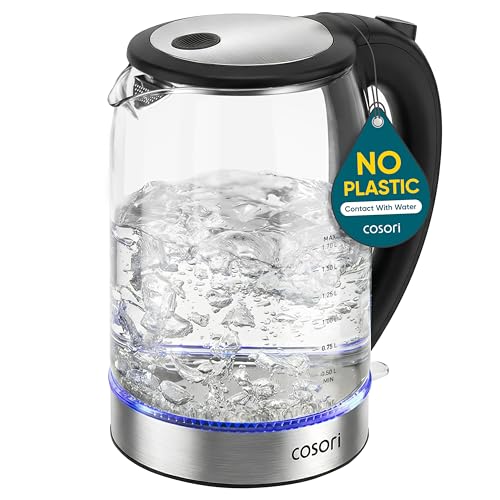
Cosori Electric Kettle 1.7L
The Cosori 1.7-liter kettle earns the first spot on speed and purity. The verified details list a borosilicate glass body, 1500 watts, a stated time of under three minutes to heat half a liter, a wide opening with a large-angle lid, and automatic shut-off with boil-dry protection. The headline feature is the absence of plastic contact with the water: no plastic sits inside the kettle, so the water never touches plastic and the taste stays clean. That matters to buyers who have noticed a faint taste from older plastic kettles. The wide mouth is the second feature that matters in daily use, because it lets a hand and a cloth reach every corner for cleaning and descaling, which keeps the kettle tasting fresh for years. The auto shut-off engages within 30 seconds of the boil, and the boil-dry protection covers the mistake of switching it on empty. The trade-offs are the absence of temperature presets and the glass body, which needs more care than stainless steel. For the household that wants boiling water fast, clean and without fuss, this is the pick to buy.
Key specs
- 1.7 liters, borosilicate glass, 1500 watts
- No plastic contact with water at any point
- Heats 0.5 liters in under 3 minutes
- Wide opening with large-angle lid for easy cleaning
- Auto shut-off and boil-dry protection
Strengths
- Fastest stated boil time in this guide
- No plastic touches the water, which gives a cleaner taste
- Wide mouth makes descaling and cleaning genuinely easy
Trade-offs
- No temperature presets for different teas
- Glass body needs care to avoid chips and cracks
- 1.7 liters is generous for one person but right for a family
Who it fits: Households that want fast boiling water with a clean taste and a kettle that is easy to clean.
Best for: fast everyday boiling with clean-tasting water
Not suited for: tea drinkers who need precise temperature presets
Check price on Amazon: Cosori Electric Kettle 1.7L

Chefman Electric Kettle 1.8L
The Chefman 1.8-liter kettle is the capacity pick of this guide, and its verified details are straightforward: 1.8 liters, 1500 watts, a borosilicate glass body, a removable lid, a stainless steel filter, BPA-free construction, and automatic shut-off with boil-dry protection. The capacity is the story. A 1.8-liter kettle boils enough water for a pot of tea, several mugs of coffee, or a pan of noodles in one go, and the 1500-watt element keeps the wait short even when the kettle is full. The removable lid matters because it opens the kettle fully for cleaning and descaling, and the stainless steel filter catches scale before it reaches the cup. The BPA-free construction and the glass body keep the water free of plastic taste. The trade-offs are the absence of temperature control and the glass body, which needs the same care as any glass kettle. For a family or a shared household where the kettle runs several times a day, the extra capacity and the fast boil make this the most practical pick here.
Key specs
- 1.8 liters, 1500 watts, borosilicate glass
- Removable lid for easy cleaning
- Auto shut-off and boil-dry protection
- Stainless steel filter, BPA free
- Hot water boiler and electric tea kettle in one
Strengths
- Largest capacity in this guide at 1.8 liters
- 1500 watts boils a full kettle quickly
- Removable lid and steel filter make cleaning simple
Trade-offs
- No temperature control or presets
- Glass body needs care to avoid chips
- 1.8 liters is more than a single person needs
Who it fits: Families and shared households that need the largest kettle and the fastest full boil.
Best for: family-size boiling for tea, coffee and cooking
Not suited for: single-person households or precise tea brewing
Check price on Amazon: Chefman Electric Kettle 1.8L

Chefman Electric Kettle with Temperature Control
The Chefman temperature-control kettle is the pick for tea drinkers, and its verified details explain why. It offers 1.8 liters, temperature control with five presets and LED indicator lights, a removable tea infuser, a 360-degree swivel base, BPA-free stainless steel construction, and the automatic shut-off and boil-dry protection that the range carries. The presets are the feature that matters: green tea, white tea and black tea all brew best at different temperatures, and a kettle that only boils forces the drinker to guess or wait. The removable infuser turns the kettle into a proper teapot for loose-leaf tea, so the leaves steep in the kettle and the tea pours straight into the cup. The 1.8-liter capacity covers a family pot as well as a long tea session. The trade-offs are complexity and material: five presets take a little learning, and the glass body needs care. For the household where tea is a daily ritual rather than an occasional drink, this is the pick that makes the ritual better.
Key specs
- 1.8 liters, glass tea kettle and hot water boiler
- Temperature control with 5 presets and LED indicator lights
- Removable tea infuser for loose-leaf tea
- 360-degree swivel base, BPA free, stainless steel
- Auto shut-off and boil-dry protection implied by the kettle design
Strengths
- Only pick here with temperature presets for different teas
- Removable infuser makes proper loose-leaf tea without a second pot
- Large 1.8-liter capacity covers a family and a tea session
Trade-offs
- More controls mean a slightly longer learning curve
- Glass body needs care to avoid chips
- Preset temperatures suit tea drinkers more than plain boiling
Who it fits: Tea drinkers who brew green, white and black teas at different temperatures and want a kettle that does it properly.
Best for: proper tea brewing with temperature control and an infuser
Not suited for: cooks who only ever need plain boiling water
Check price on Amazon: Chefman Electric Kettle with Temperature Control

Elite Gourmet Electric Kettle EKT1001
The Elite Gourmet EKT1001 is the compact pick in this guide, and its verified details suit exactly one audience: a household of one or two. It offers a 1-liter BPA-free glass body, 1100 watts, a blue LED indicator, automatic shut-off with boil-dry protection, a 360-degree cordless base, water level markings, a mesh filter and a large pouring spout. The small capacity is a strength rather than a weakness for its audience, because a liter of water boils faster than a full family kettle and the kettle itself takes up far less counter space. The water markings let the cook measure exactly one or two cups, which saves water and energy, and the large spout pours cleanly without dribbling. The cordless base lifts off for serving at the table. The trade-offs are capacity and power: a liter will not cover a family pot, and 1100 watts is slower than the 1500-watt picks on a full kettle. For a single person, a couple, a dorm room or an office desk, those limits do not matter, and the compact size and clean pouring make this the pick to buy.
Key specs
- 1 liter, 1100 watts, BPA-free glass
- Blue LED indicator; auto shut-off and boil-dry protection
- 360-degree cordless base with water level markings
- Mesh filter and large pouring spout
- Model EKT1001, compact footprint
Strengths
- Smallest and most compact pick, ideal for one or two people
- Clear water markings and a large spout make pouring accurate
- Cordless base lifts off cleanly for serving
Trade-offs
- 1 liter will not cover a family pot of tea
- 1100 watts boils slower than the 1500-watt picks
- No temperature presets
Who it fits: Single people, couples and small kitchens who want a compact kettle that boils one or two cups fast.
Best for: single servings and small kitchens with limited counter space
Not suited for: large families or frequent hosts
Check price on Amazon: Elite Gourmet Electric Kettle EKT1001
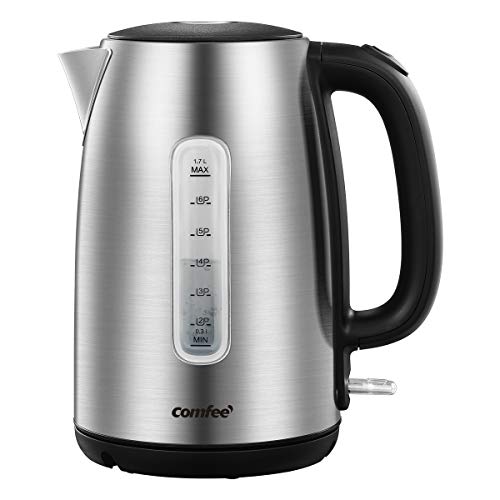
COMFEE Stainless Steel Electric Kettle
The COMFEE stainless steel kettle is the durable pick in this guide, and its verified details are deliberately simple: 1.7 liters, stainless steel construction, 1500 watts with fast boil, an LED light indicator, and automatic shut-off with boil-dry protection. The steel body is the argument. There is no glass to chip, no plastic window to cloud, and the surface resists stains and odors over years of daily use, which matters in a busy family kitchen where the kettle is handled by many hands and occasionally knocked. The 1500-watt element and the 1.7-liter capacity cover a family boil quickly, and the LED indicator shows at a glance that the kettle is heating. The trade-offs are the absence of temperature presets, an infuser and a viewing window, and the steel exterior can feel warm to the touch. For the household that wants a kettle to last, to survive daily use, and to boil water fast without fuss, this is the pick to buy, and its simplicity is the reason it will still be working years from now.
Key specs
- 1.7 liters, stainless steel, 1500 watts
- Fast boil with LED light indicator
- Auto shut-off and boil-dry protection
- Hot water kettle and electric tea kettle in one
- Stainless steel body resists stains and odors
Strengths
- Durable stainless steel body with no glass to chip
- 1500 watts and 1.7 liters cover a family boil quickly
- Simple controls with an LED indicator
Trade-offs
- No temperature presets or infuser
- No viewing window is listed in the verified details
- Stainless steel exterior can feel hot to the touch
Who it fits: Households that want a tough, simple steel kettle with no glass parts and a fast family-size boil.
Best for: durable everyday boiling in a busy family kitchen
Not suited for: tea drinkers who need temperature presets or a visible water level
Check price on Amazon: COMFEE Stainless Steel Electric Kettle

Ovente Electric Tea Kettle KP72W
The Ovente KP72W closes this guide as the classic pick: a white 1.7-liter electric tea kettle with the features that made electric kettles popular in the first place, done well. The verified details list 1100 watts, BPA-free construction, automatic shut-off with boil-dry protection, a 360-degree swivel base with cordless serving, a clear-view window, and a removable filter. The window is the feature that earns its place: it shows the water level at a glance, so the cook fills exactly what is needed and never boils a full kettle for a single cup. The cordless base lifts off for serving at the table, and the removable filter catches scale before it reaches the cup. The white finish suits a classic kitchen, although it shows stains and scale more readily than steel and needs wiping. The trade-off is power: at 1100 watts it boils slower than the 1500-watt picks, which matters on a busy morning. For the household that values a clear window, cordless serving and a familiar design over the last few seconds of boil time, this is the pick to buy.
Key specs
- 1.7 liters, white, 1100 watts, model KP72W
- BPA-free with auto shut-off and boil-dry protection
- 360-degree swivel base with cordless serving
- Clear-view window and removable filter
- Fast boiling water heater for tea and coffee
Strengths
- Clear-view window shows the water level at a glance
- Cordless swivel base serves at the table without a cord
- Removable filter keeps scale out of the cup
Trade-offs
- 1100 watts boils slower than the 1500-watt picks
- White finish shows stains and scale more readily
- No temperature presets
Who it fits: Households that want a clear water window, cordless serving and a classic kettle look at a family capacity.
Best for: family tea and coffee with easy water-level checks
Not suited for: cooks in a hurry who want the fastest possible boil
Check price on Amazon: Ovente Electric Tea Kettle KP72W
Buying guide: how to choose a water cooker
Capacity
Match the volume to the household. A 1-liter kettle suits one or two people and boils fast, while a 1.7 or 1.8 liter kettle suits a family or a household that makes several cups at once. Boiling a full family kettle for a single cup wastes water and energy, so size the kettle to the usual pour rather than the largest imaginable one.
Material
Borosilicate glass lets you see the water level and the boil, and it gives a clean taste with no plastic contact. Stainless steel is durable, keeps heat well, and survives knocks that would chip glass. A design with no plastic touching the water gives the cleanest taste, and a BPA-free construction is the minimum to look for.
Temperature control
Plain boiling suits coffee, noodles and oatmeal. Tea drinkers benefit from presets, because green, white and black teas brew best at different temperatures, and a kettle that holds a temperature saves reheating. An infuser turns the kettle into a teapot for loose-leaf tea, which is worth having if tea is a daily ritual.
Safety and the base
Automatic shut-off and boil-dry protection are essential on every kettle, and every pick here carries both. A 360-degree swivel base lets the kettle sit and lift from any angle, a cordless design serves at the table without a trailing cord, and a wide opening with a removable filter makes cleaning and descaling simple enough to do regularly.
Noise and pour control
Check how the kettle sounds and pours before buying, because both matter every day. A kettle that rattles or whistles loudly will be noticed at six in the morning, and a spout that dribbles will leave water on the counter and the table. A large pouring spout with a good lip pours cleanly, and a kettle that sits firmly on its base does not wobble when it is lifted. These details sound small until the fiftieth morning, when they decide whether the kettle feels like a tool or an annoyance.
How to use and care for your water cooker
Fill the kettle only to the level you need, using the markings or the window, and never above the maximum line. Place it on the base, switch it on, and let the auto shut-off do its work; do not hold the switch down or override it. Pour carefully, replace the kettle on the base, and let it cool before refilling. For care, descale regularly if the household has hard water, using a descaling solution or a vinegar solution according to the maker guidance, and rinse thoroughly afterwards. Wipe the exterior with a damp cloth, clean the filter, and keep the base dry. A kettle that is descaled regularly boils faster, tastes cleaner and lasts far longer than one left to scale up.
Common mistakes to avoid
The most common mistake is boiling a full kettle for a single cup, which wastes water, energy and time. The second is never descaling, which slows the boil, dulls the taste and shortens the kettle life. The third is filling above the maximum line, which can cause boiling water to spit from the spout. The fourth is choosing a kettle by looks alone and ignoring the opening size, which decides whether the kettle can actually be cleaned. Finally, do not leave water standing in the kettle for days: empty it, let it dry, and fill it fresh for the next use.
Electric kettle vs stovetop kettle
An electric kettle boils faster than a stovetop kettle, and the difference is not small. A 1500-watt electric kettle heats half a liter in under three minutes, while a stovetop kettle needs the stove to heat up first and then the water, which takes far longer and uses more energy. The electric kettle also switches itself off when the water boils, while a stovetop kettle keeps boiling until someone notices, which wastes energy and can boil dry.
The stovetop kettle has its own strengths. It needs no electricity, so it works during a power cut and on a camping stove, and a well-made one lasts for decades with almost no parts to fail. It also suits a kitchen where the look of a classic kettle matters. The electric kettle wins on speed, safety and convenience, and for most households those matter more. A home that loses power often or camps regularly may still want a stovetop kettle as a backup, but the daily kettle should be electric.
Water quality and taste
The taste of boiled water comes mostly from the water itself and the kettle it is boiled in. Hard water leaves scale on the element and the walls, which slows the boil and dulls the taste, so descaling regularly matters more than the brand of the kettle. A kettle with no plastic touching the water gives a cleaner taste, because hot water picks up flavors from plastic more readily than cold water does, and a glass or stainless steel interior keeps the taste neutral.
Filtered water helps in hard-water areas, and it reduces scale as well as improving taste. Fill the kettle fresh each time rather than reboiling old water, because reboiled water tastes flat and concentrates the minerals left behind. Empty the kettle after use, let it dry, and descale on a schedule rather than waiting for the scale to become visible. Those habits cost almost nothing and make every cup taste better.
Choosing the right size
Size is the easiest decision to get wrong, because buyers tend to buy larger than they need. A 1-liter kettle suits one or two people and boils fast, because there is less water to heat. A 1.7 or 1.8 liter kettle suits a family or a household that makes several cups at once, and it is the right size for a pot of tea or a pan of noodles. Boiling a full family kettle for a single cup wastes water, energy and time, so the right size is the one that matches the usual pour.
Consider the counter as well as the household. A large kettle takes up more space and is heavier when full, which matters for older cooks and small kitchens. A compact kettle stores easily and lifts comfortably, which matters more than capacity for a single person. When the household size is between two sizes, choose the smaller one if the kettle is used for single cups and the larger one if it is used for pots of tea. The kettle should fit the routine, not the other way around.
Descaling and maintenance
Scale is the enemy of every kettle, and it builds up fastest in hard-water areas. Scale is the chalky white deposit left behind when hard water boils, and it coats the element and the walls, which slows the boil, dulls the taste and shortens the life of the kettle. Descaling regularly is the single most important maintenance habit, and it takes only a few minutes. Use a descaling solution or a vinegar solution according to the maker guidance, boil it in the kettle, let it sit, then rinse thoroughly with fresh water and boil once more before use.
How often to descale depends on the water. In a hard-water area, descale every few weeks, and in a soft-water area every few months is enough. The signs are easy to read: white flakes in the water, a slower boil, a kettle that sounds different, or a taste that has gone flat. Do not wait for the scale to become thick, because thick scale is far harder to remove and it may already have damaged the element.
Daily care is simple. Empty the kettle after use, let it dry with the lid open, and wipe the exterior with a damp cloth. Clean the filter regularly, because a blocked filter slows the pour and traps scale. Keep the base dry and the cord tidy, and never immerse the kettle or the base in water. A kettle that is descaled on schedule and emptied after use will boil fast, taste clean and last for years longer than one left to scale up.
If the kettle has a glass body, check it for chips and cracks during cleaning, and retire it if the glass is damaged. If the kettle has a stainless steel body, wipe it dry after use to prevent water spots. Keep the manual for the descaling guidance, and follow it rather than guessing, because the wrong solution or the wrong strength can damage the interior.
Kettle safety: what to check
Every kettle in this guide carries automatic shut-off and boil-dry protection, and those two features are the ones to verify before buying any kettle. Automatic shut-off stops the element when the water boils, so the kettle never boils dry while the cook is in another room. Boil-dry protection cuts the power if the kettle is switched on with too little water or none at all, which is the mistake that damages elements and, in the worst case, starts a fire. Check that both are stated in the listing, because a kettle without them is not worth the saving.
The base and the cord deserve the same attention. A stable, wide base keeps the kettle upright when it is lifted and replaced, and a cord that is stored neatly under the base cannot be pulled by a child or caught on a drawer. Keep the base dry and the cord away from the edge of the counter, and never let the cord hang where it can be tugged. A kettle that is stable on its base and safe in its electrics is a kettle the household can trust.
Handle and lid safety matter just as much. A cool-touch handle stays comfortable to grip when the kettle is full of boiling water, and a lid that locks or fits firmly prevents hot water from spilling if the kettle is knocked. Pour slowly and steadily, keep the spout away from hands and faces, and never overfill past the maximum line, because boiling water that spits from the spout is the most common kettle injury. Those habits, plus the two safety features, make the electric kettle one of the safest appliances in the kitchen.
Our recommendation
For most households, the Cosori 1.7-liter kettle is the pick to buy first: it boils fast, keeps the water free of plastic contact, and cleans easily through its wide mouth. Families that need the largest boil should take the Chefman 1.8-liter kettle, and tea drinkers should take the Chefman temperature-control model with its presets and infuser. Single people and small kitchens will be happy with the Elite Gourmet EKT1001, the COMFEE steel kettle suits busy kitchens that need durability, and the Ovente KP72W suits households that want a clear window and cordless serving. Whichever you choose, fill only what you need and descale regularly.
Buy the kettle that matches the household and the drinks it actually makes. A family that boils water all day should take the largest fast kettle, a tea drinker should take the temperature-control model, and a single person should take the compact one. The best water cooker is the one that boils the amount you need, pours cleanly, and still works years from now.
Frequently asked questions
How fast should an electric kettle boil?
A 1500-watt kettle heats half a liter in under three minutes, and a full family kettle takes a few minutes more. An 1100-watt kettle is a little slower but still far faster than a stovetop kettle. Fill only the water you need to keep the wait short.
Is a glass kettle safe?
Yes. Borosilicate glass handles boiling water and temperature changes, and it lets you see the water level and the boil. Handle it with the same care as any glassware, avoid knocks, and do not plunge a hot glass kettle into cold water.
Do I need temperature control?
Only if you drink tea regularly. Different teas brew best at different temperatures, and a preset kettle makes that easy. If you only need boiling water for coffee, noodles and oatmeal, a simple on-and-off kettle is enough.
How do I descale a kettle?
Use a descaling solution or a vinegar solution according to the maker guidance, boil it in the kettle, let it sit, then rinse thoroughly with fresh water and boil once more before use. Descale regularly in hard-water areas to keep the boil fast and the taste clean.
Can I leave water in the kettle?
It is better not to. Empty the kettle after use, let it dry, and fill it fresh next time. Standing water tastes stale, encourages scale, and wastes energy when it is reheated from cold anyway.
Can I boil milk or soup in an electric kettle?
No. Electric kettles are made for water only, and milk or soup will stick, burn and damage the element and the interior. Use a saucepan for anything other than water, and keep the kettle clean and free of residue so the water always tastes fresh.
Why does my kettle sound louder than it used to?
Scale is the usual cause. A scaled element heats unevenly and makes more noise as it boils, and the boil takes longer. Descale the kettle and the noise usually drops back to normal. If the noise continues after descaling, check the filter and the base for damage.
Should I buy a kettle with a keep-warm function?
It helps if the household drinks tea or coffee over a long morning, because the kettle holds the water at temperature instead of cooling and needing a reboil. If the kettle is used once and emptied, the feature adds little. Check whether the keep-warm time and temperature suit the way the household actually drinks.
How much electricity does a kettle use?
A kettle uses most of its electricity while the water is heating, so the total depends on how much water is boiled and how often. Filling only the water needed is the biggest saving, because heating a full kettle for one cup wastes most of the energy. A fast 1500-watt kettle that boils quickly and switches off promptly uses less energy overall than a slower kettle left running longer.
Can I use a kettle to boil water for a baby bottle?
Yes, and many parents do. Boil fresh water in the kettle, let it cool to the temperature the feeding guidance states, and use it promptly. Do not reboil water that has been standing in the kettle, and descale regularly so the water stays clean and fresh tasting.


