Disclosure: As an Amazon Associate, airfryerkitchensupply.com earns from qualifying purchases. Links to Amazon on this page are affiliate links; they cost you nothing extra. Listing details such as price and availability change often, so check the current Amazon listing before you buy.
The best traditional bathroom vanities share a handful of qualities: framed or raised-panel doors, turned or bracketed legs, crown or base molding and a profile that looks like a piece of furniture rather than a utility cabinet. They are the right choice when your bathroom has paneling, a clawfoot tub, an arched mirror or simply a look you want to keep classic. They also tend to age gracefully, because their style has barely changed in a century.
This guide compares six traditional vanities from James Martin Vanities and ARIEL, two brands that specialize in classic detailing. You will find a quick picks table, a full section on each model with strengths, an honest limitation and a choose-or-skip line, a comparison table, a section on how to pair a traditional cabinet with hardware and lighting, a buying checklist and a set of answers to common questions.
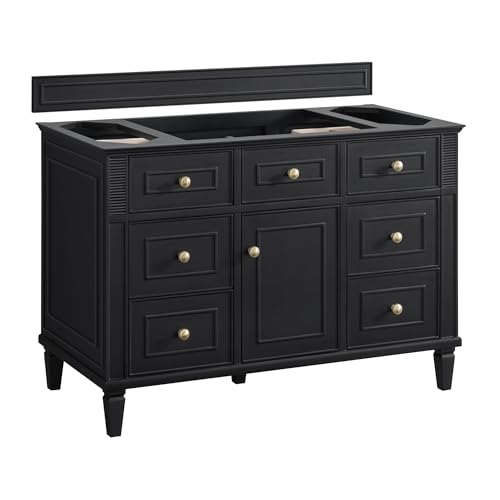
In this guide
Quick Picks: Traditional Vanities at a Glance
| Pick | Best for | Character | Link |
|---|---|---|---|
| Best overall: James Martin Brittany 48 | Classic primary baths | Traditional with transitional touches | Check on Amazon |
| Best for a Mission feel: James Martin Breckenridge 48 | Craftsman and cottage homes | Mission-inspired lines | Check on Amazon |
| Best premium look: James Martin Lorelai | Formal bathrooms | Elegant and detailed | Check on Amazon |
| Best for French-style rooms: James Martin Emmeline | Soft, curved detailing | Romantic and decorative | Check on Amazon |
| Best for a lighter classic: James Martin Solene | Bright, airy traditional baths | Refined and gentle | Check on Amazon |
| Best for adding a modern twist: ARIEL Hepburn | Updated traditional baths | Classic with a modern edge | Check on Amazon |
How We Chose These Vanities
We have not used or installed any of these vanities. The notes in this guide come from the makers’ listings, collection names and published descriptions, plus general knowledge of how furniture-style bathroom cabinets are built. Sizes, finishes, tops and included parts differ from one listing to the next, so read the current listing for width, depth, top material and contents before buying.
We focused on collections that are described by their makers as traditional or traditional-transitional, with real detailing rather than a flat panel. We also favored brands that publish several widths and finishes, so you can keep the same look if your wall changes. Where we could not state a detail with confidence, we say to check the listing.
1. James Martin Vanities Brittany 48 Inch Single Vanity
The Brittany is described by its maker as a blend of traditional and transitional design, and that mix makes it one of the easiest classic cabinets to place. It has enough detail to look like furniture, and enough restraint to avoid feeling like a museum piece. The collection comes in several widths, which helps if you are matching two bathrooms.
Who it suits: Anyone updating a primary bath who wants a traditional cabinet that will not date quickly and that works with many faucet and mirror styles.
- A blend of traditional and transitional styling makes it flexible in rooms that are not strictly period.
- The 48 inch width gives generous counter space for a single sink.
- A collection with multiple widths allows you to repeat the style elsewhere in the house.
Honest limitation: A furniture-style cabinet at this size takes real wall space and has a visual weight, so it suits a bathroom with room to breathe.
Choose it if you want a classic that does not feel stuffy. Skip it if your bathroom is tight or minimalist.
When you plan the room, think about the mirror first. An arched or framed mirror in a similar tone to the cabinet gives a cohesive look, while a pair of mirrors can echo the symmetry of the doors. Lighting in aged brass, polished nickel or oil-rubbed bronze will tie in with the cabinet hardware.
2. James Martin Vanities Breckenridge 48 Inch Single Vanity
The Breckenridge is described by its maker as a fresh take on traditional Mission furniture. The Mission influence shows up in straight lines, clear panels and an honest, hand-crafted feel, which makes this cabinet a good match for Craftsman homes, cabins and cottages.
Who it suits: People who like wood-forward styling with clean structure, and owners of Arts and Crafts bungalows or lodge-style homes.
- Straight, clean lines give it a calm look that is less ornate than many classic cabinets.
- The Mission-inspired design pairs well with natural stone tops and simple oil-rubbed bronze hardware.
- A 48 inch width offers ample counter and storage for a single basin.
Honest limitation: Its restrained detailing may feel plain to buyers who want carved ornament or curves.
Choose it if you like crafted, geometric furniture. Skip it if you prefer ornate or curved detail.
The cabinet looks most at home with wood tones, woven baskets and slightly textured wall finishes. Simple wall sconces with fabric or glass shades complete the effect. Consider wainscoting on the lower half of the wall to echo the panels of the doors.
3. James Martin Vanities Lorelai Single Vanity
The Lorelai is a more elegant, decorative cabinet, with the sort of detail that makes a vanity look like an heirloom. It is the model for bathrooms with a formal mood, where the vanity is meant to be admired as much as used. Because the collection comes in several widths, check the listing for the one that fits your wall.
Who it suits: Owners of formal, upscale bathrooms who want ornament and a sense of occasion in the room.
- Detailed styling gives the cabinet strong visual presence.
- It pairs well with marble-look tops, framed mirrors and crystal or glass lighting.
- A distinctive design reduces the need for extra decor in the room.
Honest limitation: Ornate cabinets need more careful cleaning around the trim, and they can look overdressed in a casual bathroom.
Choose it if you want a showpiece. Skip it if you prefer low-maintenance, plain surfaces.
A cabinet of this character benefits from patient styling. Keep the counter calm, with a pair of matching dispensers and a tray, and let the cabinet do the talking. Soft, warm lighting flatters the detailing and brings out the depth of the finish.
4. James Martin Vanities Emmeline Single Vanity
The Emmeline leans toward a softer, more romantic expression of traditional design. Think curved aprons, gentle detailing and the sort of finish you would expect in a French country or cottage bedroom. It brings a feminine, decorative feel to a bathroom.
Who it suits: Decorators who like curved lines, painted finishes and a gentle, vintage mood.
- Soft detailing gives the cabinet charm without heavy ornament.
- It looks lovely beside brass or antique-style fixtures and linen textiles.
- A furniture feel makes it suitable for powder rooms where the vanity is the main feature.
Honest limitation: A romantic style is a strong statement, and it may not suit a modern or masculine scheme.
Choose it if you want a gentle, decorative cabinet. Skip it if your decor is modern or industrial.
Pair it with floral or botanical prints, simple wall paint in a soft tone and a mirror with a delicate frame. Keep the floor in a quiet pattern, such as a small hexagon or a classic checker, to avoid a visual tug of war.
5. James Martin Vanities Solene Single Vanity
The Solene sits on the lighter side of traditional. It brings classic framing and detail but with a refined, airy character that suits bright rooms. If you love traditional lines but worry about heavy, dark cabinets, this is the style to explore.
Who it suits: People who want a classic bathroom that feels fresh, with light colors and a gentle atmosphere.
- A lighter finish helps small and mid-size bathrooms feel more open.
- Refined detailing offers interest without becoming busy.
- It combines easily with marble, glass and polished metal accents.
Honest limitation: Light finishes can show marks, so wipe the doors regularly and follow the maker’s care notes.
Choose it if you want classic with a light touch. Skip it if you want a dark, dramatic cabinet.
A pale cabinet like this looks wonderful against a deeper wall color, such as soft sage or muted blue, because the contrast defines its outline. Add a mirror with a slim metal frame and the result feels tailored and calm.
6. ARIEL Hepburn Bathroom Vanity Collection Single Sink
The Hepburn collection from ARIEL takes inspiration from traditional cabinetry but adds a modern twist, and it is the most flexible choice for people who like classic structure with a slightly cleaner finish. It sits between a pure period piece and a contemporary box.
Who it suits: Owners of transitional homes and anyone who wants a classic silhouette without heavy ornament.
- A modern twist on traditional shapes helps it blend with a wide range of faucets and mirrors.
- ARIEL publishes many sizes and finishes in its collections, so you can compare widths easily.
- The styling is familiar enough to suit a traditional room and clean enough for a transitional one.
Honest limitation: Because the collection includes many sizes and finish options, you need to read the listing carefully to confirm the exact configuration.
Choose it if you want a classic that stays current. Skip it if you want detailed ornament.
The simplest way to style it is with a mirror in a rounded or arched shape, hardware in brushed brass or nickel and soft, layered lighting. The result looks traditional but not fussy.
Traditional Vanities Compared Side by Side
This table compares the six vanities by style and best use. Check the live listings for the exact widths, tops and finishes, because they vary.
| Model | Style | Key feature | Best use | Link |
|---|---|---|---|---|
| Brittany 48 | Traditional and transitional | Furniture look, flexible | Primary baths | Check on Amazon |
| Breckenridge 48 | Mission-inspired | Clean, crafted lines | Craftsman homes | Check on Amazon |
| Lorelai | Formal and detailed | Heirloom presence | Formal baths | Check on Amazon |
| Emmeline | Romantic and curved | Soft decorative detail | Powder rooms | Check on Amazon |
| Solene | Light traditional | Airy, refined finish | Bright baths | Check on Amazon |
| Hepburn | Classic with a modern twist | Many sizes and finishes | Transitional baths | Check on Amazon |
What Makes a Vanity Look Traditional
Four features do most of the work. The first is door style. Raised-panel or framed doors, sometimes with an arched top, signal a classic cabinet more than any other detail. The second is the base. Bracket feet, turned legs or a furniture-style apron make the cabinet look like a chest or sideboard rather than a utility unit. The third is molding along the top and bottom edges, which gives the cabinet a finished profile. The fourth is hardware: cup pulls, ring pulls and glass or metal knobs read as period details.
If a listing has only one or two of these, it is likely transitional. That is not a flaw, but it matters if you want an unmistakably traditional bathroom. Compare the photographs, not only the name of the collection, to see how many of the four features you are really getting.
Pairing a Traditional Vanity With Hardware, Mirrors and Lighting
A classic cabinet needs a supporting cast. For faucets, widespread sets with cross or lever handles look period-appropriate, and finishes such as polished nickel, chrome, aged brass and oil-rubbed bronze all work. Pick one finish for the faucet, drawer pulls and lights and repeat it, with perhaps one accent metal.
For mirrors, framed shapes work best. Arches, rounded rectangles and ovals complement the curves of a traditional cabinet. A pair of mirrors can emphasize symmetry. Sconces on each side of the mirror give flattering, even light.
For walls, panel details such as wainscoting or beadboard add depth, and soft paint colors such as warm white, sage and muted blue keep the focus on the cabinet. If you are changing electrical fixtures, hire a licensed electrician and follow the instructions supplied with the fixtures.
Finishes and Tops: Getting the Surface Right
The finish on a traditional vanity decides its mood. White and cream painted finishes look crisp and are the most common choice for bright, cottage-style rooms. Grey and soft green painted finishes bring a quieter, more modern flavor. Stained wood in walnut, espresso or cherry tones gives a warm, library-like atmosphere, and works well with brass and bronze hardware. Glazed finishes, with a darker tone settled into the corners of the trim, emphasize the detailing and give a gently aged look.
The top matters just as much. Marble-look and quartz-look surfaces are the usual partners for classic cabinets, because their veining suits the formal profile. Natural marble has a distinctive look but needs thoughtful care, so read the maker notes on sealing and cleaning. Engineered surfaces often have a more uniform appearance and simpler care instructions. Whichever you choose, wipe spills quickly and avoid leaving wet items sitting on the surface.
Finally, think about the sink. Undermount basins give a clean line and make wiping the counter easy. Drop-in basins are common on simpler sets. Vessel bowls look decorative but add height. Check the listing to see which type your cabinet takes before you buy a separate basin.
How to Choose the Best Traditional Bathroom Vanities
Use this checklist before you buy.
- Measure the wall and the clearances. Allow for door swing, trim and the distance to the tub and toilet.
- Choose the width. Furniture-style cabinets take more visual space than flat-front ones, so a slightly smaller width may look better in a modest room.
- Check what is included. Some listings include a top, a sink, a mirror or hardware. Others do not. Faucets are usually separate.
- Review the top options. Natural stone tops need different care than engineered ones. Read the care notes.
- Look at the faucet drilling. Traditional cabinets often take widespread faucets, so check that the top matches your plan.
- Compare finishes. Painted, stained and glazed finishes behave differently, so choose one that suits your cleaning habits.
- Plan for plumbing. Furniture-style bases may have limited interior space. Ask a licensed professional about connecting supply and drain lines.
- Follow the maker’s instructions. Read installation guidance for anchoring and connections and hire a licensed professional if you are unsure.
A word on where to spend your attention: the biggest regrets with classic cabinets come from small things that are easy to settle before you order. Choose the faucet type so the top is drilled correctly. Decide on the mirror size so the wall can take it. Confirm the door swing so the cabinet does not collide with the tub. Settle those three questions and most of the risk disappears.
Common Buying Mistakes With Traditional Vanities
- Buying on style name alone. A collection can include transitional pieces. Compare photographs.
- Ignoring wall space. A furniture cabinet with a deep profile may crowd the door or tub.
- Forgetting the top. The top and sink are a big part of the look. Read what is included.
- Mismatching metals. Too many finishes make a classic room look messy.
- Skipping the delivery plan. Large cabinets arrive in large boxes. Check doorways and stairs.
- Choosing a mirror last. The mirror should be chosen with the cabinet, not as an afterthought.
Final Recommendation: One Pick Per Buyer
- Most buyers: James Martin Brittany 48, for its versatile traditional and transitional blend.
- Craftsman homes: James Martin Breckenridge 48, for the Mission-inspired lines.
- Formal bathrooms: James Martin Lorelai, for its detail.
- Romantic or French-style rooms: James Martin Emmeline, for the soft curves.
- Bright, airy baths: James Martin Solene, for its lighter finish.
- Updated classic style: ARIEL Hepburn, for its modern twist.
Whichever cabinet you choose, buy the mirror, faucet and lighting as a set of decisions rather than a series of afterthoughts. A traditional vanity looks its best when every element shares a finish and a sense of proportion, and the planning takes an evening rather than a weekend.
If you only want to look at two listings, open the Brittany and the Hepburn. One gives you true furniture styling and the other gives you a cleaner, updated version of the same idea.
Planning the Space Around It: Measurements That Decide Everything
Bathroom furniture succeeds or fails on measurements taken before the order, not on features discovered after delivery. A traditional bathroom vanity has to fit its wall, its plumbing, its door swings and the people moving around it, all in the smallest room in the house. Work through the physical checks in the order an installer would, and the shortlist in this guide narrows itself.
Start with the footprint and the clearances around it. Measure the available width at skirting level and at counter height, because walls are rarely perfectly plumb and the tighter number is the honest one. Then picture the room in use: drawers and doors need their full swing, the bathroom door itself must clear the new piece, and there has to be standing room in front for someone washing, shaving or helping a child. A piece that fits the wall but crowds the room will annoy you twice a day for years.
Next, the plumbing. Note where the water supplies and the waste exit the wall or floor, and compare them with where the new piece expects them. Small differences are routine for an installer; large ones mean opening the wall or the floor, which changes the budget and the timeline. If you are replacing an existing piece, photograph the current connections before anything is disconnected — that photo answers half the questions that come up on installation day.
Then walk the delivery route, the step most often skipped. Measure the narrowest doorway, any hallway turn and the bathroom door itself, and compare them with the boxed dimensions on the listing. Bathroom pieces are awkward rather than heavy: wide, rigid and easy to mark. Knowing the route works before the box arrives turns delivery into a non-event, and if the route is genuinely tight, some pieces can be carried in components or installed by a two-person team that you arrange in advance rather than improvise on the day.
Finally, think about the wall and floor the piece will meet. Out-of-level floors are common in bathrooms and show up as rocking or uneven gaps; soft or water-damaged flooring should be repaired while the old piece is out, not hidden under the new one. Five checks — footprint, clearances, plumbing positions, delivery route and surface condition — take twenty minutes and prevent nearly every problem this category of purchase can produce.
Everyday Life With It: Routines, Storage and Sharing the Bathroom
A traditional vanity is furniture first and plumbing second: buyers choose this style because they want the bathroom to feel like a room, with a piece that has presence, rather than a fitted unit. These vanities anchor main bathrooms and ensuites in homes whose other rooms lean classic, and they are often the single biggest purchase in a remodel, expected to set the tone for taps, mirrors and lighting chosen around them. That raises the stakes on the practical checks — a statement piece that crowds the room or fights the plumbing is a statement of the wrong kind — and on finish, since a furniture-style piece shows its quality, or its absence, at conversational distance every day.
A bathroom piece is used in short, repeated bursts: the morning rush, the evening wind-down, the quick tidy before guests. Judge the picks in this guide by those bursts rather than by the showroom moment. What matters is whether the everyday objects of your household — the tall bottle, the shared drawer, the appliance that lives on the counter — have a natural home, because a bathroom that puts things away easily stays tidy with almost no effort, and one that fights you never does.
Sharing changes the equation. Two people getting ready at once need elbow room and, ideally, storage that divides rather than mixes, so each person’s daily items stay in their own zone. Households with children need the opposite in places: step access considered, frequently used items low and safe, cleaning products up high or behind a door that closes properly. Older users benefit from storage that avoids deep bending and surfaces that are easy to keep dry and grippy underfoot around the piece.
Moisture is the constant in every bathroom routine, and it quietly decides how furniture ages. Ventilation after showers, a habit of wiping standing water rather than leaving it, and keeping the piece’s edges and joints dry extend its life more than any product you can buy. When you read the per-pick notes above, weigh the finishes and constructions against your bathroom’s real humidity: a steamy family bathroom with one small window is a harder environment than a ventilated ensuite, and the right pick is the one built for your version.
The last test is cleaning. Bathrooms are cleaned often and quickly, so surfaces that wipe down in one pass, interiors that do not trap grime in awkward corners, and hardware that does not demand special products all matter more than they appear to in a listing. The best traditional bathroom vanity for your home is the one whose storage, finish and footprint suit the routine you already have — not the routine you imagine having after a renovation.
The Picks Compared Side by Side
The shortlist — the James Martin Brittany, the James Martin Breckenridge, the James Martin Lorelai, the James Martin Emmeline, the James Martin Solene and the ARIEL Hepburn — spans the main approaches in this category, and comparing them in the right order makes the choice clear: fit first, then storage or function, then finish and style.
Fit is the gatekeeper. Models differ in width, depth and how much clearance their doors or drawers need, so begin with your measurements and eliminate anything that crowds the room, however much you like its look. the James Martin Brittany and the James Martin Breckenridge illustrate how two pieces aimed at similar spaces can divide the room differently, and the one that suits you is the one that matches your wall, your plumbing positions and your door swing, not the one with the longer feature list.
Function comes next. Compare how each pick organises the things you actually own: the division of drawers or shelves, the depth available for tall items, and how the interior behaves when it is full rather than empty. the James Martin Lorelai makes its case on one side of that argument and the James Martin Emmeline on the other, and neither is wrong — households differ in whether they store many small items or fewer large ones, and the honest inventory of your current bathroom is the best guide you have.
Finish and style close the decision. Colour and hardware set the tone of the whole room because this is usually its largest piece of furniture, so weigh how each finish will sit with your tiles, flooring and lighting, and how forgiving it will be of water spots and daily fingerprints. the James Martin Solene and the ARIEL Hepburn show the range on offer. Choose the pick that passes your measurements, stores your real belongings and suits your light, in that order, and you will not need to second-guess the order confirmation.
Installation Day, Settling In and Long-Term Care
Installation goes smoothly when the preparation is done before the box is opened. Clear the room, protect the floor along the carry route, and have the water shut-off located and tested in advance — a valve that has not moved in years sometimes objects to being used, and discovering that mid-job is nobody’s plan. Inspect the piece as it is unboxed and photograph any damage before installation begins, because a mark noticed after fitting becomes an argument, while one documented before is a simple exchange.
During fitting, the details that matter are level, seal and access. The piece should sit level so doors hang true and water behaves as it should around it. Joints that meet wet areas need their seals made carefully and left to cure for the time the product guidance specifies, not rushed because the bathroom is wanted back. Connections should be checked under pressure before everything is closed up, and a slow drip found now is a washer tightened; the same drip found in a month is a cabinet base swollen.
The first week is about settling habits. Load storage gradually rather than all at once, so you notice what naturally belongs where. Wipe standing water as you go, run the extractor a little longer than feels necessary, and check under and behind the piece once in the first days for any sign of a weeping joint. These small attentions in week one are what separate an installation that lasts a decade from one that ages in three years.
Long-term care is mostly gentle consistency. Clean finishes with a soft cloth and mild products, avoiding abrasive pads and harsh chemicals that dull surfaces and attack seals. Keep hinges, runners and joints dry, tighten anything that works loose with use, and refresh sealant when it starts to lift or discolour rather than after water has got behind it. Treated this way, a well-chosen bathroom piece is close to invisible in your life: it simply works, every morning and every evening, which is the highest compliment furniture in this room can earn.
Budgeting the Whole Job: Where Bathroom Projects Actually Spend
The piece itself is only part of what a bathroom update costs, and the buyers who finish relaxed are the ones who budgeted for the whole job around their traditional bathroom vanity rather than for the item alone. The supporting cast is predictable: removal and disposal of the old piece, plumbing adjustments, possible wall and floor repairs once the old installation is opened up, finishing materials, and the small separate items — connectors, seals, fixings, sometimes taps or wastes — that listings do not always bundle. Listing them in advance converts each from a surprise into a line item.
Quotes deserve the same treatment. Ask anyone quoting for installation to price against your written list of what the job includes, so two quotes can be compared line by line instead of by their totals alone. Where something genuinely cannot be priced until the old piece is out — the condition of the wall or floor behind it is the classic unknown — agree in advance how it will be charged if it appears. That single conversation prevents most renovation arguments, which are rarely about money itself and almost always about money that arrived unannounced.
Sequence is the other half of budgeting, because time in a bathroom project is trades waiting on each other and materials curing. Plan which facilities the household uses while the room is out of action, and whether the work can be staged so the room is never unusable overnight. If the project is one piece in a larger refresh, order the work so the largest, wettest jobs happen first and the new piece goes in after the dust-making is finished, not before — new bathroom furniture makes a poor site cabin.
Keep the paperwork as carefully as the receipts: product documents, installer invoices and a few photographs of connections and seals before they are closed in. If a joint ever weeps or a finish ever misbehaves, that folder shortens every conversation that follows. It also helps the next owner of your home, who will otherwise guess at what is behind your bathroom walls. None of this is exciting, and all of it is the difference between a purchase and a project — the picks in this guide deserve to be the second.
Matching the Rest of the Room: Finishes, Metals and Light
Bathroom furniture does not get judged alone; it is judged against the tiles behind it, the metal of the taps beside it and the light above it, every single day. A traditional bathroom vanity that looked perfect in a showroom can sit awkwardly in your room if those relationships are off, and a modest piece can look expensive when they are right. Spending ten minutes on the relationships is worth more than spending more on the piece.
Start with undertones. White tiles, white ceramics and white paint are rarely the same white, and finishes that clash in undertone — a warm, creamy piece against blue-white tiles — look subtly wrong in a way visitors notice without identifying. Take a finish sample or a good photograph into the room and look at it in morning and evening light before committing. Coloured pieces deserve the same test doubled, because bathroom light, often cool and shadowless, shifts colours more than living-room light does.
Metals are the second relationship. Tap, handles, mirror frame and light fittings read as one family; they do not all need to match exactly, but they need to look intentional together. If your new piece brings its own hardware colour, decide whether it joins the existing family or deliberately contrasts with it, and repeat that decision at least once elsewhere in the room — a lone contrast reads as a mistake, a repeated one reads as design.
Finally, consider what the piece does to the room’s light and space. Glossy and pale finishes bounce light and open small rooms; deep matte colours absorb it and make large rooms feel calmer and smaller rooms feel moodier, which may or may not be the goal. Mirrors and glass multiply whatever the piece does. None of this requires a designer’s eye — it requires looking at your actual bathroom, in its actual light, with the same honesty you brought to the measurements. The piece that passes both tests, physical and visual, is the one that will look right for a decade.
A Final Pre-Order Checklist
Before ordering, confirm these points in writing. Wall measured at skirting and at counter height, with the tighter figure used. Door and drawer swings checked against the room, including the bathroom door itself. Plumbing positions noted and compared with the new piece, with any moving work agreed in advance. Delivery route measured, including the bathroom door. Floor and wall condition considered, especially for past leaks. Included and separate items confirmed from the listing. Installer or DIY plan settled, with the water shut-off located. Seven answers, and the purchase stops being a gamble and becomes a plan.
Frequently Asked Questions
Do traditional vanities come with a faucet?
Usually not. Some listings include the top and sink, and a few include a mirror or hardware. Read the contents list and buy a faucet that fits the drilling in the top.
Are traditional vanities harder to clean?
Detailed trim can collect dust, so plan to wipe it with a soft cloth. Follow the maker’s care notes for the finish and the top.
Can I use a traditional vanity in a small bathroom?
Yes, if you choose a narrower width and a lighter finish. A smaller furniture-style cabinet can look charming and add character.
What top material suits a traditional cabinet?
Marble-look and stone-style tops are popular, and the choice depends on your cleaning habits and care. Read the notes on each listing.
Do I need a professional to install it?
Follow the maker’s instructions. For plumbing connections, wall anchoring or electrical work, hire a licensed professional.
What if the vanity arrives with damage?
Check the return terms on the listing, photograph the damage and keep the packaging, then contact the seller promptly.
How do I keep a traditional bathroom from feeling dated?
Edit the accessories. Keep the cabinet classic, but choose simple towels, a clear mirror shape and clean, uncluttered counters. Lighting with a current profile also helps, because it balances the older detailing.
Is a larger vanity always better?
No. A cabinet that fits the wall with clear space on both sides looks better than one that fills the wall edge to edge. Leave room for the door, the trim and a comfortable walkway.
Will a traditional vanity suit a modern house?
Often yes, particularly the transitional styles. A classic cabinet with clean walls and simple lighting can add warmth to a modern space.
Can I swap the hardware on a traditional vanity?
Often yes, since pulls and knobs are usually standard sizes. Measure the hole spacing on the existing hardware and compare it with replacements before ordering.
Do traditional cabinets need wall anchoring?
Heavy furniture-style cabinets are generally meant to be fixed to the wall. Use the hardware and instructions that come with the cabinet, or ask a licensed professional.
How do I choose between painted and stained finishes?
Painted finishes feel crisp and bright, while stained finishes highlight the wood and feel warm. Choose the one that matches your floors and walls.
Should I hire a professional installer or do it myself?
Confident DIYers handle straightforward like-for-like swaps, especially where plumbing positions stay put. Bring in a professional when connections need moving, when the piece is heavy or awkward for one person, when wall or floor repairs appear once the old piece is out, or whenever you are unsure about sealing wet areas. The cost of a fitting is small next to the cost of repairing water damage from a joint that was nearly right.
What should I check on the listing before ordering?
Confirm the overall dimensions, the configuration you are actually selecting, what is included and what is sold separately, and the finish name, because near-identical listings often cover several variants. If the description is ambiguous about any of those, resolve it with the seller before ordering. A screenshot of the listing and your measurements side by side is the cheapest insurance in the whole project.
How do I deal with an uneven bathroom floor?
Minor unevenness is common and is handled with levelling during installation so the piece sits true and its doors or drawers align. What matters is distinguishing cosmetic unevenness from a floor that is soft, springy or water-damaged, which needs repair first. If the old piece rocked or its seals kept failing, treat that as a clue worth investigating while the floor is exposed.
Can I install the new piece before the old one is removed?
No — the space has to be emptied, the supplies isolated and the connections exposed before the new piece can be positioned and levelled. Sequence the work so removal, any repairs, and installation happen in one visit where possible, and arrange an alternative washing arrangement for that day. Bathrooms forgive many things, but being without one unexpectedly is rarely among them.
How do I protect the finish from water damage over time?
The habits are simple: wipe standing water rather than leaving it to sit, keep the extractor running during and after showers, and reseal joints when the sealant starts to lift. Avoid leaving soaking-wet items draped over doors or edges, and clean with mild products and a soft cloth. Finishes rarely fail suddenly; they fail from months of small neglect, which means months of small attention prevent it.
What if the piece arrives damaged?
Photograph the packaging before opening it fully, then the damage itself, and contact the seller promptly with those images. Keep all packaging until the replacement or resolution is agreed, since returns usually need it. This is also why inspecting on delivery day matters: a problem documented immediately is a logistics issue, while the same problem found after installation becomes a dispute.
How much clearance do I really need in front?
Enough for a person to stand, bend and open doors or drawers fully without stepping back into the bath, the shower door or the bathroom door’s swing. In a small bathroom that may mean choosing a shallower piece over a deeper one with more storage. Storage you cannot reach comfortably is not storage, so measure the room in use, not just the wall the piece sits against.
When should sealant and seals be renewed?
When you see lifting, cracking, persistent discolouration that cleaning does not shift, or any softness in the material behind a joint. Renewing sealant is a small, inexpensive job that protects the wall, the floor and the piece itself. Put it on the same mental list as changing the extractor filter: occasional, unglamorous and disproportionately valuable.
How do I clean around and behind the piece once it is installed?
Plan for it before installation: leave the access the design intends rather than sealing every gap shut, and keep a long-handled duster or a vacuum crevice tool that reaches the sides. Dust and moisture collect where air cannot move, so the reachable gap stays fresher than the sealed one. During installation is also the moment to photograph the connections, so any future cleaning or maintenance starts from knowledge rather than guesswork.
Can I change the handles or hardware later to update the look?
Usually, yes, provided the fixing positions and spacing are standard or you are willing to fill and re-drill carefully. Hardware is the cheapest genuine refresh in a bathroom: it changes the piece’s character without touching plumbing or tiles. Keep the original hardware in a labelled bag, because returning a room to its earlier look — for a sale, for example — is sometimes worth as much as updating it was.
Should I keep spare parts or touch-up materials for the finish?
Yes — a small, labelled kit saves disproportionate trouble later. Keep any touch-up material the maker supplies, a note of the exact finish name and colour, and the details of any non-standard fixings or seals used in your installation. Finishes get renamed and ranges get discontinued, so the name written down today is the match you can still find in five years. Store the kit with the product documents rather than in the bathroom itself, where humidity helps nothing.
How do I stop the area around the piece becoming a clutter magnet?
Give every category of object a home inside the storage you have, and let the visible surfaces hold only what is used daily and looks calm doing it. The piece itself is rarely the problem; the problem is objects with no assigned place defaulting to its top and edges. A five-minute reset each week, returning strays to their homes, keeps the room looking like the photographs that made you choose the piece in the first place.