Air frying works by blasting hot air across food so the outside crisps while the inside stays tender. In a toaster oven, results depend on fan strength, rack placement and tray design. This guide focuses on ovens known for their air fry mode and their ability to crisp fries, wings, nuggets and roasted vegetables.
The six ovens below take different approaches, from French door cabinets to large digital models. We have not used these products ourselves, so confirm fan modes, included air fry baskets and cavity size on the current listing before buying. Crisping and speed claims are the makers’ own.
As an Amazon Associate we earn from qualifying purchases. Links below are affiliate links, and they do not change the product information we give.
What to Look For
| Feature | Why it matters |
|---|---|
| Fan power | A stronger fan moves hot air faster and helps crisp food evenly |
| Tray design | A mesh basket or perforated tray lets air reach all sides |
| Door style | French doors open compactly; a drop-down door is simple and sturdy |
| Cavity size | Cook in one layer, so check the area of the tray |
In this guide
Specs at a Glance
| Oven | Door style | Air fry setup | Notes |
|---|---|---|---|
| Nuwave Bravo XL Pro | Drop-down | Digital with presets | Large cavity, many presets |
| Chefman Air Fryer Toaster Oven | Drop-down | Digital | Value-oriented design |
| Midea Flexify French Door Air Fryer Oven | French door | Digital | Doors open with one handle |
| Oster French Door Air Fry Oven | French door | Dial or digital | Roomy interior |
| Cosori Air Fryer Toaster Oven | Drop-down | Digital | Several cooking modes |
| Ninja Foodi XL Pro Air Fry Oven DT200 | Drop-down | Digital | Fast-cooking design |
The 6 Best Toaster Ovens for Air Frying

Top pickBest for tweaking settings
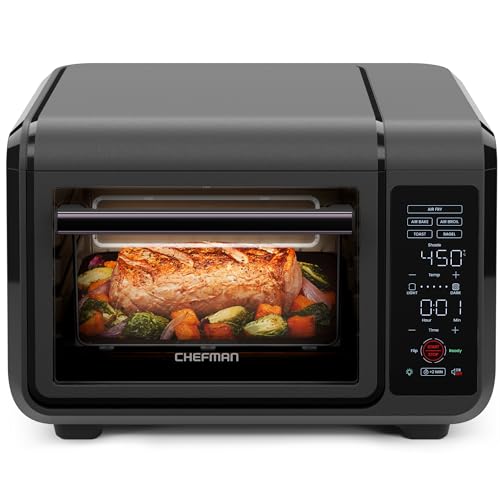
1. Nuwave Bravo XL Pro Air Fryer Oven
A large countertop oven with a digital panel, preset recipes and an adjustable temperature range. It is aimed at those who want precise control.
Suits: tweaking settings. Strengths: many presets and a roomy cavity. Weaknesses: a big footprint. Skip it if you want a tiny oven.

Best for casual cooks
2. Chefman Air Fryer Toaster Oven
A value-oriented digital oven with air fry, bake and toast modes. The brand is known for budget-friendly appliances.
Suits: casual cooks. Strengths: simple air frying. Weaknesses: fewer extras. Skip it if you want the strongest fan.
Best for tight counters
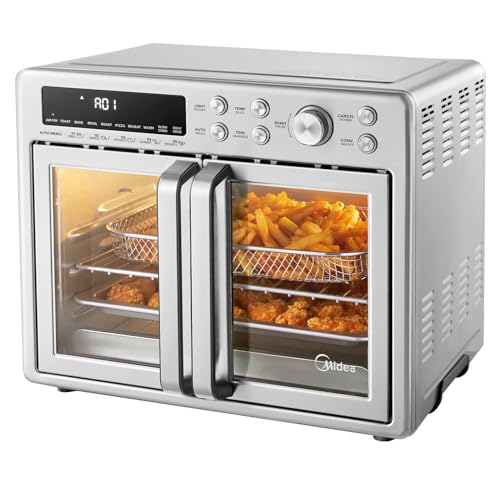
3. Midea Flexify French Door Air Fryer Oven
A French door countertop oven where a single handle opens both doors, saving room at the front. It adds air fry to standard oven modes.
Suits: tight counters. Strengths: compact door opening. Weaknesses: the doors still need clearance. Skip it if you prefer a drop-down door.

Best for family meals
4. Oster French Door Air Fry Oven
A roomy French door oven with an air fry function. It fits larger pans and is a good fit for family cooking.
Suits: family meals. Strengths: wide interior. Weaknesses: takes up counter space. Skip it if you need a compact oven.
View Oster French Door Air Fry on Amazon
Best for air fry fans
5. Cosori Air Fryer Toaster Oven
A digital oven with several cooking modes and accessories, from a brand known for air fryers. It offers straightforward presets.
Suits: air fry fans. Strengths: brand experience in air frying. Weaknesses: accessories vary. Skip it if you want a French door.
View Cosori Air Fryer Toaster Oven on Amazon
Best for batch crisping
6. Ninja Foodi XL Pro Air Fry Oven DT200
A Ninja oven with a large cavity that is built around fast air frying and multi-level cooking. It is a popular choice for batch crisping.
Suits: batch crisping. Strengths: a fast, strong fan. Weaknesses: substantial size. Skip it if you cook for one.
View Ninja Foodi XL Pro DT200 on Amazon
Care and Setup
- Shake or flip food halfway for even crisping.
- Wash the basket with a soft sponge to protect coatings.
- Empty the crumb tray often.
- Wipe grease from the cavity while still warm.
- Use a baking sheet or drip tray on the lower rack to catch grease.
Mistakes to Avoid
- Using too much oil, which smokes.
- Stacking food on top of each other.
- Skipping the preheat when a recipe requires it.
- Covering the tray with foil that blocks air.
- Leaving frozen foods with heavy ice crystals, which steam rather than crisp.
Why Airflow Decides the Crisp
Crisping depends on removing moisture from the surface of the food. Hot air moving across a wet surface carries that moisture away, and the surface then browns. This is why a strong fan and open airflow matter more in an air fry oven than raw wattage. If air cannot reach all sides of the food, it steams or browns unevenly.
The path of air through the cavity is influenced by the position of the fan, the shape of the interior and the accessories you use. A mesh basket or perforated tray lets air pass under the food, while a solid sheet blocks it. When a listing mentions an air fry basket, check whether it fits the rack and whether the oven expects you to use a particular level.
Cavity size also shapes results. A larger cavity can hold more food but has more space to heat, and air may disperse more. Cooking in a single layer with gaps lets air circulate. If you stack or crowd food, the top pieces crisp while the bottom ones stay pale. Plan to cook larger quantities in two rounds rather than pushing for one crowded tray. Frozen foods with ice crystals release steam, so shake off excess frost and give them room.
Oil, Batter and Breading
Air frying needs far less oil than deep frying, but some oil still helps. A thin coating on vegetables and potatoes encourages browning and helps seasoning stick. Too much oil drips onto the heating elements and smokes. Spray or brush a light layer, and toss food in a bowl instead of pouring oil over a tray.
Wet batters do not suit air frying because the batter drips through the basket before it sets. Foods with a dry breading, such as breadcrumb coatings, work better, and pressing the coating on firmly keeps it from blowing around in the fan. A light mist of oil on the breading helps it brown. Frozen breaded items are designed for this method, but follow the package directions and the oven’s manual.
Pat foods dry before cooking, especially meat and vegetables rinsed after washing. Moisture on the surface slows crisping. Salt can draw out moisture, so season shortly before cooking or after, depending on the food. Be aware that some aerosol cooking sprays can damage nonstick coatings on baskets and trays, so check the manual. Oils with higher smoke points are commonly suggested for high heat, but the manual and the food packaging should guide your choice.
Preheating, Timing and Temperature
Many air fry ovens perform better with a short preheat, though some manuals say it is unnecessary. A preheated cavity gives food an immediate burst of hot air, which helps the surface set. If your manual lists a preheat time, follow it, and use that as your baseline.
Cooking times in recipes are guidelines. Because air frying moves heat efficiently, small items can finish faster than you expect, so check early. Thin foods like fries or vegetables may be done in a short time, while thick chicken pieces need longer, and the inside temperature should be confirmed with a food thermometer. This is especially important for poultry and ground meats.
Shaking or turning halfway through helps even browning. In an oven, you may need to rotate the tray from front to back as well. Higher temperatures crisp faster but can scorch the outside before the inside cooks, so for thick foods consider a moderate temperature and a longer time. Let food rest briefly after cooking so steam escapes and surfaces firm up. If your oven offers presets, treat them as starting points and note the changes that work for your favorite foods. Over time you will build your own cheat sheet.
Managing Grease, Smoke and Cleanup
Grease is the main maintenance challenge of air frying. Drippings fall onto the bottom of the oven or onto a tray, and at high heat they can smoke. Put a drip tray or baking sheet on a lower rack to catch drips, but keep it from blocking airflow, and follow the manual on where to place it.
After cooking, let the oven cool, then wipe the interior while it is still slightly warm. Wash baskets and trays with a soft sponge and warm soapy water. Soak stubborn residue rather than scraping, which can harm coatings. Empty the crumb tray after each use, and check the area around the fan or vents for buildup, using only methods the manual allows.
If you smell burning, check for food on the heating elements or trapped crumbs. Avoid cooking very fatty foods at the top temperature without a tray beneath. Keep the oven away from walls and cabinets to allow heat and smoke to escape, and ventilate the kitchen when cooking greasy foods. Signs it may be time to replace an oven include a fan that rattles or slows, coatings that peel into food, persistent smoke after cleaning, uneven crisping on every cook and controls that behave unpredictably.
Door Style, Size and Everyday Handling
Door design affects daily use. A drop-down door is simple and sturdy, but it needs room in front of the oven and the open door can get hot. French doors open outward from the center and require space at the sides, though they take less depth than a drop-down. Neither is universally better, so look at how your counter is laid out.
Think about reach. A deep oven can make it awkward to retrieve food from the back. Racks that slide out smoothly help, as do handles that stay cool. Interior lighting lets you check progress without opening the door and losing heat.
Capacity and footprint should be balanced. A large oven suits batch crisping for a family but occupies counter space. A smaller oven fits tighter kitchens but means more rounds. Budget tiers often differ in fan strength, display quality, accessories and size. Higher tiers may include more presets, additional racks and a more stable temperature control, but you pay for features you may not need. Match the oven to your most common meals, check the manual for recommended accessories, and keep the listing’s size and power figures in front of you before you buy.
A Short Decision Guide by Cooking Habit
Toaster ovens with an air fry mode vary widely in capacity, controls and layout. Rather than chasing features, match the oven to the way you cook day to day.
- Toast, bagels and reheating: look for even heat across the top and bottom and a clear toast shade control.
- Sheet pan dinners: check interior width and depth against the pan you own.
- Frozen snacks and fries: a roomy rack and a strong fan help with crisping.
- Baking small cakes or cookies: look for stable low-temperature control and a clear internal light.
- Cooking for one or two: a smaller footprint leaves counter space for everything else.
- Family batches: consider larger models that accept a standard pizza or two trays at once.
Choosing based on habit rather than a list of presets avoids buying capacity you never use or too little for what you actually cook.
Door Styles and Controls Compared
| Design choice | Good points | Things to consider |
|---|---|---|
| Single drop-down door | Simple, familiar, sturdy | Needs space in front for the door to open |
| French doors | Opens both sides, easy rack access | Needs width on both sides when opened |
| Dial controls | Fast, tactile, easy for anyone to use | Less precise than digital settings |
| Digital touch controls | Presets, exact temperature and time | More menus to learn |
| Rotisserie or dehydrate extras | More cooking modes | Extra parts to store |
Think about how you stand and move in the kitchen. A door that swings away from your work area can be much more convenient than one that blocks it.
Mistakes That Hold Back Crisp Results
- Crowding the rack so air cannot flow between pieces of food.
- Using a deep or solid tray that blocks air movement underneath the food.
- Skipping a pat-dry step for wet foods, which then steam instead of crisp.
- Using too much oil or sprays the maker does not recommend.
- Not turning or shaking food when the recipe or the manual suggests it.
- Pushing the oven right against a wall, which can block vents and heat the surrounding surface.
- Ignoring the crumb tray, which can smoke if it is full of old crumbs.
When in doubt, use a smaller batch and give each piece space. A second batch is usually faster than trying to rescue an overloaded first one.
Placement, Ventilation and Safe Clearance
A toaster oven gets hot on its outer surfaces, and the maker’s manual specifies how much clearance you need on all sides and above. Follow it exactly. Place the oven on a stable, heat-resistant counter surface, away from the edge, and keep cords from touching hot surfaces. Never place it under low cabinets where heat and steam can damage the finish.
Plug the oven directly into a wall outlet, avoiding extension cords and power strips unless the maker states they are suitable. If your outlet seems loose, or you are uncertain about the circuit, ask a licensed electrician. Do not leave the oven unattended while it is in use if the maker advises against it, and keep flammable items such as paper towels and cloths away from it.
Cleaning Routine That Prevents Smoke and Odor
Grease and crumbs are the main cause of smoke and smell. After the oven has cooled and is unplugged, empty and wash the crumb tray, and wipe the interior with a soft cloth and mild soap. Wash racks and pans according to the manual, and dry them before putting them back. Do not use abrasive pads on nonstick interiors, or sprays not recommended for the unit.
Wipe the glass door and the exterior as needed, and check the heating elements for stuck-on residue without touching them while hot. A short wipe after every few uses is easier than a long scrub after months of buildup. If you notice persistent smoke, a damaged cord, or an element that looks cracked, stop using the oven and contact the maker.
Sizing a Toaster Oven to Your Pans and Plates
Capacity numbers on toaster oven listings are often given in quarts or litres, or by a claim such as fits a standard pizza. Neither tells you whether your own pans will fit. Spend a few minutes with a tape measure instead.
- Measure the outside dimensions of the pan or tray you use most, including handles.
- Compare those numbers with the interior width, depth and height in the specification.
- Leave a gap on each side for air to move, as the manual advises.
- Check the distance between the rack and the heating elements for thick foods such as a chicken.
- Look at rack positions, since having several gives you more flexibility.
Also think about the external footprint. A wide oven with a door that swings open takes more space than its capacity might suggest. Mark its measurements on the counter with tape and picture your usual kitchen routine around it.
When you are choosing between two sizes, consider that a slightly larger oven handles occasional big jobs, but heats more air for everyday small ones. Match the size to what you cook most days, not what you might cook once a year.
How to Narrow Down the Picks for Toaster ovens for air frying
With several strong options in this guide, the fastest way to a good decision is to stop comparing everything at once. Start by removing any pick whose basic format does not suit your space or routine, using the descriptions above. Then compare what remains on the two or three points that will affect you weekly, such as size in daily use, the controls you will touch every time and the cleaning the toaster oven will ask of you. Features you will use twice a year should never outvote the ones you will use twice a day.
Read the honest limitation in each review as carefully as the strengths. A limitation that touches something you rarely do is a fair trade; a strength that serves a habit you do not have is worth nothing to you. This is why the same guide can honestly serve different households with different answers. Your job is not to find the best toaster oven in the abstract, but the one whose strengths and weaknesses line up with your life with the fewest daily frictions.
Before you order, do a final reality check on the exact listing for the model you have chosen. Listings change, similar model names differ in small details, and the version in front of you is the one that will arrive. Confirm the dimensions, the requirements and what is included, and keep a note of what you checked. That five-minute habit prevents most disappointments, and it costs nothing but attention at the moment when attention matters most.
Air Frying Well in a Toaster Oven
Air frying in a toaster oven is a game of airflow, and every good result comes back to it. Preheat so the first minute is hot, use the basket or rack intended for the mode, and lay food in a single layer with visible space between pieces. Wet batters do not suit the method; dry coatings, seasoned surfaces and a light touch of oil crisp best. Turn food once if your oven browns unevenly, and expect smaller pieces to finish sooner, so cut evenly. Frozen foods are the mode’s home ground, but they still need space and a shake or turn partway. When a batch disappoints, the cause is almost always crowding, a cold start or food that went in wet. Fix those three and the mode delivers the crisp, quick cooking it promises, without a separate appliance on the counter.
Choosing Toaster ovens for air frying: The Details That Decide Daily Satisfaction
Start with the foods you will cook most, because a toaster oven that is perfect for one household can be wrong for another. List your real weekly jobs: toast, reheated pizza, frozen snacks, baked potatoes, a tray of vegetables, a small casserole or a batch of cookies. Then compare that list with the functions and interior described for each pick in this guide. A model whose strengths match your five most common jobs will satisfy you far more than one bought for a function you use twice a year.
Interior fit comes next, and it means your own pans and dishes, not just the ones supplied. Measure the tray, dish or small roasting pan you reach for most and check it against the interior described in the listing, allowing room for air to circulate around it. Air frying and convection cooking both depend on that airflow, so a pan that fills the cavity wall to wall will cook unevenly however good the oven is. Leave breathing room and results improve immediately.
Controls and presets deserve a realistic look. If you love dialling in exact settings, a detailed panel will please you; if you cook half-asleep at breakfast, simple controls you can operate without thinking are worth more than extra programmes. Consider everyone who will use the oven, where it will sit, and whether the display and labels can be read in your kitchen’s light. Daily ease beats theoretical versatility over years of breakfasts.
Finally, think about cleaning and counter life. Crumb trays, removable parts, interior finishes and the space the oven needs around it for ventilation decide how it ages in a real kitchen. An oven that is easy to wipe out gets wiped out; one that is awkward slowly fills with baked-on residue and starts to smoke. Choose the model whose upkeep, footprint and controls all fit the kitchen it will actually live in.
Real-Life Situations and How to Match Them
On a weekday morning, a good toaster oven handles toast, warmed pastries and a quick breakfast without heating the whole kitchen or the main oven. At lunch it revives leftovers properly: pizza regains a crisp base, roasted vegetables keep their edges, and a portion of last night’s bake reheats evenly instead of steaming in a microwave. These small daily rescues are where the appliance quietly earns its counter space.
For evening cooking, think in trays. A single layer of vegetables, a small fillet of fish, a few chicken thighs or a dish of baked pasta all suit the scale, and air fryer modes add browning and crispness to frozen foods and snacks. For households of one or two, the toaster oven often becomes the main oven, with the big oven reserved for celebrations. For families, it works as the flexible second oven that absorbs side dishes and children’s portions.
Baking in miniature is its own pleasure: a small batch of cookies, a tray of scones or a little cake cooks without a long preheat and without heating the whole house in summer. The lesson across all these uses is the same. A toaster oven rewards cooks who match the food to its scale, use a single layer where crispness matters and treat it as a real oven in small form, not as a toy and not as a microwave.
Setup, First Use and Building Good Habits
Place the oven on a stable, heat-safe surface with the clearances the manual specifies, because the exterior gets hot and the vents need room. Keep it away from curtains, paper and anything that should not sit beside a working oven, and make sure the cord reaches the socket without strain. Before the first real meal, run the oven as the maker directs for any initial heating, and learn where the rack positions sit and which pan belongs on each.
Preheating matters more than many new owners expect. A toaster oven heats quickly, but food put into a cold cavity cooks unevenly and air fried items crisp less well. Give it its short preheat, arrange food in a single layer with space around it, and choose the rack position for the job: closer to the heat for browning, central for even baking. Small adjustments like these explain most of the difference between disappointing and excellent results.
Build a small routine around each cook: check the food a little before the time you expect, because compact ovens run close to the food and browning can move quickly at the end; use proper oven gloves, since handles and racks sit close together; and let the oven cool before you wipe it out. The first week with a new toaster oven is calibration time, and notes on your favourite dishes will save guesswork for years.
Cleaning, Care and Keeping It Working Well
Crumbs and grease are the whole cleaning story, so stay ahead of them. Empty the crumb tray regularly, before it is full, and wipe the interior once it has cooled whenever something fatty or sugary has cooked. Residue left inside bakes harder with every use, smokes at lower temperatures and eventually flavours food. A soft cloth, mild cleaning and patience protect interior finishes far better than occasional aggressive scrubbing.
Wash removable racks, trays and baskets as the maker directs and dry them fully before returning them. If an air fryer basket is supplied, treat it kindly, because bent or damaged mesh cooks unevenly and is awkward to clean. Keep the door glass clean so you can judge browning without opening the door and losing heat, and check that the door seal and hinges stay free of crumbs.
Look after the outside as well. Wipe splashes off the top and sides, keep the vents free of dust, and never cover a hot oven or store items on top of it unless the maker explicitly allows it. If the oven starts smoking during ordinary cooking, the cause is usually residue or a crumb tray that needs emptying, not a fault. Clean first, and most problems leave with the crumbs.
Mistakes to Avoid and Problems Worth Knowing
The most common mistake is crowding. Piling food in layers blocks airflow, traps steam and turns air frying into steaming, so cook in a single layer and use batches for larger amounts. The second mistake is skipping the preheat or using the wrong rack position, then blaming the oven for pale or scorched results. Compact ovens are honest machines: they respond quickly, for better and worse, to how they are loaded.
Other frequent errors include using pans that block the cavity, putting sugary marinades under fierce heat without watching them, and forgetting the crumb tray until it smokes. Plastic or unsuitable containers have no place in a toaster oven, and foil should only be used as the maker allows. Read the manual’s few pages properly once, keep the tray empty and the interior wiped, and the oven will cook evenly and cleanly for a long time.
Comparing the Picks in This Guide, One by One
Nuwave Bravo XL Pro Air Fryer Oven is worth a closer look when the strengths described in its review above line up with the job you do most often. Read its entry again with your own routine in mind rather than its position in the list, and ask whether its particular balance of size, style and upkeep suits your household. If the honest limitation mentioned in its review touches something you do daily, take that seriously and look again at the neighbouring picks before deciding.
With Chefman Air Fryer Toaster Oven, the decision is about fit for your habits. Its review above sets out who it suits and where it falls short, so test those claims against your busiest week rather than your most ambitious one. A toaster oven that handles your ordinary days gracefully will satisfy you far more than one chosen for an occasional special case, and the limitation that matters least in your real life is the one you can happily accept.
Treat Midea Flexify French Door Air Fryer Oven as the answer to a specific question: which household, cooking in which way, will be glad of this every week? Its entry above gives you the material to answer honestly. Compare its strengths with the pick before and after it in this guide, because the contrasts between neighbours are usually where the right choice reveals itself. Decide by the difference that will still matter to you in a year.
Oster French Door Air Fry Oven rewards buyers who read its review for character rather than for a single standout point. Notice what it asks of you in return for its strengths, in space, attention or upkeep, and decide whether that exchange suits your home. Every pick in this guide makes such an exchange, and none of them is free. The buyers who end up happiest are the ones who chose their compromise deliberately instead of discovering it after delivery.
If Cosori Air Fryer Toaster Oven is on your shortlist, do one final practical check before deciding: re-read its listing details for the exact version on offer, confirm the dimensions and requirements against your space, and picture it in place on an ordinary evening. That small discipline catches the mismatches that reviews cannot, because listings change and model variations differ in details that matter. A pick that survives that check has earned its place in your home.
For Ninja Foodi XL Pro Air Fry Oven DT200, weigh the everyday experience its review describes: how it will feel to load, clean, open, empty or operate when you are tired and the meal matters more than the appliance. First impressions fade quickly, but the daily experience repeats for years. Choose the pick whose daily experience you would recommend to a friend in your situation, and you will rarely go wrong with the final decision.
One habit improves results with almost any toaster oven: slow down at the decision points. Measure before you buy, prepare before you start, check before you assume something is finished, and clean before residue becomes a project. None of that requires talent or extra equipment. It is simply the difference between using an appliance and fighting it, and it shows in the results far more reliably than any single feature on a specification list.
Keep a small notebook, paper or digital, for the first month with a new toaster oven. Note what worked, what surprised you and what you would do differently, in a sentence or two each time. Memory is generous to itself and quietly rewrites early struggles, while honest notes stay accurate. By the end of the month you will own a personal guide to your own equipment and habits, which is the most useful manual you will ever read.
When something disappoints, change one variable at a time. A different position, a smaller batch, a longer rest, a cleaner surface: single changes teach you cause and effect, while changing everything at once teaches you nothing and usually wastes food or money. This patient, experimental approach is how experienced cooks and careful owners actually improve, and it works for every appliance and ingredient in this guide.
Teach the other people in your household the basics of any shared toaster oven. Most damage and most disappointing results come from someone who meant well but did not know the routine: the wrong setting, the wrong cleaner, the door left open, the part forced instead of fitted. A two-minute explanation and a note where it will be seen prevent more problems than any warranty, and they make the appliance a shared pleasure rather than one person’s responsibility.
Buy accessories and extras only after the basic routine is working. The right tray, tool or spare part, chosen to solve a problem you actually have, is money well spent. A drawer of hopeful gadgets bought on the first day is usually money parked. Live with the toaster oven for a few weeks, let its real needs reveal themselves in use, and then equip it deliberately. Restraint at the start almost always leads to a better-equipped kitchen in the end.
Seasonal changes affect kitchens more than most people expect. Summer heat, winter cold, holiday quantities and everyday term-time routines all ask different things of the same toaster oven. A quick review at the change of each season, checking cleanliness, storage, supplies and the habits that have drifted, keeps performance steady all year. It takes minutes, and it prevents the slow decline that owners often mistake for an appliance wearing out.
Finally, judge your choice by a fair standard after a month of real use. Not by the first attempt, which is always partly rehearsal, and not by the most ambitious occasion of the year, but by ordinary Tuesdays. If the toaster oven handles those with ease, fits your space and habits, and asks only for care you are happy to give, you chose well, whatever any list, including this one, ranked first.
Read the current listing for your chosen toaster oven one final time on the day you order, and save a copy of the details that decided you: the exact model name, the dimensions or size, what is included and the delivery and returns terms. Listings are edited, bundles change and similar versions sit side by side, so the version you checked is the version you should confirm. If anything has changed since your research, pause and re-check rather than assuming the difference is trivial.
Think about delivery and installation as part of the purchase, not as an afterthought. Who brings the toaster oven into the home, what access do they need, and what happens to the packaging and, where relevant, the old appliance? Preparing the space, the route and the paperwork before the day turns a stressful event into a routine one. Keep the delivery note and check the item carefully before signing anything, because damage and missing parts are easiest to resolve at the door.
If you are buying the toaster oven as a gift, choose for the recipient’s habits rather than your own taste, and include the receipt arrangements they would need for an exchange. A model that suits your kitchen, garden or routine may be entirely wrong for theirs. Practical gifts succeed when they fit the other person’s space and life, and a short conversation beforehand, however much it spoils the surprise, usually produces a gift that is used for years instead of stored for months.
Consider the end of the toaster oven’s life before the beginning. Appliances and tools eventually need parts, repair or responsible disposal, and brands differ in how easy those are to arrange. Keeping the manual and model details, registering a product if the maker offers it and knowing where your local recycling or disposal point is all belong to ownership. A purchase that can be maintained and eventually retired responsibly is a better purchase than one that cannot.
Air Frying Toaster Oven FAQ
Do I need to preheat?
Many ovens crisp better with a short preheat. Follow the manual for your model.
What foods crisp best?
Fries, wings, nuggets, breaded items and roasted vegetables do well.
Why is my food not crisp?
The most common causes are crowding the tray, wet food and too little temperature.
Can I use parchment?
Only if the manual allows it, and it must be weighed down so the fan does not lift it.
Is an air fryer oven better than a basket?
An oven holds more food in one layer, while a basket is more compact.
Are French doors worth it?
They help on tight counters since the doors swing out to the sides, but they still need space on both sides when open, and a drop-down door may feel sturdier.
How long does air frying take?
Most foods finish faster than in a standard oven because the fan moves hot air quickly, but times vary by model, load and food thickness, so check early.
Can I air fry wet-battered food?
Wet batter tends to drip through the basket before it sets. Foods with a dry breading or a frozen product made for air frying work better.
Do I need to use a basket?
A mesh basket or perforated tray usually crisps better because air reaches the underside. Check your manual for the recommended accessory.
How do I check that chicken is cooked?
Use a food thermometer to confirm the inside has reached a safe temperature. Color alone is not a reliable guide.
Why does my oven smoke during air frying?
Grease dripping onto elements or a dirty cavity is the usual cause. Use a drip tray, avoid excess oil and clean the oven after use.
Can I cook two trays at once?
Some ovens allow it, but airflow may be uneven. Swap the trays halfway and check the manual for guidance.
Is preheating always required?
Not always. Follow your manual, and consider a short preheat when you want a crispier surface.
What oil should I use?
Many cooks choose an oil with a higher smoke point and use only a light coating. Follow the oven's manual and avoid sprays it warns against.
Why does one side of my toast brown more than the other?
Compact ovens place food close to their elements, so small differences in position show up quickly. Try the central rack position, turn the food partway through if your model heats unevenly, and make sure the crumb tray and interior are clean, because residue changes how heat reflects. If unevenness is new, check that an element is working properly and that the pan you use is not blocking one side of the cavity.
Can I bake a cake in a toaster oven?
Yes, in a suitably sized tin, and small bakes often turn out beautifully because the oven preheats quickly and heats evenly at that scale. Choose a tin that leaves room for air around it, use the central rack position and check a little early, because compact ovens can brown tops faster than a large oven. The same care applies to scones, muffins and traybakes: right tin, right position, watch the finish.
How do I get frozen food properly crisp?
Preheat the oven, use the basket or rack supplied for air frying so air can move under the food, and cook in a single layer with space between pieces. Turn the food once if the result is uneven, and resist overfilling, which is the main cause of soggy results. A minute or two of patience at the end, letting the food stand on the hot rack, keeps the coating crisp as it comes to the table.
What pans can I use in a toaster oven?
Use oven-safe pans that fit with clearance on all sides, and check the maker’s guidance about materials and about foil. A pan that touches the walls or elements is too big, whatever its label says. Many people find one small tray, one little casserole and the supplied basket cover nearly everything. Measuring your favourite pan before you buy the oven saves the common disappointment of a perfect dish that does not fit.
How do I stop the oven smoking during cooking?
Empty the crumb tray, wipe out grease from the interior once it has cooled, and check that fatty food is not dripping directly onto an element. Sugary marinades and very fatty items need watching and sometimes a tray beneath them. If the oven smokes during ordinary, clean cooking, that is a sign to investigate rather than ignore, but in most homes the answer is residue, not a fault.
Can a toaster oven replace my main oven?
For one or two people, often yes for everyday cooking, because it handles the portions and dishes those households make most. For large joints, big batch baking or several dishes at once, the main oven keeps its place. Many households end up using the toaster oven daily and the big oven occasionally, which is a comfortable division. Judge it by your real menu rather than by the largest meal of the year.
Where should I position food for air frying compared with baking?
Air frying wants maximum airflow, so use the basket or rack position the maker recommends for that mode, with food in a single layer. Baking wants even, central heat, so the middle position with a proper tin suits it better. Using the baking setup for air frying traps steam, and using the air fry setup for a cake can over-brown the top. The rack position is a small choice with a large effect.
How do I keep the door glass clear?
Wipe it once the oven has cooled whenever splashes appear, because baked-on grease on glass becomes stubborn quickly. A clean window lets you judge browning without opening the door and losing heat, which improves results as well as appearance. If the glass has become cloudy with old residue, gentle, patient cleaning as the maker directs works better than abrasive tools that can damage the surface.
The Short Version
For presets, the Nuwave Bravo XL Pro. For value, the Chefman. For compact doors, the Midea Flexify. For family meals, the Oster. For air fry experience, the Cosori. For fast batches, the Ninja DT200.