A solar cooker turns sunlight into a working oven, with no fuel, no flame, and no power cord. The best solar cookers use a parabolic dish or an insulated box to focus the sun on a pot, and they cook rice, stews, vegetables, and even bread with nothing but daylight. They suit camping, emergency preparedness, and anyone who wants to cook outdoors without carrying fuel.
This guide covers the best solar cookers for home and camping use, from compact portable ovens to large parabolic dishes built for serious outdoor cooking. Every pick below is a real solar cooker sold on Amazon, checked for design, capacity, and portability. If you want to cook with the sun, start here.
In this guide
Quick picks: best solar cookers
| # | Product | Where to buy |
|---|---|---|
| 1 | MrMapMax Solar Oven 4.5L Portable Solar Cooker | Check on Amazon |
| 2 | 59 inch Solar Cooker Portable Concentrating Parabolic | Check on Amazon |
| 3 | SolCook All Season Solar Cooker | Check on Amazon |
| 4 | CheriMuMu 1500W Parabolic Sun Oven 1.5m | Check on Amazon |
| 5 | YIPONYT 1800W Portable Parabolic Solar Cooker 59 inch | Check on Amazon |
| 6 | HIOSUNSTOVE Solar Stove Portable Solar Oven 4.5L | Check on Amazon |
How the picks were chosen
Each cooker in this guide was checked against the same list. First, it had to be a solar cooker by design, with sunlight as the only heat source: a parabolic dish that concentrates the sun, or an insulated box oven that traps solar heat. Electric hot plates and camping stoves that happened to appear in the search results were excluded, because they do not cook with the sun. Second, it had to state a usable size or capacity, such as a dish diameter or a pot volume, so you can tell before buying whether it fits your cooking. Third, it had to be portable enough to carry outdoors, since a solar cooker that never leaves the house is of little use.
Design shaped the ranking. Parabolic dishes concentrate sunlight onto a small area and cook fast, which suits frying, boiling, and quick meals. Box ovens heat more slowly and evenly, which suits baking, slow cooking, and keeping food warm. Both designs earned places in this guide, because the right design depends on what you cook. A thermometer earned credit, because solar cooking depends on the sun and a thermometer tells you when the oven is ready. Foldable designs earned credit too, since a dish that folds flat is far easier to carry to a campsite.
Capacity mattered as well. A 4.5-liter oven cooks a family meal, while a larger parabolic dish handles bigger pots and more food. The picks below cover both, so a solo camper and a family cook can each find a fit. Finally, each pick had to be verifiable on the site store: a matching brand and model name, a working product image, and a link that takes you to that exact model. Six cookers met every part of that test.
The best solar cookers in detail

Top pick
1. MrMapMax Solar Oven, 4.5L Portable Solar Cooker
The MrMapMax Solar Oven is a 4.5-liter portable solar cooker with a thermometer, built for fuel-free outdoor cooking. The 4.5-liter capacity is a practical size for a family meal: it holds a pot of rice, a stew, or a batch of vegetables, and the thermometer tells you when the oven has reached cooking temperature. The portable design suits camping, picnics, and emergency use, where fuel may be scarce or unavailable.
The thermometer is the feature that sets this one apart for beginners. Solar cooking depends on the sun, and the oven temperature changes with the time of day and the cloud cover. A built-in thermometer removes the guesswork: you can see when the oven is hot enough to cook, and you can adjust the angle to the sun until the reading climbs. For a first solar cooker, that feedback is worth more than extra size.
Strengths:
- 4.5-liter capacity cooks a family meal
- Built-in thermometer shows when the oven is ready
- Portable design suits camping and emergency use
Trade-offs:
- Cooking speed depends on the sun, so cloudy days are slow
- A 4.5-liter pot limits very large batches
- Needs direct sunlight and regular re-aiming as the sun moves
Who it fits: campers, families trying solar cooking for the first time, and anyone building an emergency kit with a fuel-free cooker.
Best for: first-time solar cooking with a thermometer. Not suited for: large groups or cooks who need fast meals on cloudy days.
Check price on Amazon: MrMapMax Solar Oven 4.5L Portable Solar Cooker

2. 59-Inch Portable Concentrating Solar Cooker, Parabolic
The 59-Inch Portable Concentrating Solar Cooker is a large parabolic dish listed at 1800W, built for outdoor cooking with concentrated sunlight. The 59-inch dish focuses the sun onto a small cooking area, which gives strong, fast heat for boiling, frying, and searing. The portable design packs down for transport, so a large dish does not mean a permanent installation.
A large parabolic dish is the fastest way to cook with the sun. The dish gathers sunlight across a wide area and concentrates it on the pot, which brings water to a boil far faster than a box oven. That speed suits meals that need high heat, such as frying or boiling, and it suits cooks who want solar cooking to feel like ordinary cooking rather than a slow experiment.
Strengths:
- 59-inch parabolic dish concentrates strong, fast heat
- Suits boiling, frying, and searing outdoors
- Portable design packs down for transport
Trade-offs:
- The large dish needs open space and direct sun
- Concentrated heat needs care: the focal point is very hot
- Needs re-aiming as the sun moves across the sky
Who it fits: outdoor cooks who want fast solar cooking, and campers with space for a large dish.
Best for: fast solar cooking with high heat. Not suited for: small balconies, shaded campsites, or cooks who want a set-and-forget oven.
Check price on Amazon: 59 inch Solar Cooker Portable Concentrating Parabolic
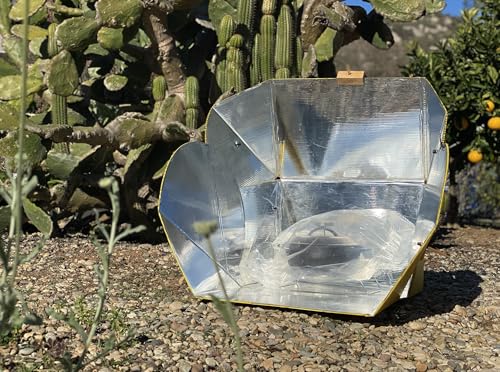
3. SolCook All Season Solar Cooker
The SolCook All Season Solar Cooker is a versatile solar cooker that also works as a food dehydrator and a camp stove, built for camping cookware, canning, and outdoor cooking. The all-season design suits use across the year, not just in high summer, and the dehydrator function adds a second use: drying fruit and food with the same sun that cooks dinner.
Versatility is the appeal here. One piece of equipment covers cooking, dehydrating, and camp-stove duties, which suits a camper who wants to carry less. The all-season claim matters too: a solar cooker that works in spring and autumn, not only in July, gets far more use across the year. For a household that camps in several seasons, that range is practical.
Strengths:
- Works as a solar cooker, food dehydrator, and camp stove
- All-season design suits use beyond high summer
- One piece of equipment covers several outdoor jobs
Trade-offs:
- Multi-use design may cook slower than a dedicated parabolic dish
- Dehydrating needs dry air as well as sun
- Needs practice to judge cooking times in different seasons
Who it fits: campers who want one solar tool for cooking and drying, and households that camp in spring and autumn as well as summer.
Best for: all-season camping with cooking and dehydrating. Not suited for: cooks who want the fastest possible solar heat.
Check price on Amazon: SolCook All Season Solar Cooker

4. CheriMuMu 1500W Parabolic Sun Oven, 1.5 m Diameter
The CheriMuMu Parabolic Sun Oven is a portable solar cooker with a 1.5-meter diameter dish, listed at 1500W, built for camping and outdoor solar cooking. The 1.5-meter dish is a serious size: it gathers a large area of sunlight and concentrates it on the cooking pot, which gives strong heat for boiling and frying. The portable design suits campsites and gardens where a large dish can sit in open sun.
Dish size is the key number for a parabolic cooker, and 1.5 meters is generous. A bigger dish gathers more sun and cooks faster, which matters when you are cooking for a group or boiling a large pot. The trade-off is space: a 1.5-meter dish needs an open spot with clear sun, and it needs re-aiming as the sun moves. For a garden or an open campsite, that is a fair trade for the speed.
Strengths:
- 1.5-meter dish gathers a large area of sunlight
- Strong concentrated heat suits boiling and frying
- Portable design works at campsites and in gardens
Trade-offs:
- Needs a wide open space with clear direct sun
- The focal point is very hot and needs care
- Needs regular re-aiming through the day
Who it fits: outdoor cooks with garden or campsite space, and anyone cooking for a group with solar heat.
Best for: large-batch solar cooking outdoors. Not suited for: small balconies, shaded yards, or cooks who want a compact oven.
Check price on Amazon: CheriMuMu 1500W Parabolic Sun Oven 1.5m

5. YIPONYT 1800W Portable Parabolic Solar Cooker, 59-Inch Foldable Sun Oven
The YIPONYT Portable Parabolic Solar Cooker is a 59-inch foldable sun oven listed at 1800W, built for outdoor camping, picnics, and garden cooking. The foldable design is the practical advantage: a 59-inch dish folds down for carrying and storage, so a large cooker does not need a large vehicle or a permanent spot in the garage. Once unfolded, it works like any large parabolic dish, concentrating sunlight onto the pot.
Folding matters because a parabolic dish is awkward to carry. A rigid 59-inch dish needs a roof rack or a large car, while a foldable one fits in a car trunk with the rest of the camping gear. That portability is what makes a large dish usable for real camping trips rather than only for backyard cooking. The 1800W listing reflects the strong concentrated heat the dish delivers in full sun.
Strengths:
- 59-inch dish folds down for carrying and storage
- Strong concentrated heat for boiling and frying
- Suits camping, picnics, and garden cooking
Trade-offs:
- Assembly and aiming take a few minutes at each use
- The focal point is very hot and needs care
- Needs open sun and space to unfold fully
Who it fits: campers who want a large parabolic dish they can actually transport, and families who cook outdoors on weekends.
Best for: portable large-dish solar cooking. Not suited for: cooks who want a rigid, always-ready oven with no setup.
Check price on Amazon: YIPONYT 1800W Portable Parabolic Solar Cooker 59 inch

6. HIOSUNSTOVE Solar Stove Portable Solar Oven, 4.5L
The HIOSUNSTOVE Solar Stove is a portable solar oven and solar cooker with a 4.5-liter capacity, built for outdoor cooking with sunlight. The 4.5-liter capacity suits a family meal, and the portable stove format is easy to carry to a campsite or set up in a sunny garden. The oven design traps solar heat around the pot, which suits slow cooking, stews, and keeping food warm.
A 4.5-liter solar oven is a practical family size. It holds enough for dinner without being too heavy to carry, and the oven format is more forgiving than a parabolic dish: it heats evenly, holds temperature well, and needs less frequent re-aiming. For a household that wants to try solar cooking without managing a large dish, this is the simpler starting point.
Strengths:
- 4.5-liter capacity cooks a family meal
- Oven format heats evenly and holds temperature
- Portable and easy to set up outdoors
Trade-offs:
- Slower than a large parabolic dish for boiling
- Needs direct sun for several hours for a full meal
- Large batches may need two rounds
Who it fits: families trying solar cooking for the first time, and campers who want a simple, portable oven.
Best for: slow solar cooking for a family. Not suited for: fast boiling or frying, or cooking on heavily cloudy days.
Check price on Amazon: HIOSUNSTOVE Solar Stove Portable Solar Oven 4.5L
Best solar cookers compared
| Cooker | Size | Design | Best for |
|---|---|---|---|
| MrMapMax Solar Oven | 4.5 L | Portable oven with thermometer | First-time solar cooking |
| 59-Inch Concentrating Cooker | 59 in dish | Parabolic, listed 1800W | Fast solar cooking with high heat |
| SolCook All Season | All season | Solar cooker and dehydrator | All-season camping |
| CheriMuMu Parabolic Sun Oven | 1.5 m dish | Parabolic, listed 1500W | Large-batch outdoor cooking |
| YIPONYT Parabolic Cooker | 59 in dish | Foldable parabolic, listed 1800W | Portable large-dish cooking |
| HIOSUNSTOVE Solar Oven | 4.5 L | Portable solar oven | Slow solar cooking for a family |
How to choose a solar cooker
Start with design: parabolic dish or box oven. A parabolic dish concentrates sunlight onto a small area and cooks fast, which suits boiling, frying, and searing. A box oven traps heat around the pot and cooks slowly and evenly, which suits baking, stews, and keeping food warm. If you want speed, choose a parabolic dish. If you want a forgiving oven that holds temperature, choose a box oven. Many solar cooks eventually own one of each.
Next, check size. A 4.5-liter oven cooks a family meal, while a 59-inch or 1.5-meter dish handles larger pots and more food. Measure the pot you plan to use and check that it fits the cooker, since a pot that is too wide for the dish or too tall for the oven will not cook well. For a closer look at outdoor cooking gear in general, see our guides to the best griddles for outdoor cooking and the best multi-fuel pizza ovens for outdoor cooking.
Portability decides whether the cooker leaves the house. A foldable dish fits in a car trunk with the rest of the camping gear, while a rigid dish needs a roof rack or a large vehicle. A compact oven carries easily by hand. If you camp, choose a cooker you can actually transport; if you cook in the garden, portability matters less and size matters more.
A thermometer is worth having, especially for a first solar cooker. Solar cooking depends on the sun, and the oven temperature changes with the time of day, the season, and the cloud cover. A thermometer tells you when the oven is ready and whether you need to re-aim the dish. Without one, you are guessing, and guessing wastes sunny hours.
Finally, be honest about your sun. A solar cooker needs direct sunlight for several hours, and it cooks slowly or not at all under heavy cloud. If your campsite is shaded or your region is often overcast, a solar cooker is a supplement to a camp stove rather than a replacement. In open sun, it is a real cooker that needs no fuel at all.
Cost is the last factor, and solar cookers are forgiving here. A compact portable oven costs little more than a good camp pot, and even a large parabolic dish costs less than a season of propane for a gas stove. There is no fuel bill afterward, which means the cooker pays for itself over time in saved fuel. Spend on size and build first, and treat extra features such as a thermometer as a bonus that makes the cooker easier to use rather than a reason to buy the most expensive model.
How solar cooking works
A parabolic solar cooker works like a magnifying glass: the curved dish reflects sunlight onto a small focal point where the pot sits. The larger the dish, the more sunlight it gathers and the hotter the focal point gets. That is why a 59-inch or 1.5-meter dish can boil water quickly in full sun, while a small dish heats more slowly. The pot should be dark-colored, since a dark pot absorbs sunlight and a shiny pot reflects it away.
A box solar oven works differently: it traps heat. Sunlight enters through a glass or clear panel, heats the dark interior and the pot, and the insulated walls keep the heat inside. The oven heats more slowly than a parabolic dish, but it holds temperature well and cooks evenly, which suits baking and slow cooking. The oven needs less aiming than a dish, since it gathers sunlight across a wider angle.
Both designs need the sun. Aim a parabolic dish at the sun so the focal point sits on the pot, and re-aim every 20 to 30 minutes as the sun moves. A box oven needs less attention, but it still benefits from turning toward the sun every hour or so. Cooking times run longer than on a stove, so plan the meal around the sun: start early, use the strongest midday sun for the main cook, and keep food warm in the oven afterward.
Using and caring for your solar cooker
Set up in full sun with a clear view of the sky. Even a partly shaded dish loses a large share of its heat, so pick an open spot away from trees and buildings. Put the cooker on level ground so the pot sits stable, and keep it where you can reach it easily to re-aim. A windbreak helps on breezy days, since wind cools the pot and the dish.
Use dark, thin-walled pots with lids. A dark pot absorbs sunlight, a thin wall passes heat quickly, and a lid keeps the heat in and the steam where it belongs. A shiny or thick pot slows the cook noticeably. If your pot is light-colored, a dark cloth or a blackened exterior helps, and a glass lid lets you check the food without lifting the lid and losing heat.
Re-aim as the sun moves. A parabolic dish needs adjusting every 20 to 30 minutes to keep the focal point on the pot, while a box oven needs turning about once an hour. Mark the shadow of the dish on the ground when it is aimed well, and you will see at a glance when it has drifted. Regular aiming is the difference between a meal that cooks and one that stalls.
Clean the reflective surface gently. A parabolic dish loses power when its reflective surface is dusty or scratched, so wipe it with a soft cloth and soapy water after use, and store it where nothing will scratch it. A foldable dish should be folded only when clean and dry, and a box oven should be wiped inside and out so food residue does not attract insects.
Common mistakes to avoid
The most common mistake is cooking in partial shade. A dish that looks sunny but sits under a tree branch loses a large share of its heat, and the meal takes far longer than planned. Check the spot at the time you plan to cook, not just in the morning, since shadows move with the sun.
The second mistake is using the wrong pot. A shiny stainless pot reflects sunlight away from the food, and a thick pot takes a long time to heat through. Use a dark, thin-walled pot with a tight lid, and the same cooker will perform far better. A glass lid helps you check progress without losing heat.
The third mistake is forgetting to re-aim. The sun moves about 15 degrees every hour, and a dish aimed at noon is badly aimed by two in the afternoon. Set a timer and re-aim regularly. A box oven is more forgiving, but it still cooks faster when it faces the sun.
The fourth mistake is planning a meal that needs the cooker to work like a stove. Solar cooking is slower, and it depends on the weather. Start early, choose foods that suit slow cooking, such as rice, stews, and root vegetables, and keep a backup plan for a cloudy day. A solar cooker is a real cooker, but it is not a fast one.
The fifth mistake is looking into the focal point or touching it. The concentrated sunlight at the focal point of a large parabolic dish is hot enough to burn skin and damage eyes. Never look directly at the focal point, keep hands away from it, and keep children and pets clear of the dish while it is aimed at the sun.
Solar cooker types in detail: parabolic, box, and panel
Parabolic cookers use a curved dish to focus sunlight onto a single point. The dish can be a rigid bowl or a set of reflective panels arranged in a curve, and the pot sits at the focal point on a stand. The advantage is speed and heat: a large dish can boil water and fry food, which makes it the closest solar equivalent to a stove burner. The disadvantage is attention: the dish needs aiming every 20 to 30 minutes, and the focal point is hot enough to burn, so it needs care around children and pets.
Box ovens use an insulated box with a clear top. Sunlight enters through the glass or plastic panel, heats the dark interior, and the insulation keeps the heat inside. The advantage is forgiveness: the oven heats evenly, holds temperature well, and needs aiming only about once an hour. The disadvantage is speed: a box oven heats more slowly than a parabolic dish, and it rarely reaches frying temperatures. It suits baking, stews, rice, and slow cooking, which is most of what a family eats.
Panel cookers use flat reflective panels arranged around a pot to bounce sunlight onto it. They are the lightest and cheapest type, and they fold flat for storage, which suits backpacking and emergency kits. The disadvantage is power: a panel cooker gathers less sunlight than a dish of the same size, so it cooks more slowly. It suits a solo camper or an emergency kit where weight and pack size matter more than speed.
Choosing between them is a matter of what you cook and where. A parabolic dish suits a cook who wants speed and high heat in an open garden or campsite. A box oven suits a family that wants a forgiving cooker for everyday meals. A panel cooker suits a backpacker or an emergency kit where the cooker must fold flat and weigh almost nothing. The picks in this guide cover the parabolic and box designs, which are the two most useful types for home and camping use.
Solar cooking for emergency preparedness
A solar cooker earns a place in an emergency kit because it needs no fuel, no power, and no supply chain. When the power is out and the gas is gone, a solar cooker still works as long as the sun shines. That independence is the reason many preparedness guides list a solar cooker alongside water storage and a first aid kit. It does not replace a camp stove, but it adds a cooking method that cannot run out of fuel.
Choose a cooker that is simple, rugged, and easy to store. A foldable parabolic dish or a compact box oven fits on a shelf in a garage, and it should be ready to use without assembly tools or spare parts. A thermometer helps, since emergency cooking is stressful enough without guessing whether the oven is hot. Keep a dark pot and a lid with the cooker, so the kit is complete and ready.
Practice before you need it. Solar cooking is a skill, and the first time you use a solar cooker should not be during an emergency. Cook a few meals with it on sunny weekends, learn how long rice takes, how often to re-aim, and what the oven can and cannot do. That practice turns a piece of emergency equipment into a tool you actually know how to use.
Store the cooker where it stays dry and clean. A dusty reflective surface loses power, and a scratched dish focuses sunlight poorly. Wipe the cooker after each use, fold it only when clean and dry, and check it once a season to make sure it is still in working order. An emergency tool that is checked regularly is ready when it is needed.
Cooking times and meal planning with the sun
Solar cooking runs on the sun schedule, not the clock, so plan meals around the strongest sun of the day. The best cooking window is usually late morning through mid-afternoon, when the sun is high and the heat is strongest. Start a slow meal such as rice or stew in the late morning, and it will be ready by early afternoon. Save quick cooking, such as boiling water or frying, for the midday peak when a parabolic dish is at its hottest.
Give every dish more time than a stove would need. Rice that takes twenty minutes on a stove may take an hour in a box oven, and a stew that simmers for two hours indoors may need three in solar heat. That is not a flaw: slow, steady heat suits rice, beans, and root vegetables, and the food rarely burns in a solar oven because the heat is gentle and even. Plan the meal backward from the time you want to eat, and start earlier than you think you need to.
Keep food warm in the oven after it finishes cooking. A box oven holds temperature well, so a finished dish can sit in the oven for an hour without overcooking, which gives you flexibility when the rest of the meal is still coming together. A parabolic dish is less forgiving for holding food, since the focal point keeps cooking the pot, so move finished food to a covered pot in the shade or into the box oven to hold.
Final recommendation
For most first-time solar cooks, the MrMapMax Solar Oven is the best starting point: a 4.5-liter portable oven with a thermometer that tells you when it is ready, in a size that cooks a family meal. If you want speed, step up to a large parabolic dish: the YIPONYT 59-inch foldable model gives strong heat and packs down for transport, while the CheriMuMu 1.5-meter dish suits a garden or an open campsite where space is no problem.
Campers who want one tool for several jobs should look at the SolCook All Season, which cooks and dehydrates, and families who prefer slow, even cooking should choose the HIOSUNSTOVE 4.5-liter oven. Whichever you choose, use a dark pot, re-aim as the sun moves, and start early. For more on solar cooking designs, see our guide to the best designs for solar cookers.
Start with the cooker that matches where you cook: a compact oven for the family, a foldable dish for the campsite, or a large dish for the garden. Solar cooking rewards patience, and the first meal cooked with nothing but sunlight is a good reason to keep going.
Frequently asked questions
How long does solar cooking take?
Longer than a stove, and the time depends on the sun, the cooker, and the food. A parabolic dish in full midday sun can boil water in well under an hour, while a box oven may need two to three hours for a full meal. Rice, stews, and root vegetables suit solar cooking well because they tolerate slow, steady heat. Start early and use the strongest sun of the day for the main cook.
Can a solar cooker work on a cloudy day?
Only slowly, or not at all. A solar cooker needs direct sunlight, and heavy cloud cuts the available heat sharply. Light cloud slows the cook but may still work for a box oven, while a parabolic dish needs clear sun. Treat a solar cooker as a fair-weather tool and keep a camp stove as a backup for cloudy days.
What foods cook best in a solar cooker?
Rice, beans, stews, soups, root vegetables, and baked dishes suit solar cooking because they tolerate slow, even heat and do not need precise timing. Frying and searing need a parabolic dish with strong concentrated heat. Delicate foods that need exact temperatures are harder, so save those for the stove.
Is a parabolic dish or a box oven better?
A parabolic dish cooks faster and reaches higher heat, which suits boiling and frying. A box oven heats more slowly and evenly, which suits baking, stews, and keeping food warm, and it needs less aiming. If you want speed, choose a dish. If you want a forgiving oven, choose a box. Many solar cooks eventually own one of each.
Do I need a special pot for solar cooking?
Use a dark, thin-walled pot with a tight lid. Dark pots absorb sunlight, thin walls pass heat quickly, and a lid keeps heat and steam inside. A shiny pot reflects sunlight away and slows the cook noticeably. A glass lid helps you check the food without lifting the lid and losing heat.
Is solar cooking safe?
Yes, with care. Never look directly at the focal point of a parabolic dish, and keep hands, children, and pets away from it, since the concentrated sunlight is hot enough to burn. Handle the pot with mitts, since it gets as hot as any oven pot. Store the dish where it cannot accidentally focus sunlight when not in use.
Can I bake bread in a solar cooker?
Yes, in a box oven, which holds even heat well enough for bread, cakes, and baked dishes. A parabolic dish is less suited to baking, since its heat is concentrated on one point rather than spread around the pot. Use a dark baking pan with a lid, start early in the day, and allow extra time compared with a kitchen oven.
What should I pack with a solar cooker for camping?
Pack a dark, thin-walled pot with a tight lid, a thermometer if your cooker does not have one, oven mitts, and a windbreak. A folding table or a level spot of ground helps the cooker sit stable, and a spare lid is useful if one gets damaged. Keep the cooker clean and dry between trips, and check the reflective surface before you leave.


