A slow cooker with scheduling features lets you load the pot in the morning and have dinner ready when you walk in, without leaving food on a warm setting for hours. Programmable timers, an automatic switch to warm, and in some cases phone-controlled power make that possible.
This list includes programmable cookers, multi-cookers that offer a slow cook mode, a probe model, and a smart plug for anyone who owns a basic slow cooker and wants timer control. We have not used these products ourselves, so confirm capacity, controls and compatibility on the current listing before buying.
As an Amazon Associate we earn from qualifying purchases. Links below are affiliate links, and they do not change the product information we give.
What to Look For
| Feature | Why it matters |
|---|---|
| Timer | A countdown that switches to warm keeps meals from overcooking while you are out |
| Controls | Dials are simple; digital panels allow precise time and temperature steps |
| Probe | A built-in probe cooks to a set temperature instead of a set time |
| Remote option | A smart plug adds app scheduling to a cooker with a simple on switch |
In this guide
Specs at a Glance
| Product | Type | Scheduling | Notes |
|---|---|---|---|
| Hamilton Beach Set ‘n Forget | Programmable slow cooker | Probe and timer | Switches to warm automatically |
| Crock-Pot Cook & Carry | Programmable slow cooker | Digital timer | Locking lid for travel |
| Breville Fast Slow Pro | Multi-cooker | Programmable settings | Pressure and slow cook modes |
| Cuisinart Cook Central | Multi-cooker | Programmable timer | Brown, steam and slow cook |
| Ninja PossibleCooker PRO | Multi-cooker | Digital controls | Several cooking modes in one pot |
| Kasa Smart Plug Mini | Wi-Fi smart plug | App schedules | Pair with a basic cooker |
The 6 Best Smart Slow Cookers with Scheduling
Top pickBest for cooks who like roasts done to a target
1. Hamilton Beach Set ‘n Forget Programmable Slow Cooker
A long-running programmable slow cooker built around a temperature probe. You pick a time or a probe temperature, and the cooker moves to warm when it finishes.
Suits: cooks who like roasts done to a target. Strengths: a probe and an automatic warm setting. Weaknesses: the probe needs careful placement. Skip it if you want app control.
View Hamilton Beach Set ‘n Forget Slow Cooker on Amazon

Best for potlucks and family dinners
2. Crock-Pot Cook & Carry Programmable Slow Cooker
A programmable oval slow cooker with a digital countdown and a locking lid with handles for potluck travel. It holds food on warm after the timer ends.
Suits: potlucks and family dinners. Strengths: a lid that locks and a simple timer. Weaknesses: no Wi-Fi features. Skip it if you want phone alerts.


Best for people who want pressure and slow cooking in one
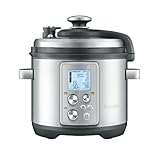
3. Breville Fast Slow Pro Multi-Cooker
A multi-cooker that combines pressure cooking with slow cooking, with programmable steps and a digital display. It is a bigger counter commitment than a basic slow cooker.
Suits: people who want pressure and slow cooking in one. Strengths: detailed controls and two methods. Weaknesses: a large footprint. Skip it if you only need a basic pot.

Best for one-pot meals
4. Cuisinart 3-in-1 Cook Central Multicooker
A multi-cooker that can brown, steam and slow cook with a programmable timer. Browning in the same pot saves a pan before the long cook begins.
Suits: one-pot meals. Strengths: browning and slow cooking in one. Weaknesses: a modest feature set compared with newer multi-cookers. Skip it if you want pressure cooking.


Best for big-batch cooking
5. Ninja PossibleCooker PRO Multi-Cooker
A multi-cooker with several cooking functions including slow cook, sear and steam, using a large pot that moves from searing to long cooking without changing pans.
Suits: big-batch cooking. Strengths: many functions in one pot. Weaknesses: size and weight on the counter. Skip it if you have little storage.


Best for owners of a simple cooker
6. Kasa Smart Plug Mini
A small Wi-Fi smart plug that lets you schedule power through an app. Use it only with cookers that start when plugged in and have a mechanical switch left on, and follow the cooker’s safety guidance.
Suits: owners of a simple cooker. Strengths: app schedules and remote on or off. Weaknesses: not suitable for every appliance. Skip it if your cooker needs a button press to start.

Care and Setup
- Let the insert cool before washing, to protect the finish.
- Check the manual before using any plug-in timer with a cooker.
- Fill the pot within the range the maker recommends.
- Wipe the heating base with a damp cloth and never submerge it.
Mistakes to Avoid
- Using a smart plug with a cooker that does not restart after power loss.
- Leaving cold, raw meat on a delayed start for too long.
- Overfilling the pot.
- Skipping the lid seal check on a travel model.
Delay Start Versus Countdown Timer: Know Which You Are Buying
Scheduling language on product pages can blur two different features, and the difference decides whether a cooker fits your day. A countdown timer starts cooking the moment you press start and runs for the time you set, then usually switches to warm. A delayed start waits for a set period before heating begins. Many slow cookers have the first but not the second.
For a typical workday, the countdown timer is what most people need. You load the pot, choose low and eight or so hours, and the cooker finishes and holds the food warm. A true delayed start is less common on slow cookers, and it carries a food safety trade-off because raw ingredients sit unheated at room temperature while they wait. Multi-cookers more often offer a delay function, and their manuals usually set a maximum delay and warn about perishable ingredients.
When you read a listing, look for the exact wording. Does it say countdown, program, delay, or schedule? Does it say the cooker switches to warm automatically? Does it list maximum cook time and how long warm lasts? If the listing is vague, check the manual or the maker’s support pages.
- Choose a countdown timer with auto-warm for most workday cooking.
- Choose a delay start only if you understand the safety limits for raw food.
- Choose a probe model if you cook roasts to a target temperature.
Safe Scheduling When Raw Meat and Dairy Are Involved
The convenience of putting dinner in early comes with a rule: perishable food should not sit at room temperature for long before heating. Official food safety guidance generally treats the range between cold fridge temperatures and hot cooking temperatures as the danger zone, where bacteria multiply quickly. A cooker that waits several hours before it starts heating puts raw poultry, meat, fish or dairy in that zone.
Practical ways to keep to the rule include:
- Prepare ingredients the night before and store the cut-up food and the sauce in the fridge, then combine and start the cooker just before you leave.
- Use a pot that does not hold cold insert after the heating starts, following the manual on whether you can add refrigerated food to a preheating base.
- Keep delays short and follow the maker’s stated limit for any delay function.
- Use shelf-stable or dry ingredients, such as beans that have been prepared correctly, when you do want a long delay.
Also think about the end of the cycle. When the timer ends and the cooker moves to warm, the food should stay hot enough to be safe. The warm setting is meant for limited holding, not for hours of storage. If you may be late home, plan for it by choosing a recipe that tolerates longer holding, such as a stew, rather than a delicate dish. Check official guidance for time limits, and discard food that has been held too long.
Using a Smart Plug With a Slow Cooker: Compatibility and Safety
A smart plug can add app scheduling to a basic cooker, but it only works with certain designs. The cooker must begin heating as soon as it receives power, with a simple mechanical switch left in the on position. Cookers with digital panels, touch controls or a button that needs pressing to start will usually come back from a power interruption in a standby or off state, so the plug cannot start them.
Before you buy, check these points:
- Does the cooker manual allow use with timers or external plugs? Many advise against it.
- Is the plug rated for the power draw of the cooker? Check the plug’s listing against the wattage printed on the appliance.
- Does your home Wi-Fi reach the spot where the cooker sits?
- Does the app let you set a schedule that runs even if the phone is off or away?
Pair this with sensible safety habits. Never leave a cooker connected to something that could turn it on when the pot is empty. Keep the cord and plug away from wet areas and the hot base. If the plug feels warm or discolored, stop using it.
Remember that a plug only controls power, not temperature, and it does not know when food is done. For anything perishable, the food safety points above still apply.
Probe Cooking and Cooking to a Temperature Instead of a Time
Cooking by time is the traditional slow cooker method, but time is only a proxy for doneness. A built-in probe lets you cook to a set internal temperature, which suits roasts, whole chickens and large cuts where overcooking dries the meat. The cooker holds the target, then moves to warm.
A probe cooker still needs good technique. Insert the probe into the thickest part of the meat and keep it away from bone, fat pockets and the pot wall, since these give misleading readings. Make sure the probe tip is submerged in food, not sitting in liquid alone. Keep the cord routed so the lid still closes properly without crushing the wire.
Ask a few questions when you compare models:
- Is the probe fixed or removable, and can you replace it?
- What temperature range does the cooker accept? Check the manual for what the targets cover.
- What happens if the probe is not inserted? Does the cooker fall back to a timer?
- Is the probe safe to wash, and how do you clean it?
Leave tough braised cuts to long timed cooking rather than a probe target, since they need time to break down connective tissue. A probe is best for tender roasts and poultry. For stews, soups and chili, a timer is simpler and works perfectly well.
Power Cuts, Wi-Fi Drops and App Reliability
Smart features are only as good as the connection and the behavior when something goes wrong. Before you rely on a connected cooker, find out what it does after a brief power cut. Some resume the program. Others stop and wait for you to restart. A few go to warm, which can be a problem if food was only partway through cooking. The manual should describe this, and it is worth reading before you leave food unattended.
Wi-Fi and app issues are the next concern. Apps can lose connection, change after updates, or stop being supported. Look at whether the cooker works fully without the app, so a dropped connection never ruins a meal. Check that the key function, such as the timer and warm setting, is stored on the cooker itself rather than relying on the cloud.
Questions to ask before buying:
- Can I operate every cooking mode from the panel without the app?
- Does the app need an account, and what data does it collect?
- Does the cooker support the Wi-Fi band my router uses?
- Will I get alerts if the cooker stops or the connection drops?
For many households, a well-built programmable cooker with a simple timer and auto-warm gives most of the benefit with fewer points of failure. Add connected features only if you will use them regularly.
A Checklist for Choosing a Programmable Slow Cooker
Scheduling features add convenience and a few extra questions. Consider these before you buy.
- How many people do you cook for, and what size pot do you need?
- Do you want a simple timer, a delay timer or app control?
- Does the cooker switch to a keep-warm mode when the time ends?
- Is the control panel easy to read and use?
- Can the insert go in the dishwasher, and is it safe for the oven if you need that?
- Does the lid seal well, and does it have a handle you can hold with a mitt?
Think about how you cook during a busy week. If you leave in the morning and return in the evening, a delay timer and a keep-warm mode need to match your hours.
For app-connected models, check that the app works with your phone and your wireless network.
Comparing Control Types
Different interfaces suit different cooks.
| Control | Strength | Consider |
|---|---|---|
| Manual dial | Simple and reliable | No scheduling |
| Digital timer | Counts down and switches to warm | Slightly more settings |
| Delay timer | Begins cooking later | Follow official food-safety guidance for long waits |
| App control | Remote monitoring and adjustment | Needs a network and phone |
Long delays need care with perishable ingredients, since food sitting at room temperature is a concern. Follow official guidance and the maker’s instructions.
Planning Meals Around a Schedule
Choose recipes that suit long, gentle cooking. Cut ingredients to even sizes, place firm vegetables near the bottom and avoid lifting the lid often. Use the cooker within its fill lines, and follow the manual on liquid amounts.
Plan your timing so that food does not sit warm for hours beyond the cooking time. Cool leftovers promptly, store them in the refrigerator and reheat them thoroughly, in line with official food-safety guidance.
Reading a Slow Cooker Listing
Look at the capacity, the wattage and the cooking modes. Check the materials of the insert and the lid, and look at the cord length and dimensions. Read about the programmable options, the keep-warm limits and any probe or sensor.
See what the listing says about app features, firmware updates and support. A clear warranty is helpful for appliances that run for many hours.
Mistakes to Avoid With Smart Slow Cookers
- Relying on the app without checking the cooker. Confirm the lid is seated.
- Overfilling the insert. Follow the fill line.
- Adding frozen food without guidance. Follow the maker’s advice and official guidance.
- Setting a long delay for perishable foods. Check the safety advice.
A Short Glossary of Slow Cooker Terms
Programmable cookers add new vocabulary to an old appliance.
- Low and high: two heat settings that differ in how quickly the contents reach a simmer.
- Keep-warm: a lower setting that holds food at serving temperature after cooking ends.
- Probe cooking: a mode that uses a temperature probe to decide when to switch off or hold.
- Insert: the removable pot, often ceramic or metal, that holds the food.
- Firmware: the built-in software that controls a connected cooker and may be updated by the maker.
- Delay timer: a setting that waits before beginning to cook.
When you see these terms in a listing, check the manual for how each behaves on that specific model. Makers use their own names, and the settings can differ.
It is worth planning for power interruptions. If the power goes out while the cooker is running, follow the manual and official food-safety guidance about whether the food remains suitable to eat.
Consider the network side of connected cookers too. Keep the app updated, choose a strong password for your account, and follow the maker’s guidance on privacy and updates. If you do not want a connected appliance, many models work fine with local controls alone.
Finally, clean the insert and the lid after every use. Let the ceramic cool before washing to avoid thermal shock, and follow the manual for dishwasher guidance.
Matching Smart Slow Cookers With Scheduling Features to How You Actually Cook
The right choice among smart slow cookers with scheduling features depends less on any single headline feature and more on how set-ahead meals that are ready when the day ends fits into an ordinary week at your house. Start by picturing the last few times you wished you owned one. Were you cooking for two on a weeknight, feeding a crowd, or trying to keep food ticking along while you did something else entirely? Each of those situations rewards a different design, and a model that feels perfect for one household can feel like hard work in another. Writing down your two or three most common situations before you compare models keeps the decision grounded in real use instead of showroom appeal.
Space is the second honest test. Measure where the new purchase will live in the counter, including the room needed to open doors or lids fully, reach controls without stretching over hot surfaces, and set down trays or boards nearby. Then think about where it goes between uses if it will not live out permanently: a cupboard shelf, a garage rack or a spot by the back door. Gear that is awkward to store quietly stops being used, however good it is on paper. A slightly simpler model that lives within easy reach usually serves a household better than a larger, more capable one that has to be fetched, assembled and put away every single time.
Finally, be honest about how much attention you enjoy giving a meal. Some people love tending, checking and adjusting; others want to set things up and walk away. Neither preference is wrong, but it should steer you between the more hands-on and more automated designs in the list above. If you share cooking with a partner or family members, their patience matters too: controls everyone understands get used correctly, while a system only one person can operate becomes a bottleneck on busy days. The best purchase is the one the whole household will still be using happily a year from now.
The Buying Criteria, One Level Deeper
Capacity deserves a second look because it is easy to misjudge in both directions. Think in terms of the largest load you cook a few times a year, not the largest load you can imagine. Oversizing wastes money, space and often fuel or energy on every ordinary use, while undersizing only hurts on the big occasions — and those can usually be handled by cooking in batches or borrowing capacity from your oven or a second device. Look at usable space rather than headline space: shelves, racks, probes or cooking surfaces that cannot be used at the same time as the others do not add real capacity, whatever the summary numbers suggest.
Controls and feedback shape every use after the first. You want to be able to tell, at a glance and from a normal working distance, what the device is doing and how long it has left to run. Buttons or dials you can operate with messy or gloved hands, displays that stay readable in bright light, and alerts you can actually hear from the next room all matter more in practice than a long list of extra programmes. If a design depends on an app, check what still works when the phone is elsewhere or the connection drops; the core job should never depend entirely on a network behaving itself.
Build quality shows itself in the parts you touch and clean rather than in the parts you admire. Hinges, latches, handles, knobs and seals take the daily strain, so look for smooth movement, even gaps and materials that will not suffer from heat, moisture or repeated washing. On anything that cooks, even heat matters more than peak heat: food at the edges should behave much like food in the centre, and the design should make it easy to move things around when it does not. Where replacement parts such as the crock or filters exist, a maker that sells them openly is a quiet sign the product is meant to be kept, not replaced.
Running costs and consumables are the part of the budget people forget. Before you buy, think through liners if you use them, plus the usual storage containers for leftovers, and how often your style of cooking will get through them. A model that is cheap to buy but hungry in daily use can cost more over a few years than a thriftier design that cost more up front. The same goes for your time: a design that needs constant supervision, complicated assembly or lengthy cleaning is charging you minutes on every use. Add those minutes across a year of regular cooking and they often outweigh a modest difference in purchase price between two otherwise similar models.
Setup, First Use and Getting Comfortable
Set aside unhurried time for the first setup rather than trying to fold it into a meal you have promised other people. Unpack on a clear surface, check every part against the manual’s list while it is all in front of you, and keep the packaging until the first successful use is behind you. Wash or wipe down the parts the manual tells you to prepare, in the way it describes, and run any empty first cycle or burn-in it recommends. That first session is also the moment to learn where the hot, sharp or heavy parts are, so later use feels routine rather than surprising.
Your first real meal should be something forgiving that you already know how to cook another way. Familiar food gives you a baseline: you can judge what the new gear changed, instead of guessing whether a disappointing result came from the recipe or the equipment. Take a few notes as you go — settings used, how long things took, what you would move or change next time. Those notes feel unnecessary on the day and invaluable a month later, when you are trying to repeat a success or avoid repeating a mistake. Two or three calm practice runs will teach you more than any amount of reading.
Build a small routine around each use: what gets checked before you start, where tools and ingredients wait while things cook, and what happens in the first few minutes after serving. For smart slow cookers with scheduling features, that routine might mean confirming fuel or power, checking that the crock, the lid and the outside of the base are clean and in place, and knowing exactly where hot items will land when they come off the heat. Routines sound dull, but they are what separate relaxed cooks from frazzled ones, and they are the main reason experienced users seem to get better results from the same equipment as everyone else.
Cleaning, Care and Storage That Prevent Most Problems
Most problems with smart slow cookers with scheduling features start as cleaning that was postponed once too often. Grease, ash, moisture and food residue build up quietly and then show themselves as off flavours, uneven performance, sticking, smells or parts that no longer move freely. A short clean while things are still warm — once it is safe to touch — almost always beats a long scrub days later. Follow the manual on which parts can be washed, soaked or put through a dishwasher, and be especially careful with anything electrical, coated or sealed: water and harsh scouring undo in one afternoon what careful use preserves for years.
Make a simple rhythm: a quick wipe and empty after every use, a proper clean of the crock, the lid and the outside of the base after a few uses, and a deeper check every season. On that deeper check, look for rust starting at edges and fasteners, seals that have flattened or cracked, cables or cords with damaged insulation, and vents or openings that have narrowed with residue. Catching these early is cheap; catching them late usually means a repair or a replacement. Dry everything thoroughly before storage, because trapped moisture does more quiet damage in a cupboard or garage than almost anything that happens during cooking itself.
Store the gear the way you would want to find it on a busy day: clean, dry, complete and with its small parts kept together. A labelled box or bag for accessories, cords and attachments saves the rummaging that leads people to improvise with the wrong tool. If the counter is outdoors or in a garage, a cover or a sheltered spot protects against weather and dust between uses. Keep the manual, or at least a photo of its key pages, somewhere you can find it; the one specification or cleaning instruction you need is always the one that has gone missing.
Troubleshooting: What to Check Before You Blame the Product
When results disappoint, change one thing at a time and start with the basics. Confirm the setup matches the manual: parts seated correctly, vents or openings in the position the design expects, and the right mode or setting for the food in front of you. Check the simple supplies next — fuel or power, the freshness and preparation of the food itself, and whether the load is larger, thicker or colder than the last time things worked well. A surprising share of bad results trace back to an overloaded cooking space, food that went on straight from the coldest part of the fridge, or a lid and door opened so often that the cooking environment never settled.
Temperature and timing questions deserve a calm, methodical answer rather than guesswork. Give the equipment time to settle after any adjustment before judging the result, and judge doneness by the food — its feel, its juices, its tenderness and, where food safety matters, a thermometer reading taken in the thickest part — rather than by the clock alone. If you use a separate thermometer or probe, test it occasionally in iced water and in boiling water so you know whether the readings themselves can be trusted. Keep a short log of what you changed and what happened; patterns appear in a log that memory smooths away.
Know the point at which troubleshooting stops and support begins. Burning smells from electrical parts, damaged cords, cracked components that carry weight or hold heat, gas smells that do not clear, or controls that behave erratically are all reasons to stop, switch off and contact the maker rather than improvise. The same applies to anything still under warranty: opening sealed parts or modifying a design can void cover you have already paid for. For everything less serious, the maker’s support pages and manual troubleshooting tables are genuinely useful, because the most common faults on any popular model are well known and usually simple.
How to Choose Between the Picks Above
The shortlist in this guide — Hamilton Beach Set ‘n Forget Programmable Slow Cooker, Crock-Pot Cook & Carry Programmable Slow Cooker, Breville Fast Slow Pro Multi-Cooker, Cuisinart 3-in-1 Cook Central Multicooker, Ninja PossibleCooker PRO Multi-Cooker and Kasa Smart Plug Mini — covers the main shapes this category takes, and the honest differences between them are about fit rather than quality alone. A practical way to decide is to score each model against your own three situations from earlier: your most common cook, your biggest regular cook, and the way you prefer to work. Cross off any model that fails one of those outright, however impressive its other features look. What remains is usually two or three genuine contenders, and between those, the deciding factors are the everyday ones: controls you like, cleaning you will actually do, and storage that fits your space.
If you are buying as a gift, weight simplicity and forgiveness more heavily than maximum capability. A design that does the core job beautifully and explains itself clearly will be used every week; a feature-packed one that needs study may end up admired and untouched. And if you are replacing something you already own, name the one thing that frustrated you most about the old one before you shop. Making sure the new purchase fixes that specific frustration — rather than simply being newer — is the surest route to feeling, a year later, that the money was well spent on smart slow cookers with scheduling features.
A Final Practical Checklist Before You Buy
Work through the unglamorous checks before the exciting ones. Confirm the measurements where the purchase will live in the counter, including door, lid and drawer swing, the reach of any cord, and the clearance the maker asks for around vents and hot surfaces. Confirm what arrives in the box and what is sold separately, because a missing rack, probe, tray or fitting discovered on cooking day turns a good purchase into a frustrating one. Read the returns terms while you still have a choice of sellers; a product you can return after a genuine trial is a lower-risk purchase than the same product bought with no way back.
Think, too, about the second month rather than the second day. In the second month the novelty has gone, and what remains is the weekly reality: how long setup takes when you are tired, whether cleaning the crock, the lid and the outside of the base still feels reasonable, and whether the results have become reliably repeatable. Products that survive the second month become fixtures. If a design only impresses when you imagine its best possible day, and looks like a burden on an ordinary tired evening, believe the ordinary evening. It is the one that will happen most often, and it is the standard your purchase has to meet to earn its space.
Lastly, plan the first few uses as a small project rather than a single event. Choose two or three dishes or tasks that suit set-ahead meals that are ready when the day ends, buy ingredients or supplies for those first, and give yourself permission for the first attempt to be a lesson rather than a performance. Households that approach new equipment this way almost always end up using it more, because early confidence compounds. The cooks who abandon good equipment usually do so after one over-ambitious first attempt that no beginner with unfamiliar gear should have been expected to pull off.
Scheduled Slow Cooker FAQ
What is a scheduled start on a slow cooker?
It is a delay or program that begins cooking later, though food safety limits how long raw ingredients should sit first. Follow the maker’s advice.
Do slow cookers with probes cook faster?
Not necessarily. A probe stops cooking at the target temperature, which prevents overcooking.
Is a smart plug a safe shortcut?
Only if the appliance manual allows it. Many cookers are not designed for it.
Can multi-cookers replace a slow cooker?
For most recipes, yes, though check the slow cook setting on the listing.
Do all slow cookers with timers switch to warm automatically?
Not all of them. Check the listing and manual for an automatic warm setting, because a basic timer may simply stop heating when it ends.
How long can food stay on the warm setting?
The limit depends on the model and on food safety guidance, so check the manual. Warm is for short holding, not for leaving a meal for many hours.
Can I start a slow cooker from my phone?
Only on models built for it, or with a compatible smart plug on a simple cooker. Check the manual to confirm that remote starting is allowed and safe for your appliance.
What happens if the power goes out while it is cooking?
It varies. Some models resume, some stop and wait, and some go to warm. If you were away, check the food and discard it if you are unsure how long it sat.
Is a multi-cooker a good choice for scheduling?
It can be, since many have delay start and detailed programs. They also have more menus to learn, and the slow cook mode may differ from a dedicated slow cooker.
Should I choose a probe or a timer?
A probe suits roasts and poultry you want cooked to a target. A timer is simpler for stews, soups and braises that cook by time.
Can I use a smart plug with any slow cooker?
No. It works only with cookers that start heating as soon as they get power. Check the manual and the plug's rating before using one.
How full should the crock be for scheduled cooking?
Most slow cookers behave best between about half and two-thirds full. Too little food cooks faster than the timings suggest and can dry at the edges; an overfilled crock heats slowly and unevenly, which matters for food safety as well as texture. If you regularly cook small amounts, a smaller cooker will serve you better than a large one used nearly empty.
Is it safe to leave a slow cooker running while I am out?
Slow cookers are designed for unattended cooking, and scheduling features exist for exactly that. Use them sensibly: place the cooker on a clear, heat-safe surface away from anything flammable, keep the cord untangled and out of walkways, and follow the manual on maximum unattended times, especially for recipes that start from raw meat.
Why did my meal overcook even though I used the timer?
Timers control when cooking stops or switches to warm; they do not adjust for a smaller load, a hotter kitchen or ingredients that started warm. Until you know your model, test a new recipe on a day when you are home for the last hour, note how it behaves, and adjust the liquid and timing the next time. Warm settings hold food; they still change its texture over hours.
What is the best way to handle leftovers from the crock?
Move leftovers into shallow containers and refrigerate them promptly rather than leaving food sitting in a switched-off crock. Shallow containers cool evenly and reheat better. If the crock itself is going into the fridge, check the manual first: some crocks handle that happily, while sudden temperature changes can damage others.
Can I put frozen ingredients straight in?
Be cautious. A slow cooker raises temperature gradually, and a solid frozen mass can spend too long in the range where bacteria grow. Thaw meat in the fridge overnight, or choose recipes written specifically for frozen ingredients in your model’s manual. Hot liquid added at the start helps smaller frozen items, such as vegetables, come up to temperature sensibly.
How do I stop sauces turning out watery?
Slow cookers trap moisture, so most recipes need less liquid than their stovetop versions. Resist lifting the lid to check, since each lift lets out accumulated heat and steam. If a sauce is thin at the end, simmer it briefly with the lid off or stir through a small amount of cornflour mixed with cold water and give it a few minutes to thicken.
Safety deserves a place in any buying decision, not as an afterthought but as a feature to check like any other. Look for stable footing, handles that stay cool enough to use as intended, cords and cables that route away from heat and traffic, and controls that cannot be knocked into a new setting by a passing sleeve. Then keep the same mindset in daily use: turn pot handles, keep loose clothing and towels away from heat, supervise children around hot equipment, and never leave a live cooking fire or a heating appliance entirely unwatched beyond what its maker intends. Most accidents in home cooking are small, predictable and preventable, which is exactly why a calm routine matters more than confidence does.
Consider the environment the equipment will work in over its whole life, not just on delivery day. Kitchens get steamy, patios get rained on, garages get dusty, and counters get crowded as other appliances arrive. A design with sealed, wipeable surfaces, protected controls and honest guidance about where it is meant to be used will age far better than one that assumes perfect conditions. If you live somewhere humid, coastal or very cold, say so when you read makers’ guidance, because those climates are harder on seals, electronics, finishes and stored fuel than the mild conditions most product photography quietly assumes.
Teach one other person in the household how the equipment works, even if cooking is mostly your job. A second person who can check a temperature, safely move food, or shut things down properly is a genuine safety feature, and it turns cooking for a group from a solo performance into something shared. Write the household’s few house rules — where hot items land, what never goes near the heat, how the gear is left after use — somewhere visible until they are second nature to everyone.
Keep a small notebook or phone note dedicated to this one area of cooking. Record the model settings or setup you used, the size and starting state of the food, the weather or room conditions if they mattered, and one honest sentence about the result. Reviewing a season of those notes shows patterns no single cook can teach: which settings you always override, which foods your household asks for again, and which problems keep coming back to the same simple cause. That record quietly turns guesswork into knowledge, and it makes every later purchase better informed too.
When friends ask what to buy, the most useful answer is rarely a model name. It is the reasoning in this guide: match capacity to real loads, favour controls everyone can understand, respect the cleaning a design demands, and count the running costs honestly. A buyer who understands those four things can judge a new model on the spot, including models that did not exist when this guide was written. Features change every season; the questions that reveal whether a product fits a household barely change at all.
Budget a little of the purchase price for the unglamorous extras that make the main purchase work well: the right tools for handling hot food, storage that keeps parts together, cleaning supplies the maker recommends, and a backup for anything the cook depends on, such as a second thermometer or spare fuel. People who skip these end up improvising at the worst moments. People who plan for them find the whole hobby calmer, and their main equipment lasts longer because it is being used the way it was designed to be used.
The Short Version
For a probe, the Hamilton Beach Set ‘n Forget. For travel, the Crock-Pot Cook & Carry. For pressure and slow cooking, the Breville Fast Slow Pro. For browning, the Cuisinart Cook Central. For a big pot, the Ninja PossibleCooker PRO. For app timers on a simple cooker, the Kasa Smart Plug Mini.
Related Guides
- 6 Best Rice Cookers: 3 to 10 Cups Compared by Controls (2026)
- 6 Best Slow Cookers: 6 to 7 Quart Manual and Programmable (2026)
- 6 Best Ceramic Slow Cookers: Manual and Programmable (2026)
- 6 Best Cookers: Multi, Rice, Pressure and Slow (2026)
- 6 Best Countertop Cookers: Pressure, Rice and Slow (2026)


