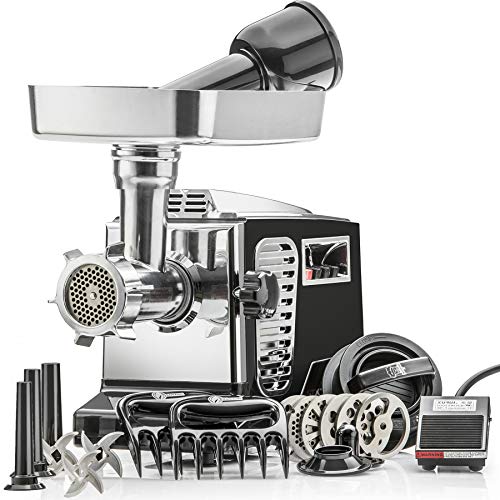
A manual meat grinder is one of the oldest powered-by-you machines in the kitchen: a hand crank turns an auger inside a horizontal barrel, the auger pushes meat forward, a rotating knife shears it against a perforated plate, and ground meat falls out of the holes in strands. There is no motor to burn out, no cord to manage, and nothing between your hand and the work except a gearless, direct mechanical link. That simplicity is exactly why the category survives. A hand grinder asks for cold meat, reasonable batch sizes and a steady arm, and in return it gives the cook complete control over texture, from a coarse chili grind to a fine sausage emulsion base, using nothing but interchangeable steel plates.
This guide ranks manual grinders on the things that genuinely separate them: the size of the grinding throat, measured in the trade’s numbered system; how the machine fixes itself to the counter, by clamp or by suction; what the body is made of, and how that material behaves around water and raw meat; which plates and knives arrive in the box; and how much effort the crank demands when the meat is cold, fatty and full of sinew. Every pick here is a true hand-crank machine. Electric grinders are a different category with a different budget, and they appear only in one short section explaining when the motorised tool is honestly the better buy. If your goal is small-batch burgers with a grind you control, sausage made from your own seasoning, or game meat processed at home without a trip to a butcher, a manual grinder is usually enough, provided you match the size and mounting to the way you actually cook.
Some links in this guide are affiliate links, which means this site may earn an affiliate commission when readers buy through them, at no extra cost to the reader. That commission is how the research behind guides like this one gets paid for. The rankings below are built from manufacturer specifications, product documentation and the mechanical principles of grinding, and the order reflects the balance of throat size, mounting, build and plate support that matters most in regular use.
In this guide
Quick picks: best manuel meat grinders
| # | Product | Where to buy |
|---|---|---|
| 1 | LEM #8 Stainless Steel Hand Grinder | Check on Amazon |
| 2 | Weston #10 Manual Meat Grinder | Check on Amazon |
| 3 | Huanyu Manual Meat Grinder | Check on Amazon |
| 4 | Porkert #10 Meat Grinder | Check on Amazon |
| 5 | LEM #12 Stainless Steel Hand Grinder | Check on Amazon |
| 6 | Weston #32 Manual Meat Grinder | Check on Amazon |
What to look for in a manual meat grinder
Throat size: the numbered system that decides your batch size
Manual grinders are sized by a number that refers to the diameter of the plate and the bore of the barrel: #8, #10, #12, #22 and #32 are the common steps. The number is not a brand code and it is not marketing. A #8 machine takes smaller chunks, moves less meat per crank turn and suits a household grinding a kilo or two at a time. A #12 swallows larger cubes and clears a batch noticeably faster, and a #32 is a serious bench tool built for whole-animal work. Bigger is not automatically better, because the crank effort rises with the bore and a large machine is heavier to mount, wash and store. The honest question is how much meat you grind in a typical session and how often. Weekly burger blends point to #8 or #10; hunting-season processing points to #12 and above. Plate diameter also decides which spare plates and knives fit your machine, so the number you choose follows you for the life of the tool.
How it mounts: clamp versus suction base
A hand grinder generates real torque, and the mounting is what keeps the machine from walking across the counter while you crank. Clamp-on models grip the edge of a table or worktop with a screw clamp under the body. They are the older and stronger solution, they hold through heavy, sinewy loads, and they ask for a solid edge of the right thickness, which rules out some thick stone counters and delicate tabletops. Suction-base models lock a large rubber cup to a smooth surface with a lever. They leave no marks, they work on polished counters where a clamp cannot bite, and they store more compactly. Their weakness is the surface itself: suction lets go on textured, wooden or dusty counters, and a base that releases mid-grind is worse than annoying, it is a spill of raw meat. Choose the mounting that matches your counter first and your preferences second, because a grinder that cannot stay put cannot grind.
Materials: tinned cast iron, stainless steel, and plastic
The classic manual grinder is cast iron coated in a food-safe tin wash. Cast iron brings mass, and mass brings smoothness: the heavy body resists the pulsing of the crank and the casting lasts generations. The tin coating protects the iron, but it is a coating, not a cure; it wears over years, and once it thins, the iron beneath can rust if the machine is put away damp. Stainless steel bodies answer that problem directly. They tolerate washing and drying without ceremony, they do not need oiling, and they cost more for the same size. Plastic and aluminium-bodied tabletop models trade durability for lightness and easy storage, and at the small end of the market they are a rational choice for occasional use. Whatever the body, the knife and plates should be proper steel, because those are the parts that cut, and a dull or soft knife is the single most common cause of a bad grind on any machine.
Plates and knives: what arrives in the box
The plate decides the texture. Large holes, around ten millimetres, give a coarse grind for chili and rustic sausage; medium holes near six millimetres suit burgers and everyday mince; fine holes around three to four and a half millimetres produce the tight texture wanted for frankfurters, bologna-style sausage and a second grind. A useful grinder ships with at least two plates, one coarse and one fine, plus a sharp four-point knife matched to its size. Read the box contents carefully, because some machines arrive with a single medium plate and expect you to buy the rest. The knife must sit flat against the plate with the cutting edges facing the plate, and the retaining ring must draw the pair together without play. A knife and plate that do not mate flat will smear fat instead of cutting it, whatever the brochure says about power, and on a manual machine there is no motor torque to hide the problem.
Sausage tubes and stuffing attachments
Many manual grinders double as sausage stuffers. The auger that pushes meat through a plate can also push seasoned mince through a stuffing tube into a casing, using a spacer or stuffing plate in place of the fine plate. Sets differ widely: some include two or three tubes in the common casing sizes plus a flange, others include a single tube, and some include none. If sausage is part of your plan, the included tubes matter, because a grinder used as a stuffer works slowly and steadily, which suits small batches and beginners learning casing handling. A dedicated vertical stuffer is faster for large volumes, but for a few kilos at a time the grinder-as-stuffer arrangement is entirely workable and saves buying a second machine. A kubbe attachment, a hollow bulbous nozzle for making stuffed kibbeh shells, appears in some kits and is a pleasant extra rather than a reason to choose one grinder over another.
Cleaning and care after raw meat
Every part that touches meat must come apart, wash, and dry completely, every time. Judge a grinder by how it strips: the retaining ring unscrews, the plate, knife and auger slide out, and the barrel should be open enough to scrub. Run a piece of stale bread through at the end of a session and it pushes out much of the remaining meat, which makes the wash faster and less wasteful. Tinned cast iron must be dried immediately and wiped with a thin film of food-safe oil before storage, the same discipline as a cast iron pan. Stainless parts forgive a slower routine but should still be dried rather than left in a draining rack overnight. Plates and knives store best dry, separated or wrapped, because a knife edge knocking against other steel in a drawer dulls quickly. None of this is difficult, but a design that traps meat in crevices turns a five-minute job into a twenty-minute one, and that friction decides whether the grinder gets used weekly or annually.
Crank effort: handle length, meat temperature and sinew
There are no gears to multiply your strength on most manual grinders; the crank drives the auger directly. Effort therefore depends on handle length, throat size and what you are feeding. Cold meat, close to freezing at the edges, cuts cleanly and cranks steadily. Warm meat smears, wraps the knife in sinew and makes the crank heavy and jerky. Sinew and silverskin are the real load: they wind around the knife hub and stall the auger until cleared, which is why trimming before grinding matters more on a hand machine than on an electric one. A longer crank handle gives leverage at the cost of a wider turning circle that needs counter space. When you read accounts of a grinder being hard work, the cause is usually warm meat or a dull knife rather than the machine, and the fix is in the preparation, not the purchase.
Spare plates, standard sizes and long-term support
A grinder is a platform, and its long-term value sits in the plates and knives you can buy for it years later. The numbered sizes are broadly standardised, so a #8 or #12 machine from a supported brand can usually take plates in sizes the original box never included: extra-fine plates, coarse bean or vegetable plates, and replacement knives. Brands differ in how completely they support their hand grinders, and the documentation is the tell: a maker that lists plate sizes, knife part numbers and stuffing tube diameters for a manual model is a maker that expects the tool to stay in service. Odd, unnumbered tabletop sizes can be excellent value, but treat their plates as wear parts with no guaranteed supply, and consider buying a spare knife at the same time as the machine. None of this appears in headline specifications, and all of it decides whether the grinder is still grinding a decade from now.
Hopper capacity and the rhythm of feeding
The hopper, the tray or funnel above the throat, looks like a minor detail and shapes every session. A wide, shallow tray lets you stage a layer of chilled cubes where you can see and select them, feeding lean and fatty pieces alternately without reaching back into a bowl. A narrow funnel hopper forces you to feed piece by piece and keeps the next handful waiting. Neither is wrong, but the tray suits deliberate blending while the funnel suits plain, single-meat grinds. Height matters too: a tall machine on a thick counter can put the crank at an awkward level, so judge the setup at your own counter height, not from a product photograph.
How a manual grinder actually works
Inside the barrel, the auger is a screw. As it turns, its flights carry meat forward and compress it gently toward the front of the machine. There, the knife, a cross of four sharpened arms fixed to the auger’s end pin, rotates against the stationary plate. Meat pressed through the knife’s sweep is sheared off at the plate’s holes and extruded in strands. Two details decide whether the result is clean-cut mince or a smeared paste. The first is sharpness: the knife edges and the flat face of the plate do the cutting together, and a worn pair crushes rather than shears. The second is temperature. Fat that is cold and firm cuts into distinct particles that stay separate in the strand; fat that is warm smears across the plate, seals the holes and turns the texture gummy. This is why every serious grinding routine starts with cubed meat spread on a tray in the freezer until the edges firm up, and why the grinder’s own metal parts are often chilled alongside it.
The first grind is usually coarse, through the largest plate, which breaks the meat down with the least effort and the least smearing. For burgers and everyday mince, a single pass through a medium plate may be all that is wanted. For sausage, a second pass through a finer plate, after the seasoning has been mixed in and the meat re-chilled, builds the tight, even texture that binds in the casing. Feeding matters as much as hardware: steady, moderate handfuls keep the auger loaded without packing it, and the pusher, never fingers, keeps meat moving into the throat. Worked this way, a manual machine produces mince indistinguishable from an electric grinder’s output. The difference is throughput and arm fatigue, not quality, and for small batches the slower pace lets the cook notice problems, a warming tray of meat, a wrapping knife, early enough to fix them.
Building the grind: fat ratios, blends and texture
The reason to grind at home at all is control, and control starts with the ratio of lean to fat. Butcher’s shorthand expresses it as a pair of numbers: mince around eighty percent lean to twenty percent fat gives burgers that stay juicy without greasiness, while sausage usually wants nearer seventy to thirty, because the fat carries seasoning and keeps the link moist through cooking. Leaner blends near ninety-ten suit some fresh sausages and lighter cooking but dry out quickly on a grill. Supermarket mince hides these decisions inside a single anonymous product. A home grinder makes them yours, and the manual machine’s plate system is how the decision is executed: fat and lean can be ground together through the coarse plate so they emerge already interleaved, then the blend can be mixed and, for sausage, reground finer once the seasoning is in.
Blending different cuts is the second lever. Chuck brings deep beef flavour and a natural fat balance; brisket adds richness and a softer fat that renders kindly; short rib contributes both fat and an almost buttery texture; round is lean, economical and best used to stretch richer cuts rather than alone. Pork shoulder is the sausage maker’s default because its ratio arrives close to ideal straight off the bone. None of this requires exotic sourcing: it requires a grinder that lets you combine what the butcher has, in proportions you chose, at a texture you set with the plate. Texture is the third lever, and the one a manual grinder handles best, because changing a plate takes seconds. A coarse, single-pass grind gives loose, rustic burgers and chili meat with distinct particles; a medium grind is the all-purpose setting; a double grind through a fine plate gives the tight, uniform mince that emulsified sausages and fine meatballs demand. Owning two or three plates turns one machine into all three textures, which is why the plate support discussed earlier matters more than any single specification on the box.
Hand grinder or electric grinder: the honest boundary
An electric grinder wins on volume and stamina. If the plan is twenty kilos of venison in an afternoon, or a weekly sausage production that fills a freezer in one session, the motor earns its price and the hand crank becomes a false economy measured in shoulders. Electric machines also grind steadily through partially frozen blocks that would stall a hand auger, and they free both hands for feeding and catching. The manual grinder wins everywhere else. It costs a fraction as much; it stores in a drawer or a small cupboard rather than claiming counter space; it works during a power cut, at a camp, or in a cabin with no supply at all; it washes up as a handful of parts rather than a motorised head; and its pace forces the small-batch discipline, chilled meat, trimmed sinew, plates chosen deliberately, that produces the best texture anyway. The boundary sits roughly at batch size and frequency. A few kilos, a few times a month, favours the hand machine decisively. Whole animals, week after week, favour the motor. Many experienced home butchers own both and reach for the manual grinder more often than they expected, because most real grinding jobs are small ones.
The six best manual meat grinders

LEM #8 Stainless Steel Hand Grinder: the stainless all-rounder
The LEM #8 hand grinder takes the classic clamp-on design and rebuilds it in stainless steel, which removes the one chore that puts people off cast iron: the immediate drying and oiling after every wash. The body clamps to a counter or table edge, the auger and barrel are stainless throughout, and the machine arrives with a stainless cutting knife and two plates, one coarse and one fine, which between them cover burgers, mince and a first sausage grind without further purchases. The #8 size is the sweet spot for household work: large enough to move a couple of kilos of cubed beef or pork without an endless session, small enough that the crank stays manageable when the meat is cold and firm.
Support is where this grinder pulls away from cheaper stainless rivals. LEM treats its hand grinders as part of the same grinding system as its electric range, so #8 plates in additional sizes, replacement knives and stuffing tubes are listed, documented and easy to find, and the plate size is the common standard rather than a proprietary oddity. The crank handle is long enough for proper leverage, the retaining ring is heavily knurled and easy to grip with wet hands, and the whole head strips down to a barrel, an auger, a knife, a plate and a ring in seconds. Nothing about the design is novel, and that is the point: every decision favours parts availability and easy washing over novelty. For a household that grinds regularly and wants to wash up without a rust-prevention ritual, this is the sensible centre of the category.
Session workflow is where the #8 quietly shines. The plates swap in seconds, so a two-texture routine, coarse plate for the first pass, fine plate after seasoning, happens without tools or fuss, and the stainless parts can go straight into the wash bowl between passes if the second grind needs a fully clean, cold head. The clamp footprint is modest, which matters in smaller kitchens: the machine mounts on the edge of a worktop or a sturdy table and comes off again without rearranging the room. For the household pattern this grinder is built for, a couple of kilos on a weeknight, that setup-and-done speed is worth more than raw bore size.
Strengths: stainless body and auger shrug off washing; two plates included; deep spare-parts and plate support; clamp holds firmly through sinewy loads. Trade-offs: sits in the premium tier for a hand grinder; the clamp needs a solid counter edge of suitable thickness; #8 throughput is modest for very large batches. Who it suits: regular home grinders making burgers, mince and small sausage batches who want stainless convenience with a proper plate ecosystem, so compare the included plate sizes when you check price on Amazon.
Check price on Amazon: LEM #8 Stainless Steel Hand Grinder

Weston #10 Manual Meat Grinder: the traditional kit with sausage tubes
Weston’s #10 manual grinder is the old pattern in its most complete modern form: a heavy cast iron body with a food-safe tin coating, a clamp base, and a box that includes grinding plates plus a sausage stuffing kit with tubes and a funnel, so the machine arrives ready for both mince and links. The #10 bore is a step up from #8, moving meat a little faster per session, and the sheer mass of the casting gives the crank a flywheel steadiness that light machines cannot imitate. This is the grinder shape that farmhouse kitchens used for a century, from a brand whose catalogue revolves around home processing; the documentation reflects that focus, with plate sizes and accessory lists spelled out.
The stuffing kit is the detail that earns this model its place. Many buyers discover sausage making a year after buying a grinder, and a machine that already includes tubes in the common casing sizes, plus the stuffing plate to use them properly, removes the second purchase entirely. Used as a stuffer, the #10 works at the slow, controllable pace that suits someone learning to fill casings without air pockets. The iron body asks for the traditional care routine in return: wash, dry immediately and thoroughly, and wipe the surfaces with a whisper of food-safe oil before it goes away. Owners who treat that routine as part of the job get a machine that outlasts trends; owners who leave it wet in the sink will meet rust, as with any tinned iron tool.
As a grinder pure and simple, the #10 also holds its own. The bore takes generous strips of shoulder or chuck without the constant re-cutting a smaller throat demands, and the included plates cover the household range from coarse chili grind to a finer sausage pass. The funnel supplied for stuffing doubles as a feeding aid that keeps fingers well away from the throat while loading. Buyers comparing this machine with stainless rivals should weigh one honest exchange: the Weston asks for two minutes of drying and oiling after the wash, and gives back a lower tier of pricing and a box that already contains the sausage kit others sell separately.
Strengths: complete kit including sausage stuffing tubes; heavy casting cranks smoothly; #10 bore clears household batches briskly; strong accessory and plate support. Trade-offs: tinned cast iron demands prompt drying and oiling; heavy to move and store; the tin coating wears over years of use. Who it suits: cooks who want one traditional machine that grinds and stuffs from day one and who accept cast iron care as part of the craft, so look for the full tube set in the box when you check price on Amazon.
Check price on Amazon: Weston #10 Manual Meat Grinder

Huanyu Manual Meat Grinder: the suction-base stainless option
The Huanyu manual grinder answers a specific modern problem: the kitchen with thick stone counters, waterfall edges or a landlord’s worktop that no clamp may grip. Its stainless steel body stands on a broad suction base that locks to smooth surfaces with a lever, and the machine includes grinding plates and sausage stuffing tubes, so despite its compact footprint it covers the same two jobs as the clamp-on classics. The design is a tabletop unit rather than an edge-mounted one, which also changes the working position: the hopper sits on the counter in front of you and the crank turns at a comfortable height without leaning over a table edge.
Everything about this machine trades a little capacity for convenience. The throat is smaller than a #10 or #12, the hopper holds modest handfuls, and the suction base is only as trustworthy as the surface beneath it: on polished stone, glass-smooth laminate or a clean steel bench it holds with real conviction, while on textured, porous or wooden surfaces it can creep or release, and the honest advice is to seat it, check it with a hard sideways pull, and only then load the hopper. In return, it stores in a fraction of the space a cast iron grinder needs, washes without any rust concerns, and can be set up in seconds for the small, frequent jobs, a kilo of pork for dumplings or a batch of burger mince, that make up most home grinding. For renters and small kitchens, that convenience is not a compromise; it is the entire point.
Strengths: suction base leaves counters unmarked and suits thick stone tops; stainless construction; includes stuffing tubes; compact to store and quick to set up. Trade-offs: suction fails on textured or wooden surfaces; smaller throat and hopper slow larger batches; base must be reseated and checked before each session. Who it suits: apartment and rental kitchens with smooth counters that grind small batches often and cannot use a clamp, so confirm your counter surface is smooth and sealed when you check price on Amazon.
Check price on Amazon: Huanyu Manual Meat Grinder

Porkert #10 Meat Grinder: the old-world cast iron original
Porkert has cast meat grinders in the Czech Republic for generations, and its #10 hand grinder is the traditional European pattern essentially unchanged: a dense cast iron body with a tin finish, a clamp base, a long crank and a bore sized for family-scale processing. Where newer designs chase features, the Porkert concentrates on the casting itself, thick, smooth-running and heavy in the hand, with machining that keeps the knife seated flat against the plate. It is the grinder most likely to be handed down rather than replaced, and in markets with a living tradition of home sausage and game processing it remains a default recommendation passed between hunters and butchers.
The #10 plate size follows Porkert’s own long-standing standard, and spare plates and knives are available in the usual coarse-to-fine range, though buyers outside Europe may find them through specialist importers rather than every marketplace seller, which is worth checking before purchase rather than after. The box is honest and plain: grinder, knife, plates, and little in the way of bundled extras, so sausage makers should budget for tubes separately if stuffing is planned. Care is the cast iron routine, prompt drying and a light oil film, and the tin finish rewards it by ageing gracefully. Choose this machine for the quality of the iron and the smoothness of the crank, not for a long feature list, and it will not disappoint.
The working experience rewards the traditional layout. The crank’s arc is long and the gearing is direct, so the machine settles into a slow, powerful rhythm that suits dense, cold meat, and the clamp casting is deep enough to grip thick farmhouse tabletops that shallower clamps cannot reach. Owners upgrading from a lightweight tabletop grinder notice the difference in the first session: the Porkert does not flex, chatter or creep, it simply turns. That planted feel is the product being sold here, and for cooks who grind as a seasonal ritual, a deer in autumn, a pig’s worth of sausage before winter, the ritual quality of the tool is part of the satisfaction.
Strengths: exceptionally dense, smooth-running casting; traditional design proven over decades; #10 size balances pace and effort; built to be inherited rather than replaced. Trade-offs: few bundled extras, with stuffing tubes a separate purchase; spare plates may come via specialist importers; cast iron care routine applies in full. Who it suits: buyers who want the traditional European tool at its best and grind family batches of meat and game regularly, so verify spare plate availability for your region when you check price on Amazon.
Check price on Amazon: Porkert #10 Meat Grinder

LEM #12 Stainless Steel Hand Grinder: the step up for bigger batches
Everything said about the #8 LEM applies here at a larger scale. The #12 hand grinder keeps the stainless body, the clamp mounting and the two-plate starter set, but its wider bore takes bigger cubes and moves noticeably more meat per crank turn, which compounds across a long session: a deer broken down into grinding meat, or a pork shoulder destined for sausage, simply clears faster. The #12 plate ecosystem is the deepest in the manual category, because the size is shared with popular electric grinders, so plates from extra coarse to very fine, replacement knives and stuffing tubes are all documented and stocked.
The step up is not free. The machine is heavier, the clamp needs a genuinely solid edge, and the wider bore asks more of your arm when the meat is tough, so the preparation rules, deep-chilled meat, well-trimmed sinew, sharp knife, matter even more. It is also the point where a household should be honest about frequency: the #12 earns its size when batches regularly run past three or four kilos, and it is wasted on a kitchen that grinds a single kilo of beef on Sundays. It is the largest hand grinder most homes will ever need, and the stainless construction means the post-session wash stays as simple as the smaller model’s.
Strengths: quickest stainless hand grinder here; deepest plate and accessory ecosystem of any pick; stainless care routine; handles game-day batches without motor anxiety. Trade-offs: heavy, with a clamp that demands a sturdy table edge; more crank effort on tough, sinewy loads; oversized for small weekly grinds. Who it suits: hunters and homesteaders processing several kilos at a time who want hand power with electric-category plate support, so match it to your real batch size when you check price on Amazon.
Check price on Amazon: LEM #12 Stainless Steel Hand Grinder

Weston #32 Manual Meat Grinder: the biggest hand grinder
The #32 is where manual grinding reaches its practical limit. Weston’s largest hand grinder is a heavy tinned cast iron machine whose wide throat takes large chunks that smaller grinders would need cut down, and whose auger moves meat at a pace no other pick here approaches. It exists for one job: serious volume processed by hand, a whole deer or hog broken down at a farm table, a hunting party’s shared harvest, a smallholding’s sausage day. Mounted firmly to a bench or heavy table, the big casting turns with the same flywheel steadiness as its #10 sibling, simply scaled to work that would take a small grinder all day.
Commitment is the honest word for everything else about it. The machine is heavy enough that moving and washing it is a task in itself, the clamp needs a bench edge that can take real torque, and tough loads at this bore size are a genuine workout that many owners share between two people, one feeding, one cranking. Storage needs a shelf, not a drawer. None of that is a flaw; it is the physics of the largest hand size, and the buyers who need a #32 know exactly who they are. For everyone else it stands as the boundary marker of the category: if your batches have outgrown this machine’s appetite, the next step is not a bigger hand grinder, it is an electric one.
Workflow at this scale becomes a small production line. Meat is cubed coarsely, staged in trays, and fed in a continuous stream while the receiving bowl is swapped as it fills; the #32’s appetite is what makes that rhythm possible. Many owners bolt or clamp it to a dedicated bench for the season rather than mounting and removing it each time, which suits the way the tool is actually used: intensively, for a few big days a year, then cleaned, oiled and put away until the next harvest. Judged on those days, its cost per kilo processed is among the lowest in this guide.
Strengths: unmatched hand-grinding throughput; swallows large chunks with minimal pre-cutting; massive casting stays planted under load; Weston plate support behind it. Trade-offs: very heavy to move, wash and store; needs a bench-grade mounting edge; hard work on sinewy loads, best shared between two people. Who it suits: high-volume game and farm processing where hand power is a deliberate choice and the batch sizes justify the biggest bore, so plan its bench space and storage before you check price on Amazon.
Check price on Amazon: Weston #32 Manual Meat Grinder
Side by side: the six grinders at a glance
| Model | Size | Body | Mount | Best at |
|---|---|---|---|---|
| LEM #8 Hand Grinder | #8 | Stainless steel | Clamp | Everyday household grinding, easy care |
| Weston #10 Manual | #10 | Tinned cast iron | Clamp | Grinding and sausage stuffing from one box |
| Huanyu Manual Grinder | Compact tabletop | Stainless steel | Suction base | Smooth counters, small frequent batches |
| Porkert #10 | #10 | Tinned cast iron | Clamp | Traditional build quality and longevity |
| LEM #12 Hand Grinder | #12 | Stainless steel | Clamp | Larger batches, deepest plate range |
| Weston #32 Manual | #32 | Tinned cast iron | Clamp | Maximum hand-powered volume |
Read the table by size first, because batch size is the decision you live with at every session, and by mounting second, because a grinder that cannot fix itself to your counter cannot work at all. Material comes third: it decides your washing routine, not your results.
Matching the grinder to the meat
Different meats load a hand grinder differently, and the match between animal and machine explains many disappointed purchases. Beef is the most forgiving: firm, clean-cutting and usually bought in grinding-ready cuts, so even a #8 handles it pleasantly. Pork is softer and fattier, which makes it easy on the crank but strict about temperature, since warm pork fat smears faster than beef fat. Poultry is the tenderest load of all and grinds best nearly frozen, in small machines as happily as large ones, though its softness makes a sharp knife essential to avoid a paste. Lamb behaves like a fattier beef and rewards a coarse first plate. Game is the demanding case: venison and similar meats are lean, which helps, but they arrive with silverskin and connective tissue that must be trimmed ruthlessly, because a hand auger has no spare power to argue with sinew. Hunters grinding a season’s worth are exactly the buyers the #12 and #32 exist for. Fat itself is an ingredient to plan: pork back fat is the sausage maker’s standard addition to lean game, ground through the coarse plate while very cold so it stays in distinct particles. Choose for the meat you actually process, not the meat in the brochure photograph.
Setting up: assembly order and the first session
A manual grinder assembles in one correct order, and learning it once prevents most beginner frustration. The auger slides into the barrel first. The knife follows onto the auger’s end pin with its cutting edges facing outward, toward where the plate will sit; this orientation is the single most common assembly error in the category, and a reversed knife produces paste instead of mince while feeling almost normal at the crank. The plate seats next, located by its notch or flat so it cannot rotate, and the retaining ring screws down over both, snug and hand-tight, drawing knife and plate into flat contact. Before meat ever enters the machine, run a slice of bread through: it confirms the assembly turns freely, and the emerging crumbs prove the cutting pair is shearing. Mount the grinder before loading it, clamp tightened fully or suction base locked and given a hard sideways tug first, and set the receiving bowl in place. For a first session, grind a small batch of inexpensive meat and treat it as calibration: you are learning how cold the meat must be, how fast your machine likes to be fed, and how its crank feels when everything is right, so that later, expensive meat meets a practised routine.
Technique: grinding well by hand
Good mince is decided before the crank turns. Cut the meat into strips or cubes sized for the throat, trimming away heavy sinew, silverskin and any gristle that would wrap the knife, and spread the pieces on a tray in a single layer. Chill the tray until the meat is firm and cold throughout, with edges just beginning to crisp, and chill the grinder’s barrel, auger, knife and plate alongside it if there is room. Cold is the whole secret: firm fat cuts into clean particles, the strands fall separate and defined, and the crank turns with a steady resistance instead of a sticky drag. Set a wide bowl under the outlet, ideally over ice for longer sessions, and keep the unground meat in the refrigerator, bringing out one tray at a time rather than letting the whole batch warm on the counter while you work.
Feed steadily and let the auger do the pulling. A manual grinder rewards rhythm over force: moderate handfuls, a turn of the crank that never quite stops, and the pusher guiding meat into the throat without packing it down. If the strands emerge smeared or the meat starts to warm and weep, stop, re-chill everything, and check the knife for wrapped sinew before blaming the machine. For a finer result, pass the coarse grind through the machine a second time on the finer plate, mixing seasonings in between passes for sausage and mixing by hand only until the mince turns tacky and cohesive, which is the protein development that makes a sausage bind. Alternating lean pieces with fatty ones as you feed keeps the fat distributed evenly instead of arriving in a single rich layer at the end. Finish by pushing a piece of bread or a wad of the last meat scraps through to clear the barrel, then strip the machine down while the residue is still fresh and easy to wash away.
Sausage and more: the grinder’s second jobs
Used as a stuffer, the same machine that ground the meat fills the casings: fit the stuffing plate and tube, slide the soaked casing onto the tube, and crank slowly while guiding the filling with one hand to keep it even and free of air pockets. The pace of a hand grinder, often criticised for grinding, is an advantage here, because casings forgive a slow, watchful operator and punish a fast one with bursts. Beyond sausage, the coarse plate handles jobs that sit awkwardly between chopping and grinding: breaking down cooked meat for rillettes and pâtés, mincing hard vegetables and soaked beans for vegetarian mixtures, reducing stale bread to crumbs, and grinding nuts or dried fruit for baking where a food processor would turn them to paste. Respect the limits that the documentation implies: a meat grinder is built for moist, yielding loads, and dry, hard materials like whole spices or coffee belong to tools designed for them. The kubbe attachment found in some kits, a hollow nozzle that forms a thin meat shell for stuffing, is worth an afternoon’s experiment for anyone who enjoys the dish.
Care, rust and storage
Disassemble the grinder fully after every session: ring, plate, knife, auger and barrel each wash separately in hot soapy water, with a brush for the plate holes, because a single blocked hole hides a plug of meat that no rinse reaches. Dry every part immediately and completely; on this step the materials part company. Stainless parts need nothing further. Tinned cast iron asks for one extra minute: a light coat of food-safe oil rubbed over every surface, the way you would season a skillet, and that minute is repaid in decades of service. Store plates and knives dry and protected, ideally in a cloth or a small container with a little rice or a food-safe desiccant in humid climates, and keep the knife paired with its plate, because the two wear into each other and cut best as a matched set. A knife that has dulled can be lapped flat on fine abrasive or replaced cheaply; a knife left to rust in a damp cupboard takes the plate’s face with it. Store the assembled machine dry, in the open air of a cupboard rather than sealed in plastic, and a grinder bought once will still be grinding when the kitchen around it has been remodelled twice.
Common mistakes that ruin a grind
The first mistake is warm meat, and it causes most of the others: fat smears, strands merge into paste, the plate blinds over and the crank turns heavy. The second is skipping the trim, so sinew winds around the knife hub until the auger stalls and the operator forces the crank, which fixes nothing and strains the mounting. The third is assembling the knife backwards, cutting edges turned away from the plate, a error so common that it should be the first check whenever a grinder that worked last month suddenly produces mush. The fourth is overfeeding, packing the throat tight so the auger compresses instead of conveys. The fifth is washing and walking away, leaving an iron machine damp in the sink, which is how a lifetime tool acquires rust in a single season. Every one of these is a preparation mistake rather than a purchasing mistake, and every one is fixed in the routine, not in a more expensive box.
Two further errors happen when you buy rather than when you use it. The first is choosing a size for the batches you imagine instead of the batches you make, which leaves most owners of oversized machines dreading the wash-up and most owners of undersized ones dreading the crank. The second is buying on body material alone while ignoring plate support, then discovering a year later that the extra-fine plate the sausage recipe wants does not exist for that machine. Both mistakes are quiet, both are common, and both are avoided by the checks in the buying section above: real batch size, real counter, real plate list.
Frequently asked questions
What size manual meat grinder do I actually need?
Match the number to your typical batch. A #8 handles one to three kilos comfortably and suits households grinding for burgers and weekly mince. A #10 or #12 steps up to regular sausage making and game processing in the three-to-eight kilo range, with less time at the crank per kilo. A #32 is justified only by genuinely large, frequent batches. Remember that the number also fixes your plate ecosystem, so choosing a size with strong spare-plate support, as the #8 and #12 offer, protects the purchase over the long term.
Can a manual grinder handle a whole deer?
Yes, with the preparation the job always required. A deer breaks down into a manageable quantity of grinding meat once the prime cuts are taken, and a #12 machine processes it in a steady session, especially with the meat well chilled and trimmed of silverskin, which is the part that slows any grinder. The #32 exists precisely for hunters who do this every season and want the work done faster. What a hand grinder will not forgive is warm meat or an untrimmed batch; the animal is not the obstacle, the routine is.
Why is my ground meat coming out smeared instead of in clean strands?
Almost always one of three causes: the meat and fat were too warm, so the fat spread across the plate instead of cutting; the knife is dull or seated with its cutting edges facing away from the plate; or sinew has wrapped the knife hub and is holding the knife off the plate’s face. Chill everything, check the knife orientation and sharpness, clear any wrapped fibre, and the strands return. A smeared grind is a diagnostic, not a verdict on the machine.
Is a manual grinder good enough for sausage making?
For small and medium batches it is genuinely well suited. The grinding side handles the coarse and fine passes sausage requires, and fitted with a stuffing plate and tubes, the same machine fills casings at a slow pace that beginners find easier to control than a fast stuffer. The practical limit is volume: stuffing many kilos through a grinder’s auger takes patience, and households who graduate to large seasonal production usually add a dedicated stuffer while keeping the grinder for grinding.
How do I stop a cast iron grinder from rusting?
Wash it, dry it immediately and completely, then rub a little food-safe oil over the metal before putting it away, the same routine as a cast iron pan. The tin coating on a quality iron grinder does much of the protective work, but it cannot protect a machine left wet. Store it dry and unsealed so air can circulate. If light surface rust ever appears on an uncoated spot, scrub it away, dry the part thoroughly, re-oil it, and the machine returns to service unharmed.
Choose the grinder whose size matches your real batches and whose mounting matches your counter, keep the meat cold and the knife sharp, and a machine with no motor at all will quietly out-grind, out-last and out-simplify almost everything else in the drawer.